 But to deny that a sound argument could be based on one’s subjective experience of one’s own cognitive processes is self-exempting if it is -itself- claimed to arbitrate the status of that experience in relation to such an argument. This is the same old self-referential inconsistency that itself claims to be above that which it is itself an instance of by sheer force of the domain of its subject term.
The delusion of grandeur is in thinking that one has the logical standing to predicate the -denial- of such an inferential move with any authority beyond one’s -own- cognitive subjectivity by exempting oneself from that alleged limitation in order to make that trans-subjective claim and thus pass judgment on the entire scope and limits of that very subjectivity itself for all thinking subjects.
Moreover, how could one’s own subjectivity be capable of such a universal claim about what one can or cannot know or infer, if subjectivity itself is as self-limited as that claim itself asserts? Especially when no argument or criteria is ever even mentioned.
In fact, how does this differ from a religious-like admonition: “Believe in my arbitrarily subjective self-stultifying claims about the possibility of knowledge and thou shalt be saved”?
In other words, how does an unargued self-contradictory prohibition on everyone’s thinking differ from the religious proof-texting of an arbitrarily-protected claim that restricts all other claims except itself?
Such self-exemption is never mentioned for a reason, although not a logical one.
]]> If we have a question on the historicity of the resurrection, Timothy McGrew is our first port of call; there is no one we would turn to before him on the subject. Tim is also highly regarded for his work on probability theory and on miracles – he is the author of “Miracles” for the Stanford Encyclopedia of Philosophy. We have previously linked to his Library of Historical Apologetics.
I mention all this because Tim recently gave an excellent talk, which is available free as an MP3 and is entitled “Undesigned Coincidences in the Gospels.” Tim’s wife, Lydia McGrew, who first alerted us to this talk, writes:
Undesigned coincidences in the Gospels … is an argument that was well-known in the nineteenth century but has, for no really clear reason, simply been forgotten as time has gone on. It is a cumulative case argument that the Gospels reflect, to an important extent, independent knowledge of actual events. Please note that this argument is quite independent of one’s preferred answer to the synoptic question. That is to say, even if, e.g., Mark was the first Gospel and others had access to Mark and show signs of literary dependence on Mark, the argument from undesigned coincidences provides evidence for independent knowledge of real events among the Gospel writers. There are many more of such coincidences beyond those given in the talk.
Two of Tim’s other talks, which overlap the material in this talk but also extend it, “Beyond Minimal Facts, Part I: External Evidences” and “Beyond Minimal Facts, Part II: Internal Evidences” can be ordered for a small fee – details here. Matt and I have both of these and can highly recommend them.
]]>“‘You must love the LORD your God with all your heart, all your soul, all your strength, and all your mind.'” (Luke 10:27)
“Test everything, hold on to the good.” (1 Thess 5:21)
“See to it that no one takes you captive through philosophy and empty deception, according to the tradition of men, according to the elementary principles of the world, rather than according to Christ.” (Colossians 2:8)
“Always be prepared to give an answer to everyone who asks you to give the reason for the hope that you have.” (1 Peter 3:15)
A couple of years ago Matt made it to the position of one of two final candidates for a position with a Christian school who wanted to hire a theologian to re-write their curriculum and work with their teachers so as to better bring God into each subject area. The final interview went badly. Matt was asked for how he would approach science and creation issues and he gave an answer not unlike this comment which he left in the comments thread of my post “The NZARH and the Privileging of Secularism“:
The Atheist Missionary asked: “If a student approaches their science teacher and asks whether the world is only 6000 years old, what should the science teacher tell them?”
Matt answered: “If it is a public school with a significant “fundamentalist constituency” the teacher should tell the student that according to the best current scientific theories the world is several millions of years old and explain why they think this. The teacher could then state that some religious groups believe that the world is 6000 years old and this is because they think the bible is God’s word and that Genesis 1-11 should be read literally. The teacher could note that if these assumptions are correct then God teaches that current science is wrong and there would be good reasons for thinking science is mistaken. The teacher could add that there are other Christians who think Genesis 1-11 should not be interpreted literally but he should note that whether the assumptions and interpretation in question are correct or not is a theological dispute which he as a science teacher cannot really comment on. He could refer the student to some books which discuss these issues from various angles and perhaps even refer him to the Religious Education teacher who might be able to explain the theological positions better.
If the student asks what do you think? The teacher could answer, “I accept that science is the only reliable way of coming to these questions, and I don’t accept the assumption that the Bible is God’s word; however, these are philosophical and theological positions, not strictly scientific ones.” Alternatively he might state, “while I accept the Bible is God’s word I think Genesis 1-11 is not supposed to be interpreted literally, I think when you examine the kind of writing it is there are good reasons for thinking something else is going on there and so there is no reason for thinking science has made a mistake here.” Again, the teacher should encourage the student to come to an understanding of the issues for himself and should recommend a range of people or resources from different perspectives for him to consult. What he should not do is say: ‘no it is millions of years old and anyone who thinks otherwise is an ignorant fool worthy of ridicule.’
The former approach that I advocate encourages understanding of the issues and it encourages the student to think wholistically about all the questions- scientific, philosophical and theological – as well as how to distinguish the different issues and assumptions involved and so on. The latter position, which appears to be the attitude of many, does not do this. It essentially fosters ignorance about why others think the way they do and encourages intolerance based on this ignorance.”
In the final interview Matt said he thought that at a senior level differing approaches to how Genesis relates to evolutionary theory should be presented; the arguments for different positions should be examined and tested with a view to the students grappling with the theories and coming to an informed conclusion. Some on the interview panel reacted strongly against this, suggesting Matt was claiming “God was wrong” and one even insinuated Matt might be an atheist. They claimed he had denied scriptural authority and even suggested that his whole theology should be in question. Matt was advised the next day that the school were not sure if they were going to hire the other candidate but they definitely were not going to hire him. (Ouch!)
In addition to the frustration of missing an opportunity to serve God with his giftings we were frustrated at the school’s apparent refusal to be willing to permit room for the engagement of the common reasons for doubt that many young people growing into independence have.
It would be nice if this experience was a once-off and was unique to that school but we have not found that to be the case in New Zealand. Matt has been passed over for full-time employment for his “socratic” style of engaged teaching; the received wisdom in another Christian school was to encourage the memorisation of facts and filling in of work sheets in philosophy and religious education classes. Matt committed the offence of engaging the senior students in socratic dialogue instead of handing around cross-word puzzles.
Similarly, in the tertiary sector, we have found that evangelical colleges put a limited premium on these issues too. Once Matt, in an interview for a Theology Lecturer position, was asked if he though having a PhD in Theology made him over-qualified(!) (A pastor with a BMin was appointed in that instance).
People associated with another institution which came under some criticism for hiring someone with a PhD in Education and the equivalent of a preaching licence in Theology to teach their philosophical papers have expressed the attitude that philosophy is something one can apparently “just pick up.” The same institution, along with others and some para-church organisations, have repeatedly shown in their hiring practices their view that at best one only needs a BA on the topic or sometimes not even that if they happen to be the latest trendy para-church intern who has read a popular book on world views and who has written a couple of essays that impressed the equally unqualified hirer.
In addition to not valuing analytic theology and philosophy as academic disciplines, in other contexts we have heard these subjects denigrated by people saying “you can’t argue with personal experience, just love people and show them you care.” The attitude that this is all that is needed to engage non-Christian New Zealand is common.
It is sad that evangelical Christians in New Zealand are so wedded to these paradigms because recent research from Fuller Theological Seminary, has shown them to be hugely damaging. As Nancy Pearcey points out in “How Critical Thinking Saves Faith,”
Fuller Seminary recently conducted a study on teens who become leavers [of the Christian faith] in college. The researchers uncovered the single most significant factor in whether young people stand firm in their Christian convictions or leave them behind. And it’s not what most of us might expect.
Join a campus ministry group? A Bible study? Important though those things are, the most decisive factor is whether students had a safe place to work through their doubts and questions before leaving home.
The researchers concluded, “The more college students felt that they had the opportunity to express their doubt while they were in high school, the higher [their] levels of faith maturity and spiritual maturity.”
The study indicates that students actually grow more confident in their Christian commitment when the adults in their life — parents, pastors, teachers — guide them in grappling with the challenges posed by prevailing secular worldviews. In short, the only way teens become truly “prepared to give an answer to everyone who asks” (1 Pet. 3:15) is by wrestling honestly and personally with the questions.
As the researchers put it, “Students who had the opportunity to struggle with tough questions and pain during high school seemed to have a healthier transition into college life.”
Sadly, most churches and Christian schools do not encourage “tough questions.” In Dyck’s interviews with leavers, most reported that “they were regularly shut down when they expressed doubts.” They were ridiculed, scolded, or made to feel there was something immoral about even asking.
Instead of addressing teens’ questions, most church youth groups focus on fun and food. The goal seems to be to create emotional attachment using loud music, silly skits, slapstick games — and pizza. But the force of sheer emotional experience will not equip teens to address the ideas they will encounter when they leave home and face the world on their own.
Over the years as Matt and I have worked with and spoken to groups of all ages and levels of education we have always found that without exception those hungriest for solid analytical theological engagement are teenagers (followed closely by their parents).
I so get why. I was raised in a non-Christian home with very limited exposure to Christianity. When I found myself in a church and learning the ‘rules’ of conservative Christianity I had a lot of questions about them. Why do I have to stop having sex until I am married – where does it say that in the Bible? Don’t give me 10 reasons why sociologically some study says it is harmful, where does God say it? Where does it say I should not masturbate? What is wrong with swearing? Why can’t I smoke a little dope occasionally? Why do I have to throw out my tarot cards? I also had a lot of questions about scripture and Christianity in general. Being a real nuts and bolts thinker, I found answers like “you should just have faith,” “we don’t really need to know the details of that, just focus on the cross,” and “don’t ask so many questions, don’t over think it, work on your relationship with Jesus”, “pray in the Holy Spirit that you might experience God”, “focus on being part of the big story” extremely irritating. What is faith? What is the significance of the cross? How am I supposed to have a deep relationship with someone who I do not know anything about? Pray in the what now? Being part of the “big story” sounds trendy but what does it mean and how does focussing on it answer my specific questions? What is the point of experiencing something you do not understand? And what is with the trinity – everyone who attempts to explain it to me seems to contradict the last person!

I joined a cell group and I recall lots of yummy food, feel good platitudes, motivational tips and one session where we put lots of different sized rocks, sand and water in an empty ice-cream container to demonstrate the importance of prioritising the big things in life; when we put the big things first the small things fit in around them but if we focus on the small things we have no room for the big things – an astute point and all, but it did not answer my questions!!!!
I was not alone as Drew Dyck points out in “The Leavers: Young Doubters Exit the Church“,
At the 2008 American Sociological Association meeting, scholars from the University of Connecticut and Oregon State University reported that “the most frequently mentioned role of Christians in de-conversion was in amplifying existing doubt.” De-converts reported “sharing their burgeoning doubts with a Christian friend or family member only to receive trite, unhelpful answers.”
Churches often lack the appropriate resources. We have programs geared for gender – and age-groups and for those struggling with addictions or exploring the faith. But there’s precious little for Christians struggling with the faith.
Eventually I worked through all these things and got my answers but it was no thanks to the church I was in, it was through meeting Matt, Glenn and Ruth Peoples and David Hillary and the intense conversations and bible studies we engaged in that were fuelled from the independent readings of theologians and Christian philosophers that we were separately engaged in. Eventually we found a church that was big on discussion, deep questions and answers but we went through more churches than we found to get there. The church as a whole simply did not cater to people like us and the university campus was full of a lot of us who simply were no longer looking.
Prior to this, the appeal of what was being taught to me in church just did not do it for me. I could not see much difference between what the church had to offer and what the world did but in the former there were more rules. My pastor (at the church that we found which did answer our questions) once profoundly said “we must present the gospel clearly and precisely enough so that those hearing can either accept it or reject it. Too many churches are scared of the latter.”
Drew Dyck puts his finger on precisely what my problem was with my cell-group and my old church,
When sociologist Christian Smith and his fellow researchers examined the spiritual lives of American teenagers, they found most teens practicing a religion best called “Moralistic Therapeutic Deism,” which casts God as a distant Creator who blesses people who are “good, nice, and fair.” Its central goal is to help believers “be happy and feel good about oneself.”
Where did teenagers learn this faith? Unfortunately, it’s one taught, implicitly and sometimes explicitly, at every age level in many churches. It’s in the air that many churchgoers breathe, from seeker-friendly worship services to low-commitment small groups. When this naïve and coldly utilitarian view of God crashes on the hard rocks of reality, we shouldn’t be surprised to see people of any age walk away.
I challenge anyone working with teens to consider whether the way they are interacting with their teens looks like just pizza, pot-luck dinners and video nights or whether it looks like the scriptures I began with. Church has to be a place for everyone including thinkers and questioners or there is no way we will be able to achieve our mission. Dyck agrees,
One place to begin is by rethinking how we minister to those from youth to old age. There’s nothing wrong with pizza and video games, nor with seeker-sensitive services, nor with low-commitment small groups that introduce people to the Christian faith. But these cannot replace serious programs of discipleship and catechism. The temptation to wander from the faith is not a new one. The apostle Paul exhorted the church at Ephesus to strive to mature every believer, so that “we may no longer be children, tossed to and fro by the waves and carried about by every wind of doctrine, by human cunning, by craftiness in deceitful schemes” (Eph. 4:14, ESV).
The other tragedy here is that there is a wealth of resources and groups for people who do wrestle with these questions. While not everyone is as pathological as Matt to take Plantinga’s God and Other Minds: A Study of the Rational Justification of Belief in Gods to the beach with him for recreational reading, many people have written works and resources for the layman on these issues. Consider for example Timothy Keller’s recent and very accessible to the lay person book Reasons for God: Belief in an Age of Skepticism, which introduces some of the better academic resources at a popular level. Or the brilliant Reason for the Hope Within edited by Michael Murray, which though authored by professional philosophers is incredibly lay friendly – no Christian with questions should be without this book! Or consider sites like our son Christian and his teen friends favourite, William Lane Craig’s Reasonable Faith. We have recently discovered and have been recommending to homeschooling families Confident Christianity. There there is philosopher Glenn People’s excellent podcasts (complete with his original rock music and sound effects) and New Zealand’s own Thinking Matters. Go to The Veritas Forum and hunt through their resources – they have some brilliant DVDs of their forum sessions; we watched some really good ones featuring JP Moreland last year. Or if you’re really brave, ask Matt to come and speak at your church or to your youth group or if he is too far away consider hiring him to write you some group studies or just work through our Sunday Study series or his Contra Mundum Columns. These are just a few ideas to get started on the important task of critical engagement, there are heaps more out there.
I am grateful to André Z for his assistance in writing and editing this post.
]]> The ultimacy and decisiveness of reason is itself just as vulnerable as the existence of God. That one ought to “justify” one’s thought is to me just another religious-like commandment. If someone does not buy into the god-level authority of reason, especially pertaining to universal and ultimate domains of predication themselves, there is no possible logically prior inferential warrant.
Only assuming logic and reason makes logical priority possible and necessary, so there is nothing possibly logically prior, in the sense of more inferentially basic, if logic itself is questioned. One can end up *appealing* to some kind of intellectual pragmatics, but that cannot be a *logical* appeal without simply begging the same question all over again: namely, whether logic or general reason have any god-like authority over one’s thinking.
And this is just as questionable in any other proposed authority. Hardly limited to the God belief. Sorry to dash a certain hope.
But these points and any other possible points that I might be making in this writing are themselves subject to the same problems, since they too depend on a wholesale acceptance of some core of a logical/rational ideal, nonlocal obligation relations between rational standards and each mind, the preferential value of inquiry, the decisive criterial status of reason, and so on.
But at that level what can be argued against them?
And what need is there to justify them?
]]>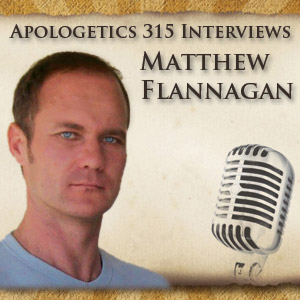
Matt is the first kiwi apologist to be featured in this series and stands alongside
such contemporary greats as William Lane Craig, Michael Licona, Gary Habermas, Paul Copan, Greg Koukl, Doug Groothius, Doug Geivett, Craig Hazen, Peter Williams, Kenneth Samples, Chris Shannon to name a few.
The interview is in the form of a half-hour podcast entitled Apologist Interview: Matthew Flannagan. It covers how Matt got into philosophy of religion, the international attention some of his work has received, his upcoming research projects, his upcoming US speaking engagements, his recent debate with Raymond Bradley, his thoughts on the benefit of public debate, the need for reasoned faith and more.
We’d like to thank our generous supporters who donated the necessary equipment for us to be able to do interviews via Skype.
]]>Enjoy.
RELATED POSTS:
Fairies Leprechauns, Golden Tea Cups and Spaghetti Monsters
Richard Dawkins and Open Mindedness
Matt is speaking on the topic “Is belief in God rational when you can’t prove that God exists?” at 12pm, Thursday 5 August in the Gold Lecture Theatre on the Auckland Unitec campus on Carrington Rd. The talk will be based on the Showing Christianity is True essay Matt had published as part of Apologetics 315’s essay series, “Why is Christianity True?”
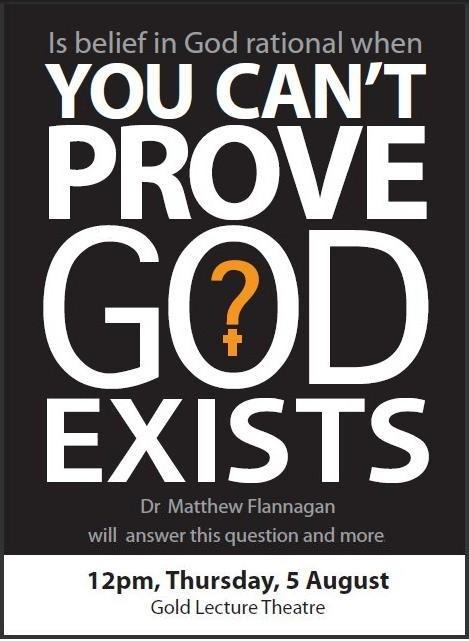
The format is a talk delivered followed by Q&A. The event is open to the public and entry is free.
]]>In my first post, Epistemology 101: Science, Faith and Authority Part I, I set out some basics about epistemology. In Part II I looked at testimony and authority. Now I will turn to my final point, what about the clash of traditions or authorities, what should we believe then?
Here is a fairly obvious example, suppose I am not a biologist but I hear it on authority that the scientific consensus is that evolutionary theory is the correct account of human origins. In the absence of any defeaters for this, such as the absence of compelling reasons for thinking that the biological sciences are unreliable in this area or some compelling disproof of evolution, I should accept this claim. One the other hand, I read the Bible and it looks like it states that the world was created by God in six 24-hour days and that humans and animals were created on separate days. I examine the subsequent genealogies and I discover that when added up these entail that the world is only a few thousand years old. If I accept the Bible as authoritative and as the word of God, then I have a reason for thinking that evolution is false. What should I do?
I am using this case as a vivid example because it is such an obvious one in an evangelical setting, particularly one like this full of scientists who will have experienced the tension first hand. I want to look at two approaches that I think are mistaken. The first is exemplified by a well meaning school board member I encountered a few years ago. I was applying for a job as a curriculum developer at a Christian school. I was asked if I would teach that Genesis was true. I responded by saying that at the senior level, students should learn about the debate over how Genesis should be interpreted. They should be encouraged to ask whether it literally teaches that the world was created in six 24-hour days or whether, as some scholars believe, the days are a kind of literary device drawing out the relationship between human and divine work. The board member responded in horror, he said “are you saying God might be wrong?” I did not get the job.
There was some wisdom in the board member’s response. If God teaches something then it is true and what God says trumps all human opinion, including scientific opinion. The problem is that I was not questioning what God said, I was questioning an interpretation of Genesis which was the basis of the board member’s conclusions about what God said. God does not make mistakes but human interpreters do.
Throughout history brilliant Christian theologians have disagreed as to how to interpret scripture and also which theological perspectives are correct. The fact that they disagree means that they cannot all be correct. Our theologising then is fallible and it is not given that we are always correct. It is mistaken then to assume that when the scientific consensus clashes with our theology it is always wrong and our theology is always correct.
In a room full of scientists this is probably uncontroversial but I want to also reject an equally erroneous view. This is the view that whenever scientific consensus clashes with a theological position, the theological position is always incorrect. Often this view is based on mistaken views on history. In the 19th century an interpretation of Church history known as the conflict thesis emerged. This position taught that religion and science had been locked in conflict throughout their history and that science had flourished only by fighting off the shackles of the church, which had consistently suppressed its ideas. The picture was of a Church constantly losing ground to science. This view of the history of science has been rejected by most historians today but its legacy lingers on.
In fact the history of science and religion is quite different. There were few conflicts of the sort this thesis puts forward and when they did occur issues were not as simple as science being right and theology wrong. In fact, in some cases the opposite was been true. The fact is that scientific consensus can be and has been, in the past, mistaken. Only a few decades ago the steady state theory of cosmology was widely accepted and it was believed the universe had no beginning, a thesis in direct contradiction to the Christian doctrine of creation ex nihilo. Today, theology now appears to have been correct. In the 12th century a similar clash occurred between aristotlean science and that of the Church. The church was proven correct. There are other examples, such as denials that people groups such as the Hittites ever existed and claims people could not write at the time of Moses.
Further, scientific consensuses changes over time. Alvin Plantinga notes,
According to Bryan Appleyard, “At Harvard University in the 1880’s John Trowbridge, head of the physics department, was telling his students that it was not worthwhile to major in physics, since all the very important discoveries in the subject had now been made. All that remained was a routine tidying up of loose ends, hardly a heroic task worthy of a Harvard graduate.”4 Twenty years later the same opinion seemed dominant: for example, in 1902 Albert Michelson, of Michelson-Morley fame declared that “the most important fundamental laws and facts of physical science have all been discovered and these are now so firmly established that the possibility of their ever being supplanted on consequences of new discoveries is remote.”5 And of course we all know of the scientific theories that once enjoyed consensus but are now discarded: caloric theories of heat, effluvial theories of electricity and magnetism, theories involving the existence of phlogiston, vital forces in physiology, theories of spontaneous generation of life, the luminiferous ether, and so on.[1]
Scientific consensuses then can and have been mistaken. In addition to this there is an important insight in the comment of the school board member who cost me employment. Given the fallibility of humans, even as a group, if God says something and the scientific community says something else then we have good reasons for thinking the scientific community is wrong and hence we do have a viable defeater for the testimony we have heard. God, understood as a all knowing, all powerful, perfectly good being, certainly is not mistaken and it is not as if he needs some scientists to enlighten him or correct his teaching.
I think the correct response is to allow science and theology to mutually correct each other. Take the case of evolution and the Bible. One needs to ask just how likely is it, given the evidence, that evolution occurred? One also needs to ask just how likely is it that the interpretation of Genesis underlying creationism is correct? If it is more likely that a literal interpretation of Genesis is true than it is that evolution is true then we should reject evolution despite the consensus in favour of it. On the other hand, if there are reasons for thinking our interpretation of Genesis is mistaken and that the evidence for evolution is overwhelming then we should conclude that God is not teaching us that the world is only a few thousand years old.
My own view is that there are good reasons for rejecting a literal interpretation drawn from what we have learned about ancient near-eastern texts from the same period. Evidence suggests that ancient genealogies did not function the way the literalist picture suggests and that much of early Genesis is a polemic against ancient near-eastern mythology rather than sober history. But my views are beside the point main point.
My point is that I think as Christians we need to say that both science and theology are valid ways of knowing and that human theorising in both fields are fallible.
There is a view in our culture which denies this, this is a view called scientism which claims, following Bertrand Russell, that whatever is knowable is knowable by the methods of science and what science does not tell us is not knowable. This is, however, a philosophical and theological view that rejects the existence of revelation. If we accept that God has spoken to humanity then we should not assume that God has not said something that is the basis for a legitimate critique of scientific claims or culture and if he has then we should not cower from offering such a critique despite the fact that the scientific community thinks otherwise. At the same time we should not embrace the kind of naiive theologising that reads the bible in English, ignores the fact that God’s word was mediated through human texts in different languages which essentially boils down to “God said it, that settles it” type thinking. Both approaches should be repudiated.
Let me make a final comment in this area. If we are to gain an accurate picture of the world then we need to take into account all information we know that is relevant to the question. If we bracket some information which is relevant then the picture we will only be probable on “part of the evidence” and may not be probable when everything else is factored in. If one accepts that science is the only way of knowing this does not matter much. Nor does it matter much if we think that all that is at issue is what we find in the scriptures. But if we accept, as I think we should, that both are valid sources of information then theologians and scientists needs to take others insights into account. There might be areas of reality in which both make claims. If scientists proceed ignoring information from theology that is relevant to what they study and theologians ignore what scientists are saying when it is relevant to the issue both will end up with a distorted view.
I think this picture applies to the issue of climate change. We have scientific claims about anthropogenic global warming being affirmed and contradicted in the media, in the pulpit, on talk-back radio, in the blogosphere and so on. Those of us who are not climatologists rely on testimony and we need to start being critical about whether much of what we hear is subject to defeaters. Similarly, the issue has moved beyond science into areas of ethics, public policy, laws and even pictures of eschatology. In these areas scientists are not experts and questions of theology and ethics, among other things, come into play and we need to have a method for negotiating this.
[1] Alvin Plantinga “Creation and Evolution: A Modest Proposal” in Robert Pennock Ed Intelligent Design Creationism and Its Critics: Philosophical, Theological and Scientific Perspectives (Cambridge, The MIT Press – Bradford Books, 2001) 785.
RELATED POSTS:
Epistemology 101: Science, Faith and Authority Part I
Epistemology 101: Science, Faith and Authority Part II
In my first post, Epistemology 101: Science, Faith and Authority Part I, I set out some basics about epistemology, I now want to turn to one particular way we know things: testimony. Nicholas Wolterstorff defines paradigmatic cases of testimony as: believing X on the say so of someone else Y. There is a highly influential tradition of epistemology which is sceptical or critical of beliefs based on testimony.
Testimony
In his Essay on Human Understanding John Locke argued that one had a duty to not believe any proposition merely on the authority of another person. One should trust the testimony of another only if one has:
(a) good reasons for thinking that the testifier is reliable; or,
(b) good reasons for believing the truth of the proposition itself.
Taking another persons word for something in the absence of independent evidence is irrational. Locke hinted that such gullibility was socially dangerous, tied up with intolerance, authoritarianism and oppression.
Something like this lurks in contemporary culture and is often encapsulated in quotes such as “think for yourself.” The problem is that a little reflection shows that this view of testimony is mistaken.
CAJ Coady summarises the problem, if one is going to have evidence for the reliability of a testifier then this evidence will either include some other testimony or it will be based upon sources apart from testimony. The first option is obviously a non-starter, any evidence based on testimony will have to, by Locke’s position, be shown to be reliable by further testimony and so on, ad infinitum, until we reach some non-testimonial source. However, if we embrace the second option and we exclude what we know by way of testimony from our evidence base then we will have so little to go on that such grounds will be almost impossible to come by.
To demonstrate this consider an example from Greg Dawes in a paper he wrote on faith,
Very many of our beliefs are held on the basis of testimony. (In this context I shall sometimes refer to these as beliefs held on the basis of authority.) Does e=mc2 represent the rate at which matter can be transformed into energy? I believe so, although I would not have the faintest idea how to demonstrate its truth I have it on good authority that it is true…Of course, there is a sense in which I do believe this on the basis of evidence. I have reasons to believe in the trustworthiness of the sources from which I gained the information.[1]
Like Locke, Dawes suggests that a non-physicist such as himself can rationally believe e=mc2 because he has reasons to believe that his sources are trustworthy. I believe this last comment is incorrect. Consider, for example, what reasons he could offer for believing that the source of his information was reliable? Presumably, it would be because the author of the book where he read it or the person who told him the information was a physicist. Nevertheless, how does Dawes know this? He could have read the person’s qualifications off a faculty list, off the dust-jacket of the book or have been told them by the person in person but in each case he is relying on testimony and so, in the absence of further reasons, he cannot believe these sources. Suppose, however, Dawes was to investigate thoroughly and locate the address of the university where the degree in physics was claimed to be awarded in order to travel there and personally check the original records. Yet again, he will be relying on testimony in the form of an address list and records. He also would have to have trusted the testimony of maps and road signs in getting to the institution in question.
Consider then what Dawes would have left to go on if he did not use testimony. He could not rely on any information that he himself did not observe first-hand. This would exclude any information about events prior to his own lifetime, any events in his own lifetime that he did not remember witnessing first-hand and any event that happened in a place other than where he was at the time. Nothing read in journals, books, heard in lectures, taught to him by his parents or teachers could be used. Nothing heard on the news, read on the computer, told over the phone or reported on in the media could be included. Almost everything he had learnt through his entire education would be excluded because nearly all of it is based on testimony. It seems, then, that if Dawes were really to comply with the epistemic standards that he laid down, he could not rationally believe in e=mc2. It appears he is mistaken in thinking that one needs to have reasons for thinking a given authority is reliable in order to be warranted in believing in testimony.
I think this example shows that this is not isolated. What we know, by way of being told by others, accounts for a huge and pervasive amount of what we believe. Everything I know about other places, other times, everything learned at school, university, from my parents, friends, books, newspapers, television, etc is based on testimony. If I were to try to verify any of these beliefs without first relying on some other piece of testimony, I would be unable to. The kind of critical attitude where one deplores believing things on faith or on the say so of others is un-viable. As social beings with a limited perspective in time and space, and with limited areas of speciality, we need to trust the testimony of others for most of what we know.
Testimony Beliefs as Basic Beliefs
For this reason the idea that one cannot accept something on the say so of testimony until it is verified is problematic. Instead I am inclined to accept a different picture of the role that testimony and faith in authorities should play in our knowledge. The picture that testimony beliefs are properly basic beliefs.
To see what I mean by this consider the following point by Roy Clouser,
If everything needs to be proven then the premises of every proof would need to be proven. But if you need a proof for every proof, you need a proof for your proof, and a proof for your proof of a proof and so on-forever. Thus it makes no sense to demand that everything be proven because an infinite regress of proofs is impossible.[2]
Clouser notes that the appeal to evidence, in the form of premises from which one infers a conclusion, have to terminate somewhere if we are to avoid being sceptical about everything.
The terminus is a set of ultimate premises called basic beliefs, which are those beliefs that form the foundation of our knowledge. We are justified in believing them independently of any argument or proof for them.
If this seems counter-intuitive consider that there are plenty of things we believe that are not based on arguments. Our belief in the existence of the past or our belief that it is wrong to rape women or our belief that other people exist or that basic axioms of logic are true are not based on inferences to the best explanation so that they are rationally believed because they explain some phenomena better than all alternatives. It is rather that these beliefs are part of the background data that we use to assess proposed explanations against.
Usually basic beliefs are grounded in some form of experience. We recognise these as true because we experience or see them to be true. For example, I see that the basic axioms of logic are self-evident, I remember the existence of a past event, I intuitively see that rape is wrong and think anyone who does not see this is simply morally blind. I see the chair in front of me, I hear the car outside and so on. These beliefs function as fundamental premises that we argue to other theories from.
It is important to note that while we are justified in believing basic beliefs in the absence of evidence for them, their justified status can be defeated if we gain good reasons for rejecting these beliefs. For example, on a Tuesday evening I have a vivid experience of my brother entering my room, I form the basic belief that “my brother is in my room.” The next morning I hear that my brother was out all evening. I also discover that the medication I took the night before has hallucinatory side effects. The basic belief, grounded in my perceptual experience of observing my brother entering the room on Tuesday night is defeated. There are two ways basic beliefs can be defeated, undercutting defeaters involve a reason a person acquires which, when added to their stock of beliefs, gives them reasons for thinking that the source of the basic belief is unreliable – my discovery of the hallucinatory side effects is an example of this. Rebutting defeaters, on the other hand, are reasons one acquires for thinking the belief itself is false. My discovery that my brother was not home is a rebutting defeater, if he was not home then he was not in my room.
The picture I want to suggest is that in many circumstances beliefs held on the basis of testimony function as basic beliefs. When a person, whom we take to be a competent authority, affirms a proposition P then in the absence of defeaters we are rational in accepting P. We do not need to prove that what the person says is true before we can accept it and nor do we have to prove that they are a reliable authority before we have to accept it. We do, however, have to take seriously any purported defeaters we are confronted with. We have to take seriously evidence we have that the authorities in question are not actually a reliable guide in the area in which they are speaking and we have to take seriously arguments given against what we accept.
Translating this into a current context, contrary to what is often thought, most of our knowledge of scientific facts is, in fact, on the basis of testimony. As a child I ask questions, why does this happen? what caused this? and so on, my parents tell me answers and I believe them. I go to school and I am taught science and later physics and chemistry, I go to university and attend lectures, I read text books, I might do some experimental work myself but it is in the context of what I have already learned from testimonial sources. I read about studies scientists have done in journals and I believe what is written in these journals. Despite the bravado of self-professed free thinkers, our acquisition of scientific knowledge is pervasively shot through with faith – faith in authorities, faith that others are being honest to us and are trustworthy and so on. It can be no other way. Hence, to believe some fact about the world merely because another has told you it is true is not irrational but in fact a sensible thing to do.
Consider an example, I am in my car listening to the radio and Keisha Castle-Hughes is on air talking about climate change. The media are praising her for her brave efforts to educate the public. How should I respond? In this instance I am inclined to think that I face some defeaters. I know Castle-Hughes is an actor and has no real expertise in the area in which she is talking. I also know that actors are good at being very convincing at playing a role, which is not real. I know Castle-Hughes is quite young and is unlikely to have had a very substantial science education, much less time to specialise in climatology. I know the media are notoriously unreliable, journalists tend to be very political, their deadline give them limited time to research and they are not experts in science at all. In this instance, I think that I have real reasons to be sceptical of what Castle-Hughes is saying. Even if what she is saying, in fact, is true, I should not believe it just because she says so.
Here is another example. I read a book by Richard Dawkins. He claims that the evidence quite conclusively suggests there is no God. Now in some places Dawkins offers arguments and I can assess these using my ability to reason deductively but in other places he simply tells his readers things. He puts forward various arguments for God’s existence, which he says these are representative of the case for theism, he attributes these to Thomas Aquinas, talks of first-cause arguments and the like. This is a bona fide, scientist with a professorship at Oxford. His specialty is zoology.
However, accurately representing Aquinas’ arguments for God requires knowledge not in zoology but in medieval philosophy. A knowledge of what arguments have been put forward for theism, which are the most representative, which are the best, requires knowledge of a discipline called philosophy of religion. Dawkins’ position as a zoologist means his knowledge is in a very different field. Hence, his being a scientist gives me no reason to accept his work on Aquinas.
This underscores an important point. If a person has some bone fide authority in a field it means he has authority in that field, it does not mean he or she has any authority in another field. Scientists qua scientists are experts in science, not morality, public policy, law, ethics, theology and what have you. Similarly, pastors are trained in biblical exegesis and theology, their knowledge, therefore, is in those fields and not science. One of the problems with the rise of the Internet is that people can get information on any subject any where from any source. In this context it is important to examine carefully whether we have good reasons for questioning whether the source is authoritative.
It is not a bad idea to make our starting place be that we will accept what we are told by authorities but we should not always end there.
In my final post in this series, Part III, I will look at what we should do when authorities clash.
[1] Greg Dawes, “Faith and Reason”, a paper presented to the University of Otago Theology and Religious Studies Faculty. This is contained in Dawes, Philosophy of Religion (so far unpublished) 34.
[2] Roy Clouser Knowing With the Heart (IVP: Downers Grove, 1999) 69.
RELATED POSTS:
Epistemology 101: Science, Faith and Authority Part I
Epistemology 101: Science, Faith and Authority Part III