To establish this I argued three things.
[1] That many critiques atheists offer of theism are moral critiques. Atheists argue that historically theism has been intricately linked with various forms of social oppression and/or the sacred texts of theistic religions condone oppressive practices.
[2] That such critiques presuppose or assume the existence of moral duties. The critic has to assume that these practices are wrong even though the religious believers condone them.
[3] That if one accepts the standard arguments atheists use against theism then the presupposition that there are moral duties is unjustifiable because precisely analogous arguments can be used to show there are no moral duties.
Now if these three contentions are true then there is a fundamental incoherence in many common critiques of theism. If Loftus is going to provide a rebuttal of these contentions then he needs to provide reasons for thinking one of these three contentions is false.
Unfortunately, instead of engaging the argument, Loftus ignored it and attacked a string of red herrings.
 Loftus’ first argument in Do You Want to Be a Christian Apologist? Part 10 was to assert that I am “intellectually dishonest”, although somewhat charitably he states I am probably not aware I am dishonest – presumably I suffer from profound self-deception. Apparently the truth of this claim is blatantly obvious to “us” [by which he apparently means the atheist community].
Unfortunately, simply stating that I am self-deceived and asserting with great confidence that I am wrong is not actually tantamout to offering a reason for questioning [1], [2] or [3] above. If it did then one could easily demonstrate that Loftus’ own work is substandard, I could just assert that it is and that everyone knows I am right and hey presto there’s my proof .
Clearly, this is not a method by which one can reliably establish the truth or falsity of the matter.
Loftus second argument begins with him drawing from my preamble:
“Some atheists offer moral critiques of theism; their claim is not just that belief in God is false or unjustified, it is that such irrational beliefs are intricately linked with immoral and oppressive practices. Moral outrage often motivates the critiques offered – one only needs to read the condemnation of religious wars, religiously motivated terrorism, inquisitions, witch hunts, the suppression of science, sexism, homophobia, and so on, which is so prevalent in many free thought writings. Similarly, one needs only to read the accusations, regularly repeated in popular atheist literature, that the Bible condones slavery, or genocide, or stoning cheeky children, or rape, to observe this.
Note that behind this critique is the presupposition that there are moral duties. People have a duty to not engage in wars or acts of terrorism, religious people who promote sexist or homophobic practices are wrong for doing so. I think this is nonsense as it assumes there is such a thing as a moral duty, it assumes things religious people do can be wrong. This is false and here is why.”
After citing me Loftus rejoins:
“Note the diversion here? Instead of providing answers to skeptical arguments he’s asking how anyone can have a moral critique of the Bible who doesn’t believe it’s the inspired word of God. He’s special pleading. No one else, given the rules of his game, can offer a moral critique of the Bible. Not a Hindu, nor a Muslim, nor a Buddhist, nor even liberals like the late John Hick or Thom Stark, or process theologians….. Do they? Do pantheists have a moral basis for critiquing the Bible? Flannagan would also have to reject the Natural Law Ethics (NLE) of the Catholic church, for if Natural Law Ethics obtains then even atheists have a basis for their moral critiques of the Bible. …”
Unfortunately this rejoinder has little rational merit at all.
First, I do address the sceptical arguments in question. By defending [3] I argue that analogues of these arguments entail an obvious false conclusion and therefore they cannot be sound. This is clear from reading the section of the original post which Loftus does not cite.
Second, contrary to what Loftus tells his readers, nowhere in the cited preamble do I claim people cannot make a moral critique of the Bible if they do not believe it is the inspired word of God.
What I explicitly state is that “behind this critique is the presupposition that there are moral duties. People have a duty to not engage in wars or acts of terrorism.” In other words, what I state is that these critiques are sound only if there are moral duties and the actions in question are, in fact, wrong. Nothing is said about needing to believe the Bible is the inspired word of God. All one needs to do to verify this is to read the section that Loftus cites. It is somewhat ironic that between Loftus’ claims that I am “intellectually dishonest” and “willfully ignorant” because I “don’t understand atheist arguments” Loftus misrepresents my argument to his readers, a misrepresentation that could easily be cleared up just by actually reading the passage he copied and pasted.
Third, even if I had argued this, which I did not, it would not mean I was engaging in special pleading. Special pleading occurs when one person applies certain standards to others while taking their own position to to be exempt from these standards without providing adequate justification for the exemption. There is no reason to think that people who think the Bible is the sole basis for morality do not apply this standard to themselves. Loftus may disagree with this position but simply disagreeing with something and annexing the name of a fallacy to it does not mean it is actually a commission of that fallacy.
Loftus’s second rejoinder is to state:
“I see no reason to think atheists cannot spot irrational moral beliefs that cause harm to others. We have a computer. It’s called our brain. Evolution explains how we got it. All it needs to do is compute the steps.”
There are several problems with this response. First, it’s fallacious; Loftus here argues that because he sees no reason why atheists cannot spot irrational beliefs, it follows they can and do spot such beliefs. In other words, he is suggesting that if there is no reason for denying something then we should affirm it. This is false and undercuts his own comments about theism and the burden of proof. After all, if the fact we have no reason for denying something means we should affirm it then it is up atheists to prove God does not exist, until they do we should all be theists.
But second, even if this argument were not fallacious it is irrelevant because I never denied, nor do I deny, that atheists can spot irrational beliefs in others – there are some atheists, like Graham Oppy, who are very good at doing this. What I did argue was (a) in order to offer moral critiques of theism atheists need to themselves have rationally justified belief that duties exist; and, (b) if the arguments atheists typically offer against theism are true then they do not have a rationally justified belief that duties exist. Again Loftus simply engages in fallacious reasoning and misrepresentation.
The only time Loftus actually responds to my argument is when he makes a short response to [1] above. He states:
“Our critiques of the Bible can best be seen as reductio ad absurdum type of arguments. By taking the evolved morality that all civilized Christians now accept, we are simply forcing them to explain the barbarisms found in the Bible based on their own moral perspective, not ours. The main reason our critiques have force is because of the evolved morality modern Christians have accepted.”
Here Loftus suggests atheists do not need to believe in moral duties to offer moral critiques of the Bible. All that’s necessary is that Christians do. Athiests can simply assume the theist’s moral beliefs for the sake of argument and show these beliefs, the ones theists hold, provide a critique of theism.
This is an interesting suggestion. The problem is that if Loftus only accepts that duties exist for the sake of argument, and does not himself affirm that the actions in question are wrong, then the believer can easily escape the reductio he proposes. When Christians are are aware that the “evolved morality” they accept conflicts with what the Bible portrays then they can respond by denying that this evolved morality is correct. No doubt many atheists will find this response outrageous, but here is the problem. Unless they actually believe in moral duties they have no way they can justify such outrage. After all, they themselves also believe the actions objected to are not wrong. They believe nothing is wrong. To counsel a person to reject Christianity because it entails a particular action is not wrong and then to tell that person to adopt in its place a form of atheism that entails that nothing is wrong, including that action, is incoherent. This is precisely the kind of special pleading Loftus rails about.
Ironically, one line of argument Loftus makes, far from rebutting my argument, actually confirms it. Loftus argues:
“The main reason our critiques have force is because of the evolved morality modern Christians have accepted. If Christians stepped back in time they would find our critiques wouldn’t have any force at all to them. They wouldn’t even be considered as critiques, just explanations of what believers in a prior era accepted as moral truth. Like this:
“Slaves? I own several of them. What’s the big deal?”
“Women? My wife is my property, yes. I can sell my daughters as sex slaves if I want. So?”
“War? We slaughtered everyone, even the children. Is there a problem?”
“Child sacrifice? Sure I did it. Yahweh commanded it.”
“Witches and heretics? Yes, we must kill them as God commanded. Thanks for noticing.”
Let’s assume for the sake of argument the dubious exegetical and historical claims Loftus assumes are accurate. Here Loftus frankly states two things: (i) that people in different times and places did not accept different moral beliefs to those we hold; and, (ii) to those who do not accept these moral beliefs the arguments he gives have no force.
This is very interesting because Loftus has made a reputation defending what he calls the Outsider Test for Faith (“OTF”). The OTF states that when approaching any religious faith one must adopt a presumption of scepticism: only if the faith can be shown to be true from this presumption is it rational to believe in it. Why must we adopt a presumption of scepticism with regard to religious beliefs? On p 69 of his book Why I became an Atheist Loftus is explicit. A presumption of scepticism is justified because “religious faith does in fact vary from culture to culture and different times in history.”
Loftus, in affirming both (i) and (ii), commits himself to moral scepticism; (i) tells us that moral beliefs have the very feature which he says justifies a presumption of scepticism in the case of religion. Moral beliefs differ from culture to culture and vary at different times in history. If his critique of theism is sound then we should begin with a position of scepticism towards moral beliefs and we should accept them only if they can be justified from this perspective. By affirming (ii) Loftus accepts that these beliefs cannot be justified from such a sceptical perspective. To a person who did not accept these moral beliefs Loftus’ arguments “have no force”. The very argument Loftus uses to reject theism, therefore, is one which, if it is sound, means one should reject the moral beliefs Loftus uses to critique theism. When it comes to the morality of slavery or killing heretics we should be moral sceptics and refuse to state such things are wrong.
At this point it’s worth reminding my readers that Loftus wrote on p 231 of Why I became an Atheist:
“He took her into the kitchen, and stripped her from neck to waist. He made her get upon the stool, and he tied her hands to a hook in the joist. After rolling up his sleeves, he commenced to lay on the heavy cow skin, and soon the warm, red blood came dripping to the floor … No words, no tears, no prayers, from his gory victim, seemed to move his iron heart from its bloody purpose. The louder she screamed, the harder he whipped; and where the blood ran fastest, there he whipped longest. He would whip her to make her scream, and whip her to make her hush; and not until overcome by fatigue, would he cease to swing the blood clotted cowskin.Why didn’t the Christian God ever explicitly and clearly condemn slavery?”
Here Loftus suggests slavery is wrong and then uses this as a premise to criticise Christianity.
It is clear that despite all his confident bluster that it is Loftus’ position that engages in special pleading and not mine. Loftus needs to get clear on what he thinks. Does he think the behavour he refers to on p 231 of his book is wrong? If he does not then why does he attack Christains for allegedly supporting it? If it is, then he needs to admit that his own Outsider Test for Faith is worthless. Calling people dishonest and misrepresenting their position before one’s adoring atheist fans is not a response, nor is asserting over and over again that others are brainwashed.
What Loftus needs to do is show how his moral beliefs are justified from the presumption of moral scepticism. That requires him to provide a non-question begging argument from non-moral premises to the conclusion that duties exist. Either that or he needs to retract the arguments he has made against God’s existence where he endorses such a presupposition. These problems have been pointed out to Loftus numerous times yet in his public works he has never adequately addressed them. In fact, when one reads his responses often it is pretty clear he has simply ignored these critiques and changed the subject. It is time for the confident bluster and chest beating to end and for Loftus to answer the hard questions about his own incoherence.
Addendum
John Loftus were Christians in the ante-bellum South doing something wrong when they endorsed the beating of slaves? If so, can you please provide an argument which starts from the default position of moral scepticism and shows from that perspective that moral duties exist? If you cannot then perhaps its time to admit that the OTF fails and the Emperor is naked.
Matt’s chapter is a reprint of his chapter “Did God Command Canaanite Genocide?” in the forthcoming in April B&H Academic book: Come Let Us Reason: New Essays in Christian Apologetics edited by Paul Copan and William Lane Craig.
Here is the editorial review from Amazon:
“While New Atheists like Richard Dawkins, Sam Harris, and others proclaim loudly their rationality, clear thinking, and incontrovertible scientific arguments, others are beginning to wonder how genuinely rational they are. Have they proved anything? Have they argued convincingly? Have they pinpointed any real challenges to the credibility of Christian faith?
“True Reason,” edited by Tom Gilson and Carson Weitnauer, brings together a compendium of writers–philosophers, apologists, ethicists, theologians, historians–who look carefully at the best arguments atheism has and evaluate their validity, logic, assumptions, and naturalist conclusions.Authors include noted philosopher William Lane Craig and popular apologist Sean McDowell, along with Gilson, Weitnauer, John DePoe, Chuck Edwards, Matthew Flannagan, Peter Grice, Randy Hardman, David Marshall, Glenn Sunshine, David Wood, and Samuel Youngs. Each chapter tackles a different atheist argument and brings reason fully into the discussion.
Which is more reasonable: atheism or Christianity? Read “True Reason” and think for yourself.”
Get your copy now, read it, and let us know what you think both here and on Amazon 
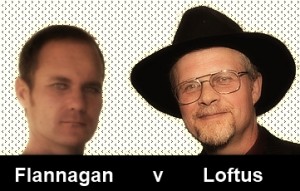 As you all know, Matt and I are going to the US to speak at 4 conferences in November. John W. Loftus is aware of this and in a comment on this blog has suggested a debate between himself and Matt during the 3 days we have spare between conferences – ideally for us 14 Nov. We have had some email discussion with him about this including agreeing that the topic for debate will be something around Loftus’ Outsider Test for Faith, maybe, “Is Christianity True?” or something like that.
A couple of groups within the Christian Apologetics Alliance have indicated keeness to see it happen, we have even had small pledges of money towards helping it happen, but so far no one has been able to say “yes, we will organise it” and we need that to happen asap or we are just going to run out of time. So, can you organise it can you offer support towards anyone organising it? Do you want to see it happen? (If it happens it will be videoed)
]]> Recently Hector Avalos has responded to a particular argument in my book Is God a Moral Monster? (Baker). In it, I follow biblical scholar Jerome Walsh’s interpretation of Deuteronomy 25:11-12:[1] If two men, a man and his countryman, are struggling together, and the wife of one comes near to deliver her husband from the hand of the one who is striking him, and puts out her hand[yad] and seizes his genitals, then you shall cut off her hand [kaph]; you shall not show pity.
I first came across Walsh’s perspective by way of Richard Davidson’s book on sexuality in the Old Testament, Flame of Yahweh (Hendrickson)—a book I highly recommend. I follow both Walsh and Davidson on the view that this text is not referring to amputating the hand, but rather depilation. This was a punishment of humiliation involving shaving a woman’s pubic hair in thekaph—the curved region below the waist. I won’t elaborate on what my book says, but I’ll simply address Deuteronomy 25:11-12 in the bulk of this blog posting. In the post, I’ll address the question of lex talionis (“an eye for an eye”) and the work of Raymond Westbrook.
1. Preliminary remarks: I have been in communication with Jerome Walsh, who prefers to stay out of the discussion. Walsh has read Avalos’s post, though, and noted too that he did not see anything new in Avalos’s arguments that he hasn’t encountered before. He simply saw nothing linguistically to persuade him to alter his views.
Avalos’s repeated identification of kaph = “hand” as the “literal” meaning is misleading. While it may be the commonest meaning, the term has less-common usages too (the bowl of a spoon, the frond of a palm tree). It’s unproductive to start from the assumption that commonest meaning is the only one allowable unless one can prove otherwise. The point in the article is that yad tends to refer to the hand without connotation or nuance, or when the hand is envisaged, as an instrument of pointing, hitting, doing. Kaph, so far as he can see, connotes the hand as an instrument of grasping and holding, thus the curvature and the focus on the palm.
In Walsh’s estimation, Avalos seems to be operating from the position of a methodological absolutism: “X” is the common opinion, and unless one can definitively prove not-X, then one must espouse X. He doesn’t appear to leave much room for “more likely” or “less likely” as the possible evaluation of a hypothesis.
Avalos cites Marc Cortez for support: “The Law on Violent Intervention: Deuteronomy 25.11-12 Revisited,” Journal for the Study of the Old Testament 30:3 (2006), 431-47. As I note in my book, though, it is unfortunate that Cortez fails to interact with Walsh’s essay, which had been published two years earlier.
In correspondence with Walsh (May 2010), he commented on an online version of Cortez’s article. He pointed out that while Cortez dismisses Eslinger’s attempt to identify kaph with gynecological exactitude (and he can agree with Cortez on that point), Cortez does not deal with the fact that kaph is used not just for the palm of the hand, but for several other curved, arched objects, both corporeal (sole of foot) and not (bowl of a spoon, frond of a palm tree). Walsh’s argument simply treats kaph as the curve of the groin, a very likely meaning in Song of Solomon, and (pace Cortez) in Genesis as well.
Cortez wants to retain without discussion the understanding of kaph as “hand.” But Walsh notes that Cortez’s explanation of why a “talionic” law would equate “hand” as an instrument of offense with “palm of the hand” as the object of “cutting-off” is, basically, “why not?” That begs the question. Further, he ignores completely that there is no reason whatsoever for treating the qal of qatsats as if it were the piel. In the piel, it clearly means “to cut off.” In the few other instances of its appearance in the qal, it means “to cut (hair).” Why, in this unique case, should the qal be translated as if it were a piel?
Now, Walsh readily acknowledges that his article is not the standard reading of the passage, and that Cortez’s evaluation of others’ interpretations of Deut 25:11-12 is judicious, careful, and sober. He would agree with Cortez completely that the peculiarities of this unique law in the Israelite corpus have led scholars to some truly egregious attempts to make sense of its oddity. And Cortez is very good indeed at identifying the unpersuasive lengths to which some scholars have gone. But he, like all of those scholars, has not looked at the words. This is the contribution that Walsh’s article proposes to make. Instead of accepting unquestioningly that “you shall cut off her hand” is what the Hebrew words mean, he has argued that that is a misreading of the Hebrew terms. To put the disagreement in a nutshell, let me quote a line from Cortez’s article. Cortez says: “The first and most important question that must be addressed with respect to the woman’s punishment is whether or not it should be understood as an application of the lex talionis.” Not so. The first and most important question that must be addressed with respect to the woman’s punishment is WHAT THE WORDS MEAN. Only then can we even approach the question of whether or not the punishment is a talionic counterpart to the crime.
In short:
(a) Kaph does not refer to the “hand,” simply speaking. It refers to the hand as an instrument of containing (thus as a curved holder, often translated as the “palm of the hand”). Yad refers to the hand as an instrument of control, of holding, of pointing. To treat the two terms as synonyms in order to establish the talionic quality of the law is unconvincing.
(b) Kaph clearly can refer to the genital region. Even if one does not follow Eslinger’s particulars (and I most certainly do not), the uses in Genesis and Song make it clear that something below the waist is intended. Kaph can also refer to several other bodily and non-bodily curved objects.
(c) The verb qatsats means “cut off” in the D-stem (the piel). To assume that it means that in the qal has no justification in Hebrew. Our only qal examples of the verb other than the passage under consideration are universally accepted as meaning “to shave.”
Those observations invalidate the translation “cut off her hand”; Walsh’s proposal is an attempt to cope with that invalidation and offer an alternative that is consistent with what we know of Hebrew.
Here are further points to note:
2. Concerning kaph: Yes, kaph certainly does mean “whole hand” in numerous instances. It doesn’t refer only to the palm of the hand. Yad can be distinguished primarily by the nuance of grasping or holding (kaph) versus that of pointing or striking (yad), but there is clearly a great deal of denotational overlap. Therefore, there could be a talionic quality to the law, despite the shift from yad to kaph: she puts out her yad, but grasps with her kaph, which is the instrument of crime and therefore the object of punishment. (Others have argued, in somewhat the same vein, that yad means the hand-including-[part-of-]the-forearm, whereas kaph means the hand from the wrist down. Thus only the kaph gets punished, since the kaph is the specific part of the yad that touched the assailant’s genitals.)
Even though kaph refers preponderantly to the human hand, not to other objects, the meaning of kaph is not the starting point of Walsh’s argument. Given that kaph can mean other parts of the body as well, and that the usages in Genesis and in Song of Solomon indicate that it can be used of some bodily area below the waist, one shouldn’t foreclose the possibility of such a meaning here before having examined the rest of the verse. Eslinger’s arguments for a sexual referent (especially in the explicitly sexual context of grasping the assailant’s genitals) are strong.
3. On the verb qatsats: It is true that, sometimes, a verb can be used in both piel and qal in almost the same senses. But this is clearly not the normal practice with Hebrew verbs. The D-stem (the piel) transitivizes an intransitive qal, or (often) intensifies it. Sometimes it means something entirely different. Here the intensifying force is seems inescapable. Why assume that the qal and piel do mean the same thing unless that conclusion is inevitable? Otherwise, why distinguish two morphological categories?
Hezekiah “shaved off” the gold leaf from the Temple doorposts, using the D-stem of qatsats (2 Kgs 18:16). That is the reading of RSV, NRSV, NIV (and probably other versions as well); they translate it “stripped.” It is unconvincing. If the decoration is gold plate, one “removes” it or “cuts it off” (qatsats, D-stem), one does not “shave” gold plate. And if the decoration is gold leaf, which could theoretically be “shaved,” wouldn’t it make more sense to follow other versions (e.g., NAB, NJPS) in assuming that Hezekiah had the gilded doors and doorposts themselves removed and sent as tribute? In Walsh’s view, that is what is pretty clearly meant. Cogan and Tadmor, in the Anchor Bible, argue for “stripping,” and call the idea that Hezekiah “cut off” the doorposts “novel”; they then cite two passages (2 Kings 16:17 and 24:13) to support their idea. In Walsh’s reading, both passages they cite undermine their argument and demonstrate that qatsats in the D-stem clearly means to “cut up” or “cut off.”
In the qal, qatsats is very rare. Aside from Deut 25, it occurs only three times, always in the same phrase, and always in Jeremiah, to describe a particular group of desert raiders (Jer 9:25; 25:23; 49:32). There is nothing in any of those texts to suggest that this shaving was ritual, that it was considered “mutilation,” or that it deserves the term “hacking off” (which tries to reintroduce the intensification of the D-stem sub rosa). There is absolutely nothing in any of the three Jeremiah texts to indicate that the term refers to more than a distinctive hair-style (or perhaps beard-style), created precisely by the way the hair was cut or shaved (qatsats in the qal). (The Hebrew is, literally, “shaved at the edges”; “temples” is a more or less conventional translator’s guess as to what part of the cranium the “edges” are.) Far from being scorned as a form of mutilation, hair-shaving appears in approved Yahwistic rituals, as Walsh mentions in his article (see Numbers 6 on the Nazirite; Deut 21:12 [what appears to be a mourning ritual]; and especially Numbers 8:5-14, where the purification of a Levite in preparation for undertaking his sacred duties includes shaving all his hair, presumably including pubic hair).
In short, there is no evidence in any of the appearances of qatsats of an overlap between piel (“to cut off, to sever, to amputate”) and qal (“to cut [hair]”) meanings.
4. What of “show her no mercy?” It is true that the few other instances of this formula (apparently four, all in Deuteronomy) appear in contexts of serious crimes and punishments (usually, though not always, involving death). But it need not be assumed that the formula is appropriate only when such seriousness is the case. It seems to be a stereotyped legal formula, and that suggests that its function may be other than that of a literal admonition or an expression of outraged horror. Scholarly argument has been made that the force of this formula is to disallow the alternative of substituting a fine for the specified punishment. If that is the case, then it preserves the talionic relationship between offense and punishment (notice that the same formula is associated with the fundamental statement of talion in Deut 19:21) and does not allow the woman to escape her public humiliation by paying a fine (something her husband may have been quite willing to do for her, since she has saved him from a beating). But this does not require us to deem whatever she did as heinous as murder and other “show no mercy” offenses.
5. What of the Septuagint (LXX) and Aramaic translations? True, these translators render the verb qatsats as “cut off” (rather than “shave”), but the greater weight should be given to the Hebrew text.
6. A clear parallel in Middle Assyrian Laws (MAL) with Deuteronomy 25:11-12? A common argument in an attempt to show that Deuteronomy 25 refers to a literal amputation is that there is a purported parallel in Middle Assyrian Laws. However, the single most significant difference between the MAL (A ¶¶ 4) and Deut 25:11-12 is that the MAL explicitly cites the crushing of the man’s testicle(s). The biblical passage does not. One can’t formulate a law and leave out the specifics of the crime! True, the verb hzq can sometimes imply damage, but more often it does nothing of the sort. Therefore this law, as formulated, would apply to any woman who took hold of the assailant’s genitals whether or not she did any damage. The parallel with the MAL, as attractive as it seems superficially, founders on that difference. Moreover, there is no sense of proportion (as there is in the MAL). The verb hzq might mean simply grab, or grab (roughly), or grab (and squeeze), or grab (and crush), each of which—if this is a talionic law—would require a different punishment (as in the MAL); but there is no such recognition ofdegrees of damage and correlative degrees of punishment. And therefore the mutilation-as-punishment mandated by the MAL can’t be used to argue for a “mutilation” interpretation ofDeut 25:11-12. Rather this passage refers to a punishment of humiliation. As Raymond Westbrook, in his History of Ancient Near Eastern Law, writes of punishment in the ancient Near East: “Humiliation was a valid form of punishment.”[2]
At any rate, Walsh’s case for depilation should not be so easily dismissed. In fact, Bruce Wells, who has coauthored Everyday Life in Biblical Israel with Raymond Westbrook, recently reviewed a summary of Walsh’s case for depilation rather than mutilation.[3] He concurred with Walsh!
As for the interpretation of Deut 25:11-12, I find the summary that you gave quite convincing. In fact, it fits the talionic pattern better than the traditional interpretation. If a second edition of Everyday Law ever comes out (and I have no idea if this will ever happen), I will make it a point to include this interpretation. The only thing I would add is that, according to my understanding of biblical and ANE law in general, compensation in place of the shaving would still have been an option in situations like this.[4]
7. A Misuse of Raymond Westbrook’s Work? Finally, let me comment on Avalos’s “challenge” to both Matt Flannagan and me. We argue that the three talionic passages (“an eye for an eye”) in the Pentateuch do not require bodily mutilation but make provision for monetary compensation. For example, Exodus 21:22-25 makes room for such monetary provision in repayment for physical injury. Matt Flannagan and I have appealed to various scholars, including the late Assyriologist Raymond Westbrook, for support on this. Avalos has thrown down the gauntlet to give a simple “yes” or “no” on whether Westbrook viewed one of these talionic passages—namely, Leviticus 24:17-22—literally.
First, here is Avalos’s initial charge against Flannagan: “Why Dr. Flannagan Fails History”.
Westbrook has made himself quite clear in Everyday Law in Biblical Israel: An Introduction[Louisville: Westminster/John Knox Press, 2009], pp. 78-79). Therein he discusses how later Rabbinic literature, and specifically Mekhiltah Neziqin 8 to Exodus 21:24, claimed that “An eye for an eye’ [means] money.”
Westbrook comments: “This interpretation seems strained to a modern reader. The introduction to the formula in Leviticus 24:19 is unequivocal: “If anyone maims a fellow, as he had done so shall it be done to him” [emphasis Avalos’s].
Then Matthew Flannagan responded to Avalos’s charge (“A Reply to Hector Avalos’s ‘Why Flannagan Fails History’”) that Flannagan had egregiously misrepresented Westbrook on the above passage. Flannagan interpreted Westbrook as saying that even though Lev. 24:19(seemingly) presents an unequivocal formula for literal maiming and that the rabbinic interpretation (“eye for eye” means “money”) seems strained to modern readers, this rabbinic understanding is actually on track.
In a June 30 comment by Avalos responding to Flannagan’s “Reply to Hector Avalos,” Avalos says this (my italics):
Note Westbrook’s phraseology: “Scholars have therefore tended to see the rabbinic opinion [that ‘an eye for an eye’ means ‘money’] as a disguised reform.”
The scholars who see the Rabbinic monetary payments as a “reform” are the ones that are incorrect in Westbrook’s opinion, and NOT the ones that hold that Lev. 24:17-22 was meant literally. That should be clear if you had read enough of Westbrook’s works, which clearly you have not done.
Why not just admit you [Matt Flannagan] are wrong instead of making it worse for yourself?
Then atheist John Loftus, confident in Avalos’s judgment, piled on and proceeded to accuse Flannagan and me of “lying for Jesus”—or something close to it in, Only Paul Copan and Matthew Flannagan Can Set the Record Straight.
(Ironically, I had posted comments in response to Matt Flannagan’s “Reply to Hector Avalos,” as Matt Flannagan pointed out how Hector Avalos had misrepresented me as well. Did Avalos admit he was wrong, despite my follow-up comments further exposing Avalos’s misrepresentation? Not at all. He asserted he stood by these misrepresentations as accurate and then engaged in what struck me as diversionary tactics, calling on me to declare whether Westbrook’s writings on Lev. 24:17-22 consider lex talionis literal or not.)
Well, Avalos has actually made it worse for himself because it is he—not Flannagan—who has misread Westbrook! Just to confirm this, I contacted Westbrook’s co-author Bruce Wells, who co-wrote the above-cited book, Everyday Law in Biblical Israel. Here was Bruce Wells’ email reply to my query about what he and Westbrook meant in their book (pp. 78-79) about the meaning of the Leviticus 24 passage in connection with the rabbinic “reformed” view of monetary compensation:
I think I can clarify what Westbrook and I were trying to say about the talio passages in the Pentateuch. First, it sounds as if the statement of talio in Leviticus is final and that there is no room for a monetary punishment in place of the physical punishment. It’s not that the Leviticus text explicitly excludes monetary punishment, but it makes no reference to it whatsoever. What we were trying to say is that, even though it sounds “unequivocal,” it’s not. There would have always been the allowing of a monetary punishment to take the place of the physical punishment. Second, we were trying to say that the rabbis’ interpretation was actually on the right track in this case (we say elsewhere, I think, that the rabbis were often not on the right track). The eye-for-eye principle meant that the appropriate amount of money for an eye should be paid and no more. Third, when we say that the penalties don’t seem to fit, we mean something like this. The Exodus text is about striking a pregnant woman and possibly injuring the fetus. The text goes on to say “tooth for tooth,” but teeth wouldn’t be involved in the event, regardless of whether one thinks that injury to the woman is paramount in the text or injury to the fetus…. we believe that compensation (a monetary fine/punishment) was always allowed to take the place of the literal, physical punishment.[5]
Now Matt Flannagan and I can put it to Hector Avalos: “Why not just admit you are wrong instead of making it worse for yourself?”
[1] Jerome T. Walsh, “You Shall Cut Off Her…Palm? A Reexamination of Deuteronomy 25:11-12,” Journal of Semitic Studies 49 (2004): 47-58.
[2] Raymond Westbrook, History of Ancient Near Eastern Law, Vol. 1 (Leiden: Brill, 2004), 75.
[3] Email from Bruce Wells, 7 July 2011.
[4] Wells’ final point is one with which I would concur and would include in my second edition ofIs God a Moral Monster?!
[5] The email from Bruce Wells was from 6 July 2011.
Westbrook and Wells also write this about the talionic passages:
The three references in the Torah to talio all consist of a list of injuries and maimed body parts, with slight variations in detail. Curiously, in none of the contexts in which they occur do they quite seem to fit. In Exodus, the list follows a case involving the miscarriage of a fetus; in Leviticus, that of a blasphemer, in a sequence that begins with the punishment of homicide and compensation for killing a sheep. In Deuteronomy, it supposedly represents the punishment of a false accuser. The overall impression is of an ancient maxim, applied wherever “measure for measure” is to be the standard of justice, whether or not the case involves any of the physical injuries listed. Raymond Westbrook and Bruce Wells, Everyday Life in Biblical Israel (Louisville, KY: Westminster John Knox Press, 2009), 79.
Cross Posted at: Parchment and Pen
In the comments section, Avalos pretty much admits that Westbrook holds the view I maintained he does. When a questioner asks Avalos about the lex talionis he stated:
“This is a highly contested issue. Some think that the literal interpretation could still be held even in post-Christian Jewish texts (I cited some in my initial post). Westbrook believes that both the literal and monetary co-existed, each applied depending on circumstances, in the biblical period.”
Compare this with my comment to Max explaining my position:
“Westbrook argues that serious wrongs “gave rise to a dual right in the victim or his family, namely to take revenge on the culprit, or to make composition with the culprit and accept payment in lieu of revenge”. He goes on to note, “[t]his right was a legal right, determined and regulated by the court”. The courts could “fix the level of composition payment” making “revenge a contingent right, which was only revived if the culprit failed to pay”.
When talionic legal formulae occur in A.N.E. legal texts they merely express that the punishment be proportional to the crime. This could involve punishment in kind (which would be proportional to the crime) but in most cases it would probably involve monetary compensation.”
Avalos is aware of my dialogue with Max as he quotes from it in his post. Readers will note the position he now attributes to Westbrook. This is almost exactly the view I said Westbrook held in my response yet, oddly, this comment by Avalos occurs under a post he entitled “Flannagan versus Westbrook” where he continues to argue to Debunking Christianity’s readers that I misrepresented Westbrook’s position.
I am flat tack with mid-semester marking at the moment, in the coming month I have two conferences looming I am giving papers to, I am moderating a panel discussion and speaking in another so unfortunately I cannot respond to all of Avalos’ claims. However, I do want to address one objection he raised in Why Dr. Flannagan Fails History, Dr. Hector Avalos Responds, which was part of Avalos’ case that I engaged in “a very selective and uncritical reading of the sources” I cited to support my position:
“As it is, Flannagan might need to update his Copan readings. On page 121 of Is God A Moral Monster: Making Sense of the Old Testament (Grand Rapids, MI: Baker Books, 2011), Copan reluctantly admits that Deuteronomy 25:11-12 might be “the only biblical instance of punishment by mutilation.” So now Copan has gone from arguing that the Bible represented an advance over other cultures that practiced legal mutilation to making a case for the Bible’s superiority because it might have ONLY ONE case of mutilation for a poor woman helping to save her husband. What a magnificent improvement.”
 The conclusion people are supposed to draw from this is that I am unaware of Copan’s latest writings. However, as my readers know, I have read Copan’s book (Paul sent me an electronic copy before it was published because he wanted my feedback on the manuscript; he also sent me post publication electronic and hard copies as well). It is worth comparing Avalos’ citation, and summary with a copy and paste from the original, as it is revealing to do so. Here is what Copan actually says on page 121:
“At first blush, this passage apparently requires that a woman’s hand must be cut off if she seizes the genitals of the man fighting with her husband—and scholars typically take this view. Now, if this were the case, it would be the only biblical instance of punishment by mutilation;… A more plausible interpretation of this passage is the punishment of depilation (“you shall shave [the hair of] her groin”), not mutilation. The word commonly translated “hand [kaph]” can refer to the “palm” of a hand or some rounded concave object like a dish, bowl, or spoon or even the arch of a foot. The commonly-used word for “hand” (yad) isn’t used here. It would be strange to cut off the “palm” of a hand!”
Avalos has taken Copan’s comments, “if this were the case, it would be the only biblical instance of punishment by mutilation”, and he has snipped off “if this were the case, it would be” and has presented the snipped quote to his readers so that looks as though Copan believed that it actually was the case,
“Copan reluctantly admits that Deuteronomy 25:11-12 might be ‘the only biblical instance of punishment by mutilation.'”
Avalos then proceeds to ridicule Copan for holding to the view he has falsely attributed to him. Not only did Copan not say what Avalos attributed to him but in the text, still on page 121, Copan affirms only a few lines later that he quite clearly does not hold to this position. He then proceeds to argue against it.
Now I put to you that it is highly implausible that this is a misreading on Avalos’ part. This appears to be a deliberate fabrication created by snipping half a sentence and then putting words in front of it to change its meaning.
It is hard to believe that anyone who read the original, especially someone who read the whole chapter, would have thought Copan was saying what Avalos says he did. It appears as though Avalos has choosen to misrepresent the views of another scholar on Debunking Christianity deliberately.
Of course most of Loftus’ readers will not have read Copan and I am sure it is rhetorically powerful to engage in these kinds of strategies, but I’ll leave my readers to judge whether they think this counts as a sound critique.
]]>
Avalos raises several points which I cannot address in a single post. Here I will simply address his claim that I that I relied “on a very selective and uncritical reading of the sources”, misrepresented the views of Raymond Westbrook and utilised “careless scholarship”.
1. My Sources
In my review I stated,
“On p215, Avalos dismisses Copan’s contention that the lex talionis does not call “for bodily mutilation, but rather just (monetary) compensation” as “mere assertion”. However, only a page later, Avalos criticizes Copan’s comments about the manumission of slaves citing the authority of “Raymond Westbrook, one of the foremost biblical legal specialists”. In fact, Westbrook has defended Copan’s position on the lex talionis [“The Character of Ancient Near Eastern Law” in A History of Ancient Near Eastern Law (Boston: Brill Academic Publishers, 2003) 74].”[1]
Here I state the position that Avalos attributes to Paul Copan, the position that that the lex talionis does not call “for bodily mutilation, but rather just (monetary) compensation”, has been defended by Raymond Westbrook in a particular book that I referenced. Avalos contended I have “misrepresented Westbrook”; he provides four arguments for this conclusion. None of them is sound.
 First Avalos stated that I offered “no actual quote to support this allegation so that we can verify whether he is even reading Westbrook correctly.” This is false, I did provide a way of verifying my claim. While, due to word count restrictions, I did not give a direct quote, I did provide a reference; I referred the reader to page 74 of Westbrook’s “The Character of Ancient Near Eastern Law” in A History of Ancient Near Eastern Law (Boston: Brill Academic Publishers, 2003). This is clear from the quotation above, which, oddly, Avalos cited in his criticism.
Moreover, even if I did not provide a citation (which I patently did) Avalos’ conclusion that I misrepresented Westbrook would not follow from this. What would follow would be that he would have no way of checking that I had not misrepresented Westbrook; however, the fact one cannot check that something is not the does not mean it is, in fact, the case. From my living room in New Zealand tonight I cannot check the whether Loftus has not robbed a bank, so can I conclude he is a bank robber? Of course not.
It is logical howlers like this in Avalos’s work that has lead me to be so critical of it. If Avalos cannot check whether my citation was accurate then he cannot know I misrepresented it, which raises the question: why then has he claimed that I did?
2. Wrong Book
Avalos’ second argument was to ignore my citation and refer to a different book by Westbrook. He states:
“Westbrook has made himself quite clear in Everyday Law in Biblical Israel: An Introduction[Louisville: Westminster/John Knox Press, 2009], pp. 78-79). Therein he discusses how later Rabbinic literature, and specifically Mekhiltah Neziqin 8 to Exodus 21:24, claimed that “An eye for an eye’ [means] money.”
Westbrook comments: ‘This interpretation seems strained to a modern reader. The introduction to the formula in Leviticus 24:19 is unequivocal: “If anyone maims a fellow, as he had done so shall it be done to him.'” [Emphasis Avalos’]
There are several problems here.
First, this does not refute my claim. I said Westbrook defended a certain position in his article “The Character of Ancient Near Eastern Law” in A History of Ancient Near Eastern Law. Pointing out that Raymond Westbrook argued for a different view in a different book, does not show that my claim was false or a misrepresentation.
Second, the quote Avalos provided from the different book by Westbrook does not contradict my claim. By prefacing the quotation with “Westbrook has made himself quite clear”, “Therein he discusses how … and specifically…” and “Westbrook comments”, Avalos creates the impression that Westbrook claimed that the rabbinic position is “strained” and is “unequivocally” contradicted by the biblical text. However, the careful reader will note that the citation does not actually say this. In the citation, Westbrook states that the modern reader will find the non-literal rabbinic reading strained and he provided a reason why the modern reader might draw this conclusion. That, by itself, does not show that Westbrook considers it strained. It is Avalos’ preface that creates this impression. To know whether Westbrook agrees with the modern reader, one needs to examine the context of the quote. Here is the citation in context:
“Their interpretation seems strained to a modern reader. The introduction to the formula in Leviticus 24:19 is unequivocal: “If anyone maims a fellow, as he had done so shall it be done to him.” Scholars have therefore tended to see the rabbinic opinion as a disguised reform: the revision of a barbaric ancient law for a more enlightened age. It fit in with a developmental view of history going back to the eighteenth century, which saw humanity progressing in stages from unbridled revenge to controlled revenge to court-ordered compensation. This view was reinforced by the discovery of the Laws of Hammurabi, which revealed the existence of an explicit talionic provision hundreds of years earlier than the Torah (196-97):
If a man destroys a man’s eye, they shall destroy his eye.
If he breaks a man’s bone, they shall break his bone.
The discovery of other and even older cuneiform codes, however, which require payment, not talio, has confused the picture. The old developmental view cannot be maintained, although various attempts have been made to modify it (Diamond 1957).”[2] [Emphasis mine]
When one reads the citation Avalos provided in context it is not at all clear Westbrook was claiming this reading is “strained” or that it is “unequivocally” mistaken. Westbrook states that the modern reader and some scholars have considered this reading strained. However, he thinks these people’s position has been “confused” by more recent discoveries that mean the position it is based on “cannot be maintained”. So, contrary to the impression Avalos creates with his citation, Westbrook was not clearly stating that the rabbinic reading is strained; he appears to be citing a view for the purpose of criticising it. Avalos should be more careful before wrongly accusing others of “very selective and uncritical reading of the sources”.
Westbrook continues:
“The rabbinical view may not be entirely unhistorical. The Roman Twelve Tables, roughly contemporary with the biblical codes, provides (I 13 [VIII 2]):
If he destroys a limb, there shall be talio, unless he compounds with him.
If ransom were a possible alternative to talionic revenge, then the approach of the Priestly source in Leviticus 24:19 is understandable. It is the same opposition to payment of ransom that P manifests in the case of homicide (Num. 35:31).
The three references in the Torah to talio all consist of a list of injuries and maimed body parts, with slight variations in detail. Curiously, in none of the contexts in which they occur do they quite seem to fit. In Exodus, the list follows a case involving the miscarriage of a fetus; in Leviticus, that of a blasphemer, in a sequence that begins with the punishment of homicide and compensation for killing a sheep. In Deuteronomy, it supposedly represents the punishment of a false accuser. The overall impression is of an ancient maxim, applied wherever “measure for measure” is to be the standard of justice, whether or not the case involves any of the physical injuries listed. [3][Emphasis mine]
Here, in the book that Avalos chose to cite from, Westbrook offers some evidence for the position that I attributed to him. His stated conclusion is that the “overall impression” created by the evidence is that the lex tallion is a “legal maxim”, a kind of proverb that asserts “measure for measure”. This is precisely what I said he had claimed in the book I referenced; it seems clear that this is Westbrook’s view.
Interestingly, after offering an out of context quote, which he set up (or perhaps carelessly worded) to give the impression that Westbrook considered the rabbinic view “strained“, Avalos admits this is actually not the case. He adds, “Westbrook does argue that instances of replacing lex talionis with monetary fines in later rabbinic literature may have had some historical precedent” – but that is what I said Westbrook position was. Apparently Avalos believes that stating Westbrook does argue for the position I said he did means I misrepresented Westbrook!?!
Avalos’ admission also undermines his use of this quote. If Westbrook had made his claim clear by stating that “this interpretation seems strained” and that it is “unequivocally” denied by the text then Westbrook would not have immediately argued that this interpretation “may have had historical precedent”.
3. Avalos Misrepresents his own Quotation
Avalos’ third response was to state that:
“In any case Westbrook is not arguing that the biblical laws of lex talionis NEVER were taken literally, which is the claim from Copan that I was addressing (with the exception of life for a life).”
This is another false claim. In “Yahweh is a Moral Monster” Avalos summarised Copan as follows:
“None of the examples illustrating “an eye for an eye” calls for bodily mutilation, but rather just (monetary) compensation.”[4]
Note that this is not the claim that lex talionis was never taken literally; it is the contention that the laws of the lex talionis did not call for bodily mutilation. So all Avalos has done here is misrepresent his own quotation of Copan. Nothing in this argument shows that I was engaging in a “very selective and uncritical reading of the sources.”
4. What Westbrook actually said
Interestingly, in the work I actually cited, Westbrook did defend the claim that none of the examples illustrating the “an eye for an eye” principle called for bodily mutilation. On page 74, Westbrook described how talionic legal formulae such as “an eye for an eye or a tooth for a tooth” are not uncommon in such codes; he describes them as “ironic punishments”.[5]
Elsewhere he highlights the suggestion that such laws “reflect the scribal compilers’ concern for perfect symmetry and delicious irony rather than the pragmatic experience of the law courts” and he contends that the method used in legal texts was “to set out principles by the use of often extreme examples”.[6] He goes on to note, “[s]ome law codes impose physical punishments and others payments for the same offenses, while some codes have a mixture of the two. There is not necessarily a contradiction.”[7] He explains that, “in highlighting one or the other alternative, the codes are making a statement as to their view of the gravity of the offence”.[8] He also states:
“The basic approach (in my view, and in this I differ fundamentally from the evolutionary school) was that these wrongs gave rise to a dual right in the victim or his family, namely to take revenge on the culprit, or to make composition with the culprit and accept payment in lieu of revenge”.[9] [Emphasis original]
Note the phrase “in my view”. In the citation I provided, Westbrook clearly is speaking for himself; he is not, as in Avalos’ quote, mentioning the position of someone else whom he proceeds to disagree with.
Westbrook goes on to state, “[t]his right was a legal right, determined and regulated by the court”, he explains that the courts could “fix the level of composition payment” making “revenge a contingent right, which was only revived if the culprit failed to pay”.[10] So my claim that the position Avalos attributed to Copan’s was, in fact, defended by Raymond Westbrook in the text I actually cited was correct; it was also proved correct by the text Avalos cited.
Avalos asked what evidence there is for the view that the lex talionis was a legal maxim and was not necessarily a reference to literal mutilation. Some evidence was actually mentioned on the page Avalos cited from only a few sentences after the quotation he provided. Joe Sprinkle gives a good summary of the evidence for this position in his article “The Interpretation of Exodus 21:22-25 and Abortion” Westminister Theological Review in 1993.[11] Sprinkle offers several different lines of internal textual and external evidence that has been offered for this view; he cites several studies defending it including another study by Westbrook. Unfortunately, the library I have access to does not have these other studies but Sprinkle’s article does provide a summary of them. So Avalos’ claim that Copan’s position is based on “mere assertion” is false. One can disagree with the evidence if they like but to claim it does not exist is false.
5. Invalid Inference
Avalos’ last argument was to say that when Westbrook defends a non-literal talion he “is citing as precedents some of the Near Eastern laws that Copan treats as inferior.” This argument is irrelevant. Even if Westbrook’s evidence is incompatible with some other claims Copan makes that does not mean my claim that Westbrook defended this view is false; neither does it mean my claim is a misrepresentation of Westbrook’s views nor does it mean Copan’s view is based on mere assertion. In fact, if, as Avalos, states, Westbrook cites precedents to support the position I said he held, then he did in fact support that position, and he provided evidence for it. Far from establishing Avalos’ conclusion, this argument contradicts it.
Avalos seems to think that pointing out a different Christian writer said something on another subject that contradicts an argument Westbrook makes for a position I said he held shows that I was wrong to say he held it. Unfortunately this is not a valid inference of any sort.
Conclusion
It is worth recapping this. I claimed that in a particular article Raymond Westbrook defended a particular position. Avalos accused me of misrepresenting Westbrook in doing this. He defended this conclusion by:
(i) Claiming falsely that I provided no way of verifying my claim; apparently insinuating that because he could not verify it (which he could have) I misrepresented it.
(ii) Taking a quote from a different book to the one I mentioned.
(iii) Quoting from this book out of context so it sounds like Westbrook rejects the position I claimed he held.
(iv) Following his out of context quote with an admission that Westbrook does think there is evidence for the position I attributed to him.
(v) Misrepresenting his own quotation of Paul Copan.
(vi) Claiming that Westbrook did argue for the position but that this contradicts Copan’s comments on a different subject I was not addressing.
How (i)-(vi) provide any basis for Avalos’ claim that I misrepresented Westbrook is beyond me. I think these fallacious tactics speak for themselves.
[1] John W. Loftus, ed., The Christian Delusion: Why Faith Fails. Reviewed by Matthew Flannagan, Philosphia Christi, Vol. 13, no. 1 – Summer 2011, 232.
[2] Everyday Law in Biblical Israel: An Introduction (Louisville: Westminster/John Knox Press, 2009), 78.
[3] Ibid 78-79.
[4] Hector Avalos “Yahweh is a Moral Monster” in John W. Loftus, ed., The Christian Delusion: Why Faith Fails, (Amherst, NY: Prometheus Books, 2010) 215.
[5] Raymond Westbrook, “The Character of Ancient Near Eastern Law,” in A History of Ancient Near Eastern Law, Vol. 1, ed. Raymond Westbrook (Boston: Brill Academic Publishers, 2003), 74.
[6] Ibid 71
[7] Ibid 78.
[8] Ibid.
[9] Ibid.
[10] Ibid.
[11] Joe M. Sprinkle, “The Interpretation of Exodus 21:22-25 Lex Talionis and Abortion,” Westminister Theological Journal 55.2 (1993) 237-243.
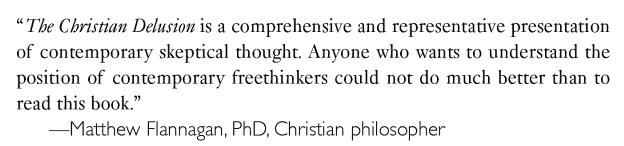
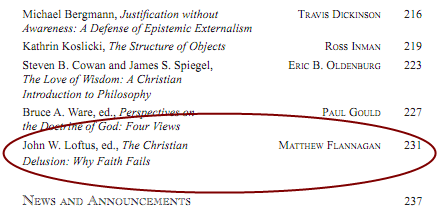
As a result of being published on the blurb of the book, the current edition of Philosphia Christi, Vol. 13, no. 1 – Summer 2011, shows the following in the table of contents under “Book Reviews”:
 The Editor of Philosophia Christi has kindly granted Matt permission to reproduce his review of The Christian Delusion: Why Faith Fails here on MandM.
A Review of The Christian Delusion: Why Faith Fails
by Matthew Flannagan
In The Christian Delusion John Loftus brings together a series of articles by contemporary free thinkers all focused around a common epistemological critique. It is the sequel to Loftus’s Why I Became an Atheist: A Former Preacher Rejects Christianity.
The book is divided into five parts, each addressing a different aspect of Christianity. Part 1 is entitled “Why Faith Fails” and comprises four chapters. In chapter 1, David Eller argues that religions both deeply influence and are deeply influenced by culture; he argues that different cultural contexts lead to different forms of Christianity. In chapter 2, Vallerie Tarico draws on cognitive science to offer naturalistic explanations for why people believe in God. In chapter 3, Jason Long explains how people believe in Christianity despite its obvious absurdity by documenting how humans frequently engage in certain fallacies, have certain biases, believe things that are comfortable and resist changing their minds.
By themselves it is hard to discern how these chapters provide arguments against Christianity. They appear to assume Christianity is false and provide naturalistic explanations as to why people believe such falsehoods. The relevance is explained in chapter 4, where John Loftus uses them to defend what he calls the Outsider Test for Faith (“OTF”). Loftus argues that a rational person should adopt the same skeptical stance towards her own religious beliefs that she does towards religions she rejects. The OTF undergirds all the articles in the book.
Part 2 is entitled “Why the Bible is not God’s Word”. Edward Babinski, in chapter 5, combs various psalms, myths, hymns, art work and apocalyptic literature and concludes that the Bible teaches a flat-earth cosmology where God literally lives just above the sky. Needless to say, Babinski’s exegesis is extremely literalistic. On p143 he states that Revelation 21:16 claims that the New Jerusalem is 12,000 stadia in height and then argues that something this size would “block jet streams in the upper atmosphere and be pummeled by natural and manmade objects orbiting the earth” (one wonders how an asteroid can strike a metaphor).
In chapter 7 Paul Tobin summarizes some fairly standard arguments against the reliability of the Bible – it is inconsistent, not supported by archeology, contains forgeries and fairy tales, etc. Loftus rounds off this section with a long list of passages that he contends people have historically appealed to in order to justify immoral acts.
We move onto “Why the Christian God is not Perfectly Good” in Part 4. Hector Avalos offers a critique of Paul Copan’s “Is Yahweh a Moral Monster?” [Philosophia Christi 10 (2008): 7-37]. Avalos draws on a lot of ancient Near East (“ANE”) material; however, he often does so quite selectively. On p215, Avalos dismisses Copan’s contention that the lex talionis does not call “for bodily mutilation, but rather just (monetary) compensation” as “mere assertion”. However, only a page later, Avalos criticizes Copan’s comments about the manumission of slaves citing the authority of “Raymond Westbrook, one of the foremost biblical legal specialists”. In fact, Westbrook has defended Copan’s position on the lex talionis [“The Character of Ancient Near Eastern Law” in A History of Ancient Near Eastern Law (Boston: Brill Academic Publishers, 2003) 74]. Further, Avalos contends that Jesus took the lex talionis literally in Matt 5:38-39, a position refuted by David Daube [The New Testament and Rabbinic Judaism (London: Athlone Press, 1956) 256].
Exegetical issues aside, much of Avalos’s moral arguments contains subtle fallacies. He argues Christians are committed to accepting the counter factual: If YHWH commands you to kill P then it is permissible to kill P. He then points out that if we replace the word YHWH with Allah, you get the conclusion it is permissible to kill Americans if Allah commands it. Avalos contends that this calls into question the “logic” of theistic ethics. It does not. Any sound argument will be analogous to an unsound argument if we replace a true premise with a false one.
Perhaps the most glaring problem with Avalos’s article is that after he argues The Torah is immoral and unjust he states that moral relativism is true. But how can a relativist consistently claim that the moral code of another culture is immoral?
Loftus rounds of Part 3 by arguing that the existence of animal suffering is incompatible with belief in God in chapter 9.
Part 4 argues “Why Jesus is not the Risen Son of God”. In chapter 10, Richard Price engages in a largely ad hominem attack on Greg Boyd and Paul Rhodes Eddy. He argues that methodological naturalism is the correct historical method and that Jesus is mythical figure. Applying the OTF, in chapter 11 Richard Carrier argues that Christians should respond to the claim Christ rose from the dead with the same skepticism they have towards miracle stories in Herodotus. Loftus finishes the section with chapter 12 by taking the apocalyptic imagery of Olivet discourse literally; he argues that Jesus was a failed apocalyptic preacher who predicted the end of the world and got it wrong.
In the final section, Part 5, the authors argue that “Why Society does not depend on Christian Faith”. Failing to distinguish ontological questions from sociological ones, David Eller in chapter 13, offers the non-sequitur that because different systems of mores can exist independently of religious beliefs morality does not depend on religion. He also contends that anyone who fails to grasp this point “understands very little about religion or morality” – something I am sure is news to Robert Adams, John Hare, Stephen Layman and Mark Linville.
In chapter 14 Hector Avalos selectively argues that Christianity was responsible for the Holocaust. He argues the Nazis were Christians; they promoted an Aryan Christianity which taught Jesus, preached love of one’s own race and opposed the Jews. According to this Nazi theology, Paul and the later Jewish apostles corrupted Christianity by teaching love of all people including other races. Then only a few pages later he rebuts attempts to hold Darwinism responsible for the holocaust on the grounds that these fail to distinguish Darwinism from later interpretations or misinterpretations of Darwinism by others.
An even bigger howler occurs on p374; Avalos appeals to anti-Jewish pogroms that occurred in 1096 as evidence of Christian anti-Semitism. Avalos concedes “church authorities did denounce these pogroms” but dismisses this, suggesting “the laity may have acted the way they did because of words such as those of Pope Innocent III…in 1208” Are we to seriously believe the pogroms of 1096 were motivated by a papal announcement made 112 years after the fact? The book closes in chapter 15 with Carrier critiquing Rodney Stark’s claim that Christianity caused the rise of modern science.
Perhaps the greatest problem with this book is the incoherence of the main line of argument. Loftus outlines the OTF in terms of two theses:
[1] The religious diversity thesis: that people from different cultures adopt different religious beliefs;
[2] The religious dependency thesis: which religion one adopts is overwhelmingly dependent on cultural conditions.
Loftus contends [2] is a plausible inference from [1] and that [1] and [2] entail the OTF. So, Christians should approach Christianity with the same skepticism they have towards Islam or Hinduism or even belief in fairy worship. Their beliefs are rational only if they can be justified from this default skeptical position.
Various analogies call this argument into question. For example, according to the articles of Avalos and Loftus, previous Christian and Jewish cultures held moral beliefs which were very different to ours. They believed in killing heretics, accepted racism, slavery, killing witches, supported genocide and so forth. Further, Carrier argues Christians despised the virtues of curiosity necessary for science. So it seems that an analogue of [1] applies to many of our moral beliefs.
Similarly, Babinski, Carrier, Eller, Price and others note that Christian and ANE cultures did not endorse a scientific epistemology or critical historical method. They believed in myths over empirical research or held to superstitious religious doctrines instead of believing the current scientific theories we believe today. Ancient Greek historians credulously accepted unreliable miracle stories. Consequently an analogue of [1] applies equally well to epistemological positions such as these.
Given that [2] is inferred from [1], if Loftus’ argument is valid then analogues of [2] must apply to Loftus et al’s own moral, epistemological and scientific beliefs. But then parity of reasoning would entail that their readers should adopt the same skepticism towards science and critical history as they hold towards the myths and superstitions of primitive cultures. Similarly, readers should adopt the same skepticism towards Loftus et al’s beliefs that anti-Semitism, killing heretics, committing genocide and burning witches is wrong as they hold towards the moral beliefs of cultures that practice and endorse these actions.
This conclusion is obviously absurd; but, more importantly, if it were embraced it would undercut the very premises the authors in the book use to argue against Christianity. In numerous places Loftus et al appeal to science, canons, critical history and the immorality of certain actions to critique Christian belief. They do not attempt to justify these beliefs from premises which would be accepted by a skeptical outsider from a radically different culture. But these are the kinds of beliefs which analogues of [1] and [2] apply to, and hence, are the kind of beliefs the OTF says we should be highly skeptical of. If the OTF is correct we should, in fact, treat Carrier and Price’s critical history with the same skepticism we currently treat miracles in Herodotus. We should treat Babinski’s appeal to modern cosmology with the same skepticism we treat ANE cosmological myths. We should treat Avalos’s appeal to the wrongness of slavery with the same skepticism we treat appeals to the permissibility of genocide.
Loftus is aware of this line of criticism; on p89 he admits an analogue of [1] applies to his scientific and epistemological beliefs “Unless I could have come up with this vast amount of knowledge myself, then I wouldn’t know any different than others if I was born in 1000 BCE”. He states “I was indeed lucky to have been born when and where I was born to know what I do in order to offer the OTF as a critique of religious faith.” Citing Carrier, on p101 he makes a similar response regarding moral beliefs using the example of democracy, “any rational sixteenth-century man who was given all the information we now have (of the different outcomes of democratic vs. non-democratic nations over a long period of time) would agree with us that democracy is better.”
Both these answers involve the abandonment of the OTF. Loftus assumes that he is “lucky” to be brought up in a culture that has got it right with regards to science, epistemology and morality. He suggests that what counts is not the stance skeptical outsiders hold but rather the stance outsiders would hold if they were insiders; that is, if they had all the knowledge which people of Loftus’s persuasion hold. This seems like special pleading. One can imagine Christians responding in an analogous way. If Muslims were lucky enough to be brought up in a Christian home and culture they would know the same things about Jesus that we Christians have been fortunate enough to learn. Loftus can only rule out this parity of reasoning by begging the question and assuming from the outset that the moral and epistemic beliefs of skeptics count as knowledge but Christian beliefs do not.
This review has been fairly negative; however, despite the problems inherent in this book, which are substantive, The Christian Delusion is still worth reading. The book is a comprehensive and representative expression of contemporary skeptical thought from some leading free thinkers in a single volume. Given the pervasiveness in our culture of the line of argument advanced in this book, anyone who wants to understand the position of contemporary free thinkers could not do much better than to read it.
To subscribe to Philosophia Christi visit the Evangelical Philosophical Society Store.
]]>Is anyone buying this? I mean, clearly what I should do is leave with the rest of the class and talk to my lecturer later. [Doh!]
Illustrations of this sort are often used in conflict of laws or legal interpretation classes to show that what prima facie appears to be a contradiction between two pieces of legislation actually is not. This is because imperatives occur in contexts where commonly accepted qualifications, riders, priorities, idioms, etc are assumed to be understood; implicit background beliefs are in play.
We can see this clearly in the example above. I know it is unlikely my lecturer wants his students to obey his instructions to the extent that they burn to death. I know this because I know something of his purposes and of his character. I know him to be fairly decent, humane and not one to issue arbitrary, irrational commands. I know also something of the weights involved in the issues. For example, I know the fire policy is university policy and it concerns the issue of safety – both the physical safety of students as well as its own, it does not want to be sued or prosecuted or subject to critical public scrutiny. I know that the lecturer’s authority is derived from university authority and so his instructions cannot contradict or override it. I also know that the reason he gave the instruction for me to stay behind in class was because he wanted to work with me in the future to ensure the sales of his book make the top 10 list. So from all of this I can safely conclude that he did not mean for me to follow his instructions on pain of death today.
Of course if I already believed my lecturer to be a petty, arbitrary, narcissistic, cruel bully, capable of anything who routinely issued commands with the purpose of harming, maiming and destroying students (and if I suspected he wanted to take my essay and publish it as his own so as to keep all the book royalties for himself) I might take a different approach as to how I read his instructions together. But it would be uncharitable of me in excelsis to adopt this assumption of his character as the default one to reason from.
Taking these contextual factors together, along with a basic grasp of the English language, its idioms and a dose of common sense it is not that hard to navigate apparently conflicting instructions.
I raise this because a site ironically called “Common Sense Atheism” recently put up a short post entitled 6 Questions with which to Stump Conservative Christians. I was extremely underwhelmed by the questions and was left wondering if the author had actually read any Christian works above Sunday School level on Christian ethics, biblical interpretation and so on (and clearly had not read very far into this blog) but I found one of the questions stood out en stupidus maximus (that’s a legal latin maxim meaning it was so stupid it had to be taken out). Question 4 asks,
“The Bible says to worship God (obviously) and to obey your mother and father, but what do you do if your parents tell you to worship other gods?”
Here, the atheist is trying to establish a contradiction in the commands God issues and from this contradiction we are presumably supposed to concede that Christians are irrational or that God does not exist or some such thing (and, of course, any Christian reading it is supposed to be “stumped”).
No Christian I know would be even momentarily stumped by this because the answer is obvious: in such a case you should disobey your parents and worship God; end of. I find it no more paralysing than the issue of whether I should leave class when the fire alarm sounds or stay to talk to my lecturer. In both cases, I understand that the command cannot sensibly be understood as an absolutely unqualified imperative. I doubt very much that God, out of allegiance to Him, wants us to give up allegiance to Him.
Of course if one wanted to make God look silly and arbitrary one could interpret it this way, just as you could attribute silly interpretations of what my lecturer meant such as intepreting his instructions as a command to wait for him even if I get burned alive in a fire or that my lecturer does not exist, but why would you?
If you think I am just picking on one unfortunate atheist’s example I beg to differ. When Matt was an undergrad at the University of Waikato a leader of the campus rationalist society confronted him with Isaiah 30:26,
The moon will shine like the sun, and the sunlight will be seven times brighter, like the light of seven full days, when the LORD binds up the bruises of his people and heals the wounds he inflicted.
The rationalist then informed Matt as to what the temperature of the sun was. He multiplied that number by seven and then noted that if it were to become that hot then world would burn to a crisp. He concluded that the Bible taught that heaven was hotter than hell. Matt’s initial inclination was to laugh and asked the guy if the exchange had “brightened up his day and warmed his heart.” It turned out that the example came from a highly regarded book by a scientist critiquing creationism, ironically entitled “Telling Lies for God: Reason vs Creationism” [scientists really really shouldn’t pontificate on theology]. The book had recieved endorsements from leading Australian Clergy. [I am reminded of Rob Muldoon’s position on Australians]
Then there was a discussion I had on Debunking Christianity’s “Madeleine Flannagan is Happy to be Treated as Women Were in the Bible!” where John Loftus pointed to Deuteronomy,
“Deuteronomy 22:23 If a man happens to meet in a town a virgin pledged to be married and he sleeps with her, 24 you shall take both of them to the gate of that town and stone them to death—the girl because she was in a town and did not scream for help, and the man because he violated another man’s wife. You must purge the evil from among you.
Deuteronomy 22:28 If a man happens to meet a virgin who is not pledged to be married and rapes her and they are discovered, 29 he shall pay the girl’s father fifty shekels of silver. [c] He must marry the girl, for he has violated her. He can never divorce her as long as he lives.”
Now Matt had written several posts on this atheist chestnut which saw me get embroiled in an exchange with both Loftus and Stephen Carr. Carr surmised that,
“If a woman is threatened with a knife, told she will be killed if she screams out, and does not scream out, there will always be a Christian to say , and I quote ‘isn’t she a part of the problem’?”
Apparently the non-offensive-to-God way to rape a woman is to simply render her incapable of screaming because God’s issue is with the screaming and not the raping…
Apparently when the bible lays down case laws, it cannot simply lay down a paradigm. It must spell out every possible nuance, qualification, exception, situation, application to analogous situations and so on.
Apparently if it does not do this then it is denying opposition to the act – now even modern case law precedents do not function like this and legislation is never drafted this way but apparently this is the way to read Biblical law.
Seriously.
Perhaps Carr is a too easy a target. Atheist philosopher Michael Martin makes a similar interpretation of Deuteronomy,
“it is assumed that in all cases that a rape victim could cry for help and if she did, she would be heard and rescued. Both of these assumptions are very dubious and sensitive to the contextual aspects of rape.”
I am at a loss to understand why atheists insist on reading these texts like a lawyer with Aspergers Syndrome in search of a convincing technicality by way to circumvent the spirit and intendment of the law? I mean why? We can all handle instructions that conflict with fire alarms going off, we don’t interpret modern laws like this, so why do atheists (and some Christians) switch to such silly anachronistic readings when the instructions are attributed to God?
I suspect the issue is the background factors I mention above. Many atheists believe God is a petty, arbitrary, narcissistic, cruel bully, capable of anything who routinely issues commands with the purpose of harming, maiming and destroying people. They believe that the bible is obviously silly, irrational, oppressive and supports contradictory absolutism in the family, is anti-women (and so obviously supports rape) is full of scientific absurdities (and so Isaiah was talking about cosmology) and so on.
When you have a pre-conceived notion as to what you want the text to mean – be it an uncharitable reading or what you think or have heard that the text teaches – I suppose the silly reading is congenial. What this tells us is that the reading of the text is not what leads atheists (and some Christians) to their conclusions, rather it is their conclusions lead them to read the text this way.
]]>He took her into the kitchen, and stripped her from neck to waist. He made her get upon the stool, and he tied her hands to a hook in the joist. After rolling up his sleeves, he commenced to lay on the heavy cow skin, and soon the warm, red blood came dripping to the floor … No words, no tears, no prayers, from his gory victim, seemed to move his iron heart from its bloody purpose. The louder she screamed, the harder he whipped; and where the blood ran fastest, there he whipped longest. He would whip her to make her scream, and whip her to make her hush; and not until overcome by fatigue, would he cease to swing the blood clotted cowskin.
Loftus is not alone, it is often affirmed as an incontestable and obvious truth that the Bible supports slavery. Atheist philosopher Walter Armstrong substantiated this accusation with a citation from the book of Leviticus, “as for your male and female slaves whom you may have: you may buy male and female slaves from among the nations around you” (Lev 25:44 ESV).
The ESV here uses the English word ‘slave’ to translate the Hebrew word ebed. The problem is that it is not at all clear that these two terms are analogous. In 1690 philosopher John Locke argued that an examination of the Old Testament’s references to an ebed shows that it is not the equivalent what we think of when we hear the term ‘slave.’ Locke is only one of many scholars who have come to the same conclusion.
The Oxford Dictionary defines a slave as a “person who is the legal property of another or others and is bound to absolute obedience, human chattel.” Rodney Stark utilises a similar definition, “A slave is a human being who, in the eyes of the law and custom, is the possession, or chattel, of another human being or of a small group of human beings. Ownership of slaves entails absolute control, including the right to punish (often including the right to kill), to direct behavior, and to transfer ownership.” Timothy Keller astutely observes that the English term ‘slave’ carries connotations of new-world slavery as it was practiced in the British Empire and made infamous in the antebellum southern states of the US.
In the British Empire and in many US states, slavery was governed under the Code of Barbados. This code was explicitly racist and described Africans as “heathenish, brutish, and an uncertaine, dangerous kinde of people.” It allowed owners to use, “unlimited force to compel labor without penalty even if this resulted in maiming or death.” It denied slaves due process rights and permitted owners to, in effect, kill their slave for any cause. It forbade slaves from marrying. It effectively prevented owners from setting their slaves free. Keller writes that, “The African slave trade was begun and resourced through kidnapping.” Stark notes that “20 to 40 percent of slaves died while being transported to the coast, another 3-10 percent died while waiting on the coast, and about 12 to 16 percent boarded on ships died during the voyage.”
However, what the Old Testament refers to differs from slavery, so understood, in several important respects.
First, an ebed was not acquired by kidnapping. Kidnapping a human being and selling that person as a slave was a capital offence in the Old Testament (Ex 21:16). Moreover, slave trading is implicitly condemned in the book of Revelation (Rev 18:13) and explicitly condemned by Paul as contrary to the law and sound doctrine (1 Tim 1:9-10).
In the Old Testament an ebed was usually person who offered to work for another, free of charge, in exchange for a debt being cancelled. It resembled a form of indentured servitude.
Second, the institution was not based on notions that ebed were of an inferior race. In fact, the opposite is affirmed. In the book of Job we read,
If I have rejected the cause of my male or female slaves [Hebrew: ebed amah] when they brought a complaint against me; what then shall I do when God rises up? When he makes inquiry, what shall I answer him? Did not he who made me in the womb make them? And did not one fashion us in the womb? (Job 31:13-15)
Here Job refers to an ebed as having a right to go to court and sue his or her “owner” in pursuit of his or her rights. Job bases this on the idea that both he and his ebed are equal, both are created by God.
Third, as Locke noted, an ebed was not the property of another and could not be disposed of. To deliberately kill an ebed was a capital offence (Ex 21:20-21). Similarly, it was illegal to strike an ebed (Ex 21:26-27).
However, some dispute this latter point on the basis of Exodus 21:20-21,
If a man beats his male or female slave with a rod and the slave dies as a direct result, he must be punished, but he is not to be punished if the slave gets up after a day or two, since the slave is his property.
Some interpret this passage to mean that because a “slave” is the property of another they can severely beat the slave and providing the beating is not fatal, there is no legal punishment. However, this fails to deal adequately with the context and the Hebrew text, the word translated as ‘property’ here is actually ‘silver’ (a reference to money) and the word translated ‘punishment’ here is not the usual word for punishment.
Old Testament scholar Christopher Wright notes that the word implies “the shedding of the blood of the master of the slave” and so refers to capital punishment. It is used in direct contrast with the same word in the previous verse where it is stated that deliberately killing an ebed is to be avenged. Therefore, it does not say the person will not be punished for beating a slave, it says he will not be executed for it unless he kills the slave. For further evidence that the passage is not a license to beat, a couple of verses later even causing a minor injury on an ebed, such as a bruise, is explicitly condemned. The same contrast occurs in the passage immediately preceding where a free man who struck and killed another was to be “held responsible” but not if the person survived. It is clear, however, that the person was in fact to be legally punished as v 19 states he had to compensate his victim for the injury. Hence, in context the ‘held responsible’ is referring only to being held responsible for murder and is not speaking to the lesser charges of assault. What Ex 21:20-21 says then, is that if a person deliberately kills his or her ebed then that person is to be held responsible for murder and executed. If the slave “gets up after a day or two,” then the person is not to be held responsible for murder because the ebed is his or her “silver.”
This makes sense as a few verses later, in Ex 21:26-27, striking a slave is explicitly prohibited and the legal punishment is for the ebed to go free. In The Old Testament, the penalty for assault was for the assailant to provide monetary compensation to the victim. This would create a quandary in this case as an ebed is in a position of servitude because he or she is in debt to the person he or she works for. In such a case the assailant would owe money to a person who owes him or her money. The Old Testament resolves the issue by declaring that even a trivial strike, such as causing a bruise (v21:25) should result in an immediate cancelation of the ebed’s entire debt, which would often result in a financial loss to the assailant. The New Testament similarly concurs, prohibiting “masters’ from even threatening their “slaves” (Eph 6:9) and to treat their “slaves” the way the “slave” is required to treat them.
Further, unlike new-world slavery which was life long and where, under the Barbados Code, emancipation was effectively prohibited, an ebed could not be held in service for more than six years (Ex 21:2). Upon release, their employer was morally required to give them sufficient resources for them to be set up on their own feet (Deut 15:12-18) and the community left resources for them to live on for a year (Ex 23:10-11, Lev 25:2-7).
These passages are often thought to refer only to Hebrew and hence Jewish slaves. Wright, however, argues that that in its original context the key word ibri designated a social class, not an ethnic group. This was the class of people who did not own land and in an agrarian economy survived by hiring themselves out to land owners.
In fact, in the passage immediately before the verse Armstrong cites the Old Testament forbids any Israelite taking another Israelite as a ebed on the grounds that they are a “ebed of God” whom God has redeemed. Paul applies the same teaching to Christians prohibiting Christians from being sold as ‘slaves’ (1 Cor 7:23). Similarly, the Old Testament commanded people to prevent family members from becoming an ebed by paying their debts for them (Lev 25:48). Further, Paul, after writing to the Corinthians and encouraging them to “retain the place in life that the Lord assigned,” encourages slaves to purchase their freedom and to not remain in this position if it was possible to do so (1 Cor 7:21-22).
Finally, if an ebed fled from an oppressive employer it was illegal to return him or her to “his master.” Instead, he or she was to live “wherever he likes and in whatever town he chooses” (Deut 23:15-16). It was forbidden to send an ebed back to his or her owner; contrast this with the practice in the antebellum south, the Fugitive Slave Act 1850 required the return of run-away slaves at penalty of law.
Contrary to what some contend, the Old Testament does not permit slavery. It is more accurate to say it tolerates indentured servitude under certain situations; the paradigm being where the servitude is voluntary, temporary, is done in exchange for payment of a debt where the alternative is starvation and destitution and only in situations where the servant is given the same basic legal rights as everyone else and is protected from abusive treatment. To suggest this picture fits with the opening quote above is a stretch to say the least.
I write a monthly column for Investigate Magazine entitled Contra Mundum. This blog post was published in the April 10 issue and is reproduced here with permission. Contra Mundum is Latin for ‘against the world;’ the phrase is usually attributed to Athanasius who was exiled for defending Christian orthodoxy.
Letters to the editor should be sent to: ed*******@************************TE.com
RELATED POSTS:
Contra Mundum: Secular Smoke Screens and Plato’s Euthyphro
Contra Mundum: What’s Wrong with Imposing your Beliefs onto Others?
Contra Mundum: God, Proof and Faith
Contra Mundum: “Bigoted Fundamentalist” as Orwellian Double-Speak
Contra Mundum: The Flat-Earth Myth
Contra Mundum: Confessions of an Anti-Choice Fanatic
Contra Mundum: The Judgmental Jesus
Dr. Matthew Flannagan, Christian philosopher and Adjunct Lecturer in Philosophy for Laidlaw College and Bethlehem Tertiary Institute.
The Christian Delusion is a comprehensive and representative presentation of contemporary skeptical thought. Anyone who wants to understand the position of contemporary free thinkers could not do much better than to read this book.
Matt intends to write a more thorough review which we will submit for publication both nationally and internationally.
]]>