[P1] If DCM is true, then if God commands unjust actions unjust actions are morally required
[P2] It is possible for God to command unjust actions
[P3] It is not possible for unjust actions to be morally required.
These three premises, entail a contradiction. [P1] conjoined with [P2] entails that it is possible for unjust actions to be morally required. However, this conclusion explicitly contradicts [P3]. Moreover, [P1] is clearly true. If I contend that A and B are really the same property, then if any action that has A will also have B. So it follows that if an unjust action has the property of being commanded by God. It will also have the property of being morally required.
Philip Quinn responds to the abhorrent commands objection, by rejecting [P2].[2] Quinn notes that on standard conceptions of God has certain character traits essentially. God is omniscient, omnipotent, but he is also loving and just. It is impossible however for a loving and just person to knowingly and deliberately command something incompatible with love and justice. If someone did this, they couldn’t coherently be called just or loving. The upshot is that [P2] is false. Affirming that a loving and just being commands injustice is to affirm something logically impossible.
Hooker’s Critique
Brad Hooker offers a response to Quinn.[3] Hooker notes that DCM has the implication that “Before God made any commands, there were no moral requirements.” However, Quinn suggests that God has the property of being just essentially, this means that requirements of justice must exist antecedent to any commands God issues. But that means there are requirements of justice antecedent to requirements of morality.
Hooker then offers the following argument:
[P1] If DCM is correct all moral requirements depend on Gods commands.
[P2]: If all moral requirements derive from God’s commands, then the requirements cannot exist until the commands exist.
[P3]: Even before God made any commands, there were requirements of justice constraining His commands.
[C1] Before God made any commands, there were no moral requirements (from premises 1 and 2)
[C2] Requirements of justice were not moral requirements. (from P3 an C1)
However, Hooker argues that [C2] is false. He concludes:
Since the logic of the above argument is valid, then if the argument’s conclusion is false, at least one of the argument’s premisses must be false. Premiss 2 cannot plausibly be denied. To reject Premiss 1 is to abandon the Divine Command Theory. So is Premiss 3 the one to reject? According to Quinn, even before God makes His first command, His inherent justice would keep Him from making unjust commands. To reject Premiss 3 is to abandon Quinn’s defence of the Divine Command Theory … [4]
Response to Hooker
I agree with Hooker that, if the conclusion of the argument is false, then at least one of its premises must be false. I also agree that a divine command theorist cannot abandon P1 or P2 and abandoning P3 commits him to abandoning Quinn’s defence of DCM. The critical question is whether [C2] is false. Why is [C2] implausible? Hooker’s argument against [C2] is brief. He writes:
However, requirements of justice are moral requirements. If they are moral requirements, then presumably they also were moral requirements (and will continue to be). Conclusion 2, therefore, seems false… the Divine Command Theory commits us to the implausible view that requirements of justice are not moral requirements.
Noticing a subtle shift in this argument is important. In Hooker’s argument, C2 is the claim that “moral requirements of justice were not moral requirements. (emphasis mine). The “were” refers to the time before God issued any commands. P1 P2 and P3 do not entail that moral requirements are not moral requirements posterior to such commands. The divine command theorist could affirm, and I suspect probably will affirm, that antecedent to any commands by God, there were requirements of justice. But no one was under any moral requirement to act justly. Posterior to Gods commands, however, there is such a requirement. Hence while the requirements of justice are moral requirements now, they were not prior to God issuing any commands.
A distinction made by John Mackie is illustrative here. Mackie famously argued for moral nihilism. According to Mackie, our moral discourse presupposes that objective moral requirements exist. He then argued that no such requirements do exist and so our moral discourse is systematically mistaken. Claims such as “Bill is morally required to act justly are false.
Mackie’s thesis is jarring, to soften the blow he but that in denying moral requirements exist he points out he is “not denying that there can be objective evaluations relative to standards,” taking, as an example, the standard of justice:
In one important sense of the word, it is a paradigm case of injustice if a court declares someone to be guilty of an offence of which it knows him to be innocent. More generally, a finding is unjust if it is at variance with what the relevant law and the facts together require, and particularly if it is known by the court to be so. More generally still, any award of marks, prizes, or the like is unjust if it is at variance with the agreed standards for the contest in question: if one diver’s performance, in fact, measures up better to the accepted standards for diving than another’s, it will be unjust if the latter is awarded higher marks or the prize …”[5]
What follows from nihilism is instead that:
The statement that a certain decision is thus just or unjust will not be objectively prescriptive: in so far as it can be simply true it leaves open the question whether there is any objective requirement to do what is just and to refrain from what is unjust, and equally leaves open the practical decision to act in either way.[6]
On this Mackie is surely correct, a person who embraces nihilism and thinks nothing is really right or wrong can still understand the concept of what is loving and just. Such a person could know that this idea of justice entailed certain standards and paradigmatic examples and he or she could in many cases tell whether certain behaviour was loving or was in accord with the standards of justice. She or he also could choose to live in accord with these standards if he or she wanted to and she or he could choose not to live in accord with them. He or she could simply reject that there was any objective moral obligation to behave in accord with such standards. The question of whether an action is just and loving and whether it is obligatory are, in principle, separate questions.
This distinction is subtle but important, and it has application here. DCM entails that, prior to God’s commands, no action is morally wrong. This, however, does not mean that actions cannot be loving and just prior to God’s commands. Prior to God’s act of commanding, certain actions will be loving and just without it being the case that they are obligatory. Because God is loving and just he commands people to behave in loving and just ways so that actions which are just antecedent to his commands become morally required or obligatory posterior to such commands.
It seems then that Hooker then is mistaken when he states “Divine Command Theory commits us to the implausible view that requirements of justice are not moral requirements.” Hooker here has moved from C1 which claims moral requirements were not moral requirements antecedent to God’s commands to the claim they are not moral requirements posterior to God’s commands.
The only reason Hooker gives for this leap is to assert “If they [requirements of justice] are moral requirements, then presumably they also were moral requirements (and will continue to be).” But apart from Hooker’s presumption, there is no reason to think that, and certainly no reason for a divine command theorist to believe this. As far as I can tell its coherent to claim that actions could be unjust but not obligatory prior to God’s commands.
[1] I say most here, William Lane Craig, Robert Adams, C Stephen Evans, William Alston, and Peter Forrest all contend the property of being commanded by God and the property of being morally required are informatively identical. By contrast, Philip Quinn holds that Gods commands directly and immediately cause the existence of moral requirements. This difference though important will not affect the subsequent discussion of Philip Quinn.
[2] Philip Quinn, “Divine Command Theory” In The Blackwell Guide to Ethical Theory, ed. H. LaFollette, (Cambridge, Mass.: Blackwell Publishers, 2000) 70-71
[3] Brad Hooker “Cudworth and Quinn” Analysis 61: 4 (2001); 333-335
[4] Brad Hooker “Cudworth and Quinn” Analysis 61: 4 (2001); 335
[5] John Mackie “The Subjectivity of Values” in Ethics: Essential Readings in Moral Theory ed George Sher (Routledge, 2012) 184.
[6] Ibid.
]]> Last week Sam Harris and William Lane Craig debated the question: “Is the Foundation of Morality Natural or Supernatural?” at the University of Notre Dame. Given my interest in divine command meta-ethics I found the debate and the subsequent online discussion concerning it extremely interesting. I was particularly interested in how the ‘new atheist’ movement would address this issue given Dawkins’ neglect of moral arguments in The God Delusion. Unfortunately, the debate turned out to be very one-sided. [Both the debate video and the debate MP3 are now online.]
In this review I will analyse the debate in two parts. In Part I, I will look at the discussion of Craig’s contention that,
1. If God exists then we have a plausible account of (a) the nature of moral goodness and (b) the nature of moral obligation.
In Part II, I will examine Harris’s contention that,
2. If atheism is true then we have a plausible account of (a) the nature of moral goodness and (b) the nature of moral obligation.
A couple of definitions are necessary here; what both Craig and Harris are defending are rival accounts of what both goodness and moral obligation are. When Craig or Harris offers an account of the nature of goodness, each is offering an account of what moral values and obligation are, that is, their ontological or metaphysical nature. Similarly, when Craig refers to God, he is referring to a personal immaterial being who is necessarily existent, omniscient, omnipotent and morally perfect.
Craig’s Argument for a Divine Command Theory
In support of 1(a) Craig argued that if theism is true, goodness could be identified with God himself. His view is that goodness is best understood in terms of an exemplar, that good is identified with the perfect paradigm of a good person and that the goodness of everything else is measured by its resemblance to this paradigm. An analogy to this idea is the official “metre stick” that exists in France today. The metre stick is exactly one metre long, and the length in metres of every other length is determined by comparison with it. In the same way, God is both perfectly good and is the standard of goodness for everything else. God’s goodness, for Craig, is cashed out in terms of certain character traits. To claim God is good is to claim that he is truthful, benevolent, loving, gracious, merciful and just, and that he is opposed to certain actions such as murder, rape, torturing people for fun and so on.
In support of 1(b) Craig argued that if God exists, moral obligations can be identified with Gods commands. He therefore advocated the version of a divine command theory of obligation proposed by Robert Adams in Finite and Infinite Goods.
While Craig sketched his account of goodness and obligation in his opening statement, he never offered any actual argument for why he thinks that if theism is true, this account is correct; yet later in the debate he said it was obvious. While I myself agree with a certain version of divine command theory, I think this suggestion is inadequate. There have been many objections raised against such theories in the literature, and hardly any of them presuppose the non-existence of God. I think these objections fail, and most of them fail miserably. But it would be a gross overstatement to claim that, given the truth of theism, a divine command theory is obvious.
Later in the debate,Craig did offer an argument of sorts for a divine command theory. He contended that obligations arise only in response to imperatives or demands by an authority. As moral obligations are a type of obligation, they share this feature, of which divine command theory is the best explanation. The obvious question here is, why should we think obligations arise only in response to imperatives from an authority? Craig does not say. Moreover, there do appear to be counter-examples to this claim. For instance, consider the non-moral social obligations people have to friends or hosts, these are not grounded in imperatives from an authority.
Consequently, considered by itself, Craig’s argument for a divine command theory seems insufficient. However, I suspect his comments at least suggest a more defensible argument. Robert Adams has persuasively argued that the role that guilt, censure, punishment, forgiveness and social inculcation play in morality suggests moral obligations are a form of social requirement; “being obligated to do something consists in being required (in a certain way under certain situations) by another person or groups of persons not to do it”[1]. If this is the case then a divine command theory plausibly explains, in a way that naturalistic and secular theories struggle to, how moral obligations can be objective and also how they can be a demand made by a person. Unfortunately, Craig did not develop this point.
Harris’s Response
Harris’s first rebuttal ignored 1a) and raised four main objections to 1b), which I will outline below.
Abhorrent Commands
Harris objected that a divine command theory entails that any action at all could be right, no matter how abhorrent. However, Craig pointed out in his opening statement that this objection falsely assumes that God could command anything at all, including abhorrent acts. A divine command theory does not identify our obligations with the commands of just anyone but only with the commands of God defined as omnipotent, omniscient, and morally perfect. And it is impossible for a morally perfect being to command abhorrent acts. Consequently, this objection fails. Despite Craig pointing this out, Harris continued to allude to this objection several times. He never tried to demonstrate how an omniscient being that was perfectly good could command what is abhorrently evil.
Old Testament Barbarisms
A second line of argument Harris made against 1b) was his allegation that the Old Testament teaches the permissibility of genocide and slavery. While I disagree with this claim, and have argued for my views elsewhere on this blog [see my genocide and slavery tags], the major problem in this context is that even if the claim is true, it does not refute 1b). Contention 1b) simply asserts that if God, understood as an “essentially omniscient, omnipotent, morally perfect being”, exists then it is plausible to identify our moral obligations with God’s commands. Nothing in this thesis says anything or commits one to saying anything, about whether the Old Testament is an authentic revelation of this God’s commands. While many divine command theorists believe in biblical infallibility, many do not. A divine command theorist could claim that the wrongness of an action is determined by God but we know what is right and wrong from our conscience—not from a written revelation. Philip Quinn once suggested this kind of theory.[2] Similarly, a divine command theorist could reject some Old Testament stories as immoral, as Robert Adams appears to[3]. Hence, as a rebuttal of 1b) this argument is a red herring. Craig repeated this fact early on in the debate, yet Harris continued to ignore it, repeating the red herring over and over again.
Miscellaneous Objections to Christian Theology
Harris’s main rebuttal of 1b), however, was four-fold. He contended:
(i) that the existence of evil in the world suggests that God does not exist;
(ii) that the doctrine of hell as a place of eternal conscious torment is unjust;
(iii) that the doctrine of exclusivism is unjust;
(iv) that these beliefs are jointly psychopathic.
What is bizarre about this is that none of these arguments actually address Craig’s contention.
Consider (i), the claim that evil proves God does not exist. Craig’s contention in 1b) was a conditional statement that: If God exists then we have a plausible account of the nature of moral obligation. Arguing that God does not exist does not refute this conditional since the conditional does not claim that God exists. Again, this was pointed out by Craig repeatedly in the debate and Harris repeatedly ignored it.
Similarly, Harris’s arguments in (ii) and (iii) do not refute 1b). Hell and particularism are doctrines in Christian theology. But the moot was not about whether Christianity is true. Craig’s contention was that, if God exists then we have a plausible account the nature of moral obligation. Nothing in this conditional requires one to embrace a particular view of hell or Christian soteriology or even Christianity at all. In fact, one could accept 1b) without even being a theist. Once again, this was pointed out to Harris by Craig early on, yet Harris continued to ignore it and instead resort to making jibes at Christian doctrines.
In the same way, (iv) is equally beside the point. Apart from the fact that simply referring to a claim in pejorative terms is not a rebuttal, these claims were not what the debate was about anyway. Hence his comments were strictly irrelevant. The debate was not about whether Christianity is psychopathic.
Evidentialism
One final objection Harris alluded to was that there is no evidence for God’s existence. But again, this is irrelevant to 1b). The debate simply was not about whether there was evidence for God’s existence. Again, Craig’s first contention was only that: if God exists then we have a plausible account of the nature of moral obligation. Nothing in this claim requires one to believe there is evidence for God’s existence. At some point, the question can no longer be evaded – does Harris even understand conditional implication in a debate resolution?
It is worth noting that, in addition to being irrelevant, this objection has two other problems. First, it begs the question. If Craig is correct in holding that 1b) is true and 2) is false, then there is evidence for God’s existence. If moral obligation can be plausibly explained only on the assumption that God exists then the existence of moral obligations would be evidence for God’s existence. Consequently, to establish that there is no evidence for God’s existence, Harris would have to attack 1 and defend 2, something he spent almost the entire debate not doing.
A final point on this last issue. At several points in his opening statement, Harris appealed to intuitive moral judgements about the wrongness of causing suffering. He stated that he was justified in accepting them as “axioms” without any evidence. Now I think something like what Harris says here is correct. I accept that certain moral claims are properly basic and justified independently of any argument for their truth. The problem is, however, once you grant that substantive moral claims can be properly basic, it is hard to see how you can then reject the arguments of people like Alvin Plantinga that God is rational in the absence of evidence. What exactly is it about religious beliefs that disqualifies them from being properly basic that does not apply to moral beliefs?
Harris never answered (or even bothered to raise) this question; the only time he came close to doing so was when he argued that one cannot have properly basic beliefs about God because people disagree radically over the nature of God. However, as the existence of this debate shows, people also disagree widely over the nature of morality. So not only was the evidentialist objection irrelevant to the actual debate, Harris’s use of it was an obvious case of special pleading. Craig put his finger on this problem when he noted that Harris took morality on faith despite claiming to have proven it by science—an argument that Harris, true to form, consistently ignored.
Consequently, regarding contention 1, Craig clearly presented the better case. While Craig did not really offer any arguments for his contention untill late in the exchange, and even then the argument he gave was rather undeveloped, Harris never offered a response. He pretty much ignored 1a) and threw out one relevant point in argument against 1b) which Craig had already refuted in his opening statement and which has been rebutted in the philosophical literature ad nauseum. In every other argument Harris offered against a divine command theory, he ignored the theory altogether instead he offered objections to numerous other positions that were not divine command theory and which were not even pertinent to the debate.
Harris’s attitude appeared to be, “’in spite of the agreed-on subject of the debate, I’ll say whatever negative thing I like about Christianity and that will surely count as an awesome argument.” Unfortunately for the new atheists rational discussion does not function this way. Rational discussion involves listening to what your opponent actually contends, attempting to understand it, responding with reasoned arguments and sticking to the topic you agreed would be the focus of the discussion.
In Debate Review: Sam Harris and William Lane Craig on Divine Command Theory Part II, I will discuss Harris’s contention that morality can be grounded in the natural facts studied by science.
[1] Robert Adams Finite and Infinite Goods (New York: Oxford University Press, 1999).
[2] Philip Quinn “Divine Command Theory” in Blackwell Guide to Ethical Theory ed Hugh La Follette (Malden MA: Blackwell Publishing House, 2000) 67.
[3] Adams Finite and Infinite Goods, 277-291.
“One good way to end a conversation – or start an argument – is to tell a group of well educated professionals that you hold a political position (preferably a controversial one such as being against abortion or pornography) because it is required by your understanding of God’s will. In the unlikely event that anyone hangs around to talk with you about it, chances are that you will be challenged on the ground that you are intent on imposing your religious beliefs on other people. And in contemporary political and legal culture, nothing is worse.”[1]
Carter is referring to the separationist understanding of religion and public life, the idea that in a contemporary pluralistic society significant restraint must be put on the political role of religious reasons. This restraint is negative; when a functionary deliberates over a proposed policy it is not justified for that functionary to decide to support or oppose that policy on grounds derived from religion. A corollary of this is that citizens should not try to influence public policy by appealing to religious reasons. Separationists argue that the public policy of a pluralistic society must be able to be justified by a plausible secular justification in order for it to be just to all. Religious beliefs, while utilised and followed in private, should be kept separate from public policy debates, the administration of public institutions and the deliberation of public functionaries.
Dominant advocates of this view include philosophers John Rawls, Robert Audi, Gerald Gaus and Jürgen Habermas. In “Religion as a Conversation-Stopper” Richard Rorty described separationism as:
“the happy, Jeffersonian compromise that the Enlightenment reached with the religious. This compromise consists in privatizing religion — keeping it out of … “the public square,” making it seem bad taste to bring religion into discussions of public policy.”[2]
Advocates for religious restraint typically claim that it need not be codified. It is simply a moral requirement which applies to all citizens regardless of their role within society — some form of censure rather than legal stricture is what is suggested. This is what Rorty means when he refers to it being “bad taste” to bring religion into the public square. Notwithstanding the separationists stated intention, in my thesis I will argue that this call for religious restraint is not simply theoretical philosophy, which is present in society only by way of self-imposed moral restraint or the sort of peer-pressure Carter’s quote alluded to. I will argue that the norm of religious restraint is increasingly present in our public policy and jurisprudence.
Rorty alluded to Jefferson’s famous “Wall of Separation Letter” where Jefferson set out his understanding as to how the First Amendment’s Establishment Clause should be interpreted. Tellingly, this suggests a link between the separationist philosophy and the way the religious freedom components of Bills of Rights are interpreted. These components address the very same questions I opened with; how should religion fit into a just pluralistic society? The purported answers are commonly given in slogans, “freedom of religion”, “free exercise”, “freedom to manifest one’s religion” and statements declaring the separation of church and state, opposing Establishment and so on. I say ‘slogans’ because such clauses are typically light on detail; fleshing out what they mean and how they are to apply at a practical levels, to specific cases falls to the commentators, the lawyers who propose particular interpretations in their submissions and ultimately the judiciary. The resulting body of jurisprudence reflects the perspectives of the dominant views in society.
Consider the US Supreme Court’s three leading Establishment Clause precedents: Lemon, Endorsement and Coercion. The first of the three parts of the Lemon Test requires public policy to have a valid secular purpose, a non-religious rationale must be offered for all state actions. The Endorsement Test prohibits the state from “endorsing” religion over irreligion. The Coercion Test provides that the state must not coerce religious practice; not only must it not be required, but in Lee v Weisman the application was shifted to what Justice Scalia, in his dissent, termed a “test of psychological coercion”. The US Supreme Court essentially took the view that being one of few (or the only one) to opt out of a religious practice in a public setting was considered a form of state coercion by peer pressure. I will argue that in each of the dominant Establishment tests, a requirement for the state to place a restraint on religion or for religion to be kept from public life can be seen. This stricture affects public policy and is essentially separationism in codified form.
Despite its current orthodoxy, separationism has its critics, particularly in philosophy and law. These critics collectively hold that although separationism claims to operate impartially, it, in fact, gives public hegemony to secular perspectives. Critics argue that the call for religious restraint is unjust for religious citizens as it requires conformity to secularism and thus privileges secularism over religion. Philip Quinn observes;
These principles impose burdens on religious people that [the separationist] nowhere suggests imposing on nonreligious people. … [The separationist] does not propose that nonreligious people must be sufficiently motivated by adequate religious reason for their advocacy or support of restrictive laws or policies. The lack of symmetry is striking.[3]
Christopher Eberle, Terence Cuneo agree there is a clear asymmetry in the way religious beliefs are treated by the state compared with secular beliefs. They question why religious believers, who participate in public, are required to bracket beliefs they hold as both true, important and relevant to the issue; Stephen Carter labels this “[t]he separation of church and self.”[4] Nicholas Wolterstorff argues that separationism violates the equal freedom component of a pluralistic democratic society, “Using their religious convictions in making their decisions and conducting their debates on political issues is part of what constitutes conducting their lives as they see fit.”[5][Emphasis added] Philip Devine point out that “Freedom of religion is not only the freedom to advocate religious (or irreligious) ideas; it is the freedom to form, sustain, participate in, and transmit, forms of community life”.[6] Yet separationists maintain that some form of religious restraint is not only in accord with the notion of liberal democracy but essential to it. As Rorty put it, “we shall not be able to keep a democratic political community going unless the religious believers remain willing to trade privatization for a guarantee of religious liberty.”[7]
The dominant tests seek to apply a reading of Jefferson’s “Wall of Separation Letter”; but in an article in First Things entitled “Establishing Free Exercise,” Vincent Phillip Muñoz argues that James Madison, the author of the First Amendment and a noted authority on the subject, did not intend this;
“When editing the religious freedom amendment to Virginia’s state Bill of Rights, Madison proposed the following:
‘That religion or the duty we owe to our Creator, and the manner of discharging it, being under the direction of reason and conviction only, not violence or compulsion, all men are equally entitled to the full and free exercise of it accord[in]g to the dictates of conscience; and therefore that no man or class of men ought, on account of religion to be invested with peculiar emoluments or privileges, nor subjected to any penalties or disabilities.’
Madison interpreted “free exercise” to mean no privileges and no penalties on account of religion.”[8][Emphasis added]
Munoz argues that Madison’s “no privileges, no penalties” test could unify “the no-establishment and free exercise provisions into a coherent whole that recognizes the legitimate concerns of both sides of the debate while, at the same time, respecting our nation’s founding heritage.”[9]
“no privileges, no penalties” would not require forays into students’ psychological feelings. Judges would not need to inquire if school children feel like “insiders” or “outsiders,” or if a child might perceive the state to be “endorsing” religion, which are necessarily subjective judgments. Courts would only need to ask if, on account of religion, religious citizens as such were granted a material benefit or if nonreligious citizens were subject to a penalty like a fine or imprisonment. For Newdow, the relevant question is: Was Michael Newdow’s daughter subject to some form of disciplinary action because she would not say the Pledge? Since she was not, the Pledge stands.”[10]
The “no privileges, no penalties” test upholds freedom of religion and separation of church and state by essentially permitting religion to have a place in public life as long as those who engage in public religious conduct do not gain a privilege for doing so and those who do not wish to participate are both free to opt out and are not penalised for doing so. Interestingly, the New Zealand jurisdiction’s approach, within the limited cases to date – where as long as one can ‘opt out’ of a religious practice there is no coercion, has some affinity or parallel with a “no privileges, no penalties” approach. Munoz’s appropriation of Madison has the potential to be a just way forward in both the debate within philosophy and in law. It does not have the privatising effect on religion that the dominant tests do, neither does it have the asymmetry.
I have this week been accepted into the University of Auckland’s LLM program. In 2011 I will start my studies towards a Masters of Law by thesis-only. This blog post is part of the proposal I have submitted to write it on – it may change as my supervisors and I work things out but this is the gist of what is in my head. I’d love to hear your thoughts – it will help get me thinking on where I am going with this!
RELATED POSTS:
Contra Mundum: Secularism and Public Life
Religious Restraint and Public Policy: Part I
Religious Restraint and Public Policy: Part II
Religious Restraint and Public Policy: Part III
Religious Restraint and Public Policy: Part IV
Religious Restraint and Public Policy: Part V
Religious Restraint and Public Policy: Part VI
[1] Stephen Carter The Culture of Disbelief: How American Law and Politics Trivialise Religious Devotion (1993) 23-24.
[2] Richard Rorty “Religion as a Conversation-Stopper” (1994) 3:1 Common Knowledge 1, 2.
[3] Philip Quinn “Religion in the Public Square: The Place of Religious Convictions in Political Debate” (2000) 60:2 Philosophy and Phenomenological Research 487 (book review).
[4] Carter, above n 1, 1.
[5] Nicholas Wolterstorff “The Role of Religion in Decision and Discussion of Political Issues” in Nicholas Wolterstorff & Robert Audi (eds) Religion in the Public Square: The Place of Religious Convictions in Political Debate (1997) 77.
[6] Philip Devine We: A Study in Social and Political Philosophy, Ch 10 accessed 10 December 2010.
[7] Rorty, above n 2, 3.
[8] Vincent Phillip Muñoz “Establishing Free Exercise” First Things (January 2004) 139-142, 141.
[9] Ibid 139.
[10] Ibid 142.
In “God, Morality and Abhorrent Commands: Part II Robert Adams” I mentioned Phillip Quinn’s observation that theists can face a particular dilemma,
“[I]t seems possible that a theist should have both good reasons for believing that God has commanded him to perform a certain action and good reasons for believing that it would be morally wrong for him to perform that action. Thus a theist can be confronted with moral dilemmas of a peculiar sort.”
Quinn’s point is that a theist might find himself believing all three of the following propositions:
[1] Whatever God commands is morally permissible;
[2] God commands X;
[3] It is wrong to do X.
Adams and Kant argued that one should resolve dilemmas of this sort by affirming [3] and denying [2]. I argued in Part I Kant and Part II Robert Adams that this conclusion is unjustified. What Adams does show is that one cannot “accept a theological ethics that ascribes to God a set of commands that is too much at variance with the ethical outlook that we bring to our theological thinking.” [Emphasis added] His position, in fact, suggests that in many cases we should accept divine commands at variance with our moral beliefs. Hence, there may well be times when it is rational to reject [3] and embrace [2].
In this last post I will elaborate Quinn’s answer to this question. Quinn’s position can be seen by contrasting two approaches he takes to specific examples of the kind of dilemma he cites.
The first is Quinn’s response to the dilemma posed by “the sins of the patriarchs” this is the term medieval theologians gave to specific dilemmas they thought they saw in the biblical texts, cases “where God commands something that appears to be immoral and indeed to violate a prohibition he himself has laid down.” Three examples were dominant in medieval discussions. These were: (a) the case of Abraham being commanded to kill Isaac; (b) a command in Exodus 11:2 which was interpreted to be a command to plunder the Egyptians; and (c) the command to Hosea to have sexual relations with an adulteress. (Hosea 1:2, 3:1)
Quinn’s response is to appropriate the response suggested by Augustine, Bernard, Aquinas and, in most detail, by the 14th century theologian Andreas de Novo Castro:
“[T]here are actions which, ‘known per se by the law of nature and by the dictate of natural reason, are seen to be prohibited, as actions which are homicides, thefts, adulteries, etc., but, with respect to the absolute power of. God, it is possible that actions of this kind not be sins.’”
Andreas’ claim is that certain actions such as theft, adultery and killing the innocent are wrong and that people know by nature that they are wrong. What he contends, however, is that God could have made them permissible if he choose to do so by simply commanding them. Moreover, Andreas accepts that in the cases of (a), (b) and (c) God did do this and so on these occasions the actions in question were not wrong.
Quinn notes that a divine command theory makes sense of this. According to a divine command theory wrongness is constituted by the property of being contrary to God’s commands. So where God has issued a command to all people to refrain from P, engaging in P would have the property of being wrong. However, if, in a specific situation, God commands a specific person to do P then P is no longer contrary to God’s commands, for that person, and hence, no longer has the property of being wrong, for that person.
Quinn notes that this does not, as critics contend, open the flood-gates allowing everyone to kill or steal or so on because if a specific individual is commanded to kill or steal or commit a sexual indiscretion for a specific occasion then it is only permitted for that particular individual to perform that act on that particular occasion. Hence, this view is compatible with contending that these actions are generally, and in most cases, wrong. Moreover, nothing about this view requires a person to believe that God ever issued such commands to anyone apart from the specific instances mentioned nor does it require a person to accept any and every claim made by any would be killer, thief or sexually promiscuous person that God has commanded them to act as they do.
People who hold this view can, and typically do, think that cases where God does command such things are extremely rare and that any claim that God has commanded such an action today is unlikely. In fact, they may have theological reasons for thinking such commands would not occur outside of the events recorded in salvation history. Adopting this view, one could even accept that such actions are, for practical purposes, absolutely wrong. All this position entails then is that in specific, rare and probably never to be repeated occasions, these actions have been permitted.
Quinn’s second approach is to respond to an objection made to divine command theory by 17th century Philosopher Ralph Cudworth. Cudworth objected that the divine command theory makes morality arbitrary, according to a divine command theory, anything at all could be deemed ‘right’ as long as God commanded it. Wes Morriston formulises the objection as follows:
(i) The divine command theory entails that whatever God commands is morally obligatory;
(ii) God could command X;
(iii) so if the divine command theory is true, X could be morally obligatory;
(iv) but X could not be morally obligatory;
(v) therefore, the divine command theory is false.
[ X = the action of torturing children purely for fun]
Quinn’s response here is interesting (and I think substantially correct). He notes that this objection assumes (ii) is true, that it is possible that God could command atrocious things like torturing people for fun. This assumption seems very dubious.
We need to remember that we are not talking about right or wrong as being based on the commands of just anyone, we are talking about God, understood as a being with certain attributes. The most notable of these is His being omnipotent, omniscient, loving, good and just.
So, as God is understood by divine command theorists, the claim that it is possible for God to command people to torture others for fun is true only if it is possible for a morally perfect person, who is fully informed of what he is doing, to command such an atrocious thing. But this is impossible. As Quinn notes, “If God is essentially just, there will be constraints on the antecedent intentions God can form.” A just being cannot command just anything, hence Cudword’s argument fails.
What is immediately apparent is the contrast between these two approaches. In the sins of the patriarchs case, Quinn has responded to the dilemma by denying [2] on the basis of [3]. He argued that the actions in question are not wrong for these individuals in these contexts because God commanded them. However, regarding the example of torturing children for fun, Quinn has denied that [3] is possible on the basis of his moral judgements about [2], torturing children for fun is the kind of action a loving and just being could not command. Quinn notes the apparent inconsistency,
“Given that I say it is impossible for God to command someone to torture an innocent child just for the sake of amusement, it may seem that I must also say that it is impossible for God to command Abraham to sacrifice Isaac, impossible for God to command the Israelites to plunder the Egyptians, and impossible for God to command Hosea to have sexual relations with the sinful woman.”
Quinn’s response is that in the case of torturing children for fun, the most plausible response is to answer that God could not command such a thing; “it would be a mistake to generalize to the conclusion that it is an implausible kind of response in every possible case, including all cases of the immoralities of the patriarchs.” This is because in the case of torturing children for fun Quinn’s response was based on the intuitive insight that it is impossible for an omniscient, loving, just and good being to command such a thing.
However, he notes that our intuitions about different cases differ. While it is intuitively obvious that it is impossible for a perfectly good being to command us to torture others merely for fun, it is not obvious that it is impossible for a good being to ever permit stealing – cases exist where a person might need to steal food in order to avoid their child succumbing to starvation and in such cases it is not obvious that stealing is always wrong. Moreover, in the case of plundering the Egyptians, the Israelites had just been liberated from slavery and were taking property from those who had held them in slavery. Similarly with Hosea, like Quinn, I don’t find it intuitively obvious that there is no possible world or situation where a good person might permit someone to sleep with an adulteress. So, these cases are not on par with the case of a command to torture children for fun.
Behind Quinn’s analysis is the epistemic principle he attributed to Kant, “whenever two conflicting claims differ in epistemic status, the claim with the lower status is to be rejected.” Unlike Kant, however, he does not assume that moral claims will always have a higher status than theological ones. In the case of torturing children for fun the claim that such an action is necessarily wrong has a fairly high epistemic status; the idea that it is wrong to torture children for fun is so central to our understanding of goodness that denying it would make it impossible to coherently claim a good being commanded it. On the other hand, the claim that God has commanded such a thing or even could does not have a high status. Hence it is sensible to contend that God cannot issue such commands.
In other cases, such as the immoralities of the patriarchs, the contention that the action is wrong does not have a high epistemic status. It is not obvious that our beliefs about it being always wrong to sleep with adulteresses or that it is wrong in any circumstances to steal, have anywhere near the strength our belief about torturing children for fun does. That it is never permissible to steal is a moral judgment. One can coherently deny that a perfectly good being would endorse this judgment and there appears to be some scriptural support for the claim God did command theft on a specific occasion. So, provided the exegetical case for this command having occurred is conclusive enough, one can accept that God commanded it.
Quinn’s approach, I think, also incorporates some of the insights of Adams. Adams argued that in order for [1] to be correct God must be understood as good. Quinn’s response to Cudworth illustrates that Cudworth’s objection fails only because God is essentially good. Similarly, Adams argued that in order to meaningfully say God is good, one cannot attribute to God a set of commands so much at variance with our beliefs about morality that one could no longer coherently claim that a good person had commanded them. Quinn’s response acknowledges that in this sort of situation one would have compelling reasons for thinking that God did not issue the commands in question because accepting God did would be incoherent. What Quinn’s approach adds is that there are also many situations in which our theological beliefs can correct and critique our moral beliefs. We might be quite sure on exegetical grounds that God has commanded some action and coherently believe this; if this is the case then unless we have equal or stronger reasons for thinking the action is wrong, it will be rational to accept God’s command. Quinn’s position, therefore, takes seriously the fact that our moral judgments are fallible and an authentic encounter with God’s will is therefore likely to contrast with some of our moral beliefs.
RELATED POSTS:
God, Morality and Abhorrent Commands: Part I Kant
God, Morality and Abhorrent Commands: Part II Robert Adams
In “God, Morality and Abhorrent Commands: Part I Kant” I mentioned Phillip Quinn’s observation that theists can face a particular dilemma,
“[I]t seems possible that a theist should have both good reasons for believing that God has commanded him to perform a certain action and good reasons for believing that it would be morally wrong for him to perform that action. Thus a theist can be confronted with moral dilemmas of a peculiar sort.”
Immanuel Kant argued that when faced with such a dilemma the theist should reject the belief that God has commanded the action and accept the moral belief. This was due to his belief that moral beliefs are more certain that theological beliefs. I contested this claim. More recently Robert Adams has defended Kant’s conclusion. Consider the structure of the kind of dilemma Quinn cites,
[1] Whatever God commands is morally permissible;
[2] God commands X;
[3] It is wrong to do X.
These three claims contradict each other; like Kant, Adams suggests that the rational person should reject [2]. However, his reasons are somewhat different. Adams persuasively reasons that [1] is true only if God is understood as perfectly good, in the sense of being loving, just and so on. If God were evil or morally indifferent then it would be possible for him to command wrongdoing and so [1] would be false. This means that a person who accepts [1] must presuppose that God is good.
Adams argues that God cannot be meaningfully said to be good if what he commands drastically departs from what we consider to be right and wrong. Human beings have some grasp of what constitutes goodness and some grasp of what constitutes right and wrong and it is part of our concept of what is good that a good being does not command wrong doing. Moreover, to call a being good is to attribute to it a character trait that is incompatible with certain other actions, attitudes and so on. Raymond Bradley made the point succinctly in his debate with William Lane Craig “Can a Loving God Send People to Hell?“
“If we were to describe someone such as Hitler as perfectly good despite all his evil doings, we’d be playing word games which are intellectually dishonest as they are morally pernicious. … it would be to deprive the word “holy” of its ordinary meaning and make it a synonym for “evil.”
This supports Adams’ conclusion that one cannot rationally accept [1] as one implicitly assumes that God does not issue commands at variance with our conception of morality. In Finite and Infinite Goods: A Framework for Ethics he concludes,
“Our existing moral beliefs are bound in practise, and I think, ought in principle, to be a constraint on our beliefs about what God commands. We simply will not and should not, accept a theological ethics that ascribes to God a set of commands that is too much at variance with the ethical outlook we bring to our ethical thinking.” [Emphasis original]
As with Kant there is a lot of truth to this; however, Adams’ position has certain limits. As critics of Adams have pointed out his conclusion is limited. In the paragraph above Adams concludes that “our existing moral beliefs” must be a constraint on our beliefs about what God commands. His justification for this is that we “should not, accept a theological ethics that ascribes to God a set of commands that is too much at variance with the ethical outlook we bring to our ethical thinking.” The phrase “too much” suggests that one can accept ascription of a set of commands that is somewhat at odds with the outlook we bring to our ethical thinking.
Two points Adams makes elsewhere in Finite and Infinite Goods suggest that this limitation on his conclusion is necessary. First, while we do have some grasp of what is good and some grasp of what is right and wrong it is evident that our moral judgements are fallible. Adams calls this the “transcendence” of the good. He states,
“All of God’s commands and judgments are right; God is the ethical standard. But our beliefs (even the most cherished) about them must be distinguished from God’s commands and judgments themselves. To fail to make that distinction is idolatry.”
Adams is surely correct here. While God does not command wrongdoing. It is quite likely that a perfectly good omniscient being would command something contrary to what we think is wrong. Our moral intuitions are fallible, hence it is possible that some of God’s commands would clash with our own moral judgements. In fact to suggest that God would never command something which we consider to be wrong expresses an incredible hubris. It is to dogmatically assume that we are such good judges of morality that God could never disagree with us. It is to put our own moral judgements beyond question. The existence of some commands that strike us as strange or immoral does not count for much.
Second, our concept of goodness and our judgement about particular cases can be and sometimes is subject to revision. We change our opinions about the goodness and rightness of certain things without “playing word games which are intellectually dishonest” or depriving “the word ‘holy’ of its ordinary meaning and make it a synonym for ‘evil.’” If this were not the case, one could never honestly or rationally change ones mind on an ethical issue. Nor could people coherently disagree with or persuade one another about moral issues. Adams’ notes this when he writes that he accepts “the possibility of a conversion in which one’s whole ethical outlook is revolutionized, and reorganized around a new center” but “we can hardly hold open the possibility of anything too closely approaching a revolution in which, so to speak, good and evil would trade places”.
These points, however, quite evidently limit Adams’ conclusion. What his argument, in fact, shows is not that “our existing moral beliefs must serve as a constraint on our beliefs about what God commands” but rather that certain types of our existing beliefs do this, those so central to our concept of goodness that accepting them would be “approaching a revolution in which, so to speak, good and evil would trade places.” In “A Psychological Constraint on Obedience to God’s Commands: The Reasonableness of Obeying the Abhorrently Evil” James Rissler notes,
“In such an instance, obedience requires that one give up everything one previously believed about morality… one has been commanded to relinquish everything one understands about the nature of goodness, one will have no concept of the good with which to identify Gods command, there will be complete breakdown of between everything one currently affirms about goodness and everything one is asked to believe about goodness.”
Rissler gives two examples; the first is where God issues a command to reverse one’s conception of right and wrong or issues a set of commands, each one of which negates every moral imperative one currently accepts. Second, he suggests that a moral belief might be “sufficiently integral to one’s conception of morality” that abandoning it would force such a radical revision as to destroy one’s concept of goodness all together. Imagine a command to kill everyone around you purely for entertainment or a command that said harming, hurting and inflicting suffering on people for no reason at all is permissible. Consider a command to hate God and despise all other human beings. One cannot accept a system of divine commands where every duty we believe in is declared false nor can we accept a system which suggests that the vast majority of our moral beliefs are mistaken. This would come too close to the problematic revolution Adams talks of.
To sum up, in Part I and II, I have looked at the Kantian approach to the kind of dilemma Quinn sketches. Neither Kant or Adams, I think, establish the claim that in “our existing moral beliefs must serve as a constraint on our beliefs about what God commands.” They did, however, lend support for a weaker thesis. Kant’s argument, for example, does suggest that those moral claims about which we are certain, should serve as such a constraint and I mentioned several beliefs which I consider to be fairly certain as examples.
Adams’ argument on the other hand suggests that we cannot coherently “accept a theological ethics that ascribes to God a set of commands that is too much at variance with the ethical outlook we bring to our ethical thinking.” He argues that we cannot coherently or defensibly accept a theological ethics which, in effect, makes good and evil trade places and which so radically transforms our concept of goodness so that good becomes a synonym for what we call evil or calls our concept of goodness so radically into question that it breaks down. Certain beliefs such as it is prima facie wrong to inflict pain and suffering on others or it is prima facie wrong to treat others with contempt” or it is prima facie wrong to lie, steal and kill are so central to our account of goodness that we cannot coherently accept that a perfectly good being has issued commands that negate them.
In my next post I will look at Philip Quinn’s alternative.
RELATED POST:
God, Morality and Abhorrent Commands: Part I Kant
God, Morality and Abhorrent Commands: Part III Philip Quinn
In “Commonsense Atheism and the Canaanite Massacre” I addressed a question put to me by Luke from Commonsense Atheism,
“If Matt did think these events happened literally as described in the Bible, would he then conclude that God was an evil monster to command them? Or would he, in the end, agree with Bill Craig that genocide is okay as long as God feels like it?”
In my response I pointed out Craig claims that killing non-combatants in war is permissible if a loving and just God commands it (which is an implication of a divine command theory). This conditional is arguably true. Either it is possible for a just and loving omniscient person to command genocide or it is not. If it is then genocide would only be commanded in situations where a just and loving person, aware of all the relevant facts, could endorse it; under these circumstances it is hard to see how genocide could be evil. On the other hand, if it is impossible for a just and loving omniscient person to ever command genocide then the situation Luke mentions is one with an impossible antecedent. On the standard accounts of counter-factual logic, conditionals with impossible antecedents are true. So far from being absurd there are reasons for thinking this conditional is true.
The question Luke asks is really a species of a larger and important question in theological ethics. In Finite and Infinite Goods Robert Adams notes “A convincing defense of a divine command theory of the nature of obligation must address our darkest fear about God’s commands–the fear that God may command something evil.” Philip Quinn makes a similar point,
“[I]t seems possible that a theist should have both good reasons for believing that God has commanded him to perform a certain action and good reasons for believing that it would be morally wrong for him to perform that action. Thus a theist can be confronted with moral dilemmas of a peculiar sort.”
I suspect Luke is really asking how a theist can rationally respond to a dilemma of this sort. While I do not know what Luke’s opinion on this issue is, a common view is that if a theist has good reasons for believing an action is wrong then any claim that God has commanded should be rejected. The locus classicus for this position is Immanuel Kant; in Reason within the Bounds of Religion, Kant stated:
“Abraham should have replied to this supposedly divine voice: “That I ought not kill my good son is quite certain. But that you, this apparition, are God — of that I am not certain, and never can be, not even is [read: if] this voice rings down to me from (visible) heaven.”
Similarly, in the Conflict on the Faculties he states he states,
“That to take a human being’s life because of his religious faith is wrong is certain, unless (to allow the most extreme possibility) a divine will, made known to the inquisitor in some extraordinary way, has decreed otherwise. But that God has ever manifested this awful will is a matter of historical documentation and never apodictically certain. After all, the revelation reached the inquisitor only through the intermediary of human beings and their interpretation, and even if it were to appear to him to have come from God himself (like the command issued to Abraham to slaughter his own son like a sheep), yet it is at least possible that on this point error has prevailed.”
Kant, here, is discussing the kind of dilemma Quinn refers to. The dilemma can be spelled out as follows, in certain situations a theist might find him or herself with reason to affirm the following three propositions,
[1] Whatever God commands is morally permissible;
[2] God commands X;
[3] It is wrong to do X.
These three claims cannot all be true, so a rational person must reject one of them; the question is which one? Kant’s answer is that when faced with a dilemma of this sort the theist should reject [2]. It is worth elaborating on his position a bit.
First, note that Kant accepts [1] he grants that if we knew that God commanded the killing of a particular human being, it would be permissible to kill that human being. Kant’s objection is that one cannot be rational in believing that God has, in fact, issued such a command. Philip Quinn notes that Kant’s argument involves an appeal to an epistemic principle: whenever two conflicting claims differ in epistemic status, the claim with the lower status is to be rejected. Kant contends that moral claims such as “it is wrong to kill innocent people” are certain. However, claims that God commands or forbids a certain action are not certain and never can be. From these points it follows that a rational person will accept [3] and reject [2].
Despite its appeal Kant’s argument is flawed for several reasons. Philip Quinn notes two problems. First, “Kant has an extremely optimistic view of our ability to attain epistemic certainty about principles of moral wrongness,” he thinks we can be certain of moral claims. This, however, is dubious. There are some moral claims of which I am fairly certain. I am certain, for example, that it is wrong to inflict as much pain on another as I can merely for my own entertainment. I am fairly certain that killing, assault, theft and lying are prima facie wrong and can only be justified if some overriding moral reason applies. However, many moral claims are highly controversial and are far from certain at all. Consider, for example, the debate over whether the bombing of Hiroshima was justified because it saved a huge number of lives by ending a war early. While I myself do not share this opinion, I would not say I am certain about it. Similarly, consider moral debates about capital punishment or euthanasia or affirmative action. While I believe there are defensible and justified answers to these questions, I doubt we can claim certainty about answers to these questions.
Second, Kant claims that we can never be certain that God has prohibited a certain action. Quinn notes, “It would thus seem to be well within God’s power to communicate to us a sign that confers on the claim that God commands some intolerant behavior, for example, issuing threats to heretics, a fairly high epistemic status.” If God were to do this then we would have certainty that he had commanded the action. So it is not clear that beliefs about what God wills are always less certain than moral beliefs.
I am inclined to push this criticism further. It seems to me that many sceptical worries that are raised about God and his commands apply with equal force to moral beliefs. Consider three common concerns sceptics raise about religion. One is the claim that the existence of God is not necessary to explain any empirical phenomena. The second is the concern that the claim God exists and has commanded a particular action cannot be empirically demonstrated or proven to exist. The third is the widespread pluralism with regard to both the existence of God and his nature. All three of these worries apply to moral beliefs. The existence of moral properties appears unnecessary to explain any empirical phenomena, almost any empirical phenomena can be explained equally well by accepting that moral beliefs are all false but that people think they are true. Attempts to prove that moral beliefs are true from non-moral premises alone are probably more controversial than any argument for the existence of God. And there is widespread pluralism over whether moral properties exist; nihilists and non-cognitivists deny such properties exist and amongst believers in the truth of moral beliefs, there is widespread disagreement over the nature of morality. Intuitionists contend it is a non-natural property, naturalists contend it is a natural property but disagree over what the natural property in question is, supernaturalists contend it is a divine command or a theological property and so on.
In fact, Kant’s own argument provides an example of this point. Kant argues in The Conflict in the Faculties that we can never be certain that God has commanded an action because,
“the revelation reached the inquisitor only through the intermediary of human beings and their interpretation, and even if it were to appear to him to have come from God himself (like the command issued to Abraham to slaughter his own son like a sheep), yet it is at least possible that on this point error has prevailed.”
But this is equally true of many moral beliefs, a good amount of what people believe with regards to morality comes to them through the intermediary of human beings and their interpretation. Most westerners belief’s in liberal ideals, such as, the equality of women, opposition to slavery and so are mediated through human beings. Moreover, even if we directly intuit moral properties, it is possible that we are mistaken. Human moral intuitions and judgements are fallible and can err. So in many instances I am inclined to think that the sceptical worries people raise to conclude that theological beliefs are uncertain apply also to moral beliefs. To appeal to these concerns, so as to claim that belief about God’s will is less certain than moral beliefs, is to engage in special pleading.
In my next post I will look at Robert Adams’ defence of Kant’s position and then I will look at Philip Quinn’s alternative.
RELATED POSTS:
God, Morality and Abhorrent Commands: Part II Robert Adams
God, Morality and Abhorrent Commands: Part III Philip Quinn
DR CHRIS TUCKER’S INTRODUCTION
Published here with permission
Dr. Matthew Flannagan is quickly becoming a respected scholar on issues related to the philosophy of religion, ethics, and theology. His articles and book chapters cover such weighty topics as, whether the Bible condones genocide, the ethics of holy war, abortion and tonight’s topic, the relationship of God and morality. The importance of Dr. Flannagan’s work has led to many speaking engagements all over New Zealand and also in the United States. Two of these speaking engagements were public debates, including one against Dr Bill Cooke, an erstwhile President of the New Zealand Association of Rational Humanists. Dr Flannagan received his PhD in Theology from the University of Otago. From the University of Waikato, he received his Master’s in Philosophy with First Class Honours. You can follow Dr Flannagan’s work at mandm.org.nz, the blog that he co-authors with his wife, Madeleine Flannagan. When he is not working, he enjoys spending time outdoors with his wife and four children. Please join me in welcoming Dr. Matthew Flannagan
DR MATTHEW FLANNAGAN’S OPENING STATEMENT
Is it defensible to ground right and wrong in the commands of God? In this debate I will defend an affirmative answer to this question. I will defend the position that moral rightness and wrongness consist in agreement and disagreement, respectively, with Gods commands1– this is what Philosophers call a divine command theory. In defending this thesis I will do two things. First I will argue the standard arguments against a divine command theory fail. Second I will argue that Ray’s attempts to refute this theory fail. God is the source of morality.
1. Standard Arguments Against a Divine Command Theory
Divine command theories are frequently said to suffer a debilitating problem, they make morality arbitrary – anything at all could be deemed ‘right’ as long as God commanded it, even torturing other people for fun. This objection assumes that it is possible that God could command atrocious things like torturing people for fun. This assumption, however, seems very dubious. We need to remember that we are not talking about right or wrong as being based on the commands of just anyone, we are talking about God defined by Ray as “omnipotent, omniscient, and morally perfect.”
So, as the terms are defined, the claim that it is possible for God to command people to torture others for fun is true only if it is possible for a morally perfect person to command such an atrocious thing. But this is unlikely. The very reason critics cite examples such as torturing people for fun is because these actions are paradigms of conduct that no morally good person could ever entertain or endorse.
A predictable rejoinder to this response is that if some action is wrong because God prohibits it then God cannot be said to be good in any meaningful sense. The claim ‘God is good’ turns into no more than the claim that God obeys his own commands, if this is so, can God be said to have any duties at all?
The suggestion that if God has no duties then he cannot be said to be good in any meaningful sense, has a grain of truth to it. If we are going to understand God’s goodness in terms of God having duties that he consistently fulfils then a divine command theory cannot account for God’s goodness. However, why must the phrase ‘God is good’ be understood in terms of God having duties? I do not see why it should?
Many theologians and philosophers have suggested an alternative, God’s goodness should be understood in terms of God having certain character traits. To claim God is good is to claim that he is truthful, benevolent, loving, gracious, merciful, that he is opposed to certain actions such as murder, rape, torturing people for fun and so on. Now, even if God does not have duties, it does not follow that he cannot have character traits such as these. It is true that God is not under any obligation to love others or to tell the truth or what have you, but that does not mean he cannot love others or tell the truth. God does not have to have a duty to do something in order to do it.
So the standard criticisms of a divine command theory fail.
2. Raymond Bradley’s Moral Argument
Ray attempts a different tack. Ray argues the divine command theorist is committed to five inconsistent propositions:
1. What God proposes for our belief–including beliefs about what we ought to do–is what we ought to believe or do.
2. In his holy scripture God proposes for our belief that he has caused, committed, condoned, or laid down commands for us to obey, every one of the four types of crimes of types A, B, C, and D.
3. It is morally wrong to cause, commit, condone, or command any of the crimes of types A, B, C, D.
4. God is omnipotent, omniscient, and morally perfect.
5. A morally perfect being would not do anything that is morally wrong.
In response to this I will make three lines of criticism.
I
The first line of criticism is that even if Ray’s argument is sound it does not show that a divine command theory is false. Ray has argued that the Bible presents an indefensible picture of God. However, the question of biblical infallibility is not the topic of our debate tonight. While many divine command theorists believe in biblical infallibility, some do not. A divine command theorist could, for example, claim that the wrongness of an action is determined by God but we know what is right and wrong from our conscience and not from a written revelation. The Philosopher Philip Quinn suggested a theory like this.2 Alternatively he or she could accept some other revelation such as the Talmud or the Koran. So strictly speaking, Ray’s argument does not address the moot of the debate tonight. One could accept everything Ray says about the Bible and still defensibly embrace a divine command theory, the claim that God is the source of morality is untouched.
II
This brings me to my second line of criticism. Ray’s third proposition [3] is formulated as:
3. It is morally wrong to cause, commit, condone, or command any of the crimes of types A, B, C, D.
This claim is ambiguous; there are two ways it could be interpreted. The first is:
[3a] It is morally wrong for human beings to cause, commit, condone or command any of the crimes of types A, B, C, D.
or Ray could mean:
[3b] It is morally wrong for any person (including God) to cause, commit, condone or command any of the crimes of types A, B, C, D.
To be valid Ray’s argument needs to be interpreted in terms of [3b]. Ray argues that God, engages in wrongdoing when he causes, commits, commands and condones A B C and D. There are two problems with this interpretation.
First, Ray’s argument does not justify this conclusion. Ray states “to deny (3) would be to … ally oneself with moral monsters like Ghenghis Khan, Hitler, Stalin, and Pol Pot.” This is false: Genghis Khan, Hitler and Stalin are human beings to condemn them we only need to accept [3a] not [3b].
Second, Ray’s argument is circular, [3b] assumes that God has duties; however, on my view the wrongness of an action consists in its being forbidden by God. Given that God does not issue commands to himself it follows that he has no duties. To propose [3b] Ray has to assume that my view is unjustified, which is what he is supposed to be proving. He is reasoning in a circle.
III
My third line of criticism concerns Ray’s second proposition,
2. In his holy scripture God proposes for our belief that he has caused, committed, condoned, or laid down commands for us to obey, every one of the four types of crimes of types A, B, C, and D.
Actually none of the passages Ray cites contain commands to us. He cites some of God’s actions and he cites some commands God gave to Israel and to Joshua but one cannot directly infer from these that these are commands issued to us.
We have to keep in mind that the Bible is a collection of Ancient Near Eastern (ANE) texts. It was written centuries ago in three different languages, none of which were English. The cultural methods of written communication back then differ significantly from what we are used to when we pick up the latest ‘new atheist’ book at Whitcoulls. Further, the Bible is made up of various books written in various literary genres. To interpret it correctly one needs to take what it says in context – as a whole – and in accord with the literary conventions governing ancient texts translated from foreign languages. Ray fails to do this,
Instead he uses a selective, out of context, and excessively literalistic interpretation of these passages.
let me cite some examples.
1. The Slaughter of the Canaanites
The first is the slaughter the Canaanites. Ray claims God “orders the slaughter, without compassion, of hundreds of thousands of women, children, and suckling babes.” Ray here alludes to the book of Joshua’s record of the conquest of the Canaanites. Critics, like Ray, are quick to point out that this text states Joshua “totally destroyed all who breathed”, left “no survivors” in “the entire land”, went through the land “exterminating them without mercy” at God’s command.
What they do not note is that the text proceeds after this to state that the Canaanites were, in fact, not literally wiped out. Over and over the text affirms that the land was still occupied by the Canaanites, who remained heavily armed and deeply entrenched in the very same regions and the very same cities that Joshua was said to have “destroyed all who breathed” and left “no survivors” in. In light of this, it is unlikely that the author intended the language in question to be taken literally.3
This conclusion is confirmed by research into Ancient Near-Eastern history writing. In a comprehensive comparative study of Ancient Near-Eastern historiography. Old Testament scholar, K Lawson Younger concludes that the Old Testament uses the same literary conventions as other Ancient Near-Eastern conquest accounts. He also establishes that within this genre the rhetoric of total conquest, complete annihilation, destruction of the enemy, killing everyone, leaving no survivors, and so on are frequently used as hyperbole4: the language functions like a person watching David Tua in a boxing match, yells, “Knock his block off! Hand him his head! Take him out!” or hopes that the All Blacks will “annihilate the Springboks” or “totally slaughter the Wallabies.”5 Now, sports fans do not actually want David Tua to decapitate his opponent or the All Blacks to become mass murderers. Understood in a non-literal sense, the phrases probably meant something like, attack them, defeat them, drive them out; not literally kill every man, woman, child, donkey, etc.
2. Capital Punishment.
My second example is Ray’s reference to at least 34 offences for which God prescribes the death penalty. (Actually there are only 15 such offences). Ray contends that these passages constitute literal commands to the courts to execute people. This is dubious. The Torah is is written according to the literary and rhetorical conventions of Ancient Near-Eastern legal writing. J J Finkelstein notes that capital sanctions in such texts,
[W]ere not meant to be complied with literally even when they were first drawn up, [But rather they] serve an admonitory function. If one would be bold enough to restate Hammurabi’s 230 as a direct admonition it might run to this effect: “woe to the contractor who undertakes construction and in his greed cuts corners”.6
One of the leading experts on Ancient Near-Eastern legal texts Raymond Westbrook states they “reflect the scribal compilers’ concern for perfect symmetry and delicious irony rather than the pragmatic experience of the law courts.”7 The method used was “to set out principles by the use of often extreme examples.”8 In Ancient Near-Eastern legal practice a person who committed a serious crime would be legally considered to have forfeited their life or limb – this, however, did not mean that they were executed or mutilated. Instead they could ransom their life or limb by making a monetary payment decided by the courts “the death sentence is mostly hyperbole,” a literary device designed to under underscore the seriousness of the crime.9
A careful reading of the Torah confirms this. The clearest example occurs in Numbers 35. After laying out clearly and repeatedly that a person who kills in pre-meditation “shall surely be put to death” the text goes on to state “Do not accept a ransom for the life of a murderer, who deserves to die. He must surely be put to death… .” Unless there was an assumed practice of “ransoming” the lives of those under a capital sentence, this comment seems superfluous. Old Testament scholar Joe Sprinkle notes, “The availability of ransom seems to have been so prevalent that when biblical law wants to exclude it, as in the case of intentional murder, it must specifically prohibit it.”10
3. Hell
My third example is Ray’s discussion of hell. Ray cites the book of Revelation’s reference to “the lake of fire” where “they will be tormented with burning sulphur in the presence of the holy angels and of the Lamb, and the smoke of their torment ascendeth for ever and ever”. He maintains this text teaches God will torture people forever merely for not having the right religious beliefs.
This is dubious, Revelation is apocalyptic literature. Apocalyptic literature is highly metaphorical and uses stock symbols drawn from the Old Testament. If one looks at how the symbols Ray refers to are actually used in the Old Testament, they do not support Ray’s conclusion. The imagery of sulphur being poured upon people and smoke rising is regularly used in the Old Testament to symbolise the destruction of various nations.(Deut 29:23; Job 18:15-17; Ps 11:6; Isa 30:33, Isa 34-8-11). Similarly the “lake of fire” is drawn from Daniel, where it symbolises the destruction of various world empires. In Rev 18, a few chapters later, the destruction of a city, named Babylon (probably a reference to Rome or Jerusalem) is symbolised by the city being tormented by fire and onlookers watch the rising smoke. The message is that Babylon has been judged and destroyed, not that it continues to be tortured forever.
The same is true of Ray’s references to the Gospels; the phrase the “weeping and gnashing of teeth” occurs many times in both the Old Testament and the New Testament, and in almost every instance signifies hatred or rage and envy at God or the righteous – not the agony of pain and torture.(Job 16:9; Ps 35:16, Psalm 112:10, 36:16, 37:12; Lam. 2:16, Acts 7:54) In one instance, in fact, it states “they will gnash their teeth and waste away.” Similarly, the phrase “unquenchable fire” is used nine times in the Old Testament. There it refers not to a fire that tortures but one that consumes what it devours because it is never put out. (see Isa 1:31, 34:10, 11; Jer 4:4, 7:20, 17:27, 21:12; Ezek 20:47, 48; Amos 5:6).
Ray cites from the King James version of 2 Thessalonians 1:7-8, “the Lord Jesus Christ shall be revealed from heaven with his mighty angels, in flaming fire taking vengeance on them that know not God.” He, however, snips the end off the quote, the full text states,
God is just: He will pay back trouble to those who trouble you and give relief to you who are troubled, and to us as well. This will happen when the Lord Jesus is revealed from heaven in blazing fire with his powerful angels. He will punish those who do not know God and do not obey the gospel of our Lord Jesus. They will be punished with everlasting destruction and shut out from the presence of the Lord and from the glory of his might.
In context the reference to fire clearly means destruction and not torture.
Ray’s claim that the Bible teaches that people will be condemned ‘merely for having the wrong religion’ is equally dubious. An in context examination of the passages he cites show that the basis of judgement is a person’s actions not merely their beliefs.
Conclusion
First, even if Ray’s case is sound, at best it only amounts to an attack of the doctrine of biblical infallibility, the denial of which is perfectly compatible with a divine command theory of ethics.
Second, his argument for proposition (3) commits the fallacy of equivocation and assumes the very thing the argument is trying to prove.
Finally, Ray’s argument for (2) consists of citing a series of passages, often selectively, out of context and without regard for literary genre or literary conventions that are found within the texts itself.This might might be a sure-fire way to make the best-seller list at Whitcoulls but it is obviously not the way any serious biblical scholar should read a text.
Divine command theorists are not committed to all of the five inconsistent propositions he refers to and so are not required, on pain of contradiction, to deny that God is the source of morality.
1. Robert M Adams “Moral Arguments for Theism” in Robert Adams The Virtue of Faith (New York: Oxford University Press, 1987) 145.
2. Philip Quinn “Divine Command Theory” in Blackwell Guide to Ethical Theory ed Hugh La Follette (Malden MA: Blackwell Publishing House, 2000) 67.
3. See Nicholas Wolterstorff’s “Reading Joshua” in Divine Evil ? The Moral Character of the God of Abraham eds Micheal Rea, Michael Murray and Michael Bergmann (New York: Oxford University Press, 2010) forthcoming.
4. K Lawson Younger Jr Ancient Conquest Accounts: A Study in Ancient Near Eastern and Biblical History Writing (Sheffield: Sheffield Academic Press, 1990).
5. This example is adapted from Alvin Plantinga “Reply to Fales” and Nicholas Wolterstorff “Reading Joshua” in Divine Evil ? The Moral Character of the God of Abraham eds Micheal Rea, Michael Murray and Michael Bergmann (New York: Oxford University Press, 2010) forthcoming.
6. J. J. Finkelstein The Ox that Gored (Philadelphia: American Philosophical Society, 1981) 35.
7. Raymond Westbrook, “The Character of Ancient Near Eastern Law,” in A History of Ancient Near Eastern Law, Vol. 1, ed. Raymond Westbrook (Boston: Brill Academic Publishers, 2003) 74.
8. Ibid.
9. Walter Kaiser, “Gods Promise Plan and his Gracious Law,” Journal of the Evangelical Theological Society 35:3 (1992) 293. Joe M Sprinkle “The Interpretation of Exodus 21:22-25 (Lex Talonis) and Abortion,” Westminster Theological Journal 55 (1993) 238.
10. Joe M Sprinkle “The Interpretation of Exodus 21:22-25 (Lex Talonis) and Abortion,” Westminster Theological Journal 55 (1993) 238.
Please note that this series is not a transcript of the debate. Each post in this series is effectively a very close approximation of what was said on the night and has been put together from the papers and notes each speaker prepared and spoke from plus any additions each recalled making.
RELATED POSTS:
Video: Bradley v Flannagan “Is God the Source of Morality?
The Podcast: Bradley v Flannagan
Joint Communique: Bradley v Flannagan Debate
Raymond Bradley’s Opening Statement: Bradley v Flannagan Debate
Bradley’s Reply to Matt: Bradley v Flannagan Debate
Flannagan’s Reply to Ray: Bradley v Flannagan Debate
Glenn Peoples’ Review: Bradley v Flannagan Debate
William Lane Craig, Raymond Bradley and the Problem of Hell Part One
William Lane Craig, Raymond Bradley and the Problem of Hell. Part Two.
Sunday Study: Joshua and the Genocide of the Canaanites Part I
Sunday Study: Joshua and the Genocide of the Canaanites Part II
Capital Punishment in the Old Testament: 1
Capital Punishment in the Old Testament: 2
Here is a pic of the first one.

Here we are told one million kiwis are good without God because the census says so. This, however, is fallacious. What the census shows is not that one million kiwis are good without God, it shows that one million kiwis are good (although this is granting a lot for the sake of argument) without believing in the existence God. But to say one can be good without believing in God is not the same as saying one can be good without God. Many people throughout history have been able to live and breath without believing in the existence of hydrogen and oxygen atoms, it does not follow that they could live without water.
Moreover, it is hard to tell what the point of this sociological fact is anyway. Why does the fact that people do not need to believe in something to do good deeds mean that the belief is false? For centuries people have done good deeds and lived good lives without believing in evolutionary theory or quantum mechanics, should we conclude that these theories are therefore ‘probably false’? Surely these atheists are not suggesting that our beliefs should be based on what is useful or helpful as opposed to what is true or false?
Perhaps the atheists here mean to convey something else. Some Christian thinkers such as William Lane Craig, Robert Adams, Stephen Layman, Alvin Plantinga, John Hare, Philip Quinn have argued that moral properties such as right and wrong depend on God for their existence. Atheist writers such as Paul Kurtz and Christopher Hitchens retort that this claim is falsified by the existence of morally upright atheists. I suspect something like this is behind the slogan on the billboard, it repeats Hitchens and Kurtz’s retorts as though they said something insightful or clever.
The problem is, as any one familiar with this discussion should know, this retort misses the point (as I pointed out in On a Common Equivocation). Craig, Adams, et al are not claiming that one needs to believe in God to be good (a point made several times in the literature and particularly made so many times to Kurtz that it beggars belief that he keeps repeating it) rather their claim is that moral properties, such as right and wrong, depend on God for their existence.
This is a fairly basic and elementary distinction in the literature. How exactly expressing a common philosophical confusion counts as reason for thinking “there probably is no God” is hard to see.
Let’s look at the next one.
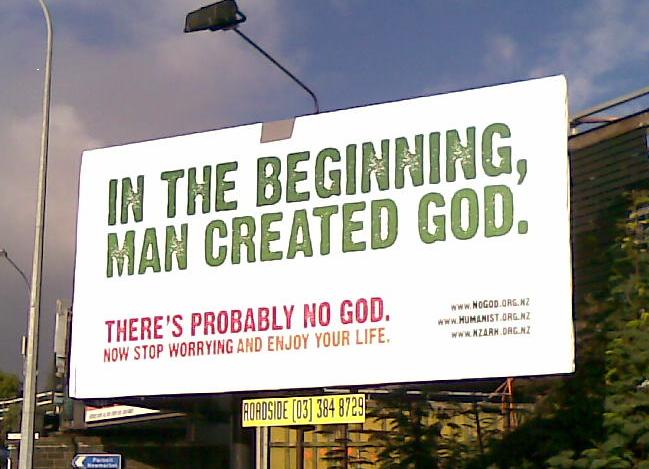
What is asserted here? That man created God. This, however, is clearly absurd. God is typically defined as an all-powerful, all-knowing, immaterial, necessarily-existent being who created the world. Now if one is going to claim that humans actually created an all-powerful, all-knowing, immaterial, necessarily-existent who created the world, then they are contradicting themselves.
Humans are part of the world and therefore cannot have created the being that created the world – otherwise humans would have to exist prior to their own existence.
Similarly, one cannot create a necessary being, this would entail it is possible for a necessary being to not exist, in which case it would not be a necessary being. Taken in a straight-forward, literal manner (the way freethinkers are so fond of taking every passage in the Bible) this billboard simply asserts contradictions.
Of course, the authors of this billboard probably do not mean to say humans actually created God, they do not think he exists after all. Their claim is that humans created the idea or concept of God and developed it. This is undoubtedly true. Of course, humans also invented the idea or concept of atoms as well, ancient Greek philosophers came up the basics of this concept millennium ago. This trivial fact tells us nothing about whether or not the idea or concept humans developed actually corresponds to anything in reality. To assume that it tells us something about whether the idea or concept is true or false is a fairly obvious case of the genetic fallacy.
So the second billboard either asserts a contradiction or it is a clear case of a logical fallacy.
The last one is my favourite.

I am inclined to think the argument on this sign is invalid. To see why let’s take out the term “God” in the sign and replace it with some other term such as “non-Christian perspective.” When we do this we get: “We all reject most non-Christian perspectives, some of us just reject one more.” This argument has true premises, do we now have, a knock-down argument for Christianity?
Similarly, an analogous argument form with true premises gives us an argument for nihilism, the total denial of the existence of morality. “We are all nihilists about some conceptions of morality, some of us are just nihilistic about one more.”
The same argument for also furnishes a refutation of secularism, “we all reject some secular perspectives on reality, some of us just reject one more.” I could go on.
Taking a stand on any issue of philosophical substance, whether by affirming, denying or simply being sceptical of it, is to put oneself in opposition to any number of other people and groups who take a contrary stance. That is life. Such pluralism hardly provides a reason for thinking “there probably is no God” any more than it gives us a reason to doubt any other perspective on the world.
So what do the atheist billboards do? Well the first one tells us that some atheist groups conflate basic philosophical distinctions and don’t really understand the debate they are contributing to. The second shows us that these groups think contradictions and obvious fallacies are some how savvy and smart. The last shows us that they think that invalid argument forms, forms from which you could infer the denial of anything and everything by substituting one true premise with another, are avant-garde.
All in all, pretty accurate advertising for these groups.
Hat tip: MCAS
]]>One good way to end a conversation – or start an argument – is to tell a group of well educated professionals that you hold a political position (preferably a controversial one such as being against abortion or pornography) because it is required by your understanding of God’s will. In the unlikely event that anyone hangs around to talk with you about it, chances are that you will be challenged on the ground that you are intent on imposing your religious beliefs on other people. And in contemporary political and legal culture, nothing is worse.
Carter puts his finger on an important perspective which is pervasive in contemporary liberal societies. This is the view that citizens of liberal democracies may justly support the implementation of a law only if they reasonably believe themselves to have a plausible secular justification for that law. Further, they must be willing to appeal to secular justifications alone in political discussion. The upshot of this perspective is that it is perceived to be unjust to support or advocate for laws for theological or religious reasons.
I will refer to this position as secularism, the commitment to the position that the public square should be secular. The secularisation of political culture is, of course, an implication of accepting this position. Richard Rorty described it as,
The happy, Jeffersonian compromise that the Enlightenment reached with the religious. This compromise consists in privatizing religion — keeping it out of … “the public square,” making it seem bad taste to bring religion into discussions of public policy.
My experience as a New Zealand citizen is that secularism is widely held and taken for granted in our culture by media, politicians and popular culture. I also think, perhaps predictably, that secularism of this sort is questionable.
Let me begin by pointing out that several writers have observed that prima facie there is something unfair or discriminatory about secularism. Contemporary critics of secularism, Christopher Eberle and Terence Cuneo, note that it entails “There is an important asymmetry between religious and secular reasons in the following respect: some secular reasons can themselves justify state coercion but no religious reason can.”
Another critic, Philip Quinn, observes that secularists impose “burdens on religious people” that they nowhere suggest “imposing on nonreligious people.” Secularists do “not propose that nonreligious people must be sufficiently motivated by adequate religious reason for their advocacy or support of restrictive laws or policies. The lack of symmetry is striking.”
This raises an obvious question, why the asymmetry? On the face of it secularism appears to privilege secular ideologies and doctrines in public debate whilst relegating religious or theological perspectives to the private sphere. What is the basis for this? Two reasons are typically offered and neither is terribly compelling.
The first is that it is dangerous to allow theological or religious concerns into public debate. Defenders of secularism raise the specter of the wars of religion that tore Europe apart during the 17th century or they mention episodes such as the Inquisition and Crusades, which are said to be consequences of allowing religious reasons to influence public and political life. It is argued that the only way to keep social peace and prevent the kind of violence that Europe witnessed is to ensure religious reasons do not influence public life and that all political discussions take place on secular terms.
This argument assumes that appeal to religious reasons is the cause of religious wars and appeals to secular reasons protect us against such wars. Writing in the Stanford Encyclopedia of Philosophy, Eberle and Cuneo note that the religious wars of the 17th century were caused not by the appeal to religious reasons per se but rather by the violation of religious freedom. Moreover, they note that even in the 17th century, religious persecution was typically justified on secular grounds. They go on to observe that religious freedom is not necessarily safeguarded by secularising public debate. They note that many “secularists have a long history of hostility to the right to religious freedom and, presumably, that hostility isn’t at all grounded in religious considerations” In addition, they note correctly that some of the most important defences of religious persecution and defences of religious tolerance, such as those proposed by John Locke and Pierre Bayle, appealed to explicitly theological grounds.
Yale philosopher Nicholas Wolterstorff makes a similar point, he notes that much of “the slaughter, torture, and generalised brutality of our century has mainly been conducted in the name of one or another secular cause–nationalism of many sorts, communism, fascism, patriotisms of various kinds, economic hegemony.” He also stated that “many of the social movements in the modern world that have moved societies in the direction of liberal democracy have been deeply and explicitly religious in their orientation.” Wolterstorff cites examples such as the abolitionist, civil rights and various other resistance movements as examples.
The assumption that secular reasoning is always tolerant and religious reasoning is always intolerant does not survive scrutiny. Particular types of religious reasons in particular political contexts can lead to wars and abuse, whereas appealing to other types of religious reasons in other contexts can be beneficent. The same is equally true of secular reasons. Certain types of secular reasons can be dangerous in particular contexts and other types of secular reasons are not. To single religious reasons out as being ‘too dangerous to be aired in public’ and insisting on a default to secular reasons seems ad hoc and unjustified.
The fear of religious wars is not the only argument typically offered for the secular public square. The main reason offered for secularism is that religious reasons are not accessible to all people. Auckland Law Professor Paul Rishworth observes, “some have contended that the nature of religious belief is such that, while it may be integral to individual autonomy and development, it has no proper role in public policy debates and that these ought to be conducted exclusively in secular terms that are equally accessible to all.” [Emphasis added]
Something like this is also evident in defences of secularism. Leading secular Philosopher Michael Tooley states, “For it is surely true that it is inappropriate, at least in a pluralistic society, to appeal to specific theological beliefs of a non moral sort… in support of legislation that will be binding upon everyone.” Robert Audi, one of the leading defenders of secularism, states “as advocates for laws and public policies, then, and especially for those that are coercive, virtuous citizens will seek grounds of a kind that any rational adult citizen can endorse as sufficient for the purpose.” [Emphasis added] In essence, because not everyone in society accepts the existence of God or some theological perspective on life then it is unjust to base laws governing their conduct on theological or religious grounds.
This argument is deeply flawed. If taken consistently it would require not just the exclusion of religious reasons but the exclusion of any reasons that were controversial and not accepted by all people. The problem is that many secular justifications and ideologies are also controversial in the same way. Quinn makes the point,
If the fact that religious reasons cannot be shared by all in a religiously pluralistic society suffices to warrant any exclusion of religious reasons for advocating or supporting restrictive laws or policies, then much else ought in fairness also to be excluded on the same grounds.
He goes on to note,
Indeed, it would seem that the appeal to any comprehensive ethical theory, including all known secular ethical theories, should be disallowed on the grounds that every such theory can be reasonably rejected by some citizens of a pluralistic democracy. And if justification of restrictive laws or policies can be conducted only in terms of moral considerations no citizen of a pluralistic democracy can reasonably reject, then in a pluralistic democracy such as ours very few restrictive laws or policies can be morally justified, a conclusion that would, I suspect, be welcomed only by anarchists. [Emphasis added]
I agree with Quinn. There is special pleading going on whereby theological beliefs are rejected on certain grounds, while secular ones are not, even though the same grounds and reasons, consistently applied, should lead to the rejection of secular beliefs.
On examining secularism and the main arguments for it, it certainly is not evident that a just or fair society will have a secularised public square. To insist this is the case prima facie seems to favour secular views of the world for no adequate reason. Contrary to what some maintain, secular reasons, like religious reasons, can be used to justify atrocities and human rights abuses. Further, like religious reasons, secular reasons are frequently controversial and not shared by all intelligent people. Of course, secularists might consider religious views of the world to be false but then, of course, religious people consider secular views of the world to be false and given the diversity of secular moral theories on offer they cannot all be true (some are at odds with each other) so why single out religious views? The question remains as to why morality requires that public discussions privilege secular perspectives by requiring that all such discussions are engaged in on secular terms. I suspect we will be waiting a long time for an answer.
[In this article I acknowledge being influenced by my wife Madeleine Flannagan’s supervised research paper “Religious Restraint and Public Policy” which she wrote under the supervision of Professor Rishworth, the Dean of the University of Auckland’s School of Law.]
I write a monthly column for Investigate Magazine entitled Contra Mundum. This blog post was published in the June 10 issue and is reproduced here with permission. Contra Mundum is Latin for ‘against the world;’ the phrase is usually attributed to Athanasius who was exiled for defending Christian orthodoxy.
Letters to the editor should be sent to: ed*******@************************TE.com
RELATED POSTS:
Contra Mundum: Richard Dawkins and Open Mindedness
Contra Mundum: Slavery and the Old Testament
Contra Mundum: Secular Smoke Screens and Plato’s Euthyphro
Contra Mundum: What’s Wrong with Imposing your Beliefs onto Others?
Contra Mundum: God, Proof and Faith
Contra Mundum: “Bigoted Fundamentalist” as Orwellian Double-Speak
Contra Mundum: The Flat-Earth Myth
Contra Mundum: Confessions of an Anti-Choice Fanatic
Contra Mundum: The Judgmental Jesus
(b) Thinness
A closely related problem is that if it is applied consistently the argument from respect excludes too much. If justification is limited to principles that no reasonable person can reasonably be expected to reject then little will be able to be justified. Glenn Peoples notes the problem;[31]
Given this view of justification, you can only endorse a policy if it is such that it can be endorsed in light of the actual beliefs and goals held by the KKK, the Catholic Church and the humanist rationalist society.
Wolterstorff observes that “in our actual societies, anyone who embraced this position would simply refrain from advocating any position whatsoever on any issue of importance to society.”[32] Quinn agrees, “as Wolterstorff notes, he knows of no law or policy that has come up for discussion in the United Sates in recent years that has had the support of a consensus of all the rational adult citizens.”[33]
Gerald Gaus, who is otherwise sympathetic to the DRR, also agrees; he notes that, given Rawls’s requirement for consensus, public reason “loses its character as a liberal doctrine, for little, if anything, is the object of consensus among reasonable people.”[34] Kent Greenawalt argues that public reason is incapable of grounding policy on most contentious political issues.[35] Peter de Marneffe concurs.[36]
Wolterstorff contends that public reason must be supplemented by ideas drawn from comprehensive doctrines or it will not be able to function as an adequate base for justifying many substantive policies. To make his point, Wolterstorff cites the welfare debate. Advocates for the varying perspectives appeal to ‘freedom’ and ‘equality’ but mean different things by these terms; they prioritise the relevant rights differently, they disagree as to how such rights should be weighed against social utility. It is unlikely that public reason, common sense and uncontroversial science can justify welfare legislation to a standard that all can reasonably accept. [37]
Wolterstorff makes similar points over the fundamental premise in the abortion debate; equal protection has radically different meanings depending on how one interprets public reason’s answer to the question, ‘is the fetus a person or not?’[38] Eberle,[39] Quinn[40] and Jean Hampton[41] agree that public reason cannot settle the question as to whether a fetus is a person yet Rawls argues that public reason can settle the abortion debate (case in point: reasonable people disagree over the answers public reason can give). [42]
Rawls’ version of the argument from respect is not the only one that faces these problems; similar issues arise with other conceptions of the DRR. Any attempt to ground the DRR in the notion that coercive legislation cannot be justified unless the reasons advanced can be grounded in the reasonably-held principles and beliefs shared by all people will face the same problem. This is evident when one examines other versions of the DRR which do not employ Rawls’ idea of public reason.
Rawls employs public reason to place a restraint on all comprehensive viewpoints, whether religious or secular. Robert Audi’s position is less restrictive. Audi applies the restraint primarily to religious reasons. He proposes a principle of “secular rationale”, a principle of “secular motivation” and something he calls “theo-ethical equilibrium.”[43]
His secular rationale principle claims that “one should not advocate or support any law or public policy that restricts human conduct unless one has, and is willing to offer, adequate secular reason for this advocacy or support.”[44] His principle of secular motivation goes further; “one should not advocate or promote any legal or public policy restrictions on human conduct unless one not only has and is willing to offer, but is also motivated by, adequate secular reason, where this reason (or set of reasons) is motivationally sufficient for the conduct in question.”[45] Theo-ethical equilibrium is “a rational integration between religious deliverances and insights and, on the other hand, secular ethical considerations … a mature, conscientious theist who cannot reach it [theo-ethical equilibrium] should be reluctant or unwilling to support coercive laws or public policies on a religious basis that cannot be placed in that equilibrium.”[46]
Audi argues that “an adequate reason for a law or policy is a proposition whose truth is sufficient to justify it.”[47] He places the restraint on religious reasons;[48]
A secular reason is, roughly, one whose normative force, that is, its status as a prima facie justificatory element, does not (evidentially) depend on the existence of God (for example, through appeals to divine command) or on theological considerations (such as interpretations of a sacred text), or on the pronouncements of a person or institution qua religious authority.
Given that comprehensive secular perspectives are not excluded by this version of the DRR, it appears that Audi’s conception can escape the problem of thinness that Rawls’ public reason faces. Comprehensive secular viewpoints should provide people with a thicker perspective, broad enough to justify many substantive policies.
However, an examination of the reasons Audi advances in favour of his version of the DRR will reveal this contention to be mistaken. By broadening public reason to adequate secular reason Audi’s position is thicker than Rawls’ but its asymmetrical treatment of religious and secular views puts it back in the path of the charges of incoherence and thinness. I will elaborate.
Like Rawls, Audi offers a version of the argument from respect. He states “as advocates for laws and public policies, then, and especially for those that are coercive, virtuous citizens will seek grounds of a kind that any rational adult citizen can endorse as sufficient for the purpose”[49] [Emphasis added] In another article, he argues that[50]
adherence to the principle of secular rationale helps to ensure that, in determining the scope of freedom in a society, the decisive principles and considerations can be shared by people of differing religious views, or even no religious convictions at all.
Audi assumes that secular views are accepted by all whereas not everyone accepts the truth of religious premises. This is a big assumption. In fact some secular views are not accepted by all; religious people can and do reasonably reject secular views. This renders Audi’s position incoherent as adherence to Audi’s position, by Audi’s position, requires us to reject it. Quinn explains, [51]
If the fact that religious reasons cannot be shared by all in a religiously pluralistic society suffices to warrant any exclusion of religious reasons for advocating or supporting restrictive laws or policies, then much else ought in fairness also to be excluded on the same grounds. For example, justification of a restrictive law or policy by an appeal to its maximization of utility should be excluded because many citizens reasonably reject utilitarianism. Indeed, it would seem that the appeal to any comprehensive ethical theory, including all known secular ethical theories, should be disallowed on the grounds that every such theory can be reasonably rejected by some citizens of a pluralistic democracy. And if justification of restrictive laws or policies can be conducted only in terms of moral considerations no citizen of a pluralistic democracy can reasonably reject, then in a pluralistic democracy such as ours very few restrictive laws or policies can be morally justified, a conclusion that would, I suspect, be welcomed only by anarchists.
In addition, Audi’s position imposes a burden on religion that is not imposed on secularism despite secularism possessing the same features used to exclude religion. In the absence of some other factor, specific to religion and not applicable to secularism, the asymmetry is arbitrary. To escape this problem Audi would have to reject not only religious reasons but all reasons that are not “shared by people of differing religious views, or even no religious convictions at all.” However, if he takes this line, his position is rendered too thin and fares no better than Rawls.’
(c) Audi’s defence
In a defence of his position against this line of critique, Robert Audi questions if the DRR is as thin as critics maintain, [52]
I would think that if we stick to principles of justice, which form only a small part of a comprehensive view, and if we do not take agreement to imply unanimity as opposed to consensus, there is a better chance of agreement than on the whole of such a larger view. Perhaps the chance is still not good, … But is there not a strong consensus, at least among citizens of democratic societies, that justice requires not only equal protection of the laws but also laws that protect liberty, including political and religious liberty and freedom of speech, up to a certain level? There are of course disagreements on matters of detail…
While it is true that most people hold to some conception of justice and equality, and affirm the right to exercise certain liberties, the details of their understanding of these norms are not as minor as Audi suggests. As I alluded to earlier, people can mean quite different things by these terms and can prioritise and weigh their importance quite differently. Closer examination of these “matters of detail” reveals substantive lack of consensus.
Equal protection requires agreement over the question as to whom it applies. In Nazi Germany everyone was owed equal protection by the state; however, certain classes of people were deemed sub-human. Likewise with justifications offered for the new-world slavery as practised in the British Empire and antebellum United States, slaves did not qualify; similarly, with the abortion debate over the status of the fetus. Then there is the extent and nature of the protection to consider. Should the state regulate how many times a week one engages in exercise and eats fruit and vegetables on the grounds of protecting the health of its people or should it simply protect people from aggressors? Is Audi suggesting that simply agreeing that such protection should apply equally to all is sufficient to make his case and what form that should take is mere detail? Unless supplemented by definitions as to its recipients, nature and scope the term “equal protection before the law” is a vague statement lacking substantive content.
The liberties Audi lists are also fraught with difficulty in interpretation as reasonable people do not agree on them. Are they negative or does the state have a duty to provide or subsidise them? The substantive content and meaning of the terms ‘freedom’ and ‘liberty’ is disputed depending on whether one is talking to a libertarian or a socialist. Then there are the problems specific to each liberty.
Consider freedom of religion. Steven Smith has argued that, strictly speaking, it is inaccurate to claim there is such a thing as a right to freedom religion. Instead there exists a spectrum of views about religious tolerance. Diverse writers, such as Aquinas, Cromwell, Locke and Mill each agreed that some religious dissent should be tolerated by the state but disagreed both on the limits and on which religions should be tolerated in society. Smith concluded that as no state tolerates all religious sects and very few tolerate none, the idea of a concept of freedom of religion supported by some and opposed by others is illusory. Which account of religious tolerance is correct depends on comprehensive views; adjudication between different understandings of religious tolerance is not possible without appealing to some comprehensive view. Settling these matters from something like public reason or adequate secular reason seems extremely difficult.[53]
Does freedom of speech entail prior restraint or does it stop at the initiation of force? What about content and the manner of expression? How should we define speech? Does it include a right to engage in hate, racist, blasphemous, defamatory or sexist speech? Is it acceptable to wear Nazi emblems or deny the holocaust?
Reasonable people disagree over more than just the details; they disagree over the terms, the nature, the extent and hold to a different range of finite cases. People use and understand the relevant terms in very different ways. Audi misconstrues the situation when he argues there is unanimity in society on fundamental principles of justice. The thinness objection stands.[54]
In my next post, Religious Restraint and Public Policy: Part IV, I will look at Gerald Gaus’ attempt to salvage the argument from epistemic inaccessibility and will offer some critical analysis of this.
[31] Glenn Peoples Religion in the Public Square: Liberal Political Philosophy and the Place of Religious Convictions
[32] Nicholas Wolterstorff “The Role of Religion in Decision and Discussion of Political Issues” in Nicholas Wolterstorff & Robert Audi (eds) Religion in the Public Square: The Place of Religious Convictions in Political Debate (Rowman and Littlefield Publishers Inc, Lanham Md, 1997) 67-120, 154.
[33] Philip Quinn “Religion in the Public Square: The Place of Religious Convictions in Political Debate” (2000) 60:2 Philosophy and Phenomenological Research 486, 487 (book review), 488.
[34] Gerald Gaus Justificatory Liberalism: An Essay on Epistemology and Political Theory (Oxford University Press, New York, 1996) 293.
[35] Kent Greenawalt Private Consciences and Public Reasons (Oxford University Press, New York, 1995) 141-150.
[36] Peter de Marneffe “Rawls’s Idea of Public Reason” (1994) 75 Pacific Philosophical Quarterly232.
[37] Wolterstorff, above n 32, 103-104.
[38] Ibid 104.
[39] Christopher Eberle Religious Convictions in Liberal Politics (Cambridge University Press, Cambridge, 2002) 217-222.
[40] Phillip Quinn “Political Liberalisms and Their Exclusions of the Religious” (1995) 69:2 Proceedings and Addresses of the American Philosophical Association 35, 37-46.
[41] Jean Hampton “The Common Faith of Liberalism” (1994) 75 Pacific Philosophical Quarterly 208.
[42] John Rawls Political Liberalism (Columbia University Press, New York, 1993) 243-244.
[43] Robert Audi “Liberal Democracy and the Place of Religion in Politics” in Nicholas Wolterstorff & Robert Audi (eds) Religion in the Public Square: The Place of Religious Convictions in Political Debate (Rowman and Littlefield Publishers Inc, Lanham Md, 1997) 1-66, 25-37.
[44] Robert Audi “The Separation of Church and State and the Obligations of Citizenship” (1989) 18 Philosophy and Public Affairs 259, 279.
[45] Ibid 284.
[46] Audi, above n 43, 21.
[47] Audi, above n 44, 284.
[48] Ibid 278.
[49] Audi, above n 43, 17.
[50] Audi, above n 44, 290.
[51] Quinn, above n 40, 39-40.
[52] Audi, above n 43, 131-132.
[53] Steven Smith Foreordained Failure: The Quest for a Constitutional Principle of Religious Freedom (Oxford University Press, New York, 1995). (PhD Thesis, University of Otago, 2007) 118.
[54] Paul Rishworth suggests these examples do not show there is no secular consensus but rather that there is a secular consensus at a high level of abstraction. Supervisor’s feedback from Paul Rishworth to Madeleine Flannagan dated 30 October 2009. This may be the case, however, the thinness objection does not maintain that there is no secular consensus; it maintains that there is no secular consensus thick enough to provide an answer to many substantive public policy questions. For Rishworth’s objection to stand, this higher level of abstraction would have to furnish principles thick enough to answer such questions and the examples above show that it cannot.
RELATED POSTS:
Religious Restraint and Public Policy: Part I
Religious Restraint and Public Policy: Part II
Religious Restraint and Public Policy: Part IV
Religious Restraint and Public Policy: Part V
Religious Restraint and Public Policy: Part VI