Blog

  • Guest Sunday Study: Moral Perspectives on Lying

    Bethyada explores the morality of lying. (This guest post is part of open mic week(s))

    There are a range of Christian theories on the moral acceptability of lying.

    The issues around lying seem difficult to fully categorise in English. The problem is a lack of simple words to express subtle differences in meaning. To illustrate this note that the concept of lying can be considered analogous to killing. With killing we have sub-terms such as murder, manslaughter, and capital punishment. We also recognise killing in a variety of situations such as warfare and self-defence. The debate about the morality of types of killing is more transparent because we agree on meaning, even if we disagree or the moral acceptability of them.

    Whereas “lying” merely means distorting the truth irrespective of the circumstances. There are terms such as deception, falsification, untruthfulness, but these are basically synonymous. There are situational terms though, such as perjury.

    So is falsehood a single conceptual category? I have long thought it meaningful that the 9th commandment is not, “You shall not lie,” but rather, “You shall not bear false witness against your neighbour.” I have previously distinguished between reality and what one perceives as reality stating that affirming a false belief is not lying. I have also made the distinction between voluntary and forced disclosure of information which I wish to expand on here.

    The moral debate is that either:

    • lying (or specific types or lying) is objectively wrong, that is, various forms of absolutism; or
    • lying is not intrinsically wrong (for all people), (though it may be preferable to avoid in certain situations for other reasons), that is, forms of subjectivism.

    Christianity claims that morality has its source in the moral law giver, thus it views the morality of truth telling as objective: the same rules for all people at all times. Here are particular forms of such absolutism.

    1. Unqualified Absolutism

    Lying is always wrong. People should never lie ever. No matter what the situation or consequences.

    Doug Beaumont explains such unqualified absolutism.

    Unqualified Absolutism is based on the idea that most moral actions are intrinsically right or wrong, and because sin is always avoidable there can be no actual moral conflict. Given a choice between telling the truth or lying to avoid a murder, for example, one must choose telling the truth for in that instance it is not the one speaking, but the murderer who is sinning. In that case it is better to permit sin than to commit it. This view states that moral “oughts” are viable regardless of their consequences, for any moral philosophy that has exceptions results in relativism. Moral law is based on God’s unchanging nature, therefore moral law itself is unchanging. Logically, if an act is intrinsically evil, it cannot become good because of a changing situation. Finally, God can always provide a third alternative to sinful actions.

    This is how many people view lying. It is a somewhat reasonable but it lacks depth. Exceptions to rules don’t intrinsically mean relativism. True, exceptions can be special pleading or hypocrisy, but they may be legitimate (eg. age based rules). And as I note below, unqualified absolutism may conflate intrinsically different actions.

    2. Conflicting Absolutism

    Lying is wrong, but it needs to be considered within the situation. If lying conflicts with another moral commandment then one must do obey the higher moral. But lying, while required, is still sinful.

    Such a position acknowledges that we have moral conflict (at least in this age). I think this is an improvement as it notes that as bad as lying may be, it may not be the greatest evil (though lying is a bigger evil than many acknowledge). This position encourages people to do good and love their neighbour.

    It fails in that it suggests at times all options a man may have involve sin. However if we wish to do right, Scripture suggests we are able to do so (thru God). Further, how much less are we to blame when others have placed us in a dilemma, rather than our own prior choices.

    3. Graded Absolutism

    Lying is wrong unless it conflicts with a higher moral commandment. Obeying the higher moral by lying is not wrong or sinful.

    This resolves the dilemma or not being able to make a right choice. It affirms moral conflict, but it claims that the choice to do the better is good. And not sinful if a greater good is being done. There may be some support from Jesus’ words to the Pharisees. It discussing tithing garden herbs Jesus states

    “But woe to you Pharisees! For you tithe mint and rue and every herb, and neglect justice and the love of God. These you ought to have done, without neglecting the others.”

    While one could claim that tithing herbs and doing justice are morally equal—Jesus does say not to neglect the former—the context would suggest that doing justice is a higher moral command. Apologists for unqualified absolutism could argue Jesus commands they do both, but there is no conflict between moral obligations set up here, so unqualified absolutism cannot be proven from the passage. I am merely illustrating that moral commands are graded.

    It is important to note that this is not arguing that the end justifies the means. Yes, the end is considered, but for the sake of doing good, not for preferred result. Doing good may have unpleasant consequences.

    4. Libertarian Absolutism

    Lying is wrong if one is voluntarily giving information. One need not tell the truth if one is being compelled to divulge information. I am responsible for my actions, not yours.

    This has the advantage over graded absolutism in that it recognises that voluntary information and compelled information are categorically different. It is somewhat analogous to saying that predatory killing is sinful but self-defensive killing is not.

    Interestingly Jesus’ words may shed some light on our understanding here.

    After this Jesus went about in Galilee. He would not go about in Judea, because the Jews were seeking to kill him. Now the Jews’ Feast of Booths was at hand. So his brothers said to him, “Leave here and go to Judea, that your disciples also may see the works you are doing. For no one works in secret if he seeks to be known openly. If you do these things, show yourself to the world.” For not even his brothers believed in him. Jesus said to them, “My time has not yet come, but your time is always here. The world cannot hate you, but it hates me because I testify about it that its works are evil. You go up to the feast. I am not going up to this feast, for my time has not yet fully come.” After saying this, he remained in Galilee.

    But after his brothers had gone up to the feast, then he also went up, not publicly but in private. The Jews were looking for him at the feast, and saying, “Where is he?” And there was much muttering about him among the people. While some said, “He is a good man,” others said, “No, he is leading the people astray.” Yet for fear of the Jews no one spoke openly of him.

    About the middle of the feast Jesus went up into the temple and began teaching. (John 7, emphasis added)

    Jesus said he wasn’t going but then he did. This implies that Jesus’ answer was not true. In fact some manuscripts say, “I am not yet going up to this feast.” Which would seem to make Jesus’ answer more honest. Looking at the passage it is clear Jesus wished to go without others initially knowing he was there. He is asked if he is going, however Jesus does not wish to tell this person. Being evasive may be construed as a yes. Jesus says that he is not going to this feast. Within the libertarian absolutism view a request is made of Jesus to divulge information he does not wish to give and he is at liberty to answer in a way that does not divulge same information.

    This position is distinct from graded absolutism in that one is not weighing up morality in conflict. The distinction is in will for informing.

    Although one could think nothing one hears in conversation is reliable, the solution is listen to what people wish to tell you.

    5. Authoritative Absolutism

    Non aggressive version

    • Lying is wrong in non-aggressive situations. Self-defence against an aggressor allows for lying. Authorities are owed the truth.

    Libertarian version

    • One need not tell the truth if one is being compelled to divulge information unless being compelled by a legitimate authority.

    Authoritative absolutism states the voluntary information must be true as per libertarian absolutism, or that all information must be true unless facing an aggressor. It states that, in general, compelled information does not need to be true though there can be variation on what is meant by compulsion.

    But this position does allow an appropriate authority to force information (whereas strict libertarian absolutism would not). A person following libertarian absolutism would allow one to lie in court if he did not wish to divulge the truth. Non-aggressive absolutism would mean that it is eumoral (morally good) to tell the truth in legitimate courts and immoral to withhold it. Note the caveat: obeying a lesser authority is not required if that means disobeying a higher one. Obeying a policeman, a ruler, or a court is necessary even unjust ones, or in unpleasant circumstances; unless doing so compromises a higher earthly ruler or God.

    Conclusion

    People may argue for the legitimacy of any of these options within Christian theology. Unless one recognises that the concept of lying may include more than one category, graded absolutism is as far as one can advance and this seems to be the best approach. However the knowledge of a permissible sub-categorisation based on the distinction between voluntary and involuntary knowledge sharing allows for more nuanced views.
    Moral perspectives on lying


    There are a range of Christian theories on the moral acceptability of lying.

    The issues around lying seem difficult to fully categorise in English. The problem is a lack of simple words to express subtle differences in meaning. To illustrate this note that the concept of lying can be considered analogous to killing. With killing we have sub-terms such as murder, manslaughter, and capital punishment. We also recognise killing in a variety of situations such as warfare and self-defence. The debate about the morality of types of killing is more transparent because we agree on meaning, even if we disagree or the moral acceptability of them.

    Whereas “lying” merely means distorting the truth irrespective of the circumstances. There are terms such as deception, falsification, untruthfulness, but these are basically synonymous. There are situational terms though, such as perjury.

    So is falsehood a single conceptual category? I have long thought it meaningful that the 9th commandment is not, “You shall not lie,” but rather, “You shall not bear false witness against your neighbour.” I have previously distinguished between reality and what one perceives as reality stating that affirming a false belief is not lying. I have also made the distinction between voluntary and forced disclosure of information which I wish to expand on here.

    The moral debate is that either:

    • lying (or specific types or lying) is objectively wrong, that is, various forms of absolutism; or
    • lying is not intrinsically wrong (for all people), (though it may be preferable to avoid in certain situations for other reasons), that is, forms of subjectivism.

    Christianity claims that morality has its source in the moral law giver, thus it views the morality of truth telling as objective: the same rules for all people at all times. Here are particular forms of such absolutism.

    1. Unqualified Absolutism

    Lying is always wrong. People should never lie ever. No matter what the situation or consequences.

    Doug Beaumont explains such unqualified absolutism.

    Unqualified Absolutism is based on the idea that most moral actions are intrinsically right or wrong, and because sin is always avoidable there can be no actual moral conflict. Given a choice between telling the truth or lying to avoid a murder, for example, one must choose telling the truth for in that instance it is not the one speaking, but the murderer who is sinning. In that case it is better to permit sin than to commit it. This view states that moral “oughts” are viable regardless of their consequences, for any moral philosophy that has exceptions results in relativism. Moral law is based on God’s unchanging nature, therefore moral law itself is unchanging. Logically, if an act is intrinsically evil, it cannot become good because of a changing situation. Finally, God can always provide a third alternative to sinful actions.

    This is how many people view lying. It is a somewhat reasonable but it lacks depth. Exceptions to rules don’t intrinsically mean relativism. True, exceptions can be special pleading or hypocrisy, but they may be legitimate (eg. age based rules). And as I note below, unqualified absolutism may conflate intrinsically different actions.

    2. Conflicting absolutism

    Lying is wrong, but it needs to be considered within the situation. If lying conflicts with another moral commandment then one must do obey the higher moral. But lying, while required, is still sinful.

    Such a position acknowledges that we have moral conflict (at least in this age). I think this is an improvement as it notes that as bad as lying may be, it may not be the greatest evil (though lying is a bigger evil than many acknowledge). This position encourages people to do good and love their neighbour.

    It fails in that it suggests at times all options a man may have involve sin. However if we wish to do right, Scripture suggests we are able to do so (thru God). Further, how much less are we to blame when others have placed us in a dilemma, rather than our own prior choices.

    3. Graded absolutism

    Lying is wrong unless it conflicts with a higher moral commandment. Obeying the higher moral by lying is not wrong or sinful.

    This resolves the dilemma or not being able to make a right choice. It affirms moral conflict, but it claims that the choice to do the better is good. And not sinful if a greater good is being done. There may be some support from Jesus’ words to the Pharisees. It discussing tithing garden herbs Jesus states

    “But woe to you Pharisees! For you tithe mint and rue and every herb, and neglect justice and the love of God. These you ought to have done, without neglecting the others.”

    While one could claim that tithing herbs and doing justice are morally equal—Jesus does say not to neglect the former—the context would suggest that doing justice is a higher moral command. Apologists for unqualified absolutism could argue Jesus commands they do both, but there is no conflict between moral obligations set up here, so unqualified absolutism cannot be proven from the passage. I am merely illustrating that moral commands are graded.

    It is important to note that this is not arguing that the end justifies the means. Yes, the end is considered, but for the sake of doing good, not for preferred result. Doing good may have unpleasant consequences.

    4. Libertarian absolutism

    Lying is wrong if one is voluntarily giving information. One need not tell the truth if one is being compelled to divulge information. I am responsible for my actions, not yours.

    This has the advantage over graded absolutism in that it recognises that voluntary information and compelled information are categorically different. It is somewhat analogous to saying that predatory killing is sinful but self-defensive killing is not.

    Interestingly Jesus’ words may shed some light on our understanding here.

    After this Jesus went about in Galilee. He would not go about in Judea, because the Jews were seeking to kill him. Now the Jews’ Feast of Booths was at hand. So his brothers said to him, “Leave here and go to Judea, that your disciples also may see the works you are doing. For no one works in secret if he seeks to be known openly. If you do these things, show yourself to the world.” For not even his brothers believed in him. Jesus said to them, “My time has not yet come, but your time is always here. The world cannot hate you, but it hates me because I testify about it that its works are evil. You go up to the feast. I am not going up to this feast, for my time has not yet fully come.” After saying this, he remained in Galilee.

    But after his brothers had gone up to the feast, then he also went up, not publicly but in private. The Jews were looking for him at the feast, and saying, “Where is he?” And there was much muttering about him among the people. While some said, “He is a good man,” others said, “No, he is leading the people astray.” Yet for fear of the Jews no one spoke openly of him.

    About the middle of the feast Jesus went up into the temple and began teaching. (John 7, emphasis added)

    Jesus said he wasn’t going but then he did. This implies that Jesus’ answer was not true. In fact some manuscripts say, “I am not yet going up to this feast.” Which would seem to make Jesus’ answer more honest. Looking at the passage it is clear Jesus wished to go without others initially knowing he was there. He is asked if he is going, however Jesus does not wish to tell this person. Being evasive may be construed as a yes. Jesus says that he is not going to this feast. Within the libertarian absolutism view a request is made of Jesus to divulge information he does not wish to give and he is at liberty to answer in a way that does not divulge same information.

    This position is distinct from graded absolutism in that one is not weighing up morality in conflict. The distinction is in will for informing.

    Although one could think nothing one hears in conversation is reliable, the solution is listen to what people wish to tell you.

    5. Authoritative absolutism

    Non aggressive version

    • Lying is wrong in non-aggressive situations. Self-defence against an aggressor allows for lying. Authorities are owed the truth.

    Libertarian version

    • One need not tell the truth if one is being compelled to divulge information unless being compelled by a legitimate authority.

    Authoritative absolutism states the voluntary information must be true as per libertarian absolutism, or that all information must be true unless facing an aggressor. It states that, in general, compelled information does not need to be true though there can be variation on what is meant by compulsion.

    But this position does allow an appropriate authority to force information (whereas strict libertarian absolutism would not). A person following libertarian absolutism would allow one to lie in court if he did not wish to divulge the truth. Non-aggressive absolutism would mean that it is eumoral (morally good) to tell the truth in legitimate courts and immoral to withhold it. Note the caveat: obeying a lesser authority is not required if that means disobeying a higher one. Obeying a policeman, a ruler, or a court is necessary even unjust ones, or in unpleasant circumstances; unless doing so compromises a higher earthly ruler or God.

    Conclusion

    People may argue for the legitimacy of any of these options within Christian theology. Unless one recognises that the concept of lying may include more than one category, graded absolutism is as far as one can advance and this seems to be the best approach. However the knowledge of a permissible sub-categorisation based on the distinction between voluntary and involuntary knowledge sharing allows for more nuanced views.
  • Guest Post: The Rise and Fall of the New Zealand Christian Blogosphere

    ScrubOne has gone back through the  New Zealand blog rankings over the past year and documented the rise and fall of the Christan blogs to see if the launch of the MandM Top 10 NZ Christian Blog rankings has had observable impact. (This guest post is part of open mic week(s))

    A lot of people have noticed that the top 10 Christian blogs here on MandM are ranking higher in the general rankings over time. It’s been suggested that the rankings themselves might be responsible themselves for this phenomenon, by making more people aware of the Christian blogs out there.

    So I thought I’d put that hypothesis to the test.

    I used Tumeke! Ranking data to trace blogs over the past year. I noted the rank of the blogs included in the MandM rankings, from the time they were first used in those rankings, not when they first appeared on Tumeke!.

    I used Tumeke! for several reasons.

    1. It’s more respected
    2. It’s been operating longer
    3. Halfdone rankings have tended to favour Christian blogs for some unknown reason. Thus the Tumeke! Rank becomes a “tougher” test of popularity
    4. Basically, I’m too lazy to do both!

    The first issue we have is that the data is problematic. New blogs come on the scene, old blogs fall off. So I tweaked the data a bit.

    1. Removed MacDoctor – he scored very highly before being placed on the “Christian” list. I think most people would agree that him being a Christian isn’t the primary reason why people read his blog. So he’s not really
    2. Removed Backchat Café and NZ Debate, both of whom started and ended within the survey period.

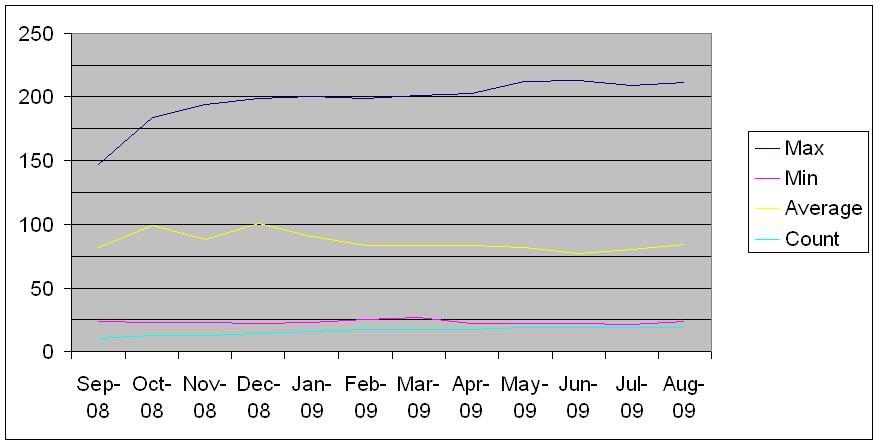
    Charting what’s left, we come up with this (I’ve divided the Max score by 10 to keep it in the scale).

    Total Christian Blogs

    So the number of Christian blogs has increased. Also, as the blog rankings have grown the lowest ranked blog has pushed out lower and lower – i.e. if 300 blogs are ranked, clearly the lowest ranked Christian blog is likely to be in the 200s. No surprises with either of those. The average looks interesting, but we need to dig further.

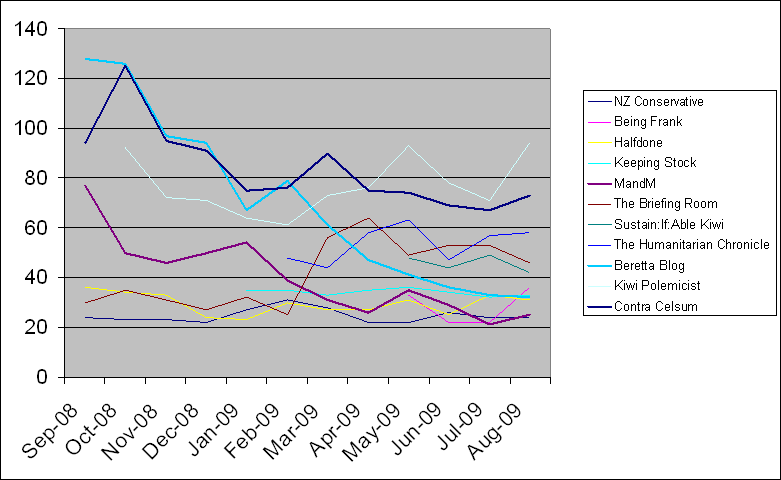
    Here’s the 11 blogs that averaged the highest score.

    Note the highest score in a Christian blog that didn’t make it onto this chart is 62. That was by Samuel Dennis back in November, so our method didn’t eliminate any good starters thus making the trend look better.

    Improvements Over the Year

    The most impressive improvements over the year have been MandM and the Beretta blog. Both have come from very uninspiring rankings to sweep into the top 40.

    Contra Celsum also made some good gains. I’ve highlighted these blogs to make their movement easier to see.

    Not all blogs gained during the year. Kiwi Polemicist slipped after almost making it to 60. The Briefing room dropped right off after February.

    But what has really gotten the attention of those watching the Christian rankings is the number of blogs that are now in the top 50/60. This can be clearly seen in this chart, with a mere 3 in the top 40 at the beginning. Now however, there are 8, 5 of those being in the top 40. That’s all in spite of TBR’s dropping off the pace.

    Some of us have suspected that this is due to improving scores. That’s partially true, with Beretta and MandM improving drastically, but mostly it’s been due to already good Christian blogs getting included in the stats, and other blogs such as MacDoctor and Keeping Stock identifying or being identified as Christian.

    Speaking of MacDoctor, in spite of his exclusion from the analysis, he is the only one who consistently makes it into the Tumeke! top 20.

    Something for us all to work on, eh?

  • Guest Post: Dan Brown’s History of Science

    This guest post was submitted by Dr James Hannam. Dr Hannam is a UK based historian with degrees in physics and history from the Universities of Oxford and London and a PhD in the history of science from the University of Cambridge. He blogs at Quodlibeta.

    The film adaptation of Dan Brown’s Angels and Demons was released this year and, on top of Brown’s new novel, appears to have done a roaring trade. Reports suggest that this is a better effort by director Ron Howard than his The Da Vinci Code, although most critics would feel that making a worse film would have been a stiffer test.

    For those lucky enough to be unfamiliar with the book, Angels and Demons is set in Rome where hunky Harvard symbologist Robert Langdon, played by Tom Hanks, is trying to prevent the Illuminati from detonating an anti-matter bomb.  According to Dan Brown’s alternative view of history, the Illuminati are a secret society of scientists (Copernicus and Galileo were, of course, members) who were persecuted by the Catholic Church.  After a great purge in the seventeenth century, we learn, the society went underground and plotted revenge. For some reason, it has taken them over three hundred years to get their act together.

    The Da Vinci Code launched the literary careers of a whole faculty previously-obscure professors of New Testament Studies. Admittedly, they had good reason for wanting to put the record straight about Brown’s distortions of early Christian history.  This time, it’s historians of science who might be upset by Brown’s misrepresentation. Because his contention that the Catholic Church has spent the last two millennia holding back the advance of science is as wrongheaded as the story that Mrs Jesus retired to the south of France with her kids.

    Of course, it’s not just Dan Brown who believes in the battle between science and religion. While few people think that the Illuminati really were a group of scientists suppressed by the Church, the perception of an eternal conflict between reason and faith is widespread. It’s true that the Church did make a single significant mistake in 1616, when it banned Copernicus’s opinion that the earth orbits the sun. But the subsequent trial of Galileo over the issue had more to do with papal self-esteem than astronomy. And even in this case, the Catholic Church was siding with the scientific consensus of the time. Still, you can’t manufacture an eternal conflict from a single example, so proponents of the hypothesis have had to resort to a different strategy – inventing the evidence.

    For example, in the book of Angels and Demons, Brown alleges that the Church had Copernicus murdered for his heliocentric model. While this is a more extreme allegation, there is a general belief that Copernicus feared persecution for his ideas. It’s widely thought that he refrained from publishing them until he was on his deathbed. In fact, he had circulated a pamphlet outlining his theory decades before he died. This was favourably received by senior churchmen and he was urged to publish by a cardinal. He even dedicated his great book, On the Revolutions of the Heavenly Spheres, to the Pope.

    Alas, as long as the likes of Dan Brown sell far more books than historians of science, this is a myth that is unlikely to go away.

    James Hannam’s book God’s Philosophers: How the Medieval World Laid the Foundations of Modern Science is published by Icon. The best price we could find for it from a New Zealand bookseller, with free delivery, was through The Nile Online Bookstore at the above link. International readers can buy it through Amazon. As I have previously stated elsewhere, it would make a good Christmas gift…

    RELATED POSTS:
    The “Dark Ages” and Other Propaganda
    More on the “Dark Ages” and Other Propaganda
    Things They Don’t Teach you in Public Schools…
    The Flat Earth Myth
    Contra Mundum: The Flat-Earth Myth

  • My Story: Lousy ACC Cover and Thoughts on the Proposed Changes

    Yesterday I applied for and got a one week extension on my research project as I couldn’t keep up with the necessary pace to finish it by Friday – I was getting too sore. This means that open mic week(s) needs to continue a little longer so please bear with us and do submit a guest post.

    Whilst we are trying to have blinkers on in terms of anything but study and essential day to day life, there have been some issues that have come up that we really want to blog on but lack the time. One in particular really has me going – the proposed changes to ACC.

    There is not point in repeating what most bloggers of my political persuasion have already opined, I’ll just throw down a few thoughts from my own perspective as an ACC client.

    My first point is that ACC is not welfare. It is an Accident Compensation Scheme. Accident compensation is about restoring a victim of an accident that was not their fault to as close as possible the state they were in pre-accident. Tort law is the area of law that, in the absence of state interference, covers injury caused by people’s negligence – what we call “accidents” here in New Zealand. Tort law says that you must take your victim as you find them; restoration, assessment of harm, is not to be based on the average person but on that person, the victim.

    My next point that I’d like you to keep in mind as you read this is that I think that ACC should be private and fault based. This is my ideal. My ideal is not reality as in New Zealand, accident compensation is state run. While it remains state funded, while the option to sue my injurer remains unavailable to me by statute, it must function as a just and fair accident compensation scheme, run in line with tort jurisprudence.

    “The assessor ACC sent around told me, get this, that my 8 and 9 year olds should be doing all the washing, vacuuming, dishes, etc! Unbelievable! I would, justifiably, have CYF on my doorstep if took that advice.”

    I have some criticisms of the proposed changes based on that fundamental premise ACC is built on, that it is supposed to be an accident compensation scheme. I reiterate, I support moves in the direction of privatisation e.g. rebates for those who take out private accident insurance. I agree that it should not be available to those who get hurt participating in crime. I think it should not be available to those who self-harm when they have refused treatment and are culpable for the self-harm (I think self-harm is not as cut and dried as people think). I also think, given how bankrupt ACC is, that it is only realistic that the money come from somewhere, increased levies are inevitable as is some threshold or excess level. However, that is about as far as I’ll go with the government on this one. Getting it right as to what should be cut and what must be left is crucial and ACC and the new proposals FAIL miserably on this score.

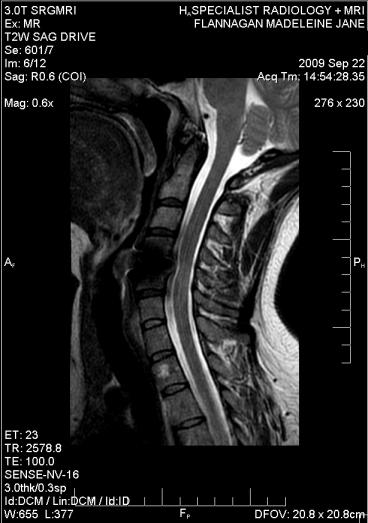
    People say that ACC is “excellent cover” and a “great scheme” but I disagree. I have lived on it for the past year and half since a car accident required the big black thing, in the middle of the below MRI scan of my neck, to be inserted into my neck. See how it is making a bulge into my spinal cord (the long dark gray thing in the middle)?

    My MRI

    Anyway, having set out my premises, disclosed my bias and established that I am, in fact, injured, now judge for yourself if you think my cover is excellent or great or even adequate.

    Pre-accident I was the main bread-winner for our family which comprises 4 children and two adults. I worked for a generous company that gave regular pay rises, gifts and outings to its staff and sometimes their families. I had access to discounted (sometimes free) cereal products and sandwich spreads which helped a lot with the family grocery bill. The company paid for my university fees, my text books and for me to attend lectures so I could complete my law degree. I had a career path set out in front of me, there was a ladder to climb. Matt worked part-time/fixed-term jobs within academia as he has struggled to find full time work as an academic within New Zealand. That worked for us as someone had to be home with the kids, though we would have preferred it the other way around, Matt full-time as an academic and me part-time but you know, life’s like that sometimes and as a family you make the best of it.

    In March 08, whilst I was lawfully stopped at traffic lights, having left work heading for Uni, a woman drove into the back of my car, smashed me into the car in front, writing off my car and destroying two of the discs in my neck which led to disc replacement surgery in Dec 08. She was never charged, I was never given an explanation as to what happened, oh and, she never even had the decency to come over to my car and see if I was alright – other people, passers by and the occupants of the car in front, called the ambulance and stayed with me. As far as I know she got to go back to her life with only her own car insurance claim to worry about and she doesn’t have a clue about what happened to me (my injuries were initially mis-diagnosed as mild whiplash).

    My employer got put through hell. All sorts of ACC nightmares ( I was officially on the clock) that took managers out of their normal jobs. My managers had to put up with temp after temp who couldn’t quite do my job because they didn’t have my institutional knowledge of the company. Nevertheless work sent me flowers, phoned me and held my job far longer than they legally had to. Eventually, when it became apparent I was not going to be fit for work for a very long time, if ever, they let me go but threw me a big party and gave me a leaving present.

    ACC’s treatment of me was a different story.

    We live on 80% of the full-time salary I was earning two years ago. No pay rises, no perks, no discounted household products or entertainment. No uni fees, no text books… So in reality it is not 80% of the income I was on as part of that income was not not salary, it is less than 80%.

    How would you and your household  cope with a 20%+ drop in your income?

    Then there are the extra costs that ACC do not cover:

    Because I cannot just go to the chemist and get my pain medications without a prescription, I have to pay $20 a pop to my GP every 6 weeks to get the piece of paper that says I can get my pain meds. I tell the GP what drugs I want, how many and the GP rubber stamps it.

    Every 12 weeks my specialist wants an x-ray. These cost me $35 a pop.

    We have to purchase a tube of deep heat every week – it’s $8-10 depending on supermarket specials.

    Then there is the petrol spent driving to the GP, pharmacy and specialist (his office is a decent drive). There is also the removal of Matt from whatever work or study he is doing to attend these appointments as I often cannot drive to them. Then there is the babysitting to get rid of the kids so I can attend these.

    Add in the random stuff, MRI scans, visits to pain clinics and you get a more of these costs.

    The expensive supportive bed we had to purchase so I could sleep cost a couple of grand.

    Then there is the $200 pillow – it is a neck injury that I have afterall.

    We recently purchased a monster bean bag so I have something supportive I can sit in, it is excellent for recovering after I have overdone it and it will be vital for exams and for having something portable when I want/need to go out – I can now spend a weekend-day at the beach with my kids for example. It cost $150.

    Then there is Osteo treatment. Osteo treatment reduces the level of pain drugs I need to take by almost half. It is a very effective form of treatment. I am in less pain, I have improved function as a result of less pain, I can get more out of my life and I take less drugs. Osteo is GOOD. This costs me $35 per week. (Physio is free but physio is not effective for this injury – I have seen half a dozen different physios and none can produce the results anything like what osteo treatment can). As a family we made the sacrifices necessary to find that $35 a week. Until last week when my Osteo informed me that ACC had declined to fund their part of the treatment. I now owe my Osteo $75 for the 3 treatments that  I had after ACC decided they were not going to keep funding treatment but didn’t bother to tell me or the Osteo. If I want to continue Osteo I have to find $60 a week now.

    But see above, I don’t have $60 spare a week. ACC does not even come close to restoring me to what I had before I was the victim of an accident.

    So it is back to being a curled up ball of pain with no life or being completely fuzzed out on drugs.

    Did I mention that continually taking the drugs (before I discovered osteo) irritated my stomach and caused so much pain to my stomach that I was admitted to hospital last year?

    Apparently this decision makes sense to someone in ACC.

    How does one quantify the mental costs? The stress, the cost to my family, my children not having me able to  actively participate in the physical aspects of their lives, knowing I will probably never be able to do the sport I love again?

    But that’s not all. Then there are the battles with ACC.

    They are trying to get me off their books. Now I get that. People bludge, make claims they are not entitled to and ACC needs to work out who should be on their books and who should not. However, when you have someone on your books who is in the constant, intense pain I am in, who has their life as altered as mine is, who has doctors and specialists and osteos and physios and everyone who has examined them singing the same tune, that should tell you something. That should tell you that paying a consultant to come around to that person’s house and spend two hours plus with them and then go away and write up a report stating what potential jobs that person could do if they went back to work is a tad premature. Especially when that person is but 2 papers away from having a law degree as obtaining the law degree dramatically changes the types of jobs that person will be able to do. But no, after ACC did this they then sent me to their own specialist, just yesterday, to get him to agree that I could do said recommended jobs.

    They told me that if he said I could work 35 hours (30 hours under the new changes) then I would lose the 80% of my wage that ACC pay me and if in fact I couldn’t work that I would get sickness benefit instead (considerably less than 80% of my wage). Thankfully, the specialist on meeting with me agreed that it was extremely premature for me to be seeing him to discuss work options given the pain levels and almost seemed embarrassed at having been put in this position by ACC when it was so obvious – I have an outstanding MRI result that I have the scans for but not the result, that may or may not rule out more surgery and the pain clinic has just accepted me for their program but I am yet to do it – that I am a long way away from being able to work.

    The taxpayer footed the bill for all of the above and it was not only unnecessary but extremely worrying for us. An example of ACC working to a time-formula rather than on the file facts.

    Even more worrying is that under the proposed new changes ACC will not have to factor in my former salary level.  In the meeting with the consultant who looked at my job skill set, the fact I knew how to make coffee and run a restaurant meant that things like waitressing, barista work, etc came up. I knew how to do these things from the crap jobs that one picks up when one is a student or is going through rough patch but I hated those jobs. I absolutely never want to have to do though sorts of jobs again. I worked hard and gained skill sets and then gained a job that I loved that was using those new skills precisely so that I did not have to do, what I viewed as, crap jobs. Further it is not my fault that I lost that job. Thankfully a policy existed that meant that ACC could only push me towards jobs that paid within the ball-park of my previous job and used my skill-set so the risk of having to take a crap job in the event I recovered was minimised.

    However that policy is about to be axed.

    Amongst National’s proposed changes to ACC is the removal of that policy, if passed it will mean that if ACC find you a crap job using the skills obtained from you old after school job you have to take it, even if your pre-accident job was something much better paid and more prestigious and fulfilling. That is just not ok. It is not adequate compensation at all. If I was on unemployment benefit I would take any job I could get – in fact being unemployed is precisely how I came to get cafe and restaurant experience in the first place, I did take any job I could get. But this is different. I am not on welfare, I am on ACC.

    Then there is the home help thing. We have 4 kids. Two of our kids, our boys, have disabilities (Aspergers Syndrome and as-yet-undiagnosed-but-diabolically-behaved). Matt has this  year gone off to teachers training college so he can get a post-grad diploma in teaching (more state bollocks but that’s another post) so he can improve his chances of obtaining full-time work and get our family back above the bread-line – so he is not  home much. Mon-Fri I am at home with our 8 and 9 year olds who are homeschooled largely because of the undiagnosed condition of the youngest. I cannot do dishes, washing (we do 1-2 loads per day), vaccuming, mopping, picking up, etc. Matt and Sherry (17 year old at Uni) get home frequently, after dinner, and then have assignments and study to do as well as helping as much as they can with housework.

    ACC were giving me 6 hours a week home help to stay on top of those day-time things which meant that if Matt and Sherry got stuck into the rest around their studies we could keep on top of our housework. ACC mysteriously slashed my home help, to 2 hours a week. When I protested it I got given a review. The reviewer was really harsh. She kept saying that ACC will only pay for washing to be done once a week, vacuuming once a week, etc – though no policy proving that was shown to me and when I asked “well how did I used to get 6 hours a week, has been a policy change?” this was dodged. She kept saying other people cope, you have a husband and two teenagers they should be helping. When I pointed out that they are, that they are permanently exhausted from all they do and I feel like a bad mother for the amount Sherry helps with yet my house is still a mess as they are leaving the house at 6.30am and coming home after 6pm with assignments and doing what they can but it is not enough, also that  our 14 year old has Aspergers Syndrome and just panics and goes loopy if he is asked to do much more than a batch of dishes, he has a mental condition, it is not reasonable to expect too much from him.  In response to this, the assessor ACC sent around told me, get this, that my 8 and 9 year olds should be doing all the washing, vacuuming, dishes, etc! Unbelievable! I would, justifiably, have CYF on my doorstep if took that advice. I’m all for encouraging the kids to help out – it is part of being a family, it is how one learns to do these things for adult life but pulling the slack left by an adult incapable of running the house is going beyond too far for most, let alone 8 and 9 year olds!

    Once I am free of exam and research I am going to do a massive appeal over this, a heap of energy expended fighting for something I shouldn’t have to fight for, but in the mean-time don’t visit because my house is a tip – I am horribly embarrassed by it but short of hurting myself or treating my young children like slaves or having Matt and Sherry give up sleep – they are both exhausted – there is not much I can do about it. It is again ridiculous and another example of lousy cover. There were no medical indicators to support their decision to slash my home help, my specialist, the specialist ACC  sent me to yesterday and my GP agree that I need a good 4-6  hours a week home help but ACC will not listen to them.

    If you think I am starting to sound like a bludger who wants to get picky whilst resting on the taxpayer I remind you that ACC is not welfare, it is compensation, it is supposed to restore me to my pre-accident life because, due to no fault of my own, I was a victim of someone else’s negligence.  This policy will fall well short of that goal. If I am made to go waitressing our family will have to take a $30,000+ drop in pay and I’ll be stuck with a mind-numbing, dead-end job. Why? because I lawfully stopped at a traffic light and the state has set up the law so that the person who injured me was allowed to just walk away, I cannot sue and we are all penalised so hard via taxation that only the wealthy can afford to pay twice and get private accident insurance? How is that just?

    I am not saying that I don’t think I should have to go back to work, when/if I am recovered and able to unless I have a job every bit as excellent as the job I had before the accident (that is probably unrealistic as I had it very good) but it is reasonable to want something close surely? To want something at least in the ball-park pay wise and with a future attached it it? Is that asking too much given that several years of pain-hell will have passed before I ever/if I ever get to that point?

    If ACC cannot provide good support and restore people to something at least resembling the victim of an accident’s pre-injury life then it needs to be axed and handed over to the private sector. It cannot, see above, so axe it now.

    To those of you insisting it remain state owned and protesting raises in levies ask yourself, how would you cope if you  were injured and were in my situation? Your career cut-off, your income slashed, the treatment options that were working now just out of reach and your future bleak? Is it worth the socialist-joy of knowing that “we own it”?

    A better question, if you had to pay for accident compensation and you had the money to do so would you choose a company who gave the cover as outlined above or would shop around?

  • Common Historical Myths About the Church

    This post is part update, part recycle.

    Earlier on in this blog’s life, I ran a small series of posts last year on common historical myths about the Church that  are so pervasive in society that most Christians fall for them. Anyway, after receiving some correspondence, I have updated this post, More on the “Dark Ages” and Other Propaganda.

    [I hope I am being mysterious enough to make you want to check it out – especially you Bethyada]

    RELATED POSTS:
    The “Dark Ages” and Other Propaganda
    More on the “Dark Ages” and Other Propaganda
    Things They Don’t Teach you in Public Schools…
    The Flat Earth Myth
    Contra Mundum: The Flat-Earth Myth
    Guest Post: Dan Brown’s History of Science

  • Guest Post: Having a Beer… for the Glory of God!

    As it is still open mic (blog?!) week(s) here are MandM; here is another guest post from Jonny King who, if you have not visited his blog before, you’ll find has a rather distinctive style; he threatened to burn effigies of our blog if we didn’t publish him LOL!

    Having a Beer… for the Glory of God!

    What?… I did put it in the singular… “a beer,”… lest we also forget 1 Cor. 10:31, unless you are planning other excursions for the liquid refreshment?!

    No, I don’t believe that this will be a candidate for the next issue in the Tui billboards dotting themselves over various parts of the Islands of NZ [for all you unfortunate individuals who are not so domiciled, these are somewhat tongue-in-cheek, culturally relevant statements, attached to the phrase “Yeah Right.”].

    … and No, I haven’t had one, let alone a few, quiet ones, before I sat my repository of blogging thoughts down before my little friend, the computer… I can talk to it for days and it will listen to every word, unlike some other people I know… Yes, I am referring to my fixer.

    I am Jonny King is not a big fan of the amber ale as a drink of choice.  Maybe, it is an acquired taste, but surely such shows that I have probably not inculcated myself to such a reality.  Or, maybe, I need to pay for the privilege.  Therefore, whatever you think of my liquidity, I am not pushing my barrow in the pursuit of guilt-free cravings.

    I, in fact, prefer something even darker… (more…)

  • Guest Post: Corruption Rampant in Student Unions Throughout New Zealand

    Andy Moore penned this guest post. It follows nicely on from ScrubOne’s:

    “Free hamburgers and sausage sizzle, $5 jugs of beer” read the advertisement in the student magazine CANTA, a week or so before the University of Canterbury Student Association’s (UCSA) AGM. The quorum for the AGM is 120 students as established in the constitution, and it was pitiful to read the president pleading in his weekly column for people to come along. Of course they’d already attempted to run the AGM the week before, but hadn’t made the quorum. So out with the bribes and cheap beer and let’s try this one again. And where else to host the AGM than outside the student pub, in the amphitheatre? From a compulsory membership of 18,000 students, the UCSA was struggling to make up this poorly representative quorum by offering cheap alcohol and free food, only it wasn’t free because the students paid for it in their levy – yep, even the ones who didn’t attend the meeting. Oh, but perhaps I’m coming down a bit strong – after all, the agenda for the meeting was seeking to raise the quality of life for students. Ahem. Seeking to raise the quality of life for the students on the Exec, by raising all their salaries, including bumping the president’s salary up over the $50k mark. With a budget close to $9m ($1.2m from student levy in 2008) and aprox $400k expenditure by the Exec on a yearly basis it makes you wonder where all the money is going. All the while you’ve got growing frustration from students at steadily increasing food-costs on campus with only one cafe operating that is not owned by the University or UCSA.

    Meanwhile in Wellington, pro-VSM students have got together, primarily from within the ACT on Campus and Young Nats groups, and outflanked the executive and other pro-compulsion students at Victoria University. As Jenna Raeburn says in her live-blog post, “a bunch of liberty lovers and I decide to exercise our rights as (unwilling) members of VUWSA and attend their Student Representative Council”. Ultimately, “The motion passes 45-35! [how does this work when there are only 63 people here??? where did these 35 come from?] VUWSA supports the Education (Freedom of Association) Amendment Bill.” You can read Jenna’s full account of the meeting here – as she says, “VUWSA can’t even count hands or run a meeting, and we subject tens of thousands of students to their antics and put them in charge of millions of dollars every year?” – and without consent of their constituents (students) at that! The ACT on Campus Youtube channel has full footage of the meeting which is a real eye-opener. Vice President of ACT on Campus NZ summarily congratulated VUWSA on their stance on VSM in an (albeit) tongue-in-cheek press release later that evening. However the VUWSA exec aren’t going to go down without a fight and so are attempting to illegally veto the decision made at the annual meeting that took place on Wednesday.

    Roger Douglas’s private members bill to bring freedom of association into student unions will go a long way in addressing this snapshot of problems.