Blog

  • MandM win M&M’s

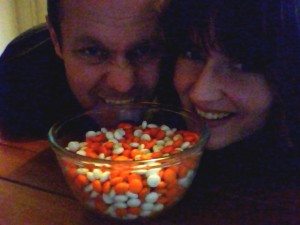
    Over the weekend Matt entered one of those count the number of lollies in the jar competitions and won the competition. So last night he brought home his prize, a jar full of jaffa M&M’s. I couldn’t resist sharing a pic of MandM with the M&M’s especially now that we live in Auckland.

    MandM with M&Ms

    They are all gone now.

    … my tummy hurts….

  • Published – Three Strikes: Proportion and Protection

    The editor of the New Zealand Law Students Association (NZLSA) publication LEX has just advised me that she has published my article “Three Strikes: Proportion and Protection.”

    In it I argue that the objections to the The Sentencing and Parole Reform Bill (a.k.a the “Three Strikes Bill”) on the basis that it affronts the proportionality doctrine, which stems from the Bill of Rights, is flawed. I argue that criticisms of the Bill along these lines confuse appropriate force for punishment with defensive force.

    UPDATE:
    Not to be outdone, Matt just came in from the supermarket with the October edition of Investigate Magazine, which of course, features his regular Contra Mundum article – this month entitled, “God, Proof and Faith” complete with pullquote “the sceptic’s position eats its own tail … [it] is incoherent” and photo of Richard Dawkins labeled “delusional?” (you gotta love editor Ian Wishart). We’ll have a full copy of this article available on this blog at the end of the month; the editor prefers us to penalise those of you who don’t buy his magazine by making you wait.

  • The 2009 Forum on the Family: A Review

    On Friday Madeleine and I attended the Forum on the Family and the following is our long awaited (and long) review of it.

    The Forum kicked off with an impassioned talk from Bev Adair. Bev gave a harrowing account of her own story of childhood physical and sexual abuse and subsequent encounter with God that transformed her life and character and enabled her to break the cycle in her own life, heal and bring her own experience into her work with the Family and Child Trust. She stressed that the solution to child abuse was that people stopped blaming others or their social context for what happens to them; that they must cease demanding solutions from the state and being reliant on welfare; she called for individuals and communities to take responsibility for their own actions and for an end to the silence; abuse is not invisible, people who see it must act. Bev stated that voluntary organisations that were not funded by the state were doing some of the most effective work in the community and the consensus from them was that poverty does not make people hurt their children, she pointed out that countries with real poverty don’t brutalise their children or have stats like New Zealand’s.

    What was interesting was that later in the program the children’s commissioner, Dr John Angus, gave a much drier facts and figures type talk that reinforced what Bev stated. Relying on data compiled by CYFS, Angus noted that abuse tended to be more correlated to drug and alcohol abuse than poverty and that while reports of child abuse are on the increase, the actual cases are not. Like Bev he also suggested that the solutions were at the family, individual and community levels as opposed to government. Angus noted that one of the biggest problems was that when people were worried about a friend or family member’s conduct they rang CYFS rather than actually confronting or addressing it at a family level. Angus argued that real progress is made when families and communities own the problem and openly confront the issues family members face and offer constructive help instead of just looking to the state. It was at this family/community level, that real change can be made.

    In contrast to this, Labour Leader Phil Goff gave a speech about how poverty and economic hardship were the key issues in child abuse. Goff spoke of the need for a society where no children missed out on health care, education or basic necessities due to economic deprivation. He noted the historic Christian motivation behind the original welfare policies of Labour and suggested a need for all parties to work towards helping families in need. While I am not generally a fan of Labour, it is hard to dispute Goff’s claim that we should work towards having a society where no child misses out on basic necessities due to poverty and God clearly would want Christians should to be committed to achieving such a society, that said, none of this speaks to the question as to how this should be done and what the just and appropriate means of bringing it about are (I have discussed the issue of sustenance rights in a previous post). In the Q&A when I questioned Goff further on this he made it clear that he specifically saw this support as primarily coming from the state and not from the voluntary sector on the grounds that “the state has the money.” (Ironically Goff also justified high taxes on the grounds that it was needed for the state to play this role making his position somewhat circular.) These criticisms aside, Goff is to be commended for being the first Labour leader to front up and address the Forum on the Family and for attempting to build bridges with conservative Christians instead of trying to “marginalise them out of existence.”

    One unfortunate feature of Goff’s talk was the focus in the Q&A on the smacking issue. Goff suggested this was a side issue, not as important as child abuse and that people should focus their energy and passions on more important issues. That is, of course, correct and the fixation by members of the audience on this issue did seem disproportionate. However, at the same time, as members of the audience noted, a large number of the audience were from voluntary organisations that were dealing with domestic violence and child abuse at the coal face; hence, the suggestion they were not addressing this or were not as committed to these issues is inaccurate. Moreover, opponents of the current s59 of the Crimes Act had repeatedly told Labour that laws about smacking had nothing to do with child abuse in the past. Proponents had justified the decriminalisation of reasonable force for the purposes of parental correction on the grounds that it would help to stop child abuse and some had, in fact, equated smacking with child abuse. The previous Labour government’s support of this line of argument was the reason that there was now a Bill before the house, John Boscawen’s Crimes (Reasonable Parental Control and Correction) Amendment Private Member’s Bill. So for Phil Goff to now claim now that concern around s59 was a side issue and the question of child abuse was a different, more important issue that Labour was deeply committed to was more than a tad disingenuous, which is what evoked the scathing (and justified) attack from Christine Rankin that David Farrar referred to on his Facebook page.

    Moreover, with a Bill before the house, Labour really do need to take a stance; it is fine to say s59 is not their main focus but when the bill is actually put before them they will need a position. Their opinion on the now, apparently separate and unrelated to light smacking, issue of child abuse, while commendable, is not what they will be asked to vote on. When Madeleine pressed Goff on this he stated that Labour will be voting against Boscawen’s Bill.

    Not all the speakers spoke on child abuse and s59, Greg Fleming, CEO of the Maxim Institute, gave a good talk entitled “Right Wing, Left Wing. What Does it Mean? Does it Matter?” Fleming made essentially three points; first, he noted that the terms ‘right wing’ or ‘left wing’ often function as labels that are used to pigeon hole or brand a person so as to summarily dismiss their position without actually addressing it or considering its merits. Fleming’s contention that such dismissals often reflect a kind of unjustifiable intellectual laziness is undoubtedly correct and occurs far too often.
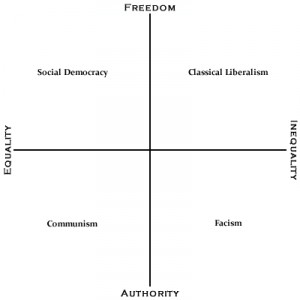
    Political SpectrumFleming’s second point was to suggest that the labels ‘left’ and ‘right,’ when understood correctly, do have a useful descriptive function in highlighting where a person sits on a particular spectrum. For Fleming, this spectrum constituted a horizontal axis whereby equality was at one end, the left and inequality at the other, the right. In addition to the horizontal left-right spectrum is a vertical spectrum with freedom at the top and authority on the bottom. These axes lead to communism being on the bottom left, totalitarian authority to maximise equality; fascism on the bottom right, totalitarian authority to maintain inequality; social democracy on the top left, limited government focused on achieving equality; finally, classical liberalism on the right, limited government for the sake of maximising individual freedom.

    One criticism I have of this is that (more…)
  • Pulse Check

    We have not fallen off the face of the earth, just too much on. Auckland Bloggers drinks was very cool, extremely packed out and seriously a who’s who of blogging – for a list of who may or may not have been present see Ryan Sproull’s write up of the night.

    We then went straight into the Family First Forum on Friday followed by dinner and drinks with a few bloggers, bloupies and others at the forum.

    Then we hung out with Andy Moore who stayed with us til last night. Then we began writing blog posts but then it was 1am and we were not finished… church now so check in later.

    If you want some Family First Forum tidbits, Big News has a few posts, Andy Moore has done a write up and if you are friends with David Farrar on Facebook he has half a dozen cryptic comments about things MP’s said on his front page, things said to MP’s that he Facebooked from the Forum (not that he conceded where he was):

    David Farrar Just met a young guy from Destiny Church. Asked him his role there and he said he was bodyguard for Brian Tamaki. Hope he is paid well!

    David Farrar Heh. Someone inro’d themself to a MP as the No 1 NZ Christian Blogger. [No idea who that might have  been…] I quipped that must make me the No 1 hedonistic blogger 🙂

    David Farrar Goff has just said he used to smack his kids

    David Farrar Rankin just attacked Goff big time. Not sure that is wise for a Families Commissioner.

    David Farrar My name twin, David Farrier, is sitting next to me. Still can’t believe people sometimes confuse us!

    David Farrar Heh John Key just said that he is happy to announce they are keeping the H in Helensville 🙂

    David Farrar Six questions so far to John Key – all on smacking so far. There are other issues!

    We’ll get our official report on the forum up later today.

  • Tekton E-Book: John Loftus’ Why I Became an Atheist Refuted Feat. MandM

    Tekton Education and Apologetics ministries have released an online book, John Loftus’ Why I Became an Atheist Refuted, as a special edition for their E-Block Online Journal. While most of the book is authored by JP Holding, Chapter 2 is not completely,

    Chapter 2: “The Christian Illusion of Rational and Moral Superiority” — Two part response. The “rational” part of the chapter is essentially a rewritten TheologyWeb posts Loftus made in 2005. Our answer here. SAMPLE CHAPTER. The “moral” half of the chapter has already been answered offsite by the posting here by Matthew Flannagan.

    The “here” is Matt’s two part series, John W. Loftus on The Christian Illusion of Moral Superiority Part I and Part II, which are critiques of John Loftus’, The Christian Illusion of Moral Superiority.

    We have not yet read the book ourselves but it was nice to get a mention.

  • Christchurch Event: John Boscawen, David Garrett, Larry Baldock on s59

    Recently I attended a public meeting in support of John Boscawen’s Bill to restore the right of parents to use reasonable force for the purposes of correction in the course of parenting removed by the current s59 of the Crimes Act. This Bill will be voted on shortly and for those of us who voted no in the recent referendum it is our best shot, currently available, to achieve a law change. Whilst National have said they will vote against it there are other parties in Parliament who might, apparently Labour are turning over a new not-so-nanny-state leaf and there are those in National who share our views who do have the power to challenge John Key’s decision to whip his MP’s (the notion that elected MP’s should vote in accord with what they believed right seems lost on John Key) so while the Bill remains alive so does some hope.

    The next meeting is in Christchurch:

    What: John Boscawen, David Garrett, Larry Baldock speaking in support of the Bill (other speakers to be advised).
    When: Monday 21 September, 7.30 p.m
    Where: St. Bede’s College, Performing Arts Centre, 210 Main North Road, Papanui, Christchurch City

    John Boscawen has challenged Clayton Cosgrove to attend; Kate Wilkinson, the National List MP for the area has also been invited.

    For info on future meetings email: kbridgman@xtra.co.nz or phone: 09 531 5531.

  • Rest in Peace William Alston

    Philosopher William Alston died peacefully in his home in Jamestown New York on 13 September 2009 aged 87; he had been diagnosed with  pancreatic cancer just a week earlier.

    Many of my readers will not know but Alston was one of the leading contemporary Christian Philosophers of the last fifty years. I discovered his writings while studying philosophy at the University of Waikato and have always found his discussions to be perceptive and insightful.  Alongside others such as Plantinga and Wolterstorff, Alston was one of my early Philosophical heroes and continues to be so.

    He wrote several excellent works in the area of epistemology and later turned his talents to contributing to the emergence of the Reformed Epistemology movement, which argues that belief in God can, in certain contexts, be properly basic: justified in the absence of any inference or argument for theism’s truth. Alston developed these insights in his ground breaking work Percieving God where he defended the rational status of mystic and religious experience, arguably one of the most significant discussions of the epistemology of religious experience since William James.

    Alston published several important essays on religious language;  critiques of the problem of evil, an excellent defence of the concept of divine action in the world, an interesting discussion on divine command theories of ethics and an inspiring spiritual auto-biography on his conversion to Christianity is published in God and the Philosophers: The Reconciliation of Faith and Reason.

    Alston’s work has influenced the current generation of Philosophers of Religion including, William Row, Alvin Plantinga, Robert Audi, George Mavrodes, William Wainwright, Daniel Howard-Snyder (who has on-line both a biography of Prof. Alston and a bibliography of his writings) and a number of others.

    Alston will be sorely missed. May he rest in peace. May the grace and peace of God be with his family and friends.

    Hat tip: Christian Theist