Blog

  • Sunday Study: Christ on The Prohibition on Homicide Part I

    This morning I preached a sermon at Riverhead Presbyterian Church on Christ’s exposition of the 6th Commandment, the prohibition on homicide, contained in the Sermon on the Mount. This Sunday Study series is essentially a transcript of today’s sermon.

    Christ states,

    You have heard that it was said to the people long ago, ‘Do not murder, and anyone who murders will be subject to judgment.’ But I tell you that anyone who is angry with his brother will be subject to judgment. Again, anyone who says to his brother, ‘Raca, ‘ is answerable to the Sanhedrin. But anyone who says, ‘You fool!’ will be in danger of the fire of hell. “Therefore, if you are offering your gift at the altar and there remember that your brother has something against you, leave your gift there in front of the altar. First go and be reconciled to your brother; then come and offer your gift. “Settle matters quickly with your adversary who is taking you to court. Do it while you are still with him on the way, or he may hand you over to the judge, and the judge may hand you over to the officer, and you may be thrown into prison. I tell you the truth, you will not get out until you have paid the last penny. (Matthew 5: 21-26)

    This passage is the first of a series where Jesus contrasts what his listeners “have heard that it was said to the people long ago” with his own teachings. In v27 he contrasts, “You have heard that it was said, ‘Do not commit adultery’” with his own teaching to not look at another person’s spouse lustfully. In v31 he contrasts, “It has been said, ‘Anyone who divorces his wife must give her a certificate of divorce,’” with his own teaching that divorce is unacceptable except for adultery. In v34 he contrasts, “you have heard that it was said to the people long ago, ‘Do not break your oath,’” with his own teaching about keeping one’s word. The rest of chapter five continues in this manner.

    One way these contrasts are commonly understood is to see Christ as repudiating and rejecting the teaching of the Old Testament and replacing it with his own teaching. The problem is that this goes against the context and genre of the text.

    In the verses immediately prior to these, Christ tells his readers not to interpret his comments as a rejection of Old Testament commands; in v17 he states emphatically “Do not think that I have come to abolish the Law or the Prophets; I have not come to abolish them.” In v19 he states, “Anyone who breaks one of the least of these commandments and teaches others to do the same will be called least in the kingdom of heaven, but whoever practices and teaches these commands will be called great in the kingdom of heaven.” The contrast Christ draws in v 20 is not between The Torah and his own teaching but between faithful obedience and the obedience of the scribes and Pharisees. This suggests that Christ is contradicting, not The Torah per se but a particular interpretation of it; he is correcting the interpretation.

    Daube provides confirmation of this. Daube notes the contrast in this pericope between “you have heard it said” and “I say to you”. This, Daube points out, was a common way of setting out rabbinic teaching. The rabbi would contrast an excessively formalistic interpretation of the torah that people had “heard” with a fuller correct one that the rabbi himself expounded. This observation fits precisely other parts of the Sermon on the Mount where the same formula is used.[1] The relevant pericope then can be usefully analysed in three parts. First, “You have heard that it was said,” the excessively formalistic interpretation. Second, “I say to you,” which is Christ’s authoritative interpretation. Finally, Christ draws two applications of the interpretation he has expounded. I will turn to each of these features in turn over a two-part series.

    You Have Heard That it was Said
    What Jesus’ hearers “heard said to the people long ago” was, “’Do not murder, and anyone who murders will be subject to judgment.” The word “judgment” (greek krisis) used here refers to legal proceedings.[2] Jesus was succinctly summarising some of The Torah’s explicit teachings regarding homicide. An overview of these teachings follows.

    Then God blessed Noah and his sons, saying to them, “Be fruitful and increase in number and fill the earth. The fear and dread of you will fall upon all the beasts of the earth and all the birds of the air, upon every creature that moves along the ground, and upon all the fish of the sea; they are given into your hands. Everything that lives and moves will be food for you. Just as I gave you the green plants, I now give you everything. “But you must not eat meat that has its lifeblood still in it. And for your lifeblood I will surely demand an accounting. I will demand an accounting from every animal. And from each man, too, I will demand an accounting for the life of his fellow man. “Whoever sheds the blood of man, by man shall his blood be shed; for in the image of God has God made man. As for you, be fruitful and increase in number; multiply on the earth and increase upon it.” (Genesis 9: 1-7)

    This passage occurs at the end of the flood story in the proto-history of Genesis 1-11. It outlines a covenant God made with Noah “and his descendants” and with “every living creature … the birds, the livestock and all the wild animals.” Two things are relevant for our discussion here, murder is implicitly condemned and human beings are commanded to ensure that those who are murdered are brought to justice.

    The same teachings are expounded upon in the law of Moses. The 6th commandment of the Decalogue, which occurs in Exodus 20 and also Deuteronomy 5, states, “you shall not man-slay;” this passage teaches that the killing of one human being by another is prima facie condemned.

    Other sections of The Torah outline duties that the community of Israel have towards people who engage in homicide;

    Anyone who strikes a man and kills him shall surely be put to death. However, if he does not do it intentionally, but God lets it happen, he is to flee to a place I will designate. But if a man schemes and kills another man deliberately, take him away from my altar and put him to death. (Exodus 21:12-14)

    The cultural back-drop to this was the ancient near-eastern custom of blood vengeance; the cultural mores of the time dictated that the kin of anyone killed by another were honour-bound to avenge the death of their kinsman by killing the killer. In such a culture anyone who killed another would flee to an altar for sanctuary.

    In this context, the universal pre-Sinai law of Genesis 9 was given a specific application in ancient Israel. If a person killed another then the community had three responsibilities. First they were to determine whether the person’s actions were premeditated and deliberate or whether they were an accident. Second, if they were accidental, the community was to provide institutions that would protect them (the reference to “an altar” and a “place they can flee” to refer to ancient practices of sanctuary). Third, if the killing was pre-meditated they were to execute the offender, that is, bringing the offender to justice.

    After the settlement of Canaan this law was expounded on in Deuteronomy 19 and Numbers 35; the Israelites were commanded to establish a series of cities of refuge, defined as, “places of refuge from the avenger, so that a person accused of murder may not die before he stands trial before the assembly.”

    While an exposition of all the aspects of these institutions are beyond the scope of this post, behind them are the same three requirements I mentioned above. First, if a killing occurred the community was required to determine whether the killer acted with pre-meditation or whether there was some mitigation or accident. This is seen in the laws relating to trials, corroboration by witnesses, perjury, etc that are laid down in The Torah. Second, if the person was not guilty of pre-meditated homicide, the community was to provide the person with protection; this is the very basis of the cities of refuge. Third, if the person was guilty of pre-meditated homicide, they were to execute him. In fact, Numbers 35 goes so far as to state, “‘Do not accept a ransom for the life of a murderer, who deserves to die. He must surely be put to death.’”

    In common with other ancient near-eastern laws, several crimes in The Torah ostensibly called for the death penalty. JJ Finkelstein notes that the capital sanctions that occur in ancient near-eastern legal texts, “Were not meant to be complied with literally even when they were first drawn up, [But rather they] serve an admonitory function”[3] Raymond Westbrook notes that such sanctions typically, “reflect the scribal compilers’ concern for perfect symmetry and delicious irony rather than the pragmatic experience of the law courts.”[4] As I argued in my series, Capital Punishment in the Old Testament, in practice such punishments were substituted for monetary compensation. Numbers 35 tells us that pre-mediated homicide constitutes an exception, in this situation the law must be applied literally.

    Interestingly, Deuteronomy suggests that failure by the leaders of the community to establish institutions that protect the innocent from being violently attacked or a failure to execute those guilty of murder, makes those communities (or at least their leaders) complicit in the crime. The reason they are to build cities of refuge is, “so that innocent blood will not be shed in your land, which the LORD your God is giving you as your inheritance, and so that you will not be guilty of bloodshed.” (Deuteronomy 19:10) Further, the murderer must be brought to justice to “purge from Israel the guilt of shedding innocent blood, so that it may go well with you.” (Deuteronomy 19: 13)

    Jesus’ summary, then, of, “Do not murder, and anyone who murders will be subject to judgment,” is an accurate rendition of what The Torah taught. Murder was condemned and a community that failed to respond justly to murder by protecting the innocent from it and condemning those guilty of it violated the command.

    The problem is that this is not all the Old Testament said. In the book of Leviticus it is affirmed that,

    ‘You shall not go about as a slanderer among your people, and you are not to act against the life of your neighbor; I am the LORD. ‘You shall not hate your fellow countryman in your heart; you may surely reprove your neighbor, but shall not incur sin because of him. ‘You shall not take vengeance, nor bear any grudge against the sons of your people, but you shall love your neighbor as yourself; I am the LORD. (Leviticus 19:16-20)

    Here there is a command to “not act against the life of your neighbour;” literally, to stand by the blood of your neighbour, that is to not refuse to protect or assist a person from danger when one is reasonably able to. Not that alongside it is a condemnation of “hating your neighbour in your heart,” bearing a grudge and lashing out with slander. In other words, The Torah requires not just that one refrain from killing and protect others from being killed, it required an absence of malice and these kinds of expression of it. In my next Sunday Study, Sunday Study: Christ on The Prohibition on Homicide Part II, I will conclude this series by looking at Christ’s authoritative interpretation, “but I say to you,” and the application of the interpretation he expounded.

    [1] David Daube The New Testament and Rabbinic Judaism (London: Athlone Press, 1956) 256.
    [2] Don Carson “Matthew” in The Expositors Bible Commentary Volume 8, ed Frank E Gaebelein ( Grand Rapids MI: Zondervan, 1984) 148.
    [3] J. J. Finkelstein The Ox that Gored (Philadelphia: American Philosophical Society, 1981) 34-35.
    [4] Raymond Westbrook, “The Character of Ancient Near Eastern Law,” in A History of Ancient Near Eastern Law, Vol. 1, ed. Raymond Westbrook (Boston: Brill Academic Publishers, 2003) 74.

    RELATED POSTS:
    Sunday Study: Christ on The Prohibition on Homicide Part II
    John Loftus on Calvin, Matthew Flannagan and Psalm 14
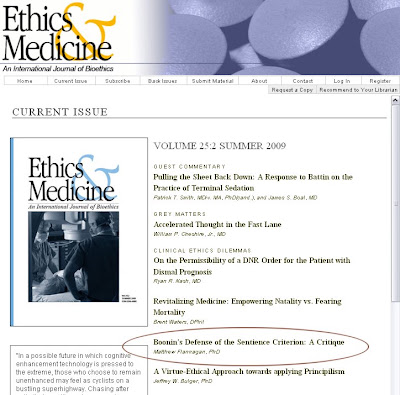
  • Published: Boonin’s Defense of the Sentience Criteria – A Critique

    We just discovered that if you go to Ethics and Medicine – An International Journal of Bioethics and click on “current issue” (VOLUME 25:2 SUMMER 2009) you will see that my article “Boonin’s Defense of the Sentience Criteria – A Critique” is now in print. It is always nice to finally see a publication in print as it can take along time from submission to acceptance til publication.

    Journal of Ethics and Medicine

    I have written to the editor and asked if I can put a copy of the article on this blog. Until I hear back I will leave you with the abstract and encourage you buy a copy of the journal or locate it at your library.

    Defenders of the permissibility of feticide commonly argue that killing an organism is not homicide unless the organism’s brain has developed enough for it to acquire sentience: the capacity for consciousness and the ability to perceive pleasure and pain. In this paper I will critique one of the more sophisticated versions of this argument that proposed by David Boonin in A Defense of Abortion. In I I will sketch some prima facie problems faced by any appeal to sentience. In section II I will examine Boonin’s attempt to defend an appeal to sentience against these problems by contructing a modified future like ours (FLO) account of the wrongness of killing. I will argue that Boonin’s modified future like ours (FLO) defence of sentience fails. Both his argument for the modified FLO account and his application of this account to feticide rest on ad hoc arbitrary manoeuvres, manoeuvres which mean that the modified FLO account is a plausible criteria for the right to life only if one already grants that feticide is not homicide.

    RELATED POSTS:
    Some Thoughts on Human Embryonic Stem-cell Research
    Is Abortion Liberal? Part 1
    Is Abortion Liberal? Part 2
    Sentience Part 1
    Sentience Part 2
    Viability
    Abortion and Brain Death: A Response to Farrar
    Abortion and Capital Punishment: No Contradiction
    Imposing You Beliefs Onto Others: A Defence

  • Christian Blog Ranking Report for May 09 – Tumeke

    Here are the top 10 NZ Christian blogs based on Tumeke’s NZ blog stats for May; these stats are used in the calculations for the MandM top 10 NZ Christian Blog rankings for May 09:
    1. MandM 35

    Top 10 Tumeke. name of blog Tumeke rank

    Of Note:

    • No change in the number 1 spot – well done NZ Conservative!
    • Welcome to the top 10 Being Frank and Sustain:If:Able Kiwi.
    • The top 8 are all in the top 50 blogs in New Zealand – when we first began running this report only 2-3 Christian blogs ever featured in the top 50 so well done everyone!
    • Christian News New Zealand, Samuel Dennis, Kiwi Polemicist, Star Studded Super Step all made the top 100 despite being outside the top 10.

    Note: This list only includes Christian blogs that openly identify as Christian blogs on Tumeke’s ranking descriptions. If you think your blog should be included contact Tim Selwyn of Tumeke and ask him to change your blog description to include something identifiably Christian on his rankings. (*hint hint* MacDoctor Moments who is identifiably Christian on HalfDone but not on Tumeke)

    Now that Tumeke’s May stats are out we will compare them with the HalfDone May report and publish the overall MandM top 10 NZ Christian Blog rankings for May 09 shortly.

  • Fisking Ian Hassall: The Arbitrary Ethical Reasoning on the Smacking Referendum

    Recently Dr Ian Hassall gave a presentation, on the upcoming referendum on section 59 of the Crimes Act 1961, entitled: How did we come to have a law that supported hitting children? This presentation defends the thesis that mild physical punishment (smacking) is wrong and should remain illegal in New Zealand. In this post I will critically evaluate Hassall’s arguments and demonstrate why they fail.

    Much of Hassall’s article discusses the evolutionary, legal and religious origins of corporal punishment and while I disagree with much of his analysis, and I am sure Paul Moon would have a few things to say about his historical claims regarding early Maori not engaging in violence against children, for the sake of space, I will forgo addressing this. I will also put to one side Hassall’s caricatured picture of ‘evangelical views’ on the doctrine of original sin which does not include a teaching on the necessity of inflicting pain repeatedly on children (I intend to do a Sunday Study on the biblical teachings surrounding this issue in the near future). Strictly speaking, the origins of the practice is irrelevant; the real issue is: now that it is here, is it wrong, is corporal punishment morally permissible and should it be illegal? These are questions of morality and ethics. My critique will focus on these aspects.

    Evidence Shows Smacking Does Not Harm
    Hassall begins his discussion of the ethical questions by conceding, contrary to the standard assertions from opponents of corporal punishment, that “a considerable body of research” shows “no detectable harm to children who have been mildly physically punished when compared with children who have had no such punishment.” This concession raises an immediate question; if mild corporal punishment is no more harmful than other forms of discipline, which are legal and considered morally unproblematic, why then is corporal punishment singled out for censure and prohibition? Hassall puts up several arguments, I will address the most significant ones.

    Equality before the Law
    Hassall argues against mild forms of corporal punishment by noting that the same acts would undoubtedly constitute a crime if done to an adult;

    The main argument against legally sanctioned assaults on children has never been a question of whether or not it does harm, as can be seen by applying the same argument to assaults on adults.

    The law that makes it a criminal offence to assault an adult does not rely for its justification on whether or not it does harm. If evidence was lacking for any ill effects from a certain level of assault by a man on his wife, for example, it would still not be acceptable. … The central issue is not whether or not harm is done but whether or not one person is entitled to assault another.

    The implicit assumption behind these appeals is that, if it is a crime to do something to an adult then it must also be a crime to do the same thing to a child. This kind of reasoning seems pervasive in the arguments of those who criticise corporal punishment. The problem is that the assumption is false.


    It is a criminal offence (theft) for a man to confiscate his wife’s property without her consent; similarly, it would be a criminal offence (false imprisonment) for a man to prevent his wife from leaving her room or her house. Yet no sensible person thinks that it ought to be a crime for parents to ground their child or confiscate property when their child is acting out.

    Corporal punishment does not seem different from other forms of parental discipline in this respect. Both corporal punishment, like smacking and non-corporal punishments, like groundings and confiscations, are such that if one adult did them to another they would be illegal.

    The Right to Physical Integrity
    A second argument Hassall raises is that children have a right to physical integrity, “the right of children to physical integrity is recognised by the UN Convention on the Rights of the Child. Twenty-three countries have recognised this right in their law.” Now the argument that we should adopt a policy on something just because twenty-three other countries have done so is not compelling in and of itself.

    Now, I accept that children have a right to physical integrity. The obvious problem, however, is that not all forms of corporal punishment damage a person’s physical integrity. Some forms, like those that inflict injuries upon their victims, clearly do but the fact that some forms of corporal punishment violate a right does not entail that all do – anymore so than the fact that some forms of non-corporal punishment, such as locking a child up in a cage without food or water, mean that all forms of non-corporal punishment are unjust. Again there appears no reason for concluding that corporal punishment is wrong or unjust by this argument.

    Feeling Guilty
    Hassall notes that parents sometimes feel guilty when they engage in corporal punishment. “It feels wrong and when we reflect, we know in our hearts it is wrong. What ordinary parent can recall without remorse the look of fear on the child’s face when they raised their arm to strike?” The problem again is that this is not unique to corporal punishment. What parent does not feel upset, for example, when they see their child crying hysterically as a result of being sent to their room or not being allowed to watch a TV show or missing out on an event they were looking forward to due to their misbehaviour? Once again this argument gives us no reason for singling out mild corporal punishment as wrong but not other forms of non-corporal punishment. The argument applies equally to all forms of punishment that make parents feel bad when administering them.

    Normalisation of Hitting
    Hassall pulls out another common argument against corporal punishment, that it sends the message that “hitting people is normal.” He notes, “if as parents we have become inured to the fear and pain we cause by hitting our children, what have we become? And if our children over the years become used to us hitting them and regard it as normal, what have they become?”

    It is evident from this comment that Hassall’s conclusion is decided aprori and read into the evidence instead of being inferred from it. In the previous paragraph I noted his claim that if parents feel bad about corporal punishment then this shows it is bad, here he suggests if they do not feel this way then this also shows it is bad. In other words, no matter what the facts are, he draws the same conclusion. But more importantly, if Hassall’s argument is sound then an analogous argument shows that non-corporal punishments are unjustifiable.

    If smacking children teaches them that hitting others is normal then wouldn’t grounding them teach that restricting others liberty is normal? Wouldn’t confiscating their property teach that taking others property without their consent is normal? All punishment by its nature involves subjecting someone to something unpleasant, usually without their consent, which in normal circumstances it would be wrong to do; consider incarceration or periodic detention. Given that one of the functions of punishment is deterrence, all forms of punishment involves some degree of threatening others and scaring them away from wrongdoing. Not only is this an argument against smacking, it is also an argument against our justice system.

    Degradation and Indirect Harm
    Hassall offers two final arguments against the legality of mild corporal punishment. The first is that mild corporal punishment causes indirect harm to children and the second is that it is degrading.

    Turning to first of these arguments, Hassall notes,

    The old law propped up a sense of entitlement to strike children. This sense of entitlement, in an angry person with limited self control, can be the beginning of a beating. Surveys of adults found guilty of abuse of children have revealed that usually the episode of abuse began with the intention to punish and escalated.

    This is a very bad argument. Essentially Hassall is arguing that mild corporal punishment is wrong because if people with limited self-control engage in it then it will escalate into a beating. He also notes that often beatings come about as a result of such escalation. The problem here is that these facts are true of many legal and perfectly permissible activities. Spousal abuse often results following escalation of a marital argument. If a person with limited self-control argues with his or her spouse he or she may lose control and commit assault. However, it does not follow that it is wrong to argue with one’s spouse nor does it follow that such arguments should be illegal. Likewise, if people with limited self-control drink alcohol they may drink excessively, get in a car and kill someone. Many criminal offences result from an escalation of drinking; does it follow that any consumption of alcohol should be illegal?


    Hassall’s main and most important argument, however, is the claim that mild corporal punishment is “dehumanising” he notes that,

    Women, servants and soldiers, once subject to legally sanctioned corporal punishment are deemed in modern times to have the right to be free from assault and the threat of assault and from the oppression and dehumanisation that accompanies the entitlement of others to inflict pain upon them.

    Here Hassall singles out a feature that he contends mild corporal punishment possesses that other punishments do not. In modern times, adults can be subject to legally sanctioned punishments, like fines and incarceration but they cannot be subject to corporal punishment and this is because the latter (not the former) is “dehumanising” in a way that the others are not. This, he thinks, is the reason smacking should remain illegal.


    The problem with this argument is the central claim behind it, that mild corporal punishment is demeaning in a way that other forms are not. David Benatar makes the point well;

    Here it is noteworthy that there are other forms of punishment that lower people’s standing even more than corporal punishment, and yet are not subject to similar condemnation. Consider, for example, various indignities attendant upon imprisonment, including severe invasions of privacy (such as strip-searches and ablution facilities that require relieving oneself in full view of others) as well as imposed subservience to prison wardens, guards, and even to more powerful fellow inmates. My intuitions suggest that this lowering of people’s standing surpasses that implicit in corporal punishment per se, even though it is obviously the case that corporal punishment could be meted out in a manner in which it were aggravated…Therefore, if we think that current practices in prison life are not wrong on grounds of degradation, then we cannot consistently say that all corporal punishment is wrong on these grounds.

    Benatar’s point is that one cannot claim that corporal punishment is less dehumanising than current legal punishments which “in modern times” are legally sanctioned against adults. Once this is realised, the central premise behind Hassall’s objection collapses; he has not singled out a property that is unique to corporal punishment that does not equally apply to any other form of punishment.


    I began this post noting that Hassall concedes that mild corporal punishment causes no more harm than many punishments which are both permissible and legal. I conclude, by noting that mild corporal punishment does not differ in any of the other features Hassall mentions either. All punishments done to children would be crimes if done by one private adult to another. If any punishment sends the message that one can mistreat another then all do. There are numerous perfectly acceptable practices which, when engaged in by people who lack self control, escalate into crime. Having to inflict any punishment is something loving parents find unpleasant and corporal punishment is no more dehumanising than many other punishments.

    Far, from showing that mild corporal punishment, such as smacking, should be singled out for prohibition, Hassall’s argument suggests that it is no more problematic than many other forms of discipline, which good parents can and do permissibly utilise. Hassall’s moral case against mild corporal punishment then is arbitrary and appears to have little rational basis.

    David Benatar “Corporal Punishment” Social Theory & Practice, Summer 1998, Vol 24, Issue 2, accessed July 3 2009.

    RELATED POSTS:
    Fisking Margaret Mayman: The Flawed Moral Theology on the Smacking Referendum
    We’re Confused about the Anti-Smacking Referendum Question
    No Defences Permitted for the Accused

    (This post was authored by Matt and was accidentally posted under Madeleine’s account.)


  • Mount Maunganui Adventures

    Mount MaunganuiYesterday I took my youngest two kids for a walk around The Mount (as Mt Maunganui is referred to by locals) as we are staying about a 2 minute walk from it at the moment.

    As we left I told them that when I was younger and I had done this walk with my parents we had once seen an orca (killer whale) swimming offshore. Brittany and Noah at once wanted to know how many orcas I thought we’d see on our walk and I had to tell them that despite the hundreds of times I had done the walk I had only every seen an orca in the harbour once so it was highly unlikely we’d see any today.

    They didn’t believe me and began eagerly discussing how many orcas they expected to see. It turned out I should have listened to them as right between Matakana Island, the long dark island with the long white beach towards the top of the picture and the Mount itself, were two orcas swimming in the harbour!

    I didn’t have a camera with me so here is a pic that the Herald took when one of their reporters spotted orca’s at the Mount.

    Today we are climbing The Mount so hopefully they will still be hanging around and we can take some of our own pics.

  • Weight Watchers and the Historical Atrocities Argument

    We’ve all heard the slogan that atheism is superior to theism because of all the atrocities committed in the name of religion. If you flick through the pages of the new-atheist publications by the likes of Dawkins, Hitchens, Loftus, Harris, et al you’ll probably find some version of this assertion in each.

    Setting aside the dubious factual claims and the fact that I could list a stack of atheist atrocities that could outnumber the theist ones just from the last century alone, there is another way of addressing the slogan. If a person joined Weight Watchers, got the points book, the pamphlets explaining how the program works and began attending weekly meetings to fellowship with others on the same journey but instead of following the instructions began to bend the rules, invent new ones and ignore others and as a result began to gain weight, could that person justifiably claim that Weight Watchers made them fat? That Weight Watchers should be rejected as a weight-loss program, in fact, attempting to lose weight in and of itself is a bad thing, because this person gained weight whilst ostensibly being a follower of the program?

    If you can see how ridiculous it would be to blame Weight Watchers and to abandon the pursuit of weight loss because someone who cheated on the program had a bad outcome then why can’t you see it when the same reasoning is applied to atrocities committed in the ‘name of’ Christianity

    H/T Rodney Lake at Thinking Matters Tauranga

  • BOP Bloggers Drinks – Tonight!

    Ozy Mandias, Matt and I will be meeting up at Latitude 37, in Mount Maunganui tonight at 7.30pm. Any other Bay of Plenty bloggers or readers are most welcome.