Blog

  • New Zealand Christian Blog Rankings for October 2008

    Extrapolating from Tumeke’s October 2008 stats, the top 10 Christian Blogs on Public Discourse in New Zealand are:

    1. NZ Conservative (23 +1)
    2. Something Should Go Here, Maybe Later (34 +2)
    3. The Briefing Room (35 -5)
    4. MandM (50 +27)
    5. Samuel Dennis (79 +1)
    6. Kiwi Polemicist (92 new)
    7. Gavin Knight (95 – 4)
    8. Put up Thy Sword (114 +1)
    9. Contra Celsum (125 -31)
    10. Say Hello to my Little Friend (a.k.a Beretta Blog) (126 +2)

    Of Note:

    • No change in the number 1 spot, well done NZ Conservative.
    • Newcomer Kiwi Polemicist debuts at number 6 (92 on Tumeke’s stats).
    • The gap between the top 4 narrows; over the past 3 months MandM have climbed 76 spots on Tumeke’s rankings.

    Other Christian blogs making the top 200 NZ blogs on Public Discourse are:

    (Numbers in brackets show the overall NZ ranking of each blog)

    Note: This list does not include Christians who blog but whose blogs are not identifiably Christian and is based on Tumeke’s classification and ranking methods.

    If you think your blog should be on the rankings click here.

  • October Blog Rankings: MandM Crack the Top 50

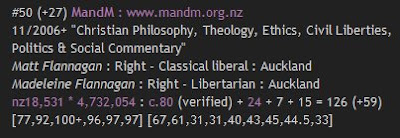
    The October NZ blog rankings are out and MandM, as predicted, is one of the top 3 movers and shakers, climbing 27 places to number 50:

    Unfortunately whilst Tim did update our URL to http://www.mandm.org.nz/ he failed to do so for our Alexa and Technorati Stats and went off our old and defunct blogspot url that we left behind nearly two months ago.

    To see the difference, compare both these stat-lines:

    nz 18,531 * 4,732,054 (old blogspot url stats)

    nz 1,694 * 1,783,797 (current mandm.org.nz stats)

    As you can see in the last two months we have climbed significantly; 3 months ago that Alexa traffic rank stat (the second, bigger number) started with a 7 and our NZ traffic stat (which measures our popularity within the international community) is equally strong.

    So thankyou everyone for your support. Your visits, your comments, your links have all helped us to achieve this result (of course we appreciate your contribution because of the contribution to the dialogue it makes first and foremost).

    If you are still linking to our old blogspot url, the one with all the mandmandmandmandm’s in it, please, please, please update it 🙂

  • What About the Poor? More on Sustenance Rights

    In my last post, What About the Poor? Sustenance Rights Examined, I noted the position of Nicholas Wolterstorff that, “If a rich man knows of someone who is starving and has the power to help that person, and chooses not to, then he violates that person’s rights as surely and reprehensively as if he had physically assaulted the sufferer.” I argued that as stated, this position is subject to three problems; first, that it leads to absurd consequences, entailing that I have a duty to give to every poor person I know about. Second, that it has totalitarian implications and third, that acceptance and practise of this principle would destroy any incentive people have to work.

    In a more recent article “Christianity and Social Justice,” Wolterstorff attempts to defend his thesis against the three criticisms I mention above.

    Turning to the first problem, Wolterstorff’s response is to note that “acknowledging a person’s right to some good does not imply laying on everyone else a duty to extend to that person that good.” This seems odd, if a right to sustenance on the part of the poor does not mean we are obligated to give them the means to sustenance, what bite does it have?

    Wolterstorff puts forward an interesting suggestion. Turning to the paradigm of a right to not be assaulted, Wolterstorff suggests that while we have a duty to not assault people we do not have a duty to protect every person against assault. However, he goes on to note that in addition to having a right to not be assaulted, people have a right against their society “to have practises” and “social structures” that protect them from assault. In particular, such things as a police force, courts and an army. Clearly, if the right does not just mean that members of society refrain from attacking people, it also means that these members have a duty support the police force. Further, if the police force is ineffective, people have a duty to try and improve it (through such things as voting and lobbying).

    Moreover, Wolterstorff suggests if “I see you about to get mugged when no policeman is in view – then I may be obliged to offer you my protection in a direct way.” Wolterstorff’s argument is that sustenance rights are analogous to the right to not be assaulted in this way. People have a duty to support whatever institutions or charities exist that alleviate poverty. If they are ineffective, they have a duty to reform them. Further, if one encounters a person in extreme necessity one is required to assist them in a direct way.

    Turning to the second criticism, Wolterstorff makes three points to get around the totalitarian implications sketched previously. First, he states that,

    the general idea behind having such a right to some good is that individual actions and social practices ought to be such that one enjoys that good. But the role of the government in practices which secure that right may be nil or negligible. Not all rights are enshrined by law. Sometimes in the early church the care for the poor of society was principally in the hands of the bishop.

    He goes on to note, correctly I think, that,

    Far from acknowledging that there is such a right, nothing directly follows as to what, if anything, governments should do by way of securing that right. In particular, it does not follow that the poor should be put on a dole supported by public taxation. In principle there is a wide variety of other practices which would undo the violation of this right, some of which the government would have little or no role.

    Accepting sustenance rights then, does not entail accepting massive public ownership or redistribution.

    Second, he tries to mitigate the objection by appealing again to the analogy with assault; “in our fallen world… we do not suppose that, in the face of all the aggressive impulses of human beings purely voluntary arrangements would suffice to secure our freedom from assault.” He goes on to note, “why should we suppose that, in the face of acquisitive impulses of human beings, purely voluntary arrangements would suffice to secure our right to sustenance?” Finally he notes, “it is true, indeed that there are dangers lurking when governments try to ensure that the rights of the poor are respected. But who would be so foolish as to argue that the armies and police forces that we assemble propose no threat?”

    Wolterstorff makes some pertinent points here. However, it is worth noting that if one takes the assault analogy seriously, several things are evident. First, the police and armed forces actually do not play as big a role in protecting us from assault as it may appear.

    The Police do not patrol everyone’s houses at night, nor does it have 24/7 video surveillance cameras set up on every home, nor do we have publicly funded burglar alarms. If people want any of these things, they hire private security guards, install privately owned cameras and buy their own alarms. The police are called when these systems fail and there is immediate danger.

    It is also worth noting that the ability of the Police to catch and prosecute assailants is limited by such things as the presumption of innocence, the need for warrants, probable cause, etc. In societies with lower crime rates, police typically have more sweeping powers, powers our society rightly rejects precisely to avoid the danger of excess state intrusion and its subsequent abuses. As such, if the state is to secure our rights to sustenance similar limits should apply.

    Turning to the third criticism, Wolterstorff states that while people do not earn their basic human rights by merit, such as the right to be free from assault or the right to liberty, the same is true of the right to sustenance. Wolterstorff notes correctly that a person can forfeit these rights by misdeeds; if a person attacks another his right to be free from assault is forfeited and I can strike him if necessary to defend myself. Similarly, if a person commits a crime they forfeit their right to liberty and can be imprisoned.

    In the same way, Wolterstorff suggests that the right to sustenance can be forfeited if a person is capable of providing for themselves but refuses to do so; just as a needy person has a right against society to sustenance, society has a right against those it supports that they will take responsibility for themselves when they can and not pass of their responsibilities onto someone else.

    As far as I can tell, Wolterstorff’s responses enable him to accept sustenance rights without falling into the problems mentioned in my previous post. It is worth noting, however, his response makes the claim that the poor have sustenance rights significantly qualified.

    What it means is that individuals in a society have a duty to support various institutions that aid and assist those who are unable to provide for their own needs. These institutions may or may not be run by the state but if they are, the state plays a last resort role and is subject to careful checks on its power. This picture may differ from that some proposed by certain types of Libertarian, particularly those who believe we have no obligations to support the poor at all, but it is hardly the charter for statism or massive public ownership

  • Homosexuality and the Right-Wing Socialists

    Lately I have been thinking I must write a post about the sacred cow of homosexuality and how it can turn the most ardent liberal into a lefty. I am not the only person to have noticed this phenomena.

    As Matt once commented, “Christians should be very concerned with people who will sell out their commitment to liberty before they would side with a Christian [or a moral viewpoint typically ascribed to a Christian]. Such people cannot be relied upon to defend my rights at all.”

    Matt was alluding to the so called principled liberals whose principles dissipate the minute they encounter someone who shares most of their views but whose moral code differs from the narrow point of view they define their liberality by.

    If you ask them to defend their views and offer a critique they cannot. I doubt they know why they hold their views they just know they are supposed to so they just repeat their mantra.

    Their blind adherence to the “correct” moral views are not based on principle or reason, if you point out a flaw in an argument for one of their sacred cows they intolerantly froth and deem you to not be a member of the club. They will jump on the “correct” side regardless of whether the arguments used are sound.

    This bigoted intolerance from the right is not completely reserved for Christians; anyone secular daring to voice a flaw in an argument advanced by the sacred cows of the-state-must-endorse-gays-movement is also slammed as illiberal.

    Look at all the fuss and bother over David Garrett’s comments on paedophilia [note the comments were NOT on homosexuality, learn the difference between an analogy and an identity claim]. In Real Bigotry Versus Mere Opinion Blair Mulholland notes:

    Today’s Herald has two separate stories dealing, in a roundabout way, with the issue of homosexuality.

    In one, we have an elected official actively condoning violence because some of his constituents regard having their town labeled a “gay capital” as an insult.

    In the other, we have a barrister, who was not an elected official at the time, pointing out that, in his view, both homosexuality and paedophilia are unchangeable psychological phenomena.

    Guess which elected official has had their head called for?

    Seriously, this is bullsh*t. The blogosphere, and I am looking at you too David Farrar, needs to get their priorities straight… so to speak. A small town Mayor says it’s allright to give Jeremy Wells the bash for a comedy piece he did ten years ago and we shrug our shoulders. A new MP makes a crude observation about human behaviour and the crowd demands crucifixion.

    It’s not acceptable.

    Consider Lucyna’s argument in Finding Socialists in the Darndest Places, she cites Lindsay Mitchell‘s argument that one spots a socialist by their walk, not their talk or the ribbons they wave.

    Want proof of how support for homosexuality turns liberals into lefties?

    Compare Blair Mulholland, who says he is “more attuned with the Libertarianz” than ACT’s, endorsement for Wellington Central with Cactus Kate’s, one of the last, self-proclaimed, bastions of complete right-wing bias, hero worshipper of ACT’s Rodney Hide.

    Blair’s endorsement:

    Stephen Franks was worth about ten regular National MPs when he was last in parliament, so if you put him in their caucus he will kick some arse. My wholehearted endorsement for the National candidate here.

    Cactus Kate’s are here, here and here:

    Grant, You are the only Labour candidate I am endorsing at this election

    and:

    With great humour I see all the National Party candidates are now MP’s and yet none of the Labour candidates made it through. Oh dear. Crying a river. With
    such a vicious swing Nationwide to National that result was a fait accompli.

    Well done Sam, Aaron, Simon and Nikki. I hope all your dreams come true. And Grant Robertson who managed despite this massive swing to Toryism, to upset
    Stephen Franks in Wellington Central. Brought a wee glow to the cheeks.

    For the benefit of our overseas readers, Grant Robertson was the Labour (left-wing) candidate and Stephen Franks was the National (right-wing) candidate in the Wellington Central electorate in the recent NZ election.

    Robertson is a unionist and state services flunky from way back; a hard-core left wing activist. As an example of what I mean, when he was National President of NZUSA he organised an activist training conference and invited and sponsored a speaker who advocated vigilante assaults on the private property of those they disagreed with.

    Franks is a former ACT Party MP (more right-wing than National), is a Classical Liberal, has years of experience as a lawyer working in NZ’s top law firms, is considered across the political spectrum as being one of the sharpest, most competent and most ethical MP’s in recent times. Franks is secular and, from conversations I have had with him, does not share my view that homosexual conduct is immoral or that abortion, far from being liberal, is homicide.

    So, I ask you, why would the uber-right wing Cactus Kate be pleased to see Robertson trump Franks? I asked her that and as yet she has not answered. As she moderates her comments, she has seen my questions, so I must assume the silence is deliberate.

    I speculate, with good reason, that the answer is Robertson is gay and that to the socialist-liberal being gay forgives every other flaw; especially when Franks, during the NZ debate to have the state endorse gay relationships through the passage of the Civil Unions Act, made some critical observations on some of the reasons advanced by the defenders of the Bill.

    This of course renders Franks a homophobic hate-filled conservative (liberals by definition are pro-everything gay, no matter how inconsistent it renders them and will turn and blacklist their own in heartbeat at the first sign of a betrayal) and elevates the statist Robertson to the position of the better candidate. [I am reminded here of Matt’s blog: Bigotry as Tolerance: Homophobia as Orwellian Double Speak.]

    Right-wing socialists loudly claim to be principled yet to avoid being associated with a perceived affront to their moral values they would sell their freedom on the basis of knee-jerk ignorance, straw-men and stereotypes.

    So now I turn to Glenn’s latest offering where he suggests that the state has no role to play in endorsing any relationships. Something liberals have always claimed on every other, non-homosexual, issue. This is a concept I endorse accross the board. Marriage existed for centuries without the help of the state. State endorsed marriage is a fairly recent phenomena.

    Extract from: Homosexuality and Socialism?

    It might seem like a very odd connection until you consider… well, actually no matter what you consider it still seems like an odd connection, but in the recent song and dance about Proposition 8 in California, that very odd connect has been reinforced yet again. I’m sure that there are plenty of homosexual people who don’t choose to identify as socialist, so don’t take me to be saying that they all do. But when it comes to the public scrap about marriage, for some of them the red comes to the surface quicker than you can drop a hat.

    As evidenced here, here, here, here and in many many other places, some outspoken homosexuals actually believe the following slogan:

    Marriage is a civil right.

    Now let me very clear what’s being said here. They’re not saying that they have the right to live together as a couple. They already have that right in California, and it was not under threat. They mean legal marriage, and I don’t mean a relationship that is legally permitted (again, they already have this, which is why Keith Olbermann is lying in the second link above when he says that all homosexuals in California who opposed proposition 8 want is the ability to be “a little less alone in the world” by having a relationship”), I mean a relationship that is created by law. What they are actually saying is this:

    I have a basic right for the government to create a type of legal relationship and to confer upon my relationship the status of being one of those relationships.

    Excuse me? There exists no such civil right, for anyone – homosexual, heterosexual…. or otherwise! What kind of nannyish rubbish is this? The government does currently create such a relationship and confer upon many heterosexual relationships the status of being one of those relationships (and it refuses to do so for others – e.g. close relatives, relationships with more than two people etc, which is why Representative Anthony D. Weiner is lying in the third link above when he says “We are not going to rest at night until every citizen in every state in this country can say, ‘This is the person I love,’ and take their hand in marriage”). It’s like thinking that the right to bear arms means that you have the right to arms, that is, the government has the duty to buy you a gun!

    If I stood up in public and said that my wife and I had a civil right to a free house from the government, what would you say? And how crazy do you think I would look if I went further and said that if the government did not provide one then it was somehow displaying hatred or contempt for me or for my relationship?

    I’m a conservative Christian, and I take very seriously the teaching of the Bible. So if you tell me that I have no choice and I must accept the fact that all marriages must be state-endorsed, then obviously I’m going to think in terms of my traditional understanding of marriage, since I don’t want the government creating and then endorsing things that are immoral. We’re going to clash and war over that. But here’s a radical thought: If you want to get married then get married, and let’s not let the government have a part of it at all!

    But what about incest, polygamy etc? Well firstly, people in the USA are already legally permitted to have sexual relations with multiple people and commit adultery. If you think that’s so horrific, then support a law banning it. And incest is already illegal, so the question of incestuous marriage isn’t an issue. The act is banned. Let’s just say that anyone can get married, as long as they don’t commit any acts that are themselves illegal (like incest or marrying a minor or any other illegal sexual practices). Enter into whatever property contracts you like, regardless of sexuality.

    Issues of sexual practices are determined on their own (e.g. the notorious “anti-sodomy law” issue in Texas). But the suggestion that you have a civil right for the government to come into your bedroom and give you a nice certificate and pat your relationship on the back (so to speak)…. Please don’t do that to my language. “Rights” are important things, and you’re dragging that word through the mud when you use it like that.

    (This is to say nothing of the misleading claim that currently, different individuals have different rights based on their sexuality. They don’t. No individual is excluded from getting married in California based on gender, race, or sexual orientation. That’s why emotive comparisons to interracial marriage being banned just have no substance.)
  • What About the Poor? Sustenance Rights Examined

    When I began university I had strong socialist leanings. The reason was that I believed, as a Christian, we had a duty to help the poor. Studying at Waikato University, however, brought me face to face with socialist academics and left-wing activists and I discovered a hostile and dangerous social agenda that I could not in good conscience embrace.

    That, however, left me with a burning question. What about the poor? If the classical liberal or conservative view is correct. What about the poor?

    In the next two posts I want to discuss my thoughts on this a bit. I will do so by examining Nicholas Wolterstorff’s defence of welfare or sustenance rights. I will argue that, as initially stated, Wolterstorff’s position is subject to three problems. In my second post, What About the Poor? More on Sustenance Rights, I will suggest that while Wolterstorff’s position can escape these problems, it does so only by qualifying itself in such a way that there is no necessary link between accepting the poor’s right to sustenance and the kind of statist re-distributionary policies favoured by the left

    In, When Justice and Peace Embrace, Nicholas Wolterstorff suggests that “If a rich man knows of someone who is starving and has the power to help that person, and chooses not to, then he violates that person’s rights as surely and reprehensively as if he had physically assaulted the sufferer.” Wolterstorff suggests further that this conclusion is orthodox Christian teaching. He provides citations from Basil, Ambrose, John Chrysostom and Aquinas to substantiate this claim.

    One immediate problem with this line of analysis is it ignores something of the context in which these theologians wrote. They were addressing the situation of alms-giving. A wealthy person living in a small town or village in the Roman Empire would come across destitute people in his community whom would ask for assistance in most cases a wealthy lord would be able to do so. In the age of the mass media, however, things are quite different. It is not just about the poor person down the road; I am regularly bombarded with stories of poverty and suffering of thousands of people all across the globe when I turn on the new or surf the web.

    In this context, to suggest that failure to alleviate any poverty I know about violates the person I fail to help and is analogous to assaulting them is problematic for a couple of reasons.

    First, take my duty (and corresponding right on the part of others) to not assault people. This duty applies 24-7, it is not like I can refrain from assault on Fridays but smash peoples heads in on Sunday. There are 6 billion people in the world, as I have a duty to not assault anyone I owe that duty to all these 6 billion people. Moreover, each one of them holds a right to not be assaulted against me. This is not problematic, because discharging my duty to all 6 billion is not hard, I can do so by refraining from assault.

    Discharging such a duty and its corresponding right, is unproblematic because the duty to not assault is a duty to not do something

    A claim right; a right requiring me to do or give assistance, however, is different. Clearly I cannot give assistance to all 6 billion people in the world at all times. I simply do not have the resources or the ability to do that. Hence, each individual poor person cannot hold a right to assistance against me. At best, I have a duty to help some people, some of the time, with some of my resources.

    A related problem is that unless I live just above the sustenance level and force my family to do the same, and donate every cent I earn above that level to the poor then I will be failing to discharge my duty. Hence, accepting Wolterstorff’s claim would quite literally imply that everyone has a duty to live just above the poverty line. Wealth of any sort is a sin, a conclusion at odds with scripture which commends many wealthy people (like Job and Abraham) as Godly people and not as mass murderers.

    A second problem is the quite oppressive political implications of Wolterstorff’s claim. Given what I have outlined above, if failure to give to a poor person when we can is analogous to assaulting them then every person who does not live just above sustenance level and does not donate everything they own and earn to charity is in fact a serious criminal. A just government would then be required to lock all these people up, their children would end up in foster care and all their property confiscated and given to the poor as restitution. The implications of accepting a right of the sort Wolterstorff affirms is totalitarianism; a system where everyone is poor and anyone else is arrested and detained. The state would be obligated to take almost everything.

    A third problem, which follows on from the first and second, is that if everyone must be self-frozen in their income to just above sustenance level and any falling below it grants one a right to receive what’s needed to get above the sustenance line wouldn’t this destroy all incentives to work or be productive in any shape or form?

    The problems with the idea of ‘sustenance right’ were not lost on Aquinas, whom Wolterstorff interestingly cites. In the Summa Theologica Aquinas addresses the question of whether a destitute person who steals food to avoid starvation has committed theft. Aquinas’s answer is no and he cites with approval the claim of Ambrose of Milan that the poor have a right to sustenance and any property given to those unable to maintain themselves is money they are owed.

    However, Aquinas goes on to offer some important qualifications. First, in the articles prior to this section of the Summa, Aquinas defends the concept of private property and argues that those who claim the private property of others are in sin, further, those who claim we are required to renounce property to be Christians are expounding a heretical doctrine. Second, Aquinas states that;

    Since, however, there are many who are in need, while it is impossible for all
    to be succored by means of the same thing, each one is entrusted with the
    stewardship of his own things, so that out of them he may come to the aid of
    those who are in need. Nevertheless, if the need be so manifest and urgent, that
    it is evident that the present need must be remedied by whatever means be at
    hand (for instance when a person is in some imminent danger, and there is no
    other possible remedy), then it is lawful for a man to succor his own need by
    means of another’s property, by taking it either openly or secretly: nor is this
    properly speaking theft or robbery.

    Aquinas observations are worth noting. Because there are so many in need and I cannot give to all I am not required to give to every needy person I know of. Instead I have a duty to give some of my money to some needy people and it is my choice to decide who. It follows from this observation that giving to the poor is an imperfect duty. Unlike the duty to refrain from assault it is not a duty to be discharged to all people at all times, but rather it is a duty to give some money to some poor people. But it is at the discretion of the property owner to decide who.

    While there is a duty to give to the poor there is not a duty to give to any specific poor individual and hence no individual poor person has a right to my property (although I will be in serious dereliction of duty if I give to no-one).

    Aquinas does provide an exception; what has been called the case of extreme necessity. As Donagan puts it, if a person “encounter[s] another who then and there needs help, which only he can give without disproportionate inconvenience” then such a person has a duty to give it and the other has a right to such help.

    The medieval position Aquinas expounded is well summed up by Donagan in The Theory of Morality. Donagan suggests that all people have a duty of beneficence, “it is impermissible not to promote the well-being of others by actions in and of themselves permissible, in as much as one can do so without proportionate inconvenience.” By promoting the well-being of others, Donagan means things such as [paraphrasing Donagan] promoting the well being and up-bringing of those who are not adults, especially orphans; helping those who have duties, which owing to bereavement, injury, illness or desertion, they can’t perform without help; restoring to a condition of independence those who have been incapacitated with illness, accident, or injury and caring for those who are crippled, deaf, blind, are chronically ill, or senile.

    However, the principle of beneficence is an imperfect duty. No individual poor person has a right to my assistance except in cases of extreme necessity. Donagan draws the appropriate conclusion; apart from cases of extreme necessity,

    Duties of beneficence, seeing they are not owed to specific individuals generate
    no enforceable rights; and apart from duties of beneficence, no innocent
    person has any obligation to contribute to the wellbeing of others, except as he
    may freely undertake.

    Donagan suggests that the duty to benefit the poor is an imperfect duty to pursue a particular end and not based on a right that another may have. While one has a duty to pursue this end, it is at a person’s discretion as to how exactly they would pursue it.

    It would seem then that social polices based on alleged welfare rights of the poor and the authority of the state to coercively uphold such rights are unjust. While we have a duty to aid the well-being of the poor as an end, no poor individual, outside of cases of extreme necessity, has a right to such assistance and hence one cannot justly be forced or required to give any individual such assistance.

    In my next post I will look at how Wolterstorff responds to criticisms of this sort and how he qualifies his position to do so.

  • The New Lineup

    The new Cabinet has been announced:

    John Key
    Prime Minister
    Minister of Tourism
    Ministerial Services
    Minister in Charge of the NZ Security Intelligence Service
    Minister Responsible for the GCSB

    Bill English
    Deputy Prime Minister
    Minister of Finance
    Minister for Infrastructure

    Gerry Brownlee
    Leader of the House
    Minister for Economic Development
    Minister of Energy and Resources
    Associate Minister for the Rugby World Cup

    Simon Power
    Deputy Leader of the House
    Minister of Justice
    Minister for State Owned Enterprises
    Minister of Commerce
    Minister Responsible for the Law Commission
    Associate Minister of Finance

    Tony Ryall
    Minister of Health
    Minister of State Services

    Nick Smith
    Minister for the Environment
    Minister for Climate Change Issues
    Minister for ACC

    Judith Collins
    Minister of Police
    Minister of Corrections
    Minister of Veterans’ Affairs

    Anne Tolley
    Minister of Education
    Minister for Tertiary Education
    Minister Responsible for the Education Review Office

    Christopher Finlayson
    Attorney-General
    Minister for Treaty of Waitangi Negotiations
    Minister for Arts, Culture and Heritage

    David Carter
    Minister of Agriculture
    Minister for Biosecurity
    Minister of Forestry

    Murray McCully
    Minister of Foreign Affairs
    Minister for Sport and Recreation
    Minister for the Rugby World Cup

    Tim Groser
    Minister of Trade
    Minister of Conservation
    Associate Minister of Foreign Affairs
    Associate Minister for Climate Change Issues

    Wayne Mapp
    Minister of Defence
    Minister of Research, Science and Technology
    Associate Minister for Economic Development
    Associate Minister for Tertiary Education

    Steven Joyce
    Minister of Transport
    Minister for Communications and Information Technology
    Associate Minister of Finance
    Associate Minister for Infrastructure

    Georgina te Heuheu
    Minister for Courts
    Minister of Pacific Island Affairs
    Minister for Disarmament and Arms Control
    Associate Minister of Maori Affairs

    Paula Bennett
    Minister for Social Development and Employment
    Minister for Disability Issues
    Minister of Youth Affairs

    Phil Heatley
    Minister of Fisheries
    Minister of Housing

    Pansy Wong
    Minister for Ethnic Affairs
    Minister of Women’s Affairs
    Associate Minister for ACC
    Associate Minister of Energy and Resources

    Jonathan Coleman
    Minister of Immigration
    Minister of Broadcasting
    Associate Minister of Tourism
    Associate Minister of Health

    Kate Wilkinson
    Minister of Labour
    Minister for Food Safety
    Associate Minister of Immigration

    OUTSIDE CABINET:
    Maurice Williamson
    Minister for Building and Construction
    Minister of Customs
    Minister of Statistics
    Minister for Small Business

    Richard Worth
    Minister of Internal Affairs
    Minister for Land Information
    Minister Responsible for Archives New Zealand
    Minister Responsible for the National Library
    Associate Minister of Justice

    John Carter
    Minister of Civil Defence
    Minister for Senior Citizens
    Minister for Racing
    Associate Minister of Local Government

    Rodney Hide
    Minister of Local Government
    Minister for Regulatory Reform
    Associate Minister of Commerce

    Heather Roy
    Minister of Consumer Affairs
    Associate Minister of Defence
    Associate Minister of Education

    Pita Sharples
    Minister of Maori Affairs
    Associate Minister of Corrections
    Associate Minister of Education

    Tariana Turia
    Minister for the Community and Voluntary Sector
    Associate Minister of Health
    Associate Minister for Social Development and Employment

    Peter Dunne
    Minister of Revenue
    Associate Minister of Health

    SPEAKER OF THE HOUSE:
    Lockwood Smith

    I will not be giving stats on the number of women or breaking down the portfolios races as this is irrelevant; ministers should be chosen on the basis of their ability.

    No major surprises really, the only thing I would comment on is the sheer number of portfolios on issues the government has no business touching or that are just dumb or paternalistic – women’s affairs is particularly grating as is broadcasting and arts, culture & heritage and the rugby world cup? does the government really have to run that?

  • And United Future’s Baubles Are…

    National and United Future’s confidence and supply agreement is out.

    Portfolios outside Cabinet:
    Peter Dunne gets Minister of Revenue and Associate Minister of Health.

    Policy Concessions Include:

    • Maintain the policy, research and advocacy role of the Families Commission whilst seeking to achieve administrative efficiencies between the operations of the Families Commission and the Office of the Children’s Commissioner.
    • Reducing elective surgery waiting lists by greater utilisation of private hospital capacity, in a planned way where this cannot be met by the public hospital system;
    • Progressing the long-term medicines strategy for quality use of pharmaceuticals in the health sector, Medicines New Zealand, including the role Pharmac should play in that strategy.
    • Support Public Private Partnerships for major roading infrastructure developments where these are deemed to be the preferred options regionally and nationally, such as the Transmission Gully highway.
    • The government notes that United Future has been committed to income splitting as a key part of their tax policy and agrees to support appropriate legislation to First Reading in Parliament.
    • Proceed with the establishment of a Big Game Hunting Council as part of a national wild game management strategy with a view to it becoming a statutory authority.
    • And the government acknowledges United Future’s ongoing support and interest in the development of the Seniors’ Gold Card, the Community and Voluntary sector, and advancing the interests of the disability sector.

    Most of it is the usual centrist stuff *sigh* but I will comment of the standouts.

    The Families Commission was a dumb idea and it has been a dumb bureaucratic nanny-state money-gobbler, just like the Children’s Commission, ever since. So ugh! to that policy.

    Income splitting is a positive move to lowering taxes but it adds complexity to the tax laws and does not benefit enough people. Lowering the top tax rates as the government are planning to to 30% would make the need for income splitting largely redundant.