Blog

  • Exams Loom: Signing Out for Now

    My last lecture of the year was taped yesterday, my first final exam in 8 years is on Thursday (whatever happened to study week?) so I am signing out of the blogosphere until my last exam on 5 November. My Labour weekend will be nothing but intense study.

    I am not stressed though as I got my final essay grade yesterday and it was the highest mark I have pulled since studying at University: 97.5%!!!!! – yay! totally made my day ! With all my grades in I now know I am going into exams sitting higher than the class average in both subjects (not bad given I have had an 8 year break from study, have completed the year pretty much absent from class due to my injury, have battled said injury and have 4 kids, a job, a blog, etc). Anyway, I would have to bomb in a spectacularly bad way to pull a fail overall – which I know I won’t.

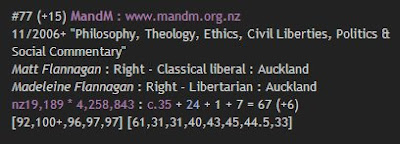
    Speaking of things that made my day yesterday, we climbed 15 spots on the NZ blog rankings for September.

    If Tim had had our correct uniques for September we would have officially climbed 26 spots to the number 69 spot (conservatively) but I recently upgraded our stats counter, so I could not provide him the data in the correct form; hence, we got guestimated – such are the rules. Tim does a great job so I won’t complain. The new position moves us to the number 4 spot of blogs formally identifed as Christian.

    So, I will leave the blog to Matt to manage, try to avoid the news, the computer and generally talking to people so I can focus purely on the books!

  • New Zealand Christian Blog Rankings for September 2008

    Extrapolating from Tumeke’s Semptember 2008 stats, the top 10 Christian Blogs* in New Zealand are:

    1. NZ Conservative (24)
    2. The Briefing Room (30)
    3. Something Should Go Here, Maybe Later (36)
    4. MandM (77)
    5. Samuel Dennis (80)
    6. Gavin Knight (91)
    7. Contra Celsum (94)
    8. Put up Thy Sword (115)
    9. Say Hello to my Little Friend (a.k.a Beretta Blog) (128)
    10. Section 59 Blog (147)

    (Numbers in brackets show the overall NZ ranking of each blog)

    *This list does not include Christians who blog but whose blogs are not identifiably Christian and is based on Tumeke’s classification and ranking methods.

    If you think your blog should be on the rankings click here.

  • Some Autobiographical Remarks: How I Discovered Christian Philosophy

    Increasingly so of late, I find myself in conversations, in the receipt of email requests or blog comments asking where to begin and how to expand one’s Christian philosophical understanding. I have been asked to recommend books and places to study and to share my own journey in this area.

    I started my studies at Waikato University in 1993. I was advised by the leadership at the church I attended, a church with some 300 student members I might add, to not study philosophy. I was told that this subject was one Christians should avoid or risk being led astray. However, for the reasons of timetabling, I was left with no option but to study Introduction to Philosophy.

    At that time the only apologists I was familiar with were Josh McDowell and Steve Kumar, who had spoken to our youth group. In Kumar’s book, Christian Apologetics: Think Why You Believe, there was a bibliography and for some reason I decided to go to the University library and follow these books up. I did not end up following the bibliography exactly as the first book that stood out on the shelf when I went into philosophy of religion section of the library was a book called God, Freedom and Evil by Alvin Plantinga and something prompted me to pick it up. I had never heard of Alvin Plantinga and had no idea that I had just picked up the definitive discussion of the logical problem of evil. As a first year student, with no background in philosophy, I actually managed to read it from cover to cover.

    This is not where I recommend people to start, as Plantinga is hard going, but it did give me one advantage. I had not been captivated by a superficial treatment of the issue but by arguably the best treatment of that issue in the literature. Plantinga opened my eyes to the possibilities of Christian theorising.

    I began devouring other authors. I stumbled on Richard Swinburne’s The Existence of God, one of the most rigorous arguments for the existence of God written in the last century. I read Paul Helm’s discussion Eternal God: A Study of God Without Time and Reichenbach’s defence of the cosmological argument in Cosmological Argument: A Reassessment. Following up a footnote in Helm’s book, I came across another author I had never heard of, William Lane Craig and read his book The Kalam Cosmological Argument. I discovered Thomas Morris’s The Logic of the God Incarnate (I don’t know why more theologians don’t read Morris) and began reading various anthologies on Philosophy of Religion.

    At the same time I was studying religious studies under Doug Pratt, someone very sympathetic to Lloyd Geering, and we covered the rationality of theism in our Introduction to Philosophy course. I can honestly say the sceptical focus of these courses had absolutely no effect except to teach me how superficial the scepticism I was being subjected to was. To be told by Geering that no intelligent person can believe in God with only brief justification and then be informed that Christianity must be completely re-worked alongside contrasted by the detailed point by point rebuttal of arguments for atheism in my extra-curricula reading by Plantinga and Swinburne meant there was no contest.

    By my second year, I had read Plantinga’s God and Other Minds: A Study of the Rational Justification of Belief in God. This book was absolutely brilliant. Plantinga demolished several common arguments for atheism; however, he also made some astutely critical points against the standard Christian arguments for God’s existence. Two thirds through the book he concluded that the arguments for and the arguments against were inconclusive, he the made what seemed to be a bizarre move and turned to the problem of other minds, he pointed out that the arguments for and against the existence of other people were equally inconclusive and in some cases the arguments failed for reasons very similar to the arguments for the existence of God. Yet, belief in other minds was clearly rational, so why wasn’t belief in God?

    This struck me as odd. Surely belief in God was totally different to belief in other minds. Faith and Rationality: Reason and Belief in God edited by Plantinga and Wolterstorff changed my stance. Until then I had been devouring books by Craig and Swinburne arguing for the existence of God. Plantinga, however, suggested that there was a flawed method behind the demand for evidence. Many discussions on the existence of God tacitly assumed that there was a neutral body of propositions assented to by believer and non-believer alike. All other propositions were rational only if they followed from this original body by evidence. Plantinga’s radical suggestion was that Christians and non-Christians started with a different body of evidence to each other. The idea of a neutral agreed upon starting point was a fiction and usually incoherent. Frequently assumptions that made sense only from a naturalistic viewpoint were smuggled in to the ‘neutral’ starting point, subtly rigging the debate.

    This opened my eyes, particularly in the area of ethics. I started seeing why people came to the conclusions they did and Christians seemed unable to combat them despite perceiving that there was something wrong with their argument. The idea that religion had no place in public life or scholarship and people had to bracket their faith commitments when answering normative questions meant that the fundamental premises Christians relied on for their conclusions were discounted from the outset. Christians were being forced to justify their conclusions from a perspective that was really hostilely secular but was taken for granted as the neutral starting point that nobody could question.

    I went on to write my Masters thesis in Philosophy on Plantinga’s ideas on faith and reason. I took the lessons I learned into my PhD in Theology and extended them into ethics. At no point, at any institution I studied in, was I ever taught these things in class. The textbooks used contained superficial treatments of Christian ethics that had been shredded by Christian Philosophers. The lecturers hadn’t read Christian Philosophy or if they had, they had only dabbled in it and had a superficial understanding or were unaware of the extent it went focussing on minor players. I had no choice but to teach myself by reading widely.

    So in summation, in New Zealand, there is nowhere (yet) where I could recommend people to study Christian Philosophy. If you want to become proficient in this field you are probably best to enrol in a secular philosophy degree program, and hunt down and read all the counter arguments from the high-level Christian philosophers as you progress.

    As a starting point, accessible to anyone without a background in Philosophy, I would recommend the book Reason for the Hope Within: Alvin Plantinga edited by Michael Murray. This book is hands down, the best introduction to Christian Philosophy and Apologetics as it combines rigour with accessibility to the lay person. I cannot recommend this book highly enough.

    Further, in conjunction with Thinking Matters Tauranga, we are developing a critical thinking course for lay people to teach the basics of logical analysis of arguments, some intro to Christian Philosophy and how to approach common objections to the faith. This will initially be launched in Tauranga early next year but we intend to bring it to Auckland and hopefully make it available more widely from there.

  • Answering the New Atheism: Invitation to a Thinking Matters Event

    Taken from Thinking Matters – Events & Announcements:

    Answering the New Atheism

    Dr Steve Kumar Dip Theo, BA, M Div, PhD

    When: Tuesday 28 October
    Time: 7.30 – 9.30pm
    Where: Bethlehem Community Church Center – 183 Moffat Rd, Bethlehem
    Cost: Free
    Event Format: Live Presentation followed by Q&A and discussions

    In this presentation, Dr Kumar will examine the objections to religion put forward by the New Atheists, showing how they fail the tests of reason, history and common sense. He will then weigh Christianity against the atheist view of the world and show how Christianity better accounts for the source of morality, meaning and truth.

    Dr Kumar has been speaking and writing about questions of religion and philosophy for over twenty five years. He is a frequent debater and guest speaker at universities and conferences throughout Europe, Asia and the Pacific and is the author of many books, including Christianity for Skeptics.

    Thinking Matters
    Thinking Matters is an inter-denominational group where you can come to analyse and discuss some of the deeper issues of the Christian faith in the areas of Philosophy, Science and Apologetics (see definitions here

    ).

    The purpose is to make Christian truth claims more relevant to an increasingly sceptical and secular culture, showing the reasons why we believe what we believe and providing answers that simply make sense.

    Who is Welcome?
    It’s open to Christian and Non-Christian alike – anyone who is seeking the truth in philosophy, science and scripture. You don’t need a philosophy or a theology degree to be able to understand the speakers.

    More on Thinking Matters Tauranga

    More on Thinking Matters

    RELATED POST: The Point of Intellectual Engagement: Why Thinking Matters

  • Guest Post: Laidlaw College’s Mark Strom Responds to Critics

    Some weeks ago I wrote a review on the launch of Laidlaw College. I commented on the new vision for the future and my own reflections and frustrations of studying at its previous incarnation, Bible College of New Zealand.

    The comments section of this post saw the eruption of strong sentiment and criticism of Laidlaw College. The level of tension evident in what was said and the volume of readers concerned about the issue was quite surprising; our site stats record that this entry is one of our most read and most commonly Googled-for blog posts. Under fire was the seriousness of Laidlaw’s commitment to its new stated vision, its ability to commit to it and the employment process around the appointment of one of the new heads of department.

    As we are not party to the hiring practices of Laidlaw and as I was an unsuccessful candidate for the position that came under fire, we did not feel it appropriate to participate in the discussion. However, given the nature of some of the claims made, we have granted Dr Mark Strom, Principal of Laidlaw College, a right of reply.

    Matt

    Mark Strom’s Response:


    I’m delighted that the changes at Laidlaw have drawn so much interest. I’m also amazed that so many people (claim to) know (alleged) relationships between institutions, the intentions of board members, the processes of faculty appointments, my motives, the extent of faculty members’ knowledge, and so much more.


    Perhaps I can clarify one or two things.

    First of all, a big thanks to Matt and Madeleine for their very fair and balanced comments on Laidlaw. I personally appreciate encouragement and support from fair-minded friends able to be constructively critique and provoke us to push on.

    Second, people are right that Laidlaw still has a very long way to go. Our best over 86 years has been very significant. But did we become somewhat captive to a dualistic piety and its attendant culture(s)? Yes. Was this true of everyone and everything at college? No. Are we genuinely imagining, articulating, designing and making concrete something more holistic and engaged? Yes. Are there gaps between what we espouse and what we deliver? Yes. Is the trajectory clearly toward teaching, researching and championing real integration of thought and culture around a critically-informed evangelical theology at the highest standards of academic quality, intellectual rigour and serious faith? Yes, yes, and yes. This is our commitment. Piece by piece we are rethinking things and taking decisions that move us toward this. And we’ll take all the constructive criticism we can get from people who can imagine what a difference Laidlaw College could make to New Zealand and beyond, and who will give us room to try, to fall short, to grow and just maybe to succeed.

    Third, a few comments on details raised by respondents.

    Matt is right to note that evangelical organisations sometimes do not follow through on significant reforms. Like every other western institution, two legacies shape us: a Classical tradition that (for the greater part) censured change; and a Judeo-Christian tradition that introduced the appalling innovation (to classical minds) that one could break with conformity and be transformed by a radically changed mindset. Centuries of dialogue, intrigue, enmity and plagiarism between the traditions, overlaid by wave upon wave of Christian convention, has bequeathed an uneasy juxtaposition of conformity and innovation to evangelical institutions and leaders. I know this only too well within myself.

    I am loathe to comment on a colleague (and Rod will be appalled that I have defended him). Were there other candidates? Yes. Were some better qualified as per degrees and writings? Yes. Were these the only criteria for the appointment? No. The following competencies were crucial. First, an ability to see the disciplines of theology through the lens of the Bible’s own narrative structures and in particular the NT witness that the story and its great themes have reached their culmination in Jesus Christ. In other words, to read Christology not as one of many loci of Christian theology, but as that which makes theology Christian. [Barth surely had that right.] Second, an ability to model the teaching of theology as engaged in matters of historical, intellectual and public discourse, ie. worldviews and their impact on society. Third, an ability to inspire teaching around these themes. Fourth, an ability to model a realistic and effective mentoring of students as they seek to choose patterns of personal and public response to God and his world that reflect an integrated faith grounded in the historic gospel. Fifth, the maturity and gifts to nurture a relational culture between academics. Rod was a very strong choice on all these criteria.

    Has Laidlaw reached its full potential as an academic institution? Not by a long shot. Do we have some fine scholars with impressive PhDs and publishing records? Yes. Do we need more of both? Absolutely, and we will seek them. Respondents may be interested to know that earlier this year we completed a faculty restructure process. Three faculty chose not to apply for new roles. All others were rehired under improved conditions for the express purpose of completion of PhDs and the generation of peer-reviewed research publications. Eleven already have PhDs. Six are underway on their PhDs (some nearing completion). Two have begun advanced studies (with highest grades) to progress into PhD studies: one in philosophy at the University of Auckland, and one in ancient history at Macquarie University. We have set the bar high for ourselves, and we have embarked on an ambitious programme of making good on these aspirations. These things do not happen overnight.

    The conspiracists may be interested to know that the Laidlaw board represents a very healthy mix of theological perspectives (within a broad evangelical consensus) and political and economic perspectives, and we enjoy spirited banter and debate on these things. The board ‘relationship’ with Maxim amounts to a few friendships. And why wouldn’t there be?! Many respondents have noted there are far too few individuals and groups in NZ prepared to engage in serious thought and action on matters that shape society. So when you find some, you engage. Do we always agree? Far from it. Do you shun the dialogue because someone has caricatured your dialogue partner (even in this blog)? I choose not to. Ignorant caricatures are one thing, but when someone writes “that Laidlaw, like many other NZ Christian organisations has been captured by Maxim institute and appointments are being made not on academic ability but from the approved Maxim checklist”, this is a stupid comment. Plain stupid…and offensive. If it were naming an individual, it might be considered defamatory. There is no agenda. There is no captivity. There is no list. This comment is ignorant, untrue and offensive to the good people of Laidlaw and of Maxim. [On a personal note, had I voted in the last Australian election (I’m an Aussie), I would have voted for Rudd – I doubt that fits the assumptions of the conspiracists.]

    The question has been raised about whether “we really need a Christian liberal arts college”. I am on record as being against the idea. Like doctoral mentor, Emeritus Professor Edwin Judge of Macquarie University, I always read the early Christians’ distinctive innovations and interactions with Greco-Roman society and thought as evidence for arguing against the idea of a distinctively Christian educational institution. Our forebears showed no sense of need nor ambition to establish Christian structures as alternatives to those of their societies. That evidence and line of inference is still suggestive to me for the modern context. Personally I have long argued against the establishment of university type programmes in Christian colleges. In my opinion, a public university education has afforded both a better education (greater breadth and less cloistered) and a stronger platform for progression into places of influence.

    However, more recently I have come to a different place. Since 2006 I have found myself arguing in favour of this College offering a small number of first class qualifications equal to or better than the best New Zealand universities (yes that is an audacious goal – but closer than some might think in some areas; yes we have a long way to go). My shift of argument has 3 pillars:

    1. I am alarmed at the loss of faith among undergraduate students (some student workers estimate it is as high as 70-80% of students by the end of their programmes). This trend includes Maori and Pacific Island students. I have come to believe the College can and should address this tragedy through the provision of first class tertiary education grounded in a biblical worldview.

    2. I believe the reductionism of knowledge in university programmes has diminished their intellectual and academic rigour and integrity (not of course in every case). I believe in time this diminishes public discourse to the detriment of the nation. I have come to believe Laidlaw can offer a credible alternative education capable in time of influencing public discourse through literate and articulate graduates. Are we there? No. This is an audacious goal that will not come quickly, easily or cheaply.

    3. I believe Laidlaw should prepare (particularly young) women and men more deliberately for leadership in society, as well as in the churches. I have come to believe Laidlaw can equip such leaders for society most effectively through first class qualifications in education and the humanities (we are moving towards a School of Humanities with a PPE style BA degree: philosophy, politics, economics). I believe these qualifications offer appropriate ‘generalist’ educations for placing leaders of faith within education, media, business, health, social services, arts, politics and community leadership as well as continuing to serve the churches. My experience advising heads of corporations (commercial and government) confirms the sense that many employers are frustrated by the narrowness of many bright young university graduates of law, accountancy, commerce, business and engineering. Many are looking for classics and PPE grads. [This was confirmed earlier this year by the global managing partner of one of the world’s highest profile consultancies when I spoke at their global partners conference.]

    My argument for Laidlaw becoming such a College is not a reaction to ‘liberal’ humanism, nor an apologetic for a retreat into a Christian ghetto. On the contrary, I want to argue for a turning of the tables on the assumed hegemony of public universities over higher education. Most of the famed European and American universities began as colleges teaching a breadth of knowledge unified by theology as the core discipline. In short, they started like us. Over time almost every one of these institutions abandoned this theological and epistemological core. In the USA in particular this has prompted the rise of the Christian liberal arts college. [Yes, you may well hear echoes of Wolterstorf, Plantinga and others, as well as my own teacher of many years ago, Cornelius Van Til (and no, I am not a card-carrying VanTillian). By the way, Nick Wolterstorf enthused with me about the vision of Laidlaw when I visited him last year. And yes, that is name-dropping to counter some respondents’ assertions that no one knows or has read anyone.]

    The current education situation seems unnecessarily polarised: it seems we either accept the hegemony of the public university over intellectual discourse; or we retreat into the parallel universe of the Christian college. I no longer accept these as the only options. The time may be propitious for quietly, slowly building a credible alternative to university education on behalf of a nation: an alternative grounded in the theological worldview of historic Christianity, free of the dualistic legacies of traditional piety, and genuinely world-engaging and world-serving in the quality and openness of its teaching, mentoring and research and its contribution to public discourse. As Madeleine points out, this will require and make possible new engagements between Laidlaw College and the public universities.

    To all this talk of excellence I hasten to add our gospel commitment to strength-in-weakness and wisdom-in-foolishness. God delights in nullifying the “things that are” by the “things that are not”. Personally, I am a university drop-out who went on to consult to CEOs of major commercial and government institutions; I am a labourer who earned a PhD in the history of ideas; I am a spare parts salesman who become a principal. Some of the finest young men and women whom we seek as our students dropped out of school, did poorly at school, and generally do not think themselves capable of the kind of academic and personal formation we are seeking to make a reality. So in all our plans for “lifting the bar” we are working hard to establish a dignified, high-quality, effective pathway for those who would otherwise be overlooked.

    We don’t for one moment think any of this can be done easily or quickly. If this is a worthy task, it is a commitment to a generation.

    The notes about William Lane Craig are a bit of a mystery to me. I certainly know who he is (recall my VanTillian heritage). So do others at Laidlaw. I do recall hearing about it late. That happens. It had far more to do with poor communication (perhaps by us) than with ignorance or reluctance. We will endeavour not to make another “academic faux pas of this magnitude”.

    This has ended up a lot longer than I intended when I started. I’d like to frame my final comments (for now) around a thought I muse upon:

    I wonder how many respondents have lead significant institutions and been charged with effecting large-scale structural and cultural change? Or let me put it another way: a lot of people who point out our inadequacies, nonetheless join us in longing for high calibre Christian scholarship that has broken with the captivity of dualism to play a significant role in influencing a nation, society and church, with the gospel. I wonder if these people have the foggiest idea what it takes to position a traditional institution to deliver on such a desire.

    In other words, the ease with which people offer their opinions on what we should or shouldn’t have done at Laidlaw to this point is remarkable. Having been charged with being naïve, it seems only fitting to turn the table.

    Changing an 86 year old institution takes imagination, courage, humility and patience. Fortunately I am surrounded by people with far more of each than I possess. The pace at which we have instituted change has been mind-bogglingly fast for some, and too slow for others. One must honour a heritage and its continuing rich contributions even as one frames a vision that calls for radical changes. You cannot go from financial uncertainty to fully funded PhDs, new faculty and facilities overnight. Governance must be tightened. Financial reporting must be reworked. Deficits must be turned into surpluses. Assets must be reexamined. Accrediting and funding agencies must be given time to appraise and support the new directions. Cultures must begin to shift.

    Those expecting overnight adoption of the conventions and facilities of fine public universities will be deeply disappointed. Public lectures putting theological reflection on the table for the first time for hundreds of people will be viewed as populism. Hiring people with outstanding capacity to forge new trust and integration of gospel, culture and faith will be viewed as far less important than getting impressive CVs. Those with an eye to the long term will recognise strategy; the laying of further foundations (in addition to the fine existing legacies) upon which a great institution can be reimagined and redesigned by people in whom is combined an acuity and humility that will welcome scholars and students who exceed them.

    Can Laidlaw “see past their discovery of the basics”? I think so.

    Will people who read theology and philosophy beyond the popular, and who long for change within churches and evangelicalism and academies and public discourse in New Zealand, give us room to try, to fail, to grow, and just maybe to succeed? Time will tell.

    The Tall Poppy Syndrome is a pernicious, cowardly trait. Laidlaw College seeks an end to its hold over the imaginations and wills of New Zealanders. The fact that we have named a big vision makes us a target. We welcome the support of those with the faith, heart and guts to back something that just might make a difference.
    RELATED POSTS:
    Laidlaw College


  • Does Pluralism Make Faith Arbitrary?

    Recently I have been reading Timothy Keller’s book The Reason for God: Belief in an Age of Skepticism. (This is not like me because I don’t typically read popular apologetics books, and it is even more rare that I would lead a blog entry with one.)

    One thing that interested me is that when Keller examines the objections to the Christian faith he addresses first, not the problem of evil, but rather the claim that it is arbitrary, dogmatic, irrational, bigoted, etc to claim that Christianity is true in the face of pervasive religious pluralism. The fact that affirming Christianity involves adopting an epistemic stance that contradicts the stance taken by so many people, is seen as arbitrary and dogmatic.

    This is particularly so if one believes, as I do, that certain Christian beliefs are properly basic, that is, one can rationally assert them independently of any proof of their veracity. Doesn’t the fact that so many other people do not hold these beliefs and often hold contrary beliefs, make faith of this sort some kind of arrogant bluster? Isn’t it arbitrary for me to assume that my particular faith is true and everyone else is incorrect? I do not think so and in this blog I will sketch some of my reasons why.

    The first thing to note about this objection is that it is based on a claim that it is arbitrary to believe a proposition in the absence of proof if numerous other people do not hold that proposition.

    Now a little reflection should demonstrate the problem with this claim; the claim itself is one many people do not hold, hence, if the claim is true it is arbitrary to believe it without proof. As none has been offered, I am inclined to take the proponent of this view’s word and reject it. Moreover, as the proponent himself has not offered a proof it must be irrational for him to accept this proposition. In fact, there is an obvious incoherence in this kind of objection; the objector proposes that I reject Christian belief on the basis of the above claim, however, I can only do that if I accept the above claim. But if I accept the above claim, I am in the very epistemic situation the claim says I should avoid. It is hard to see how any coherent or sensible objection of this sort can be raised.

    There is another problem with this objection. Suppose, for the sake of example, I accept the objector’s advice, presumably then I should cease to believe in the Christian faith. But if I do this, aren’t I adopting an epistemic stance that is contrary to that held by many people? What about the many Christians, for example, who do not reject the Christian faith? By rejecting Christianity I am taking up an epistemic stance that differs from them and hence, am taking up a stance contrary to that held by many people.

    One needs to bear in mind too that the pluralist mindset, the concern so pervasive in our culture today, that all religions are equal and it is wrong to say one is incorrect and another is right is a peculiar western phenomena. Many religions reject this mindset, most religions claim that they are true. People generally don’t believe things that they think are false; to believe a proposition is to affirm it. Once this is realised it is clear that pluralism itself is one religious perspective, one that is contrary to most, if not all others. Until the pluralist can provide compelling proof of his position, it would be silly and outright irrational, to become a pluralist on the grounds that one shouldn’t adopt views widely rejected by others unless one can prove them.

    [At a later date I hope to review Keller’s book for this blog. It is a very interesting book as although it is popular, it draws on some fairly high level Christian Philosophers such as Plantinga, Alston, Swinburne, etc and for that reason alone is worth reading. It is interesting to see how a pastor can take these writings and ideas and make them accessible to a lay congregation. I am not so impressed with the second half of the book but I have not finished it yet. Reason for the Hope Within is, I think, a better introduction to apologetics, for those who have never studied it but who want to find a starting point, but this is, so far, a good second.]

  • On Going Blonde for a Date

    I finally got a date for my impending cervical disc replacement surgery:

    9 December 2008.

    I promptly changed my hair and went blonde – its one thing I get to control I guess.

    And no, I won’t be arguing the case for the rationality of changing one’s hair when faced with life changing events!