On 30 July 2013 Matt was interviewed on Shine TV about the Government Communications Security Bureau and Related Legislation Amendment (“GCSB”) Bill. The discussion on the issues of civil liberties, spying in times of threats against citizens is very good. The video is here:
Blog
-
Marquis and Ideal Desires
In response to my post Peter Singer Human Dignity and Infanticide, Ben Jury offers some astute comments:
“I agree with you, that Peter Singer does not motivate his account of ideal desires. However, I think there is a way to motivate it as follows: Marquis objects to Singer’s account because he thinks there is an alternative account of ideal desires that is just as plausible as his. But I think Marquis’s account of ideal desires leads to a reductio. If his Marquis’s account is right, then it seems that spiders would have rights to life. This is because if spiders were fully informed and rational, they would desire to live and thus have a right to life. This is analogous to Marquis’s claim that if infants were fully informed and rational they would desire to live and thus have a right life on Singer’s account. But granting spiders the right to life seems absurd. Thus Marquis’s account of ideal desires seems mistaken. However, Singer’s account of ideal desires is not absurd because for Singer, spiders do not have desires at all and hence cannot have ideal desires. Hence, because Singer’s ideal desire account can avoid the reductio, his account is more plausible then Marquis’s. (Obviously this is excluding your Hamlet counterexample, but I am curious what you think about the above.)”
Jury notes correctly that even if this objection is sound then it only addresses my argument that Singer’s account of ideal desires is unmotivated. It does not address the Hamlet counter-example or the other objections I raised.
Nevertheless is worth asking whether Jury’s objection is sound. I do not think it is. Let me offer two responses.
First, even if Marquis’ account of ideal desires is subject to the kind of reduction that Jury mentions, it does not follow that Singer’s account is motivated. I noted in my paper: “Various different conceptions of ideal desires have been proposed which will get around the counter examples aforementioned and not all of them involve the modification of actual desires. Consequently, Singer’s position appears unmotivated.” Here I pointed out there were various different counter examples thatescape the counter examples Singer proposes his account to explain. So, even if one of them fails – the account proposed by Marquis – that does not get around the problem.
Second, I am not convinced Marquis’ account is subject to the reduction Jury mentions. In my paper Boonin on the Sentience Criteria I suggested counter examples like the one suggested by Jury can be dealt with by distinguishing two questions.[1] The first is the question of what an ideally rational self would choose for itself (i.e. the ideally rational self), and what an ideally rational self would choose for it actual self (i.e. his non-ideally rational self).
 If one asks the former question then Jury is correct e.g. a spider that had all the rational cognitive capacities of a person, idealised, would not choose to die.
The answer to the second question is not so clear. Here we ask what an ideally rational self would choose if it knew that it would in fact have a future identical with the future of a normal spider – a future existence with no conscious experience at all, where it would lack any ability to value its life or any thing at all. It is certainly not obvious that an ideally rational person would value a future made up of such circumstances.
The question then arises as to (more…)
-
Published in Philo: Is Ethical Naturalism more Plausible than Supernaturalism? A Reply to Walter Sinnott-Armstrong
Jeffery Jay Lowder has informed me that my article “Is Ethical Naturalism more Plausible than Supernaturalism? A Reply to Walter Sinnott-Armstrong” was published in the Spring/Summer 2012 issue of Philo. The abstract is below:
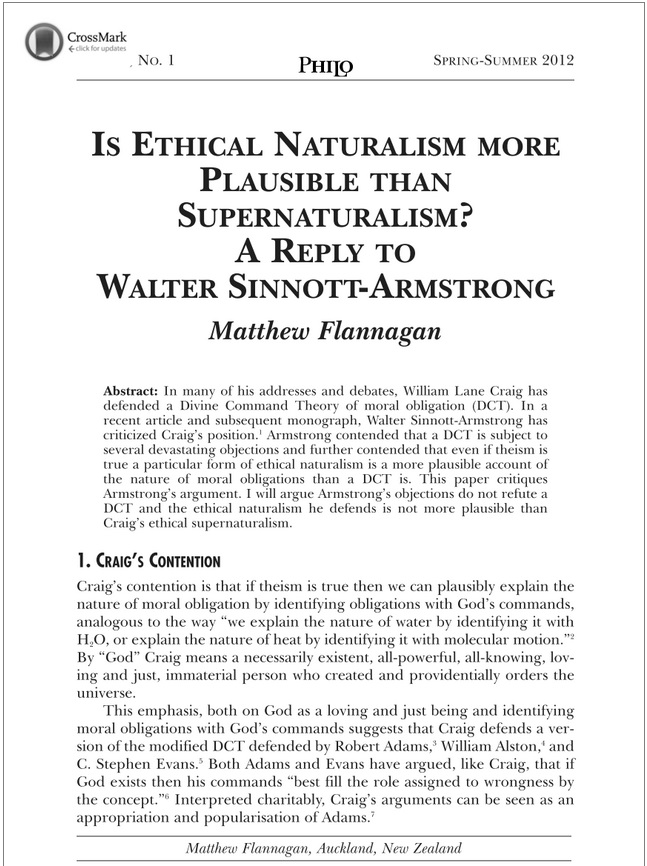 “In many of his addresses and debates, William Lane Craig has defended a Divine Command Theory of moral obligation (DCT). In a recent article and subsequent monograph, Walter Sinnott-Armstrong has criticized Craig’s position. Armstrong contended that a DCT is subject to several devastating objections and further contended that even if theism is true a particular form of ethical naturalism is a more plausible account of the nature of moral obligations than a DCT is. This paper critiques Armstrong’s argument. I will argue Armstrong’s objections do not refute a DCT and the ethical naturalism he defends is not more plausible than Craig’s ethical supernaturalism.”
You can read “Is Ethical Naturalism more Plausible than Supernaturalism? A Reply to Walter Sinnott-Armstrong” here.
-
Hear Matt @ the Stayin’ Alive 2013 Pro Life Internship Program in Wellington
This blog’s Matt will join Brendan Malone, and other speakers, to talk at the 2013 Pro Life Internship Program in Kapiti, Wellington which is running from 1-6 July 2013.
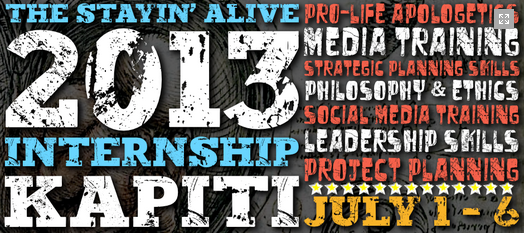
Matt’s talks will be:
Tuesday 2 July
15:00 – 16:00
Moral Relativism and AbortionWednesday 3 July
09:00 – 10:00
Kant, Utilitarianism and Abortion10:10 – 11:10
Logic and Logical FallaciesFor more information and details on how to register go to Stayin’ Alive.
-
Is a Divine Command Theory Pscyopathic? Sam Harris on Divine Commands: Part II
 In my last post, Sam Harris on Divine Commands: Part I, I criticised Sam Harris’ characterisation of divine command meta-ethics. In this post I want to turn to his second line of criticism of a Divine Command Theory. In Harris’ debate with William Lane Craig at Notre Dame, transcript here, Harris stated:
“I’m glad he raised the issue of psychopathy—we are being offered a psychopathic and psychotic moral attitude. It’s psychotic because this is completely delusional. There’s no reason to believe that we live in a universe ruled by an invisible monster Yahweh. But it is, it is psychopathic because this is a total detachment from the, from the well-being of human beings. It, this so easily rationalizes the slaughter of children. Ok, just think about the Muslims at this moment who are blowing themselves up, convinced that they are agents of God’s will. There is absolutely nothing that Dr. Craig can s—can say against their behavior, in moral terms, apart from his own faith-based claim that they’re praying to the wrong God. If they had the right God, what they were doing would be good, on Divine Command theory.”
Here, Harris suggests a Divine Command Theory expresses both a psychopathic and a psychotic moral attitude. I will address the charge of a Divine Command Theory being “psychotic” in a later post. Here, I want to address what I think is Harris’ main concern: a Divine Command Theory is psychopathic. It involves a “total detachment … from the well-being of human beings” and “so easily rationalizes the slaughter of children”. Why does Harris think this? “Because, at this moment Islamic terrorists are blowing themselves up convinced they are agents of God’s will, and a divine command theory can say nothing against their behavior in moral terms except the faith based claim that they are praying to the wrong God.”
A lot could be said about this argument. First, note that even if it were sound, it does not show the Divine Command Theory is false. Harris is, in fact, offering pragmatic arguments against the theory: it is dangerous, or is easily misused – but there are many things which are dangerous and easily misused that are nevertheless true.
More importantly, the argument is unsound. A Divine Command Theory contends that an action is obligatory if God actually commands that action. It does not contend that an action is obligatory if someone claims, or believes that God commands it. Obviously, simply believing something is the case does not mean that it is true. Harris, as an atheist, surely recognises this; many people believe and are convinced God exists yet Harris thinks they are mistaken.
Hence, the mere fact an Islamic terrorist believes God has commanded him or her to “blow themselves up” does not commit the divine command theorist to supporting terrorism. All a divine command theorist needs to say in response to Islamic terrorists is that (more…)
-
Why Defamatory Speech is not Free Speech
The following is a representation of the standard argument as to why a remedy requiring the removal of defamatory speech from a publication is not a violation of the right to free speech:
- The right to Freedom of Expression is protected by s14 of the Bill of Rights Act 1990 (“BORA”).
- The operational provisions of the BORA provide in section 5 that a reasonable limit to Freedom of Expression can be justified in a free and democratic society where that limit is prescribed by law.
- Section 5 is subject to section 4, which states in mandatory terms that no court can decline to apply any provision of an enactment on the sole grounds that the provision is inconsistent with the BORA.
- Notwithstanding this, section 6 requires the court rule in a manner as consistent as possible with Bill of Rights.
- If a Respondent’s actions constitute a breach of s4 of the Defamation Act 1992 therefore the remedy sought, removal of the defamatory material from the publication, does not violate the Respondent’s right to Freedom of Expression.
 While this is the standard argument it has always felt wrong to me. There is something unsatisfactory about appealing to a mechanism in the law that, as argued, feels like it is shearing off a part of an important right and freedom, even if the law says that it is ok.
I find this argument unsettling and lacking something; at the same time defamatory speech is insidious, causes harm, hurts; intuitively it just feels wrong to say that one is morally justified in spreading harmful falsehoods about a person and is not required to account for the wrongs done, because of their right to free speech.
After discussions with Matt about this I have decided that I prefer the following argument:
- Freedom of Expression exists to allow people to freely express their opinions and impart information without fear of legal penalty.
- Defamation is expression imparted to another that lowers the standing of a person in the eyes of their peers and is not true and is not honest opinion which is genuinely held.(I am ignoring the third defence, privilege).
- A person who expresses defamation is not engaging in Freedom of Expression as where there is no truth or honest opinion then a person is neither attempting to inform another or attempting to express their opinion.
- The basis for this is that to attempt to inform someone is to attempt to increase that person’s repertoire of true beliefs’ and to impart an opinion is to express what one honestly believes to be the case.
- Therefore, the freedom that the right to Freedom of Expression protects is all speech that is true or honestly held to be true by the speaker.
That is much better.
Defamatory speech is not free speech therefore legal sanctions against it are entirely appropriate in both legal and moral senses.
Context:
Two blogs have recently been found to have published defamation of me, the nature of which was described as “extremely serious” by a Court of Law. The above demonstrates why I feel I was perfectly justified in seeking the removal of the defamatory material, one by Court Order, one by private request. John Stuart Mill, the UN Charter, Milton, Common Law, to point to a few, have agreed for centuries that defining Freedom of Speech to be all speech that is not Defamation is just in all mediums. Defamatory speech being restricted or punished by law, offline or online, poses no threat to anyone. -
Auckland Conference: Science and Faith with Dr C John Collins
Thinking Matters have a couple of conferences coming up in July with Dr C John Collins:
 Much of Western culture assumes that science and faith are foes, that faith and scientific naiveté go hand in hand, and that science has disproved the Bible and made faith irrelevant if not completely indefensible and undesirable.
Come and hear Dr. C. John Collins explain why faith and science are actually friends, how good faith fosters good science, and how good science should actually lead people to be more open to faith and the Bible.
WHEN: Friday 19 July 7pm-9.30pm and Saturday 20 July, 9:00am-4:30pm
WHERE: City Presbyterian Church, 283 Karangahape Road, Auckland
COST: $40 ($20 for Students).Coffee and tea will be provided but please bring your own lunch.
Full details including info on how to register can be found over at Thinking Matters.
Consider also attending: Ancient Truth for Modern Times with Dr C John Collins