Blog

  • Ad Hominens, Special Pleading, Straw Men & Red Herrings: John Loftus’ Response to MandM

    John Loftus has written a response to my post “There Probably are no Duties. Now Stop Worrying and Enjoy Your Life!” Before turning to Loftus’ critique, let me recap my argument. While my post was satirical, it was intended to make a serious point. This being that many common and influential critiques of theism are incoherent.

    To establish this I argued three things.

    [1] That many critiques atheists offer of theism are moral critiques. Atheists argue that historically theism has been intricately linked with various forms of social oppression and/or the sacred texts of theistic religions condone oppressive practices.

    [2] That such critiques presuppose or assume the existence of moral duties. The critic has to assume that these practices are wrong even though the religious believers condone them.

    [3] That if one accepts the standard arguments atheists use against theism then the presupposition that there are moral duties is unjustifiable because precisely analogous arguments can be used to show there are no moral duties.

    Now if these three contentions are true then there is a fundamental incoherence in many common critiques of theism. If Loftus is going to provide a rebuttal of these contentions then he needs to provide reasons for thinking one of these three contentions is false.

    Unfortunately, instead of engaging the argument, Loftus ignored it and attacked a string of red herrings.
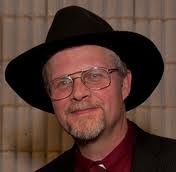
    John LoftusLoftus’ first argument in Do You Want to Be a Christian Apologist? Part 10 was to assert that I am “intellectually dishonest”, although somewhat charitably he states I am probably not aware I am dishonest – presumably I suffer from profound self-deception. Apparently the truth of this claim is blatantly obvious to “us” [by which he apparently means the atheist community].

    Unfortunately, simply stating that I am self-deceived and asserting with great confidence that I am wrong is not actually tantamout to offering a reason for questioning [1], [2] or [3] above. If it did then one could easily demonstrate that Loftus’ own work is substandard, I could just assert that it is and that everyone knows I am right and hey presto there’s my proof .

    Clearly, this is not a method by which one can reliably establish the truth or falsity of the matter.

    Loftus second argument begins with him drawing from my preamble:

    “Some atheists offer moral critiques of theism; their claim is not just that belief in God is false or unjustified, it is that such irrational beliefs are intricately linked with immoral and oppressive practices. Moral outrage often motivates the critiques offered – one only needs to read the condemnation of religious wars, religiously motivated terrorism, inquisitions, witch hunts, the suppression of science, sexism, homophobia, and so on, which is so prevalent in many free thought writings. Similarly, one needs only to read the accusations, regularly repeated in popular atheist literature, that the Bible condones slavery, or genocide, or stoning cheeky children, or rape, to observe this.

    Note that behind this critique is the presupposition that there are moral duties. People have a duty to not engage in wars or acts of terrorism, religious people who promote sexist or homophobic practices are wrong for doing so. I think this is nonsense as it assumes there is such a thing as a moral duty, it assumes things religious people do can be wrong. This is false and here is why.”

    After citing me Loftus rejoins:

    “Note the diversion here? Instead of providing answers to skeptical arguments he’s asking how anyone can have a moral critique of the Bible who doesn’t believe it’s the inspired word of God. He’s special pleading. No one else, given the rules of his game, can offer a moral critique of the Bible. Not a Hindu, nor a Muslim, nor a Buddhist, nor even liberals like the late John Hick or Thom Stark, or process theologians….. Do they? Do pantheists have a moral basis for critiquing the Bible? Flannagan would also have to reject the Natural Law Ethics (NLE) of the Catholic church, for if Natural Law Ethics obtains then even atheists have a basis for their moral critiques of the Bible. …”

    Unfortunately this rejoinder has little rational merit at all.

    First, I do address the sceptical arguments in question. By defending [3] I argue that analogues of these arguments entail an obvious false conclusion and therefore they cannot be sound. This is clear from reading the section of the original post which Loftus does not cite.

    Second, contrary to what (more…)

  • Matt to speak at the 2013 Evangelical Philosophical Society in Baltimore on Divine Commands re Abraham and Isaac

    This blog’s Matthew Flannagan has had his paper “Divine Commands and Biblical Authority: The Problem of Gen 22” accepted for the National Annual Meeting of the Evangelical Philosophical Society (“EPS”). The abstract for Matt’s paper is as follows:

    Evangelical Philosophical Society“One perennial objection to divine command meta-ethics is the possibility that God might command something abhorrent. Divine command theorists have responded that God is essentially good, as such, it is impossible for him to issue an abhorrent command. One challenge to this response, for those divine command theorists who accept a robust view of biblical authority, is the story of the binding of Isaac in Genesis 22. In this story God is said to have commanded human sacrifice; given that human sacrifice is abhorrent, and it is impossible for God to command the abhorrent, Biblical authority seems incompatible with the acceptance of a divine command theory.
    This paper responds to this challenge. First, I will argue that a careful reading of Genesis 22 in its literary context suggests God issued the command in a particular context. Second, drawing from discussions of the problem by Robert Adams Immanuel Kant, and Philip Quinn, I will discuss the circumstances under which a divine command theorist can rationally and coherently attribute a seemingly immoral command to an essentially loving and just God. I will argue that the context of God’s command in Genesis 22 is such that a divine command theorist can defensibly attribute it to an essentially good God without abandoning a robust view of biblical authority; the story of the binding of Isaac does not provide a divine command theorist with a defeater for belief in biblical authority.”

    The conference theme will be “Revelation and Authority.” The Plenary Speaker is Richard Swinburne of Oxford University. The draft copy of the ETS-EPS program is available here.

    Matt has also had a paper accepted for the Evangelical Theological Society’s Annual Meeting which is also in Baltimore around the same time – see Matt to speak at the 2013 Evangelical Theological Society in Baltimore on Feticide.

    As with previous years we will be fundraising to raise the $2,500 NZD to get him there . Donations greatly appreciated.

  • Matt to speak at the 2013 Evangelical Theological Society in Baltimore on Feticide

    This blog’s Matthew Flannagan has had his paper “Boonin’s Defense of the Sentience Criterion: A Critique” accepted for the 65th Annual Meeting of the Evangelical Theological Society (“ETS”). The abstract for Matt’s paper is as follows:

    Abstract
    “Defenders of the permissibility of feticide commonly argue that killing an organism is not homicide unless the organism’s brain has developed enough for it to acquire sentience: the capacity for consciousness and the ability to perceive pleasure and pain. In this paper I critique one of the more sophisticated versions of this argument, proposed by David Boonin in
     A Defense of Abortion. First, I sketch some prima facie problems faced by any appeal to sentience. Second, I examine Boonin’s attempt to defend an appeal to sentience against these problems by constructing a modified future like ours (FLO) account of the wrongness of killing. I argue that Boonin’s modified FLO defence of sentience fails. Both his argument for the modified FLO account and his application of this account to feticide rest on ad hoc arbitrary manoeuvres, manoeuvres which mean that the modified FLO account is a plausible criteria for the right to life only if one already grants that feticide is not homicide.”

    Matt’s ETS paper will be based on his article “Boonin’s Defense of the Sentience Criterion: A Critique” which was published in Ethics and Medicine – An International Journal of Bioethics Vol 25:2 (Summer 2009) 95-106. (You can download this article here).

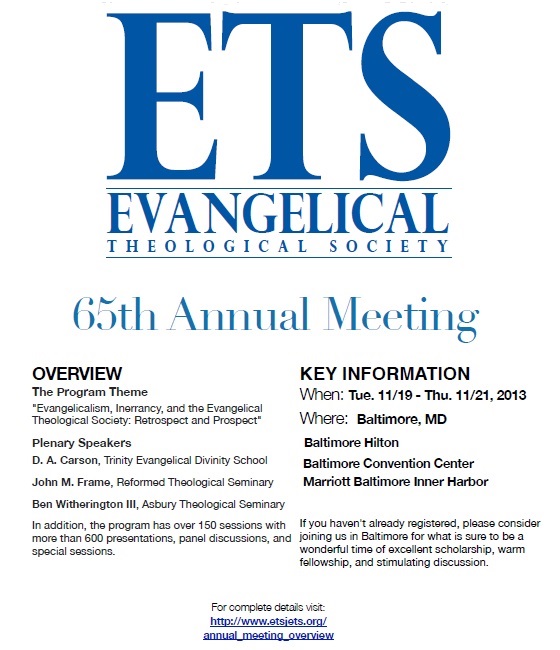
    This year’s Annual Meeting will be held in Baltimore, Maryland, USA from 19-21 November 2013.

    ETS Annual Meeting Flyer

    This year’s theme is “Evangelicalism, Inerrancy, and the Evangelical Theological Society: Retrospect and Prospect”. Plenary speakers for this year’s meeting are Dr Donald A Carson (Research Professor at Trinity Evangelical Divinity School), Dr John M Frame (Professor of Systematic Theology and Philosophy at Reformed Theological Seminary), and Ben Witherington III (Jean R Amos Professor of New Testament at Asbury Theological Seminary).

    Matt has also had a paper accepted for the Evangelical Philosophical Society’s Annual Meeting which is also in Baltimore around the same time – see Matt to speak at the 2013 Evangelical Philosophical Society in Baltimore on Divine Commands re Abraham and Isaac.

    As with previous years we will be fundraising to raise the $2,500 NZD to get him there . Donations greatly appreciated.

  • Hear Matt at MPC on: “Is it Narrow-Minded to Think Jesus is the Only Way?”

    This blog’s Matthew Flannagan will be speaking at Massey Presbytarian Church’s Night Church Service on the topic “Is it Narrow-Minded to Think Jesus is the Only Way?“

    Details are:

    MPC

    7:00pm (come at 6:30pm to grab a meal from the Night Church cafe)
    Sunday 29 September 2013
    Massey Presbyterian Church
    510 Don Buck Road, Auckland, New Zealand

    All welcome.

  • Madeleine speaking to Kerre McIvor on Newstalk ZB re Flannagan v ACC

    This morning on my way to work I turned on Newstalk ZB to find that Madeleine and her recent ACC victory were the topic of Leighton Smith’s morning show – Kerre McIvor was filling in. Madeleine ended up speaking to Kerre on air – you can listen here:

    Or download here:

    NewstalkZB have also reported on the case:

    “An Auckland lawyer has won her own legal battle against the Accident Compensation Corporation.

    Madeleine Flannagan has been fighting to get ACC to overturn its decision to stop her entitlements.

    ACC claimed her injury-related pain was due to a degenerative condition.

    Ms Flannagan says the decision was based solely on a diagnosis made by its own specialist.

    “Every doctor and specialist who’d seen me at that point and subsequently, had said it was an accident.”

    ACC overturned its decision just in time to avoid being taken to the District Court.

    It claims the “consistency and rationale of two independent specialists’ opinion” is more compelling than that of its own specialist.

    However, Ms Flannagan has her doubts over ACC’s true motives.

    “They settled about two weeks after they were served my appeal papers so I am very sceptical that it was the compelling nature of my specialist’s report.” [which they’d received copies of from Madeleine’s lawyers 1-2 years prior to offering to settle]


  • Flannagan v ACC – Victory

    Long time readers of this blog will remember than 5 1/2 years ago I was in a car accident that saw me suffer a herniated cervical (neck) disc and require disc replacement surgery. Readers will also be aware that the pain I lived (live) with did not end after that surgery and that when the Accident Compensation Corporation (ACC) went on to cut my entitlements, plunging our family into poverty (NZ definition) as I was the primary earner, I instructed John Miller Law in Wellington to fight their decision.

    Matt and I were terrified at the possible $8,000 + bill we might face if we lost; trying to provide for our 4 children in Auckland on $15,000 p/a was extremely difficult as it was without a debt like that being added to the mix. We appealed on this blog for donations and with the help of those who generously gave, along with the generosity of John Miller Law, who more than once wrote off parts of my bill, we managed to keep the legal proceedings going even after we lost the Review Hearing.

    I pressed on for a number of reasons. I firmly believe that ACC deliberately set about to exit me from cover by sending me to a doctor they knew would say I had degeneration. I believe this on the basis of the Court’s previous findings on Mr Otto and on the basis of his reputation among his peers – I have previously blogged my experience of phoning Orthapaedic Surgeon’s offices and sharing what those offices had to say about him to me. I also believe this on the basis of what happened at the appointment with Mr Otto – his pronouncement of my having a degenerative condition before he’d asked me if a single medical question and shortly before he shared that he had not yet seen my MRI, X-Ray or Bone Scan films and reports. I knew my condition was not degenerative or pre-existing: I was working full-time, studying part-time, raising 4 children, running a house and was engaging in equestrian sport on the weekends immediately prior to the accident.

    The other reason I filed was for all the other people like me. I believed then, and I still do, that ACC did what they did to me (cutting me off by sending me to a specialist they know will say a condition is degenerative when other specialists would not) to many other people and that doing so was a numbers game for them – a way of cutting their bottom line. Cut x number of people off, only teeny proportion y will fight; of those who fight ignore them unless and until you are faced with a court date, then quickly settle before that court date to avoid the public damage the judgment of the Court can deliver.

    We filed my appeal earlier this year. This consisted of three expert reports written by Orthopaedic Surgeons Greg Finch and Michael Barnes. We also filed affidavits from Matt and I, which we wrote ourselves. ACC offered to settle in full shortly after they were served: legal costs, report costs and full reinstatement of my entitlement, the maximum I could have won in Court.

    More than one person said to me ‘but Madeleine, if you settle no light will be shone on ACC’s practices’. While I shared their concerns at the lack of a precedent being set if I settled, as a lawyer I know the Court’s view on people who refuse good settlement offers and press on to hearing. I took the settlement and resolved to shine light another way. I am one of the lead stories today on the New Zealand Herald’s website (and on the website of the Otago Daily Times🙂

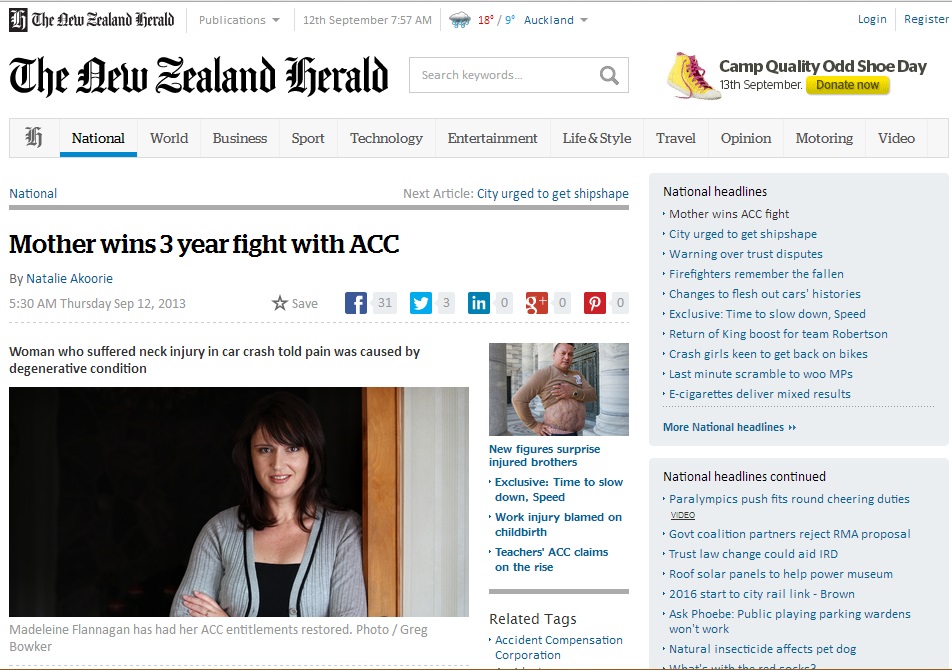
    Mother wins 3 year fight with ACC

    Click to read: Mother wins 3 year fight with ACC

    Mr Otto states in the NZ Herald article, after acknowledging he has no memory of my case, that I “would not have realised he could receive x-rays via email and that he would have seen them before diagnosing her”. I reject this. As I deposed in my affidavit:

    [40] A few minutes after making his opening statement that my condition was degenerative, Mr Otto asked me if I had brought my x-rays, MRI and bone scans. I told him that I had not been asked to and that the other specialists I had seen had all been able to log into some central record holding place and view them so it did not occur to me to bring them. He told me that his office did not have that kind of technology but he would request copies of the reports and films. I offered to send them to him but he said not to bother as ACC had only sent him a letter which didn’t say much so he was going to have to request various things from my file anyway.

    [41] In this moment it was clear that Mr Otto had made his statement about the purpose of the appointment being to discuss my “degenerative condition” in advance of asking me a single question, without having examined my x-rays and scans and on the basis of whatever ACC had communicated to him about me.

    [42] It was also clear that Mr Otto had conducted the appointment with a predetermined purpose: to determine a degenerative condition. He had decided this was my diagnosis before the examination, before being in receipt of the relevant medical evidence. I did not have confidence his diagnosis post-appointment could be objective or unbiased.

    My and Matt’s affidavits are here in full:
    13.03.22 Affidavit of Madeleine Flannagan – Flannagan v ACC
    13.03.22 Affidavit of Matthew Flannagan – Flannagan v ACC

    This is the case I refer to in my affidavit where Mr Otto was found by the Court to prefer his degeneration diagnosis in the face of evidence to the contrary: Lu-v-Accident-Compensation-Corporation-2011-NZACC-45 (A New Zealand Herald article about that case is available here)

    ACC said in the NZ Herald article “An ACC spokesman said it found the consistency and rationale of the two specialists’ opinions “more compelling” than Mr Otto’s report. “As a result ACC decided to reverse its decision.””

    I would like to stress that until ACC insisted (see affidavits) I see Mr Otto, every specialist and doctor who had seen me at that point said my issues were accident related. Mr Otto was the only one who said otherwise. Subsequant to Mr Otto’s report ACC were provided with 2 reports from Greg Finch and 1 from Michael Barnes  – these were the reports ACC found “more compelling” than Mr Otto’s – they were provided the first of these approximately 2 years before they settled, the others they received approximately 1 year before they settled. The service papers for my appeal containing these same reports they received a couple of weeks before they settled.

    Make up your own mind as to whether is was “the consistency and rationale of the two specialists’ opinions” that caused ACC to reverse its decision or whether it was the threat of a court case.

    I have to thank John Miller Law, all those who donated and encouraged me, Greg Finch, Michael Barnes, my church, my family and friends and especially my children and husband who suffered so much along side me – if it wasn’t for Matt going to my lectures and taping my classes and taking notes for me for me to attend to on the couch I would never have finished my law degree. I still live with pain today and it still impacts my life adversely but I am a lot better than I was and I continue to improve.

    Update: For those wondering how I completed a law degree when I could not work, I refer you to Matt’s post Madeleine Admitted to the Bar where he outlines just what it took and how hard it was given my injuries. It is also documented in the affidavits I have published in this post.

    NewstalkZB focussed on Madeleine’s case during the Leighton Smith show.

  • There Probably are no Duties. Now Stop Worrying and Enjoy Your Life!

    Some atheists offer  moral critiques of theism; their claim is not just that belief  in God is false or unjustified, it is that such irrational beliefs are intricately linked with immoral and oppressive practices. Moral outrage often motivates the critiques offered – one only needs to read the condemnation of religious wars, religiously motivated terrorism, inquisitions, witch hunts, the suppression of science, sexism, homophobia, and so on, which is so prevalent in many free thought writings. Similarly, one needs only to read the accusations, regularly repeated in popular atheist literature, that the Bible condones slavery, or genocide, or stoning cheeky children, or rape,  to observe this.

    DutyNote that behind this critique is the presupposition that there are moral duties. People have a duty to not engage in wars or acts of terrorism, religious people who promote sexist or homophobic practices are wrong for doing so. I think this is nonsense as it assumes there is such a thing as a moral duty, it assumes things religious people do can be wrong. This is false and here is why:

    First, the burden of proof is on he who makes a claim. I am not making a claim. I am simply not affirming that moral duties exist, therefore I do not have to justify my non-belief in duties. Instead those who believe in duties have to come up with compelling proof that they exist.

    Second, no-one has ever seen a duty. Duties have no colour, shape or smell or sound, hence, they are invisible to sensory perception. One cannot empirically verify or falsify the claim that duties exist so it is meaningless incoherent nonsense to believe in duties until verification of them is given. Moreover, the inability to verify these claims shows they are unscientific and so they cannot be accepted as rational.

    Third, no one as yet has provided a proof that duties of any sort exist. Such things, if they can be decided at all, must be shown to exist by the methods of natural science. To date no one has shown that belief in moral duties is necessary to any scientific theory; physics or chemistry or biology each have no need of that hypothesis to explain the world.

    Fourth, think of all the evil done in the name of duties. Almost every war fought throughout history has been justified by those who claimed they were doing the right thing. Inquisitions, crusades and the suppression of science were all done in the name of doing the right thing and avoiding the wrong thing. While science flies us to the moon, belief in duties flies planes into buildings. (more…)