Blog

  • Matt on “The Panel” on Pat Brittenden Mornings – with David Slack

    Radio RhemaIf you tuned in to Radio Rhema at 11:45am (NZ time) on 3 July 2012 you would have heard this blog’s Matthew Flannagan and David Slack discuss topical issues such as  the government’s idea of drug-testing beneficiaries, the government’s back-peddling on the ETS and kiwi slang, among other issues, on “The Panel” on Pat Brittenden mornings.

    You can listen online here.

  • Blogging as a Supplement to Peer Review: My 2011 SBL & ASOR Paper

    At the 2011 annual meeting of the Society of Biblical Literature and the American Academy of Religion in San Francisco I gave a paper in the Blogger and Online Publication session entitled “Blogging as a Supplement to Peer Review“. It occurred to me today that I have never published it on MandM so here it is.

    This paper will not be a normal academic paper. Normally, when I present one of them, I have a specific thesis I try and offer an argument for it and rebut arguments against it. Today however I will present more of a narrative based on some reflections from my own experience as a blogger and scholar and someone who blends the two.

    Peer ReviewI began engaging in “biblical blogging” with great reluctance.  One of my biggest reservations was that blogs are not peer reviewed. Anyone can, and does, write anything at all and get it published on the internet – even, if it’s complete nonsense. One only has to surf the net for a few minutes to see the problem.

    Further, the readership of blogs is not restricted to scholars. Many blogs feature a person writing on a subject with little or no understanding of it who have a following of devoted readers who are equally ignorant, but nevertheless read and comment on the same topic as if they were knowledgeable. My impression was that blogs on theological topics were no less immune to this problem than blogs on other topics.

    So my first reservation was that a blog post really carried no stature; I felt it would be embarrassing to be known as a blogger – I was seeking to be a scholar.

    My second reservation based on my experience with online communication. There are subtle social constraints on face to face communication. If I have to stand up and speak in front of an audience at a conference I will be nervous.  If I say something stupid publically others will laugh at me and I will be embarrassed. If I get really nasty and cross a line someone might get physically threatening and even hit me if I provoke them. There are social consequences to what I say. Online, however, many of these social constraints are muted, one can be completely anonymous or communicate from a fictional personae. People can say things they would never say saying in public without facing the normal social consequences of such comments. This means that online discussions can be counter-productive. Most bloggers will be familiar with the phenomena of “trolls” people who enter into online discussions simply to insult, attack and distract the discussion. I could not see the attraction much less the benefit of engaging in a medium like that.

    I think both these reservations have some merit. However I now believe that, despite them, blogging can serve as a supplement to peer review. It is hard to not believe that given what blogging has done for me but before I get into that, note that I said supplement, my suggestion is that it can supplement not replace peer review.

    Some Challenges of Traditional Peer Review
    In 2006 I graduated with a PhD in Theology. The prospects in the job market were bad in New Zealand – my part of the world – particularly for an unknown fresh graduate. An immediate goal of mine was to establish myself as a credible theological scholar which, of course, meant getting my work known. I resolved that I needed to be published. If I developed a series of publications, others in my field will read my work, and as a result my work will become known. I began by following the usual route of submitting articles to journals for publication and I found it hard going.

    Let me note two challenges I found with this:

    First, almost no one reads your article until it gets published, and this can affect you (more…)

  • Matt on “The Panel” on Pat Brittenden Mornings – with David Slack

    Radio RhemaIf you tuned in to Radio Rhema at 11:45am (NZ time) on 26 June 2012 you would have heard this blog’s Matthew Flannagan and David Slack discuss topical issues such as the plight of the South African grandmother who may be forced to go back home, and also, the last few days of TVNZ Seven, among other issues, on “The Panel” on Pat Brittenden morning.

    You can listen online here.

  • Singer on Matthew Flannagan in “Peter Singer Under Fire: The Moral Iconoclast Faces His Critics”

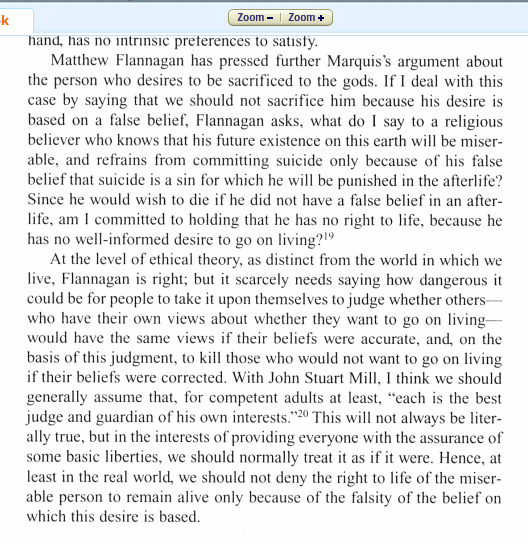
    Yesterday Matt went the library and did a little reading for his upcoming Evangelical Philosophical Society paper “Peter Singer, Human Dignity, and Infanticide“ and he discovered that email exchange he’d had with Peter Singer in 2006 had resulted in a few paragraphs in Singer’s book Peter Singer Under Fire: The Moral Iconoclast Faces His Critics.

    Here is a screen shot of what one sees when one uses the “search inside this book” function:

    Peter Singer Under Fire: The Moral Iconoclast Faces His Critics

    Matt does not feel that Singer accurately portrayed his counter example but the substance Singer presents of it is correct. Singer’s response to Matt seems to be that Matt is right in principle but in practice it would never be an issue.

  • Madeleine and Matt to speak on “Being Good: Christian Virtues for Everyday Life” at the 2012 Evangelical Philosophical Society Meeting in Milwaukee

    Evangelical Philosophical Society

    I have had to revise my earlier statements about not going to the November 2012 academic conferences in Milwaukee on the grounds that when you are personally invited to participate in a panel discussion by Doug Geivett and Mike Austin at the Evangelical Philosophical Society (“EPS”) you do not say no 🙂

    (If I said “no” I think Andrew would throw things at me and André Z would egg him on)

    Matt has been invited to speak on the same panel too.

    Here is what we know so far:

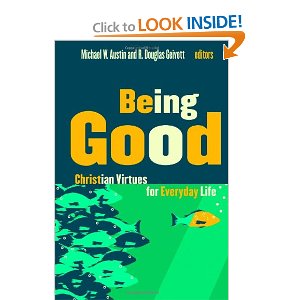
    Being Good: Christian Virtues for Everyday LifeMike and Doug co-edited a book entitled Being Good: Christian Virtues for Everyday Life.  At the EPS meeting in Milwaukee in November 2012 there will be a panel discussion in one of the sessions offering critical discussion of the book and it’s themes. Matt and I are now scheduled to be participants in that panel.

    The panel will discuss different aspects of the book, such as, an analysis of a virtue in the book that a participant disagrees with by giving an extension of the book’s discussion of character in some way.

    Matt was already going anyway as his paper on Singer and Infanticide got through the blind review process and was accepted.

    I had thought I might not go as we in the process of radically changing how I earn money. I am about to swap my regular weekly income for a contract for services that will see me retain most of the money I make my firm but pay my own expenses (and still be supervised and under the umbrella of a firm as all baby-lawyers should be under the law). So this is both exciting as I will have more control over what I earn but it is also scary as there are no guarantees that I will earn consistently; imminent changes to how legal aid is to be paid make that even scarier. The theory is that in the long run I will make more than I was on my very low baby-lawyer income but it is yet to be tested. As I am the primary earner in our house there is a lot riding on this, including the extension to our mortgage to purchase this opportunity. Going to America is not a cheap exercise from New Zealand but we have providentially managed to find a way the last two years with a lot of help from our friends so I am going to stop worrying and focus on trusting in God to whom I am  grateful for this opportunity.

  • My Faith Journey

    Like Jacob in the book of Genesis, my spiritual journey has been one of wrestling with God. Not physical wrestling, like that engaged in by Jacob, but wrestling intellectually with the questions and implications that have arisen from my realisation that God exists and Jesus Christ actually, in reality, rose from the grave.

    Faith JourneyI was not raised a Christian; in my early years my family attended an Anglican Church. This was part of the residual Anglicanism which is part of New Zealand’s heritage as a British colony.  We ceased attending in the early 80’s when I was around 6.  I was raised in a very secular environment where what are commonly referred to as ‘liberal ideals and values’ were taken for granted.

    Something kept drawing me to the reality of God. New Zealand has an amazingly beautiful country-side, which I spent a lot of my youth hiking and exploring in; I kept being aware of a spiritual presence, a glory, an amazingly awesome being reflected in the world around me and I felt it was providentially guiding me. I engaged in theological debates at intermediate and high school as I explored this sense.

    Then at 16 I began to ask serious questions about morality and my life. My parents had divorced, my friends were promiscuous, doing drugs and breaking the law. I had attended a very conservative upper-class boarding school and I had also attended a very permissive public school by then. I began to ask questions about how I should live, were the beliefs I had correct, what sort of person did I want to be? Who was correct, the Christians from the past or the moderns of today? And how do we tell – how can I know?

    These questions lead me to attend a Church in 1991, which was enthralled by the teachings of Bishop Spong. Spong was teaching that the bible was not authoritative, Christ did not rise from the dead, Christians needed to revise their views on sexuality, and so on. I was puzzled as to why a Church would teach things like this. The elders recommended I read some “modern critical scholarship”. This led me to encounter the debate over many of these issues for the first time. I discovered Josh McDowell, Alistair McGrath, Francis Schaeffer and serious evangelical scholarship for the first time.

    At a youth camp ran by the Methodist church in 1991 I ran into a small group of evangelicals who began sharing with me the Christian faith. I came before God in prayer and committed by life to following him. This was the most dramatic life changing experience I have ever had.

    I started University the next year. Waikato University was the most secular university in New Zealand, and my new beliefs came under concerted intellectual attack. For time-tabling reasons I was forced to do a philosophy degree and from day one everything I had committed to was assaulted intellectually in my classes. My wrestling with God continued. As my interlocutors raised questions I went to the library to find literature that was not on the reading lists, which helped me address these questions.

    I discovered the writings of Alvin Plantinga, Richard Swinburne, William Lane Craig and J P Moreland. I began to ask questions about how my faith related to politics or history or to the theoretical disciplines I was studying. There was no real place I knew of where evangelicals could get these questions answered so I went to the library and began to skim through the books on the shelf and read. I began using what I discovered to respond to my sceptical interlocutors. I soon found they were quite unprepared for the answers I gave. It seemed to me Christianity had lost the cultural battle by default with skeptics raising age-old questions that Christian writers had already addressed and taking the silent response as acquiescence.

    I also began to discover the great classics from Christian history. After disagreeing sharply with the very skeptical lecturer of my religious studies class I began checking primary sources. This led me to begin reading Athanasius, Augustine’s City of God, Calvin’s Institutes, sections of Aquinas and so on. I began to discover there was a wealth of history that I had not been made aware of and which my culture had caricatured.

    My wrestling with these questions transformed me radically. I went on to do a Masters degree in philosophy on the relationship between faith, reason and scholarship and a PhD thesis on ethics. I found myself estranged from the very anti-intellectual, pietistic evangelical traditions that dominate in New Zealand. I also felt estrangement from the mainstream academic community due to my commitment to a fairly conservative Christian faith.

    Despite this, I have felt in doing this I have been faithful to the call I perceived on my life at a young age. It ignited in me a passion to assist other Christians to wrestle with these questions and to come up with credible answers with which to engage the secular culture credibly.  It has led me to having a very Socratic pedagogy and a demand for a high level of logical rigour, cultural awareness, and faithful theological commitment to my endeavours. This is why I blog at MandM.

  • Madeleine on “The Panel” on Pat Brittenden Mornings – with Craig Heilmann

    Radio RhemaIf you tuned in to Radio Rhema at 11:45am (NZ time) on 21 June 2012 you would have heard this blog’s Madeleine Flannagan and Craig Heilmann discuss topical issues such as the first car to be crushed under the new laws and whether it is a deterrent or not, whether Matariki should be a public holiday, and their thoughts on the creationism debate, among other issues, on “The Panel” on Pat Brittenden morning.

    You can listen online here.