Blog

  • Goodbye Anna

    Peter Cresswell posted this afternoon that blogger Anna Woolf who blogged at Annie Fox lost her battle with Non-Hodgkins Lymphoma today.

    We first met Anna at bloggers drinks back in April this year and then we began to read her blog. Over the few short months I knew her I saw someone who bravely looked death in the face, who managed to laugh and enjoy life despite the pain she lived with and the short time she had left. Her courage was and strength amazed me.

    Goodbye Anna – bloggers drinks and blogosphere will not be the same without you.

  • NIWA, Climategate and Evasive Fallacious Answers

    Climategate has been all the rage on the blogosphere of late and judging by the emails we’ve received in the past few days from our international readers, New Zealand’s own climategate has gone global. The fuel providing the heat is a recent criticism of New Zealand’s National Institute of Water and Atmospheric Research (NIWA) by the New Zealand Climate Science Coalition (NZCSC).

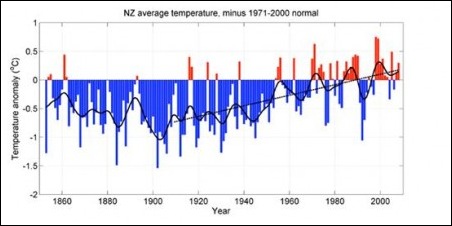
    The coalition released an 8-page report that compares the figures on NIWA’s website with the official graph NIWA has constructed that purports to show that New Zealand’s temperatures have steadily risen since 1909.

    Official New Zealand Average Temperature According to NIWA

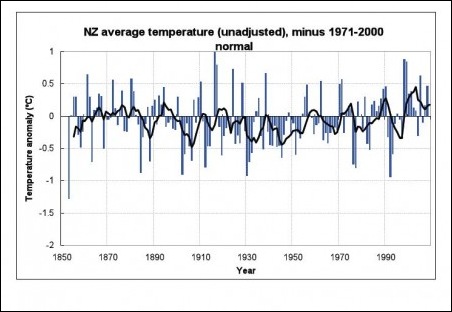
    The problem is that the two sets of figures do not match. When one graphs NIWA’s own websites figures the graph shows a constant steady rate of temperature.

    Unadjusted New Zealand Average Temperature According to NIWA

    The climb in temperature in the official graph is due to the fact that NIWA adjusted the raw data, in almost all cases, upwards. It is these adjustments, and not the raw data itself, which leads to the incline on the official graph. NZCSC have cried foul, Ian Wishart, author of best seller Air Con: The Seriously Inconvenient Truth About Global Warming, got hold of it, the blogosphere followed suit.

    In response NIWA have argued that they had good reasons for adjusting the raw data in this fashion. They maintain that over a hundred years the sites where measurements have been taken have changed and so they have needed to adjust their figures upwards to correct for the distortions these changes would have made.

    I am aware that not being a climatologist or someone that familiar with the relevant data to any great extent makes it difficult to arrive at an informed position in this debate. However, it seems to this lay person that two things are evident.

    From what I have seen from NIWA’s response, the raw data does not support their conclusions and the method of collecting the raw data was flawed and inaccurate to begin with.

    The issue then is whether one is justified in adjusting the data to fit what one thinks it would have been if these inaccuracies did not exist, and, if we are, how confident we can be of the results based on counter-factual speculations of this sort. I myself have no idea of the answer but certainly I think that it is fair for people to ask questions of this sort. Especially with the backdrop of the international climategate emails and memos and when serious political policies such as the Emissions Trading Scheme (ETS), which restricts people’s life, liberty and property, are being passed on the basis of the legitimacy of climate change science.

    Scientific debates aside, it seems that as a point of justice the burden of proof must fall on those who wish to impose severe restrictions on other people’s lives, liberty and property; those advocating restrictive policies, like the ETS and those under discussion at Copenhagen, must be able to show that their polices are defensible. This is simply an implication of the idea that people have a prima facie right to liberty and property. A prima facie right is one that holds as a default position in the absence of sufficient reason to the contrary. It seems to me fairly self-evident that if one is going to restrict people’s freedom or property one needs good reasons for doing so. A principle that suggests we could enslave, coerce and confiscate people’s property for no reason, trivial reasons or simply when we unsure there were any reasons would clearly be wrong – much more so when the question hangs over the reason as to whether or not the justification has been faked.

    One thing that did interest me in this whole debate, however, is how some scientists have defended NIWA against its critics. What I have observed does not inspire confidence.  A good example occurs over at MacDoctor. MacDoctor had raised questions about NIWA’s data, the response from Gareth Renowden, author of Hot Topic.

    I think you are giving far too much weight to the CRU email hack. Here’s a few reasons why:

    1: The emails were stolen. Those released amount to under 2% (pers comm) of the total stolen, and have clearly been selected to support the storylines being run by the “right wing blogs” you mention. The editorial selection has been made by a bunch of crooks.

    2: Many of the mails being talked about have perfectly innocent explanations (see RealClimate). They are the private conversations of a bunch of working scientists, not the science itself. We see that they can be rude about each other and their rivals — that only proves that scientists are human. However, the climate sceptic network is making all sorts of outrageous claims about what they say. Sadly you seem to have bought those interpretations, rather than the somewhat more mundane truth.

    3: Our body of scientific knowledge is found in the peer-reviewed literature, not in a careful selection of emails. Not one peer-reviewed paper is called into question by these emails.

    4: Timing is everything. These emails were “released” a couple of weeks before the Copenhagen conference, and while a major emissions reduction bill is before the US legislature. They were immediately trumpeted from the rooftops by the usual suspects – those campaigning against action on climate change. Coincidence, or part of a campaign?

    If I was a climatologist, I would be very angry at this point, not because I have to go back and redo any work, but because those seeking to delay or prevent action on climate change are resorting to vicious personal attacks against my colleagues. After all, if you can only make a case by stealing and lying, what sort of case have you got?

    There are some things about this response that deserve comment. Consider the points raised in 1: here Gareth’s response is to attack the character of those who took the emails. He notes that they are crooks, that the data has been used to support a particular line of interpretation put forward by “right wing blogs.” Similarly, in 4: he suggests that the timing of the information was politically motivated.

    These arguments commit the ad hominem fallacy; whether or not the material put forward by climate change sceptics is true or false depends on the empirical evidence for it and not on the motives of those who put it forward. One can see the point better by simply reversing it, suppose a body of scientific data is appropriated by left-wing bloggers and is released just before an important political meeting. Does it follow that the studies themselves are worthless? Gareth seems to be suggesting that because the people had particular political leanings or particular political motivations that one should reject their research without actually examining the evidence. Far from showing that the sceptics claims are unfounded, this very line of argument suggests that the scientists are letting political commitments dictate the lines of inquiry they will consider from the outset.

    Gareth’s points 2: and 3: have more merit. He suggests correctly that the nasty rude character of individual scientists does not mean their research is flawed. This is correct; it makes the valid point that whether an individual scientist has a good character is in fact a different question as to whether his arguments are sound. Of course this observation actually rebuts most of what he has said in 1: and 4:.

    Moreover, Gareth suggests that what matters is what the peer reviewed studies show and these are not called into question by anything in the leaked (stolen) emails and memos at the centre of climategate and goes on to suggest that there are innocent explanations of the conversations in question. These latter claims, if correct, do provide a valid response to the questions people raised.

    MacDoctor responds to this as follows:

    Those released amount to under 2% (pers comm) of the total stolen

    No. You can access all the emails. The ones being discussed in blogs and the media amount to about 2%.

    Many of the mails being talked about have perfectly innocent explanations

    I’m sure you are right. However, many of the e-mails have meanings that cannot be interpreted in any way except that they reveal severe selection bias. Even Monbiot thinks that they show more politics than science.

    Our body of scientific knowledge is found in the peer-reviewed literature

    Apparently not, according to the emails. There appears to have been a concerted effort made to keep certain articles out of the peer reviewed literature. The smothering of dissenting views makes for a flawed, truncated science that is all but worthless.

    Timing is everything

    Indeed. CRU timed plenty of scary statistics to be brought forth just before the Copenhagen conference – now all suspect. The timing works both ways.

    Here MacDoctor addresses both the valid and invalid arguments. In response to the issue of peer review, MacDoctor notes that the climategate emails and memos provide evidence that the process of peer review has been corrupted. He also notes that not all of the emails and memos can be plausibly explained away in the fashion Gareth suggests.

    At this point I was interested in seeing if Gareth had an adequate response to these points. I was disappointed. Gareth’s response is as follows,

    Selection bias! In the cherry-picking of stuff to feed into right wing attack lines, yes.

    The “concerted effort” was to deal with crap – papers that should never have got through peer review. Note that the perversion of peer review was actually being conducted by sceptics – notably Chris de Freitas, who as an editor at Climate Research was responsible for passing several papers from his sceptic mates for publication without proper peer review. Six editors resigned in protest. Full story here from one of the editors who resigned.

    CRU “timed” no scary statistics for release, and none of their normal products are now suspect.

    I must say I’m astonished that someone who (presumably) relies on evidence-based should be so partial when it comes to work in another field. Your choice. Your loss.

    What we see here is not a valid response to MacDoctor’s concerns but rather a series of tu quoques. He responds by noting that right wingers have selection bias. That may or may not be true but that was not the question. The question was whether the scientists at the heart of climategate had selection bias. You do not show that one person is not biased by pointing out that someone else is or might be. In the same way, pointing out, as Gareth does, that some sceptics of anthropogenic global warming (AGW) have tried to manipulate peer review does not actually tell us anything about whether defenders of AGW have also manipulated peer review.

    If anything, Gareth’s remaining comments tend to suggest that they did try to do this but were justified because the work of sceptics is “crap.” This shows us that, at the crucial point, his defence degenerates to denigration and name-calling. The rest of the response is to insinuate that those who do not disagree with these obviously fallacious arguments do not follow “evidence based research.” Strange, I though evidence based research involves actually providing evidence for your claims, not raising red herrings and making evasions.

    After reading the exchange I am left wondering; here scientists are defending their position by using clear-cut obvious examples of fallacious reasoning but surely scientists of all people know not to do this don’t they?

    For those like myself who are lay people the questions remain. Governments advocate using the force of law, with policies such as the ETS, to restrict peoples freedom, confiscate their property and raise the price of food, petrol and power. We are told this is because a “consensus” of scientists thinks certain facts about climate change and AGW are the case and that these facts justify certain action. Apart from the obvious is ought fallacy employed in such reasoning (empirical research by itself cannot answer moral questions about what we ought to do) and putting aside the question of whether scientific consensus are always reliable guides to truth, it is disconcerting, in such a politically charged context as we find ourselves in amidst climategate, that when people discover that data has been adjusted on the basis not of what it actually showed but what they think it should have shown under non-existent ideal conditions and they ask questions about this that at least some defenders of science respond with evasions. People who are trained in scientific thinking must know that such responses are fallacious and inadequate. When  I witness this, especially when some of it seems premised on the idea that views can be dismissed out of hand if the conclusions are “right wing,” it makes one, at the very least, a bit suspicious that we are dealing with politics and agendas as much as science.

  • Contra Mundum: The Flat-Earth Myth

    A while back I made a passing comment on my blog criticising an advertisement which claimed that, prior to Columbus, the Church taught that the world was flat. In response I received the following email from a high-school student in the US,

    I’ve been studying Christopher Columbus in my history class and my history books say that prior to Columbus everyone did think the world was flat……..I don’t know if it was a mistake in the history book or your mistake…..but anyway….I guess I have some things to learn! God bless ~ Katie

    We have all heard the story behind this. Prior to Columbus, the Church and its theological scholars taught that the world was flat. For this reason they opposed Columbus’ proposed voyage in 1492 as they believed he would sail off the edge of the earth (or that he would prove them wrong and they would lose standing in society). Despite this Columbus sailed anyway and his rejection of the Church’s position was vindicated, he scored a victory for science and reason.

    My correspondent is correct. They do teach this in high school text books. I was taught it at both primary and high-school. In fact, not too long ago Prentice Hall published claims to this effect in their middle school textbook Prentice Hall Earth Science.

    At a philosophy conference at Otago University, shortly after I graduated, I recall one speaker using the example of “medieval flat-earthers” in his paper as an example of an irrational belief. Almost everyone in attendance nodded their heads in agreement; no one contested the historical assumptions implicit in the example. More recently Victoria University ran a slick television campaign stating that in the 14th century most people believed the world was flat. The ad showed a picture of a boat sailing across the sea only to fall over the side of the earth and concluded “It makes you think.”

    You might have gathered from obvious clues like the title and from the way I have set this article up that I dispute the veracity of much of these historical claims. If I state this publicly there are very few settings where this admission does not at least earn me an incredulous stare (as if I were, in fact, asserting that the earth was flat). Invariably some comment follows, “come on Matt, everyone knows this story is true, didn’t you learn this at school? Haven’t you read any history textbooks?”

    It is true that I did learn this story at school and that I have read it in more than one history textbook but because I took the time to research the history of theology when I was at university I know that this story is fiction. It is a slanderous fabrication invented by opponents of Christianity in the 19th century and has been thoroughly debunked by contemporary historians of science.

    The definitive study is undoubtedly that of Jeffrey Burton Russell in Inventing the Flat Earth: Columbus and Modern Historians. Russell summarised his findings, in a paper presented to the 1997 American Scientific Affiliation Conference, as follows,

    [W]ith extraordinary few exceptions no educated person in the history of Western Civilization from the third century B.C. onward believed that the earth was flat. A round earth appears at least as early as the sixth century BC with Pythagoras, who was followed by Aristotle, Euclid, and Aristarchus, among others in observing that the earth was a sphere. Although there were a few dissenters—Leukippos and Demokritos for example–by the time of Eratosthenes (3 c. BC), followed by Crates(2 c. BC), Strabo (3 c. BC), and Ptolemy (first c. AD), the sphericity of the earth was accepted by all educated Greeks and Romans.

    Nor did this situation change with the advent of Christianity. A few—at least two and at most five—early Christian fathers denied the spherically of earth by mistakenly taking passages such as Ps. 104:2-3 as geographical rather than metaphorical statements. On the other side tens of thousands of Christian theologians, poets, artists, and scientists took the spherical view throughout the early, medieval, and modern church. The point is that no educated person believed otherwise.

    Russell traced the story about Columbus and medieval flat-earthers back to the 19th century; it originated in a fictional novel by Washington Irving The Life and Voyages of Christopher Columbus I (1829). Later it was picked up by two influential books, John Draper’s History of the Conflict between Religion and Science (1874) and Andrew Dickson White’s book A History of The Warfare Between Science and Theology in Christendom. These books famously used the Columbus story plus many others to defend the thesis that the Church, for centuries, suppressed science and worked to prevent its flourishing; this is known as the conflict thesis.

    These books and the conflict thesis they spawned, are highly influential in popular science and media coverage of theological and scientific issues today despite most historians rejecting them as propaganda. In The Encyclopedia of the History of Science and Religion, Collin Russell notes,

    Draper takes such liberty with history, perpetuating legends as fact that he is rightly avoided today in serious historical study. The same is nearly as true of White, though his prominent apparatus of prolific footnotes may create a misleading impression of meticulous scholarship.

    Steven Shapin wrote in the same vein in The Scientific Revolution,

    In the late Victorian period it was common to write about the “warfare between science and religion” and to presume that the two bodies of culture must always have been in conflict. However, it is a very long time since these attitudes have been held by historians of science.

    Numerous other specialists in the field of the history of science and religion concur that the existence of medieval flat-earthers is a myth. Numbers and Lindberg noted in a journal article, “there was scarcely a Christian scholar of the Middle Ages who did not acknowledge [Earth’s] sphericity and even know its approximate circumference.” In his study of medieval cosmology, God and Reason in the Middle Ages, distinguished historian Edward Grant noted that,

    All medieval students who attended a university knew this. In fact any educated person in the Middle Ages knew the earth was spherical, or of a round shape. Medieval commentators on Aristotle’s “On the Heavens” or in the commentaries on a popular thirteenth century work titled “Treatise on the Sphere” by John of Sacrobosco, usually included a question in which they enquired “whether the whole earth is spherical”. Scholastics answered this question unanimously: The earth is spherical or round. No university trained author ever thought it was flat.

    Draper’s and White’s books remain widely cited despite being debunked as historically inaccurate. In fact, the kinds of textbooks Katie mentioned have been subject to scathing criticism precisely for making the aforementioned claims. Lawrence S. Lerner, a professor in the Department of Physics and Astronomy at California State University who is a member of the panel that wrote the 1990 framework for science education in California’s public schools criticised Pretence Halls history text denouncing it as “ignorant fakery.” In an article entitled “Fake ‘History’ That Is Flatly Wrong,” Lerner described the flat-earth claims as a “popular piece of pseudo historical folklore” he added that it “remains popular today among people who have had little education. These evidently include the people who produce ‘science’ books for Prentice Hall.”

    The historical facts are difficult to dispute. During the, so called, “dark ages” Boethius (480-525) cited a well known and accepted ancient Greek cosmological model that affirmed the sphericity of the earth in the Consolidation of Philosophy. Isidore of Serville (560-636) affirmed a round earth in the Etymologies. Bede (672-735) in The Reckoning of Time taught the earth was round; as did Rabanus Marcus in the ninth century.

    The late middle-ages are no different. Hemannus Contractus (1013-155) measured the circumference of the world. Hildegard of Bingen (1098-1179) taught the world was round as did John of Sacrbosco (1200-1256) and Peire d’Ailly (1350-1420). Dante’s Divine Comedy portrays the earth as a sphere. In the Summa Theologicae Thomas Aquinas wrote,

    The physicist proves the earth to be round by one means, the astronomer by another: for the latter proves this by means of mathematics, e.g. by the shapes of eclipses, or something of the sort; while the former proves it by means of physics, e.g. by the movement of heavy bodies towards the center, and so forth.

    Even medieval textbooks taught the world was round. Both the Elucidarium of Honorius Augustodunensis, a twelfth century manual for educating clergy, and On the Sphere of the World, the standard cosmological textbook of medieval universities in the 13th century, taught that the world was round.

    As I have delved into religious history further I have found that this had not been the first or only instance where I was fed false propaganda about Christianity. I could document several other false versions of history; the flat-earth story will suffice for now. As New Zealand blogger Contra Celsum wrote, “the flat earthers are those who think they existed.”

    I write a monthly column for Investigate Magazine entitled Contra Mundum. This blog post was published in the December 09 issue and is reproduced here with permission. Contra Mundum is Latin for ‘against the world;’ the phrase is usually attributed to Athanasius who was exiled for defending Christian orthodoxy.

    Letters to the editor should be sent to: editorial@investigatemagazine.DELETE.com

    RELATED POSTS:
    The “Dark Ages” and Other Propaganda
    More on the “Dark Ages” and Other Propaganda
    Things They Don’t Teach you in Public Schools…
    The Flat Earth Myth
    Guest Post: Dan Brown’s History of Science

  • This one’s for Anna Woolf

    Peter Cresswell has an update on blogger Anna Woolf‘s battle with cancer which is very near the end. We met Anna on my and her birthday in April this year at bloggers drinks and have enjoyed her company and shared laughs and swapped pain meds at each bloggers drinks since.

    We have not known her that long but we have come to know an incredibly warm, funny, brave and courageous person with a heart of gold and it with deep sadness that we share this news. Our love and prayers go out to Anna, her sister Maria and her family and friends.

    You can leave a comment at the link to NotPC which will be read to Anna. This week’s bloggers drinks have now been moved to The Cavalier, which is over the road from the hospice Anna is in, with the hope that those who wish to can pop over the road and say goodbye.

  • Climate Change Statistics Humour

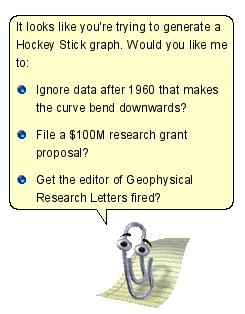
    In the wake of climategate we bring you some levity.

    Climate Change Paper Clip ManHat tip: Karen Bridgman

  • Religious Restraint and Public Policy: Part V

    In my last posts, beginning Religious Restraint and Public Policy: Part I,  I set out the doctrine of religious restraint and critiqued some of the key arguments in support of it. I looked at the objection that the argument from respect is too thin, that applied consistently it excludes too much and Audi’s response to this. I examined Gerald Gaus’ attempt to salvage the argument from epistemic inaccessibility. In this post I will examine and critique Gaus’ idea of open justification in more detail.

    (ii)        Are religious reasons ever subject to open justification?

    Gaus might rejoin that commitments to freedom of religion can be defended in terms of open justification. Consider some of the cases that divide society that I listed earlier; at least one side in such debates is mistaken, has made an error in rejecting the purported open justification presented to them. This is entirely possible. It could also be true of Qutb; perhaps he mistakenly rejected a premise that, given other things he believes, he should have embraced.

    While this rejoinder would avoid the thinness objection, the problem is that it would no longer be clear or obvious, in the absence of substantive argument, that any viewpoint could be openly justified. Neither side in the above debates is likely to concede its position as the one in error. Cuneo and Eberle note the problem;[66]

    Were we to ask Qutb whether he would have reasons to support laws that protect a robust right to religious freedom if he were adequately informed and reasonable, surely he would say: no. Moreover, he would claim that his compatriots would reject the liberal protection of such a right if they were adequately informed about the divine authorship of the Quran and the proper rules of its interpretation. While Qutb’s say-so doesn’t settle the issue of who would believe what in improved conditions, liberal critics maintain that his response indicates just how complicated the issue under consideration is. Among other things, to establish that Qutb is wrong it seems that one would have to deny the truth of various theological claims on which Qutb relies when he determines that he would reject the right to religious freedom were he adequately informed and reasonable. That would require advocates of the standard view to take a stand on contested religious issues. However, liberal critics point out that defenders of the standard view have been wary of explicitly denying the truth of religious claims, especially those found within the major theistic religions.

    Gaus’ case for open justification can only succeed if one makes certain assumptions as to the merits of substantive contentions about morality, philosophy of religion, the truth or falsity of various religious doctrines and questions of meta-ethics. However, such contentions are controversial.

    An additional problem is that open justification commits one to the DRR only if one assumes that religious reasons can never be openly justified. Recall that Audi’s definition of a religious reason is one that possesses “normative force, that is, its status as a prima facie justificatory element, does not (evidentially) depend on the existence of God.” This suggests that proponents of the DRR must assume that belief in God cannot ever be openly justified. I would dispute this.

    Philosophers and theologians have offered arguments for God’s existence entailing that the beliefs most rational people already accept commit them to theism.  Richard Swinburne has written several works arguing that Christianity is more probable than not on the public evidence than any alternative.[67] Robert Adams has argued that the best account of moral obligation is such that they are the commands of a loving God.[68] Alvin Plantinga sketched 26 arguments for God’s existence, which are currently being defended in the literature.[69] Blackwell recently published an encyclopaedia containing 11 current arguments used to defend the existence of God.[70] Edward Feser agrees,[71]

    Versions of these arguments were defended by the likes of Plato, Aristotle, Augustine, Aquinas, Duns Scotus, Descartes, Leibniz, Locke, and Newton, and their defense had absolutely nothing to do with ignorance of modern science — indeed, some of these thinkers were among the founders of modern science — because the arguments do not ultimately stand or fall with any scientific results in the first place. … Among the contemporary defenders of the arguments are writers like Alvin Plantinga, Richard Swinburne, John J. Haldane, James F. Ross, Richard Taylor, William Lane Craig, David S. Oderberg, David Braine, Barry Miller, Robert Koons, Charles Taliaferro and many others — analytic philosophers highly respected within the field and applying the most rigorous methods of analysis and argumentation. … anyone familiar with the classical and contemporary literature on philosophical theology [cannot] deny that the arguments for the theistic worldview mentioned above are every bit as defensible today as any other philosophical argument.

    Just as there are numerous secular arguments, each defended by intelligent and capable scholars, held to be sound by their proponents even if rejected by their opponents, so too are there arguments for the existence of God that meet these criteria. In light of this it seems arbitrary to simply assume that religious arguments cannot meet the standard of public justification. Critics can argue the merits of these arguments and claim that only secular arguments can succeed but this will not give proponents of religious reasons a real reason for accepting such claims. Religious believers hold quite different assessments on the cogency of these arguments. Therefore, the demand of open justification does not appear to be a sufficient reason for the restriction of religious reasons but not others.

    (iii)       Are secular reasons for coercive laws subject to open justification?
    Gaus contends that religious reasons cannot be openly justified and that secular beliefs can. Many thinkers have argued that secular perspectives cannot justify the core commitments of a liberal democracy. Nihilist thinkers have argued that secular naturalistic views of the world entail that all moral claims are false.[72] Stephen Layman[73] and George Mavrodes[74] have argued that a secular view renders belief in morality irrational. Using a Kantian line, John Hare has argued that atheism makes the moral life rationally unstable.[75] Mark De Linville argues that atheism, when combined with evolutionary theory, provides good reason for thinking our moral beliefs are unreliable.[76] Alvin Plantinga has articulated the case for the conclusion that evolution, when combined with atheism, provides a reason for being sceptical about everything we believe (public policy would be no exception).[77] Michael Perry and Wolterstorff claim that human beings possessing inherent rights (a fundamental commitment of liberal democracy) cannot be adequately defended on secular grounds and is only defensible if one assumes religious doctrines.[78]

    As with many secular arguments, religious justifications for coercive policies have been advocated by intelligent and capable scholars, held to be sound by their proponents even if they are rejected by their opponents. It would be arbitrary to simply assume that secular arguments meet the criteria of open justification and that religious ones do not.  Cuneo and Eberle note the problem;[79]

    Liberal critics maintain that we are simply not in good epistemic position to judge the reasons an agent would have to support laws that protect basic liberal commitments were he better informed and more reasonable. More exactly, liberal critics maintain that we are not in a good epistemic position to determine whether a secular agent who is reasonable and better informed would endorse or reject the type of theistic commitments that philosophers such as Wolterstorff claim justify the ascription of natural human rights. The problem is that we don’t really have any idea how radically a person would change his views were he to occupy these conditions. The main, and still unresolved, question for this version of the standard view, then, is whether there is some coherent and non-arbitrary construal of the relevant counterfactual conditions that is strong enough to prohibit exclusive reliance on religious reasons but weak enough to allow for the justification of basic liberal commitments.

    Given the divide between intelligent and capable people over various arguments for and against particular coercive policies it is not prima facie evident that any of these arguments can meet the standard of open justification. Moreover, if an argument could, there appears to be no reason to assume that it could not be a religious one. Now Gaus could examine all currently unsettled policy disputes in society and defend the ones he agrees with and attack the others but the inevitable result will be that many who do not share Gaus’ position will likely be unconvinced. If this is the outcome, there seems no reason why those who do not agree should accept the DRR.

    Feser suggests that this arbitrary singling-out of religious reasons for restraint with little or no basis seems to be based more on ignorance and bigotry than reason,[80]

    The problem, in the view of many liberals, is that religious considerations are matters of faith, where “faith” connotes in their minds a kind of groundless commitment, a will to believe that for which there is no objective evidence. Opinions on matters of public policy, they would say, can only appropriately be arrived at via methods of argument assessable by all members of the political community, not by reference to the idiosyncratic and subjective feelings of a minority.

    If religious arguments were in general really like this, then I would agree with the liberal that they ought to be kept out of the public square. But in fact this liberal depiction of religion is a ludicrous caricature, and manifests just the sort of ignorance and bigotry of which liberals frequently accuse others.

    Jeremy Waldron makes a similar point,[81]

    Secular theorists often assume that they know what a religious argument is like: they present it as a crude prescription from God, backed up with threat of hellfire, derived from general or particular revelation, and they contrast it with the elegant complexity of a philosophical argument by Rawls (say) or Dworkin. With this image in mind, they think it obvious that religious argument should be excluded from public life, … But those who have bothered to make themselves familiar with existing religious-based arguments in modern political theory know that this is mostly a travesty;

    A common theme in the arguments from respect, despite both possessing the features considered relevant, is the asymmetry between religious reasons and secular reasons. On the golden rule argument, Audi privileges secular reasons over religious reasons even though secular reasons were potentially subject to the same charges of being false and burdensome. Similarly with the argument from epistemic inaccessibility, reasonable people are able to reject both secular and religious reasons in a pluralistic society yet Audi and Rawls use this fact to exclude the latter and not the former. Likewise, with open justification, prima facie, there is no reason to accept that religious beliefs cannot be openly justified whilst secular beliefs can. Nor is there a prima facie reason for assuming that liberal commitments can be openly justified on secular grounds. In both cases intelligent and capable scholars have advanced arguments from premises which they believe others are committed to holding. Further in both cases the cogency of these arguments can be reasonably disputed.

    In my next post, Religious Restraint and Public Policy: Part VI, I will look at the dangers of religion as a justification for its asymmetrical treatment within the DRR and conclude my argument.


    [66] Christopher J. Eberle and Terence Cuneo “Religion and Political Theory” (2008) Stanford Encyclopedia of Philosophy (at 9 August 2009).
    [67] Richard Swinburne The Coherence of Theism (Clarendon Press, Oxford, 1977); The Existence of God (Clarendon Press, Oxford, 1979); Faith and Reason (Clarendon Press, Oxford, 2005); Responsibility and Atonement (Clarendon Press, Oxford, 1989); Revelation (Clarendon Press, Oxford, 2007); The Christian God (Clarendon Press, Oxford, 1994); Providence and The Problem of Evil (Clarendon Press, Oxford, 1998).
    [68]
    Robert Adams Finite and Infinite Goods (Oxford University Press, New York, 1999); “Divine Command Meta-Ethics Modified Again” (1979) 7:1 Journal of Religious Ethics 66; “Moral Arguments for Theistic Belief” in Robert Adams (ed) The Virtue of Faith and Other Essays in Philosophical Theology (Oxford University Press, New York, 1987) 144; “Divine Commands and the Social Nature of Obligation” (1987) 4 Faith and Philosophy 262.
    [69] Alvin Plantinga “Appendix: Two Dozen (or so) Theistic Arguments” in Deane-Peter Baker (ed) Alvin Plantinga
    [70] JP Moreland and William Lane Craig Blackwell Companion to Natural Theology (Blackwell Publishing, Malden MA, 2009).
    [71]
    Edward Feser “How to Mix Religion and Politics” (20056) TCSDaily (at 6 October 2009).
    [72]
    Prominent examples are: JL Mackie Ethics: Inventing Right and Wrong (Penguin, Harmondsworth, 1977); Michael Ruse “Evolutionary Theory and Christian Ethics” in Michael Ruse (eds) The Darwinian Paradigm (Routledge, London, 1989) 251-273.
    [73]
    C Stephen Layman “God and the Moral Order” (2002) 19:3 Faith and Philosophy 304; “God and the Moral Order: Replies and Objections” (2006) 32:2 Faith and Philosophy 209.
    [74]
    George Mavrodes “Religion and the Queerness of Morality” in Robert Audi and William Wrainwright (eds) Rationality, Religious Belief and Moral Commitment (Cornell University Press, Ithaca, 1986) 213-226.
    [75]
    John Hare The Moral Gap (Clarendon Press, Oxford, 1996); “Naturalism and Morality” in JP Moreland and William Lane Craig (eds) Naturalism: A Critical Appraisal (Routledge, London, 2000) 189-211; “Kant and the Rational Instability of Atheism” in Andrew Dole and Andrew Chignell (eds) The Ethics of Belief (Cambridge University Press, Cambridge, 2005).
    [76]
    Mark D Linville “The Moral Argument” in JP Moreland and William Lane Craig (eds) Blackwell Companion to Natural Theology (Blackwell Publishing, Malden MA, 2009) 391 449.
    [77]
    Alvin Plantinga Warrant and Proper Function (Oxford University, New York, 1993) 216-239; “The Evolutionary Argument against Naturalism” and “Replies to Beilby and his Cohorts” in James K Beilby (ed) Naturalism Defeated? Essays on Plantinga’s Evolutionary Argument Against Naturalism (Cornell University Press, New York, 2002) 1-15 & 204-277; “Naturalism vs Evolution: A Religion Science Conflict” in Paul Draper (ed) God or Blind Nature? Philosophers Debate the Evidence (at 3 September 2009).
    [78]
    Nicholas Wolterstorff Justice Rights and Wrongs (Princeton University Press, Princeton NJ, 2008); Michael Perry Toward a Theory of Human Rights: Religion, Law, Courts (Cambridge University Press, Cambridge, 2006).
    [79]
    Eberle and Cuneo, above n 65.
    [80]
    Feser, above n 71.
    [81]
    Jeremy Waldron God, Locke, and Equality: Christian Foundations of John Locke’s Political Thought (Cambridge University Press, Cambridge, 2002) 20. Gaus appears to agree; in his book review of Eberle’s work on the subject he writes, “At the outset, however, let me stress that Eberle has written a very good book indeed. It is manifest that he has thought much harder and deeper about justificatory liberalism than justificatory liberals have thought about religious justification and belief. His analysis of religious epistemology and mysticism (ch. 8) clearly demonstrates the extent to which many liberals have attacked caricatures of religious justification. After Eberle’s book, secular liberals must be much more careful in their claims about religious beliefs and their justifications.” Gerald Gaus “Religious Convictions in Liberal Politics” (2003) Notre Dame Philosophical Reviews (at 13 September 2009) (book review).
    (Cambridge University Press, New York, 2007) 203-229.

    RELATED POSTS:
    Religious Restraint and Public Policy: Part I

    Religious Restraint and Public Policy: Part II
    Religious Restraint and Public Policy: Part III
    Religious Restraint and Public Policy: Part IV
    Religious Restraint and Public Policy: Part VI

  • We’re in Wellington

    We’re in Wellington so we won’t be blogging til we get back.

    Hope to see you at the bloggers drinks in Wellington tonight, at the All for Life Conference on Saturday or at the Auckland Bloggers drinks this Thursday.