
Recently, I shared some reflections on the issue of immigration. Drawing on Deuteronomy 23:15–16 and the way this passage was interpreted and applied by 18th-century abolitionists, I argued that our present situation is analogous to that of illegal overstayers fleeing certain forms of degradation in their home countries. Below are some of the responses I received to this  argument, followed by my replies.
Is this a Noahide Command?
One response points out that the passage I cited is in the Torah. But the Torah is a covenant between God and ancient Israel; there are lots of commands in the Torah — the command to circumcise male children, to refrain from eating pork, not to wear mixed cloth — which contemporary Gentile Christians are not required to follow.
In reply: while not all commandments in the Torah apply to Gentiles, some do. As early as the Book of Jubilees, Jewish commentators argued that interpreters had come to recognise that, while the Torah as a whole was given only to Israel, certain commands in the Torah applied to both Jews and Gentiles alike. These were commandments that express moral requirements binding on all people — Jew and Gentile — antecedent to the Sinai covenant. Historically these were called the Noahide commandments[1]. Is the command in Exodus 23 (or Deuteronomy 23:15–16) a Noahide command?
It is plausible to say it is. The reason is that on at least one occasion God is described as expecting Gentile nations, who were not parties to the Sinai covenant, to follow this law and to be held accountable for not doing so. When Jerusalem fell to Babylon in 587 BCE, refugees fled toward the border of Edom. The Edomites slaughtered some, rounded up others, and handed the fugitives over to the Babylonians. The prophet Obadiah condemns Edom for this action:
Do not stand at the crossroads
To eliminate their survivors;
And do not hand over their refugees
On the day of their distress. (Obadiah 14)
Obadiah’s message is that God will hold Edom accountable for this action. Consequently, Deuteronomy 23:15–16 can be read as expressing a Noahide command — a moral requirement binding on Jew and Gentile alike.
A second reply turns the reader back to case 1: do you believe the abolitionists did the right thing in breaking the Fugitive Slave Act? Would it have been right to hand runaway slaves over to the authorities? If you answer yes to the first question and no to the second, then you are implicitly endorsing the abolitionists’ interpretation of Deuteronomy 23:15–16 as a command applicable to Gentile Christians living in later ages.
Limited Application
A further response is that my argument has limited application: it applies only to asylum seekers and not to other forms of immigrants. In reply, Deuteronomy 23:15–16 applies to a person fleeing slavery; by analogy it applies to a person who has fled their country to escape any condition analogous to slavery. This is significant. The 1951 Convention Relating to the Status of Refugees defines a refugee as a person who, “owing to a well-founded fear of being persecuted for reasons of race, religion, nationality, membership of a particular social group, or political opinion, is outside the country of his nationality and is unable to or, owing to such fear, is unwilling to avail himself of the protection of that country.”
That definition is narrower than what Deuteronomy 23:15–16 seems to command. A person can be in severe bondage or servitude to another without fitting that 1951 Convention definition — for example in forms of debt bondage or extreme economic servitude, or cases where the person is persecuted or mistreated for reasons other than the ones specified.
What about illegal or undocumented aliens?
A third response distinguishes between legal and illegal aliens. The claim is that we should not aid and abet the deportation of someone who has gone through the correct channels and applied for refugee status, but someone who has illegally entered the country is in a different situation: they have “jumped the queue” and failed to respect the law.
In reply, I deny their situation is different in any morally relevant way. The slave in 1850 the would have clearly crossed a border into a free state illegally, and the Jewish overstayer in the 1930s example may well have been an overstayer despite attempts to apply for asylum. These are people who are illegally in the country, and yet deporting them can still be wrong. Let us reflect on why.
Imagine I am being pursued by someone who wishes to do me harm — to enslave or kill me. I manage to escape to somewhere my pursuer cannot reach. You yell to my pursuer, “He is over there,” grab me, pull me out, and hand me over. Why would this be wrong? It is wrong because, in doing this, you are actively assisting my pursuers in enslaving or killing me. This is not merely a failure to help; it is active complicity in the attacker’s wrong.
Notice that this is true whether or not I am a documented or undocumented alien. Suppose I have entered the country illegally — I “jumped the queue.” Suppose there was a legal path I could have followed and I did not. That fact does not change that I am being pursued; it does not change that exposing my whereabouts and handing me over will result in my death or enslavement; and it does not change that, by doing so, you are complicit in that killing or enslavement. The features of the action that make turning me over wrong hold regardless of whether I followed legal channels to enter.
One way to see this is to ask the following question: was there a realistic possibility that, had the person followed the correct legal procedure, they would have been denied asylum? If the answer is yes, then this case doesn’t differ in any relevant respect from cases 1 and 2 above. The fugitive slave fleeing to a free state fled there illegally. He could have attempted to follow whatever legal procedures were available to leave his master and emigrate to a free state, but we know that under federal law in the US in 1850 this was prohibited. Making his existence known to the authorities would have resulted in his being returned to slavery.
In the 1930s, thousands of Jewish asylum seekers who legally applied to emigrate to the US were turned down. In 1939, the St. Louis, a ship carrying 900 Jews fleeing Nazi Germany, sailed to the US. The US, along with various other nations, refused the Jews entry, and the ship was forced to return to Germany. In light of these facts, it is very plausible that a Jewish overstayer who revealed themselves to the authorities would have been deported.
Suppose, then, that the person seeking asylum would have had it granted if they had followed the correct procedure. In this case, critics point out, the overstayer has “jumped the queue”; they have unfairly entered the US without following the procedures others have duly followed. Would we be justified in turning the undocumented alien in to the authorities, knowing they would be deported back to a country where they would likely be enslaved, killed, or persecuted?
I think the answer is no. Let us grant that “jumping the queue” is wrong, that laws prohibiting it are in principle justified, and that some legal penalty is warranted. Even so, it seems implausible that you would be obliged to hand me over if the penalty inflicted by the authorities is disproportionate. Suppose I knew that stealing a loaf of bread carried a sentence of death. Or that using a false passport meant being handed over to a mafia gang to be tortured and killed. In such cases, I think it would be wrong to turn in someone I knew had stolen a loaf of bread or faked a passport. The fact that it is wrong to commit fraud and theft, and that laws against them are justified, does not mean I would be justified in handing you over under such circumstances.
The case where the penalty for “jumping the queue” is deportation back to the country the asylum seeker fled from is also a case of disproportionate punishment. Remember, as we have stipulated, this is a case where asylum would have been granted had he not jumped the queue. The benefit he unfairly received, therefore, was not asylum itself—he would have gained that regardless—but merely one of convenience: less hassle, a shorter waiting period, and avoidance of some stressful processes. Do we really think that gaining this kind of advantage unfairly over another justifies execution, permanent enslavement, or permanent exile into destitution? Obviously not. Yet handing people over to authorities who will impose such disproportionate consequences makes you complicit in those outcomes.
To make this vivid: suppose someone, fearing for their life, illegally fakes identification to stow away on a boat. The captain of the boat has the following policy: if someone tells him they are fleeing for safety, he will allow them on board. However, the captain has no tolerance for stowaways. Anyone discovered stowing away will—as punishment—be thrown into the Atlantic to drown. Or suppose a pilot discovers a passenger with a fake passport and, deciding the passenger is an illegal entrant, opens the plane door mid-flight and throws them out. Both acts would be monstrous. Arresting the person and issuing a proportionate punishment at their destination might be defensible; expelling them when such expulsion will result in death is not.
Now suppose I know about the stowaway and also know that disclosure will lead to a disproportionate death sentence (being thrown from a plane or cast into the sea). Do I have a duty to disclose? I do not think so. I would be morally justified in concealing the person. I would not be obligated to hand them over.
[1] Noahide command is the term used by Rabbi’s in the Talmudic literature, Christians have expressed a similar idea using the terms “moral law” or “natural law”. Consider for example Aquinas “The Old Law showed forth the precepts of the natural law, and added certain precepts of its own. Accordingly, as to those precepts of the natural law contained in the Old Law, all were bound to observe the Old Law; not because they belonged to the Old Law, but because they belonged to the natural law. But as to those precepts which were added by the Old Law, they were not binding on save the Jewish people alone” https://www.newadvent.org/summa/2098.htm#article5
Tags: immigrationNo Comments

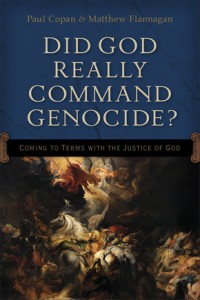 A common objection to belief in the God of the Bible is that a good, kind, and loving deity would never command the wholesale slaughter of nations. In the tradition of his popular Is God a Moral Monster?, Paul Copan teams up with Matthew Flannagan to tackle some of the most confusing and uncomfortable passages of Scripture. Together they help the Christian and nonbeliever alike understand the biblical, theological, philosophical, and ethical implications of Old Testament warfare passages.



0 responses so far ↓
Comments on this entry are closed.