Category: Fallacy Friday

  • Fallacy Friday: Ad Ignorantiam (Arguments from Ignorance)

    In the discussion following last week’s Fallacy Friday topic, Ad Populum, LJ asked about the ad ignorantiam fallacy. In particular she wanted to know about its relationship to creationism. I suspect LJ was being sarcastic but despite this it is worth exploring this issue a bit.

    First, we should recall that a fallacy is not simply a false position on some subject. The fact that someone expounds a mistaken view in theology, philosophy, science, law, ethics or any other subject does not necessarily mean that that person has committed a fallacy. A fallacy is a common mistake in reasoning. A fallacy occurs when one attempts to infer a conclusion from a premise in an invalid manner. I noted in Assessing Arguments that an argument can be valid even if it has false premises and false conclusions. So the fact that someone believes in or propounds contemporary evolutionary theory or creationism or something else does not, in and of itself, mean that that person has committed the ad ignorantiam fallacy.

    What is an Ad Ignorantiam?
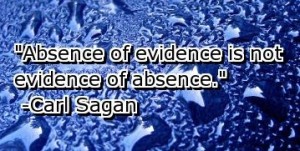
    "Absence of evidence is not evidence of absence" Carl SaganSo what exactly is the mistake being made when one commits an ad ignorantiam fallacy and how does one commit it? The ad ignorantiam fallacy is as an argument from ignorance. It occurs when a person argues that a conclusion is false because no one has shown it to be true or when a person argues a position is true because no one has shown it to be false.  Applied to evolution, the argument has the form:

    1. No one has shown that evolutionary theory is true;

    Therefore:

    2. Evolutionary theory is false.

    Similarly, with creationism:

    1. No one has ever shown creationism is true

    Therefore:

    2. Creationism is false.

    What the person who makes this inference fails to appreciate is that the failure to provide a reason for affirming a conclusion is not the same as providing a reason for thinking the conclusion is false. It is possible, and probably actual, that there are many things that are true which we do not yet know about. In such situations, no one will have shown these things to be true and no one will be able show them to be false yet they are true; we simply will not know that they are.

    An example from history might illustrate this; consider the heliocentric hypothesis, (more…)

  • Fallacy Friday Podcast on Apologetics 315: Tu Quoque (But you did it too!)

    Apologetics 315 are producing an audio version of Matt’s Fallacy Friday series.

    Fallacy Friday Podcasts

    The Fallacy Friday Podcasts are released every Friday on Apologetics 315. You can subscribe using:

    • RSS Feed
    • iTunes
    • One-Click

    The Mp3 of Tu Quoque is here.

    To navigate the series in print, use the Fallacy Friday tag, to navigate MP3 series use the Fallacy Friday Podcast tag.

  • Fallacy Friday: Ad Populum (Appeals to Popularity)

    This week I am going to look at the ad populum fallacy. Ad populum is Latin for “appeal to the people”. This fallacy occurs when a person argues that a particular claim is true because a large number of people accept it. Put crudely it contends that a position is true because it is popular – a majority of people, or a majority of one’s peers accept it.

    The Lemming PledgeAppeals to what others think have an important psychological influence on us because we are social beings and fitting in with one’s peers and the society around is important to us. Taking a view that is unpopular risks putting us at odds with others; in some circumstances it can lead to social alienation and ostracism – people risk being ridiculed, shunned or demeaned.  Our desire to avoid these sorts of responses by others can lead us to not question certain claims or to accept others.

    In fact often it is this kind of pressure that is deliberately used to try to influence people into accepting a claim is true. When I studied at University, it was far more common to hear people attempt to dismiss Christianity by claiming it was out of accord with what contemporary people think or that it was old fashioned and so on, than it was to hear any actual argument against Christianity.

    Unfortunately popularity is not the same thing as truth. If a claim is popular it tells us that a large number of people think it is true. However, a claim is true when what it affirms is, in fact, the case. It is possible that what a large number of people think is the case is not, in fact, the case. Majorities can be wrong and throughout history have been. False ideas, bigotries, prejudices, urban legends and superstitions can be widely held and popular in a society.

    As I noted in Analysing Arguments, an argument is valid when it is impossible for the conclusion to be true and the premises false. Given it is possible (in fact, it is often actual) for a popular claim to be false, inferring that a view is true because it is popular is a fallacy.

    Qualifications
    This past week Philosopher and Theologian William Lane Craig and Physicist Lawrence Krauss, debated the moot “Is there Evidence for God?” at North Carolina State University (video and MP3 available at the link). At one point during the debate, Krauss stated that 90% of the American academy of sciences did not believe in God; this, he argued, provided good reason for thinking there was no evidence for God’s existence.

    This example highlights some subtleties in how this fallacy should be applied. Krauss suggested that there is no evidence for God’s existence because the vast majority of scientists do not believe in God. In support of this he stated that the vast majority of those who have studied the evidence contend that the evidence is not there. Krauss was arguing for a position on the basis of what the majority of the experts in a field think. On the face of it, there does seem some merit to this; surely, if (more…)

  • Fallacy Friday Podcast on Apologetics 315: The Straw Man

    Apologetics 315 are producing an audio version of Matt’s Fallacy Friday series.

    Fallacy Friday Podcasts

    The Fallacy Friday Podcasts are released every Friday on Apologetics 315. You can subscribe using:

    • RSS Feed
    • iTunes
    • One-Click

    The Mp3 of The Straw Man is here.

    To navigate the series in print, use the Fallacy Friday tag, to navigate MP3 series use the Fallacy Friday Podcast tag.

  • Fallacy Friday: Ad Misericordiam (Appeal to Pity)

    This week I will look at the ad misericordiam fallacy, the fallacy of appealing to pity. Perhaps the best example I have come across is one used by my friend Francis Beckwith; In his book Politically Correct Death: Answering Arguments for Abortion Rights, Beckwith cites the following letter to the editor:

    Dear Sir:  As a mother of nine children I would like to speak out about the draft everyone is talking about. I am one that is very much against it. I lost a husband in Korea and if they draft from age 18 to 26 I stand to loose four sons and one daughter.  As a mother in poor health, I don’t think I could take that.  Why can’t [The President] leave well enough alone and try and find our boys missing or being held some place?  Mrs L T

    The fallacy in this letter is not difficult to spot; it is an argument that appeals to pity. The question is whether a law which would draft adults of a particular age into the military is just. To show it is not just one would need to offer arguments which appeal to facts and correct moral principles for this conclusion. The writer has not done this; instead Mrs LT has simply pointed out she is against the draft, she is a widow in poor health and if all of her children were drafted, sent to a war and killed she would not cope. Because decent humans are empathetic when we read a letter like this, we feel pity for the woman and sympathise with her, this sympathy is then mistakenly transferred to what she has said so that we accept her conclusion. Despite the fact no real reasons for accepting it were offered.

    To grasp the fallacy here consider a situation where a mother’s adult children had all conspired to commit a horrific crime and were about to be incarcerated. The fact that the mother is a widow, in ill health and would find it very emotionally difficult to cope with her children “going away” does not provide grounds for thinking it is unjust for her adult children to go be incarcerated. To establish that it would be unjust if they were incarcerated we would need some reasons for thinking either that the children were innocent or that the sentence was disproportionate or excessively degrading.

    The appeal to pity attempts to enlist support for a particular conclusion by getting people to sympathise with or pity the plight of the person making the argument rather than seeing the cogency of their argument. In this way it is a bit like the ad hominem fallacy. Just as the ad hominem fallacy seeks to persuade by using psychological or emotional transference which fools the hearer into transferring  disapproval of a person onto the person’s arguments or their conclusion, appeals to pity seek to fool the hearer to transfer their feelings of sympathy and empathy for a person onto that person’s argument or conclusion.

    Examples
    Appeals to pity are a text-book fallacies yet it is surprising where you find them – even professional philosophers offer them. When I did my first course in Ethics at the University of Waikato as an undergraduate, we studied different moral issues and read articles from both sides of the debate on each issue. When it came to the issue of homosexuality, (more…)

  • Fallacy Friday Podcast on Apologetics 315: The Genetic Fallacy

    Apologetics 315 are producing an audio version of Matt’s Fallacy Friday series.

    Fallacy Friday Podcasts

    The Fallacy Friday Podcasts are released every Friday on Apologetics 315. You can subscribe using:

    • RSS Feed
    • Via iTunes
    • one-click to your feed-reader

    The Mp3 of The Genetic Fallacy is here.

    To navigate the series in print, use the Fallacy Friday tag, to navigate MP3 series use the Fallacy Friday Podcast tag.

  • Fallacy Friday: Petitio Principii (Begging the Question)

    For the last few Fridays I have been publishing a blog series on logical fallacies. This begs the question, what fallacy will I discuss today?

    The above sentence illustrates how the  phrase “begs the question” is commonly misused. To test how pervasive this misuse is I typed “this begs the question” into Google and limited it to New Zealand; every single result on the first page was a misuse and after delving eleven pages into the results I gave up – there was not a single correct use of ‘begging the question’ among the lot! For this reason it is important to begin this post by clearly setting aside what begging the question is not.

    In my opening sentence I used the phrase “this begs the question” as a synonym for “this raises the question”. This is the way the phrase is commonly misused but this is not what the phrase actually means (something that  is a source of humour and irritation for English pedants).

    The Fallacy of Begging the Question
    “Begging the question” refers to the informal fallacy known as petitio principii, which literally means “requesting first principles.” The “question” in “begging the question” refers to the matter at the heart of the debate, the issue being debated. To “beg the question” is to attempt to have that question conceded by assuming it either implicitly or explicitly in the premises of the argument the arguer offers for its truth. In other words, the arguer assumes what he trying to prove and uses that assumption to prove that assumption correct.

    Strictly speaking, an argument that begs the question is valid. In Analysing Arguments, I explained that a valid argument is one where it is impossible for the premises to be true and the conclusion false. Consider the following argument form.

    [1] P

    Therefore:

    [2] P

    This argument is pretty obviously a case of begging the question. The conclusion [2] is explicitly stated in the premise [1]. It is also the case that it is impossible for [1] to be true and the conclusion [2] to be false – they utter the same proposition after all. The same would be true of any argument that contains the conclusion in the premises. It will be impossible for the premises to be true and the conclusion false given that they are the same. Further, if the conclusion is true, and P is the case, this argument is sound; [1]-[2] is a valid argument with a true premise.

    Despite this, there is obviously something fishy about these kinds of arguments and this is due to the function arguments play. Arguments are supposed to provide people with reasons as to why they should embrace a conclusion. A question begging argument relies on one already accepting the conclusion in order to provide one with reasons for doing so.

    Given this, in any normal argumentative context question begging arguments are useless. No person who does not already hold the conclusion has any reason to validly infer the conclusion is true. To anyone doubting a proposition, appealing to that proposition in an argument to convince them of its truth is not going to get the arguer very far (unless the hearer falls for the fallacy).

    Common Use
    Arguments like [1] – [2] are pretty obvious examples of begging the question but there are less obvious, more subtle and more common versions of this fallacy. Often begging the question occurs when an argument has implicit premises; the arguer’s argument or the premises of his argument relies on some unstated assumption.  Because the assumption is implicit people do not notice it.

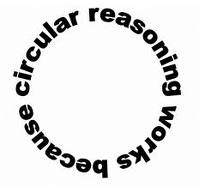
    Circular ReasoningBegging the question is a form of circular reasoning where the inference circles from the conclusion to some proposition inferred from the conclusion and then from this proposition as a premise back to the original conclusion. In text books perhaps the most common example of circular reasoning is the following argument for the existence of God:

    [1] The Bible is the word of God; (more…)