In my previous post, Is Abortion Liberal? Part 1, I argued that liberals who support the non-initiation of force principle can support abortion only on two grounds;
(a) the fetus is a person but its existence inside the mother without her consent constitutes a form aggression, and hence, the mother’s action of killing it is defensive; or,
(b) a fetus is not a person.
I will now address each of these in turn.
Is the Fetus an Aggressor?
Consider first (a), the contention that a fetus can be considered an aggressor because it is intruding upon a woman’s body without her consent; an intrusion grave enough to justify the use of lethal force. In this respect then, being subject to an unplanned pregnancy would be on par with being the recipient of a serious assault such as being raped or severely beaten.
Frank Beckwith and Steve Thomas in Consent, Sex and the Pre-Natal Rapist, have demonstrated several problems with this claim. It leads to the conclusion that, in certain circumstances abortion is justified without the consent of the woman.
Consider the following scenario. A young woman is involved in a car accident and is rendered unconscious by her injuries. She is brought to a hospital where, still comatose, she is examined by a doctor. While performing some tests, the doctor determines that the woman has been pregnant for several weeks. Furthermore, suppose that evidence comes to light to suggest that the woman is unaware of her pregnancy, perhaps her close friends know nothing of the pregnancy, her diary shows no knowledge of being pregnant, and so on.
Adopting McDonagh’s understanding of pregnancy as morally equivalent to rape or assault, what is the doctor’s obligation to this unconscious patient? It would seem that, under these conditions, the doctor is morally required to perform an abortion to rid his patient of the ‘massive intrusion’ being imposed upon her by her unborn offspring. After regaining consciousness, the woman would have to be told that she’s undergone an abortion for a pregnancy of which she was not aware, for there was good evidence that no consent had been given and that she was under assault.[i]
Beckwith’s point is that if the fetus is morally or legally on par with an aggressor who intrudes upon a woman’s body without her consent, such as a assailant or rapist then it would follow that in the case sketched above the doctor would be justified (and arguably would have an obligation) to abort despite the fact that no consent from the women had been obtained.
Consider, that if one saw a person having sex with an unconscious woman and one knew the woman had not consented, it would be absurd to wait for the woman to wake up to see if she wanted to consent to sex. One would be obligated to intervene. “[T]he doctor in the midst of the situation, aware of the pregnancy in the absence of consent, must see it as the rape-in-progress of his unconscious patient. How could he do anything else but end the assault?”[ii]
Now I assume that liberals would oppose the idea that any woman who both does not know she is pregnant and is unconscious should be subjected to an abortion without her consent. If this is the case then it is clear that they do not think that an unconsented to pregnancy constitutes an act of serious aggression.
If the fetus is an unjust aggressor then liberals are committed to coercive abortions. If coercive abortions are not liberal then the fetus is not an unjust aggressor.
Is the Fetus a Person?
If the fetus is not an unjust aggressor then a liberal defense of abortion must be based upon (b), the idea that a fetus is not a person, a being that possesses the rights to life, liberty and property that liberals believe the state exists to protect.
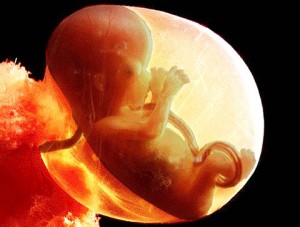
Now a fetus is clearly a human organism. After 14 days at least, it is an individual living being that is a member of the species homo sapiens. To justify abortion via (b), the liberal needs to tell us what property a human being possesses that grounds the right to not be subjected to the initiation of force, to not be killed. Further a liberal must also be able to plausibly maintain that a human organism does not acquire this property until after the fetal stage.
Peter Cresswell takes the view,
[T]he foetus is not yet a human being, but a part of a human being – the mother – who has rights over it. To be an actual, rather than merely potential, human being is, among other things, to be physically separate, which a foetus is not.
This claim is erroneous. First the “parts of” relationship is transitive; if a brick is part of a wall and the wall part of a house then the brick is part of the house. If a fetus is part of a woman’s body it follows then that any organ that is part of the fetus will be part of the mother. A woman pregnant at eight weeks then possesses four arms, four legs and two brains. If the fetus is male, she will have both a vagina and a penis and be both male and female. Conclusions that are even more bizarre follow if the woman is pregnant with twins. She could have three faces, three brains, six arms, two penises and a vagina, three hearts, six kidneys and so on.[iv]
Moreover, PC’s contention that “to be an actual human” one must be “physically separate” entails that conjoined twins are not human. Consider conjoined twins Bob and Scott. If Bob is a human being then since Scott cannot live independently of Bob, Scott must not be a human person (the converse is equally true).
Yet it is difficult to see what property Bob has that Scott lacks which would justify considering one of them human and the other not simply because neither is dependant of the other. It appears then, that one would be forced to conclude that they both are and are not, human. Perhaps PC is simply giving a poorly worded defence of the viability criteria, which I have previously critiqued here.
However, the usual liberal response is to ground the right to not be subjected to the initiation of force, to not be killed, in certain psychological capacities that human beings typically display; such things as sentience, rationality, self-awareness, autonomy, etc.
Despite the pervasive appeal of this approach, it faces serious problems. Boonin notes that those who attempt to ground humanity in the amount of brain development an organism has face a dilemma. “Any appeal to what a brain can do at various stages of development would seem to have to appeal to what the brain can already do. Or to what the brain has the potential to do in the future.”[v]
Either option leads to problems for a defender of the permissibility of abortion who does not also want to endorse infanticide. This is because “by any plausible measure dogs, and cats, cows and pigs, chickens and ducks or more intellectually developed than a new born infant.”[vi] Suppose, then, one takes the first horn and appeals to what the brain can already do. However, unless one wishes to affirm that cats, dogs and chickens are human beings, “appeals to what the brain can already do” will “be unable to account for the presumed wrongness of killing toddlers or infants.”[vii] Suppose, then, one takes up the second horn of the dilemma and appeals to “what the brain has the potential to do in the future;”[viii] Boonin notes that this will entail that feticide is homicide. “If [such an account] allows appeals to what the brain has the potential to do in the future, then it will have to include fetuses as soon as their brains begin to emerge, during the first few weeks of gestation.”[ix]
A couple of examples will illustrate this. Suppose the liberal appeals to sentience, the capacity for consciousness and the ability to perceive pleasure and pain. This criterion will mean abortion is permissible up to 24 weeks.[x] The problem is that this criterion also catches cats, dogs, cows, and chickens as well all. All of which are as sentient if not more sentient than new born infants and post-24 week fetuses.
If the liberal draws the line at sentience, he/she will have to hold that farming, butchers shops, McDonald’s restaurants, Kentucky fried Chicken restaurants all engage in unjustified aggression against people because they kill sentient beings without their consent. Further, to remain consistent, the liberal will have to maintain a policy of outlawing all these industries and prosecuting those who engage in them for murder and cannibalism.
Suppose the liberal appeals to more advanced psychological states such as self-awareness, rationality or autonomy. Such accounts of the grounding of rights will exclude the animals mentioned above and will exclude human fetuses. The problem is, according to this account, newborn infants are not persons either.
In a definitive study of infanticide, Michael Tooley compiles an impressive array of neurological and physiological data that demonstrates that infants are not persons in this sense until some time after birth.[xi] The price of this line of inference is the reduction of newborn infants to the ethical level of cows. A newborn cow, and certainly a mature cow, is more person-like than an infant is. It is difficult to understand by this view why killing and eating infants is any more problematic than consuming a Big Mac.
Of course the liberal can avoid this by claiming that it is the potential to acquire properties such as rationality, self-awareness, autonomy, not their actuality that matters. This will enable one to claim infants are protected by the non-initiation of force principle and will exclude animals. But the problem of course is that foetuses will also be protected by the non-initiation of force principle because fetuses also have the potential to possess these properties.
In summation, liberal proponents of the non-initiation of force principle can only support abortion if they are willing to be inconsistent and arbitrary in their application of the principle or if they are willing to endorse not just infanticide but the eating of newborn infants or state mandated vegetarianism or coercive abortions. These policies are an anathema to most liberals; as such, abortion is not liberal.
UPDATE: In response to comments below see Sentience Part 1 and Sentience Part 2.
[i] Francis J. Beckwith & Stephen Thomas, “Consent, Sex, and the Prenatal Rapist; A Brief Reply to McDonagh’s Suggested Revision of Roe v Wade,” Journal of Libertarian Studies 17: 3 (2003): 4.
[ii] Ibid, 6.
[iii] Peter Creswell, “Not PC: Cue Card Libertarianism – Abortion”.
[iv] Here I am influenced by Peter Kreeft, The Unaborted Socrates (Downers Grove, IL: InterVarsity Press, 1983), 45-47 and Francis J Beckwith, Politically Correct Death, 124.
[v] David Boonin, A Defense of Abortion (Cambridge: Cambridge University Press, 2003) 125.
[vi] Ibid, 121.
[vii] Ibid.
[viii] Ibid.
[ix] Ibid.
[x] It is generally accepted that sentience occurs around 24 week’s gestation. There is some dispute over this and some scientists date sentience in the first 10 weeks of gestation.
[xi] Michael Tooley, Abortion and Infanticide (New York: Oxford University Press, 1983) Ch. 11.5.