Category: Current Events

  • Open Letter to Maurice Williamson

    Dear Maurice Williamson,

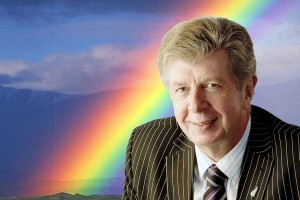
    Maurice Williamson and his "big gay rainbow"I hear you are having some troubles in the media at the moment. Apparently there are moral questions swirling around you about honest disclosure, potential abuse of power, unduly influencing the police in favour of a person who donated money to you, and so on.

    Don’t let judgmental people like Prime Minister John Key discriminate against you any longer. Such people clearly believe they can make moral judgments about what is appropriate and impose them onto you. Stand up to the bigots.

    Here is my advice to you.

    Call a press conference and do the following:

    1. Point out that the moral rules about lying and bribing being an abomination come from that archaic book, The Bible. While you are at it, make a sarcastic jab about how some people think you will go to hell for doing such things, then mock this belief with silly jokes about the physics of hell.
    2. Observe that there was recently a rainbow in New Zealand somewhere and opine that this proves that God approves of your actions.

    Do this and I am certain you will be hailed as a man of great moral insight. All will agree that you have given a decisive answer to the serious moral questions raised about your conduct. Perhaps David Farrar will blog about it on Kiwiblog, you’ll get offers to stand for Governor in several states in America, and someone in Hollywood might even offer you a spot on their show to obtain your insight.

    We all know, after all, that serious moral questions can be adequately set aside by engaging in these kind of tactics, and given your well known moral insight and wisdom, that’s all you need to do. You have led the nation utilising such wisdom and discernment in the past, I am sure you can do it again.

    All the best,

    Matthew Flannagan

  • Yet Another Lawyer Agrees: Marriage Amendment Act Bill is an Affront to Freedom of Religion and Belief

    Barrister Ian Bassett has given another opinion describing the risks to freedom of religion and belief of Louisa Wall’s Marriage Amendment Act Bill if it is enacted in its presently proposed form, which would include this amendment:

    “Without limiting the generality of subsection (1), no celebrant who is a minister of religion recognised by a religious body enumerated in Schedule 1, and no celebrant who is a person nominated to solemnize marriages by an approved organisation, is obliged to solemnize a marriage if solemnizing that marriage would contravene the religious beliefs of the religious body or the religious beliefs or philosophical or humanitarian convictions of the approved organisation.”

    It is clear that any marriage celebrant exercising their public function who is not covered by the amendment risks being in breach of the New Zealand Bill of Rights Act 1990 and the Human Rights Act 1993 if they refuse to perform their public function as marriage celebrants because it is a same sex couple seeking to be married.

    Injustice

    Church ministers, marriage celebrants, court registrars, church elders, leaders, photographers and caterers and any other person or entity supplying services to the public risks being in breach of the Human Rights Act 1993 if they refuse to supply services to a couple seeking to be married because the couple are same sex. For some this could also mean risking their employment.

    Service providers to the public risk being in breach of the Human Rights Act 1993 if they refuse to supply services to a married couple because the couple are same sex.

    The New Zealand Law Society’s Law Reform Committee headed by Professor Paul Rishworth LLB (Hons) M Jur highlighted the risk to freedom of religion and belief in the Bill in its submission to Parliament:

    “The proposer of the Bill said that the Bill was not intended to compel marriage celebrants to perform marriages contrary to their religious beliefs. However, in the Law Society’s view, Professor Rishworth says it is arguable that marriage celebrants who refuse to perform same-sex marriages will be acting unlawfully under the Human Rights Act 1993, the New Zealand Bill of Rights Act 1990, or both.

    “We want to highlight arguable conclusions which seem to be at odds with the settled intentions of the Bill’s drafters. Whatever the position, the Law Society believes it makes sense to put the matter beyond doubt,” Professor Rishworth says.

    The only thing that the amended Bill puts beyond doubt is that the critics of those raising fears about the Bill’s threat to freedom of religion and belief were wrong. By recommending an amendment the Select Committee are agreeing that a risk existed, as the likes of Ian Bassett, Grant Illingworth have argued, contra to The Human Rights Commission’s claim that all “…religious officials and leaders are free to refuse to perform marriages that are not in accordance with their religious beliefs.”

    Bassett, Illingworth and Rishworth are not alone with their concerns among the legal fraternity.

    Graeme Edgeler, a Wellington Barrister has been quoted in the Herald saying:

    … if an independent celebrant declined to marry a same-sex couple, the couple could then complain to the Human Rights Commission.

    “It’s not about [celebrants] being forced, it’s about people getting in trouble afterwards if they didn’t,” he told APNZ.

    “They’re not breaking any rule in the Marriage Act, but rules in other acts. The main one would be the Human Rights Act, which says you can’t discriminate on the basis on sexual orientation or gender.”

    Auckland Barrister Rachel Wong has raised issues against the Bill.

    This blog’s Madeleine Flannagan LLB, Associate Barrister and Solicitor at Coast Legal, adds her voice:

    “The Bill, in its present form, fails to protect individual freedom of religion and belief (belief being a comprehensive viewpoint not based on religion). The proposed amendment only protects group religious rights, which is little protection at all for most religious celebrants as few denominations hold formal views on marriage, many practitioners of religion do not belong to a group and for those that do they might hold a different personal view on this topic to the group view. The amendment then fails to protect the religious freedom of most religious celebrants just as it utterly fails to protect the freedom of belief of non-religious celebrants who have no group to appeal to to protect their freedom.”

    Ian Bassett’s latest opinion thoroughly analyses the legal effects of the amended Bill, a summary as to whose freedom of religion and belief it protects and whose it does not follows: (more…)
  • Matt on Radio: Women tells Court of Appeal being pregnant with a defective baby is an injury

    A New Zealand woman has gotten her case against the Accident Compensation Corporation (“ACC”) into the Court of Appeal. The Herald carried the story. Matt was interviewed for his view on Radio Rhema last week.

    The woman was told at her 20-week scan that "no anatomical abnormality" was detected. Photo / Getty Image

    ACC claim mother: I would have aborted

    Woman says she would have terminated pregnancy had she been told baby was disabled.

    A woman who says she would have terminated her pregnancy had doctors properly diagnosed her unborn child with spina bifida is seeking ACC cover for her disabled daughter.

    In what her lawyer says could be a landmark case if she is successful, the woman has won the right to a hearing in the Court of Appeal against the decision by the Accident Compensation Corporation not to grant her cover for her young daughter.

    The Auckland mother says her 5-year-old daughter, who walks mostly with a support frame, may miss out on crucial and costly physiotherapy as she grows older.

    “We want her to have the best possible life that we can give her and with ACC cover it makes it a lot easier for us to be able to provide everything we need to provide,” said the mother, who did not want to be named.

    She said her evidence to the court that she would have chosen to abort the pregnancy if she and her partner had been told of their daughter’s condition at 20 weeks’ pregnancy was difficult testimony to give.

    “Obviously once she’s with us we want and love her,” the mother said yesterday.

    Continues…

  • Madeleine on Same Sex Marriage, US Election Result and Scalping on “The Panel” – with Craig Heilmann

    Radio RhemaIf you tuned in to Radio Rhema at 11:45am (NZ time) on 8 November 2012 you would have heard this blog’s Madeleine Flannagan and Craig Heilmann discuss the Same Sex Marriage Bill and Louisa Wall’s submission, the US Election Result and if Scalping Tickets is okay, on “The Panel” on Pat Brittenden mornings.

    You can listen online here.

  • Madeleine on Housing Shortage Public Policy and Swearing at the Boss on “The Panel” – with Bob McCoskrie

    Radio RhemaIf you tuned in to Radio Rhema at 11:45am (NZ time) on 30 October 2012 you would have heard this blog’s Madeleine Flannagan and Bob McCoskrie discuss the housing shortage, the government’s plan to fix it and the legal consequences of  swearing at the boss, on “The Panel” on Pat Brittenden mornings.

    You can listen online here.

  • Matt on Rugby as Religion, Churches and Social Media, USA Presidential Debate on “The Panel” – with Craig Heilmann

    Radio RhemaIf you tuned in to Radio Rhema at 11:45am (NZ time) on 4 October 2012 you would have heard this blog’s Matthew Flannagan and Craig Heilmann discuss rugby as religion, if churches are using social media effectively, the PPTA conference and the USA presidential debate, on “The Panel” on Pat Brittenden mornings.

    You can listen online here.

  • “Same-Sex Marriage is not Valid Marriage” – A Potentially Convict-able Statement

    In MandM on Same-Sex Marriage and on being “sneaky” we referred to section 56 of the Marriage Act 1955 which provides:

    56 Offence to deny or impugn validity of lawful marriage

    (1) Every person commits an offence against this Act, and shall be liable on summary conviction to a fine not exceeding 100 pounds, who—

    (a) alleges, expressly or by implication, that any persons lawfully married are not truly and sufficiently married; or

    (b) alleges, expressly or by implication, that the issue of any lawful marriage is illegitimate or born out of true wedlock.

    (2) For the purposes of this section the term alleges means making any verbal statement, or publishing or issuing any printed or written statement, or in any manner authorizing the making of any verbal statement, or in any manner authorizing or being party to the publication or issue of any printed or written statement.

    (3) A person shall not be deemed to make an allegation contrary to the provisions of this section by reason only of using in the solemnization of a marriage a form of marriage service which at the commencement of this Act was in use by the religious body to which that person belongs, or by reason only of the printing or issue of any book containing a copy of a form of marriage service in use at the commencement of this Act by any religious body.

    Criminal OffenceLousia Wall’s Marriage (Definition of Marriage) Amendment Bill, which seeks to amend the Marriage Act to allow for same-sex marriage does not seek an amendment to this section. This suggests that if her Bill passes, then anyone who claims that a same-sex marriage is not a valid marriage or a true marriage commits an offence.

    The fairly comprehensive legal opinion by Ian Bassett, argues that the law will have this effect.

    This is, of course, concerning because this is precisely what many religious groups teach. The Westminster Confession, for example,which is the doctrinal standard for  Presbyterian and Reformed Churches, states:

    I. Marriage is to be between one man and one woman: neither is it lawful for any man to have more than one wife, nor for any woman to have more than one husband at the same time.

    II. Marriage was ordained for the mutual help of husband and wife; for the increase of mankind with a legitimate issue, and of the Church with an holy seed; and for preventing of uncleanness.

    This defines marriage as being between a man and a woman. It entails that if a union is not between a man and a woman then it is not a marriage. Moreover, the purposes of the institution explicitly exclude same-sex unions in that the purposes include the mutual help of a husband and wife and procreation which rules out same-sex unions – particularly if the biblical and theological context and basis for those affirmations is understood.

    When the Human Rights Commission was asked about this, prior to the Basset legal opinion being commissioned, it gave the following response: (more…)