Currently I am working on a post on the issue of non-discrimination rights and the morality of discrimination. In the mean-time I thought I would highlight the thoughtful commentary from James-Michael Smith in this video.
Tag: Freedom of Religion
-
Religious Freedom and Non-Discrimination
-
Yet Another Lawyer Agrees: Marriage Amendment Act Bill is an Affront to Freedom of Religion and Belief
Barrister Ian Bassett has given another opinion describing the risks to freedom of religion and belief of Louisa Wall’s Marriage Amendment Act Bill if it is enacted in its presently proposed form, which would include this amendment:
“Without limiting the generality of subsection (1), no celebrant who is a minister of religion recognised by a religious body enumerated in Schedule 1, and no celebrant who is a person nominated to solemnize marriages by an approved organisation, is obliged to solemnize a marriage if solemnizing that marriage would contravene the religious beliefs of the religious body or the religious beliefs or philosophical or humanitarian convictions of the approved organisation.”
It is clear that any marriage celebrant exercising their public function who is not covered by the amendment risks being in breach of the New Zealand Bill of Rights Act 1990 and the Human Rights Act 1993 if they refuse to perform their public function as marriage celebrants because it is a same sex couple seeking to be married.

Church ministers, marriage celebrants, court registrars, church elders, leaders, photographers and caterers and any other person or entity supplying services to the public risks being in breach of the Human Rights Act 1993 if they refuse to supply services to a couple seeking to be married because the couple are same sex. For some this could also mean risking their employment.
Service providers to the public risk being in breach of the Human Rights Act 1993 if they refuse to supply services to a married couple because the couple are same sex.
The New Zealand Law Society’s Law Reform Committee headed by Professor Paul Rishworth LLB (Hons) M Jur highlighted the risk to freedom of religion and belief in the Bill in its submission to Parliament:
“The proposer of the Bill said that the Bill was not intended to compel marriage celebrants to perform marriages contrary to their religious beliefs. However, in the Law Society’s view, Professor Rishworth says it is arguable that marriage celebrants who refuse to perform same-sex marriages will be acting unlawfully under the Human Rights Act 1993, the New Zealand Bill of Rights Act 1990, or both.
“We want to highlight arguable conclusions which seem to be at odds with the settled intentions of the Bill’s drafters. Whatever the position, the Law Society believes it makes sense to put the matter beyond doubt,” Professor Rishworth says.
The only thing that the amended Bill puts beyond doubt is that the critics of those raising fears about the Bill’s threat to freedom of religion and belief were wrong. By recommending an amendment the Select Committee are agreeing that a risk existed, as the likes of Ian Bassett, Grant Illingworth have argued, contra to The Human Rights Commission’s claim that all “…religious officials and leaders are free to refuse to perform marriages that are not in accordance with their religious beliefs.”
Bassett, Illingworth and Rishworth are not alone with their concerns among the legal fraternity.
Graeme Edgeler, a Wellington Barrister has been quoted in the Herald saying:
… if an independent celebrant declined to marry a same-sex couple, the couple could then complain to the Human Rights Commission.
“It’s not about [celebrants] being forced, it’s about people getting in trouble afterwards if they didn’t,” he told APNZ.
“They’re not breaking any rule in the Marriage Act, but rules in other acts. The main one would be the Human Rights Act, which says you can’t discriminate on the basis on sexual orientation or gender.”
Auckland Barrister Rachel Wong has raised issues against the Bill.
This blog’s Madeleine Flannagan LLB, Associate Barrister and Solicitor at Coast Legal, adds her voice:
“The Bill, in its present form, fails to protect individual freedom of religion and belief (belief being a comprehensive viewpoint not based on religion). The proposed amendment only protects group religious rights, which is little protection at all for most religious celebrants as few denominations hold formal views on marriage, many practitioners of religion do not belong to a group and for those that do they might hold a different personal view on this topic to the group view. The amendment then fails to protect the religious freedom of most religious celebrants just as it utterly fails to protect the freedom of belief of non-religious celebrants who have no group to appeal to to protect their freedom.”
Ian Bassett’s latest opinion thoroughly analyses the legal effects of the amended Bill, a summary as to whose freedom of religion and belief it protects and whose it does not follows: (more…)
-
“Same-Sex Marriage is not Valid Marriage” – A Potentially Convict-able Statement
In MandM on Same-Sex Marriage and on being “sneaky” we referred to section 56 of the Marriage Act 1955 which provides:
56 Offence to deny or impugn validity of lawful marriage
(1) Every person commits an offence against this Act, and shall be liable on summary conviction to a fine not exceeding 100 pounds, who—
(a) alleges, expressly or by implication, that any persons lawfully married are not truly and sufficiently married; or
(b) alleges, expressly or by implication, that the issue of any lawful marriage is illegitimate or born out of true wedlock.
(2) For the purposes of this section the term alleges means making any verbal statement, or publishing or issuing any printed or written statement, or in any manner authorizing the making of any verbal statement, or in any manner authorizing or being party to the publication or issue of any printed or written statement.
(3) A person shall not be deemed to make an allegation contrary to the provisions of this section by reason only of using in the solemnization of a marriage a form of marriage service which at the commencement of this Act was in use by the religious body to which that person belongs, or by reason only of the printing or issue of any book containing a copy of a form of marriage service in use at the commencement of this Act by any religious body.
 Lousia Wall’s Marriage (Definition of Marriage) Amendment Bill, which seeks to amend the Marriage Act to allow for same-sex marriage does not seek an amendment to this section. This suggests that if her Bill passes, then anyone who claims that a same-sex marriage is not a valid marriage or a true marriage commits an offence.
The fairly comprehensive legal opinion by Ian Bassett, argues that the law will have this effect.
This is, of course, concerning because this is precisely what many religious groups teach. The Westminster Confession, for example,which is the doctrinal standard for Presbyterian and Reformed Churches, states:
I. Marriage is to be between one man and one woman: neither is it lawful for any man to have more than one wife, nor for any woman to have more than one husband at the same time.
II. Marriage was ordained for the mutual help of husband and wife; for the increase of mankind with a legitimate issue, and of the Church with an holy seed; and for preventing of uncleanness.
This defines marriage as being between a man and a woman. It entails that if a union is not between a man and a woman then it is not a marriage. Moreover, the purposes of the institution explicitly exclude same-sex unions in that the purposes include the mutual help of a husband and wife and procreation which rules out same-sex unions – particularly if the biblical and theological context and basis for those affirmations is understood.
When the Human Rights Commission was asked about this, prior to the Basset legal opinion being commissioned, it gave the following response: (more…)
-
Freedom of Religion in a Secular Society @ Auckland University this Monday
 As part of AUSA’s Human Rights week at the University of Auckland, and in association with Thinking Matters, Matt and I will be giving a free public lecture with Q&A on the topic “Freedom of Religion in a Secular Society” on Monday 12 September from 7-8.30pm in Clock Tower Lecture Room 032.
The Facebook page for this event states:
The New Zealand Bill of Rights Act states:
13 – Everyone has the right to freedom of thought, conscience, religion, and belief, including the right to adopt and to hold opinions without interference.
14 – Everyone has the right to freedom of expression, including the freedom to seek, receive, and impart information and opinions of any kind in any form.
15 – Every person has the right to manifest that person’s religion or belief in worship, observance, practice, or teaching, either individually or in community with others, and either in public or in private.
- How should we read these sections alongside idea that New Zealand is a secular society?
- How should we read them alongside the viewpoint advanced most notably by philosophers such as John Rawls that religion should be privatised?
- Does Separation of Church and State require Separation of Religion from public life?
- Can we still have Freedom of Religion in New Zealand and hold to these views?
- What approach is just and fair in a pluralistic society like ours?
Analytic Theologian and Ethicist, Dr Matthew Flannagan and Legal Scholar, Madeleine Flannagan (a post-graduate student in Law at Auckland) will give a joint lecture followed by a Q&A session on the topic Freedom of Religion in a Secular Society from 7.00-8.30pm on Monday 12 September 2011 in Clock Tower 032.
-
A Godless Public Square: Do ‘Private’ Christian Beliefs Have a Place in Public Life? on Video
Thinking Matters and Evangelical Union hosted an event at the University of Auckland for Jesus Week entitled A Godless Public Square: Do ‘Private’ Christian Beliefs Have a Place in Public Life? This event was essentially a conversation between Theology, Philosophy and Law on the topic of Religion in Public Life. It featured Matthew Flannagan – Analytic Theologian, Glenn Peoples – Philosopher and Madeleine Flannagan – Legal Scholar and was moderated Patt Brittenden. If you missed it you can now watch it on video.
httpv://www.youtube.com/watch?v=sfnCKFs9DWk&list=PLEB96E8226DC6BA8C&feature=plpp
Each speaker has published the speeches they wrote for this event:
- Matthew Flannagan’s speech – Theology
- Glenn Peoples’ speech – Philosophy
- Madeleine Flannagan’s speech – Law
Hat tip (and credit for filming and editing this video): Stuart at Thinking Matters.
-
A Godless Public Square: Do ‘Private’ Christian Beliefs Have a Place in Public Life? Part III Madeleine Flannagan – Law
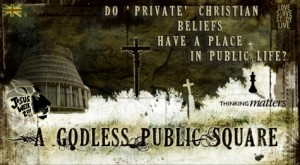 A few weeks ago, as part of Jesus Week at the University of Auckland, Thinking Matters and Evangelical Union hosted an event entitled A Godless Public Square: Do ‘Private’ Christian Beliefs Have a Place in Public Life? This event was a conversation between Theology, Philosophy and Law and featured Matthew Flannagan – Analytic Theologian, Glenn Peoples – Philosopher and Madeleine Flannagan – Legal Scholar. The video is still being edited and will be available soon but for now, this 3-part series comprises the written speeches of each speaker.
Madeleine Flannagan – Law
Glenn and Matt dealt with moral restraint; the idea prevalent in our society that those of us with religious convictions ought to keep them to ourselves when we participate in public life.
Often people contend or try to imply that this obligation is required by law. We’ve all heard politicians, people in the media, leaders in our communities, lecturers at university assert that we are a secular nation and that our commitment to freedom of religion requires a secular public square.[1]
And they are not wrong to a degree. It is evident that something like this ‘obligation’ advanced by the likes of Rawls, Audi, Gaus, et al is present in western jurisprudence – most obviously in that coming out of the United States; you do not need to have studied law to be aware of this, you will have picked up on it if you have watched any American TV.
Separation of Church and State or Separationism?
Most people are aware that the US Supreme Court has interpreted America’s Religious Freedom and Free Exercise laws to mean that religious instruction, prayer, references to God, displays of the 10 commandments, nativity scenes — even where participation is totally voluntary — are banned from public institutions.
This “separationist” reading of the 1st amendment is drawn from US Founding Father Thomas Jefferson’s “Wall of separation Letter” to the Danbury Baptists Association in 1802. But it is unlikely that this reading is what Jefferson meant. At the time he was writing in early nineteenth century America, the common perception of the relationship between church and state reflected a long-standing European tradition.
Legal scholar Steven Smith wrote in “Separation and the Secular: Reconstructing the Disestablishment Decision” that,
… At least since the middle ages, scholars and polemicists of all stripes had argued-on both religious and political grounds-that the church should exercise control over the state or-again on both religious and political grounds-that the state should control the church. The common view for centuries had been that an established church was essential to political and social stability.[2]
He added,
… In medieval Europe, for example, kings had claimed, and had exercised, the power to appoint bishops and popes. After the Reformation, the British monarch became the official head of the Church of England, and British government assumed control over both the selection of ecclesiastical officials and the formulation of religious doctrine.[3]
In fact, the Book of Common Prayer, including the 39 Articles, was commissioned and approved by the Crown.
Smith goes on,
… medieval popes regularly crowned earthly emperors and kings, and they claimed (and frequently purported to exercise) the authority not merely to excommunicate but actually to depose those kings. Popes sometimes asserted jurisdiction to adjudicate what were essentially political or property disputes. In England, the Church enjoyed-and still enjoys-official representation in Parliament. Immigrants later imported established churches in some form into most of the American colonies.[4]
The church-state relationship that was familiar to an eighteenth century American was that “governments controlled or directly intervened in the internal affairs of churches, and churches claimed and were formally endowed with governmental powers.”
At the time Jefferson was writing, many US States had established churches; so when the United States Congress promised to “… make no law respecting an establishment of religion, or prohibiting the free exercise thereof…”[5] they more likely had in mind that Separation of Church and State is simply the idea that the church should not be formally endowed with governmental powers and the state should not try to intervene in or control the church.
Separation of church and state is not separation of religious beliefs from public life (perhaps this confusion arises because both concepts have the word “separation” in them). The idea that Congress meant something more than mere Separation of Church and State when it passed the first amendment – that Congress meant Separationism — was birthed in the mid to late 20th century – some 200 years later – by the US Supreme Court when it began to hear cases about prayer in schools and the funding of Catholic schools.
Separationism and Separation of Church and State, as we have seen, are different ideas and one doe not entail the other.
Comparitive Jurisdictions
This is not just about the US. Separationist understandings of freedom of religion can be seen in Western jurisprudence elsewhere. There are European cases that exhibit it – even in places like the UK that do have an established church. Many of you will have heard the cases in the media of workers being sent home from their jobs after refusing to follow an instructions from their employers to remove religious jewellery[6] – normal jewellery was fine, just not anything that symbolised God.
The “Liberty Intervening” case is another UK example; a state-Celebrant refused to perform civil partnerships between members of the same sex. Because of her views on marriage, she was found to have discriminated against those couples. She could not appeal to freedom of religion as the court held that her employer’s requirement she perform same sex civil partnerships did not interfere with her ability to worship.[7]
Then there is this case, the summary from the head note explains (more…)
-
The New Zealand Association of Rationalist Humanists and the Privileging of Secularism
The New Zealand Association of Rationalist Humanists (“NZARH”) has a statement of aspirational ideals for the New Zealand state on their website. Entitled “The Tolerant Secular State” it is anything but.
The first two sentences of the document exhibit a confusion which is inherent throughout (and commonly found in discussions of church and state):
“The NZARH strongly believes that government should be secular; that is dealing with the issues of this world rather than following a religious agenda. Our law should not give one set of beliefs privilege over another and the state should treat religious organisations the same as any other organisation.”
An equivocation on the meaning of the word “secular” in the very first sentence is immediately apparent.
Stephen Smith notes that the word secular has two distinct meanings. Etymologically, “secular” refers to things pertaining to this world and life as opposed to the next. In this sense of the word “secular” is not opposed to religion; many religious beliefs and values pertain to life in this world, beliefs about: marriage, sex, human life, killing, justice for the poor, what one’s duties are in this life, what God’s purposes are in this life and so on are all secular beliefs in this sense. The second and more common meaning of “secular” is to say it excludes, is in opposition to beliefs and values that are religious in nature; this is usually the first definition one will find in a dictionary.
The NZARH use both meanings in the first sentence of their “Tolerant Secular State” document (more…)