Tag: NZARH

  • The New Zealand Association of Rationalist Humanists and the Privileging of Secularism

    The New Zealand Association of Rationalist Humanists (“NZARH”) has a statement of aspirational ideals for the New Zealand state on their website. Entitled “The Tolerant Secular State” it is anything but.

    The first two sentences of the document exhibit a confusion which is inherent throughout (and commonly found in discussions of church and state):

    Lord Voldemort

    “The NZARH strongly believes that government should be secular; that is dealing with the issues of this world rather than following a religious agenda. Our law should not give one set of beliefs privilege over another and the state should treat religious organisations the same as any other organisation.”

    An equivocation on the meaning of the word “secular” in the very first sentence is immediately apparent.

    Stephen Smith notes that the word secular has two distinct meanings. Etymologically, “secular” refers to things pertaining to this world and life as opposed to the next. In this sense of the word “secular” is not opposed to religion; many religious beliefs and values pertain to life in this world, beliefs about: marriage, sex, human life, killing,  justice for the poor, what one’s duties are in this life, what God’s purposes are in this life and so on are all secular beliefs in this sense. The second and more common meaning of “secular” is to say it excludes, is in opposition to beliefs and values that are religious in nature; this is usually the first definition one will find in a dictionary.

    The NZARH use both meanings in the first sentence of their “Tolerant Secular State” document (more…)

  • Contra Mundum: Selling Atheism

    New Zealand motorists will have noticed a new genre of advertising billboards, those attempting to sell the concept that there is probably no God. These billboards are the collective efforts of the New Zealand Atheist Campaign, The Humanist Society and the New Zealand Association of Rationalist Humanists. Like all advertising campaigns, these billboards offer clever-sounding slogans, which are indicative of the philosophy of the seller – in this case three variants of popular ‘new-atheist’ arguments. Like any consumer, I want to read the product labelling a little deeper before I consider buying. So here I intend to unpack the slogans and take a look at the implicit reasoning behind each.

    Each billboard has the tagline “There’s probably no God. Now stop worrying and enjoy your life.” My first thought on seeing this was that authors must find atheism psychologically liberating. We do not have to worry that there is a God and that means that we can enjoy ourselves but why would the existence of God be something to worry about? Is it the moral accountability that goes with it? If God exists then we might have to worry that He has seen what we have done in secret, and being free from this worry enables us to enjoy our lives. If this is so then prima facie this suggests that guilt is a major motivation behind, at least some peoples, atheism.

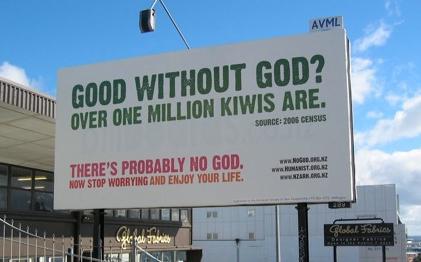
    The tagline aside, let’s look at the three slogans currently affronting us as we navigate our cities. The billboard on Auckland’s Newton Rd states, “Good without God? Over One Million Kiwis Are. Source:2006 Census.”

    Good without god?

    Here we are told that one million kiwis are good without God because the census says so. Now a lot could be said about the appeal to the census here, I don’t recall a question on it asking me if I was good and even if it did I am not sure that we should take too much from self-reported assessments of people’s own integrity. Let’s assume, however, that the billboard makes a fair claim. The inference is still is fallacious. What the census shows is not that one million kiwis are good without God, rather, it shows that one million kiwis are good without believing in the existence of God. But to say that one can be good without believing in God is not the same as saying that one can be good without God. Many people throughout history have been able to live and breath without believing in the existence of hydrogen and oxygen atoms yet it does not follow that they could live without hydrogen and oxygen.

    I am still left wondering how the fact that people do not need to believe in something to do good deeds renders the belief false? For centuries people have done good deeds and lived good lives without believing in heliocentricism or quantum mechanics, should we conclude that these theories are therefore ‘probably false’? Surely we are not being asked to buy that the basis of our beliefs should be what is useful or helpful as opposed to what is true?

    Perhaps the sellers mean to convey something else. Some Christian thinkers such as William Lane Craig, Robert Adams, Stephen Layman, Alvin Plantinga, John Hare and Philip Quinn have argued that moral properties such as right and wrong depend on God for their existence. Atheist writers such as Paul Kurtz and Christopher Hitchens retort that this claim is falsified by the existence of morally upright atheists. I suspect something like this is meant by the slogan on the billboard, it repeats Hitchens’ and Kurtz’s retorts as though they said something insightful or clever.

    This retort misses the point. Craig, Adams, et al are not claiming that one needs to believe in God to be good – a point made several times in the literature (and particularly made so many times to Kurtz that it beggars belief that he keeps repeating it) rather, their claim is that moral properties, such as right and wrong, depend on God for their existence. This is not the same thing, we know that water depends for its existence on the existence of hydrogen and oxygen, this does not mean, however, that we need to believe in the existence of hydrogen and oxygen in order to effectively recognise and use water. Ancient and medieval people were drinking, washing in, swimming in and sailing on water centuries before the discovery of contemporary atomic theory.

    This is a fairly basic and elementary distinction in the literature. How exactly expressing a common philosophical confusion counts as reason for thinking “there probably is no God” is hard to see.

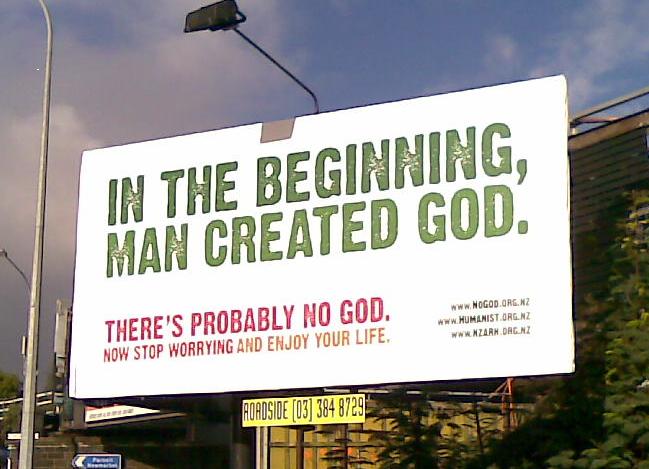
    Parnell Rise’s billboard informs us “In the Beginning Man Created God.”

    In the beginning man created god

    This one asserts that man created God. Now if one takes this statement in an absurdly literal manner (the way many sceptical organisations approach parables, hyperbole and poetry in the Bible) we find that atheists are telling us that God actually exists. I have no issue with the slogan at this juncture, however, the idea that God was created by human beings is clearly absurd. God is typically defined as an all-powerful, all-knowing, immaterial, necessarily-existent being who created the world and who sustains everything in it. Now if one is going to claim that humans actually created an all-powerful, all-knowing, immaterial, necessarily-existent who created and sustains the world, then they are contradicting themselves. Humans are part of the world and therefore cannot have created the being that created the world – otherwise humans would have to exist prior to their own existence.

    Of course to interpret this billboard in this way would be uncharitable. The authors of this billboard probably do not mean to say that humans actually created God, they do not think He exists after all. Their claim is that humans created the idea or concept of God and developed it. This is undoubtedly true. Of course, humans also invented the idea or concept of atoms as well – ancient Greek philosophers came up with the basics of this concept millennia ago – but this fact tells us nothing about whether or not the idea or concept humans developed actually corresponds to anything in reality. To assume that it tells us something about whether the idea or concept is true is a fairly obvious case of what logicians call the genetic fallacy.

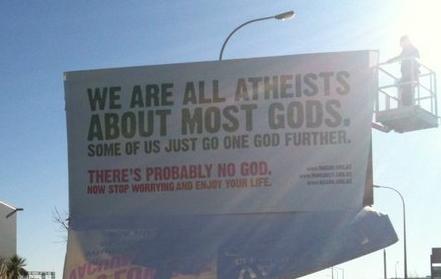
    The last one is my favourite, “We Are All Atheists About Most Gods. Some of Us Just Go One God Further.”

    We are all atheistsTo see the problems with this slogan take out the term “God” in the sign and replace it with some other term such as “non-Christian perspective.” When we do this we get: “We all reject most non-Christian perspectives, some of us just reject one more.” This argument has true premises, do we now have, a knock-down argument for Christianity?

    Similarly, an analogous argument form with true premises gives us an argument for nihilism, the denial that humans have moral duties, the total denial of the existence of morality. “We are all nihilists about some conceptions of morality, some of us are just nihilistic about one more.”

    The same argument for also furnishes a refutation of secularism, “we all reject some secular perspectives on reality, some of us just reject one more.” I could go on.

    Taking a stand on any issue of philosophical substance, whether by affirming, denying or simply being sceptical of it, is to put oneself in opposition to any number of other people and groups who take a contrary stance. That’s life. Such pluralism hardly provides a reason for thinking “there probably is no God” any more than it gives us a reason to doubt any other perspective on the world.

    So what do the atheist billboards do? Well the first one tells us that some atheist groups conflate basic philosophical distinctions and do not really understand the debate they are contributing to. The second shows us that these groups think contradictions and obvious fallacies are some how savvy and smart. The last shows us that they think that invalid argument forms, forms from which you could infer the denial of anything and everything by substituting one true premise with another, are avant-garde. All in all, pretty accurate advertising for these groups.

    I write a monthly column for Investigate Magazine entitled Contra Mundum. This blog post was published in the Sept 10 issue and is reproduced here with permission. Contra Mundum is Latin for ‘against the world;’ the phrase is usually attributed to Athanasius who was exiled for defending Christian orthodoxy.

    Letters to the editor should be sent to:
    editorial@investigatemagazine.DELETE.com

    RELATED POSTS:
    Contra Mundum: Did God Command Genocide in the Old Testament?
    Contra Mundum: Fairies, Leprechauns, Golden Tea Cups & Spaghetti Monsters
    Contra Mundum: Secularism and Public Life
    Contra Mundum: Richard Dawkins and Open Mindedness
    Contra Mundum: Slavery and the Old Testament

    Contra Mundum: Secular Smoke Screens and Plato’s Euthyphro

    Contra Mundum: What’s Wrong with Imposing your Beliefs onto Others?
    Contra Mundum: God, Proof and Faith
    Contra Mundum: “Bigoted Fundamentalist” as Orwellian Double-Speak
    Contra Mundum: The Flat-Earth Myth
    Contra Mundum: Confessions of an Anti-Choice Fanatic
    Contra Mundum: The Judgmental Jesus

  • There’s Probably No God? Fisking Atheist Billboards

    On the way back from Bloggers drinks we drove past one of the controversial atheist advertising billboards, put up by NZ Atheist Campaign, The Humanist Society and NZARH, which have appeared around Auckland. This appears to have come on the back of the Richard Dawkins inspired bus advertising that made headlines earlier this year. It is worth fisking them a bit.

    Here is a pic of the first one.

    Good Without God? Over One Million Kiwis Are.

    Here we are told one million kiwis are good without God because the census says so. This, however, is fallacious. What the census shows is not that one million kiwis are good without God, it shows that one million kiwis are good (although this is granting a lot for the sake of argument) without believing in the existence God. But to say one can be good without believing in God is not the same as saying one can be good without God. Many people throughout history have been able to live and breath without believing in the existence of hydrogen and oxygen atoms, it does not follow that they could live without water.

    Moreover, it is hard to tell what the point of this sociological fact is anyway. Why does the fact that people do not need to believe in something to do good deeds mean that the belief is false? For centuries people have done good deeds and lived good lives without believing in evolutionary theory or quantum mechanics, should we conclude that these theories are therefore ‘probably false’? Surely these atheists are not suggesting that our beliefs should be based on what is useful or helpful as opposed to what is true or false?

    Perhaps the atheists here mean to convey something else. Some Christian thinkers such as William Lane Craig, Robert Adams, Stephen Layman, Alvin Plantinga, John Hare, Philip Quinn have argued that moral properties such as right and wrong depend on God for their existence. Atheist writers such as Paul Kurtz and Christopher Hitchens retort that this claim is falsified by the existence of morally upright atheists. I suspect something like this is behind the slogan on the billboard, it repeats Hitchens and Kurtz’s retorts as though they said something insightful or clever.

    The problem is, as any one familiar with this discussion should know, this retort misses the point (as I pointed out in On a Common Equivocation). Craig, Adams, et al are not claiming that one needs to believe in God to be good (a point made several times in the literature and particularly made so many times to Kurtz that it beggars belief that he keeps repeating it) rather their claim is that moral properties, such as right and wrong, depend on God for their existence.

    This is a fairly basic and elementary distinction in the literature. How exactly expressing a common philosophical confusion counts as reason for thinking “there probably is no God” is hard to see.

    Let’s look at the next one.

    In the Beginning, Man Created God.

    What is asserted here? That man created God. This, however, is clearly absurd. God is typically defined as an all-powerful, all-knowing, immaterial, necessarily-existent being who created the world. Now if one is going to claim that humans actually created an all-powerful, all-knowing, immaterial, necessarily-existent who created the world, then they are contradicting themselves.

    Humans are part of the world and therefore cannot have created the being that created the world – otherwise humans would have to exist prior to their own existence.

    Similarly, one cannot create a necessary being, this would entail it is possible for a necessary being to not exist, in which case it would not be a necessary being. Taken in a straight-forward, literal manner (the way freethinkers are so fond of taking every passage in the Bible) this billboard simply asserts contradictions.

    Of course, the authors of this billboard probably do not mean to say humans actually created God, they do not think he exists after all. Their claim is that humans created the idea or concept of God and developed it. This is undoubtedly true. Of course, humans also invented the idea or concept of atoms as well, ancient Greek philosophers came up the basics of this concept millennium ago. This trivial fact tells us nothing about whether or not the idea or concept humans developed actually corresponds to anything in reality. To assume that it tells us something about whether the idea or concept is true or false is a fairly obvious case of the genetic fallacy.

    So the second billboard either asserts a contradiction or it is a clear case of a logical fallacy.

    The last one is my favourite.

    We are all atheists about most gods. Some of us just go one god further.

    I am inclined to think the argument on this sign is invalid. To see why let’s take out the term “God” in the sign and replace it with some other term such as “non-Christian perspective.” When we do this we get: “We all reject most non-Christian perspectives, some of us just reject one more.” This argument has true premises, do we now have, a knock-down argument for Christianity?

    Similarly, an analogous argument form with true premises gives us an argument for nihilism, the total denial of the existence of morality. “We are all nihilists about some conceptions of morality, some of us are just nihilistic about one more.”

    The same argument for also furnishes a refutation of secularism, “we all reject some secular perspectives on reality, some of us just reject one more.” I could go on.

    Taking a stand on any issue of philosophical substance, whether by affirming, denying or simply being sceptical of it, is to put oneself in opposition to any number of other people and groups who take a contrary stance. That is life. Such pluralism hardly provides a reason for thinking “there probably is no God” any more than it gives us a reason to doubt any other perspective on the world.

    So what do the atheist billboards do? Well the first one tells us that some atheist groups conflate basic philosophical distinctions and don’t really understand the debate they are contributing to. The second shows us that these groups think contradictions and obvious fallacies are some how savvy and smart. The last shows us that they think that invalid argument forms, forms from which you could infer the denial of anything and everything by substituting one true premise with another, are avant-garde.

    All in all, pretty accurate advertising for these groups.

    Hat tip: MCAS

  • William Lane Craig, Raymond Bradley and the Problem of Hell. Part Two.

    In a previous post I mentioned Professor Raymond Bradley’s (Bradley) contention that,

    [3] The bible teaches that God will torture people endlessly for their beliefs.

    In his article he cites several scriptural passages in support of this contention. I think his exegesis is problematic; I cannot go into huge detail in a blog post but I will endeavour to address the main arguments he offers.

    In essence, Bradley cites from three sections of the New Testament: Matthew, Acts and the Epistles, and Revelation. I will examine each in turn.

    Matthew
    Bradley writes:

    In the Gospel of Matthew alone he characterizes it in terms which evangelists adore: “unquenchable fire,” “fiery hell” (twice), “torment,” “burned with fire,” “furnace of fire” (twice), “weeping and gnashing of teeth” (five times), “eternal fire,” and “eternal fire which has been prepared for the devil and his angels. [Emphasis Original]

    Bradley refers to references to “fire,” “torment” and “weeping and gnashing of teeth.” He assumes, without argument, that each of these phrases refer to torturing people. However, an examination of the relevant passages shows this to be false.

    Unquenchable Fire
    The phrase “unquenchable fire” occurs Matt 5:12 and does not refer to torture.

    His winnowing fork is in his hand, and he will clear his threshing floor, gathering his wheat into the barn and burning up the chaff with unquenchable fire. [Emphasis Added]

    The phrase originates in the Old Testament. There it refers not to a fire that tortures but one that consumes what it devours, because it is never put out. (see Isa 1:311, 34:10, 11; Jer 4:4, 7:20, 17:27, 21:12; Ezek 20:47, 48; Amos 5:6). The context bears this out; Matt 5:12 states “burning up the chaff with unquenchable fire” [emphasis added]. The metaphor here is a farmer burning chaff. Now when burned, chaff is consumed and destroyed by fire and not tortured (unless Bradley is asserting that Chaff has consciousness). The picture then is of separation and annihilation, not everlasting torture.

    It is worth noting that not only does this passage not support Bradley’s contention (a), it does not support (b) either. In v 10-11 the reason people might be subject to judgement is not because of what they believe, but because of unrepentant wrongdoing. Moreover, the earlier context alludes to “lack of fruit,” an Old Testament idiom for lack of virtuous conduct.

    Fiery Hell
    The references to “hell fire” do not bear Bradley’s point out either. The Greek word for hell is Ge-Hinnom. Ge-Hinnom was a valley outside of Jerusalem. In the time of Manasseh, this valley was used for human sacrifices to the Canaanite God Molech. For this reason the area became a euphemism for disgrace, shame and contempt. Later after the Assyrian invasion, it was a place where dead bodies were piled up and cremated. Isaiah used metaphors of mass cremation as a metaphor for future judgement. This imagery became a metaphor for final judgment in Jewish Apocalyptic writings.

    The term “fiery hell” does not necessitate a picture of everlasting torture; again the references to hell in Matthew bear this out. In 5:29-30 the contrast is drawn between cutting off your hand and throwing it into hell or throwing your whole body into hell. This again is not an allusion to torture (unless severed hands have consciousness?). In Matt 10:28, the contrast is between a person who kills a body and God who kills body and soul in hell. The picture is, again, not of torture but of being discarded and destroyed. Moreover, in all these references things are thrown into hell not because of what they believe but because of what they do.

    Burned with Fire
    Again when one looks at the actual passages in context, one sees they do not say what Bradley alleges. The repeated picture is of a tree being cut down and burned due to its lack of fruit (Matt 3:11 and Matt 7:19). The imagery is again of throwing something away and destroying it and not of torture (trees are not conscious). Moreover, fruitlessness is standard apocalyptic imagery for unjust conduct, not for mistaken belief.

    Furnace of Fire
    The references to a “furnace of fire” in Matt 13 do not convey endless torture. In 13:40 the explicit metaphor is of weeds which are pulled out and burned. Moreover in v 47, the furnace stands in a Semitic parallel to fish that are already dead but are thrown away as rubbish. Moreover, in both passages it is clear that judgement is inflicted upon people because they “do evil” or are “wicked”; it is again actions not beliefs.

    Gnashing of Teeth
    Similarly Bradley appears to interpret the phrase “weeping and gnashing of teeth” as referring to the agony of torture. This again is unlikely. The phrase occurs many times in the Old Testament (Job 16:9; Ps 35:16, 36:16, 37:12; Lam. 2:16) and in the New Testament, and in almost every instance signifies hatred or rage at God or the righteous. Not the agony of pain and torture.

    Eternal Fire
    It is equally doubtful that the phrase “eternal fire” means eternal torture. Jude v7, for example, uses the term “eternal fire” to describe the judgment that befell Sodom and Gomorrah, towns that were reduced to rubble and not tortured forever.

    The passages in Matthew referred to are firstly symbolic, and secondly, do not support Bradley’s contention that they teach that God will torture people forever because of their beliefs. Its also worth noting Bradley’s citations from Matthew are selective. He cites the “fire” metaphor but ignores the metaphors for judgement of being incarcerated or of being expelled from a party which also occur in Matthew, etc and in each case it is the person’s deeds and not their beliefs, which are the basis for judgment.

    Epistles and Acts
    Bradley’s citations from Acts and the Epistles similarly do not back up his point. He notes,

    According to Luke, the reputed author of The Acts, there is salvation in no one else; for there is no other name under heaven that has been given among men, by which we must be saved.” (Acts 4:12). And St. Paul makes it clearer still when he tells us that “the Lord Jesus Christ shall be revealed from heaven with his mighty angels in flaming fire, dealing out retribution to those who do not know God [my emphasis]and to those who do not obey the Gospel of our Lord Jesus Christ. And these will pay the penalty of eternal destruction” (II Thess. 1:7-9). [Emphasis Original]

    The problem is that neither passage affirms that people are tortured for ever because of what they believe. The passage in Acts asserts that people are saved in Jesus’ name and does not state that people will be tortured because of their beliefs. Similarly, Paul does not state that people will be tortured but that they will be destroyed and the basis is not that they do not have certain beliefs but that they “do not know God” and “do not obey the Gospel of our Lord Jesus Christ.”

    Revelation
    At the Auckland Craig v Cooke debate Bradley cited a further passage from the Book of Revelation,

    If anyone worships the beast and his image and receives his mark on the forehead or on the hand, 10 he, too, will drink of the wine of God’s fury, which has been poured full strength into the cup of his wrath. He will be tormented with burning sulfur in the presence of the holy angels and of the Lamb. 11 And the smoke of their torment rises for ever and ever. There is no rest day or night for those who worship the beast and his image, or for anyone who receives the mark of his name.” 12 This calls for patient endurance on the part of the saints who obey God’s commandments and remain faithful to Jesus.

    There are several metaphors in this passage, a reference to the “wine of God’s fury” the picture of torment in burning sulphur and the picture of rising smoke. Bradley appears to have attached on to the latter two and interpreted them rather literally. The problem here is that the genre of Revelation is Apocalyptic literature. Such literature is highly metaphorical and uses stock symbols (common symbols repeatedly used in this type of literature). Careful note should be taken when reading Revelation of the metaphors in it and also the Old Testament background of these metaphors. The position is far more nuanced than Bradley appears to think.

    The picture of fire and sulphur followed by rising smoke is drawn from the account of Sodom and Gomorrah’s destruction by “burning sulphur.” Gen 19 adds,

    27 Early the next morning Abraham got up and returned to the place where he had stood before the LORD. 28 He looked down toward Sodom and Gomorrah, toward all the land of the plain, and he saw dense smoke rising from the land,

    This imagery of sulphur being poured upon people and smoke rising was later used in the Old Testament to symbolise the destruction of various nations. (Deut 29:23; Job 18:15-17; Ps 11:6; Isa 30:33). Perhaps one of the clearest uses of this imagery is seen in Isaiah 34

    9 Edom’s streams will be turned into pitch, her dust into burning sulfur; her land will become blazing pitch! 10 It will not be quenched night and day; its smoke will rise forever. From generation to generation it will lie desolate; no one will ever pass through it again.

    Now Edom did not literally burn forever in sulphur. In fact, taken literally, the differing metaphors in Isa 34 for Edom’s destruction would contradict each other. But Apocalyptic literature is not supposed to be taken this literally (just as many of the phrases we use today are not meant to be taken literally). What Apocalyptic literature does in this instance is use various differing, dramatic, visual images to describe total the destruction of Edom. Similar imagery to this passage is used thought the book of Revelation. In fact, in Rev 18 when the destruction of a city, named Babylon but probably a reference to Rome or Jerusalem, the city is said to be tormented by fire and onlookers watch the rising smoke. The message is that Babylon has been judged and destroyed.

    ***

    In essence, then, [3] is mistaken. It is based on an excessively literalistic reading of Apocalyptic literature. Bradley’s argument is not an argument for atheism. It can only succeed as an argument for atheism if one accepts both the infallibility of scripture and an excessively literalistic reading of the text, one that fails to take into account the genre of Jewish Apocalyptic writings. The correct response to this objection is not to become an atheist but to reject poor hermeneutics.

    RELATED POSTS:
    William Lane Craig, Raymond Bradley and the Problem of Hell Part Two
    The Battle of the Bill’s: A Review of the Craig – Cooke Debate
  • Is God a Delusion? The Auckland Craig v Cooke Debate Online

    Dr William Lane Craig and Dr Bill Cooke debated the moot “Is God a Delusion?” at Auckland University on 17 June 2008. The debate was chaired by Professor John Bishop and was organised by New Zealand Association of Rationalists and Humanists and Tertiary Students Christian Fellowship with MandM.

    High quality DVD copies of the debate are available from John Welch for $39.95 NZD + P&P.

    Our review of the debate is here. Enjoy 🙂

  • William Lane Craig, Raymond Bradley and the Problem of Hell Part One

    During the Q & A at the recent Auckland Cooke – Craig debate, Professor Raymond Bradley (Bradley), Emeritus Professor of Philosophy at Auckland University, offered an argument, which he has laid out in more detail in his article A Moral Argument for Atheism, as follows:

    Christians accept that:

    [1] Any act that God commits, causes, commands or condones is morally permissible;
    [2] It is morally wrong to torture people endlessly for their beliefs;
    [3] The bible teaches that God will torture people endlessly for their beliefs;

    From this he inferred that:

    [4] God does not exist.

    Dr William Lane Craig (Craig) responded that the conclusion does not follow from the premises unless one assumes that the Bible is infallible. [1] and [2] entail that God will not endlessly torture people for their beliefs. However, [3] entails the negation of this only if one adds the further premise, that whatever the bible teaches about God is true. If one does not grant this assumption, the fact that the bible records that God will do something does not entail that he actually will do this. Hence, even if Bradley’s argument is sound it is really an argument against theism conjoined with biblical infallibility, not against theism per se.

    In his article, Bradley argues that this option is unavailable to the Christian theist. He writes:

    this would be to be to abandon the chief foundation of religious and moral epistemology (ways of obtaining religious and moral knowledge) … the question arises as to how we are supposed to know of God’s existence let alone look to him for moral guidance. After all, it is a distinguishing feature of theism, as opposed to deism, to hold that God reveals himself to us and, from time to time, intervenes in human history. And the Bible, according to theists, is the principal record of his revelatory interventions. If the Bible, with its stories of Moses and Jesus, is not his revealed and presumptively true word, then how are we to know of him? If God doesn’t reveal himself through the Old Testament Moses and the New Testament Jesus, then through whom does he reveal himself? To be sure, a theist could well claim that God also reveals himself through other channels in addition to the Bible: reason, tradition, and religious experience all being cases in point. But to deny that the Bible is his main mode of communication would be to deny that the principal figures in Judaism and Christianity can really be known at all. Apart from the scriptural records, we would know little, if anything, of Moses or Jesus, it being doubtful that secular history has anything reliable to say about either. Apart from the scriptural records we would know nothing of the so-called Ten Commandments that God supposedly delivered to Moses, or of the ethical principles that Jesus supposedly delivered in his sermons and parables.

    Bradley is mistaken. He confuses the claim (i) that scripture is reliable, with the claim (ii) that scripture is infallible. In order for the Bible to give us reliable, trust-worthy information about God, (i) needs to be the case. However, (i) is compatible with admitting that on some issues scripture is mistaken.

    Therefore, Bradley’s argument does not have the bite he (and some members of the audience on Tuesday) thought it did. Nether-the-less as an evangelical, Craig is committed to some form of scriptural infallibility and I share this commitment with him. So it is best to see if another line of attack is available.

    Craig’s second point alluded to an ambiguity in [2]. [2] states it is wrong to endlessly torture people for their beliefs. However, this could be interpreted two possible ways, it could be interpreted as:

    [2a] It is wrong for human persons to endlessly torture people for their beliefs;
    [2b] It is wrong for any person including God to endlessly torture people for their beliefs.

    Now in order for Bradley’s argument to follow, [2b] needs to be the case. It needs to be the case that God is engaging in wrongdoing if he tortures people for their beliefs. However, in the article Bradley cites in support of this argument, he provides reasons only for [2a]. He argues that to deny principles such as do not torture people endlessly for their beliefs,

    … would be to ally oneself with moral monsters like Ghenghis Khan, Hitler, Stalin, and Pol Pot. It would be to abandon all pretense to a belief in objective moral values. Indeed, if it is permissible to violate the above principles, then it isn’t easy to see what sorts of acts would not be permissible. .. [It] would be tantamount to an embrace of moral nihilism. And no theist who believes in the Ten Commandments or the Sermon on the Mount could assent to that.

    What Bradley fails to appreciate is that these absurd consequences follow from the rejection of (2a) and not from the rejection of (2b). Moreover, as Craig noted there are good reasons for thinking that it is (2a) and not (2b) that is true. This is because (2b) assumes that God has duties. Both, Craig and I believe in a meta-ethical view known as the Divine Command Theory (DCT). According to this position, it is wrong for a person to perform an action, if and only if, God commands them to not perform this action. It follows from a DCT that God has duties only if he issues commands to himself. Given he does not issue commands to himself, it follows that God cannot have duties.

    God does issue commands to human beings. One command is to not torture people for their beliefs. It follows that (2a) is true and (2a) prevents us allying ourselves with moral monsters such as Pol Pot, Stalin, Hitler, etc.

    Craig’s response, then, is correct. I am inclined to think, however, that Bradley’s argument can be recast without presupposing that God has duties. It is essential to theism and to the defensibility of a divine command theory to maintain that:

    [1’] God is good (where good is referred to in terms of virtues as opposed to (duties).

    And a person, following Bradley’s lead, could argue that:

    [2’] A good person does not torture people for their beliefs.
    [3] The bible teaches that God will torture people endlessly for their beliefs.

    And [1’], [2’] and [3’], when conjoined to a commitment to biblical infallibility, entail a contradiction.

    The best response to Bradley is to attack [3]. Now note that [3] asserts at least two things; first: (a) scripture states that God will torture people forever; second, (b) God does so because of what such people believe. The crucial question then is what reasons Bradley offers for the truth of (a) and (b)? In my next post William Lane Craig, Raymond Bradley and the Problem of Hell Part Two I will examine some of these reasons and argue that they are mistaken.

    RELATED POSTS:
    William Lane Craig, Raymond Bradley and the Problem of Hell Part Two
    The Battle of the Bill’s: A Review of the Craig – Cooke Debate

  • Just in – the Palmy Debate

    I have an initial report from the Palmerston North Bill Craig v Bill Cooke debate held last night:

    There was a massive turnout of 1399 exactly in attendance. The word is that Cooke stepped it up and performed better than in Auckland but that Craig still won. Feedback from those in attendance was that it was a fantastic evening, thoroughly enjoyed by all.

    I have been promised a more thorough report later today so will update this post accordingly.

    Madeleine

    UPDATE:

    Author of Confusion wrote this review, reproduced in part below:

    William Lane Craig & Bill Cooke Public Debate (Palmy)

    Last night (19th June, 2008) I attended the debate which I talked about in a previous post.
    I was astounded at the attendance – the Regent Theatre in Palmerston North has a capacity of about 1,400 and it was easily 90% full for most of the night. There was an impressive diversity of age, gender, and race evident in the audience and I would say it was a fairly accurate cross-section of adult society (it certainly wasn’t an old white men’s club!). From responses to the speakers the audience was polite but predominantly Christian and this reinforces my impression is that there is a growing religious movement pushed by several of fairly active church groups in Palmerston North and it is something I am going to start keeping a closer eye on.

    My overall impressions of the debate were disappointing, and pretty much match Damian’s initial impressions. Craig had a definite game plan in the debate, and it was clearly a game plan from a skilled formal debater. Set up premises and then defend them. Sadly Cooke’s game plan was to dismiss the moot, largely ignore Craig’s premises (begrudgingly discussing them, almost as after thoughts) and mostly talking to three points almost despite whatever Craig said. I will raise these first and then go on to discuss Craig’s arguments:

    Cooke’s Approach

    1. Atheists do not assert there is no god but that they do not see the case for god as compelling or even a coherent claim (based on weak definitions). Unfortunately, while an interesting point, Craig never really tried to pin this on Cooke so it was really not a point worth making in the debate.
    2. He used Lloyd Geering’s idea that the notion of “God” is a barrier to understanding the world around us, and that focusing too much on god gets in the way of rational discourse and promotes undue authority amongst those who claim to understand it. This was an interesting tactic but it failed against the so-called “logic” of Craig because most people (including Craig) missed the connection.
    3. Cooke’s final point was that we should stop arguing about our differences and instead focus on our similarities and on solving real problems. This sort of argument, while noble, is not the way to win debates. He talked about how he was happy that Craig was a Christian and that he encouraged diversity of opinion. Again very noble, but in debates it is about point scoring not nobility (one reason I dislike the format) and this counted against Cooke especially in an audience of largely opposing views.

    So overall it didn’t really seem like Cooke came to debate. The only life really came from him during the Q&A when some quick witted answers did score some points, but by then it was far too late. If the debate was scored he would have clearly lost.