Tag: Thinking Matters

  • Auckland Conference: Science and Faith with Dr C John Collins

    Thinking Matters have a couple of conferences coming up in July with Dr C John Collins:Science and Faith Friends ofr Foes?Much of Western culture assumes that science and faith are foes, that faith and scientific naiveté go hand in hand, and that science has disproved the Bible and made faith irrelevant if not completely indefensible and undesirable.

    Come and hear Dr. C. John Collins explain why faith and science are actually friends, how good faith fosters good science, and how good science should actually lead people to be more open to faith and the Bible.

    WHEN: Friday 19 July 7pm-9.30pm and Saturday 20 July, 9:00am-4:30pm
    WHERE: City Presbyterian Church, 283 Karangahape Road, Auckland
    COST: $40 ($20 for Students).

    Coffee and tea will be provided but please bring your own lunch.

    Full details including info on how to register can be found over at Thinking Matters.

    Consider also attending: Ancient Truth for Modern Times with Dr C John Collins

  • Auckland Conference: Ancient Truth for Modern Times with Dr C John Collins

    Thinking Matters have a couple of conferences coming up in July with Dr C John Collins:Ancient Truth for Modern Times

    What is the Bible? What authority if any does the Bible have in the 21st Century? How should the Bible shape the life of the Church and individual believers?

    Our approach to Scripture is fundamental to our ability to understand who God is and what he has to say to us. Come and hear Dr C John Collins explore the nature, authority, and purpose of the Bible in the 21st Century.

    WHEN: Saturday, 13 July, 9:00am-4:30pm
    WHERE: City Presbyterian Church, 283 Karangahape Road, Auckland
    COST: $20 ($10 for Students).

    Full details including info on how to register can be found over at Thinking Matters.

    Consider also attending: Science and Faith with Dr C John Collins

  • Advance: Exploring Tough Questions About Christianity

    This blog’s Matthew Flannagan is scheduled to speak alongside Dr Glenn Peoples, Dr Chris Tucker, Sean du Toit and Jacqui Lloyd at this Friday’s one day Auckland conference Advance: Exploring Tough Questions About Christianity.

    Advance: Exploring Tough Questions About Christianity

    From the promotional material:

    Are faith and reason enemies? Should we take Christianity seriously in the world of ideas? Can we even know that Christianity is true? Thinking Matters and Evangelical Union are proud to host Christian philosopher, blogger, and popular speaker Dr Glenn Peoples to explore these questions and examine the evidence.

    Workshops sessions available:

      • Dr Chris Tucker on the ‘problem of evil’
      • Shawn Means on maths, the universe, and God
      • Sean du Toit on who wrote the books of the New Testament
      • Dr Matthew Flannagan on reading difficult Old Testament passages

    The day will conclude with a panel featuring Dr Glenn Peoples, Dr Matthew Flannagan, and Jacqui Lloyd which is open to any question.

    The location is ‘GAPS’ 17A Powell St, Avondale – slightly out of the city (and a 10 min walk from Avondale train station), this rustic location is ideal for seminars and discussion.

    Cost: $15. Lunch is included.

    Register at the Facebook event page here.

  • Why Defend Christianity? Hear Matthew Flannagan speak on Thursday

    Matt is speaking for Thinking Matters on the topic Why Defend Christianity? This coming Thursday, from the Facebook Event:

    Matthew Flannagan“The Christian faith seems increasingly at odds with those in the world around us. From the media, to skeptical teachers and unbelieving peers, the gospel seems irrelevant and out of date. How do we talk to others about God and the Bible? Can we really argue people into the kingdom of God? Or should we just focus on compassion and loving others? Next Thursday, Thinking Matters Auckland is hosting Christian theologian Dr Matt Flannagan to speak on these questions and more. Matt will examine the Biblical and practical evidence for defending Christianity and show why it is vital to knowing and communicating our faith in the 21st Century. The event is free, so come along and bring a friend.

    Matt is a theologian and prominent New Zealand Christian commentator, debater, and blogger. He specialises in applied ethics and the interface between philosophy and theology. Currently, Matt works part-time as a teaching pastor and youth group leader for Takanini Church of Christ while he runs the popular blog MandM with his wife Madeleine.

    Thinking Matters is a New Zealand Christian ministry that exists to encourage the life of the mind in the love of God.”

    Thursday 4 April @ 7.30pm @ Auckland Chinese Presbyterian Church, 105 Vincent Street, Auckland, New Zealand

  • Thinking Matters Youth Conference

    This Saturday is the first, of hopefully many, Thinking Matters Youth Conference, the schedule is  below.  I am leading a breakout session on Moral Relativism

    WHEN: Saturday, February 18
    WHERE: Greenlane Christian Centre, 17 Marewa Rd, Greenlane, Auckland
    COST: $10


    Schedule:
    10am Registration
    10.30am Jeff Tallon – Is Science a Threat to Faith?
    11.30am Sean McDowell – Is Faith Blind? (via Skype)
    12.15pm Lunch
    1pm Breakout Sessions 1

    • Stream 1: Is morality relative and does it matter? – Matt Flannagan
    • Stream 2: How can one religion be “right” and the others “wrong”? – Trevor Mander
    • Stream 3: Why doesn’t God do something about the evil in the world? – Ben Carswell
    • Stream 4: Does God get mad when we doubt? – Jason Kumar and Dominic Bnonn Tennant
    1.45pm Breakout Sessions 2 (repeated)
    2.30pm Tim McGrew – Is the Bible Reliable? (via Skype)
    3.30pm Q&A Panel – Jeff Tallon, Ben Carswell, Matt Flannagan, and Trevor Mander
    4.15pm Conference closes
  • Freedom of Religion in a Secular Society @ Auckland University this Monday

    Church and StateAs part of AUSA’s Human Rights week at the University of Auckland, and in association with Thinking Matters, Matt and I will be giving a free public lecture with Q&A on the topic “Freedom of Religion in a Secular Society” on Monday 12 September from 7-8.30pm in Clock Tower Lecture Room 032.

    The Facebook page for this event states:

    The New Zealand Bill of Rights Act states:

    13 – Everyone has the right to freedom of thought, conscience, religion, and belief, including the right to adopt and to hold opinions without interference.

    14 – Everyone has the right to freedom of expression, including the freedom to seek, receive, and impart information and opinions of any kind in any form.

    15 – Every person has the right to manifest that person’s religion or belief in worship, observance, practice, or teaching, either individually or in community with others, and either in public or in private.

    • How should we read these sections alongside idea that New Zealand is a secular society?
    • How should we read them alongside the viewpoint advanced most notably by philosophers such as John Rawls that religion should be privatised?
    • Does Separation of Church and State require Separation of Religion from public life?
    • Can we still have Freedom of Religion in New Zealand and hold to these views?
    • What approach is just and fair in a pluralistic society like ours?

    Analytic Theologian and Ethicist, Dr Matthew Flannagan and Legal Scholar, Madeleine Flannagan (a post-graduate student in Law at Auckland) will give a joint lecture followed by a Q&A session on the topic Freedom of Religion in a Secular Society from 7.00-8.30pm on Monday 12 September 2011 in Clock Tower 032.

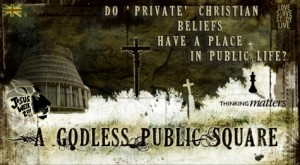
  • A Godless Public Square: Do ‘Private’ Christian Beliefs Have a Place in Public Life? Part III Madeleine Flannagan – Law

    A Godless Public Square: Do ‘Private’ Christian Beliefs Have a Place in Public Life? A few weeks ago, as part of Jesus Week at the University of Auckland, Thinking Matters and Evangelical Union hosted an event entitled A Godless Public Square: Do ‘Private’ Christian Beliefs Have a Place in Public Life? This event was a conversation between Theology, Philosophy and Law and featured Matthew Flannagan – Analytic Theologian, Glenn Peoples – Philosopher and Madeleine Flannagan – Legal Scholar. The video is still being edited and will be available soon but for now, this 3-part series comprises the written speeches of each speaker.

    Madeleine Flannagan – Law

    Glenn and Matt dealt with moral restraint; the idea prevalent in our society that those of us with religious convictions ought to keep them to ourselves when we participate in public life.

    Often people contend or try to imply that this obligation is required by law. We’ve all heard politicians, people in the media, leaders in our communities, lecturers at university assert that we are a secular nation and that our commitment to freedom of religion requires a secular public square.[1]

    And they are not wrong to a degree. It is evident that something like this ‘obligation’ advanced by the likes of Rawls, Audi, Gaus, et al is present in western jurisprudence – most obviously in that coming out of the United States; you do not need to have studied law to be aware of this, you will have picked up on it if you have watched any American TV.

    Separation of Church and State or Separationism?

    Most people are aware that the US Supreme Court has interpreted America’s Religious Freedom and Free Exercise laws to mean that religious instruction, prayer, references to God, displays of the 10 commandments, nativity scenes — even where participation is totally voluntary — are banned from public institutions.

    This “separationist” reading of the 1st amendment is drawn from US Founding Father Thomas Jefferson’s “Wall of separation Letter” to the Danbury Baptists Association in 1802. But it is unlikely that this reading is what Jefferson meant. At the time he was writing in early nineteenth century America, the common perception of the relationship between church and state reflected a long-standing European tradition.

    Legal scholar Steven Smith wrote in “Separation and the Secular: Reconstructing the Disestablishment Decision” that,

    … At least since the middle ages, scholars and polemicists of all stripes had argued-on both religious and political grounds-that the church should exercise control over the state or-again on both religious and political grounds-that the state should control the church. The common view for centuries had been that an established church was essential to political and social stability.[2]

    He added,

    … In medieval Europe, for example, kings had claimed, and had exercised, the power to appoint bishops and popes. After the Reformation, the British monarch became the official head of the Church of England, and British government assumed control over both the selection of ecclesiastical officials and the formulation of religious doctrine.[3]

    In fact, the Book of Common Prayer, including the 39 Articles, was commissioned and approved by the Crown.

    Smith goes on,

    … medieval popes regularly crowned earthly emperors and kings, and they claimed (and frequently purported to exercise) the authority not merely to excommunicate but actually to depose those kings. Popes sometimes asserted jurisdiction to adjudicate what were essentially political or property disputes. In England, the Church enjoyed-and still enjoys-official representation in Parliament. Immigrants later imported established churches in some form into most of the American colonies.[4]

    The church-state relationship that was familiar to an eighteenth century American was that “governments controlled or directly intervened in the internal affairs of churches, and churches claimed and were formally endowed with governmental powers.”

    At the time Jefferson was writing, many US States had established churches; so when the United States Congress promised to “… make no law respecting an establishment of religion, or prohibiting the free exercise thereof…”[5] they more likely had in mind that Separation of Church and State is simply the idea that the church should not be formally endowed with governmental powers and the state should not try to intervene in or control the church.

    Separation of church and state is not separation of religious beliefs from public life (perhaps this confusion arises because both concepts have the word “separation” in them). The idea that Congress meant something more than mere Separation of Church and State when it passed the first amendment – that Congress meant Separationism — was birthed in the mid to late 20th century – some 200 years later – by the US Supreme Court when it began to hear cases about prayer in schools and the funding of Catholic schools.

    Separationism and Separation of Church and State, as we have seen, are different ideas and one doe not entail the other.

    Comparitive Jurisdictions

    This is not just about the US. Separationist understandings of freedom of religion can be seen in Western jurisprudence elsewhere. There are European cases that exhibit it – even in places like the UK that do have an established church. Many of you will have heard the cases in the media of workers being sent home from their jobs after refusing to follow an instructions from their employers to remove religious jewellery[6] – normal jewellery was fine, just not anything that symbolised God.

    The “Liberty Intervening” case is another UK example; a state-Celebrant refused to perform civil partnerships between members of the same sex. Because of her views on marriage, she was found to have discriminated against those couples. She could not appeal to freedom of religion as the court held that her employer’s requirement she perform same sex civil partnerships did not interfere with her ability to worship.[7]

    Then there is this case, the summary from the head note explains (more…)