Tag: Thinking Matters

  • A Godless Public Square: Do ‘Private’ Christian Beliefs Have a Place in Public Life? Part II Glenn Peoples – Philosophy

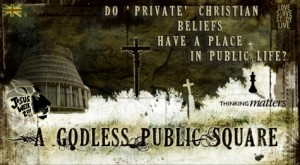
    A Godless Public Square: Do ‘Private’ Christian Beliefs Have a Place in Public Life? A few weeks ago, as part of Jesus Week at the University of Auckland, Thinking Matters and Evangelical Union hosted an event entitled A Godless Public Square: Do ‘Private’ Christian Beliefs Have a Place in Public Life? This event was a conversation between Theology, Philosophy and Law and featured Matthew Flannagan – Analytic Theologian, Glenn Peoples – Philosopher and Madeleine Flannagan – Legal Scholar. The video is still being edited and will be available soon but for now, this 3-part series comprises the written speeches of each speaker.

    Glenn Peoples – Philosophy

    Often the subject of religion and politics is alluded to by way of references to terrorism, vigilantism, totalitarianism and persecution, as though these are the only alternative to a public square stripped of religious conviction altogether. This is about as helpful and honest as the automatic association of secularism with the purges of Stalin. The truth is that the flourishing debate in the Western world over the legitimate role of religious convictions in our public decision making is set within the broad liberal democratic tradition. Within that tradition, taking for granted things like freedom of religion, freedom of speech, clear institutional separation of church and state, freedom of association and so on, we’ve seen that it is clearly possible to hold a variety of views on the proper place of religious belief in politics, policy, public lobbying, your own voting and so on. Of course, there are plenty of religious people in the world and in history who do not cherish liberty and mutual respect (as there are and have been non-religious people who do not cherish these things), but you and I do.

    Our popular level discussion here in New Zealand over the proper role of religion in a free society – in the media, in letters to the editor, on talkback radio, in religious speeches, could have been greatly benefited by an exposure to the way that this issue has been dealt with in philosophy, specifically in political philosophy, in ethics and philosophy of religion, which are the areas that really interest me. In particular the following issues need to be seen as central: What is the specific concern that justifies people in identifying religious convictions as an area of worry over and above other convictions? Are these concerns applied consistently and fairly when not thinking in terms of religious convictions? Are they the right concerns to have about public life generally? Secondly, should these concerns really cause us to reconsider the role of religious convictions at all? If so, then how?

    Why is religion singled out?

    Conflict and Polarisation
    Why is there an issue centred specifically around religion in the public square? We don’t hear much, if anything, about the worry of acting on our political beliefs or (usually) our ethical convictions or our scientific findings – at least not because they are political beliefs, ethical convictions scientific findings, yet there is a concern about religious beliefs in the public square, and that concern exists because the beliefs in question are religious. What makes religion special?

    Perhaps the more popular reason that people might have for wanting to see religion take a back seat when it comes to public reason is that, in their view, religious beliefs unleashed in public are dangerous in certain ways. American philosopher Robert Audi is not alone in voicing the concern that “religious disagreements are likely to polarize government” leading to irresolvable disputes and political stand-offs.[1] In order to avoid strong polarisation and the associated mischiefs that come with it (lack of co-operation, social unease and mutual suspicion, perhaps even rioting and acts of violence or terrorism as in Northern Ireland), let us keep our religious beliefs well away from our political reason.

    Matt has already said a thing or two about this, so I’ll just be brief. Is this fair? For starters, is it really true that as soon as we allow people to lobby, vote or even legislate in certain ways because of their religious convictions, we will witness intractable political stand-offs and social disorder? Not at all. We can easily imagine scenarios in which one person or group lobbies for a given policy because their religious convictions motivate them to do so, and another person or group lobbies for exactly the same policy with quite different motives. I think, for example, of the government’s role in marriage. I know of religious people who maintain that the state has no role in formalising marriage since this is, in brief, “God’s business” that the government should frankly stay out of as a matter of the purity of marriage as a holy institution. I also know of libertarians committed to the doctrine of self-ownership and the priority of personal liberty who also think, without any reference to God, that marriage properly belongs entirely to the private realm. So it can’t be the case that endorsing policies because of one’s religious convictions will inevitably or always lead to social or political polarisation and conflict.

    That said, it’s true that different religious convictions (more…)

  • A Godless Public Square: Do ‘Private’ Christian Beliefs Have a Place in Public Life? Part I Matthew Flannagan – Theology

    A Godless Public Square: Do ‘Private’ Christian Beliefs Have a Place in Public Life? A few weeks ago, as part of Jesus Week at the University of Auckland, Thinking Matters and Evangelical Union hosted an event entitled A Godless Public Square: Do ‘Private’ Christian Beliefs Have a Place in Public Life? This event was a conversation between Theology, Philosophy and Law and featured Matthew Flannagan – Analytic Theologian, Glenn Peoples – Philosopher and Madeleine Flannagan – Legal Scholar. The video is still being edited and will be available soon but for now, this 3-part series comprises the written speeches of each speaker.

    Matthew Flannagan – Analytic Theology

    Recently, many Christian ethicists have defended the central place of God’s commands in Theological ethics. In this talk I want to discuss one important objection to appeals to God’s commands; this is the claim that, while it is perfectly appropriate for believers to appeal to purported divine commands when regulating their private conduct or the conduct of voluntary religious communities who believe in such commands, it is morally wrong to appeal to theological beliefs of this sort in any discussion of social ethics. When doing Ethics as a public enterprise i.e. engaging in debates over social policy or offering criticism of cultural and social practices, Christian Ethicists are morally bound to only appeal to secular considerations. I will argue that this position, though widely accepted inside and outside of the church, is mistaken.

    The Objection
    So what is the problem with appealing to divine commands in social ethics? Christian theological convictions ought to impact the whole of life both in the private and public spheres; this is what is meant by the idea of an “undivided life”, where Jesus is Lord of all aspects of our lives.

    Yet this consequence of Christian faith conflicts with a pervasive contemporary attitude: the view that that religion is fundamentally a private matter. It is accepted that a Christian is free to utilise theological convictions when they make decisions about their own life but in a pluralistic society it is increasingly deemed inappropriate to bring such convictions into public discussions about morality, law, politics, economics, education, scholarship and so on. The desire to influence society with Christian ideals or to convert others to the faith is viewed by many as an intolerant desire to impose one’s private views onto others.

    It is widely accepted that theological convictions can govern churches and the private lives of believers yet we are told that the public square – government, public policy, the courts, the academy, education, business, arts, media, etc – should be secular only.The problem is nicely summarised by Stephen Carter Christian theological convictions ought to impact the whole of life both in the private and public spheres; this is what is meant by the idea of an “undivided life”, where Jesus is Lord of all aspects of our lives.

    Yet this consequence of Christian faith conflicts with a pervasive contemporary attitude: the view that that religion is fundamentally a private matter. It is accepted that a Christian is free to utilise theological convictions when they make decisions about their own life but in a pluralistic society it is increasingly deemed inappropriate to bring such convictions into public discussions about morality, law, politics, economics, education, scholarship and so on. The desire to influence society with Christian ideals or to convert others to the faith is viewed by many as an intolerant desire to impose one’s private views onto others.

    It is widely accepted that theological convictions can govern churches and the private lives of believers yet we are told that the public square – government, public policy, the courts, the academy, education, business, arts, media, etc – should be secular only.

    This event looks at this issue. The conversation will span Theology, Philosophy and Law led by a panel made up of Christian representatives from each discipline along with you the audience:

    “One good way to end a conversation – or start an argument – is to tell a group of well educated professionals that you hold a political position (preferably a controversial one such as being against abortion or pornography) because it is required by your understanding of God’s will. In the unlikely event that anyone hangs around to talk with you about it, chances are that you will be challenged on the ground that you are intent on imposing your religious beliefs on other people. And in contemporary political and legal culture, nothing is worse.”[1]

    Carter cites the objection that appealing to God’s commands in public moral debate involves imposing one’s religious beliefs onto other people, and points out that such impositions are morally wrong. Note that the objection is not that such divine commands do not exist or that it is irrational to believe that they do. The objection is a specifically moral one. It is morally wrong to appeal to such beliefs; doing so violates a moral obligation people have to not impose their religious beliefs onto others. Something like this moral objection is widely held, both inside and outside the church. In response to this I will make four points. (more…)

  • This Wednesday @ Auckland Uni: A Godless Public Square – Do ‘Private’ Christian Beliefs Have a Place in Public Life?

    A common slogan in western liberal societies is that religion is a private matter; it has no place in public discussions of law, economics, public policy, education, social ethics, culture and so on. This “separationist” view is often attributed to US Founding Father, Thomas Jefferson “Wall of Separation Letter” and has become the orthodox view in liberal thought receiving important advocacy by philosophers such as John Rawls.

    This idea is often enforced in the courts with public displays or manifestations of religion being challenged on freedom of religion grounds. This has recently been seen in European countries; recent laws and cases have seen bans on religious emblems being worn in schools, employment situations and in public generally. The UK courts recently ruled that Christians could not foster children out of fear their private beliefs about homosexual conduct might be taught to the children.

    In the US, a confusing, and often contradictory, array of cases on everything from public displays of the ten commandments, home-schooling, school vouchers and so on has rendered the position in the position more and more hostile towards religion being exercised in public and the law has become more and more difficult to comply with because of increasing lack of clarity as to how it works.

    Increasingly in the West we are seeing the idea of religion being something private being accepted by Christian believers who feel that while they personally believe something it is inappropriate for them to apply or utilise these beliefs when thinking about or going about issues that may affect others.

    An increasing body of theological, philosophical and legal scholarship has called this orthodox view into question. These scholars have argued that the orthodox view is unjust, contradictory and arbitrary. It is unjust in that it places moral and social restraints on religious advocacy that are not imposed on non-religious views. It is arbitrary and contradictory in that the reasons typically offered for this view, if sound, seem to apply with equal force to any controversial view whether religious or secular and, in fact, to many doctrines central to liberal thought itself. Moreover, it suggests that even if religious beliefs are true and relevant to public issues, believers are to conduct themselves in public in a manner which ignores these beliefs or treats them as if they are not true if they cannot be justified from a secular viewpoint; in private they are free to believe what they want.

    Critics of orthodoxy contend this separation of faith and self in public is unrealistic at a psychological level and that it fails to understand how religions function in the lives of believers who believe their religion to be true and not merely just a personal private preference.

    New Zealand jurisprudence has not seen the litigation on this subject that the United States and Europe has so it is largely untested. The practice of being influenced by international precedent from the commonwealth and US jurisdictions coupled with our secular society which contains strong factions in favour of the liberal view – secular humanist groups, some politicians, scholars, media, bloggers – suggests that it will fall the way of the rest of the western world unless a robust counter-view is developed and advanced in the New Zealand across disciplines.

    Further to the issue of justice, the tendency to view religious beliefs as a merely private preference that is isolated from one’s public actions, decisions and choices is pervasive in the New Zealand evangelical church and it leads to a view of religion that ignores questions of truth and focuses instead on private benefit and piety of religious belief.

    For these reasons it is important this conversation be had across disciplines; particularly the three disciplines of theology, philosophy and law need to understand and hear each other so we can work together on this problem.

    With this backdrop in mind, Thinking Matters and Evangelical Union bring you, as part of Jesus Week, the following event:

    Godless Public Square

    A Godless Public Square:

    Do ‘Private’ Christian Beliefs Have a Place in Public Life?

    A Jesus Week Dialogue between Theology, Philosophy and Law

    7pm Wednesday 3 August
    Lib B28 (Library Basement, 5 Alfred St) University of Auckland

    Organised by: Thinking Matters and Evangelical Union
    Format: Panel Discussion followed by Q&A
    Moderated by: Patt Brittenden
    Speakers: listed in the order they will speak in: (more…)

  • A Godless Public Square: Do ‘Private’ Christian Beliefs Have a Place in Public Life? @ Auckland Uni

    Mon 1- Friday 5 August marks Jesus Week. A number of events will be held on the University of Auckland campus of which we are part of including this one brought to you by the Evangelical Union and Thinking Matters:

    Godless Public Square

    A Godless Public Square:

    Do ‘Private’ Christian Beliefs Have a Place in Public Life?

    A Jesus Week Panel Discussion
    7-9pm Wednesday 3 August
    Lib B28 (Library Basement) University of Auckland

    Christian theological convictions ought to impact the whole of life both in the private and public spheres; this is what the idea of an “undivided life” means, Jesus is Lord of all aspects of our lives.

    Yet this consequence of Christian faith conflicts with a pervasive contemporary attitude: the view that that religion is fundamentally a private matter. It is accepted that a Christian is free to utilise theological convictions when they make decisions about their own life but in a pluralistic society it is increasingly deemed inappropriate to bring such convictions into public discussions about morality, law, politics, economics, education, scholarship and so on. The desire to influence society with Christian ideals or to convert others to the faith is viewed by many as an intolerant desire to impose one’s private views onto others.

    It is widely accepted that theological convictions can govern churches and the private lives of believers yet we are told that the public square – government, public policy, the courts, the academy, education, business, arts, media, etc – should be secular only.

    This event looks at this issue. The conversation will span Theology, Philosophy and Law led by a panel made up of Christian representatives from each discipline along with you the audience.

    Up for discussion are issues like:

    – Is it wrong for Christians to impose their ‘private’ religious beliefs onto others?
    – Is secularism the neutral perspective it is claimed to be?
    – Are public expressions of religion regulated by law?

    Bring your own questions and ask them at the Q & A session.

    This is a free event open to the public, which will be lay friendly – a university degree is not necessary in order for you to attend!

    Panel:

    Moderator:

    RSVP on Facebook here (or just turn up with your friends)

  • Ethics: What Does God have to do with it? @ Auckland University

    World class Ethicists John Hare (Yale Divinity) and Mark Murphy (Georgetown Philosophy) are in town for the Naturalisms in Ethics Conference and the Meeting of the Australasian Philosophy of Religion Association at the University of Auckland where they will be speaking along with New Zealand’s top Ethicists.

    We leaped on the opportunity to organise the following event, brought to you by the University of Auckland Department of Philosophy and Thinking Matters Auckland:

    Ethics: What does God have to do with it?

    Ethics: What Does God have to do with it? 
    A Conversation with Three Christian Philosophers

    7pm Tuesday 26 July
    Room OGGB4/260-073 (Owen Glenn Building)
    University of Auckland

    The question of the relationship between religion and morality has long been the subject of discussion and debate in western culture. Some philosophers and theologians contend the two cannot be separated; theological beliefs about God and the afterlife are needed to explain the existence and nature of moral obligations, and to ground motivation to live a moral life.

    Others contend the opposite. They claim that morality is entirely independent of religion and that religion encourages immorality. Questions have also been raised as to whether religion adds anything to morality in terms of its ideas about atonement, forgiveness and moral faith which are lacking in secular views.

    This panel brings together several of the world’s leading Christian thinkers on this question to discuss issues such as:

    – Why do we have to do what is right?
    – Can someone be a ‘good’ person without belief in God?
    – What role do grace and forgiveness play in morality?

    Bring your own questions and ask them at the Q & A session.

    This will be a free, lay friendly event open to the public – a university degree is not necessary in order for you to attend!

    Panel:
    Prof John Hare – Yale Divinity School
    Prof Mark Murphy – Department of Philosophy, Georgetown University
    Dr Glen Pettigrove  – Department of Philosophy, University of Auckland

    (Click on each of their names – they are each seriously cool!)

    Moderator:
    Dr Matthew Flannagan

    RSVP on Facebook or just turn up – bring your friends. This is soooo not to be missed!

  • Watch the Video of “The New Atheism, Science & Morality” with Glenn Peoples

    The unofficial video of Glenn Peoples’ talk at Auckland Uni “The New Atheism, Science & Morality” is online.

    Hat Tip: E†B

  • Dr Glenn Peoples on Science and Morality, Sam Harris & the Claims of the New Atheism @ Auckland Uni

    Christian philosopher and blogger Dr Glenn Peoples is coming to Auckland to give a public talk entitled “Science and Morality: Is there a Naturalistic Basis of Moral Truth?” This talk will examine the claims of the new atheism, particularly the work of Sam Harris. Dr Peoples will ask, can the natural world tell us what is right and wrong, without need for God? Can moral facts be grounded scientifically? He will argue that the attempt to ground morality outside of God ultimately fails. An opportunity for questions and answers will follow the talk.

    Science and Morality

    The talk will be held at the University of Auckland on Monday 6 September from 7-9pm in LIB 15 (in the main campus library basement at 5 Alfred St, Auckland City). Admission is free and is open to anyone. We do advise that you arrive early to locate parking and to obtain a good seat.

    If you enjoyed the panel discussions and the debate we organised earlier this year on Auckland’s campus, you should enjoy this event.

    Dr Glenn Peoples is a graduate in theology (BD) from the Bible College of New Zealand and has a masters degree (MTHeol) and a doctorate in philosophy from the University of Otago. For over ten years he has been writing and speaking, both in New Zealand and abroad, on intellectual issues that Christians face, including the place of faith in the public square, justice and human rights and the reasons for Christian belief. He lives in Dunedin with his wife Ruth and their four children and he blogs at “Say Hello to my Little Friend: The Beretta Blog and Podcast“

    This event is brought to you by Thinking Matters, in association with Evangelical Union. Here is the event’s Facebook Page.