Last week Jordan Hampton from Crash Course Apologetics interviewed me about chapters 12-13 of my book Did God Really Command Genocide. In this is the section of the book, I discuss divine command metaethics and critique some of the most important objections raised against divine command theories. The interview is nearly two and a half hours long. We go over every objection I respond to in the book. Enjoy
Tag: Sam Harris
-
Divine Command Theory: answering classic and contemporary objections
-
True Reason: Confronting the Irrationality of the New Atheism – in Paperback
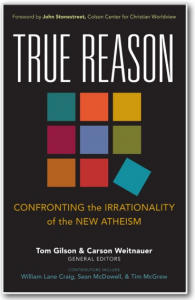 The paperback version of the Kindle book, True Reason: Christian Responses to the Challenges of Atheism, which Matt wrote a chapter for, recently arrived from the publishers. This release has been re-released as True Reason: Confronting the Irrationality of the New Atheism (the link takes you to the book’s official website).
True Reason is still edited by Tom Gilson and Carson Weitnauer and is still published by Kregal Publications; however, this edition has been updated and expanded and it has two additional chapters. The table of contents is as follows:
- The Party of Reason?
Tom Gilson - The Irony of Atheism
Carson Weitnauer - Dawkins’s Delusion
William Lane Craig - Richard Dawkins’s Illusions
Chuck Edwards - Unreason at the Head of Project Reason
Tom Gilson - John Loftus and the “Outsider-Insider Test for Faith”
David Marshall - Atheism and the Argument from Reason*
Lenny Esposito - The Explanatory Emptiness of Naturalism
David Wood - Reason in a Christian Context
Peter Grice - The Marriage of Faith and Reason
David Marshall - Faith and Reason in Historical Perspective*
David Marshall and Timothy McGrew - A Sun to See By—Christianity, Meaning, and Morality
Samuel J. Youngs - Are Science and Christianity at Odds?
Sean McDowell - God and Science Do Mix
Tom Gilson - The Problem of Evil and Reasonable Christian Responses
John DePoe - Historical Evidences for the Gospels
Randy Hardman - Did God Command the Genocide of the Canaanites?
Matthew Flannagan - Christianity and Slavery
Glenn Sunshine - Epilogue
Carson Weitnauer
*Chapters Seven and Eleven are new additions in the second edition, not included in the Kindle version of True Reason.
The blurb from Amazon is as follows:
Today’s New Atheists proclaim themselves our culture’s party of reason. It is a claim they cannot sustain. Reason is the New Atheists’ weakness, not their strength and in fact, the Christian faith is a far better place to look for True Reason.
In sixteen carefully constructed essays by more than a dozen Christian thinkers including William Lane Craig, Sean McDowell, and Timothy McGrew,True Reason unmasks the frequent irrationality displayed by leading atheists like Richard Dawkins, Sam Harris, and Christopher Hitchens. The authors go on to show the great extent to which the Christian faith has historically supported sound reasoning, and that Christian thinkers, past and present, have demonstrated real excellence in reasoned, rational thinking.
Making their case accessible to the first-time inquirer as well as the serious student, this top-flight team of writers presents a sound defense and a strong introduction to the true reason uniquely found in Christianity.
You can buy the paperback version of True Reason: Confronting the Irrationality of the New Atheism on Amazon here.
- The Party of Reason?
-
Is a Divine Command Theory Psychotic? Sam Harris on Divine Commands Part III
 In Sam Harris on Divine Commands Part I I criticised Harris’ characterisation of divine command meta-ethics. I refuted Harris’ contention a divine command theory is pscyopathic in Is a Divine Command Theory Pscyopathic? Sam Harris on Divine Commands: Part II. In this last post in this series, I will address Harris’s contention that a divine command theory reflects a “psychotic moral attitude”. Harris says a divine command theory is “psychotic because this is completely delusional. There’s no reason to believe that we live in a universe ruled by an invisible monster called Yahweh.”
Harris’s argument in this regard seems to involve four premises. [1] A person can accept a divine command theory only if her or she believes in the existence of an invisible monster called Yahweh (which Harris earlier identifed as an “iron age God of war”); [2] there is no evidence for an invisible monster called Yahweh; [3] to believe something without evidence is delusional; [4] to be delusional is to be psyhcotic.
Turning to [1], a divine command theorist holds that the most plausible account of the nature of moral obligations is that moral obligations are constituted by, or are identical with, God’s commands. God is understood by the theorist to be a being worthy of worship, a necessarily existent, essentially loving and just, omniscient, omnipotent, personal being who created, sustains and providentially guides the universe. Holding this position does not commit one to believing in an invisible monster or a stone-age God of war for two reasons.
First, a divine command theory is compatible with being an athiest. Plantinga has noted that a person could argue that moral obligations are best accounted for in terms of God’s commands and then conclude from this that if God does not exist then moral obligations do not exist either. In this sense a divine command theory could be a premise in an atheistic argument for nihilism. Interestingly, when I was a grad student in the 90’s I attended a conference where one of the presenters offered an argument for nihilism very much along these lines.
Second, most divine command theorists accept the existence of moral obligations. Most would accept, for example, that moral claims such as that it is wrong to torture children purely for entertainment are true, and that, the action of torturing children in this way actually has the property of being wrong, further, that it does so independently of whether we or our society believe that it does.
A divine command theorist does not have to identify this God with Yahweh. Obviously, divine command theorists who are Jews or Christians will do this, but that’s in virtue of their Judaism or Christianity, it is not in virtue of their belief in divine command meta-ethics. Strictly speaking a divine command theorist could reject the identification and still maintain that moral obligations are best identified with the commands of God.
Third, even if one does identify God with Yawheh, it is evident that such an identification would rule out construing God as “an invisible monster” who is, according to Harris, ” a stone-age God of war”. If Yahweh is identified as a loving and just, invisible person, then he is neither an invisible monster or a stone-age God of war. Of course, a person who held this view might grant that at one piont in history, perhaps in the late Bronze Age or early Iron Age, various people groups believed that Yahweh was a God of war, but by identifying God as Yahweh, such a person is explictly rejecting this conception. The fact that people once concieved of something a certain way tells us nothing about whether that thing is, in fact, that way. Harris may as well castigate contemporary atomic theory by pointing out that ancient greek atomists held scientifically indefensible understandings of an atom.
So Harris’ [1], the contention that a person can accept a divine command theory only if they believe in the existence of an invisible monster is false.
Turning then to [2], the contention that there is no evidence for the existence of an invisible monster called Yahweh. Harris’s argument is circular. Suppose, for the sake of argument, (more…)
-
Is a Divine Command Theory Pscyopathic? Sam Harris on Divine Commands: Part II
In my last post, Sam Harris on Divine Commands: Part I, I criticised Sam Harris’ characterisation of divine command meta-ethics. In this post I want to turn to his second line of criticism of a Divine Command Theory. In Harris’ debate with William Lane Craig at Notre Dame, transcript here, Harris stated:“I’m glad he raised the issue of psychopathy—we are being offered a psychopathic and psychotic moral attitude. It’s psychotic because this is completely delusional. There’s no reason to believe that we live in a universe ruled by an invisible monster Yahweh. But it is, it is psychopathic because this is a total detachment from the, from the well-being of human beings. It, this so easily rationalizes the slaughter of children. Ok, just think about the Muslims at this moment who are blowing themselves up, convinced that they are agents of God’s will. There is absolutely nothing that Dr. Craig can s—can say against their behavior, in moral terms, apart from his own faith-based claim that they’re praying to the wrong God. If they had the right God, what they were doing would be good, on Divine Command theory.”
Here, Harris suggests a Divine Command Theory expresses both a psychopathic and a psychotic moral attitude. I will address the charge of a Divine Command Theory being “psychotic” in a later post. Here, I want to address what I think is Harris’ main concern: a Divine Command Theory is psychopathic. It involves a “total detachment … from the well-being of human beings” and “so easily rationalizes the slaughter of children”. Why does Harris think this? “Because, at this moment Islamic terrorists are blowing themselves up convinced they are agents of God’s will, and a divine command theory can say nothing against their behavior in moral terms except the faith based claim that they are praying to the wrong God.”
A lot could be said about this argument. First, note that even if it were sound, it does not show the Divine Command Theory is false. Harris is, in fact, offering pragmatic arguments against the theory: it is dangerous, or is easily misused – but there are many things which are dangerous and easily misused that are nevertheless true.
More importantly, the argument is unsound. A Divine Command Theory contends that an action is obligatory if God actually commands that action. It does not contend that an action is obligatory if someone claims, or believes that God commands it. Obviously, simply believing something is the case does not mean that it is true. Harris, as an atheist, surely recognises this; many people believe and are convinced God exists yet Harris thinks they are mistaken.
Hence, the mere fact an Islamic terrorist believes God has commanded him or her to “blow themselves up” does not commit the divine command theorist to supporting terrorism. All a divine command theorist needs to say in response to Islamic terrorists is that (more…)
-
Sam Harris on Divine Commands: Part I
In a previous post, Divine Commands and Pyschopathic Tendancies, I said I would look in more detail at Sam Harris’ charge that Divine Command Theories (“DCT”) of meta-ethics are psychopathic. In this, and in several forthcoming posts, I will attempt to deliver on that promise.In Harris’ debate with William Lane Craig at Notre Dame, transcript here, Harris offered three direct lines of argument against a DCT. (I say direct lines because many of Harris’ rebuttals did not address DCT at all; rather he engaged popular objections to Christian doctrines about exclusivism and hell.) The first direct argument was as follows:
“According to Dr Craig’s Divine Command theory, God is not bound by moral duties; God doesn’t have to be good. Whatever he commands is good, so when he commands that the Israelites slaughter the Amalekites, that behavior becomes intrinsically good because he commanded it.”
Here Harris makes three claims. First he argues that according to a DCT God does not “have to be good”. Second, he infers from this that God can therefore make any action at all intrinsically good. Third, he alludes to an incident in the book of Samuel where, on the face of it, God commands the killing of the Amalekites.
Turning to Harris’s first claim, according to DCT a person has a duty to a person to do some action only if that person is commanded by God to do it. As God does not issue commands to himself he is not bound by moral duties. Harris infers from this that “God doesn’t have to be good”.
Whether this is inference is sound depends on what Harris means by “have to be good”. There are at least two possible things he could mean by this.
Sometimes when we say someone does or does not “have” to do something, we mean they are not morally obligated to do it. When I tell my children they have to tell the truth, for example, I am saying they have a duty to tell the truth. In other contexts however, when we say that someone does or does not “have” to do something we mean it is possible for them to do it.
If Harris, in saying “God does not have to be good”, means God is not under an obligation to be good then his inference is sound; if God is not bound by duties then he obviously does not have an obligation to be good. This, however, does not entail that it is logically possible for God to lack goodness.
If, on the other hand, Harris’ claim that “God does not have to be good” carries the implication that it is possible for God to do evil then it is a a flat out straw man.
Craig’s position is that (more…)
-
Divine Commands and Psychopathic Tendencies
 There has been some interesting debate in the blogosphere over Sam Harris’ contention that a divine command theory of ethics manifests “a psychopathic and psychotic moral attitude.”
Randal Rauser responded to Harris’ contention noting that “if you read through the twenty traits on the Psychopath Checklist you’ll find qualities like callousness, shallow effect, grandiose sense of self-worth, and lack of empathy. But you won’t find adherence to a divine command theory of meta-ethics among them.” Christopher Hallquist rejoins:
“I almost have a hard time believing Randal is serious here. When he talks about “adherence to a divine command theory of meta-ethics,” what he means is believing that blowing up a bus full of children is right if that’s what God told you to do. That may not be explicitly listed in the Psychopath Checklist, but neither are things like actually blowing up a bus full of children. And being willing to approve of such an act just because you think God approves certainly sounds like something that would require a shocking degree of callousness and lack of empathy.”
I plan to address Harris’ original charge in a future post. Here I will limit my comments to Hallquist’s defence of it. Hallquist suggests that a divine command theory (DCT) is psychopathic for two reasons. First, a DCT entails the following conditional: If God commands you to blow up a bus full of children then you are required to blow up a bus full of children. Second, accepting the truth of this conditional requires a “shocking degree of callousness and lack of empathy” possessing such callousness and lack of empathy is, a of course, a psychopathic trait.
Hallquist has considerable confidence in these arguments. So much so he finds it hard to believe Randal’s denial of his conclusion is serious. Note also the rhetorical tactics he uses. The picture of people up blowing up buses full of children brings immediately to pictures of terrorism, sometimes terrorist activities are done for religious motivations, and since 9/11 there has been considerable fear and angst about terrorist acts of this sort. Hence, Hallquist taps deep into people’s fears. Moreover, a long meta-narrative going back to the enlightenment contends religion causes wars, is the source of violence and so on, whether that narrative is historically accurate or not is a matter of considerable dispute. However, prejudices of this sort are widely believed and raw in a post 9/11 environment. The fact a position resonates with people’s fears, emotions and prejudices, however, does not excuse us from asking whether it is true or rationally defensible. In this case I think a little reflection shows it is not. Hallquist’s argument is unsound and, in fact, incoherent. Hallquist’s bravado is therefore strongly misplaced.
Let us turn to Hallquist’s first premise. A DCT entails the conditional: If God commands you to blow up a bus full of children then you are required to blow up a bus full of children. This conditional is indeed an implication of divine command theories. Undoubtedly that sounds shocking at first but note two important points which Hallquist skims over:
First, this is a conditional or hypothetical statement; it states that if God commanded blowing up buses then blowing up buses would be morally obligatory. Nothing about this conditional entails that God actually ever does, or even could, command such a thing, nor does it entail one is ever rationally justified in believing that he does. It simply states that if this situation occurred then the action would be permissible. It’s a well-known point in logic that a person can affirm that one thing would be true if a certain situation occurred without being committed to claiming it ever occurs. It would be true for example that if I had never been born then I would not be writing this post right now, that does not mean I believe I was never born.
Second, DCT entails that blowing up buses is morally obligatory only (more…)
-
True Reason: Christian Responses to the Challenges of Atheism – on Kindle
The kindle edition of new book featuring responses to the New Atheists, aimed to be readable at the popular level entitled True Reason: Christian Responses to the Challenges of Atheism is now available on Amazon. This blog’s Matthew Flannagan contributed to a chapter in it alongside William Lane Craig, Sean McDowell and others.
Matt’s chapter is a reprint of his chapter “Did God Command Canaanite Genocide?” in the forthcoming in April B&H Academic book: Come Let Us Reason: New Essays in Christian Apologetics edited by Paul Copan and William Lane Craig.
Here is the editorial review from Amazon:
 “While New Atheists like Richard Dawkins, Sam Harris, and others proclaim loudly their rationality, clear thinking, and incontrovertible scientific arguments, others are beginning to wonder how genuinely rational they are. Have they proved anything? Have they argued convincingly? Have they pinpointed any real challenges to the credibility of Christian faith?
“True Reason,” edited by Tom Gilson and Carson Weitnauer, brings together a compendium of writers–philosophers, apologists, ethicists, theologians, historians–who look carefully at the best arguments atheism has and evaluate their validity, logic, assumptions, and naturalist conclusions.Authors include noted philosopher William Lane Craig and popular apologist Sean McDowell, along with Gilson, Weitnauer, John DePoe, Chuck Edwards, Matthew Flannagan, Peter Grice, Randy Hardman, David Marshall, Glenn Sunshine, David Wood, and Samuel Youngs. Each chapter tackles a different atheist argument and brings reason fully into the discussion.
Which is more reasonable: atheism or Christianity? Read “True Reason” and think for yourself.”
Get your copy now, read it, and let us know what you think both here and on Amazon 🙂
