Tag: Science and Religion

  • Hear Matt’s Three Talks on “Questions People ask”

    Recently Matt spoke at  Orewa Community Church, as part of their series on “Questions People ask”. His three talks: “How can there be just one religion?”, “How does God allow suffering?”, and “Hasn’t Science disproved Christianity?” are all available to listen online to here.

    Real Questions People Ask

  • God or Natural Law: A False Dichotomy

    A few weeks ago someone showed me a newspaper article entitled “New theory could prove how life began and disprove God”, which was published in the UK newspaper The Independent. Now I have, of course, heard media pronouncements of the nature published in this article frequently, reporters often seem to have a knack for making provocative pronouncements about the theological and philosophical implications of various theories (and one can usually take such prouncemants with a grain of salt), but this one caught my attention because of the unstated premise it contained. This premise is, I think, common in discussions about religion and science, which makes it worth addressing in its own right.

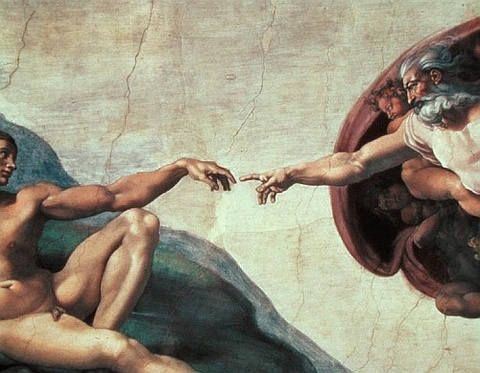
    Michelangelo's 'God Creates Adam

    The author’s commentary opens as follows:

    “A new theory could answer the question of how life began – and throw out the need for God. A writer on the website of Richard Dawkins’ foundation says that the theory has put God “on the ropes” and has “terrified” Christians. It proposes that life did not emerge by accident or luck from a primordial soup and a bolt of lightning. Instead, life itself came about by necessity – it follows from the laws of nature and is as inevitable as rocks rolling downhill. …”

    According to the author, the ‘new theory’ proposes that life arose from non-life by “natural necessity”, that is: according to the laws of nature. Interestingly, the author assumes the fairly standard account of ‘laws of nature’ whereby they are more than just regularities, they involve a kind of necessity that explains or grounds regularities.  The author draws the conclusion from the new theory that God does not exist.

    Now the author is not exactly clear on why this conclusion follows. One argument he seems to grope towards is that the new theory provides all sorts of problems for belief in God because someone on Richard Dawkins’ website says it does.  I suspect, however, that – apart from simple affirmations of faith in Dawkins blog – the author has something a bit more sensible in mind in his thinking.

    The premise is that: life arose from non-life, according to the laws of nature; the conclusion is that: God did not create life. The unstated assumption seems to that: if you can explain something by natural law then it follows that God did not do it.  Implicit in the reasoning is the assumption that appeals to natural law and God are rival and incompatible hypothesises; the truth of one excludes or rules out the other.

    I think anyone familiar with the history of theological thought should find this assumption odd. For (more…)

  • Auckland Conference: Science and Faith with Dr C John Collins

    Thinking Matters have a couple of conferences coming up in July with Dr C John Collins:Science and Faith Friends ofr Foes?Much of Western culture assumes that science and faith are foes, that faith and scientific naiveté go hand in hand, and that science has disproved the Bible and made faith irrelevant if not completely indefensible and undesirable.

    Come and hear Dr. C. John Collins explain why faith and science are actually friends, how good faith fosters good science, and how good science should actually lead people to be more open to faith and the Bible.

    WHEN: Friday 19 July 7pm-9.30pm and Saturday 20 July, 9:00am-4:30pm
    WHERE: City Presbyterian Church, 283 Karangahape Road, Auckland
    COST: $40 ($20 for Students).

    Coffee and tea will be provided but please bring your own lunch.

    Full details including info on how to register can be found over at Thinking Matters.

    Consider also attending: Ancient Truth for Modern Times with Dr C John Collins

  • Contra Mundum: When Scientists Make Bad Ethicists

    One thing I find particularly frustrating is reading commentary on theology and philosophy written by scientists. To be fair, some scientists I have read are informed and do offer astute and insightful comments; commonly, however, one finds a person who is undoubtedly brilliant in their own field, writing with confident gusto, articles that fail to understand the most basic theological and philosophical distinctions.

    Jerry CoyneA good example can be seen in a recent USA Today article by influential biologist Jerry Coyne entitled, As atheists know, you can be good without God. Coyne, an outspoken atheist, is disturbed that many Americans, including some prominent scientists, believe that our instinctive sense of right and wrong is “strong evidence for [God’s] existence.” He ventures into moral philosophy to explain why this is clearly mistaken.

    From the get-go Coyne demonstrates he does not understand the issues.

    It is necessary to accurately understand the position Coyne is criticising before we look at the paucity of his critique. The argument that our instinctive sense of right and wrong “is strong evidence for [God’s] existence” found its most important formulation in a 1979 article by Yale Philosopher Robert Adams. In it, Adams noted that we instinctively grasp that certain actions, like torturing children for fun, are wrong; hence, he reasoned, we are intuitively aware of the existence of moral obligations. According to Adams, the best account of the nature of such obligations is that they are commands issued by a loving and just God. Identifying obligations with God’s commands can explain all the features of moral obligation better than any secular alternative. Consequently, the existence of moral obligations provides evidence for God’s existence.

    It is important to note what Adams did not claim. Central to Adams’ argument, and to pretty much every author who follows him, is a vital distinction; this is the distinction between the claim that moral obligations are, in fact, divine commands and the claim that one cannot recognise what our moral obligations are unless one believes in divine commands or some form of divine revelation. Adams illustrates this distinction with the example of H20 and water.

    Contemporary chemistry tells us that the best account of the nature of water is that water is, in fact, H20 molecules. This, of course, means that water cannot exist unless H20 does. However, it does not mean that people who do not know about or believe in the existence of H20 cannot recognise water when they see it. For centuries people recognised, swam in, sailed on and drank water before they knew anything about modern chemistry.

    This distinction has important implications. The claim that moral obligations are, in fact, commands issued by God does not entail that people must believe that God exists and has issued commands in order to be able to recognise right and wrong. These are separate and logically distinct claims.

    Coyne conflates this distinction from the outset. After noting that some people believe that moral obligations provide strong evidence for God’s existence, he claims that this is an oft-heard argument, “‘Evolution,’ many argue, ‘could never have given us feelings of kindness, altruism and morality…’;” to this he rejoins that, “scientists studying our primate relatives, such as chimpanzees, see evolutionary rudiments of morality: behaviours that look for all the world like altruism, sympathy, moral disapproval, sharing — even notions of fairness.”

    This is confused. Apart from the fact that no one who cites morality as evidence for God actually makes the argument about evolution that Coyne sets out, the claim that moral obligations cannot exist independently of God is not the claim that without God people would not have moral feelings. Feeling that one has an obligation to do something and actually having an obligation to do it are clearly different things. People can feel that they have a certain obligation without it actually being the case that they do.

    Coyne makes a similar mistake when he argues that secular European countries like Sweden and Denmark “are full of well-behaved and well-meaning citizens, not criminals and sociopaths running amok.” This  (more…)

  • Religion, Science, 9/11 and the Moon: Dawkins’ Response to Copan

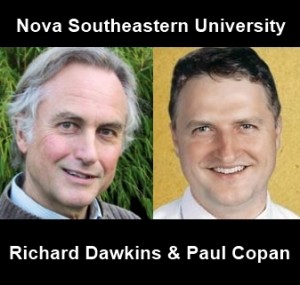
    Richard Dawkins and Paul CopanParchment and Pen, has an audio of a brief exchange between Paul Copan and Richard Dawkins who was speaking in Ft. Lauderdale at Nova Southeastern University on “The Fact of Evolution.” (The following week, Paul Copan spoke on “The Fact of God” at Nova Southeastern and gave a direct response to Dawkins.) This MP3 of Paul Copan and Richard Dawkins’ exchange is from the Q&A of Dawkins’ talk.

    In it Paul alludes to an argument advanced by C S Lewis, Alvin Plantinga, Michael Rea, Victor Reppert and also alluded to by Patrica Churchland, Thomas Nagel, William Whewell and Friedrich Nietzche. The argument is that if our cognitive faculties evolved by natural selection, unguided by God, then our cognitive faculties cannot be rationally relied on to give us truth. The literature on this argument is interesting but I won’t comment on that here.

    What interests me is the comment Dawkins made in the MP3 which got the applause of the audience. Dawkins appears to not grasp the point of the argument and takes it to be asking for a reason why he supports “scientific rationalism”. He said he believes in scientific rationalism because it “works”. He then provided an example of how it “works”, it is that “science flies us to the moon, while religion flies planes into buildings.”

    Much could be said here but I want to limit myself to a single point, the evidence Dawkins cites that science works and religion does not. Dawkins offers that science has done good things such as getting us to the moon; religion has done bad things like destroying the World Trade Centre on 9/11. In other words, the positive things science does commends it as a something we should trust whereas the negative things religious does commends it as some thing which we should not trust.

    So let’s look at the claim Dawkins made that “science” got us to the moon. Now how does a subject, get us to the moon? Presumably what he means is that it was through science that we developed the rocket propulsion technology which enabled us to get to the moon.

    But here is the problem. If the fact that science developed the propulsion technology that got us to the moon means that science is responsible for the flight to the moon, and can take credit for it, then science must be responsible for the flight into the World Trade Centre; science developed the propulsion technology of aeroplanes, hence, it should be science not religion that is blamed.

    Moreover, rockets are used for other things apart from space and air travel (more…)

  • The Sceptic and the Scientist: Ed Feser on Richard Dawkins and PZ Myers

    String TheoryHe is not one to pull punches and true to form, in To a Louse, Ed Feser holds a mirror up to the kind of reasoning that is all too common amongst Dawkins and Myers fans with this fictional dialogue between a scientist and a science sceptic;

    Skeptic: Science is BS. Physicists believe in these things called “quarks,” which are little flavored particles that spin around and work like magic charms. Their evidence is that they read about them in a James Joyce novel. Some of them think the universe is made up of tiny shoelaces tied together, though they admit that they have no evidence for this and have to take it on faith. Einstein said morality is all relative – which is why he stole his ideas from this guy who worked in a patent office, and why Richard Feynman stole atomic secrets during WWII. Meanwhile, the chemists contradict the physicists and believe instead in little colored balls held together by sticks. Biologists believe monkeys can give birth to human beings. What a bunch of crap! It’s child abuse to teach kids about this stuff in schools.

    Scientist: Are you joking? If not, I suggest that you actually read some science before criticizing it.

    Skeptic: I’ve already read a lot about it, in blog comboxes like this one. And why should I waste my time reading anything else? I already know it’s all BS! Didn’t you hear the examples I just gave?

    Scientist: No, you’re missing my point. You’ve completely distorted what scientists actually say. It’s not remotely as silly as you think it is. In fact it’s not silly at all. But you need to actually read the stuff to see that.

    Skeptic: So you deny that physicists believe in quarks? What flavor are your quarks, chocolate or vanilla? Do you deny that they think we came from monkeys? Which monkey was your mother?

    Scientist: No one says that monkeys gave birth to humans. That’s a ridiculous caricature. And of course I don’t deny that physicists believe in quarks, but you’re badly misunderstanding what they mean when they attribute “flavor” to them. They don’t mean that literally…

    Skeptic: Oh so it’s just empty verbiage, then. See, you’re just proving my point for me.

    Scientist: No, it’s not empty verbiage. It’s technical terminology.

    Skeptic: I see, like magic spells. That’s why (more…)

  • John Lennox on the “Religion v Science” Myth

    John Lennox will arrive in Auckland in less than two weeks for his New Zealand tour.

    If you are not familiar with Lennox watch this video “The “Religion v Science” Myth.” In it Lennox examines the historically ignorant myth that religion is and always has been at odds with science.

    Details of Lennox’s upcoming New Zealand tour are here: Hear John Lennox in New Zealand.

    Hat tip: Glenn Peoples