Recently, I gave a talk at New Hope Community Church in East Auckland. This talk was on the topic “Is Jesus the only way? I attach it here.
Tag: Pluralism
-
Hear Matt’s Three Talks on “Questions People ask”
Recently Matt spoke at Orewa Community Church, as part of their series on “Questions People ask”. His three talks: “How can there be just one religion?”, “How does God allow suffering?”, and “Hasn’t Science disproved Christianity?” are all available to listen online to here.

-
Is it Arrogant to Claim Jesus is the Only Way?
Last week I spoke at Massey Presbyterian Church on the topic “Is it arrogant to claim Jesus is the only way?” The following is an abridged version of the talk I gave.
 I was recently on a panel at Auckland University where an audience member raised the issue during the Q&A of religious pluralism. The issue is commonly raised as a rhetorical challenge, “isn’t it arrogant to believe Jesus is the only way?” In a world where there exists widespread religious pluralism, where there are people who are just as intelligent, educated, and ostensibly as sincere as we are who hold to and pratice a different religion to Christianity or no religion at all, how can a Christain maintain that she is right and everyone else is wrong. Isn’t believing that Jesus is the only way simply arrogant?
In addressing this question I will first make three preliminary comments to identify what the issues are. Then, I will sketch three lines of response.
First some prelimaries. As a matter of logic, if you affirm some proposition then you must reject the negation or denial of that proposition. Contradictory claims cannot both be true. It follows from this that in so far as one accepts the teachings of a religion like Christianity are true, as opposed to accepting the teachings for purely pragmatic reasons, one is rationally commited to rejecting claims that contradict this teaching. If one accepts God exists then it follows that one will believe that atheism, the denial of God’s existence, is false. If God created the world then the claim the world is not created is false. If Jesus died by crucifixition then the claim he did not exist or he died some other way is false.If there will be a final ressurection from the dead where people are judged for their actions then the claim there is no afterlife is false. So, if one accepts Christianity is true then one has to believe that other religions and perspectives that contradict Christianity are false; failure to believe this would be irrational.
Second, accepting Christianity is true does not commit one to holding that there is no truth or value or good in other religions but it does commit one to the claim that these religions are mistaken where their teachings contradict the teachings of Christianity. This is signifcant as there are many issues on which different religions agree with Christianity, which makes them compatible with Christian teaching.
Consider, for example Islam. Muslims believe there is only one God whom they call Allah. Allah is the Arabic word for God and was used by Christians to refer to God before the time of Mohamed. Muslims also believe that God is the creator and sustainer of the world. They believe God is all powerful, all knowing and has certain traits such as being just and merciful. Muslims believe God will judge all people and there will be a general ressurection of the dead. In all these things, Christians agree with them.
Similarly, there are issues where Islam teaches about the way we should live that are perfectly compatible with Christian teachings, and which are arguably admirable given the standard Christian teachings on the same things. Muslims believe that one should give a third of one’s income to the poor, that one should pray five times a day.
On the other hand, Islamic theology teaches things that are incompatible with central Christian doctrines. Muslim’s deny the Trinity, deny that Jesus was the son of God, deny that Jesus was crucified and that he rose from the dead. They affirm that Mohamaded is the final and ultimate prophet of Allah. Accepting Christianity commits one to denying these claims but not the former ones.
What this shows is that Christians can accept that other religions and beliefs, and philosophers and theologians from within those traditions, can gain and appropriate genuine insight into the nature of God and his will for human kind. In fact, the Christian scriptures affirm this. In the first chapter of Romans the Apostle Paul states that “since the creation of the world God’s invisible qualities—his eternal power and divine nature—have been clearly seen, being understood from what has been made, so that people are without excuse.” Paul goes on to observe that this knowledge has been corrupted by Greco-Roman society but the point is that even behind such distortions is geniune insight of which the Pagans are (more…)
-
Guest Post: One Less God
Bethyada from True Paradigm writes:
I have read a few posts on the ‘one less god’ proposition. Stephen F Roberts originally put it,
“I contend we are both atheists, I just believe in one fewer god than you do. When you understand why you dismiss all the other possible gods, you will understand why I dismiss yours.”
elsewhere he says,
“We are all atheists, some of us just believe in fewer gods than others.”
I have read a few responses against this illogical claim.
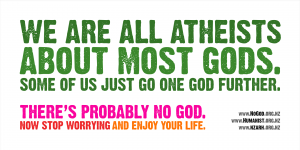
One retort is to state that Christians do believe in several gods, it is just that the lesser gods are demons and Christians claim allegiance to the true God. Yahweh is not just a local deity (1Ki 20:23) but the true God, creator heaven and earth
And Hezekiah prayed before the LORD and said: “O LORD, the God of Israel, enthroned above the cherubim, you are the God, you alone, of all the kingdoms of the earth; you have made heaven and earth. (2 Kings 19:15)
the most high God,
Abram said to the king of Sodom, “I have lifted my hand to the LORD, God Most High, Possessor of heaven and earth,…” (Genesis 14:22)
Though there is truth to this, depending a little on how one defines God, I do not think this rebutal gets to the crux of the problem.
Another response is to state that polytheists believe in gods for different reasons than monotheists believe in God. Polytheists believe X and monotheists believe Y, thus the monotheist’s refutation of X does not refute Y, which the atheist is claiming. In other words, the reason Christians reject other gods is not the same as the reason they accept the Christian God. This is logically true, and hints at the atheist error, but does not get to the heart of it. It is inadequate though because it is not immediately obvious that polytheists and monotheists have significantly different reasons for theism. Romans 1 suggests that there are some basic reasons why all people are theists, but our fallen nature means this may be distorted such that theism becomes polytheism or, as per Romans, animism and pantheism.
A related response is to state that Christians see polytheism is a distortion of monotheism. As such, removal of the distortion does not remove the argument. The dismissal of the wrong elements of theism is not an argument against theism. This gets closer to the problem.
The primary problem with the atheist position is that it makes a category error. The following analogy demonstrates this central issue. As such the analogy is useful, but for several reasons I think it is inadequate and could be improved upon. Nevertheless, if it illustrates the problem it is helpful.
“Let’s say that people are debating the best colour for stop signs. One person may prefer red for stop signs. Another green. Still others think that any colour can be used and no standardisation is necessary, and others promote the use of all colours on every sign.
The atheist response is like saying you can’t agree on what colour to use because there are in fact no colours. Colours do not exist.”
Debating colour preference is not the same as debating the existence of colours. Dropping from one god to no gods is not a continuation of the number-of-gods argument, it is a completely different argument.
Consider the deity set. It is either empty: atheism; or not empty: theism. The argument over the number of members in a non-empty theism set is unrelated to argument about whether or not the set is in fact empty.
Douglas Wilson put it well in his response to Sam Harris,
“You say, “Understand that the way you view Islam is precisely the way devote Muslims view Christianity. And it is the way I view all religions.” Well, no, not exactly. And well, actually, no, not at all.
Suppose we are considering a phenomenon that is, by most accounts, inexplicable by an unsupervised occurrence—three of us attend a sophisticated party uptown, and halfway through the evening at the party we find a trout in the punch bowl. At this point, the three of us divide into three schools of thought. I think that Smith, a practical joker, put it there; our friend Murphy thinks that Jones, the avant-garde performance artist, put it there; and you think that it has simply shown up as the result of natural forces. My central point is not to interact with the truth or falsity of your naturalistic position—except perhaps through the use of this absurd example of the punchbowl—but rather to show that you are arguing for something completely different from what Murphy and I are arguing. We all have an explanation but your explanation is of a different kind altogether.
The differences between two of us (between Murphy and me) concern who put the trout in the punchbowl. The difference between the both of us together and you iswhether someone put a trout in the punchbowl. And who and whether represent different questions entirely. Quite apart from who is right and who is wrong about this, it is important to note that we are not disagreeing in the same way or over the same kind of issue at all. Murphy and I are disagreeing over the relative behaviours of Smith and Jones, but not over whether the trout calls for an explanation. Maybe I am more hostile to Smith than I ought to be, and maybe Murphy is deeply prejudiced against Jones. Maybe we are both wrong about who put it there. But thinking someone’s explanation is inadequate (when we agree the phenomenon must be explained) is quite different from arguing with someone who says it calls for no outside explanation whatever.” (Letter from a Christian Citizen)
RELATED POST:
Selling Atheism -
Oprah Winfrey, Religious Pluralism and Woolly Thinking
 I once caught 5 minutes of Oprah discussing religion. She made the comment, in a very sage-sounding tone, that she believed all religions are true. The audience immediately interrupted her with resounding applause; camera shots caught audience members nodding in approval, clearly impressed with the wisdom of the claim just made.
This commonly heard platitude may sound clever, wise and sensible but let’s unpack it:
- All religions are true;
- Christianity is a religion;
- Christianity claims to be the only true religion;
Therefore:
- If all religions are true, Christianity is the only true religion.
[The same line of argument works with any religion which rejects the first premise.]
-
Contra Mundum: Pluralism and Being Right
Recently I attended a lecture on science and religion at the University of Auckland. As is normal after such talks students stayed and discussed issues raised by the presentation. One student brought up a fairly common chestnut, he objected to the claim made by some Christians that their religion was true and that other religions were false. It was not the first time I have heard someone contend that it is arbitrary, dogmatic, irrational, bigoted, etc to claim that Christianity is true in the face of pervasive religious pluralism. Frequently I have been accused of these things for making similar claims.
This objection is often exasperated by another stance I hold to. In an earlier column (“God, Proof and Faith,” Investigate, Oct 09) I argued that one is rational in accepting certain Christian beliefs even if one cannot prove that they are true to a sceptical inquirer. The fact that so many other people do not hold these beliefs, and often hold contrary beliefs, often attracts accusations of arrogance. Isn’t it arbitrary for Christians like the student at the talk and me to assume that our particular faith is true and everyone else’s worldview is incorrect?
I think the answer is no.
However, before I explain my reasons for this assessment let me first address one assumption that sometimes undergirds it. It is not unusual to hear that affirming that one’s position is right and that those who disagree are wrong is itself arrogant. However, this belief is not only mistaken, it is incoherent. My wife, Madeleine Flannagan, put it well in a blog post entitled “Of course I think I’m right!“
“The statement, “you think you are right” is always asserted by someone who themselves thinks they are right to assert that I think I am right. However, if their objection is cogent, then I should reject their objection. This is because the person who objects that I think I am right is suggesting that I adopt an irrational stance, that I should believe something that I think is incorrect; but if I think it is incorrect then I am not going to believe it.
No sane person holds to a belief they think is wrong or inferior to other viewpoints. I mean, why would you? You would hardly rank the differing views and then decide to hold the second or third most plausible view. You hold the view you think is the most plausible – the correct view – and by doing that you tacitly reject the other views.”
So merely saying you are right and others are wrong by itself is unremarkable, we all do it. I find though that objectors like those I encountered at the science and religion talk frequently want to say more than this. They contend that it is arbitrary, dogmatic, irrational, bigoted, etc to believe that your position is right, in the absence of proof, if numerous other people do not agree with you.
I think there are two problems with this contention.
First, note that the contention itself is one that many people do not hold to; hence, if the claim is true, it is arbitrary, dogmatic, irrational, bigoted, etc to believe it without proof. Further, the proponent of this contention has not offered any proof – simply asserting we should adhere to this contention is not proof – so it must be arbitrary dogmatic, irrational, bigoted, etc for the objector to accept this contention.
Turning to the second problem, suppose I do accept this contention and I (wanting to avoid being arbitrary, dogmatic, irrational, bigoted, etc) cease to believe the Christian faith is correct. In doing so I will be adopting a stance that is contrary to that held by numerous other people – Christians. It seems that I cannot escape the problem. Unless I can offer proof that Christianity is wrong, I will be being arbitrary, dogmatic, irrational, bigoted and so on.
The reality is that in the pluralistic world we live in, a person cannot avoid taking a stance on ultimate questions, such as, “does God exist?” “What is the place of human beings in the cosmos?” What is ultimately real?” “Is there life after death?” “Is there such a thing as sin?” “Is there a highest good for human beings?” “What is it?” And so on. Even being agnostic or apathetic is to take up a stance towards these questions, it is to implicitly hold that they are unimportant or if they are important that one has insufficient grounds for getting an accurate answer. Not only is taking a stance unavoidable, it is also unavoidable that any stance taken will differ from that taken by numerous other people, and that any stance taken will be such that one cannot prove it from premises that all people accept. In this respect religious perspectives are no different from secular ones and it is arbitrary, dogmatic, irrational, bigoted to pretend that they are.
I write a monthly column for Investigate Magazine entitled Contra Mundum. This blog post was published in the Nov 10 issue and is reproduced here with permission. Contra Mundum is Latin for ‘against the world;’ the phrase is usually attributed to Athanasius who was exiled for defending Christian orthodoxy.
Letters to the editor should be sent to:
editorial@investigatemagazine.DELETE.comRELATED POSTS:
Contra Mundum: Abraham and Isaac and the Killing of Innocents
Contra Mundum: Selling Atheism
Contra Mundum: Did God Command Genocide in the Old Testament?
Contra Mundum: Fairies, Leprechauns, Golden Tea Cups & Spaghetti Monsters
Contra Mundum: Secularism and Public Life
Contra Mundum: Richard Dawkins and Open Mindedness
Contra Mundum: Slavery and the Old Testament
Contra Mundum: Secular Smoke Screens and Plato’s Euthyphro
Contra Mundum: What’s Wrong with Imposing your Beliefs onto Others?
Contra Mundum: God, Proof and Faith
Contra Mundum: “Bigoted Fundamentalist” as Orwellian Double-Speak
Contra Mundum: The Flat-Earth Myth
Contra Mundum: Confessions of an Anti-Choice Fanatic
Contra Mundum: The Judgmental Jesus
-
Video of Matthew Flannagan on Apologetics: Answering Objections to the Christian Faith
Matt spoke at the Thinking Matters Auckland Launch on 8 March 2009 on Apologetics: Answering Objections to the Christian Faith. If you missed it or wish to see it again or if you have been thinking about attending a Thinking Matters seminar or booking Matt as a speaker and you are not sure if he will go over your head then grab a cuppa and sit back and enjoy the below video.
This talk is a great intro into the subject of apologetics and addresses some common objections such as:
- It is irrational to believe things that cannot be proven
-
It is arbitrary to believe that one particular religion is true
-
The existence of evil disproves Christianity
The question and answer section at the end is very good too.RELATED POSTS:
Video of Matthew Flannagan Speaking on Moral Relativism