Tag: Science and Religion

  • Hear John Lennox in New Zealand UPDATED

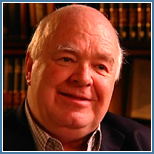
    John LennoxProfessor John Lennox of the University of Oxford will arrive in New Zealand in a fortnight for a brief public speaking tour in the centres of Auckland, Wellington and Christchurch.
    His New Zealand speaking itinerary of public events is below; all public events are free.

    Auckland

    Sunday 27 February

    9:30 – 11:00am Preaching at Howick Baptist Church on the corner of Picton and Wellington Streets, Howick, Auckland. Facebook Event Page.

    1:00 – 3:00pm Science and Religion Q&A at the Salvation Army East City Corps, 37-45 Wellington Street, Howick Auckland. Facebook Event Page.

    7:00 – 9:00pm Preaching at Greenlane Christian Centre, 17 Marewa Rd, Greenlane, Auckland.

    Monday 28 February

    7:00 – 9:00pm “Christ Among the Philosophers” at St Paul’s Church, Symonds St, Auckland. Facebook Event Page.

    Organised by Compass, “Dr Lennox will address questions such as, is faith delusional? Is it reasonable? How can we live faithfully in the public square? How might one engage faithfully as a Christian in the academy?”

    Tuesday 1 March

    12:00 – 1:00pm (this talk will be repeated in the same room from 1:00-2:00pm) “Has Science Buried God?” Public lecture at Auckland University at the Cap and Gown Lounge (Bar), Level 3, Students Union, Auckland University Campus. Facebook Event Page.

    Organised by TSCF: “Science and reason seem to be claiming to have disposed of our need of God. But have they? Prof John Lennox, author of “God’s Undertaker”, engages with the issues in an accessible, thoroughgoing and scientifically sound way. As a world renowned academic mathematician and the only Christian academic that Richard Dawkins has been happy to engage in public debate, John brings illumination, humour and challenge (as well as a cool accent) into this tense and controversial area.”

    7:30 – 9:30pm “So you want to change the world?” Student Meeting TSCF Offices, 441 Queen Street.

    Wellington

    Wednesday 2 March

    7:00 – 9:00pm “Why God Loves Richard Dawkins?” or “God and Stephen Hawking” at St Michael’s, Upland Road, Kelburn, Wellington. Facebook Event Page.

    “Hawking’s book argues that invoking God is not necessary to explain the origins of the universe, and that the big bang is the consequence of the laws of physics alone. Hawking has said, “One can’t prove that God doesn’t exist, but science makes God unnecessary”. Professor Lennox will discuss the flaws in Stephen Hawking’s logic and demonstrate that, far from disproving a creator, Hawking’s argument make the existence of God far more probable.”

    Christchurch

    Sunday 6 March

    9:00 – 10.30am Speaking at Spreydon Baptist Church, Corner Lyttelton & Cobham StreetsSpreydon,Christchurch

    Biography

    God's Undertaker: Has Science Buried God?Dr John Lennox is a Professor of Mathematics at the University of Oxford, a Fellow in Mathematics and the Philosophy of Science and (more…)

  • Alexander Pruss on Scientific Rigour

    Cookie-cutter scienceGiven the debate raging on JT’s Progressive Enslavement: The Seductions of Scientism I thought it timely to share this comment left on The Prosblogion by Baylor University Associate Professor of Philosophy and blogger Alexander Pruss,

    “Given the pessimistic meta-induction, or given the fact that we know that at least one of the two central theories in physics (relativity and quantum mechanics) is false (since the two are incompatible), I don’t think scientific standards of proof should be something for Christians to aspire to. We should aspire to something stronger. And the fact is that the Christian apologetic tradition does contain many very strong arguments.”


  • Progressive Enslavement: The Seductions of Scientism

    One of the silly characteristics of our age is the credulous and naive veneration of science. It has led to the emergence of what we call scientism–faith in science as the ultimate source of truth and wisdom. This faith is pervasive.  How many social issues or ethical questions are falsely claimed to be resolved by the magisterium of “scientists say . . . “, or “science tells us . . . “? Consider the insinuation of “science” into the humanities: social “science”; political “science”; anthropological “science”; and “scientific” pedagogy, to name but a few.  Recall how global warming propagandists have tried to pull a swift one by asserting, “the science is settled” by which is meant that infallible truth has been discovered, and that all must now stop debating, stop questioning. Reflect on how politicians crave “scientific” warrant for crazy schemes. Consider how the adjective “unscientific” is used to bludgeon the views of opponents. It is the ultimate evisceration of an opponent’s argument.

    "Mee-mee-mee meep"How did it come to this?  Whilst not alone, probably the most influential protagonist in the English speaking realm for “science”  and the “scientification” of all of life has been John Dewey.  He moved things along a bit from the first phase of the Enlightenment which had held to the idea that Nature was governed by a collage of immutable laws.  Darwin had taught Dewey and his contemporaries otherwise.  Darwin and his popularizers had “convinced” the West that Nature was not fixed, but was changing; mankind, therefore, could not be said to have an immutable nature.  Mankind was now seen as also changing and developing.

    But, reasoned Dewey, this opened up the opportunity for mankind to seize the day.  Mankind had become so advanced and developed that he could now take charge of and manage his own evolutionary development.  “Following Bacon’s prescription, the power to manipulate nature with a view to human purposes had been exercised to remarkable effect.  But the [old] belief  in a fixed human nature meant that the power unleashed by science had not yet been applied in a thorough fashion to our essentially plastic human nature and political society.” (J. Judd Owen, Religion and the Demise of Liberal Rationalism: The Foundational Crisis of the Separation of Church and State (Chicago: University of Chicago Press, 2001), p.19)  If the scientific method were applied to humanity, we would be able to take effective charge of our evolutionary development.  Humanity would therefore progress more effectively and more quickly.

    Here is Dewey, writing in 1931:

    The entrenched and stubborn institutions of the past stand in the way of our thinking scientifically about human relations and social issues.  Our mental habits in these respects are dominated by institutions of family, state, church, and business that were formed long before men had an effective technique of inquiry and validation.  It is this condition from which we suffer today.  Disaster follows in its wake. (Cited by Owen, ibid, p.21)

    Note the radical nature of the claims here. We must, says Dewey learn to think scientifically about human relations and social issues.  Science alone has an effective technique of “inquiry and validation”; the verities of the past (family, church, state) are relics.  If we continue to resist the “sciencing” of society, we will face disaster.  He means by this that we will not be able to take control of our development–which opens up the possibility, if not probability, that mankind will self-extinguish, proving unfit to survive.  Because Nature is evolving, old verities are worthless.

    Dewey  went on to assert that the Great Scientific Revolution was still awaiting.  We ain’t seen nothing, yet.

    In spite, then, of all the record of the past, the great scientific revolution is still to come.  It will ensue when men collectively organize their knowledge for application to achieve and make secure social values; when they systematically use scientific procedures for the control of human relationships and the direction of the social effects of our vast technological machinery.  (Ibid, p.22)

    The hard, natural sciences had allowed man to understand and then to control and exploit nature to his own advantage.  Dewey says the same rigorous methodology, when applied to humanity and society will allow us to “secure” social values (picking out the best from the emergent changing value grid); then controlling human relationships and setting the direction of society.  “Science” will enable humanity to take control of its own destiny; control its own evolutionary development.

    Two postulates immediately follow: “science” must be elevated into a quasi-infallible status, which explains why scientism is an intrinsic part of the new idolatry.  The ultimate answer to all public and human problems becomes, What does “science” tell us? or, What is the scientific approach?  Secondly, science must control humanity–which is to say that a power nexus of science-government must be formed to order everything, which helps explain the relentless expansion of state powers in the twentieth century to “make things right”.

    The natural law theorists of the early Enlightenment elevated natural law to the place of God.  This meant that mankind was subject to the natural order and could only succeed as he worked in accordance with natural law or “the way the world worked”.  As Rushdoony has astutely pointed out, (more…)

  • False Alarm: Falsificationism and its Misapplication

    A fair number of people are fond of the claim that if one is to be able to take a claim seriously, it really ought to be falsifiable. One easy response is that it’s difficult to see how this particular claim, about how we are to go about accumulating knowledge and believing stuff, is itself falsifiable; but if that seems a bit too quick a dismissal, there are other fairly well documented reasons to be dubious of ‘falsificationism’ and its claims to epistemological kingship.

    Some ideas can be tested reasonably well e.g. with this early electron microscope. Others await the examination of evidence in different ways.

    The idea is commonly associated with the scientific method; a purportedly precise way of doing things that many (perhaps particularly scientists, surprisingly enough) are pretty sure everyone should be keen on. If you want to know something, use science – it works. Indeed, the requirement of falsifiability is sometimes seen as a shibboleth for rationality, or at least orthopraxy amongst ‘reasonable’ people. In the discipline of the philosophy of science itself however, it would appear to be considerably less popular than among certain popularisers of science; an intriguing sociological fact. Falsificationism is a dumbed-down version of the views of method which Karl Popper offered the scientific community. Yes, science involves testing claims against the evidence, but there is more to it than that. A requirement of falsifiability may be seen as a suitably sceptical approach; even (as I’ve seen) contrasted with the blind faith apparently invested by religious people in their beliefs. This is problematic for a number of reasons, some of which will become clear. Lying behind it is a conveniently selective scepticism which puts aside the complexities of science and assumes or pretends that the project of explicating the order in the universe is a natural fit with naturalism. If you want to know why science works, it’s not science and it may not be falsifiable theories which will give good answers.

    Perhaps the most pressing issue behind this post is widespread allegiance amongst many naïve people to some form of ‘scientism’. I and other Christians who decry this trend away from genuine rationality and accompany the hand-wringing with good arguments are often assured that it does not in fact exist (more…)

  • Dr Glenn Peoples on Science and Morality, Sam Harris & the Claims of the New Atheism @ Auckland Uni

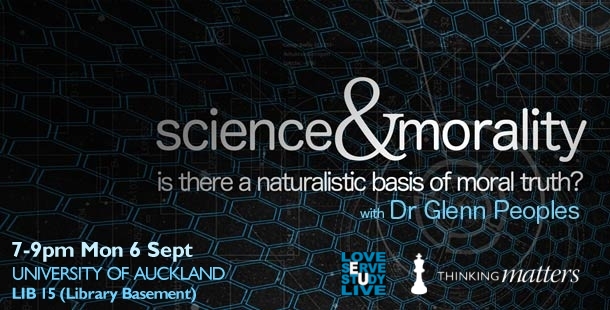
    Christian philosopher and blogger Dr Glenn Peoples is coming to Auckland to give a public talk entitled “Science and Morality: Is there a Naturalistic Basis of Moral Truth?” This talk will examine the claims of the new atheism, particularly the work of Sam Harris. Dr Peoples will ask, can the natural world tell us what is right and wrong, without need for God? Can moral facts be grounded scientifically? He will argue that the attempt to ground morality outside of God ultimately fails. An opportunity for questions and answers will follow the talk.

    Science and Morality

    The talk will be held at the University of Auckland on Monday 6 September from 7-9pm in LIB 15 (in the main campus library basement at 5 Alfred St, Auckland City). Admission is free and is open to anyone. We do advise that you arrive early to locate parking and to obtain a good seat.

    If you enjoyed the panel discussions and the debate we organised earlier this year on Auckland’s campus, you should enjoy this event.

    Dr Glenn Peoples is a graduate in theology (BD) from the Bible College of New Zealand and has a masters degree (MTHeol) and a doctorate in philosophy from the University of Otago. For over ten years he has been writing and speaking, both in New Zealand and abroad, on intellectual issues that Christians face, including the place of faith in the public square, justice and human rights and the reasons for Christian belief. He lives in Dunedin with his wife Ruth and their four children and he blogs at “Say Hello to my Little Friend: The Beretta Blog and Podcast“

    This event is brought to you by Thinking Matters, in association with Evangelical Union. Here is the event’s Facebook Page.

  • Gary Gutting on Richard Dawkins’ Atheism

    The New York Times has an accessible and excellent critique of Richard Dawkins’ argument for the non- existence of God, written by University of Notre Dame Philosopher Gary Gutting entitled, “On Dawkins’s Atheism: A Response.”

    Enjoy.

    RELATED POSTS:
    Fairies Leprechauns, Golden Tea Cups and Spaghetti Monsters
    Richard Dawkins and Open Mindedness

  • Epistemology 101: Clash of Authorities Part III

    This three-part blog series is essentially the talk I gave at the recent Clearing the Air Forum, which was entitled “Discovering Truth in the Synthesis of Science and Faith.” The audience was comprised of scientists, church leaders, journalists and other interested parties so this is a fairly lay introduction to epistemology.

    In my first post, Epistemology 101: Science, Faith and Authority Part I, I set out some basics about epistemology. In Part II I looked at testimony and authority. Now I will turn to my final point, what about the clash of traditions or authorities, what should we believe then?

    Here is a fairly obvious example, suppose I am not a biologist but I hear it on authority that the scientific consensus is that evolutionary theory is the correct account of human origins. In the absence of any defeaters for this, such as the absence of compelling reasons for thinking that the biological sciences are unreliable in this area or some compelling disproof of evolution, I should accept this claim. One the other hand, I read the Bible and it looks like it states that the world was created by God in six 24-hour days and that humans and animals were created on separate days. I examine the subsequent genealogies and I discover that when added up these entail that the world is only a few thousand years old. If I accept the Bible as authoritative and as the word of God, then I have a reason for thinking that evolution is false. What should I do?

    I am using this case as a vivid example because it is such an obvious one in an evangelical setting, particularly one like this full of scientists who will have experienced the tension first hand. I want to look at two approaches that I think are mistaken. The first is exemplified by a well meaning school board member I encountered a few years ago. I was applying for a job as a curriculum developer at a Christian school. I was asked if I would teach that Genesis was true. I responded by saying that at the senior level, students should learn about the debate over how Genesis should be interpreted. They should be encouraged to ask whether it literally teaches that the world was created in six 24-hour days or whether, as some scholars believe, the days are a kind of literary device drawing out the relationship between human and divine work. The board member responded in horror,  he said “are you saying God might be wrong?” I did not get the job.

    There was some wisdom in the board member’s response. If God teaches something then it is true and what God says trumps all human opinion, including scientific opinion. The problem is that I was not questioning what God said, I was questioning an interpretation of Genesis which was the basis of the board member’s conclusions about what God said. God does not make mistakes but human interpreters do.

    Throughout history brilliant Christian theologians have disagreed as to how to interpret scripture and also which theological perspectives are correct. The fact that they disagree means that they cannot all be correct. Our theologising then is fallible and it is not given that we are always correct. It is mistaken then to assume that when the scientific consensus clashes with our theology it is always wrong and our theology is always correct.

    In a room full of scientists this is probably uncontroversial but I want to also reject an equally erroneous view. This is the view that whenever scientific consensus clashes with a theological position, the theological position is always incorrect. Often this view is based on mistaken views on history. In the 19th century an interpretation of Church history known as the conflict thesis emerged. This position taught that religion and science had been locked in conflict throughout their history and that science had flourished only by fighting off the shackles of the church, which had consistently suppressed its ideas. The picture was of a Church constantly losing ground to science. This view of the history of science has been rejected by most historians today but its legacy lingers on.

    In fact the history of science and religion is quite different. There were few conflicts of the sort this thesis puts forward and when they did occur issues were not as simple as science being right and theology wrong. In fact, in some cases the opposite was been true. The fact is that scientific consensus can be and has been, in the past, mistaken. Only a few decades ago the steady state theory of cosmology was widely accepted and it was believed the universe had no beginning, a thesis in direct contradiction to the Christian doctrine of creation ex nihilo. Today, theology now appears to have been correct. In the 12th century a similar clash occurred between aristotlean science and that of the Church. The church was proven correct. There are other examples, such as denials that people groups such as the Hittites ever existed and claims people could not write at the time of Moses.

    Further, scientific consensuses changes over time. Alvin Plantinga notes,

    According to Bryan Appleyard, “At Harvard University in the 1880’s John Trowbridge, head of the physics department, was telling his students that it was not worthwhile to major in physics, since all the very important discoveries in the subject had now been made. All that remained was a routine tidying up of loose ends, hardly a heroic task worthy of a Harvard graduate.”4 Twenty years later the same opinion seemed dominant: for example, in 1902 Albert Michelson, of Michelson-Morley fame declared that “the most important fundamental laws and facts of physical science have all been discovered and these are now so firmly established that the possibility of their ever being supplanted on consequences of new discoveries is remote.”5 And of course we all know of the scientific theories that once enjoyed consensus but are now discarded: caloric theories of heat, effluvial theories of electricity and magnetism, theories involving the existence of phlogiston, vital forces in physiology, theories of spontaneous generation of life, the luminiferous ether, and so on.[1]

    Scientific consensuses then can and have been mistaken. In addition to this there is an important insight in the comment of the school board member who cost me employment. Given the fallibility of humans, even as a group, if God says something and the scientific community says something else then we have good reasons for thinking the scientific community is wrong and hence we do have a viable defeater for the testimony we have heard. God, understood as a all knowing, all powerful, perfectly good being, certainly is not mistaken and it is not as if he needs some scientists to enlighten him or correct his teaching.

    I think the correct response is to allow science and theology to mutually correct each other. Take the case of evolution and the Bible. One needs to ask just how likely is it, given the evidence, that evolution occurred? One also needs to ask just how likely is it that the interpretation of Genesis underlying creationism is correct? If it is more likely that a literal interpretation of Genesis is true than it is that evolution is true then we should reject evolution despite the consensus in favour of it. On the other hand, if there are reasons for thinking our interpretation of Genesis is mistaken and that the evidence for evolution is overwhelming then we should conclude that God is not teaching us that the world is only a few thousand years old.

    My own view is that there are good reasons for rejecting a literal interpretation drawn from what we have learned about ancient near-eastern texts from the same period. Evidence suggests that ancient genealogies did not function the way the literalist picture suggests and that much of early Genesis is a polemic against ancient near-eastern mythology rather than sober history. But my views are beside the point main point.

    My point is that I think as Christians we need to say that both science and theology are valid ways of knowing and that human theorising in both fields are fallible.

    There is a view in our culture which denies this, this is a view called scientism which claims, following Bertrand Russell, that whatever is knowable is knowable by the methods of science and what science does not tell us is not knowable. This is, however, a philosophical and theological view that rejects the existence of revelation. If we accept that God has spoken to humanity then we should not assume that God has not said something that is the basis for a legitimate critique of scientific claims or culture and if he has then we should not cower from offering such a critique despite the fact that the scientific community thinks otherwise. At the same time we should not embrace the kind of naiive theologising that reads the bible in English, ignores the fact that God’s word was mediated through human texts in different languages which essentially boils down to “God said it, that settles it” type thinking. Both approaches should be repudiated.

    Let me make a final comment in this area. If we are to gain an accurate picture of the world then we need to take into account all information we know that is relevant to the question. If we bracket some information which is relevant then the picture we will only be probable on “part of the evidence” and may not be probable when everything else is factored in. If one accepts that science is the only way of knowing this does not matter much. Nor does it matter much if we think that all that is at issue is what we find in the scriptures. But if we accept, as I think we should, that both are valid sources of information then theologians and scientists needs to take others insights into account. There might be areas of reality in which both make claims. If scientists proceed ignoring information from theology that is relevant to what they study and theologians ignore what scientists are saying when it is relevant to the issue both will end up with a distorted view.

    I think this picture applies to the issue of climate change. We have scientific claims about anthropogenic global warming being affirmed and contradicted in the media, in the pulpit, on talk-back radio, in the blogosphere and so on. Those of us who are not climatologists rely on testimony and we need to start being critical about whether much of what we hear is subject to defeaters. Similarly, the issue has moved beyond science into areas of ethics, public policy, laws and even pictures of eschatology. In these areas scientists are not experts and questions of theology and ethics, among other things, come into play and we need to have a method for negotiating this.

    [1] Alvin Plantinga “Creation and Evolution: A Modest Proposal” in Robert Pennock Ed Intelligent Design Creationism and Its Critics: Philosophical, Theological and Scientific Perspectives (Cambridge, The MIT Press – Bradford Books, 2001) 785.

    RELATED POSTS:
    Epistemology 101: Science, Faith and Authority Part I
    Epistemology 101: Science, Faith and Authority Part II