Tag: Richard Dawkins

  • Dawkin’s dilemma: How not to answer the question “Why Be Moral?”

    In his bestselling book, the God Delusion, Richard Dawkin’s responds to the question: “If there is no God, Why be good?”Richard Dawkins

    Posed like that, the question sounds positively ignoble. When a religious person puts it to me in this way (and many of them do), my immediate temptation is to issue the following challenge: ‘Do you really mean to tell me the only reason you try to be good is to gain God’s approval and reward or to avoid his disapproval and punishment? …If you agree that, in the absence of God, you would ‘commit robbery, rape, and murder’, you reveal yourself as an immoral person, ‘and we would be well advised to steer a wide course around you’. If, on the other hand, you admit that you would continue to be a good person even when not under divine surveillance, you have fatally undermined your claim that God is necessary for us to be good.[1]

    Dawkin’s thinks someone who asks “if there is no God, why be moral?” is assuming that the Gods approval is the only reason they to do good. He attacks this assumption with a dilemma. Either this assumption is true, or it is not true. If it is true, the questioner reveals themself to be an immoral person. He is someone who refrains from theft, murder and rape only because God will punish him. We should shun and avoid someone like this. If the questioner’s assumption is not true, then the claim that there is no reason to do good without God is undermined. The fact he would continue to do what is right, even if God did not exist shows that he does have reason to do good even if God does not exist. 

    I think each step of this response is mistaken. 

    First, is it true that this question presupposes that threat of divine punishment is the only reason anyone has to refrain from immoral behaviour? I think the answer is clearly no.

    The question “why be good?” or “why be moral?” This question has a long history in western thought question going back at least as far as Plato’s republic. John Tilly explains that according to the standard interpretation of the question, it involves: 

    A request for a justification for giving precedence to moral reasons for action when such reasons conflict with other reasons (e.g., those of self-interest). Whenever moral reasons recommend one course of action and nonmoral reasons recommend another, why should I favor the first set of reasons? What argument could persuade me to do[2]

    This simple question has proved difficult to answer. So much so that, the 19th-century Philosopher Henry Sidgwick declared it to be “The profoundest problem in ethics”. During the 17th-19th[3] centuries, several philosophers argued this recalcitrant problem posed difficultly for any purely secular understanding of morality. Thomas Reid’s (1710–1796) summary is typical.

    What about cases where concern for our happiness on the whole conflicts with a concern for duty? This is a merely imaginary conflict; there can’t actually be any such opposition between the two leading principles. While the world is under a wise and benevolent administration, it’s impossible that any man should be a loser by doing his duty. So every man who believes in God, while he is careful to do his duty, can safely leave the care of his happiness to his Maker. He realizes that his most effective way of attending to his long-run happiness is by attending to his duty. But consider the case of an atheist who wrongly thinks his virtue is contrary to his happiness on the whole. … this man’s dilemma is without remedy. It will be impossible for him to act so as not to ·seem to himself to· contradict a leading principle of his nature. He must either sacrifice his happiness to virtue, or his virtue to happiness, and he has to decide whether it is better to be a fool or to be a knave! [4]

    Reid points out that the “why be moral?” challenge presupposes the existence of a dilemma: what duty requires contradicts what my long-term happiness requires. Because the “the world is under a wise and benevolent administration” Reid thinks such dilemmas are “imaginary”. They never, in fact, occur. However, they would occur if, contrary to fact, God did not exist. So, if atheism is true, some answer to this dilemma is needed if morality’s rational authority is to be vindicated.

    Nothing in this line of argument assumes that the only reason Reid has to do good is divine reward or punishment. Reid speaks of a dilemma between “two rational governing principles in the constitution of man.” [5]. A dilemma occurs when one has two options, both of which are problematic. We do have powerful moral reasons independent of our self-interest demanding us to do what is right. But we also have powerful prudential reasons pointing the other way. For Reid, Divine sanctions mean that prudential reasons never really point the other way. But they are not the only reasons in the equation. Reid is not atypical in this. Someone who asks, “if there is no God, why be good?” need not assume the only reason he or anyone else has for doing good is divine reward or punishment.

    However, let’s suppose for the sake of argument they did assume this. Dawkin’s attempted rebuttal of this assumption fails. Consider Dawkin’s discussion of the dilemmas first horn.

    “If you agree that, in the absence of God, you would ‘commit robbery, rape, and murder’, you reveal yourself as an immoral person, ‘and we would be well advised to steer a wide course around you’.[6]

    Dawkin objects that anyone who answers “yes” reveals themselves to be an immoral person. That may be true. But it is also irrelevant in this context. Remember what the question is: Dawkin’s interlocutor asks the question “Why we should always do what is morally right when it contradicts our self-interest?”. To answer, “because if you don’t, you are acting immorality” misses the point. Dawkin’s interlocutor knows it is immoral to act contrary to immorality. He is instead asking why he should side with morality and not self-interest in the first place.

    An illustration might help here. Imagine that a religious sceptic was asking “If God exists, why should I do what he says”? I doubt Dawkin’s would consider the response “because God tells you to and if you don’t, you aren’t following God” to be a satisfactory answer. The question is “why to obey God?”, answering “because God tells you to”  begs the very question at issue.

    The same thing is true when the question is “if there is no God, why be good”. Dawkin’s interlocutor is asking “if God does not exist, why always do what is required by morality”? The response “if you don’t you are immoral” begs the question in the same way. Just as the theist cannot cite God’s commands as a reason for obeying God’s commands, the atheist cannot cite moral requirements as a reason for obeying moral requirements.

    So Dawkin’s treatment of the first horn misses the point. What about the second horn? Dawkin’s writes.

    If, on the other hand, you admit that you would continue to be a good person even when not under divine surveillance, you have fatally undermined your claim that God is necessary for us to be good.[7]

    This confuses two separate questions. The original question was “why should you be good, without God”. The questioner doubts we always have reasons to do always what is right. However, this doubt is compatible with admitting that one would continue to do what is right without God. What you should do and what you would do are not the same thing. Dawkin’s argument here was anticipated and responded to by Henry Sidgwick :

    It was no use to say that if I was a moral hero, I should have formed a habit of willing actions beneficial to others which would remain in force, even with my own pleasure in the other scale. I knew that at any rate, I was not the kind of moral hero who does this without reason; from blind habit. Nor did I ever wish to be that kind of hero: for it seemed to me that that kind of hero, however admirable, was certainly not a philosopher. I must somehow see that it was right for me to sacrifice my happiness for the good of the whole of which I am a part.[8]

    Sidgwick accepts that if I am a highly moral person, I will have formed a habit of doing good actions. These habits will mean I will have a strong disposition to continue doing good when I believe it is not in my self-interest. But, this does not show that I really do have a reason for doing this. I could be just acting out of blind habit and prior commitment to morality. One possible response to the question, “why be good?” is to admit there is no reason and affirm we “must simply decide between the moral life and its alternatives.” [9] People can sometimes make arbitrary non-rational leaps of faith where they commit to some form of life without reason or rational grounds. If people never did this, the whole raison d’être for writing The God Delusion is undermined. The fact that morally upright people admit that they would always do what is right in the absence of God. Doesn’t show they have reasons to do so.

    Lets recap: Someone asks a serious sceptical question about Dawkin’s beliefs. His response is first to express outrage at an “ignoble.” [10] question and claim it is a “conversation stopper.” [11]. Then he paints a very uncharitable and inaccurate picture of the person who dares ask this ignoble question. Suggesting that religious believers who raise this sceptical challenge reveal themselves to be selfish egoists, amoral people we should consider shunning. When the believer objects that he isnt, in fact, an amoralist, Dawkin’s takes that as evidence the believer doesn’t really accept the sceptical challenge. The subtext is that anyone who really harboured this doubt about secular morality is a dangerous psychopath we are well-advised to keep away from. 

    For the reasons spelt out above, none of this count as a good answer to the question: why be moral without God” There may, or may not, be a good answer to this question. But if there is Dawkin’s doesn’t provide it. This seems to be more a case of passive-aggressive rhetorical bullying than substance. He responds to a sceptical question, not by answering it. But with sarcastic outrage, an insinuation the questioner is dangerous, evil, and should be shunned for asking the question. These are the kind of tactics one expects from cult leaders or so-called religious fundamentalists. One doesn’t expect it from someone who is supposed to be a proponent of rational scientific free inquiry. 


    [1] Richard Dawkin’s, The God Delusion (Houghton Mifflin Harcourt, 2006) 226-227

    [2] John Tilley, “Two (Faulty) Responses to the Challenge of Amoralism” available at https://www.pdcnet.org/wcp20-paideia/content/wcp20-paideia_1998_0044_0248_0253 accessed 26/1/21 

    [3] Examples include Rene Descartes, John Locke, George Berkeley, John Gay, John Brown, Edmund Law William Paley, Thomas Reid, and Immanuel Kant, perhaps most famous for pressing this difficulty is Henry’s Sidgwick.

    [4] Thomas Reid, Essays on the Active Powers of Man, III iii. viii, 4 see http://www.earlymoderntexts.com/assets/pdfs/reid1788essay3part3.pdf accessed 12 January 2020

    [5] See, Thomas Reid, Essays on the Active Powers of Man, III iii. viii, 4 seehttp://www.earlymoderntexts.com/assets/pdfs/reid1788essay3part3.pdf accessed 12 January 2020

    [6] Dawkins, God Delusion, 227

    [7] Dawkins, God Delusion, 227

    [8] See, Henry Sidgwick “Method of Ethics” Preface to the sixth edition.

    [9] See Tilley, Two (Faulty) Responses to the Challenge of Amoralism” available at https://www.pdcnet.org/wcp20-paideia/content/wcp20-paideia_1998_0044_0248_0253 accessed 26/1/21

    [10] Dawkins, God Delusion, 226

    [11] Dawkins, God Delusion, he has no answer to the question and hence nothing to say. 
  • God or Natural Law: A False Dichotomy

    A few weeks ago someone showed me a newspaper article entitled “New theory could prove how life began and disprove God”, which was published in the UK newspaper The Independent. Now I have, of course, heard media pronouncements of the nature published in this article frequently, reporters often seem to have a knack for making provocative pronouncements about the theological and philosophical implications of various theories (and one can usually take such prouncemants with a grain of salt), but this one caught my attention because of the unstated premise it contained. This premise is, I think, common in discussions about religion and science, which makes it worth addressing in its own right.

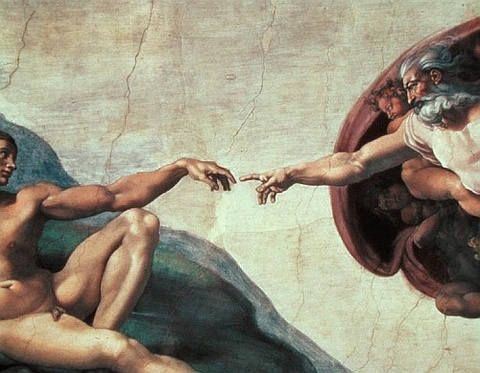
    Michelangelo's 'God Creates Adam

    The author’s commentary opens as follows:

    “A new theory could answer the question of how life began – and throw out the need for God. A writer on the website of Richard Dawkins’ foundation says that the theory has put God “on the ropes” and has “terrified” Christians. It proposes that life did not emerge by accident or luck from a primordial soup and a bolt of lightning. Instead, life itself came about by necessity – it follows from the laws of nature and is as inevitable as rocks rolling downhill. …”

    According to the author, the ‘new theory’ proposes that life arose from non-life by “natural necessity”, that is: according to the laws of nature. Interestingly, the author assumes the fairly standard account of ‘laws of nature’ whereby they are more than just regularities, they involve a kind of necessity that explains or grounds regularities.  The author draws the conclusion from the new theory that God does not exist.

    Now the author is not exactly clear on why this conclusion follows. One argument he seems to grope towards is that the new theory provides all sorts of problems for belief in God because someone on Richard Dawkins’ website says it does.  I suspect, however, that – apart from simple affirmations of faith in Dawkins blog – the author has something a bit more sensible in mind in his thinking.

    The premise is that: life arose from non-life, according to the laws of nature; the conclusion is that: God did not create life. The unstated assumption seems to that: if you can explain something by natural law then it follows that God did not do it.  Implicit in the reasoning is the assumption that appeals to natural law and God are rival and incompatible hypothesises; the truth of one excludes or rules out the other.

    I think anyone familiar with the history of theological thought should find this assumption odd. For (more…)

  • True Reason: Confronting the Irrationality of the New Atheism – in Paperback

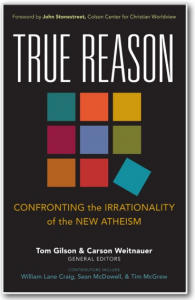
    True Reason: Confronting the Irrationality of the New AtheismThe paperback version of the Kindle book, True Reason: Christian Responses to the Challenges of Atheism,  which Matt wrote a chapter for, recently arrived from the publishers. This release has been re-released as True Reason: Confronting the Irrationality of the New Atheism (the link takes you to the book’s official website).
    True Reason is still edited by Tom Gilson and Carson Weitnauer and is still published by Kregal Publications; however, this edition has been updated and expanded and it has two additional chapters. The table of contents is as follows:

    1. The Party of Reason?
      Tom Gilson
    2. The Irony of Atheism
      Carson Weitnauer
    3. Dawkins’s Delusion
      William Lane Craig
    4. Richard Dawkins’s Illusions
      Chuck Edwards
    5. Unreason at the Head of Project Reason
      Tom Gilson
    6. John Loftus and the “Outsider-Insider Test for Faith”
      David Marshall
    7. Atheism and the Argument from Reason*
      Lenny Esposito
    8. The Explanatory Emptiness of Naturalism
      David Wood
    9. Reason in a Christian Context
      Peter Grice
    10. The Marriage of Faith and Reason
      David Marshall
    11. Faith and Reason in Historical Perspective*
      David Marshall and Timothy McGrew
    12. A Sun to See By—Christianity, Meaning, and Morality
      Samuel J. Youngs
    13. Are Science and Christianity at Odds?
      Sean McDowell
    14. God and Science Do Mix
      Tom Gilson
    15. The Problem of Evil and Reasonable Christian Responses
      John DePoe
    16. Historical Evidences for the Gospels
      Randy Hardman
    17. Did God Command the Genocide of the Canaanites?
      Matthew Flannagan
    18. Christianity and Slavery
      Glenn Sunshine
    19. Epilogue
      Carson Weitnauer

    *Chapters Seven and Eleven are new additions in the second edition, not included in the Kindle version of True Reason.

    Read the author’s bios here.

    The blurb from Amazon is as follows:

    Today’s New Atheists proclaim themselves our culture’s party of reason. It is a claim they cannot sustain. Reason is the New Atheists’ weakness, not their strength and in fact, the Christian faith is a far better place to look for True Reason.

    In sixteen carefully constructed essays by more than a dozen Christian thinkers including William Lane Craig, Sean McDowell, and Timothy McGrew,True Reason unmasks the frequent irrationality displayed by leading atheists like Richard Dawkins, Sam Harris, and Christopher Hitchens. The authors go on to show the great extent to which the Christian faith has historically supported sound reasoning, and that Christian thinkers, past and present, have demonstrated real excellence in reasoned, rational thinking.

    Making their case accessible to the first-time inquirer as well as the serious student, this top-flight team of writers presents a sound defense and a strong introduction to the true reason uniquely found in Christianity.

    You can buy the paperback version of True Reason: Confronting the Irrationality of the New Atheism on Amazon here.

  • There Probably are no Duties. Now Stop Worrying and Enjoy Your Life!

    Some atheists offer  moral critiques of theism; their claim is not just that belief  in God is false or unjustified, it is that such irrational beliefs are intricately linked with immoral and oppressive practices. Moral outrage often motivates the critiques offered – one only needs to read the condemnation of religious wars, religiously motivated terrorism, inquisitions, witch hunts, the suppression of science, sexism, homophobia, and so on, which is so prevalent in many free thought writings. Similarly, one needs only to read the accusations, regularly repeated in popular atheist literature, that the Bible condones slavery, or genocide, or stoning cheeky children, or rape,  to observe this.

    DutyNote that behind this critique is the presupposition that there are moral duties. People have a duty to not engage in wars or acts of terrorism, religious people who promote sexist or homophobic practices are wrong for doing so. I think this is nonsense as it assumes there is such a thing as a moral duty, it assumes things religious people do can be wrong. This is false and here is why:

    First, the burden of proof is on he who makes a claim. I am not making a claim. I am simply not affirming that moral duties exist, therefore I do not have to justify my non-belief in duties. Instead those who believe in duties have to come up with compelling proof that they exist.

    Second, no-one has ever seen a duty. Duties have no colour, shape or smell or sound, hence, they are invisible to sensory perception. One cannot empirically verify or falsify the claim that duties exist so it is meaningless incoherent nonsense to believe in duties until verification of them is given. Moreover, the inability to verify these claims shows they are unscientific and so they cannot be accepted as rational.

    Third, no one as yet has provided a proof that duties of any sort exist. Such things, if they can be decided at all, must be shown to exist by the methods of natural science. To date no one has shown that belief in moral duties is necessary to any scientific theory; physics or chemistry or biology each have no need of that hypothesis to explain the world.

    Fourth, think of all the evil done in the name of duties. Almost every war fought throughout history has been justified by those who claimed they were doing the right thing. Inquisitions, crusades and the suppression of science were all done in the name of doing the right thing and avoiding the wrong thing. While science flies us to the moon, belief in duties flies planes into buildings. (more…)

  • Contra Mundum: Dawkins and Secular Hypocrisy

    Richard DawkinsWhen I was a non-Christian I was forever hearing about how Christians are hypocrites. When I converted to Christianity at 17, one thing that struck me is how often these charges were often a case of the pot calling the kettle black. While there is undoubtedly some hypocrisy within the church, it is also pervasive outside it. Secular culture often contains absurd ironies and hypocrisy which are conveniently ignored.
    A great example was the media fiasco over William Lane Craig’s visit to the United Kingdom last year. Craig is distinguished philosopher known professionally for his work in philosophy of time and philosophy of religion. Alongside his scholarly work, he has also developed a reputation as a prolific public speaker and debater, debating many of the world’s leading sceptics. His combination of scholarly ability and effective debating skills has earned him a reputation as one of the world’s foremost Christian apologists.

    “Apparently, having two PhD’s, authoring over 100 papers, and writing 30 books on a topic makes you unqualified to speak on it, but being the star of the 80’s TV series “Growing Pains” does.”

    Craig’s visit to the UK attracted media attention when Richard Dawkins, author of the best selling “God Delusion”, publically and resolutely refused to debate him. Dawkins publically stated earlier of his critics that “he did not care” who they were, he would “dialogue” with them and “win the argument”. He also had publically debated numerous critics significantly less qualified than Craig, notably Ted Haggard. These facts, alongside Dawkins implausible and inconsistent reasons lead to accusations of cowardice and hypocrisy from other academics such as Daniel Came a philosophy professor at St Hugh’s College Oxford.

    In the UK newspaper the Guardian Dawkin’s gave two reasons for his refusal. According to Dawkins, Craig “parades himself as a philosopher, but none of the professors of philosophy whom I consulted had heard his name”. Dawkins omitted to mention that this was not the first time he had publicly denigrated Craig’s scholarly credentials. On a previous occasion  Daniel Came,  had e-mailed him stating:

    “Professor Craig has a PhD in philosophy and a PhD in theology. He is Research Professor in Philosophy at Talbot University. He has published more than thirty books and over a hundred papers in reputable peer-reviewed journal. Given your passionate and unconditional commitment to truth, I can only think that you were not aware of Professor Craig’s credentials when you made the above reference.”

    So Dawkins claim that no philosopher he had consulted had ever heard of Craig was less than honest. A less charitable person might describe this as simply slander.

    Dawkins concern about Craig’s alleged lack of scholarly credentials also seems odd seeing that he (Dawkins) had earlier accepted an invitation to debate actor Kirk Cameron.  Apparently, having two PhD’s, authoring over 100 papers, and writing 30 books on a topic makes you unqualified to speak on it but being the star of the 80’s TV series “Growing Pains” does qualify you. It’s also ironic that Dawkins would accuse Craig of lacking scholarly credentials on the matter given that he (Dawkins) is a biologist and not a philosopher of religion.

    Dawkins next excuse was that Craig is “morally unfit” to debate him.  To substantiate this he cites not from any of Craig’s scholarly writings. But two blog posts Craig had written on with the conquest of Canaan. At face value  the early chapters of the book of Joshua portrays God as commanding the killing of every man women and child in Canaan. I say “appears”, here because latter sections of the book of Joshua and its sequel in judges proceed on the assumption this never occurred, and studies into ancient conquest accounts of this genre have noted the widespread use of literary hyperbole whereby victories are described in sweeping rhetoric of killing absolutely everyone when in reality they were (more…)

  • True Reason: Christian Responses to the Challenges of Atheism – on Kindle

    The kindle edition of new book featuring responses to the New Atheists, aimed to be readable at the popular level entitled True Reason: Christian Responses to the Challenges of Atheism is now available on Amazon. This blog’s Matthew Flannagan contributed to a chapter in it alongside William Lane Craig, Sean McDowell and others.

    Matt’s chapter is a reprint of his chapter “Did God Command Canaanite Genocide?” in the forthcoming in April B&H Academic book: Come Let Us Reason: New Essays in Christian Apologetics edited by Paul Copan and William Lane Craig.

    Here is the editorial review from Amazon:

    True Reason: Christian Responses to the Challenge of Atheism“While New Atheists like Richard Dawkins, Sam Harris, and others proclaim loudly their rationality, clear thinking, and incontrovertible scientific arguments, others are beginning to wonder how genuinely rational they are. Have they proved anything? Have they argued convincingly? Have they pinpointed any real challenges to the credibility of Christian faith?

    “True Reason,” edited by Tom Gilson and Carson Weitnauer, brings together a compendium of writers–philosophers, apologists, ethicists, theologians, historians–who look carefully at the best arguments atheism has and evaluate their validity, logic, assumptions, and naturalist conclusions.Authors include noted philosopher William Lane Craig and popular apologist Sean McDowell, along with Gilson, Weitnauer, John DePoe, Chuck Edwards, Matthew Flannagan, Peter Grice, Randy Hardman, David Marshall, Glenn Sunshine, David Wood, and Samuel Youngs. Each chapter tackles a different atheist argument and brings reason fully into the discussion.

    Which is more reasonable: atheism or Christianity? Read “True Reason” and think for yourself.”

    Get your copy now, read it, and let us know what you think both here and on Amazon 🙂

  • Unbelievable? Is God a Moral Monster? Paul Copan & Norman Bacrac

    Paul Copan recently debated Norman Bacrac on the topic “Is God a Moral Monster?” on a recent episode of Unbelievable? on the UK station Premier Christian Radio.

    Matt and I just listened to it and we both thought it was worth sharing as Copan really handled himself well and very clearly articulated his position on the hyperbolic reading of the Canaanites (a position he has co-authored with Matt on). The interaction between Copan, Bacrac and the show’s host Justin Brierly was very good too.

    Unbelievable?Listen here: Unbelievable? 9 Apr 2011 – Is God a Moral Monster? Paul Copan & Norman Bacrac
    [If the link will not load the Copan v Bacrac debate directly go to the Unbelievable? page then locate the 9 April 2011 episode ]

    The blurb from the show is:

    Richard Dawkins describes the Old Testament God as “a vindictive, bloodthirsty ethnic cleanser” (among other things).  Paul Copan is a Christian apologist and has written a book, “Is God a Moral Monster?” aiming to show why God’s actions in the Old Testament are not immoral when taken in context.

    Norman Bacrac is an atheist humanist and part ot the South place Ethical Society. He believes that Old Testament morality was barbaric and we don’t need a God to tell us how to behave.  He holds that God’s morality is called into question if we take the Old Testament literally.

    So how do we interpret passages where the Israelites were commanded to wipe out whole towns including women and children?

    “The blog of Matthew and Madeleine Flannagan in New Zealand” rates a mention from the host, Justin Brierly, about 38 mins in 😉