
One thing I find particularly frustrating is reading commentary on theology and philosophy written by scientists. To be fair, some scientists I have read are informed and do offer astute and insightful comments; commonly, however, one finds a person who is undoubtedly brilliant in their own field, writing with confident gusto, articles that fail to understand the most basic theological and philosophical distinctions.
 A good example can be seen in a recent USA Today article by influential biologist Jerry Coyne entitled, As atheists know, you can be good without God. Coyne, an outspoken atheist, is disturbed that many Americans, including some prominent scientists, believe that our instinctive sense of right and wrong is “strong evidence for [God’s] existence.” He ventures into moral philosophy to explain why this is clearly mistaken.
From the get-go Coyne demonstrates he does not understand the issues.
It is necessary to accurately understand the position Coyne is criticising before we look at the paucity of his critique. The argument that our instinctive sense of right and wrong “is strong evidence for [God’s] existence” found its most important formulation in a 1979 article by Yale Philosopher Robert Adams. In it, Adams noted that we instinctively grasp that certain actions, like torturing children for fun, are wrong; hence, he reasoned, we are intuitively aware of the existence of moral obligations. According to Adams, the best account of the nature of such obligations is that they are commands issued by a loving and just God. Identifying obligations with God’s commands can explain all the features of moral obligation better than any secular alternative. Consequently, the existence of moral obligations provides evidence for God’s existence.
It is important to note what Adams did not claim. Central to Adams’ argument, and to pretty much every author who follows him, is a vital distinction; this is the distinction between the claim that moral obligations are, in fact, divine commands and the claim that one cannot recognise what our moral obligations are unless one believes in divine commands or some form of divine revelation. Adams illustrates this distinction with the example of H20 and water.
Contemporary chemistry tells us that the best account of the nature of water is that water is, in fact, H20 molecules. This, of course, means that water cannot exist unless H20 does. However, it does not mean that people who do not know about or believe in the existence of H20 cannot recognise water when they see it. For centuries people recognised, swam in, sailed on and drank water before they knew anything about modern chemistry.
This distinction has important implications. The claim that moral obligations are, in fact, commands issued by God does not entail that people must believe that God exists and has issued commands in order to be able to recognise right and wrong. These are separate and logically distinct claims.
Coyne conflates this distinction from the outset. After noting that some people believe that moral obligations provide strong evidence for God’s existence, he claims that this is an oft-heard argument, “‘Evolution,’ many argue, ‘could never have given us feelings of kindness, altruism and morality…’;” to this he rejoins that, “scientists studying our primate relatives, such as chimpanzees, see evolutionary rudiments of morality: behaviours that look for all the world like altruism, sympathy, moral disapproval, sharing — even notions of fairness.”
This is confused. Apart from the fact that no one who cites morality as evidence for God actually makes the argument about evolution that Coyne sets out, the claim that moral obligations cannot exist independently of God is not the claim that without God people would not have moral feelings. Feeling that one has an obligation to do something and actually having an obligation to do it are clearly different things. People can feel that they have a certain obligation without it actually being the case that they do.
Coyne makes a similar mistake when he argues that secular European countries like Sweden and Denmark “are full of well-behaved and well-meaning citizens, not criminals and sociopaths running amok.” This may well be true but all it shows is that people can recognise moral obligations and live in accord with them without believing in God. That no more shows that moral obligations can exist without God or that moral obligations are not divine commands than the fact that for centuries people could recognise water and swim without knowing anything about modern chemistry shows that water can exist without hydrogen.
Coyne equally fails to address the issue when he asserts that the bible endorses beating slaves, genocide, killing homosexuals, torturing people for eternity, killing children for being cheeky and so on; texts he claims Christians pass over “with judicious silence”. Apart from the fact that Coyne’s interpretation of these texts is in many places dubious and that far from passing over them in silence, Christian theologians working in the field of Old Testament ethics have written voluminous works on how these passages are to be understood, Coyne’s argument here misses the point. The claim that moral obligations cannot exist independently from the existence of a just and loving God is not the claim that the bible is an accurate source of information about what God commands. Someone could, for example, argue that the wrongness of an action is constituted by God’s commands but that we know and recognise what is right and wrong from our conscience and not from a written revelation. Some leading writers on theological ethics have suggested precisely this.
The only time Coyne is remotely on point is when he argues that if moral obligations are constituted by God’s commands then morality becomes arbitrary; anything at all could be deemed ‘right’ as long as God has commanded it – even stealing or infanticide. Coyne suggests this argument is devastating and has known to be so by philosophers for hundreds of years.
In fact, since Adams’ publication, this argument has been subject to extensive criticism in the philosophical literature. So much so that today even Adams’ leading critics grant that it fails. Adams contended that moral obligations are, in fact, the commands of a loving and just God; therefore, it is possible for infanticide or theft to be right only if a fully informed, loving and just person could command things like infanticide and stealing. The assumption that this is possible seems dubious. The very reason Coyne cites examples such as infanticide and theft is because he considers them to be paradigms of conduct that no morally good person could ever knowingly entertain or endorse.
Coyne seems vaguely aware of the response, stating “Of course, you can argue that God would never sanction something like that because he’s a completely moral being, but then you’re still using some idea of morality that is independent of God.” Here he again falls into confusion. What his response shows is that people can have ideas about and recognise what counts as loving and just independently of their beliefs about God and his commands. Now this is true but this does not show that moral obligations can exist independently of the commands of a loving and just God. Coyne again fails to grasp the basic distinctions involved in discussions of God and morality.
Not only does this argument not refute Adams position but precisely analogous reasoning provides a serious challenge to Coyne’s own secular account of morality. After claiming that moral obligations cannot be constituted by God’s commands, Coyne offers an alternative: morality comes from “evolution”, humans evolved a capacity to instinctively feel certain actions are wrong and others are right. But couldn’t evolution have produced rational beings that felt that infanticide and theft were obligatory or that rape was, in certain circumstances, ok? As Darwin himself noted,
“If men were reared under precisely the same conditions as hive-bees, there can hardly be a doubt that our unmarried females would, like the worker-bees, think it a sacred duty to kill their brothers, and mothers would strive to kill their fertile daughters, and no one would think of interfering.”
Coyne faces a dilemma. If the fact that it is possible for God to have commanded that infanticide is permissible proves that morality is not based on God’s commands then the fact it is possible for evolution to have produced rational beings who feel infanticide is permissible must prove that morality is not dependent on evolution.
Believers of God can avoid this conclusion for the reasons I pointed to above; it is unlikely that a loving and just person could command actions such as infanticide or rape whereas, evolution, guided only by the impersonal forces of nature, is not subject to such constraints. Coyne’s argument does not refute Adams’ position but it does appear to refute his own.
Now nothing I say in response to Coyne here is new, much of it has been said in the voluminous literature on God and Morality written and published over the last forty years. All Coyne had to do to realise this was actually read it. Of course, like Richard Dawkins, Sam Harris, and a host of other popular writers, Coyne has not bothered to actually read the literature on contemporary theological ethics before wading in. Instead he hopes that his stature as a biologist and his confident tone will convince many unfamiliar with the field that he has offered a devastating criticism. He has not and pretending he has is about as sensible as pretending that because I am a theologian I can offer informed commentary on contemporary genetics off the top of my head.
Matt writes a monthly column for Investigate Magazine entitled “Contra Mundum.” This blog post was published in the October 2011 issue and is reproduced here with permission. Contra Mundum is Latin for ‘against the world;’ the phrase is usually attributed to Athanasius who was exiled for defending Christian orthodoxy.
Letters to the editor should be sent to:
ed*******@************************TE.com
RELATED POSTS:
Contra Mundum: Separating Church and State
Contra Mundum: Consenting Adults and Harm
Contra Mundum: Pacifism and Just Wars
Contra Mundum: Religion and Violence
Contra Mundum: Stoning Adulterers
Contra Mundum: Why Does God Allow Suffering?
Contra Mundum: “Till Death do us Part” Christ’s Teachings on Abuse, Divorce and Remarriage
Contra Mundum: Is God a 21st Century Western Liberal?
Contra Mundum: In Defence of Santa
Contra Mundum: The Number of the Beast
Contra Mundum: Pluralism and Being Right
Contra Mundum: Abraham and Isaac and the Killing of Innocents
Contra Mundum: Selling Atheism
Contra Mundum: Did God Command Genocide in the Old Testament?
Contra Mundum: Fairies, Leprechauns, Golden Tea Cups & Spaghetti Monsters
Contra Mundum: Secularism and Public Life
Contra Mundum: Richard Dawkins and Open Mindedness
Contra Mundum: Slavery and the Old Testament
Contra Mundum: Secular Smoke Screens and Plato’s Euthyphro
Contra Mundum: What’s Wrong with Imposing your Beliefs onto Others?
Contra Mundum: God, Proof and Faith
Contra Mundum: “Bigoted Fundamentalist” as Orwellian Double-Speak
Contra Mundum: The Flat-Earth Myth
Contra Mundum: Confessions of an Anti-Choice Fanatic
Contra Mundum: The Judgmental Jesus
Tags: Charles Darwin · Contra Mundum · Divine Command Theory · God and Morality · Investigate Magazine · Jerry Coyne · Robert Adams · Science and Religion399 Comments

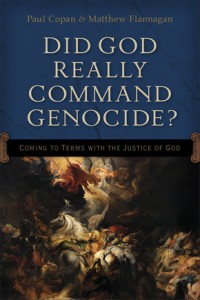 A common objection to belief in the God of the Bible is that a good, kind, and loving deity would never command the wholesale slaughter of nations. In the tradition of his popular Is God a Moral Monster?, Paul Copan teams up with Matthew Flannagan to tackle some of the most confusing and uncomfortable passages of Scripture. Together they help the Christian and nonbeliever alike understand the biblical, theological, philosophical, and ethical implications of Old Testament warfare passages.


Thanks! That’s a really good response to the article. The objections raised here I come across repeatedly in discussions on the issues. It would be nice if we could all get on the same page and realize that these objections have been dealt with adequately and been shown to be fallacious. But it seems too hard for most people to grasp. Why is that?
Anyway, thanks again for an article with philosophical precision.
Good grief!! This post may set a record for religious, deluded nuttery per sentence.
So we know that the commands of the god of the Old Testament are disgusting, sickening,stomach turning, vile and immoral because we have a conscience that did not come from the invisible man in the sky himself?
Thank you Jesus, for giving me a conscience that allows me to condemn your acceptance of slavery . And your silence on the equality of women. And the wicked pile of horse manure that emanated from your precious lips that is referred to as hell.
Thank you YHWH, for allowing me to be able to determine that much of your Old Testament is full of absolute Stone Age lunacy.
Thank you for allowing me the freedom to decide NOT to stone to death a non virgin, or someone who worked on the Sabbath, or someone who had sex with an animal, or children who were disrespectful to their parents. And thank you for letting me ignore the approximately 10 other commands from your merciful mind that condemn people to brutal deaths.
My conscience also thanks you for allowing me to chose NOT to slit the throat of an animal and sprinkle its blood throughout your temple. And burn the intestines. And its feces, as you command.
(Enjoy the smell of the occasional burning turd, do you?)
And of course, thank you for letting my conscience decide whether or not I’m in the mood to sell my daughter into slavery or to beat to death my personal slave.
Choices!!! You are certainly a god of choices! That’s why I’m such a fan!
If Matts wonderful god wasn’t such a genocidal, infanticidal, savage, vile, wicked, evil, jealous, maniacal lunatic, then we would never be able to fully appreciate how truly wonderful and moral that we are!!
Thank you Yaweh!!!! Thank You Jesus!!!
I’m so glad to know that my morality is higher than yours!
For a person who labels themself TruthOverfaith you seem particularly uninterested in being accurate in your accusations. Your deliberate distortions suggest a personality for whom truthfullness is not a priority.
Further your own lack of truthfullness rather undermines any points you wish to make about other ‘s morality.
I suspect you are a blog troll, one who enjoys the anonymity and in the process loses any sense of respect for self or others.
They say your “character” is what you are when no-one can see you. Well done, be proud.
Truthoverfaith,
I’m not sure what the point of your post is. Is it pointing out some internal inconsistency for Christian theists? It can’t be, surely. The Christian theist is inclined to try to actually understand God’s actions with fear and trembling, and be inclined to try to take instruction, or at least suspend his own judgement, when it appears that God’s actions and commands appear to contradict his present sensibilities. If Christianity is believed to be true, such an attitude is entirely the right one to take, since the Christian God is the kind of being who knows best what to do in any circumstance, who grounds moral reality. Therefore, any apparent contradictions with sensibility are either a case of the moral principles or historical context being impropery grasped, not a matter that reflects any ultimate inconsistency with moral reality.
Is it, perhaps, an argument against the truth of Christianity? That doesn’t seem to be right, either, because the truth of Christianity is established by the fact of the Resurrection and the overall philosophical plausibility of the Christian worldview, not upon its scriptures always agreeing with our modern sensibilities. If the Resurrection and the philosophical plausibility of the Christian worldview hold up, then Christianity is probably true, and the proper attitude to adopt toward the passages we find problematic is precisely that which I have outlined above. Yet, you haven’t provided any arguments against the resurrection or the general philosophical plausibility of the Christian worldview, and in any case such arguments would be off-topic.
Is it an argument against the Divine Command account of ethics? Clearly not, since there is nothing resembling an argument to this effect. The only way you could make a factual moral judgement about YHWH is if you acknowledge some greater god, but that merely reconfirms the theist’s argument, and there needs to be further argumentation that the God who exists cannot be YHWH.
Lastly, of course, you could just be venting, and I suspect that this, more than any argument, is the intent of your post. Little to no thought seems to have gone into your little screed, and you don’t engage with the arguments in the article at all. You simply pour mindless scorn and bile onto that which you do not understand. This approach impresses no one, however emotionally cathartic it may be for you personally.
While I appreciate what you’ve written I find the overall concept difficult to accept based on the findings of psychology experiments such as the famous or infamous Stanford Prison Experiment.
If we have morality hard wired into us as I think you seem to be saying then why is it so easy to construct circumstances that lead us to betray that programming ?
Might someone provide a link to the article of Jerry Coyne Matt Flannagan is referring to? (Sorry if I overlooked it.)
Here’s a message I thought you might like to hear, God’s final warning and call to anguish.
Brother Jackie
http://www.wildernessmountainministry.org
OMEGA MAN RADIO
October 7, 2011 DAY OF ATONEMENT, 7:00-11:00PM EST
http://www.blogtalkradio.com/omegamanradio/2011/10/07/episode-432-day-of-atonement–the-4th-beast–whats-next
Identifying obligations with God’s commands can explain all the features of moral obligation better than any secular alternative.
I see no reason why you can’t replace the term “god” with the term “society”, “culture” or even “shared human ancestry” and come to an equally satisfying conclusion.
The common objection I’ve seen is “But if it’s society, then what happens when two societies disagree? Who’s right?”. But isn’t this what we see in reality? It seems like there is a fallacy here in that you are claiming that because you can think of something at the extreme end of the spectrum that everyone (almost everyone) agrees to (torturing babies for fun is wrong), that it’s somehow not possible for there to be any overlap in what is considered moral if morality is driven at the societial level.
To piggy back on Paul Baird’s comment, if we have morality hard wired into us as humans, why do we see consistent variation at the societal (and other) levels? I don’t think some overlap undermines this point.
There seems to be a failure in some of the comments to distinguish between a general human ability to recognise right and wrong ( hard wired morality perhaps ) and human decision to do right or wrong. There is a big difference between knowing how we ought to behave and actually choosing to behave that way.
The old “do unto others as you would have them do unto you” is a moral standard that appears to be universal across cultures, societies and time. Yet it also appears to be standard that is ignored fully as much as it is honoured.
No one likes being stolen from but plenty of people steal. No one wants to be assaulted, but lots of people indulge in violence against others. No one likes being betrayed but adultery is common.
It really doesnt matter what culture, society or time a person has been raised in [ or the variations in conventions there in ] we all know when we are on the recieving end of behaviour we dont like, that we believe ought not to happen to us [ ie a moral understanding] yet sooner or later we all treat others contrary to this understanding. To answer Pauls question, humans choose all to often to do what they want not what they ought.
Ryan,
I think there are quite serious reasons to regard cultural relativism as an inferior meta-ethical view.
Firstly, it renders all reform against societal mores objectively immoral until or unless one can get something engrained in the general culture. That seems pretty implausible. Surely, there has been moral progress, at least in some areas at some times.
Secondly, it makes moral commands social constructions, and not objective facts, no different from fashion or convention. Yet, fashion and convention in general have no moral authority, so why should we think that the specific subset of conventions which we call “moral law,” on cultural relativism, have authority? Further, the dictates of culture are merely the dictates of the majority of the people around us. If the dictates of a single human person do not carry innate moral authority, what is it about many people which makes the collective carry moral authority? I do not think that there is a good answer.
Thirdly, I suspect that cultural relativism is self-defeating. If it is true, then there is at least one duty which transcends culture- the duty to do what the culture says. However, if there is one such duty, then cultural relativism is false.
The fact that there are moral extremes and norms toward which we intuitively agree is, I think, good evidence that there is such a thing as an objective moral law of some sort. That’s not to say that there couldn’t be overlap in what is considered moral if morality is merely a social or biological phenomenon. The problem is, if it is solely a social or biological phenomenon, we should discard any notion of morality’s being objective, authoritative, or necessary, as it appears to be. In light of the intuitive plausibility of the existence of the moral law, and the fact that it conflicts with no logical or observational evidence, there’s really no need to adopt that kind of scepticism.
Lastly, I don’t think psychological experiments like the Stanford Prison Experiment really make too much of a difference to the case for an intuitive grasp of the basics of ethics. It’s long been noted that power corrupts, and that there are situations where one’s ethics, if not honed and strengthened, breaks down. But then, there are situations where one’s reason breaks down as well. You could say of any faculty that there are circumstances where it would be inclined toward malfunction, so I’m not sure that discovering situations where ethical intuitions can be compromised is good evidence that they aren’t properly functioning in more normal circumstances.
[…] I picked up this article recently – The Self-Reported Moral Behavior of Ethics Professors. So I couldn’t help laughing when I came across this other one – When Scientists Make Bad Ethicists. […]
Matt I see what your saying here and the argument follows. Where I loose you is with your water analogy. Yes people swum in and drank the stuff before knwing of or despite its composition, but equating the truth about water to divine commands is a false equivalence. We know about water and while you’re sure about divine commands it isn’t proven, maybe one day but not yet.
I think youwil find thatjerry has read a surprising amount of theology. He may not come to the same conclusions as you but where would be the fun in that. I’d love to hear your response to his Adam and eve theology challenge though.
TruthOverFaith – you seem to be confusing God with the Bible. Nothing Matthew has argued has anything to do with arguments based on the Bible so why do you bring it up? Are you one of those fundamentalists who think that no argument is possible about anything without referring back to hoy scripture?
Atheists often make this mistake, and seem unable to engage in philosophy concerning God without referring back to scripture.
I find this oddly ironic.
[…] I picked up this article recently – The Self-Reported Moral Behavior of Ethics Professors. So I couldn’t help laughing when I came across this other one – When Scientists Make Bad Ethicists. […]
mhssu;
1) The fact that there has only be “progress” in some areas at some times underscores the point that here has also, I’m sure you’d agree, been a regress of morals in some areas at some times. I’d also bet you’d have to agree that not everyone would agree with you (or the bible or Matt or me) on what is progress and what is regress.
2) True fashion in general has no moral authority, and morality is not typically made out of cloth. Apples and oranges. And the reason the dictates of a single human person do not carry innate moral authority yet the collective does is because the collective is better able to shame, shun, imprison or execute than the individual is.
3) It is not any more true that if there is one such duty that transcends culture then cultural relativism is false, than it is that if cars have wheels, then wheelbarrows are cars. I don’t doubt much (or at least some) of our morality is derived from our biology and not from culture.
Again, no need to posit the divine.
Jeremy, I think you hit the nail on the head with what is being overlooked. There is, indeed, a huge difference between knowing right and wrong, and choosing to do the right or wrong thing. The knowledge of right and wrong is placed in us by the Holy Spirit because we are made in the image of God. However, God has given us free will. We can either embrace the Spirit within us and try to live according to God’s commands, or we can reject it and establish our own right and wrong, putting ourselves in the place of God. Our flesh being is also at war with our spirit being. We may know what is right, but sometimes go against what we know and do what is not right. That is what the Apostle Paul was referring to when he talked about doing what he didn’t want to do and not doing what he should do in Romans 7. In fact, that whole chapter is about just this very topic. For there to be any sort of “goodness,” there has to be a standard to compare it against. Jesus even spoke to this when He said “Why do you call Me good? No one is good but One, that is, God” In His bodily form He was acknowledging that it was the Father who was the source of goodness, or morality. Without a standard for comparison, morality becomes relative, rendering it pointless since we can all then establish our own standard.
Jeremy, I think you hit the nail on the head with what is being overlooked. There is, indeed, a huge difference between knowing right and wrong, and choosing to do the right or wrong thing. The knowledge of right and wrong is placed in us by the Holy Spirit because we are made in the image of God.
Carl; it’s not an issue of misunderstanding, it’s an issue of noting that no one agrees on what all moral facts are across culture and time and not having confidence that Carl or Jeremy actually has “knowledge” of what is right or wrong. Thus, it’s not all that likely that the knowledge of right and wrong was placed in Carl or Jeremy by the Holy Spirit because we are made in the image of God.
@ Jeremy – I’ll come back to my point – if this morality is hard wired into the human brain then why is it done so weakly that circumstances can be so easily constructed to overcome it ?
It seems like a pointless piece of poor programming. Can I also say that alliteration was not intentional. 🙂
@Jeremy
Thanks so much for your pathetic attempt at psychoanalysis.
How’s that lobotomy working out for you?
I would have more to say to you but by the looks of your picture I would be ridiculing the mentally challenged, and that would not make Jebus happy.
mhssu
Ahh, so your a Jesus nutter who believes that some kind of god/man hybrid actually trotted around the ancient Middle East two thousand years ago and allowed his own creation to hang him to a tree and savagely beat himself to death for some kind of disgusting, sickening, vile, immoral blood sacrifice for your terrible sins.
Do you have a name for the specific mental disorder that allows otherwise sane human beings to b believe in such astonishing Cro Magnon-level lunacy?
Were you born deluded or did someone brainwash your poor, unsuspecting brain when you were just a child?
Have you looked into Scientology? It’s almost as irrational, illogical, and downright ridiculous as Christianity. Almost.
@ TruthOverfaith
What can i say–
-at least i have the honesty to put my picture to my name
-your picture appears to be as blank as your……….
-your ranting continues to contain factual inaccuracies and historical anomalies
Thats enough for the Troll this evening. Good Night.
Well written Matt.
To others, the water analogy was to identify the difference between the essence of morality and our knowledge of the same.
I would add that the argument does not need agreement of every man as to exactly which actions are moral, while there is some overlap, the fact that we are talking about what we know to be moral may include the possibility that we may not fully know thus, there may be some disagreements. What is does entail is that we agree that morality is real. We agree there is a real essence behind the concept of morality, not just preference. (That is why examples like “torturing children for fun” are used, because most people agree that this is immoral for all people, even the people who try to argue it is acceptable.)
If you agree that there are some things that everyone ought not to do, then the argument works.
It is well written, but shows only that the issue can be argued both ways.
@ Paul
” I’ll come back to my point – if this morality is hard wired into the human brain then why is it done so weakly that circumstances can be so easily constructed to overcome it ?”
I am not sure that morality is hard wired into us, but i would argue that we can all recognise right and wrong when we perceive it being done to ourselves, thus we all have a sense of “ought” ie a moral sense.
Again i would have to emphasize that there is a big difference between being able to recognise moral actions and behaviour and actually choosing to behave that way.
Maybe we could refine the argument to say we all have a moral sense hardwired, rather than being hardwired for moral behaviour (which clearly are not).
I accept it wont persuade you , but this is what the Adam and Eve story teaches. To use the old imagery we have ‘ eaten from the tree of the knowledge of good and evil ‘. I emphasize ‘knowledge’ of good and evil not performance of good.
@ Ryan
“it’s an issue of noting that no one agrees on what all moral facts are across culture and time and not having confidence that Carl or Jeremy actually has “knowledge” of what is right or wrong”
i think this is completely irrelevant, everyone knows how they liked to be treated, with some pathological exceptions we are all capable of projecting that onto others, we all either fail to act accordingly and/or choose not to.
Hence there is a universal understanding of ‘ought’, the idea that there is right and wrong.
I suspect this can be applied cross culturally, across time, and across religions.Take the practice of Female Genital Mutilation for example, irrespective of culture or religion, no man is going to want this done to himself.
john,
Jerry Coyne has not read a surprising amount of theology. Of the little that he has actually read, he shows a rather shocking inability to understand it. From somebody so obviously intelligent, this is rather amazing. I would read the discussions back and forth between him and Ed Feser for examples of his missing (and misunderstanding) concepts that seem rather obvious. I think it’s an example of how you can be utterly brilliant in one sphere, but incapable (despite attempts) even to understand discussions in another sphere.
Here is a link to Feser’s articles on Coyne. Start at the beginning and be sure to get the groundwork before reading the more recent stuff:
http://edwardfeser.blogspot.com/search?q=jerry+coyne
Let it be noted that Feser and Coyne have absolutely no disagreements on science, but on metaphysics and the theological understanding of science. It makes for a fun read.
Ok.. I think I get the point that one doesn’t need to believe in God to recognise a divine command when they see one. But I still don’t see why evolution couldn’t be a plausible alternative explanation for the origin of morals. Yes evolution could have “produced rational beings that felt that infanticide and theft were obligatory or that rape was, in certain circumstances OK,” but only if that was adaptive behaviour. It would act against this outcome if this behaviour was not adaptive. This is because, although evolution is “guided only by the impersonal forces of nature,” one of these impersonal forces is that of natural selection that acts to reduce the incidence of maladaptive traits and increase the incidence of adaptive traits, or traits that increase an organism’s fitness. Although we are not bees, we are social organisms who live in communities. If child molestation is maladaptive because it harms the bearer of your genes or because relatives of the victim seek their retribution upon you, then couldn’t it be selected against? As a result of such selection could it then become the human norm that child molestation is regarded as aberrant behaviour? After all, one need not accept evolution to recognise an evolved behaviour when they see one.
Jonathan,
I understand what you are saying, but it’s a vast leap between an action being regarded as wrong and it being wrong. At best, I think the evolutionary explanation gets us to “We have good reasons for thinking that this or that is not beneficial to my society.” That’s still pretty far from “This or that is wrong,” and I’m not sure how you bridge the gap.
On the subject of adaptive behaviour –when a male lion achieves alpha status in a pride he will kill off any young cubs and new borns as they arrive. This does away with genetic adversaries and gets the females back into heat quickly allowing for propagation of his genes.
Yet we would never regard people who behaved in this manner as moral.
Strangely it happens here in NZ. The biggest risk factor for child abuse is an unrelated male living with Mum.
The trouble with evolution is that outcomes and success are defined by who left the most offspring, whose genes persisted best into following generations. There is no right or wrong, no ‘ought’, only what worked. Evolution is completely utilitarian and pragmatic.
The problem with evolved morality is that at most, all it can say is that we have developed instincts to do or not do certain things. But we have a lot of instincts that may have evolved, and not all of them are good. It’s easy to see how the desire to rape or the desire to avenge and hold grudges could be just as much an evolved instinct as our moral disapproval of rape or forgiving our enemies. If one set of instincts is “higher” or “better” than our other urges, then you’re appealing to an external standard and have really just pushed the morality question back.
It’s this word “obligation” I have trouble understanding.
When Matt uses the word “obligation”, is he suggesting we humans have an obligation to God to perform (or not perform) a certain act?
When Jerry Coyne perceives of morality arising out of evolution, does he see acts being performed or not performed out of an obligation to other humans, or arising out of necessarily being in a species (which has other evolved characteristics) which has survived (i.e. exists in such-and-such environment)?
Thank you for the good synthesis: that has really helped me to understand what’s the whole point behind this kind of arguments and counter-arguments about morality, evolution etc.
I’ve often thought that if the “blind” forces of evolution alone were to forge our morality, it would be impossible to explain how we don’t actually feel compelled to do atrocious things like killing people who represent a burden for the survival of the “tribe” or whatever.
Seeing these ideas framed in a clear philosophical context is quite interesting for a profane…
I’d like to hear an answer here too.
I haven’t heard any theistic account of obligation that can get past the is/ought barrier any better than anything else.
God is an authority? So what? Why is one obligated to obey commands from an authority? What does “obligated” even mean?
DRJ,
It seems to me that authority is simply a primitive concept, and duty simply is a relationship that one bears to an authority. If something has authority, then it has the power to impose duties. To say that you owe no duties to something is just to say that it has no authority, so it doesn’t make sense to say that an entity has authority over you, yet you have no duties to it.
Obviously, assigning authority to a being or entity or fact does get past the is/ought barrier- if something has authority, then you have a duty to obey it. The theist’s special claim is that authority is exercised by a personal being, as opposed to a property of, say, Platonic moral facts. The theist’s claim is more plausible because moral authority is innately prescriptive, and prescriptions are necessarily grounded in some prescriptive intent, and intent is a property of persons.
@ Jeremy – so what was the point of god putting this common sense of right and wrong into as opposed to societal influences ?
In terms of effect they seem to be pretty comparable and the latter is detectable in application.
I think my point is that faced with a natural and supernatural source for an innate sense of right and wrong I just cannot see the point of plumping for the supernatural source over the natural one.
Ryan,
1) Yes, of course there’s always progress and regress, just as there has been in all areas of knowledge throughout human history. But this isn’t a counter-argument against my point. If progress and regress is possible at all, as all sides affirm, then culture is not the determinant of morality, since any progress presupposes a standard external to that which is progressed from.
2) the point about fashion was not a comment on things made of cloth, but on the fact that a large group of people establishing a fashion- “fur is so [i]in[/i] this season!”- doesn’t establish a duty or obligation to conform to the convention. Secondly, it is not in virtue of its power to punish or shame that something has moral authority. I don’t think any theist believes this to be true of God, for instance- they would reject the notion that God has authority in virtue of being able to send you to Hell if you disagree with him. Moral authority is the power to impose duty, and simply doesn’t follow from the power to punish or shame (though those powers might come in handy in enforcing a true authority).
3) Cultural relativism is the view that all moral values are cultural artifacts, so a moral value that transcends culture does render it false.
As for biology: there may be facts about human flourishing that are rooted in our biology. There may well be facts about what behaviours we may be inclined to as a result of our biology. Neither of these can serve as the ground of moral duties, however, since no duties follow from them alone. Being able to flourish doesn’t entail duties to ensure flourishing, and being inclined to a certain kind of behaviour doesn’t entail duties to perform that behaviour. For the atheist, the vital component of objective moral duties must be illusory, a socio-biological artefact of our minds with no referent in reality. Only the theist, I think, can affirm that there are indeed such moral duties, as his worldview alone has a referent for them- the relationship that exists to the will of a necessary, supreme authority, God.
@ drj
Thanks for reviewing my question, I wasn’t sure if I asked it correctly. I sometimes feel the theistic arguments for stating one is obliged to follow moral commands from an authority has the same feel as theistic arguments that claim any Creator deity can do anything (kill, &c.) they want with their creation simply by virtue of being its Creator. This seems (to me) often asserted, but rarely reasoned out.
@mhssu
You write:
“To say that you owe no duties to something is just to say that it has no authority, so it doesn’t make sense to say that an entity has authority over you, yet you have no duties to it.”
and also:
“The theist’s claim is more plausible because moral authority is innately prescriptive, and prescriptions are necessarily grounded in some prescriptive intent, and intent is a property of persons.”
This seems to boil down to “moral authority is a property of persons”.
Bringing all these terms into morality (i.e. authority, duty, obligation) seem designed to favor theistic answers, or, more precisely, seem designed to require a an answer which involves a “personal” force which requires something.
Can’t one say one has a “duty” or “obligation” to follow the law of gravity, and that everyone just “knows” it is “wrong” to fall upward under earth-like gravity conditions. Such an authority (gravity) seems to need not be a “property of a person”, or have “intent”, or be “personal”.
This is just a quick thought, and am willing so see it fleshed out (or stomped on) by others.
@mmhsu
You write: “any progress presupposes a standard external to that which is progressed from.”
Might you provide some justification for this assertion?
I don’t quite see it this way. Let’s say a population experiences regress in the form of food shortage. The population decides that food shortage brings about undesired outcomes (e.g. hunger and death), and chooses to reduce such undesired outcomes. Such a reduction of undesired outcomes, in this case, might be described as progress. This population decides to go to the store to get more food to achieve such progress.
Is the above example not progress?
Was there something “external” (i.e. “supernatural”?) appealed to in the above example?
In such a scenario (which seems analogous to many examples of regress and progress), it appears no “external standard” is appealed to, does it?
Even divine commands are not “external”. Divine commands are for most some words in an old text, and therefore concretely not “external” to anything.
Even if divine commands are revelatory in nature, then if understood and voiced by an individual, they seem to most certainly have physical correlations to brain states.
Paul,
I’m not sure that an innate sense of right and wrong and societal influences are necessarily “opposed” as ways in which God might get us to know his will. Society has an important role in the proper function of the moral faculty- children need to be taught morality, for example, and cannot rely solely on their innate faculties. Society, I would argue, has an important role to play in all reasoning about reality.
If society happens to favour the development of at least the rudiments of conscience (and, since conscience oriented toward the good would be by and large beneficial to societies, why shouldn’t it?), then why shouldn’t it be a legitimate part of the mechanism that contributes to true moral understanding in human beings?
The point, really, is not how we get our moral sense. The point is what the object of our moral sense is. The naturalist has to deny that there is any moral truth toward which we can be properly oriented, that the sense of duty is a mere sociobiological trick. The theist, of course, does not have to deny the evidence of his conscience- he is quite free to think that society and biology are all part of the ultimately divinely ordained mechanisms by which he has access to moral truth.
enenennx,
I don’t think the parallel between natural and moral laws is a very good one.
Natural laws describe regularities in the behaviour of natural objects, while moral laws authoritatively prescribe behaviours in persons. You do not, in fact, have a duty to follow the law of gravity, since gravity makes no demands of you, but simply -causes- you to behave in certain ways.
The reason that terms like duty, authority, value, and so on are brought into morality is because that is precisely what morality is concerned with. If we do not have duties, and there is no authoritative standard of what you ought to value, then there is in fact no such thing as morality. The reason we take such things seriously is because we find, in moral experience, that we simply do have duties and that there is genuine value in the world, and there is no good reason to deny this moral experience that doesn’t work equally against all other faculties.
As for your ‘starvation reduction” example, no, it’s not an example of moral progress. The essential values haven’t changed, just their way of doing things. If the culture had to sacrifice a valued tradition that forbids saving up food in all circumstances, on the other hand, that would be a case of moral progress, and such moral progress would presume some standard according to which their tradition was wrong.
As for divine revelation, theists, and Christians in particular, have always held that there has been a natural moral revelation from God through our consciences as well as a special revelation.
@mmhsu
You write: “If the culture had to sacrifice a valued tradition that forbids saving up food in all circumstances, on the other hand, that would be a case of moral progress, and such moral progress would presume some standard according to which their tradition was wrong.”
What “external standard” is causing this? Still seems natural/internal to me. That is, if such a culture “had to give up saving food in all circumstances”, this would be internal to the culture and based on things internal to the culture. No supernatural externality need apply.
@mmhsu
You write: “As for divine revelation, theists, and Christians in particular, have always held that there has been a natural moral revelation from God through our consciences as well as a special revelation.”
Argument ad populum. (I probably spelled that wrong). Have “always” held such a belief, really? But more importantly Adam and Eve seemed not to.
Unless you can prove the existence of god, then all of these arguments are hypothetical.
No proof of god.
No proof of moral obligations or divine commands.
The theists first have to prove that their god exists!
Something seems to be missing here. Surely, we have duties with respect to beings who are not authorities over us. So a duty must be something else than a relationship between an authority and subjects.
In any case, to say that an “authority” is “one to whom you owe duties”, seems like a non-explation. That’s one way to define the term, certainly, but its not an explanation or account of how these duties come about, why they are binding, or what makes them that way, etc. Engineering definitions this way is something non-theists can easily do.
Under theism, why [i]ought[/i] one obey authority? I can see no ultimate reason why, except for self-preservation.
@Paul
humans alone have the power to recognise right or wrong and to choose how they act, to understand the difference between ‘ought’ and ‘is’.
i think mhssu answered your question well. For the naturalist there is no ‘ought’, any idea of right and wrong is purely the function of current environmental selective pressure and could change completely should that pressure change.
Coyne
“‘Evolution,’ many argue, ‘could never have given us feelings of kindness, altruism and morality…’;” … “scientists studying our primate relatives, such as chimpanzees, see evolutionary rudiments of morality: behaviours that look for all the world like altruism, sympathy, moral disapproval, sharing — even notions of fairness.”
Matt
This is confused
What? I think Jerry Coyne probably knows what he wanted to write about.
Sure there is, if I choose my definitions in a sensible way.
What if ‘ought to do X’ simply meant ‘posseses a rational reason that stands above all other reasons, to do X’ (as opposed to ‘a duty to a deity to do X’)?
I don’t think anyone can say “rational reasons’ are logically impossible under naturalism. Maybe you don’t think its true that there are reasons that can apply for everybody (I think there are, but arguments can certainly be made to the contrary) but I’ve seen no good reason why I should consider it impossible. Maybe there are universal facts about human nature – or even universal facts about the nature of all sentient creatures – which gaurentee that all sentient beings ought to behave according to the same standards of conduct.
Truthoverfaith,
Is there nothing you do but spit out vitriol and ad hominem attacks?
@Drj,
I don’t think the concept of authority needs to be “explained” or reduced to simpler components. It’s a primitive concept that one could only define in terms of other terms which rely on it, like “duty.”
Any moral system needs to posit a thing which has moral authority, or duty-giving-power. An atheistic ethical non-naturalist, for example, locates the duty-giving power in non-natural properties of the world. The naturalist tries to locate the duty giving power in certain facts about flourishing or pleasure. The theist posits a necessary, personal being as that which has moral authority, and does this because he realizes that morality is prescriptive, and prescriptions can only be exercised by a personal being.
On theism, we obey God because in necessarily and authoritatively commanding certain things of us, we have a necessary and unavoidable duty to obey him. To ask for reasons outside of this duty is simply to ask for non-moral reasons for doing a moral action, which would be really besides the point.
@Drj
The problem with defining the “ought” as, “having a rational reason, above all other reasons, to do X” is that, without smuggling in the notion of duty, you don’t get the meaning of the moral ought. If one has a “rational reason” to do something whatever that means, but no duty to do it, it’s hard to see in what sense one “ought” to do something.
@drj
Thats nice and logical but flies in the face of the reality of human behaviour.
People clearly dont do what they ‘ought’ neither in the moral sense as i understand it nor in your hypothesized natural rational sense.
If there is an evolved naturalistic and rational ‘ought’, how is it that we all live and behave in a manner so contrary to this.
@ enenennex
‘But more importantly Adam and Eve seemed not to.’
might need to go and read the story again, when confronted Adam immediately tried to blame Eve, this rather implies an understanding of culpability, responsiblity ( trying to evade it) and how he ‘ought’ to have behaved.
@ Jeremy
You state in your reply to drj:
“If there is an evolved naturalistic and rational ‘ought’, how is it that we all live and behave in a manner so contrary to this”.
However, the vast majority of us do live our lives within societal expectations of acceptable behaviour.
As Steven Pinker has just shown in his recent book “The Better Angels of Our Nature – Why Violence Has Declined” which, as he states, “The decline of violence isn’t a steady inclined plane from an original state of maximal and universal bloodshed. Technology, ideology, and social and cultural changes periodically throw out new forms of violence for humanity to contend with.
The point of Better Angels is that in each case humanity has succeeded in reducing them. I even present some statistical evidence for this cycle of unpleasant shocks followed by sadder-but-wiser recoveries”.
Obviously, given your christian perspective, you may not accept many of these behaviours, such as premarital sex, but I would say humanity on the whole is generally better off than in earlier times.
@ Paul
you are quite right i disagree completely, for instance the death rate from wars and violence may well be lower, but modern western society kills the most defenceless at rates unprecedented in history. I completely deny that killing fewer adults while aborting millions upon millions on babies represents any kind of progress. Mostly we have just changed the form of violence, it may generally be less physical but more emotional. Stress is now a big killer, loneliness and isolation are issues in an overcrowded world, an in general all our progress and wealth hasnt made us any happier. Older cultures would be dismayed at the way we treat our young and our elderly, others wouldnt believe what we have done to the environment. I am currently studying environmental science, global warming isnt going to be a threat to us, why, because chemical and pharmaceutical pollution of the environment will render us infertile long before warmer temps will threaten our survival.
Everything has changed and nothing has changed, we are just killing ourselves differently.
Whats more economic exploitation is simply more efficient than military occupation, for much of the world the results are just the same. We just feel good because we are not shooting as many people or calling them slaves. What is the effective difference between colonising India and controlling food crops with genetically enhanced seed that will not produce viable seed in the next generation. Slavery is still slavery whether we use a gun or a dollar.
Really SP just fails to recognise that violence doesnt have to be done with a physical weapon. He should get out and visit the real world.
“However, the vast majority of us do live our lives within societal expectations of acceptable behaviour”
if this is true why do we need so many laws and why is the prison population growing.
Ryan, You write”I see no reason why you can’t replace the term “god” with the term “society”, “culture” or even “shared human ancestry” and come to an equally satisfying conclusion.”
Actually there is a fairly straight forward reason why this is not true, it’s possible for human societies to command paradigmatically immoral things, and if wrongness is identical with commands of society that would not be possible. God on the other hand is omniscient, perfectly rational, essentially loving, just, impartial and so on, so it’s impossible for God to command actions which are immoral.
You add “The common objection I’ve seen is “But if it’s society, then what happens when two societies disagree? Who’s right?”. But isn’t this what we see in reality?”
That suggests you don’t understand the objection, the point is that if one identifies wrongness with what society commands, and societies command inconsistent things, then contradictory claims will be both true, which is false. What we see in reality is that societies disagree over what is morally wrong. We do not however see contradictory claims being in fact true in reality. To deny this is to deny the basics of rational thought.
You write”It seems like there is a fallacy here in that you are claiming that because you can think of something at the extreme end of the spectrum that everyone (almost everyone) agrees to (torturing babies for fun is wrong), that it’s somehow not possible for there to be any overlap in what is considered moral if morality is driven at the societial level.”
This misses the point, if two things A and B are identical, then it’s impossible for something to be an A and not be a B. This means that if you claim that wrongness is identical with what society commands then it must be impossible for a society to command people to do what is wrong.
The fact it’s is a possibility societies demands to have some overlap with what is obligatory. Does not mean its impossible for a society to command something immoral. If it’s merely possible that a society can command something that is wrong then wrongness is not identical with what society commands.
In fact one can think plausibly of actual cases where societies have issued commands to engage in moral atrocities. For example Nazi Germany, where a society commanded people to engage in the holocaust. Or the endorsement of slavery in the US south, and so on. In fact Coyne’s criticism of biblical morality in the Old Testament suggests he contends that ancient societies had religious codes which were mistaken. Sceptics can’t have it both ways here. They can’t claim that religious societies make mistaken moral judgements and also that wrongness is identical with whatever a society commands.
Paul wrote”Unless you can prove the existence of god, then all of these arguments are hypothetical.
No proof of god . The theists first have to prove that their god exists!”
Actually this is a mistake, if it’s true that the best account of the nature of moral obligations is that they are identical with God’s commands then that is evidence God exists. One good reason, commonly used in the sciences, for believing in the existence of something is precisely that that thing is entailed by the best account or explanation of certain subject matter. Scientists believe in the big bang and common ancestors for example because if these entities exist, they explain the data better than alternative hypothesises.
As to having to prove moral obligations exist, there I simply disagree with you, I don’t think I need to prove the claim: there exists an obligation to not torture children for no reason at all. Any more than one needs to prove the truth of claims such as “nothing is green all over or red all over” or “there exists a real world” or “other people exist”.
But if you want to play this card play it consistently, every time an atheist criticises Christians for doing immoral things in the past, or claims God does not exist because of some evil in the world, or claims the bible teaches something immoral. He must first prove moral obligations exist, otherwise his argument is flawed. I have never seen you do this in the past
ennenex wrote You write: “any progress presupposes a standard external to that which is progressed from.”
Might you provide some justification for this assertion?
Its unclear why people don’t grasp these points, some of them are fairly elementary issues in ethics. If a society improves its laws, that entails that its laws closer approximate to what is just than they did previously. This means the previous laws were not identical with what justice required.
If moral obligations are identical with what a society commands, then that societies laws are identical with what justice requires and so moral progress is impossible.
The same problem arises with reformers, reformers critique existing laws and call for them to change, if moral obligations are identical with societies demands then a societies laws perfectly correspond to what is morally obligatory and so reformers are in fact mistaken.
@ Matt
The fact that there may be an abstract standard of perfect goodness that an individual strives to achieve, does not indicate that this standard represents an existing object.
For example, bowling a perfect game would yield a score of 300.
However, even if no one in history had ever bowled a 300, this would still be the highest attainable score according to the rules of the game.
It is quite possible to have a theoretical ideal, yet not have any concrete instance of that ideal.
Therefore, we could say: “Yes, this thing that you call ‘God’ could be our standard for morality.
However, this tells us nothing about whether or not God exists.”
Jonathan
Yes evolution could have “produced rational beings that felt that infanticide and theft were obligatory or that rape was, in certain circumstances OK,” but only if that was adaptive behaviour. It would act against this outcome if this behaviour was not adaptive. This is because, although evolution is “guided only by the impersonal forces of nature,” one of these impersonal forces is that of natural selection that acts to reduce the incidence of maladaptive traits and increase the incidence of adaptive traits, or traits that increase an organism’s fitness.
Three things here, first, your missing the context of this argument, the examples of theft and infanticide are actually Coyne’s he had used them as counter examples to a divine command theory, arguing that that moral obligations are not divine commands because if they were that would mean its possible for infanticide and theft to be obligatory. So he can’t then turn around and claim it is possible for these things to be obligatory.
Second, I think your reading to much into the idea of adaptive here, adaptiveness and fitness are not terms for better or worse, as I understand it in evolutionary biology to say a trait is adaptive only means it enabled our ancestors to pass there genetic material on to the next generation. Its not obvious to me that say, raping a women, would be acceptable because it enabled by ancestor to pass his genes on. In fact the suggestion that because an act passes on my genes its therefore OK seems to me to be fairly implausible.
Third, it seems to me your conflating feelings of being obligated with being obligated. I don’t know of any one writing in the topic of God and morality who denies that naturalistic evolution could produce feelings of being obligated, or moral beliefs which are adaptive. But thats not the question, the question is what is the nature of obligations themselves.
”Although we are not bees, we are social organisms who live in communities. If child molestation is maladaptive because it harms the bearer of your genes or because relatives of the victim seek their retribution upon you, then couldn’t it be selected against? As a result of such selection could it then become the human norm that child molestation is regarded as aberrant behaviour?
True and similarly if attacking the neighbouring tribe killing all the men and keeping the women as sex slaves, enables one to spread ones genes into the next generation then that would also become the human norm. Unless you can make a plausible case that its impossible for actions which are morally abhorrent to be adaptive in some ecological niche , evolution cannot provide an account of the nature of moral obligation.
John “Where I loose you is with your water analogy. Yes people swum in and drank the stuff before knwing of or despite its composition, but equating the truth about water to divine commands is a false equivalence. We know about water and while you’re sure about divine commands it isn’t proven, maybe one day but not yet.
Its seems to me you fail to grasp the analogy, All your example shows is that there are differences between water and divine commands, so what? the fact they are different in certain respects does not address my point. My point is not that the relationship between Gods commands and obligation is the same as water and H20 in every respect. My point with H20 and water is that if two things are identical it does not follow that one cannot know one exists without knowing about the other.
The fact that H20 and Gods commands are different in other respects does not address this.
[…] Coyne’s* USA Today article As atheists know, you can be good without God, local theologian Matt Flannagan repeats his rather tiresome warning that scientists should not try to understand morality – “leave that to us […]
Paul you write The fact that there may be an abstract standard of perfect goodness that an individual strives to achieve, does not indicate that this standard represents an existing object. For example, bowling a perfect game would yield a score of 300.However, even if no one in history had ever bowled a 300, this would still be the highest attainable score according to the rules of the game.
Actually I don’t think this example works, but the issues are complex. Let me note that even if it did it would only apply to moral ideals. I am not talking about ideals I am talking about obligations.
The point is simply one about what is necessary for a statement to be true. Suppose I said: John is six foot tall, this statement picks out a person in the world, John, and attributes to him the property of being six foot tall. The statement is true if in fact the person in the world John has actually has the property of being six foot. It is false if he does not. The point is that statements of this sort if, are true only if certain facts about the world obtain.
Now take the claim: Torturing children for fun is wrong, on the face of it this kind of sentence functions the same way, it picks out an action in the world the action of torturing children for fun, and states that this action has a certain property, that of being wrong. If actions of torture in the world do not have this property then the statement is false.
To claim moral claims are true then requires that actions in the world actually have certain properties, if these properties do not exist the statements are not true.
@mhssu
Tell me if I’m wrong here, but it looks simply like the account of authority provided really isnt any more informative than saying something like: “Authority is the magical, mysterious, and irreducible IS that produces OUGHTS“.
And you know, that’s actually fine, but its not a particularly strong maneuver, and I don’t think it rises to the standard to which most Christian theists (and even moral nihilists) hold naturalism, when it comes to accounting for morals and moral obligations.
As you mentioned, naturalists can appeal to things like universal values, and might even claim that those universal values are the IS that produces the OUGHTS. Whether such universal values exist or not is a question of fact, but there’s no reason they cannot, in principle, exist given naturalism. And if they act as the OUGHTS, in any meaningful way, the naturalistic morals are in business!
One might not care to act rationally, or obey the law of non-contradiction, or other laws of logic, but I have no problem saying that my moral system (indeed, any moral system) will not reach such a person. The value of acting rationally is so nearly universal, that I think its all that we need to appeal too.
‘The value of acting rationally is so nearly universal, that I think its all that we need to appeal too.’
Unfortunately the failure to act rationally is also so nearly universal as to invalidate any appeal.
“Take the practice of Female Genital Mutilation for example, irrespective of culture or religion, no man is going to want this done to himself.”
I don’t see how female genital mutilation COULD be done to a man; however, there are women who defend doing this to their daughters, so I don’t think your bizarre analogy holds even when corrected. Plus, given the obvious avoidance of talking about male genital mutilation (or to use a less loaded term, circumcision), I don’t think there’s much agreement there, either.
I’ll argue morals with anyone; my only condition is this: any arguments that involve gods have to be presented by the gods involved, not by humans purporting to represent them.
@Jeremy:
I spoke of ‘the value of acting rationally’, not the success rate of acting rationally. Just because people often act irrationally does not mean they value irrationalilty.
Matt, thanks for replying to my question, and stating you didn’t quite understand why people didn’t get these elementary concepts.
But I feel you failed to address the main question I posed. What is your argument that these standards are EXTERNAL to any physical thing whatsoever. It seems we can decide to be more or less just by describing what things we would like to experience more or less of without any appeal to something external to nature and it’s observed consequences.
@ Jeremy.
I was not aware Adam “blamed” Eve. He seems to simply be reporting objecting to God that Eve offered him the fruit of the Tree of Knowledge of Good and Evil. You ascribing motive to Adam appears to be a exercise in eisegesis of the Biblical Genesis text (it may later be referred to as blaming Eve in Paul’s writings or in other NT writings, but without special pleading to being divinely inspired, those writers are also reading into the text that which is not explicitly there). I acknowledge you are apt to do such reading of the Bible as it is necessary to support many of your views. Cheers.
In the above comment “objecting” should be “objectively”, my apologies.
@ mhssu
I was with you up until the point where you said theists had some special advantage over non-theists.
It was always thus. 🙂
@enenennx
i’m having real trouble taking your last response seroiusly.
When some one is held accountable for doing something they were explicitly told not to do and their immediate response is ‘the woman you made gave it to me’, how could anyone who knows anything about human character and behaviour even attempt to characterise that as ‘objective reporting’.
Adam was ducking for cover as fast as he could, blaming the woman for the apple and God for the woman, in a rather pathetic attempt to evade responsibility for his own actions.
@drj
‘Just because people often act irrationally does not mean they value irrationalilty.’
i am not suggesting people value irrationality, rather that actions trump words. history and looking out the window show clearly that people do not act rationally much of the time, clearly little value is placed on rationality.
By way of example, what would ‘advertising’ look like if rationality dominated human decision making?
@ Brian
a little reading about analogous organs in males and females and their function may help you.
FGM is so much more and infinitely worse than circumcision.
However i think you are being deliberately obtuse, there has been no culture, society or religion where FGM like mutilation and loss of function (with resulting risk to life) has been routinely applied to the male half of the population. Thus my point about not doing to others what you wouldnt accept being done to yourself, and the fact that humans routinely fail to meet even this simple but unversal standard of ‘ought’.
It seems we can decide to be more or less just by describing what things we would like to experience more or less of without any appeal to something external to nature and it’s observed consequences.
Intially we were talking about what was external to human societies, but a similar point can be made here, people can and do desire to do and experience unjust things. The theif desires to have someone elses stuff, the rapist desires to experience the thrill of dominating his victim and so on, therefore one cannot plausibly identifiy moral obligations with what one desires to experience.
Moral obligations have certain features that any plausible account of there nature should explain, they are a property of actions, objective, constitute a overiding reason for action, and they have a certain content, for example actions like rape, murder, theft, lying and so on are wrong they seem to be concerned with issues of human flourishing and human dignity. Robert Adam’s has argued with some force that obligations have several features which suggest they are demands one person ( or persons) makes on another. Moral obligations are something other people can demand you do and you have to do it, if you don’t its legitimate for them to get angry at you, to censure you, blame you and so on, and this state of guilt can be expiated by seeking forgiveness and so on.
You cant just pull a natural property out of a hat and claim obligations are identical with that property. You need to show that property better accounts for the formal features of moral obligation than divine commands do.
@Jeremy.
You say Adam told Yahweh that Eve offered him the apple “in a rather pathetic attempt to evade responsibility for his own actions.”
Wow. Blame, pathetic-ness, and evading responsibility – none of that is explicit in the text. In the story I do not see Adam claiming not to have eaten the fruit. Reporting the circumstances of the malfeasance does not necessarily equate to assignation of blame. I am perhaps suggesting that you are blind to your own eisegesis, that’s all. And when pointed out, you seem to get all defensive and pile up more eisegesis. Good job. It appears the reporting that Eve provides regarding being tempted by the serpent, which is textually accurate, provides the literally device to tell the reader how Yahweh came to punish the serpent.
Though you write you don’t know weather to take my question seriously, what you might ought to take seriously is that if your eisegesis is wrong you are creating your own God-story, and assigning to God that which may not be true, thereby committing blasphemy, and considering Matthew 12:31, I’d certainly take it seriously, if I were concerned about such things. But if I were not, then I might not take it seriously, and you claim not to. Cheers.
Again, I’m sorry if I’m being obtuse, but I just don’t get your handling of whatever argument it is you are handling, which I think is whatever arguments you are purporting to support the assertion that moral obligations require external something-or-other.
In your most recent comment the examples you supply do not point to anything external to nature or the individual or society. Can you try handling the arguments again, or recommend a good paper on the topic. Thanks.
Matt, whenever you get into an anti-science tirade you certainly provide some humour. Three things struck me in this latest attempt.
1: You inevitable resort to the knee-jerk theological strategy of declaring you discussion partner ignorant because they have not read the theological texts you have. It’s a rather childish way of avoiding any responsibility to discuss the issues at hand.
2: Your particular use of this strategy on Jerry Coyne. He of course has had this theological flack from way back and took it seriously. He asked his critics to recommend reliable texts and has been reading them. Periodically he reports what he has learned and his conclusions on this reading on his blog “Why Evolution is True” (he is an excellent writer and these posts are quite amusing). Rather him than me, I certainly would not have taken on this task (perhaps because I have less of my life left to waste than Jerry has). However, Jerry is doing a lot to expose the absolute rubbish and bafflegab which appears to pass for serious theology these days. Something I have always suspected.
3: Your use of the water parallel. In a few sentences you reveal the power of science to explain why water behaves as it does – something theology has never been able to do. It really underlines the weakness of your final recommendation to “read the literature on contemporary theological ethics” and invites the response that you yourself should spend some time reading the contemporary scientific literature on the origins and nature of human morality. There is a lot of it out there and it is fascinating. (And, if you do want to understand why water has the properties it has you really need to read some chemical science).
Expanding on this last point. Theological epistemology could never have resulted in the development of quantum mechanics and our understanding of the electronic properties of H and O. This required scientific epistemology. And it is this that enables us to understand the nature and properties of water.
I will assert this is also the case with human morality. Theology has never been able to provide any real explanation of the origins and nature of our morality. Epistemologically it just isn’t up to the job as it makes childish declarations (effectively “god did it”) and leaves it at that. But the scientific epistemology of relying on evidence from reality, human reasoning and validation of ideas against reality is successful. We actually do have quite a good understanding of the origins and nature of human morality these days. And it is improving with time.
But your attempt to achieve understanding through theological texts really is a throwback to the days of the Galileo affair. Galileo’s great heresy was to declare that humanity should search for our understanding of reality in reality itself (he called in nature and the book of nature). That struggle between a scientific epistemology and a theological epistemology (revelation and scripture) was really what lead to the modern scientific revolution.
The scientific revolution required the victory of a scientific epistemology over religious philosophy and theology. This has largely been won, but theologians have not given up the battle completely. They still launch their attacks on scientific epistemology. In Galileo’s day it was the nature of the solar system and the universe. Today it is things like consciousness, evolution and human morality.
Further to my point that Jerry is actually reading these theological texts and debating them is the fact that there are theologically-minded intellectual who, unlike Matt, are prepared to get involved in discussing the issues with him The discussions are taking place over several publciations and blogs and are worth following. A recent post of his “Andrew Sullivan claims that Bible stories are “true” but not “real”” and his debate (occurring about now) with theologian John Haught “Sophisticated theology: why we don’t find God.“
I, for one, will check out those links, Ken. Additionally I have found your comments on this thread and on other MandM threads helpful. Also, a continued thanks to MandM for allowing open comments.
Ken, sorry but criticising a scientists writings on a subject other than science in which neither he nor you are qualified is not attacking science.
To your comments:
1. Calling someone knee jerk and childish or accusing them of avoiding responsibility is not a rebuttal. Nor is distorting what they said. I did not claim that Coyne was ignorant because he has not read the theological texts I had, what I did do was argue that he fails to offer a cogent critique of a particular line of argument because he was unfamiliar with what philosophers who have actually made that argument have proposed. Contrary to what you think its not “evading responsibility” to insist that scientists actually respond to arguments of other people rather than caricature them. When you want to respond to what I actually said with some kind of counter argument against it let me know.
2. Your second comment again contains no argument apart from an assertion that Coyne writes in an amusing way and your assertion that he is up with the play on these issues and then an assertion that theologians write “ absolute rubbish and bafflegab” unfortunately assertion and insult is not an argument. The fact is he decided to write a criticism of a philosophical argument, his comments show total unfamiliarity with pretty much every article written on this topic in the last 40 years. ָ
3. Your comments again contain no actual argument, instead you simply make assertions about how wonderful science is and how terrible theology and then make reference to Galileo. You also display the standard confusion that so many biologists have between understanding the evolutionary origins of moral pscyology and an ontological account of the nature of obligation.
I know that many scientists lag behind other disciplines in there analytic thinking ability, but you really need to understand that if you want to criticise a position in another feild you need to (a) be familiar with what that position is, and (b) offer actual arguments against those positions. When you can actually do that let me know.
Matt – I suppose I shouldn’t expect any better from you. This is your typical response and it is just a way of avoiding engagement with the issue.
The facts remain:
If you want to understand why water has the nature and properties it has you will have to consult some chemisty texts/papers. Your will need to develop a bit of familiarity with quantum mechanics and the electronic properties of atoms.
Similarly, if you want to understand human morality you will need to develop an appreciation nof psychology, anthropolgy and evolutionaray biology. particulalry iin brain science.
Theological texts will not help you one iota in either endeavour..
Your “ontological account of the nature of obligation” is purely a theological argument for imposing your values on others. In the face of the fact that these days people tend to develop their values autonomously and are not really influenced by what you believe about your gods.
You cannot understand what the significance of “obligation” or the feeling of obligation is until you understand how the mind works. Theology is of absolutely no help there.
@Matt
In regards to Divine Command Theory,
If you admit that a) actions such as torture have an attribute of ‘wrong’
(and presumably others have attributes such as ‘good’)
and b) We, as humans, have the ability to recognise these attribute in reality,
then would it not require God to only offer one command:
“Do good and avoid wrong doing”?
Furthermore,
Could God not make this command a part of us in the form of a conscience and thus not need to issue it directly, but through nature?
“Furthermore,
Rosjier you say:
“Could God not make this command a part of us in the form of a conscience and thus not need to issue it directly, but through nature?”
Or, more realistically:
A conscience will be the inevitable result of beings that evolve as a social, empathetic, intelligent, sentient species.
This doies not involve skyhooks, is antural and can be vlaidated. No ypothetic imaginary creature (gods) are required.
“You cannot understand what the significance of “obligation” or the feeling of obligation is until you understand how the mind works.”
damn most of the worlds population who arent neurologists or behavioural physchologists can never understand ‘obligation’
sometimes i wonder how man survived and florished all those years before contemporary western science came along to tell us the way things are.
‘A conscience will be the inevitable result of beings that evolve as a social, empathetic, intelligent, sentient species.’
Which species would that be? If you are alluding to Homo sapiens please explain history, politics and comtemporary society.
Jeremy, why the pessimism!: “sometimes i wonder how man survived and florished all those years before contemporary western science came along to tell us the way things are.”
The fact is humanity (women as well as men) did flourish. As Matt explained it was not necessary to understand why water has the properties it has to use it. And it’s not necessary to understand why humans have the moral nature we do to be that moral being.
If we want to understand the causes of the properties of water we need some understanding of quantum mechanics and the electronic properties of the atoms involved. If we want to understand the underlying reasons for ort moral character we need to understand things about the human brain and our social evolution.
So if we want to really understand reasons for the properties of water or our moral character we must resort to science. In neither case is theology of any use.
I don’t understand your problem with the evolutionary origins of conscience. You will have to explain your problem more clearly.
[…] Coyne’s* USA Today article As atheists know, you can be good without God, local theologian Matt Flannagan repeats his rather tiresome warning that scientists should not try to understand morality – “leave that to us […]
Matt, you said, quite rightly, that:
“if you want to criticise a position in another feild you need to (a) be familiar with what that position is, and (b) offer actual arguments against those positions. ”
I have been reading your posts and others of similar inclination. However, is there anyone out there who you consider is qualified and who does make actual counter arguments to your position? I’d be keen to read both sides of an informed debate. Who would you consider a worth sparing partner?
What I worry, is that due to the fundamentally different underlying assumptions, neither side of the argument is going to spend the time to become familiar with the others work to the satisfaction of the other side of the argument. Maybe a discussion about the underlying assumptions is more appropriate.
Does one have to be religious to believe in DCT? Are there those who are not but who postulate there must be DCs?
@mhssu
You write: “The reason we take such things seriously is because we find, in moral experience, that we simply do have duties and that there is genuine value in the world, and there is no good reason to deny this moral experience that doesn’t work equally against all other faculties.”
Perhaps you can provide an example of something that is of “genuine value in the world”, and we can go from there and see if it’s value is resultant of natural or supernatural origin. It would seem, it something of genuine value is of natural origin, supernatural explanations need not apply.
Maybe someone can answer this: what is a moral obligation?
Is there such a thing as a moral action without an obligation?
Is there such a thing as a moral action without command (divine or otherwise)?
Matt summarized Adams article thusly: “Adams noted that we instinctively grasp that certain actions, like torturing children for fun, are wrong; hence, he reasoned, we are intuitively aware of the existence of moral obligations. According to Adams, the best account of the nature of such obligations is that they are commands issued by a loving and just God.”
What article are you talking about, can you provide a link to it? It appears that neither Jerry Coyne’s article or Adams article was named or linked to in the original edition of this post. I might suggest that is bad form.
Since you say Adams found the best account of moral obligations in that they are commands issued by God, can you briefly say what alternatives his paper considers and why they were not viable alternatives for Adams?
Why do you believe torturing babies is wrong?
John
I think there are some informed critics of divine command theory in the literature. I mentioned Eric Welenberg before, but in my view the best critic is Mark Murphy whom I engaged with on this issue at the APRA conference in Auckland this year. Nicholas Wolterstorff has also written some important criticisms.
In other posts I have responded to criticisms by Peter Van Inwagen, Micheal Tooley, David Brink, and I am presented in Auckland and am presenting in San Francisco where I respond to the criticisms of Walter Sinnott Armstrong, that paper develops criticisms I have made before on this blog and I plan to put it up online in the near future. Interestingly the most important criticism I got at the Naturalism in Ethics conference for my criticisms was “your criticisms are sound, but why are you wasting time on these writers, there work is obviously bad, you should be focusing on critics that are serious” this was at a conference of profession secular ethicists, the audience at my session were largely critics of divine command ethics and contained in fact the two best critics of divine command ethics in the world.
“What I worry, is that due to the fundamentally different underlying assumptions, neither side of the argument is going to spend the time to become familiar with the others work to the satisfaction of the other side of the argument. Maybe a discussion about the underlying assumptions is more appropriate.”
I disagree, in philosophy the normal procedure is to read the arguments of the other person with care, and in divine command ethics, the discussion is usually joined conditionally, people assume theism for the sake of argument and attempt to argue that Gods commands can or cannot be plausibly identified with moral obligations, usually by looking at the implications of such a stance, or testing it against other things we know to be true about ethics and so on. This sort of dialogue happens all the time in philosophy of religion. The problem is that most people are more familiar with the writings of popular science writers like Harris and Coyne. Outside of there popular authorship almost no one takes there contribution to the field seriously. When these arguments are rebutted in the literature and shown as inadequate there readers do not know and usually lack the understanding to even grasp that it has been.
“Does one have to be religious to believe in DCT? Are there those who are not but who postulate there must be DCs?”
Actually as I have pointed out before one does not have to be a theist to believe in a divine command theory, in fact I have meet atheists who hold this view. Its possible for example to argue that if moral obligations existed they would have to be something like Gods commands, seeing God does not exist, moral obligations do not they then argue that morality is a kind of illusion which cannot be justified from a scientific world view. J L Mackie, probably the best defender of atheism of the last century, held a view like this.
Ken you write “Matt – I suppose I shouldn’t expect any better from you. This is your typical response and it is just a way of avoiding engagement with the issue.” Unfortunately, calling my response typical and claiming I am evasive does not address the arguments I made.
You add that “If you want to understand why water has the nature and properties it has you will have to consult some chemisty texts/papers. Your will need to develop a bit of familiarity with quantum mechanics and the electronic properties of atoms.” This is all true, but it does not respond to anything I said, if I had said you could not understand the physical structure of water without appealing to science this comment would have a point, but i didn’t say this, I used the H20 water example to make a different point, illustrating the difference between the claim that one thing is identical to or constituted by another and the claim that one needs to believe one proposition in order to know another.
Changing the subject from what I did say to something I did not say and responding that that second subject does not really offer a response either.
”Similarly, if you want to understand human morality you will need to develop an appreciation nof psychology, anthropolgy and evolutionaray biology. particulalry iin brain science.”
This does not follow, first the fact empirical methods are reliable methods for determining the nature of physical observable objects does not mean that these methods are reliable in answering questions of meta ethics. That follows only if assume either that science is the only reliable method for gaining information that exists or you assume moral obligations are physical objects, neither assumption is given.
Second, as numerous ethicists have pointed out this argument commits the fallacy of equivocation. When people talk about “human morality” they can mean one of two things. They could mean (a) the human practise of making judgements about what is right and wrong, and associated beliefs, social and emotion responses involved in this or (b) they could what really is right and wrong. These are not the same thing, the Nazis had a practise of making judgements and a set of beliefs and emotions and so on, yet the code they elaborated was mistaken.
Now when you state that “, if you want to understand human morality you will need to develop an appreciation nof psychology, anthropolgy and evolutionaray biology. particulalry iin brain science” this is true if you mean (a) by human morality.
These subjects can explain the nature of the beliefs, emotions, social practises involved in moral judgements.
They do not however explain (b) and its morality in the sense of (b) that philosophers are talking about.
To suggest that evolution and human psychology can explain (b) is about as sensible as arguing that the planet Jupiter is explained by human evolution. After all we know that claims about Jupiter are part of science. The practise of doing science is the result of cultural and biological evolution, science relies on a whole host of evolved dispositions of the brain to form certain judgements and draw certain inferences, does it follow from this that best account of the nature of Jupiter is that Jupiter is an evolved brain state. Obviously not, Jupiter existed prior to human brains, evolution explains our propensity to make scientific judgements not the nature of the entities we make judgements about.
In the same way , evolution explains our propensity to make moral judgements not the nature of the entities we make these judgements about.
You go on to state my “ ontological account of the nature of obligation”is purely a theological argument for imposing your values on others.” This is however mistaken,ontological accounts of the nature of moral obligations are part of moral meta ethics a branch of philosophy, not theology, and moreover anyone who claims moral obligations exist and try to explain what they are engages in it wether they are theologians or not, many atheist ethicists in fact have offered secular ontological accounts of the nature of obligation. So again your comments simply show you don’t know what your talking about.
Moreover, even if moral ontology where a purely theological argument ( which it isn’t) asserting I am motivated in by a desire to impose my beliefs onto others would not respond to this argument. You don’t refute an argument by impinging motives you have to actually offer a argument against it.
” In the face of the fact that these days people tend to develop their values autonomously and are not really influenced by what you believe about your gods.
Even if it is true that people these days do develop ethics autonously and are not influenced by gods ( which is probably false) this really does not address a divine command theory, the fact a position is not popular does not entail its false. Again to refute a position you need to offer an argument against it, not simply assert its unpopular.
Also the idea that a divine command theory is incompatible with moral autonomy has really been thrashed out in the literature. Philip Quinn offered a fairly comprehensive rebuttal of this claim in the late 70’s.
”You cannot understand what the significance of “obligation” or the feeling of obligation is until you understand how the mind works. Theology is of absolutely no help there.
This again is a fallacious inference,
first, people have known that significance of having an obligation to not rape or steal centuries prior to any discoveries of evolutionary Psycology.
Second, I am not offering an account of the significance of obligation nor am I offering an account of moral feelings. I am defending an account of the nature of obligations themselves.
Third, even if I was this inference is invalid, the first sentence tells us that knowledge of psychology is necessary to understand the significance of obligation, and theological reflection is irrelevant for this. Even if this were true it shows very little, the fact theology is irrelevant to understanding one feature that is necessary for an account does not entail its irrelevant to such accounts. That follows only if its irrelevant to every peice of knowledge necessary for such an account.
I don’t know what you mean by scientific epistemology, but I presume it involves responding to what other people have actually proposed with arguments that follow the rules of logic.
Normally changing the subject, impugning motives, ignoring what people say and asserting thinks, and commiting the fallacy of equivocation does not count as a reliable method in any discipline. The fact some scientists reason so poorly does not make such reasoning scientific.
Its really an uncontroversial claim that when one offers a rebuttal of a position they should find out what the position actually is, what arguments have been made for it, and be familar with the responses those who hold these positions have made to their critics. Charging in guns blazing only to caricature anothers position and raise arguments that have already been discussed and rejected for good reasons decades ago is not a sound way of reasoning. That fact you are a chemist or biologists does not excuse you from the basic canons of good scholarship.
Matt, i will just repeat back to you what you say: “when one offers a rebuttal of a position they should find out what the position actually is, what arguments have been made for it.”
You have maliciously misinterpreted and misrepresent my points. But again I guess I shouldn’t expect otherwise. Pity, because that approach does destroy the integrity, and therefore usefulness, of any debate.
Its pointless responding to misrepresentations. So I will just limit my response to a few very relevant questions:
1: Matt, are you aware of the large amount of contemporary research and scientific literature, books and journal papers, on human morality and the morality of other primates?
2: Have you bothered reading any of that literature?
3: If you have could you please identify the researchers you have actually read?
I am trying to assess your familiarity with the actual scientific research done in the area of the morality of humans and other primates.
Three simple questions – surely you are capable of answering them.
Matt,
I thought that Mackie was a moral nihilist. He seemed to think DCT was the most coherent position, but since from his perspective there was no God, the consistent atheist response must be amoralism.
Ken,
The problem with your questions is that most of the science of morality is not doing scientific research into morality, but into how mammals develop moral intuitions. Those are vastly different questions.
A moral question is, “Is X right or wrong?”
A scientific question is “What pressures, brain chemistry, etc. cause this person to think X is wrong?”
The latter question is what scientists are asking, as most realize that the first question is outside of their purview.
Instead of playing the “I’ve read this, have you read that?” game, why don’t you offer a moral hypothesis (such as “it is immoral to steal apples from the market”) and a scientific test to assess whether it is right or wrong without smuggling in any moral intuitions? I can’t even imagine such a test, because it seems rather obvious that moral questions are outside of the purview of science…but I’m more than willing for you to prove me wrong on this topic.
For instance, I can imagine a neuroscientist looking at the brain patterns associated with making a moral decision, or a sociologist measuring the qualitative response to action X or action Y, or a biologist giving the historical pressures that explain why natural selection led to people thinking this way or what way about action X. But none of these assess whether action X is right or wrong, without smuggling in moral intuitions.
So let’s stop the “you haven’t read the literature” game on both sides and hear out your scientific test for assessing a moral question.
Kyle, I appreciate that you concede that it is the job of science to understand human morality. Of course science does not directly determine what we consider right it wrong, although it provides valuable information for us to do so.
Now, I have been continuously clear about this differentiation. Unfortunately one of Matt’s tactics for generating flack is to continually attempt to confuse the two – or imply his discussion partners are doing so. He uses this to attack science for actually doing it’s job – claiming that one should instead consult the theologians. He doesn’t justify that claim end I don’t think he can. It is dogma for him.
Again, let’s be clear – the “I’ve read this, have you read that?” game is the one Matt uses to avoid engagement in the debate. And it is particularly disingenuous here as he is denying a role for science in understanding human morality. My questions are aimed purely to assess how familiar he is with the science he is repudiating. (Actually I find such questiosn a bit pointless – he usually disappears when they are asked).
Now, regarding moral decisions – what we consider “right” and “wrong”. These are questions we all face and resolve – in most cases unconsciously. That’s how our moral system works. Individuals who had to make rational considerations or consult their holy book every time they faced a moral decision would have been selected out.
Of course, we still do consciously rehearse hypothetical and new moral scenarios – there is the old dialectical relationship between learning and incorporation into our unconscious intuitions.
As I said we all face moral decisions and there is no rational discipline that can make those decisions for us. Not science. Not theology. This us because such decisions inevitable involve intuition and emotion. The local butcher has as much right to make these decisions as you and I. As the scientist and the theologian. If you think about it this should not be any other way. Our individual immune system handles things in much the same way. Who would hand their immune system over to the scientist or preacher?
It is silly to ask me to propose a “scientific test for assessing a moral question.” The fact that you ask it means you have not understood anything I have proposed about how human morality works.
Or is this another intentional red herring/straw man?
In order to know water is wet and has value in cleaning, all you need is your senses to experience what transpires when you wander into a collection of it.
In order to know water is made of H20 molecules all you need is sensory-expanding devices to look at it at a molecular level.
In order to know that water has mystical properties that allow it to be turned to wine and magically momentarily have a surface tension that can support a first century Palestinian Jew, all you need to do is make up a story/theology that says so, or believe such a story via hearsay, and then claim that investigation into such properties is outside the realm of current (or even future) known investigative methods.
I can’t help but feel Matthew’s response boils down to something along these lines: God-talk is required to answer questions about moral obligation if one hypothesizes that God is the source of moral obligations.
I am a novice in this field (as I imagine is evident). If someone might direct me to a good paper that states what “moral obligations” are and also argues for their existence, that would be helpful (or even a specific blog post of yours, Matt).
Thank you Ken and Matthew for engaging, I for one am trying to learn from the discussion.
G. Kyle writes: “the consistent atheist response must be amoralism.” Why on earth is this true? Matt seems to be saying that human morality is partially concerned with “a) the human practise of making judgements about what is right and wrong, and associated beliefs, social and emotion responses involved in this”, and states theology (i.e., a supernatural explanation) is not required for an understanding of this aspect of morality.
But then what Matthew seems to be doing is adding that if you REALLY what to know what is REALLY right or wrong, then you do need to develop a supernatural explanation for such things. This somehow feels to me simultaneously like a problem is being manufactured such that one can offer their preferred answer (God can only be the answer to questions to which God is decided to be the answer), and also an argument from ignorance, as well as a no true Scotsman fallacy (i.e., what Matt is saying is “what you’re talking about is not TRUE morality”, “True morality is that which only God can be the anwer for. This seems to leave morality, in this sense , as a post-hoc attempt to egotistically justify (i.e. find value) in our actions, and therefore, in ourselves.
The intent of the above quotes might be interpreted wrong. Let me be clear that that what is in quotes is not what Matt is saying specifically, just my interpretation of some of this exchange. Again, the quotes are not meant to express what Matthew has said specifically. My apologies.
enenennx,
Maybe you should re-read my comment. I was attempting to clarify Mackie’s position. Considering he is one of the greatest atheistic analytic philosophers of the last fifty years, I think he probably had good reasons for his position. You might look to his book Ethics: Inventing Right and Wrong. Since I’m both a theist and moral realist, I don’t think I should attempt to defend his atheistic moral anti-realism, haha.
But feel free to name-drop it, and seem to imply that it’s been refuted, and also asset without support what must be “the consistent atheist response.” You and Matt, peas in a pod.
Contrary to what you assert, it would seem, actually, as a self-described theist and moral realist you specifically SHOULD try to defend beliefs that are antithetical to your own. The principle of intellectual charity applies. Cheers.
@ Matthew,
I think the most charitable reading of what Ken wrote is that Adams argument for “Our feelings of moral obligations are best explained by divine commands” fails because psychology, sociology and related sciences are capable of explaining human behaviour and thus also capable of explaining our intuition that moral obligations exist and uses the analogy “Chemistry explains the behaviour of water – psychology and related sciences explain human behaviour” as an argument that invoking theological concerns is unnecessary.
@ Ken
I hope this is correct. If it is, I can see that Matthew got it wrong, since I did not an easy time myself to come up with this. I also don’t think it’s a very good objection. It’s clear that Matthew assumes that moral obligations are more than mere intuitions, he assumes that all sides in this debate actually take moral obligations for granted (otherwise, Coynes “you can be good” is wrong and nonsensical to begin with because he can’t just mean “you can follow your/have moral intuitions” – that is not and has never been the issue), so his critique also involves that even if there were indeed plausible secular accounts of why there are moral obligations, science helps us in no way understands how our minds would know that they are there.
Matthew Flannagan, the essay you refer to as “a 1979 article by Yale Philosopher Robert Adams” – can you provide the title and/or a link to it if available. (Is it the one titled “Moral Arguments for Theistic Beliefs”, which is found on pages) 90- 112 in a book titled “God”, edited by Timothy A. Robinson, copyright 1979 by University of Notre Dame Press? Thanks.
Is somebody able to summarize Stephen J. Sullivan’s critique of Robert Adams’s article, titled “Robert Adams’s Theistic Argument from the Nature of Morality”, and also Robert Adams’s response to Stephen J. Sullivan’s critique titled “Prospects for a Metaethical Argument for Theism, A Response to Stephen J. Sullivan.” Both these articles seem to have appeared in The Journal of Religious Ethics (both articles in Volume 21, Number 2, Fall, 1993.)
In the abstract of Stephen J. Sullivan’s critique of Robert Adams’s work, Sullivan claims that he examines the four arguments for the modified divine-command theory that Adams develops in his papers, and he claims to “show that three of the arguments are much too weak to enable him to make a case for theism in this way” and that the “fourth itself depends on the assumption that there is a God and so would render that case circular.”
1) Might Matthew Flannagan list the four arguments made by Adams which Sullivan is referring to, and in which way Sullivan finds those arguments weak (if Matt has read Sullivan’s paper).
In Robert Adams’s response to Stephen J. Sullivan, Adams admits that there is a point in his original 1979 paper that “needs to be (at least) updated.”
2) Can Matthew shed light on what point that is which Adams’s writes needs to be (at least) updated, and what the update entailed?
Additionally, Adams states that “I overlooked the possibility that one of my basic ideas, that of a synthetic rather than analytic theory of the nature of ethical properties, might be developed in a direction that is naturalistic (though perhaps not in precisely the sense in which I defined naturalism, as Sullivan points out). Since then there have appeared very interesting proposals for naturalistic theories of just his sort, which Sullivan cites.”
3) Does Adam’s detail what he means by “interesting”, and whether or not such interesting proposals render his arguments less convincing, or whether Adams has responses to these “interesting proposals” that makes his argument more convincing? In this article, does Adams have a response for each of Sullivan’s critiques of each of Adams’s four arguments? Or does Matt?
Additionally, does someone know if I might access these articles via a link or PDF?
Tsmon, I’ll ignore the pejorative word “charitable.”
The term “best explained by divine commands”” seems to be very naive in today’s world. For it to have any truth there would have to be some sort of evidence of these commands and of a divine agent. The hypothesis would also require testing or validation against reality. Validation and evidence are not part of theology, but they are of the scientific approach. Hence it’s success.
Matt was the one who drew the parallel with water, not me. I don’t think it really works without some changes. However, it does underline the fact that science is the way we understand things about the world and we can expect science to help in understanding human morality, how it works, how it evolved.
If Matt does believe “moral obligations are more than mere intuitions” then it is up to him to explain how and provide evidence (not references to theological bafllegab). He has not done so. Vague talk about divine commands doesn’t do it – although he might be trying to use this to impose his own moral decisions on others. His god obviously has the same moral prejudices he has. Funny how this always happens.
I think I have explained how “moral obligations are more than mere intuitions”. We are a social animal living in a society. We are also intelligent (if not individually rational). Consequently much of our obligations get developed through rational social consideration and learning. In the end these become incorporated into our intuitions. In this sense human moral decisions are objectively based.
I need some clarification of your claim. How do you think our minds come to know what our “moral obligations” are?
@ Ken
Before we continue this, I’d like to rule out further misunderstandings. Please answer the following questions:
– What is your definition of “science”?
– What is your definition of “theology”?
– What is your definition of “moral obligation”?
– Are you a moral realist or do you hold a different meta-ethical view and if so, which one?
TSmon, that new list of questions are just a diversion. I thought my simple question would hone in on the basic issue and can’t see why you can’t respond to it.
You can best understand my position from what I write, not from self definitions. My attitude towards theology has been expressed strongly here and elsewhere – it is no secret. Regarding science, I have had a career as a research scientist (chemist) with an interest in the philosophy of science as well. Draw your conclusions from that.
So I repeat my question:
“How do you think our minds come to know what our “moral obligations” are?”
It’s a simple request, no trick intended, but would certainly help clarify the discussion.
Enenennx,
What we have here is not a philosophical, moral, ethical or scientific problem. The issue between you and me is purely based on reading comprehension. Matt mentioned a view of an atheist scholar and I attempted to clarify what he said.
1 There was no name dropping, only clarification of what the previously dropped name believed.
2. I never made any claim about the coherent atheist position, but stated what Mackie held as the only coherent atheist position. That is his view.
3. I will not defend antithetical views that I do not hold in a blog comment particularly when I’m not involved in the actual discussion other than to clarify one philosopher’s position. “Intellectual charity” means that I read, and attempt to understand other peoples’ work. It does not mean that I defend their statements or positions, especially in a forum such as this.
TSmon: Ken is what some might call a “High-functioning” troll.
He always opens within an insult then conducts long-winded explanations as to why it was not when the obvious is pointed out – as the discussion shows!
Best not to bother him with actual questions!
Ennemex
I am happy to summarise those articles and add commentary at some point in the future, though doing it today would take to much time that I do not have. I actually think Adam’s responds adequately to the points you mention in Sullivan’s article. I also think Sullivan does not really get the last argument correctly, and his criticisms of Adam’s second argument is not really on point anyway.
Adam’s in fact has since then written a book Finite and Infinite Goods where he spells out in much greater detail his position and updates his arguments. In addition you can read a good critique of other theories by Thomas Carson, in “Value and the Good Life” Carson argues for a slightly different divine command theory to Adam’s but has a discussion of some of the issues surrounding ethical naturalism.
Thats all I have time for at the moment sorry.
Let me add, that when we look at Sullivan’s critique we have moved quite away from Jerry Coyne, Sullivan nowhere endorses any of Coyne’s arguments. So nothing in that exchange really alters the point I made in the post above.
Scientific studies have shown that chimpanzees can practice poor philosophy without believing in Richard Dawkins. Therefore, Dawkins almost certainly does not exist.
/debate
1: Well, no one seems prepared to answer the simple question:
“How do you think our minds come to know what our “moral obligations” are?”
I have specifically asked this of those promoting a divine command explanation of human morality. If you can’t answer a simple question like this you don’t even have a hypothesis.
But I am still open to replies. I honestly want to hear your explanation.
2: Now I want to raise a different question with Matt concerning his academic honesty in use of quotations. Usually I expect authors to be familiar with the original work they quote. Otherwise they are only quote mining and using quotes out of context to promote their preconceived argument. Hardly academically honest.
Matt’s quote from Darwin appears not to be taken from the original work but from someone else using that quote. Most likely Bill Craig who uses it a lot. I say this because Craig omitted the words “for instance, to take an extreme case, “ Many religious apologists who repeat that quote appear to have taken Craig’s version without checking because they also omit the words, although often they will indicate this with . . . . Matt hasn’t.
Darwin is often dishonestly quoted this way by religious apologists.
I think Matt has repeated that mined quote without understanding it or it’s context. He has not read the original which brings me back to my original query about the scientific sources and whether he had read them before attacking them.
3: Related to this specific question how the hell does Matt conclude?:
“the fact it is possible for evolution to have produced rational beings who feel infanticide is permissible must prove that morality is not dependent on evolution.”
I think that conflicts with Matt’s use of the quote. And his reference to the moral acceptability of infanticide amongst some human groups surely undermines his argument for objective morality represented by divine commands.
My argument is that such phenomena indicate instead that our morality is objectively based, based on the real situation and our human nature, rather than arising from any outside commands.
And then Jesus said, “Human sacrifice! What kind of Neanderthal bullshit is that? What are we, living in the fucking Stone Age?’
And his disciples responded, “Umm, Huh?”
If anyone is interested, Darwin’s works are collected online, and you read this passage in context here here
Darwin is making the argument that moral intuition is likely to arise within social animals with sufficient mental capacities, but that those moral intuitions won’t confirm to an external standard. Which seems to be what Coyne is saying. Our moral sense evolved as a way of helping groups work well together, it’s now our job to use that moral sense to make our ethical systems better.
I’ve tried very hard, but I can’t see how this article has much to do with Coyne’s one.
Here’s a newsflash for you, Ken.
EPISTEMOLOGY AND ONTOLOGY ARE NOT THE SAME THING. EVEN A 5 YEAR OLD CAN TELL THERE’S A DIFFERENCE BECAUSE THEY ARE SPELLED DIFFERENTLY.
You seem to misunderstand the point of what Matt is trying to say. The point Matt is making is that Moral Obligations cannot exist without God. He’s not trying to say that we cannot know Moral Obligations without believing in God.
In other words, he’s talking about Moral Ontology, while you are continuously getting it mixed up with Moral Epistemology. This can be seen clearly in the question you keep asking..
“How do you think our minds come to know what our “moral obligations” are?”
You’re question is quite plainly irrelevant. When you are talking about how our minds come to know things, you are talking about Epistemology. But how we come to know things is a completely different issue to whether or not these things actually exist, right?
Matt is NOT is arguing that evolution cannot produce creatures who behave according to what they believe are Moral Obligations. Matt is NOT arguing that non-Christians cannot know Moral Obligations. It’s not that hard to figure out, as we have pointed it out to you people plenty of times already. Yet for some reason you keep claiming that this is what Matt is saying.
Once more, The point Matt is making is that Moral Obligations cannot exist without God. He’s not trying to say that we cannot know Moral Obligations without believing in God.
You guys aren’t even attacking this point. You guys are attacking an obvious straw-man. Which is a weak, dishonest and petty fallacy. For once in your life, actually bother to make simple distinctions. You’re embarrassing yourselves 🙂
@TruthOverFaith
You’re a funny man. I find it extremely amusing that evolutionists like yourselves think that we’re all Nazi Monkeys. We really owe our deepest thanks to Darwin for giving Hitler justification for the genocide of millions of Jews during World War II 🙂
Thank you Dawkins for allowing me to determine that science is all about Flying Spaghetti Monsters and vacuous stone age lunacy!
Thank you Atheism for showing me that objective morality doesn’t really exist and so it’s perfectly acceptable to kill, rape, steal, mutilate and puke feces into the mouths of whoever I want!
Thank you Ken you ignoring Matts main arguments, attacking straw-man, failing to make basic philosophical distinctions and dumping a big pile of BS on top of this fine Website.
And special thanks to TruthOverFaith for being a complete Troll with the IQ of a Goat and the literary skills of a constipated fish. We cannot thank you enough for all of the precious time you’ve wasted. THANK YOU SCIENCE!!! THANK YOU!!! TROLLOLOLOLOLOLOLOLOLOLOLOLOLOLOLOLOLOL!!!!!
:3
@ Ken,
I don’t see how your question is at all relevant to the question at hand because it only covers moral epistemology, but the reall issue is not how do why not, it’s why do we know, assuming there is something to know to begin with.
Also, the fact that you refuse to define your terms makes me sympathize with the troll hypothesis.
DeadThrone,
What’s your worldview? Are you some sort of general theist/deist? If so, why are you so riled up by Ken’s comments?
@G Kyle Essary
I am a Christian, and I have dabbled in the arts of Philosophy briefly in the past.
Nothing makes me more mad than seeing a mistaken comment or silly argument being taken seriously by some others who are even more stupid. Others who think its impressively deep and profound when in reality it fails due to basic Philosophical implications.
Ken irritates me, but it is TruthOverFaith who I despise the most here. I have a weak spot for Trolls, and I apologize for making a mess in my last post. (It was a lot of fun to write though!)
@DeadThrone
Thank you for taking time away from your masterbation schedule to comment.
I’m so happy to be able to interact with fellow lovers of the precious blood of Jeezus!!
All I want to do is spread the rational, logical gift of salvation that our precious lord and savior gave us two thousand years ago in the Middle East desert when he allowed a bunch of superstitious mammals to hang him to that tree and beat the living shit out of him.
Thank you, Jesus, for taking a shit-kicking so that sinners like DeadThrone don’t have to go to the hot place below.
Oh, and is “constipated fish” the pet name for your wife?
Truthoverfaith,
And again I repeat my, as yet un-answered question, is there any substance to you beside a foul mouth? In none of your comments have you put forth anything that might be called an “argument”. As it is, you seem to be incapable of doing anything but throwing out disgusting personal attacks.
If you’re going to argue for atheism, by all means. But as yet you’v done nothing of the sort…shit or get off the pot.
TruthOverfaith – theism is obviously a threat to you, serious philosophical arguments against the existence of god is being more and more what might be termed ” arguments from outrage” .
Giving rise to the title “the angry atheists” which I deem you and Ken, but more so you to fall into this term.
It’s kind of an anti realist argument for atheism, in other words it’s grounds for adopting unbelief where that reason has nothing to do with weather that is factual to deny the existence of god.
What I fail to see is why people like you continue to be interested in discussions like these?
I mean if your a well established atheist why do you find it necessary to continue pursuing theological discussions ?
I mean your an atheist ? shouldn’t you think “oh there’s no point in thinking about this once I’ve made up my mind because I know the universe was created from nothing, by nothing, for nothing. I don’t know about you but that seems to be quite a depressing view to me, hence the question why pursue theology or theological questions if they don’t apply to you or don’t have any relevance to what you belief ?, which they clearly don’t.
Especially if all you can contribute to the conversation is derogatory comments about people’s beliefs,
“And then Jesus said, “Human sacrifice! What kind of Neanderthal bullshit is that? What are we, living in the fucking Stone Age?’And his disciples responded, “Umm, Huh?” ”
All you did by posting that comment was show that you are arrogant and you are unstable in your own beliefs, I mean even for an atheist like yourself I would think that comment would be classified as purer dis respectfulness.
I personally think that people become atheists because being a Christian doesn’t fit with what they want to do in their lives or it will cause them to make changes in their lives that they don’t want to make.
The way I see it you have to options.
1. You live your life the way you want and ignore religious view you want on the grounds that “it doesn’t work for you” and sin and have what one would consider a life of pleasure and human indulgence, now when your life ends and you find there is no god then your fine and there is no judgement that you have to worry about, but if when you die you find there is a god then you are screwed so to speak as you will have to pay for direct blatant sin you have committed.
2. You live your life according to god, repent your sin’s and acknowledge Jesus as your savour. Then when you die and you find there is no god at least you lived your life by a set of morals that only could bring about good and were positive, but if you die and you find there is a god, then you have just received the biggest reward you could ever Imagen
In conclusion from those to options you could obviously gather that you’ve got nothing to lose and everything to gain.
So I ask atheists like Ken and you, with out giving a spiteful response , a truly honest logical reason why being an Atheist is more appealing then being a Christian ?
Amen to that Andrew.
I find it a little surprising that so many people still fail to grasp basic distinctions.
Is it really that difficult to tell the difference between (a) explaining how we came to have the ability to judge that X exists and (b) explaining what X is and why X exists.
As I have already noted repeatedly evolutionary pscyology answers the first question it does not answer the second. When people argue that God explains morality however they are attempting to answer the second question not the first.
So continually asserting over and over that evolutionary pscyology answers the first question DOES NOT show that divine commands do not answer the second.
As I pointed out above, to argue it does is about as sensible as saying that because evolutionary pscyology can explain how humans came to make perceptual judgements about stars it follows that evolutionary pscyology explains what stars are composed of and explains why they exist.
That last comment made by someone using the name TSmon was not by me, who made all the other ones. I also have no idea what “but the reall issue is not how do why not, ” means.
Is there a way to register on this site?
As an atheist, I would have to agree with all the theists here that the couple rather foul-mouthed, and tragically confident atheists here are unfortunately, not even following the basic points of the conversation!
And I say this as one who feels the theists are vastly overconfident in their claims that moral facts can’t have any sensible and logical basis under naturalism!
@ The Lemonest
You offer atheists the usual choice that Blase Pascal created in his hugely flawed wager: Live life in belief, just in case there actually is a god, but if there actually isn’t, you wont have lost anything and of course if there is a god, then you have nothing to fear from death
Of course this fails in a number of ways, such as:
1 – Which god should one believe in? There are a huge number of religions with a variety of belief systems. How do you know that the one you believe in is correct? Imagine spending your whole life with a belief in the christian god, only to discover when you die that in fact Zeus is waiting to judge you!
Even if you choose a christian belief, which one should it be? Again you may live your life with the belief system of an Anglican, only to discover that the god about to judge you at death is in fact the Catholic god! (Awkward – To say the least!!!)
However, for the sake of argument, I’ll accept that as an atheist I could be wrong. If so, what would I do when faced with the reality of “Meeting my maker” so to speak?
I could answer this, but I’ll leave you with this answer – Enjoy!!!
http://debunkingchristianity.blogspot.com/2011/10/atheistswhat-if-youre-wrong.html#disqus_thread
As I pointed out above, to argue it does is about as sensible as saying that because evolutionary pscyology can explain how humans came to make perceptual judgements about stars it follows that evolutionary pscyology explains what stars are composed of and explains why they exist.
Stars exist outside of human brains. Do moral obligations?
Coyne seems to me to be saying moral obligations form as part of the evolution of social species, and are thus a human universal. You’re article seems to be on another topic.
Matt – you are jelly wrestling again. No one makes the claim you assert.
Here – I repeat my comment from a few days back:
“Kyle, I appreciate that you concede that it is the job of science to understand human morality. Of course science does not directly determine what we consider right it wrong, although it provides valuable information for us to do so.
Now, I have been continuously clear about this differentiation. Unfortunately one of Matt’s tactics for generating flack is to continually attempt to confuse the two – or imply his discussion partners are doing so. He uses this to attack science for actually doing it’s job – claiming that one should instead consult the theologians. He doesn’t justify that claim and I don’t think he can. It is dogma for him.”
You continue this tactic of confusing the two aspects. You pursue this avenue because you are not prepared to honestly discuss the real issues. And it is intriguing to consider why you are so bashful?
I will assume that you accept that science does have a role for understanding human morality, just as it has a role for understanding the underlying reasons for the nature of water and what stars are composed of. It would be idiotic not to accept this (although your mate DeadThrone seems to have more problems (or perhaps he is more honest?).
So again putting aside my specific model for human morality. Let’s concentrate on yours. As it stands it is extremely vague – hence my questions.
1: Why do you keep avoiding my question “How do you think our minds come to know what our “moral obligations” are?”
It relates only to your divine command model.
Are you refusing because you can’t see any way for human minds to discover what these commands are? Are you claiming that the commands exist but it is impossible for humans to discover them? Isn’t this inviting the response – “well- being non-detectable these commands may as well not exist. Things that don’t interact behave as if they don’t exist.
Continual refusal to provide the explanation asked by the question will force me to conclude you either have no idea how – or you are ashamed of the explanation that you use amongst yourselves, in your family and church.
2: A related question – how do you know that “divine commands existy” – not how do you know what they are? Clear?
The point is I don’t see any evidence for them, or you divine commander? And it they were part of reality I actually think science would be the way to discover them and understand them. Yet I see no evidence of them in the scientific literature. Why is this?
I believe that we have a pretty good scientific explanation of how we come to decide what is “right” and “wrong” (and why these conclusions are not permanent.
If you think your theological explanation is better – why not provide it?
By the way – there are an outstanding list of questions waiting for your reply besides these.
DeadfThrone – you say:
“Matt is NOT is arguing that evolution cannot produce creatures who behave according to what they believe are Moral Obligations. Matt is NOT arguing that non-Christians cannot know Moral Obligations. It’s not that hard to figure out, as we have pointed it out to you people plenty of times already. “ (My emphasis)
OK – you say it’s not hard to figure out. Then you will have no problem telling me:
How as a Chrsitian do you figure it out?
How do you suggest that I, as a non-theist, can figure it out?
It’s one thing to make the claim – but at the moment that is an empty claim. I honest can’t see any explanation of how provided here – only an unwillingness to answer!
I will of course draw my own conclusions if you refuse to answer again.
Wow…. what a stark reminder of Ken’s nil regard for truth and honesty.
Kenw as told:
So Ken was plainly told that it’s not hard to figure out that Matt was not making these claims about evolution and ethics. Now Ken’s reply:
Eh? How, as a Christian, does DeadfThrone figure out that matt was not making a given claim about evolution and ethics? No, Ken means “how do you figure out what’s ethically right and wrong.”
Wow, what a starkly dishonest turnabout. If a person says that X is not hard to figure out, then challenge them as though they have said Y is not hard to figure out. Breathtaking slipperiness.
What’s amazing is that this is the same person who has only just accused others of jelly wrestling.
KEN, SCIENCE CAN HELP CONFIRM HOW MORALITY WORKS IN THE HUMAN BRAIN, BUT NOT ANSWER QUESTIONS ABOUT MORALITY ISSUES.
The prove this, please answer this question,
why is rape wrong ?
Identify what is wrongness and what gives it the properties of being wrong, using your magical/universal, all knowing, can be applied to any subject you want “science”.
The Lemonest – can you not read. or do you just not bother.
I have continually made exactly the same point, and science emakes no such claim – yet some theologically minded people around here seem incapcable of recognising that. (I blame poor reading skill because oif home schooling myself).
You ask why rape is worng. It’s not hard for people to come to that conclusion based on their intuitive feelings, their empathy, and if necessary some social discussion and consideration. We even pass laws about it.
Notice – there has been absolutley no need to postulate a divine command.
I am asking those divine commanders around here how they see divine commands fitting into this picture.
How do you and your mates use “divine commands” to coinclude rape is wrong?
Or do you do it the same way I do? (Which would make your divine commmands redundant)
Glenn, I conclude from your response that you also are either incapable of answering my question, Or possible ashamed of the answer you generally use in your church and family?
How do you figure out your moral obligations, what your consider your “divine commands” are?
Glenn I will put you in the “don’t knows!”
Anyone else?
Ken – You said: “How as a Christian do you figure it out?”
Your question is vague and not entirely clear. You want me to explain how I know what “it” is? Glenn puts your question delightfully into context when he re-phrases it as..
“How, as a Christian, does DeadThrone figure out that Matt was not making a given claim about evolution and ethics?”
Here’s my answer: Christianity teaches me to be honest and truthful, and so this compels me to actually make an effort to work out basic Philosophical distinctions and understand what Matt is talking about!
Of course, that’s probably not what you meant. Because you are not a Christian, and by the way you’ve acted in this thread I doubt you are very interested in the truth or understanding what Matt is talking about at all. Once again, Glenn makes sense of your question.
“How [as a Christian] do you figure out what’s ethically right and wrong?”
Well, I already addressed this in my last post. This is an issue of Moral Epistemology, and is not really relevant to the issue at hand here. As I have ALREADY stated in the quote you cited from me, (Not that you seem to have read it!)
“Matt is NOT is arguing that evolution cannot produce creatures who behave according to what they believe are Moral Obligations. Matt is NOT arguing that non-Christians cannot know Moral Obligations.“
Matt has made ^this^ clear to you also, and so have many others in this thread, who, like me, are interested in the truth. It is YOU who continue to take what Matt says out of context and try and tie it to evolution. It is YOU who pretend that you are not pulling it out of context and point the finger at Matt.
It is people like YOU that make me lose faith in the Scientific Community. It is people like YOU who make me believe that Scientists Make Bad Ethicists… and LOL!
“Wow, what a starkly dishonest turnabout. If a person says that X is not hard to figure out, then challenge them as though they have said Y is not hard to figure out. Breathtaking slipperiness.”
You’re truly amazing, Glenn. Thanks! : D
But hey, I know your question is not relevant, but I’ll answer it anyway.
My view: God make us in such a way that we intuitively have some understanding of right and wrong. He could have easily communicated this to us through divine revelation, or he could have hard-wired it into us via Evolution. I think it’s a bit of both!
Of course, my views on how we know our Moral Obligations have nothing to do with whether or not they ACTUALLY exist, or the basis for their existence.
Sorry if I gave the impression I was unwilling to answer your question but, the thing is, I didn’t really need to because it’s not exactly relevant :PP
Paul Bennett, so the many god’s objection, its hard to know why atheism is justified by that kind of response, by the second account there are various factors in the wager, the wager says you need to take account not just the cost and benefits of believing but also the likely hood of the belief being true, so if belief that Zeus on Mount Olympus is significantly less probable than Christianity then it was still be more rational.
Also James developed the wager, it applies to live options,where there is a forced choice and it has momentous practical implications, I wouldn’t think that Zeus on Mount Olympus was really a live option today.
Also your understanding of Greek polytheism seems lacking, Zeus does not judge people, that occurs With Hades, more over polytheistic religions don’t a problem with people worshipping other gods and the Greek’s I think ultimately believed in reincarnation anyway.
Paul said “I could answer this, but I’ll leave you with this answer– Enjoy!!! ”
Paul, after correcting your misinterpretation of Greek mythology I highly doubt you could have answered this.
Ken said “Matt – you are jelly wrestling again. No one makes the claim you assert.”
Unfortunately Ken I do tend to agree with Matt here as he identifies that you (Ken) can not draw the basic distinction between an epistemological concept and an Ontological concept, it’s also the basic fundamental principal of understanding analytic philosophy, let alone trying to argue in the topic. which you can do neither.
http://www.amazon.com/Philosophy-Dummies-Tom-Morris/dp/0764551531
Look Ken I’ll pay the $13.07 and post the book to you, on the condition that you stop this antagonistic BS on this great website.
I mean you should of been banned from Glenn’s website after the ridiculous questions to demand to be answered, as they were answered on the condition that you would drop it if they were.
But no you have to prove the exact point that Glenn made.
I would love to see you have a face to face conversation about this topic as I don’t think you would be so aggressive, and when examples are presented for an argument you won’t be able to say that you never heard it.
Go read that book in the link above before you respond to this comment, ok Ken
At last – a real response. Thanks DeadThrone. Fortunately I did not get time to post the comment your initial response elucidated (I was going to put you in the same basket as Glenn).
So we “intuitively have some understanding or right and wrong.”
Exactly what science concludes and explains how this has happened through our evolution. In a sense it is hardwired (or the more basic underlying emotions and intuitions it builds on are).
But notice – there is absolutely no need to insert “God make us in such a way” or “he could have hard-wired it into us via Evolution”. Those assertions are just not required, nor is there any evidence to support them. They really are nothing more than your belief.
This is also consistent with your claim “my views on how we know our Moral Obligations have nothing to do with whether or not they ACTUALLY exist, or the basis for their existence.”
In other words you can come to the same moral conclusions I come to despite our difference in beliefs. I don’t see any “divine commands” – I don’t know if you do. But notice – it has not been necessary to postulate “divine commands” or “objective morality” to come to the same moral conclusions (or roughly the same).
And this is not surprising. As we all agree that science has the correct story for how our moral system works and has evolved. We are using this same system whatever our religious beliefs. Consequently our emotional decisions will be based on our human nature, (the fact that we are social, intelligent, sentient and empathetic creatures) and the facts of the situation being considered. While the emotive aspects mean that personal prejudices come into play (that’s where religion interferes) we are at least in principle able to rationally consider these facts and come to similar decisions.
That is why I say our moral decisions are not based on “objective morality” or “divine commands”, but they are objectively based – on our human nature and the facts of the situation being considered.
The Lemonest – I don’t htink you are serious here – you completely ignore what I have written. And you seem to think we are debating something on Glenn’s blog (impossible for me as he deletes or modifies or otherwise attempts to control my comments there. Understanbaly I no longer bother with him).
Interesting you say:
“I would love to see you have a face to face conversation about this topic.”
Interesting because several poeple have proposed exactly this – an informal debate or discussion.
I understand someone is discussing this with Matt now.
I am all for it. I am sure such a discussion could be respectful and informative.
@ Lemonest
Nice try on the dodge, but you conveniently avoid the second half of my response, namely:
Even if you choose a christian belief, which one should it be? Again you may live your life with the belief system of an Anglican, only to discover that the god about to judge you at death is in fact the Catholic god! (Awkward – To say the least!!!)
Can’t wait to see what spin you put on your next answer!!!
ken, ah, so you don’t want to admit the way you dishonestly twisted another person’s comment. Fair enough, I can see why!
As for just how you think morality really is determined (as opposed to the development of moral beliefs), it looks like you aren’t going to say anything – just raise a cloud of dust by pretending that other people are scared of you.
As for trying to conclude from my previous comment that I have no views on this – phew! Maybe concluding isn’t your thing. Anytime you like, though, people are waiting to see how you ground morality (and not just moral beliefs). Whenever you’re ready. If you don’t eventually getting around to opening up, people will assume you’ve got no position of your own.
Oh Ken, one more thing – this is another example of your habitual lie: ” he deletes or modifies or otherwise attempts to control my comments there”
As you know quite well, but I will point out for the readers here: Once I deleted an article that Ken reproduced in the comments section (and to which a link had already been provided) as this violates my blog policy. On that basis Ken is now telling people that Glenn “deletes” or modifies Ken’s own comments at my blog, when Ken is quite well aware that this is false, as I have never actually done this to his comments.
I wonder, Ken, is this kind of honesty the sort of thing that is justified by your scientific ethics? Because I have to say, it would never occur to me to carry on like this using my own system of ethics.
Glenn, you had plenty of opportunity to help me by answering my question. You chose aggression instead. So I am no longer interested in your view. I put my energy elsewhere and anyway can draw my own conclusion.
Anyone else want to add their input. How do you work out what these “divine command” are?
OK, suit yourself Ken. You chose passive aggression but you don’t see me jumping up and down about it.
If at some point you do decide to open up and tell people what the basis of ethics is (and not just ethical beliefs), I’d still be interested.
It’s up to you though. You may have good reasons for not wanting people to know where you stand.
@ The Lemonest
Paul Bennett very astutely responded to your 1st grader level of rhetoric regarding Blaise Pascal’s asinine “either or” argument.
The comments I make may seem crude and vulgar to you, but considering that I’m responding to supposedly sane people who have the audacity to try to show that some pathetically absurd ancient story about a god/man hybrid deciding to offer himself as a barbaric human sacrifice in the Middle East desert two thousand years ago can actually be justified as “rational” and “logical” and “SANE!”
To suggest that this type of asinine lunacy is deserving of serious discussion on it’s merits(!!) is beyond insane.
To suggest that the astonishing nuttery of Christian doctrine is deserving of respectful discourse should be embarrassing to any rational, sane human being.
Anyone is perfectly free to believe in any Stone Age nuttery that suits their fancy.
And I’m free to believe that anyone who believes in such nuttery is a deluded moron.
If I can cause one religious nutter to say to themselves “Ya’ know, this whole blood sacrifice thing is kind of , oh, STUPID, and maybe I shouldn’t be wasting my one precious life trying to adhere to some Neanderthal-level myth that was concocted by a bunch of superstitious, pre scientific, ignorant, ancient minded gomers who didn’t know where the sun went at night.
As I can personally attest, to be free of the chains of superstitious nuttery is to truly experience the “way, the truth,
and the life”.
@Andrew
Go back to your Rick Santorum newsletter, little boy.
“Truthoverfaith”,
“Better to remain silent and appear stupid than to open ones mouth and confirm it”
Truthoverfaith,
Given that this is a New Zealand based blog (and I also am a New Zealander), an insult containing reference to “Rick Santorum” (whoever the hell that is) isn’t particularly good.
Though I do find it amusing that, when charged with lacking any substance, you don’t prove me wrong…you simply confirm to all of us, that you are a sad, pathetic, little man whose inchoate and misguided pronouncements hold no more substance than a fart in colander.
@Andrew
Andy, you do know how to GOOGLE don’t you. Put “Santorum” in your little GOOGLE window.
You’ll find that you and Mr. Santorum have something in common.
Now, be a good little boy and go back to playing with your pecker.
And then Jesus said “I suddenly feel like a fart in colander”
@Paul Bennett,
Lemonest is well within his rights to respond as any Christian would. The fact of the matter is that a straightforward reading of Christian scripture makes it clear that there are a number of core theological propositions which are quite nicely summed up in the Apostles and Nicean creed. All Christians, whether Catholic, Anglican, Presbyterian, Baptist, Eastern Orthodox, Greek Orthodox and many more, hold to these theological propositions.
The differences that we see between the denominations are not differences about the beliefs required for salvation. They are minor differences based on different preferences such as how we lead the service, or who gets baptized and at what age. None of these are so to speak, “essential” issues. Where I take “essential” to mean those propositions which must be believed in order to be saved.
“Truthoverfaith”,
When you decide to mature a little, do let me know and we’ll have a good conversation. Until then I suggest you go have sex in travel…preferably visiting a taxidermist en route.
@Andrew
Christian’s don’t disagree over the “essential” tenets of Christianity doctrine? Including salvation?
You don’t get out much, do you?
Even the New Testament authors don’t agree on what it takes for one to be “saved”.
The book of James-You better have some works to go along with that little “faith” thing.
The apostle Paul- No works necessary here. Paul is all about some faith in some mighty blood!!!
Jesus- Well, he just rattles off a couple of commandments when he’s asked how to get inside them bog ol’ gates. No faith or works for Jebus!
So you see, Andy, it’s not as simple as your little simple mind makes it seem.
Now, please forgive me for interrupting your personal stimulation of yourself.
David, You write “Stars exist outside of human brains. Do moral obligations?” Strictly speaking this does not address my point because the example of stars shows the question of how we come to believe X and the nature of what X is are different questions and so you can’t assume that an answer to one is an answer to the other.
But to your specific question, if moral claims are going to be true ( as opposed to false) then something like this has to be the case. Merely believing something is not sufficient for the belief to be true, to be true a belief normally has to correspond to some fact which obtains independently of the belief in question. For example if I believe that a chair exists, but that is only a belief, and there is no chair in existence apart from that belief then my belief that chairs exist is false. If I perceive there is a chair in front of me and there is no chair independent of the perception, I am hallucinating. Similarly if I just believe that my brain is a certain size and that’s and my brain is not, in reality, that size independently of my belief, then I am mistaken. The same the case with moral claims: if I claim that rape is wrong, and in fact rape does not have the property of wrongness independently of me simply feeling or thinking it does then my belief is mistaken.
“ Coyne seems to me to be saying moral obligations form as part of the evolution of social species, and are thus a human universal. You’re article seems to be on another topic.” Coyne states he is addressing a particular line of argument, and criticising a particular meta-ethical position, he in fact explicitly refers to what “philosophers appreciate” and cites Plato’s Euthyphro objection so Coyne is engaging with an established line of philosophical argument. I am simply pointing out his criticisms are very bad, and in fact fail to grasp involved in that position and argument.
But as to your suggestion, again I would point out the equivocation here: when you say “moral obligations form as part of the evolution of social species” do you mean (a) that human beings as social beings evolve certain practises, feelings and dispositions to form beliefs about moral obligations or (b) the nature of a moral obligation is such that wrongness is identical with the property of being an adaptive belief or feeling.
If you mean (a) then this point is irrelevant, seeing the position Coyne addresses is an attempt to answer the question as to the nature of moral obligations and not how we came to have minds that make moral judgements his argument is irrelevant to the question at issue.
If you mean (b) then it falls prey to the objections I have already raised.
First, Coyne can’t coherently maintain this position because he rejects a divine command theory because he maintains that if God commanded infanticide then infanticide would be morally acceptable and this is a false implication, the problem is the very same line of argument applies to his own position, if creatures had evolved which had an adaptive belief that it was ok to kill infants then his theory would entail infanticide is permissible. He can’t coherently reject a divine command theory because it has a certain implication, and then embrace an evolutionary account which has the same implication.
Second, I think the claim that wrongness is identical with with adaptive moral beliefs is implausible. More many reasons, one is that its logically possible for human beings or societies to have adaptive beliefs which are unjust or abhorrent or irrational. But if wrongness is identical with the property of being an adaptive belief this would be impossible.
Nice try on the dodge, but you conveniently avoid the second half of my response, namely:
Unfortunately Paul, using pejorative language to describe a persons argument does not really address it.
Even if you choose a christian belief, which one should it be? Again you may live your life with the belief system of an Anglican, only to discover that the god about to judge you at death is in fact the Catholic god! (Awkward – To say the least!!!)
This is irrelevant to Pascals wager because Pascal was not arguing that one should adopt a particular specific series of demoninational beliefs with the wager. He was using it to argue that an agnostic should at the practical level be a theist. His point was that a practical commitment to seek God in hope and faith and live a life devoted to this was rationally preferable to agnosticism.
But seeing you love to put this kind of response to everything, perhaps you’ll explain to me why you choose the particular non Christian beliefs you do, why your particular branch of secularism and not others, why the liberal western moral positions you hold as opposed to nihilism or Marxism, I take it you have examined every other position other than the one you hold and have a knock down argument for your position.
After all this seems to be the standard you criticism Christians for not adopting.
Matt, David asked a simple question and a yes or no would have helped. Instead you have laid down a confused trail of argument to divert the question.
Is this how you handle moral problems when they confront you? When you see someone being treated badly do you go through this whole complicated debate with yourself – and then find someone else has handled the situation so you don’t have to?
Or do you respond automatically and do what your moral intuitions tell you is the “right” thing to do? Or not do it and then feel guilty afterwards because you didn’t?
Personally, I go for the second option and consider that quite normal. The human moral system evolved to react automatically, intuitively, unconsciously. Just like our immune system. It wouldn’t work otherwise. (Personally I think that consciousness is much overrated).
Of course, later in life I might rehearse moral situations I have been in, or new ones I have yet to confront. A reasoned discussion may tell me that my automatic reaction in the past was actually “wrong”. I make that decision via reasoned consideration – not by consulting an objectively existing list of commands existing somewhere out there independent of our minds or societies.
And, in a future rehearsal of a moral situation I may come to a different decision again. That’s OK – we can all be mistaken and we should be open to new information and to overcoming our prejudices. Our concept of what is “right” and “wrong” can change over time – perfectly natural and perfectly human.
But the fact that rational social discussion often produces a majority acceptance arises from the fact that our decisions atr based in objectively existing situations and the objectively existing human nature common to most of us.
Our moral conclusions are objectively based, but they are not objective in the sense of existing objectively outside human minds and societies. Divine commands just don’t exist – hence your problem of not being able to identify them. Your inability to answer my question.
This also helps us understand why human moral criteria changes over time. To some extent this results from the fact that reality is not static. Sensibly ideas, convictions, concepts of right and wrong, must also be dynamic. But it also results from the fact that as our society becomes more humane we become more capable as societies of intellectually considering our moral situations and changing our reactions. These revised decisions get incorporated into out intuitions and hence our automatic reactions change.
I have seen this over my life with our moral attitudes towards women, people of different race, homosexuals, and so on.
All to the good.
@ Andrew
It would appear that the Catholic church does not see things as you do with regard to other religions or other christian denominations, as shown in the following
The Church consistently taught that only Roman Catholics had a chance to be saved and attain Heaven. Followers of other Christian denominations and of other religions would be automatically routed to Hell for all eternity:
Pope Innocent III (circa 1160 – 1216 CE) is considered “one of the greatest popes of the Middle Ages…” 1 At the Fourth Lateran Council (a.k.a. the General Council of Lateran, and the Great Council) he wrote:
“There is but one universal Church of the faithful, outside of which no one at all can be saved.”
Pope Boniface VIII (1235-1303 CE) promulgated a Papal Bull in 1302 CE titled Unam Sanctam (One Holy). He wrote, in part:
“Urged by faith, we are obliged to believe and to maintain that the Church is one, holy, catholic, and also apostolic. We believe in her firmly and we confess with simplicity that outside of her there is neither salvation nor the remission of sins…In her then is one Lord, one faith, one baptism [Ephesians 4:5]. There had been at the time of the deluge only one ark of Noah, prefiguring the one Church, which ark, having been finished to a single cubit, had only one pilot and guide, i.e., Noah, and we read that, outside of this ark, all that subsisted on the earth was destroyed….Furthermore, we declare, we proclaim, we define that it is absolutely necessary for salvation that every human creature be subject to the Roman Pontiff.” 2
The last sentence in the original Latin reads: “Porro subesse Romano Pontifici omni humanae creaturae declaramus, dicimus, definimus, et pronuntiamus omnino esse de necessitate salutis.” 3
Pope Eugene IV, (1388-1447 CE) wrote a Papal bull in 1441 CE titled Cantate Domino. One paragraph reads:
“It [the Church] firmly believes, professes, and proclaims that those not living within the Catholic Church, not only pagans, but also Jews and heretics and schismatics cannot become participants in eternal life, but will depart ‘into everlasting fire which was prepared for the devil and his angels’ [Matt. 25:41], unless before the end of life the same have been added to the flock; and that the unity of the ecclesiastical body is so strong that only to those remaining in it are the sacraments of the Church of benefit for salvation, and do fastings, almsgiving, and other functions of piety and exercises of Christian service produce eternal reward, and that no one, whatever almsgiving he has practiced, even if he has shed blood for the name of Christ, can be saved, unless he has remained in the bosom and unity of the Catholic Church.” 4
@ Matt
Firstly, your assertion about what Pascal did or did not intend with his wager, is not shared by everyone.
Personally, I like Richard Carrier’s perspective from “The End of Pascal’s Wager: Only Nontheists Go to Heaven”
“Suppose there is a god who is watching us and choosing which souls of the deceased to bring to heaven, and this god really does want only the morally good to populate heaven.
He will probably select from only those who made a significant and responsible effort to discover the truth. . .Therefore, only such people can be sufficiently moral and trustworthy to deserve a place in heaven — unless god wishes to fill heaven with the morally lazy, irresponsible, or untrustworthy”.
So, this “alternative” scenario of God valuing rational belief and honest inquiry which is offered by Carrier and other critics is actually not much different from Pascal’s own formulation of the scenario.
Indeed, Pascal is unabashed in his criticism of people who are apathetic towards considering the issue of whether God exists.
In note 194, he retorts: “This carelessness in a matter which concerns themselves, their eternity, their all, moves me more to anger than pity; it astonishes and shocks me; it is to me monstrous.”
Far from glorifying blind irrationality, one of the chief aims of Pascal’s arguments was to shake people out of their ignorant complacency so they could rationally approach this most crucial existential matter.
Pascal even concedes in note 225: “Atheism shows strength of mind, but only to a certain degree.”
Unbelievers who persistently endeavor in an honest, rational effort to search for the truth are commended by Pascal, to the exclusion of those who are dismissive and disingenuous.
Considering the All Blacks have just got through to the RWC Final
Maybe their is a god!!! 🙂
Paul,
But wait…I’m a Wallabies fan!
GKE…
Now I can say for certain that you are going to hell!!! 🙂
No Matt,
The standard criticism for Christians is that believing that the blood of a savagely beaten god-man in the ancient Middle East was “magically” able to impact the entirety of humankind, all because the invisible man in the sky said so in his little book of magic tales, is , without a doubt, the single most absurd, asinine, ridiculous, irrational, deluded bunch of Cro Magnon nuttery that the human mind has ever concocted in our entire history on planet earth.
L. Ron Hubbard must have studied Christian doctrine and then declared “You know, this is some crazy-ass bullshit, but I think I can raise the crazy-ass bullshit bar!! And I’ll call it Scientology!!”
ToF,
What do you think this accomplishes? Do you think people read your comments and say, “Wow, you know what…that lady is right?” Since atheists in these conversations seem embarrassed of your rants, I don’t think that’s likely…so what do you want to accomplish?
Since no Christian sees any relation with your caricatures, most will just write you off. Why don’t you at least try to be civil and rational and actually join the conversation as a voice that demands to be heard not due to her silly rants, but due to her quality of argument? I promise that if you make a good rational argument, I will give it a listen. I may not agree, but at least your voice will be heard.
Ken,
Have you stopped beating your wife yet?
That is a simple question, so a simple yes or no answer will do, we don’t need complicated reasoning pointing out the question has a false assumption, that’s just evasive jelly wrestling.
As to your other comments, like I said when you actually understand the distinction between epistemology and ontology, and will address what I actually said, with an argument let me know. But pointing out to you verbatim the distinction and having you ignore it, and continually misrepresent my position as a claim about epistemology, when you know full well it is not suggest you not really interested in honest discussion.
OK, Matt. I’ll put you down in the don’t knows as well. I guess you won’t mind if I use some of your excuses to illustrate the theological tactics.
What do you know – with all this rattling on about “divine commands” only one person was game to answer the question of how they identify the “commands” – and the concept didn’t even come into his explanation!
There is a lesson there I think.
I see Ken, so you evasively refuse to answer the question about when you stopped beating your wife. Obviously all scientists can do is jelly wrestle and evade the point that they haven’t stopped beating there wives. Clearly there is a lesson here.
Funnily enough I had got answers to this question some time ago when I reviewed Paul Cliteur’s book The Secular Outlook: In Defense of Moral and Political Secularism (you can see my reivew at Secularism is important
At that time my comment was:
“A danger of divine command ethics is that its assumptions and its grounding in “divine” will, rather than independently existing reasons for action, means that no other reasons for action are necessary. So it can be used to justify the most inhumane actions.
Of course theologians claim this description is too simple. This reveals that “divine” command ethics exists in different forms with different justifications. Cliteur identifies three general varieties:
1: Mystical – where the individual directly apprehends the divine;
2: Received via mediation – through god’s representative. Commonly Catholic, and
3: Through scripture – usually protestant.
In reality these draw inspiration from claimed revelation of one form or another. God commands through the voices in your head. Through the pope, Imam or other relgious leader, or through the “holy” book suitably interpreted.
While all sorts of mental gymnastics are used to correlate “divine” command ethics with human standards of morality some adherents take the whole idea literally, rather than metaphorically or poetically. Religious extremists are firm believers in divine command ethics – they firmly reject moral autonomy.”
Reviewing those comments I can’t help coming to the conlusion the apparent unwillingness to actually describe how people receive their commnands arises from shame – that the explanation used at home or at church actually looks bloody silly when it is expressed in a discussion like this, and when you are confronted with a question from someone other than a child or fellow adherent.
@G. Kyle Essary
“Since no Christian sees any relations with your caricatures..”
Well then, Klye, Christians are even more deluded and unaware of the asinine bullshit that they believe than I had realized.
Show me the parts of my “caricatures” that are inaccurate regarding the absurdity of Christian doctrine.
Christians certainly don’t want to give any honest thought to the idea that their cherished beliefs are the very same Cro Magnon nonsense that they themselves would condemn in any other culture or religion that practiced the insidious, vile, immoral pile of lunacy of blood/human sacrifice.
And the idea that “sophisticated Christian philosophy” (an oxymoron if there ever was one) can use some type of intellectual gymnastics to salvage the primitive garbage that anchors the very heart of Christian doctrine is beyond the realm of reasoned , rational thought.
Christian doctrine is a caricature. A caricature born out of the ancient minds of primitive, ignorant mammals whose scientific knowledge of their world wouldn’t fill a thimble.
If you accept the fundamental doctrines of Christianity regarding salvation through the spilling of blood from a savage human sacrifice, then you are accepting Stone Age, primitive, caveman bullshit. And the absolute scope of this bullshit is so outrageous that it is difficult to find words to adequately describe it.
And Kyle, if this Stone Age bullshit never interfered with scientific progress, the despicable attitudes towards the gay community and their basic human rights, the despicable condemnation of contraceptives, particularly in impoverished countries, stem cell research, reproductive rights of women, etc.etc., then I would not care in any way about anyone’s particular myth or belief that they chose to follow, no matter how absurd it may be.
And again, If Christians don’t recognize their own beliefs in “caricatures” like mine, then they are too deluded or too wrapped up in their fairytale to to make an honest assessment of the astounding nuttery that they have allowed to saturate their minds. Because what I describe is absolutely accurate to the doctrines of the New Testament.
And those doctrines are, quite simply, Stone Age bullshit of the highest magnitude.
I’m sorry, but at which point did a discussion on the topic of “Does Jerry Coyne understand divine command theory” shift to the topics of pascal’s wager and wife beating?
@ TS Mon
The discussion regarding “Pascal’s Wager” was started by The Lemonest, with his use of it in his comment aimed at TruthOverFaith at 12.42am on the 16th of October.
The “Wife Beating” accusation was started by Matt in his comment directed at Ken at 2.57pm on the 17th of October.
FYI – The “Wife Beating” question is a common one that Matt and Glenn sometimes employ in their comments directed at other people on this blog.
Also FYI, if you spend enough time on this blog or for that matter on many others, you’ll soon realise that the discussion can go in almost any direction.
Sometimes it will be related to the original topic. Sometimes not. Just the way it goes!
@Paul Bennett,
Having recently spent a great deal of time analyzing Catholicism, I find your analysis lacking. It’s interesting to note that every one of those instances you cite wherein the Pope stated something to the effect of “outside the church their is no salvation” were “Papal Bulls”. The fact that they were Papal Bulls is significant in that they’re not instances where the Pope speaks infallibly. The Pope speaks infallibly only when he speaks “ex-cathedra”, a rare event.
The fact of the matter remains, that ordinary Catholics (both laity and clergy) can, and often do, disagree with Papal Bull’s.
More-over, numerous contemporary clergymen (including one Franciscan priest and one Opus Dei priest) have confirmed to me that it is possible for a person to be saved outside of the Church. Nor were these priests ignorant of their own tradition, the Opus Dei priest is a qualified “Moral Theologian”.
Finally, the fact remains that all Christians (of whatever denomination) hold to and happily declare their faith in the central tenets of the Nicene and Apostolic creeds.
@Truthoverfaith,
It’s worth pointing out that you’re taking James’ discussion of works out of its proper context. James actually makes it quite clear that works are supposed to be the proper out-pouring of faith. As Paul points out, it is faith by which we are saved. But as James points out, works are a proper outpouring of faith. In other words, if we have faith, then we should exhibit good works. But the works are themselves not salvifically efficient.
Ergo no contradiction.
I might also point out in response to your inference that I don’t get out much, that I lived in New York for a number of months and engaged with people of many different beliefs and ethnicity’s.
Finally, I might add that you’re like a record stuck in a rut. All your rants are almost word for word identical and your insults don’t generally go far from the claim that your dialectic opponent is addicted to masturbation. I find it really quite humorous that you evidently think of yourself as some kind of “intellectual”, and yet other atheists on this conversation profess to be embarrassed by your idiocy. Moreover, you’v done nothing to respond to the charge that you are a vapid individual who offers nothing but disgusting insult.
That you fail to respond to the charge of shallowness, and that you find it necessary to descend to the depths of disgusting insult I take as confirmation of my view that you are an intellectually shallow and sad individual.
Truth over faith,
Your response to G. Kyle was more reasoned and made some
good points without being quite so extravagantly expressed. If the proposition that morality demands a God (in particular a Christian God) was proven, which it never would be before someone had succumbed to bashing their head interminably on a brick wailing wall. Then, I would suggest a comparison be made between some Eastern belief systems (Buddhism and Shintoism) and christianity.
Those religions teach subordination of the Ego a concept that is alien to middle eastern and western religion . Christianity does not reject Old Testament anthropomorphising of their deity akin to a child`s view of a parent. Appeals to morality in christianity are based on that relationship. One where certain prescribed conduct is primarily achieved by threats and promises rather than appeal to innate adult-like empathy of the individual.
To the latter it is a celestial lolly scramble where some are privileged and others not by their foreknowledge of where the sweets are. We all engaged in these games as children but most of us liked the idea of competitiveness rather than amassing a hoard of lollypops to suck on for the rest of eternity.
This is a crude analogy but the whole concept of reward and punishment is crude and belongs within the confines of the nursery. That, I would imagine, would be the attitude of a Buddhist. (my son has been a Buddhist for many years. He never returned to Church from the age of 10 years when nobody could adequately convince him of the morality of a “father “allowing his “son” to be crucified to prove a gigantic point. He is now a practising psychiatrist and would have given much thought to the proposition since)
Just in case anyone is interested Cro-magnon refers to the earliest modern homo sapiens of the European Upper Paleolithic and are daated 36000 to 27000 years ago.
Irrespective of what one may think of religions originating in the Ancient Near East between 2000 and 4000 years ago , characterising them as cro-magnon is seriously ignorant both geographically and timewise.
‘And those doctrines are, quite simply, Stone Age bullshit of the highest magnitude.’
do unto others as you would have others do unto you
love thy neighbour as thyself
do not steal
do not lie
do not bear false witness
do not commit adultery
there is neither jew nor gentile, male nor female, bondman nor freeman in Christ
always do your best at your work even when no one is looking
character is what you are when you think no one can see
just a few samples of high order stone age bullshit
Note to self—try and remember not to feed the Troll, it only encourages him/ her/ it……
@ Andrew
Perhaps you’re referring to the position that the Catholic church took in the “Dogmatic Constitution on The Church – Lumen Gentium” (1964) that was on of many documents to come out of the Second Vatican Ecumenical Council (often referred to as “Vatican II). The council was held in Rome between 1962 and 1965. “Lumen Gentium” contains in its Chapter 1 an essay on “The Mystery of The Church”. Sections 14 to 16 describe the potential for salvation of:
1 – Followers of the Catholic Church
2 – Members of other Christian denominations
3 – Believers of non-Christian religions
In the section “The Constitution of the Church” the assessment reads:
“The Catholic Church professes that it is the one, holy catholic and apostolic Church of Christ; this it does not and could not deny. But in its Constitution the Church now solemnly acknowledges that the holy ghost is truly active in the churches and communities separated from itself.
To these other Christian Churches the Catholic Church is bound in many ways: through reverence for god’s word in the Scriptures; through the fact of baptism; through other sacraments which they recognize.”
It goes on to say:
The non-Christian may not be blamed for his ignorance of Christ and his Church; salvation is open to him also, if he seeks god sincerely and if he follows the commands of his conscience, for through this means the holy ghost acts upon all men; this divine action is not confined within the limited boundaries of the visible Church.”
This statement would seem to include the possibility that seekers after god may attain salvation, even though they have not concluded that god exists.
Presumably, the authors of this document define “god” in Roman Catholic terms as a super-human intelligence and personality with specific attributes, such as being omnipotent, omniscient, omnibeneficient, omnipresent, etc.
This statement indicates that even some Agnostics and Atheists could be saved and attain heaven, if they sincerely sought this Christian god.
Having said that, it also seems to imply that many Buddhists — those who follow traditions that have no concept of such a deity — will be relegated to hell after death.
I also believe that currently there are increasing attempts being made to reconcile Catholic and Anglican followers in the UK, partly as a response to the continued decline in their respective congregations.
Perhaps this just shows how pragmatic belief systems may be when faced with the harsh reality of dwindling flocks, or maybe it is a sign of god continuing to mellow over the years.
Possibly it is just a reflection of the reality of any belief system, that is created by humans and has to evolve to the growing demands of rationality, skepticism and disbelief that they are increasingly confronted with on a day to day basis.
Just a thought!
Jeremy,
You’re right, but tx T(roll)oF has been hanging around for quite sometime. Even in her response, she showed herself incapable of civility (while criticizing Christians for incivility toward gays nonetheless).
Oh yeah, and I pointed out the Cro-Magnon error to her months ago and she just got angry at me.
Matthew, I hope you hold yourself to providing the summary of Sullivan’s and Adams’s article above which you say you will produce.
Sullivan appears to have done a brief response to Adams’s Finite and Infinite Goods book (Review of Finite and Infinite Goods (2006), which can be found over at infidels.org). Does anyone know if Adams’s has responded to these further criticisms?
Do I read Sullivan’s critique of Adams right, in that Sullivan sees that Adams’s ethical theories logically lead Adams’s to be in favor of church/state separation, a humane respect for individuals in same-sex relationships, and welfare-state liberalism (or at least these all are logically consistent)?
@Paul B
Your explanation doesn’t make sense.
First of all you say Atheists might be able to go to heaven, then you say Buddhists can’t because they don’t believe in God.
Good one.
Sometimes the instinct for self-preservation wins out over the instinct to help others. How do we judge the actions of the passerby who ignores the injured toddler lying on the street for fear of possible negative consequences (i.e. “Would you be willing to throw your entire family’s savings into the endless whirlpool of accident compensation? Aren’t you afraid of being put into jail as the perpetrator? Have you ever considered that your whole family could lose happiness only because you wanted to be a great soul?”).
It would be interesting to see how both sides reasons this out as a real world example.
http://www.hindustantimes.com/Girl-run-over-and-then-left-to-die/Article1-758495.aspx
@Paul Bennett,
It’s interesting to note that those Protestants who confess the Apostles creed are themselves confessing a belief in “The Holy Catholic Church”. But they are not thereby confessing allegiance to the See of Rome. They are confessing their commitment to the principles of the Church that Christ established.
The fact does remain however, that Catholics and Protestants will generally agree (though certainly not on everything) on those doctrines which are central to salvation. Having spent some time discussing the issues with Catholics, I find that the faith v works debate rests, in large part, on misunderstandings.
@ Rosjier
Don’t blame me. I don’t change the rules, the Catholic church does, as it said here. In fact I would add that they are continually moving the goal posts as they can no longer expect easy subordination of people as they have in the past.
To be honest, if I knew that I could be burnt at the stake for my non-belief, I’d probably profess any belief to avoid such draconian punishments, as would you!
So, here it is again, with a link to the original text.
“The non-Christian may not be blamed for his ignorance of Christ and his Church; salvation is open to him also, if he seeks god sincerely and if he follows the commands of his conscience, for through this means the holy ghost acts upon all men; this divine action is not confined within the limited boundaries of the visible Church.”
Ref: “The Second Vatican Ecumenical Council: Dedicated to ‘The Immaculate’,” at: http://www.christusrex.org/www1
This statement would seem to include the possibility that seekers after god may attain salvation, even though they have not concluded that god exists. – (Surely this refers to an atheist or agnostic?)
Presumably, the authors of this document define “god” in Roman Catholic terms as a super-human intelligence and personality with specific attributes, such as being omnipotent, omniscient, omnibeneficient, omnipresent, etc.
This statement indicates that even some Agnostics and Atheists could be saved and attain heaven, if they sincerely sought this Christian god.
It also seems to imply that many Buddhists — those who follow traditions that have no concept of such a deity — will be relegated to hell after death.
Obviously, if you have a better interpretation, feel free to offer it!
@ Stu
Your post reminds me of the “Darley-Batson Good Samaritan Experiment”. To learn more use the link:
http://faculty.babson.edu/krollag/org_site/soc_psych/darley_samarit.html
The subjects of this study were undergraduate divinity students at Princeton University. Upon arrival to the experiment room, the subjects were told that the study concerned the ability of divinity students to think quickly, on their feet as it were, in preparation for a public speaking engagement.
The experimenters told the subjects that they would have to walk over to another building and give a talk to a group of freshman divinity students. Half of the subjects were told to address employment opportunities for divinity students after graduation, and the others were told to discuss the parable of the good Samaritan.
This manipulation was crossed with another variable that proved critical – the subjects were told either that they were already late for the talk and had to hurry, that they had just enough time to get to the talk, or that they had a few extra minutes.
Darley and Batson’s experiment truly begins during the subjects’ walk over to the building to deliver their talk. All subjects passed a man who was slumped over against a wall, apparently in need of assistance. The man was, in reality, a confederate of the experimenters.
As the subjects passed the confederate, he coughed twice and groaned. If the subjects asked him if he needed help, he said no, but it appeared otherwise. The subject of the sermon had no effect on the rate of helping.
Whether the experimenter instructed the subjects to hurry or not, however, mattered a great deal. Subjects in a hurry were far less likely to stop and provide assistance than the other subjects.
The results of the study are a stunning triumph of mundane features of a situation over social norms. The subjects were, after all, not a random sample of Princeton undergraduates who might lack a dedication to the social norm of helping those in need – they were divinity students.
The beliefs that these students doubtless held dear, however, were easily manipulated from an instruction by an unknown experimenter to hurry. Furthermore, even making the parable of the good Samaritan salient had no real effect on the subjects relative to the instruction to hurry.
A pro-social norm, it seems, has the most effect when acting on the norm is convenient.
I feel that this experiment is helpful in understanding that our value for human life isn’t all that great compared to our value for convenience, once we put aside social norms, laws, and shame.
It would appear that most people have principles, but few people are principled.
enenennx
I read both Sullivan’s and Adam’s articles sometime ago and wrote notes on both articles which are saved on my other harddrive, which is in the shop. So I can turn these into some post in the future if there is interest.
I’ll say two things, first, looking at the articles on “infidels.org” and then pointing out to me and others that they exist is not really responding to the arguments I made. Sullivan does not endorse or defend the arguments Coyne puts forward, nor is it the case that those of us who write on this issue are unaware of such articles, the issue is whether the arguments they put forward stand up.
Second, you state “that Sullivan sees that Adams’s ethical theories logically lead Adams’s to be in favor of church/state separation, a humane respect for individuals in same-sex relationships, and welfare-state liberalism” here your misreading Sullivan, neither he nor Adam’s claim that a divine command theory logically leads to these conclusions. He rather points out that Adam’s himself argues for these conclusions in the same book. The fact a person argues for one postion and also another does not mean the former entail the other.
This is because Sullivan recognises what I say above, a divine command theory is an ontological theory about what the nature of moral obligations are. It is not a claim about how we know what right and wrong are. Hence a person can agree that moral obligations are divine commands and yet disagree about how we come to know what God has commanded. Adam’s is a good example Adam’s does not believe the bible is infallible but rather we know what’s right and wrong through a mix of traditions handed down to us socially and moral intuitions.
Other divine command theorists like Bill Craig on the other hand hold to views of biblical infallibility, others like Quinn place different weights to the role of intuitions in moral theorising. All these views are consistent with a divine command theory. Because a divine command theory is not an attempt to answer the question “how do we know X is wrong” its answering the question, “what is wrongness”. I pointed this distinction out above, if we were to ask how do “we know water is in the glass” the answer would be something like, I taste that its water and one might be able to give an evolutionary story about how we developed taste. But if we were to ask “what is water” the answer would not be “I taste it” the answer would be “its H20” and this would be true even if humans had never evolved.Its also possible that people who agree that water are H20 might adopt different evolutionary accounts of how we know what water is and have differing opinions on how reliable our taste is at detecting it. None of this would tell us anything about whether what is H20. That’s a different question
So when people like Coyne attack a divine command theory by citing the bible and argue it affirms something terrible, or Ken points out we know what is wrong through evolved moral intuitions, and so on they show they simply do not understand what a divine command theory is or what those who propose it actually content. Ironically on infidels.org you will probably find on the same site as the Sullivan article other articles which do not recognise this. Serious thinking about these issues involves more than finding a website that puts forward a view you agree with, citing the view point and not actually bothering to understand how the issue is actually debated in the literature on the subject. Nor is it enough to say “aha, I found someone who disagrees with your conclusion” and insinuate that therefore Jerry Coyne’s very different arguments for the denial of the conclusion are worth taking seriously or that somehow the conclusion itself is mistaken.
Stu, I don’t see a scientific understanding having problems with explaining the scenario you describe. After all, even the most basic orgnanisms have a survival “instinct.” In many primates this leads to the evolution of empathy. But it also leads to other survival tactics.
On top if this social mores and education help to refine such instincts – and let’s not be suprised that is some societies natural empathy is modified by selfish or financial interests. Aren’t our natural instincts to comfort chidlren modified in our society by some of the hsyteria around child abuse.
I can’t speak for the theologically minded here – although as they are having trouble speaking for themselves – let’s have a go.
According to divine command ethics some sort of god has issued a number of commands.
She has commanded – Protect little children!”
But she has also commanded – “Protect your own interests, especially financial interest.”
Perhaps she aimed that command more at the Chinese? Or perhaps she was mumbling over the first command?
As for how the people in the street heard these commands (and perhaps in China they only heard one of them) the theologically inclined seem at a loss to explain.
Perhaps it was via a voice in their heads (or pressure in their nether regions from their wallets).. Or perhaps these partiular Chinese saw their stock exchange results as messages from their god?
Matt, you lack of attention to discussion partners is illustrated by this:
“Ken points out we know what is wrong through evolved moral intuitions,”
I have done nothing of the sort. Quite the opposite.
I have argued that our inutive moral actions are largley unconscious and based on instincts that have evolved through our development as a social, sentient, empathetic, itelligent species.
Your claim is ridiculous – implying we “know” something unconsciously. Your are confusing ontology with mechanism here – this in no way is an argument for any specific reaction being “right” or “wrong”
I have instead argued that our concept of right and wrong can be (but of course often aren’t) objectively based. Objectively based on the real facts of the situation and emotionally on the facts of human nature. No gods required.
And it is knowledge based on objective reality and reasoned consideration (especially within society) that is likely to make our moral conclusions reliable and of long standing. We see them as “right” – but as in all things such knowledge can always change with more and better information, social consideration and objectivity.
matt,
I really don’t thin you read the same article I did. The one that starts with
“Many Americans, including Francis Collins, director of the National Institutes of Health and an evangelical Christian, see instinctive morality as both a gift from God and strong evidence for His existence.”
That’s about moral instincts. Coyne says its unlikely are moral instincts are a gift from god (somewhat unconvincingly to my mind), explains where they may have come from and explains that embracing this approach to ethics doesn’t lose anything, and in fact, makes ethics something that can be reasonable argued about .
You may wish Coyne wrote an article about another moral argument for the existence of god, but he doesn’t seem to have done that.
Matthew,
First:
Regarding your responses regarding Sullivan’s critique of Adams you write that you already have some notes on a hard drive that’s in a shop and you say that you “can turn these into some post in the future if there is interest.”
I for one am interested. So when you get your hard drive, which you say has notes on this very topic, back from the shop, this should be easy for you. Of course you could write a blog post “if there is interest”, or you could do it because in an earlier comment you said you would, regardless of this new “interest” criteria, which is vague and offers a dodge if you so choose.
Second:
Matt, I have to take issue with how you quoted me.
Here is how you quoted me, you write: Second, you state “that Sullivan sees that Adams’s ethical theories logically lead Adams’s to be in favor of church/state separation, a humane respect for individuals in same-sex relationships, and welfare-state liberalism”
I did not STATE this. You have ripped the back end of a question out of context. It is precisely what I was asking, as to if I was reading Sullivan’s view of Adams’s correctly.
I asked in full:
“Do I read Sullivan’s critique of Adams right, in that Sullivan sees that Adams’s ethical theories logically lead Adams’s to be in favor of church/state separation, a humane respect for individuals in same-sex relationships, and welfare-state liberalism (or at least these all are logically consistent)?”
[As a side note, do you fell Adams’s is being logical, or logically consistent, when he comes to his conclusions regarding church/state separation, a humane respect for individuals in same-sex relationships, and welfare-state liberalism? In these cases is he being illogical, yet in his modified divine command theory musings he is a paragon of logical reasoning? If so why the discrepancy? Does the same discrepancy apply to your collected musings?]
Third:
You write: “I’ll say two things, first, looking at the articles on “infidels.org” and then pointing out to me and others that they exist is not really responding to the arguments I made.”
I agree. But this is not my area of expertise. I will point out that pointing to some notes on a hard drive in the shop is not the same as refuting those articles which appear to offer serious critiques of the article you initially rely heavily on.
And finally,
After the above two questionable actions, I likely will not take offense that you intimate it is I whom you address when you write “Serious thinking about these issues involves more than finding a website that puts forward a view you agree with, citing the view point and not actually bothering to understand how the issue is actually debated in the literature on the subject.”
I have sought out Adams’s article (which you did not provide a link to or even the title of in your original post) as well as his follow up articles and arguments, and have been casually reading multiple sides of this issue. I recognize that there appears to be serious ethicists (and meta-ethicists) on both (or more) sides of this issue, and am asking for clarification, which you, I feel aren’t offering when you defer to a hard drive that’s in the shop. Do you feel this issue is actually as resolved and obvious as you appear to claim it is. If so, why so so many professional philosopher’s disagree with you? Cheers.
@Andrew
Check out the wikipedia article on The Apostle’s Creed. Most read “the holy catholic Church” not “The Holy Catholic Church” as you write.
The word “catholic” and the word “Catholic” have different meanings. Lower-case catholic typically means comprehensive or universal, whereas upper-case Catholic typically refers to the Catholic Church. So when Catholics say the Apostles’ Creed, they are referring to the universal body of Christians, regardless of denomination.
@ Paul Bennett
“The results of the study are a stunning triumph of mundane features of a situation over social norms.”
I really must disagree, particularly if you are implying that helping distressed people on a sidewalk is a social norm. Go into any big city in the world and watch this “not” happen.
I suggest this experiment was a stunning example of self before others, a completely normal human response. And an excellent demonstration of the how humans might recognise what would constitue moral behaviour but consistantly fail to live up to those moral standards.
A point i have tried to make several times. We humans will almost always try to justify the difference between the way we behave and the way we ‘ought’ to behave. Time pressure is a very typical justification for doing other than we ought. One of our favourites in our contemporary western society.
@ Jeremy
I note that you choose to ignore the “Elephant in the room” that in this case is the fact that the individuals displaying acting this way were all undergraduate divinity students at Princeton University,
Individuals who you would expect to behave more, not less morally, given their spiritual leanings.
Didnt ignore it. Christians dont claim to be perfect, rather forgiven and trying to do better
@ Jeremy
Well that would explain a lot then!!!
“Sometimes it will be related to the original topic. Sometimes not. Just the way it goes!”
I’m sold.
1) On whether or not a Divine-Commander is affected by its commands being fulfilled or not.
If one has a duty, or an obligation to do something, does that imply that something (the thing which is issuing the commands) is being fulfilled by said duty or obligation being done? Does the duty or obligation being performed affect the entity which issues the obligation or establishes the duty?
Is a desire or want being fulfilled by the entity which dictates or commands said obligation or duty upon another entity?
Is there literature which addresses how entities which issue commands (duties/obligations) are affected (if at all) by the carrying out (or failure to carry out) commands by those entities which receive those commands?
2) On whether a Divine-Commander issues commands which are not moral obligations.
Does the Divine-Commander issue any commands which are not considered moral obligations? Can moral obligations exist without there being moral beings?
3) On my inability to grasp the water analogy (though I feel I grasp it, and I feel it is not as strong as you)
Might you propose a different analogy than water/H20 for moral obligations? The water/H20 example is difficult for me to grasp because water/H20 is a physical entity, where as moral obligations seem a mental construct or a feeling. Perhaps developing a analogy using “numbers” or, something else, I don’t know. Or perhaps might you suggest something else which exists in the same way that you claim moral obligations exist, that is, that our intuition seemingly implies contingency on reality.
enenennx – regarding you request for an anlagoy using numbers.
In my blog series on human morality I did go into this a bit in Human Morality II: Objective morality. Here I compared the concept of human morality with the concept of mathematics as described by Ropger Penrtose in his book The Road to Reality: A Complete Guide to the Laws of the Universe.
I said, and quoted:
Talking about the objectivity of mathematical truth: Penrose makes clear that this isn’t existence in a mystical sense:
“What I mean by this ‘existence’ is really just the objectivity of mathematical truth. Platonic existence, as I see it, refers to the existence of an objective external standard that is not dependent upon our individual opinions nor upon our particular culture. Such ‘existence’ could also refer to things other than mathematics, such as morality or aesthetics.”
This is why I have argued for the term – objectively based reality, rather than “objective reality”. The later, just like “divine commands” can too often be seen in an unwarranted mystical sense.
On this I agree with Roger Penrose.
And if I may hammer home to point, Matthew writes, in a response directed at me “Serious thinking about these issues involves more than finding a website that puts forward a view you agree with, citing the view point and not actually bothering to understand how the issue is actually debated in the literature on the subject.”
This is clearly strawmanning. What I actually did, was review the abstracts of each authors abstracts, as well as Adams’s 1979 article, and then quote them and ask you for your opinion and input. The way you, Matthew, frame my comments is disheartening, and seems yet another example of evasion, this time via creating a straw man. (The last time was via a bastardized quote.) I look forward to the blog posts you said you will provide.
Should I follow Jesus because he was a cool dude?
To come back to the original post (which I found very interesting),
why is it that our media have such a compulsion to worship scientists? Is a biologist more qualified to talk about God or no God than you or I?
I might be a little partial here, but how about C.G. Jung (well, I guess he saw himself as a scientist too, even if I think of him as a visionary and philosopher), who proclaimed, “I don’t believe in God, I know God”.
As for should you follow Jesus because he was a cool dude… hmh
What about Mary Magdalene? Are we following her because she was a cool gal? Or hot? Or are we done following?
I wish we were…
Paul, the wife beating example is actually a standard text book example of a particular fallacy known as the complex question.
Glenn and I use it occasionally to illustrate to others the fallacy of their arguments.
@ Matt
WRT your wife beating example, I know what it is, as you have used it on me.
I was simply responding to TS Mon’s query concerning it.
Perhaps you should direct your reply to him 🙂
@ Madeleine, TP & C, London
You ask, “Why is it that our media have such a compulsion to worship scientists?”
Firstly, I’m not sure that they worship Scientists, but more likely they recognise the validity that the “Scientific Method” gives us in helping to understand both ourselves and the world around us.
This in turn may give their conclusions and opinions based on evidence some weight in the public eye, namely the media.
Next you ask, “Is a biologist more qualified to talk about god or no god than you or I?”
One could equally argue, is the Pope more qualified to talk about god or no god than you or I?
Personally, if I was a Scientist, say an evolutionary biologist, who sees children being taught as fact that the world is at most 6000 years old and dinosaurs lived with human beings, then perhaps I’d be motivated to challenge the evidence on which those claims are based.
If this in turn, caused me to be publically promote the fact that there is no Scientifically sound evidence to support a belief in god, in that the hope that it may help protect children from such indoctrination with regard to the age of the world, etc.
Then, speaking as an educator and father, I’d say fair enough!!!
Enenemex, for the record the magazine I published the above for does not allow footnotes thats why the references were not there, to try and interpret this as evasive is I think unchartible, nor is it reasonable to ask me to suggest that my failure to provide a critique of two philosophy articles in a short com box is somehow weak reasoning.
As to my “straw man” I know you did not say that you did this, I was exptrapolating about from the fact that of all the many articles written on Adam’s work and on the moral argument and divine command theory, you happened to cite the one whose work is displayed on infidels.org. I guess I was mistaken and that’s just a coincidence.
Paul, actually what you say in your post there is fairly controversial epistemology, for example you assume there is something called the scientific method, and that it is the only reliable method for gaining truth.
Your comments also suggest that religious claims are irrational unless they are scientifically proved. This is a philosophical not a scientific claim and oddly one no one has ever proved scientifically, apparently you can make philosophical claims which are not proven scientifically, atheists do it all the time when they make comments like this.
For the record, the Pope who is one of the worlds leading theologians is more qualified to speak about god than Jerry Coyne.
@ Matt
No surprise with your response Matt, but then again we do see things in different ways, to say the least.
For the record, your right that the Pope, who is supposedly one of the worlds leading theologians, is more qualified to speak “About god” than Jerry Coyne.
However, as far as metaphysical naturalism is concerned, Coyne is more qualified to speak about the lack of empirical evidence to prove that a “god or gods exists” than the Pope ever will!!!
Matt, you may well believe that ” the Pope who is one of the worlds leading theologians is more qualified to speak about god than Jerry Coyne”. But everybodues “god” is different – a point you often acknowledge. Everybody speaksfor themselves about their own mental inventions.
But Coyne was commenting on human morality. And on that subject most of our society think the pope is one of the last persons to be trusted.
Bloody hell, just putting the words pope and morality in the same sentence caused my blood to boil.
‘ most of our society think the pope is one of the last persons to be trusted.,
really Ken, done a poll have you, last i looked Roman Catholics were one of the major religious groups in the world.
‘Coyne is more qualified to speak about the lack of empirical evidence to prove that a “god or gods exists” than the Pope ever will!!!,
for those reading Coyne is biologist whose speciality has been genetics especially those of Drosophila [thats a small fly to the rest of us ] so apart from whatever voluntary reading he may have done on evidence for or against God’s existence [ empirical or otherwise ] I suspect that the Pope is in fact more educated and vastly better qualified to speak in this area than Coyne will ever be.
Unlike the Pope who will have been obliged as part of his education to read from both sides of the debate, i would be suprised if Coyne has ever bothered to read seriously on the theist side of the debate.
Coyne claims that religion and science are incompatible, that only science is capable of revealing truth, and that scientists who hold religious views are only reflective of the idea “that people can hold two conflicting notions in their heads at the same time”.
In other words any one who doesnt agree with him is deluded and irrational. Nice guy !!
i would be suprised if Coyne has ever bothered to read seriously on the theist side of the debate.
Jerry Coyne has been making a point of reading theology for some time. You’d have to go to his website for specifics.
@Jeremy:
You wrote:
Again, the fact that people often act irrationally does not necessarily imply that little value is placed upon acting rationality. In fact, I’d wager to say that most instances where we do act irrationally, we’re convinced otherwise – that we are acting rationally.
@ Ryan Anderson
I could argue that it’s questionable whether or not Coyne has been reading theology because he wants to understand it, but that’s not relevant. What is relevant however is that this discussion isn’t about theology. At all. It’s about meta-ethics. The fact that some people in the debate are theists is completely irrelevant for this categorisation.
Hi Matt — I’ve posted an article on my blog which agrees with you in part and disagrees with you in part.
Matthew,
You write, “For the record the magazine I published the above for does not allow footnotes that’s why the references were not there.”
The magazine constraints do not apply to on-line addendums prior to blog posting. Nor does the magazine, I presume, not allow in-article naming of articles you mean to discuss (though word count may have limited you there).
You continue “…nor is it reasonable… to suggest that my failure to provide a critique of two philosophy articles in a short com box is somehow weak reasoning.” [The omission ellipsis replaces what I feel was a typo on your part.]
I do not suggest that not providing critiques is not “weak reasoning’, I am suggesting it is not reasoning at all. I additionally mean to suggest that your not providing such critiques, be it in a com box or in a blog post, will be a failure by your own standards, for you have said you will provide them when there is time (later adding the additional criteria of “interest”). As you intimate that notes for such critiques already exist, which presumes you are already familiar with these articles, I can’t imagine this would take that much additional time. As for the length of a com box preventing your, presumably, elaborate and lengthy thoughts from being displayed in their full magnificence, I was not aware com boxes were limited in their length. If that is the case, feel free to use multiple com boxes, when time allows.
You further continue “As to my “strawman” I know you did not say that you did this, I was extrapolating about from the fact that of all the many articles written on Adams’s work and on the moral argument and divine command theory, you happened to cite the one whose work is displayed on infidels.org. I guess I was mistaken and that’s just a coincidence.”
Quote-bastardization/-mining is just an “extrapolation” to you? That is rich. To be clear, you tore the back end of a question out of context and wrote that I stated something. It is akin to me quoting you as saying “Scientists Make Bad Ethicists”, implying that you are stating that all scientists make bad ethicists, knowing full well that this is not what you are saying in your article titled “When Scientists Make Bad Ethicists”.
And recall, in the context of Sullivan’s critique of Adams’s article I was asking what response Adams had provided to said critique and was asking your thought on it (presuming you knew it, and that such information was not accessible to me via the internet tubes).
I feel I have been treated unfairly and uncharitably, and in an un-christian manner (in my opinion). And I am someone on the fence, as it were, regarding these issues. That you would handle my questions in such a way makes me feel that your philosophizing is more performance art (directed at already-believers) than a search for truths (in conversation with others). Cheers.
In sum, when you are ready to provide the information you have written you will provide, I will be eager to consume it. As always, thank you for you time.
[P.S. we should both get better as writing “Adams” and “Adams’s” (or “Adams'”) in stead of “Adam’s”, out of basic respect.]
To Ken and Jeffery Jay Lowder, thank you for providing links which discuss these issues, I look forward to viewing them later.
Tsmon writes:
“I could argue that it’s questionable whether or not Coyne has been reading theology because he wants to understand it, but that’s not relevant. What is relevant however is that this discussion isn’t about theology. At all. It’s about meta-ethics. The fact that some people in the debate are theists is completely irrelevant for this categorisation.”
@ Tsmon
Could you argue that “it’s questionable whether or not Coyne has been reading theology because he wants to understand it”, or will you let your final word on the matter me a cheap insinuation that Coyne has ulterior motives that entail him not understanding it?
Perhaps you can help illustrate how meta-ethical arguments which invoke a Divine Commander are, according to you, emphatically not theological. Do you see meta-ethical arguments which propose a Divine Commander as possibly encompassing both God and non-God(like) entities to ground moral obligations? Can you give me an example of a non-God(like) entity which can ground moral obligations? I find this confusing (I am a novice), because for example, one definition of Divine Command Theory at Wikipedia is “Divine command theory is the meta-ethical view about the semantics or meaning of ethical sentences, which claims that ethical sentences express propositions, some of which are true, about the attitudes of God.” Thanks.
TSmon – you point out:
“this discussion isn’t about theology. At all. It’s about meta-ethics. The fact that some people in the debate are theists is completely irrelevant for this categorisation.”
So true.
When it come to morality we all do it. The theologian or scientists has no more right to ponitificate than the local butcher or tram driver.
In fact, it turns out there is data indicating “ethicists” are not as good at morality as non-ehticists (see Ethicists have problems with ethics!)
Certainly the pope’s behabiour in convering up child rape and financial crimes within his organisation shows that for all his talk he is very poor at morality himself.
So beware of those who talk about moral truths as if they knw something you don’t. They have never got it right with anything else, why should they get it right with moral decisions?
Jeffery Jay Lowder – A question for you in response to your post.
You say:
“On the other hand, Flanagan is absolutely correct when he says there is a difference between moral obligation and the feeling of obligation. So even if, for the sake of argument, Coyne is successful in offering a naturalistic explanation for the feeling of obligation, it doesn’t follow that Coyne has explained moral obligation in general.”
Now that seems to me obvious, but trivial. Of course most people are aware of the difference between what we feel as “right” and what may actually be “right”. However, we do operate mainly in the auto mode and that is why we have a system which provides us woith moral decisions based on feelings, intuitions and emotions.
It is in the times of reflection, conscious deliberation, that we attempt to understand what is really “right”, what are our objective moral obligations rather than what we feel they are.
So – the elephant in the room is – how do we learn, find out, what is “objectively right”, what are “objective moral obligations are?” Or in Matt’s terminology what are these “divine commands?”
Matt avoids, even refuses to, answer that question. He claims it is a wife beating question. I can’t for a minute believe he doesn’t have some description of the process but for some reason he may be ashamed of it and not prepared to air it anywhere but in his church or family. Not for grown-up consumption.
So, I ask you it you can see a way, a process, for you and me determining what these “objective moral obligations” or “divine commands are?
I personally don’t see this as the huge problem Matt seems to. And I think we all do it.
But tell us what you think.
Ken writes:
“So – the elephant in the room is – how do we learn, find out, what is “objectively right”, what are “objective moral obligations are?” Or in Matt’s terminology what are these “divine commands?”
Matt avoids, even refuses to, answer that question. He claims it is a wife beating question. I can’t for a minute believe he doesn’t have some description of the process but for some reason he may be ashamed of it ”
Perhaps Matt can’t answer a question like “Do you beat your wife.” Let me try. I don’t have a wife, and I therefore don’t beat what is non-existent to me, and if you’ve heard otherwise, let me be clear, I have never beat anybody’s wife nor have I had a wife in the past which I have beaten. That seems easy. Even complex and loaded questions can be answered with minimal qualifications and thereby clear any misunderstandings which may arise in reasonable people. [Though at this point I must point out that Matt might extrapolate my statement and quote just “I beat my wife” and alert the authorities.]
More importantly, I will take a novice’s stab at addressing the elephant in the room, as to how do we learn, find out, what is “objectively right”, what are “objective moral obligations are?”
I imagine the DCT-believer has two options. 1) divine sacred texts (i.e. hearsay of what other’s have said has been divinely revealed to them) or 2) special revelation (i.e. “it’s written on my heart”). I’m confused it Matthew thinks this elephant in the room is a complex or loaded question.
I believe I understand that deciding what revelation (of DCs) is, and even whether it exists, and the complexities of deciding what is true revelation and what is false revelation make doing so nearly (if not completely) impossible.
Maybe Matt’s description for how we learn what is objectively right is on that hard drive of his that’s in the shop.
“Matt avoids, even refuses to, answer that question. He claims it is a wife beating question. I can’t for a minute believe he doesn’t have some description of the process but for some reason he may be ashamed of it and not prepared to air it anywhere but in his church or family. Not for grown-up consumption.”
No Ken, I pointed out to you that your question asks, how do we know what moral obligations we have, which is a question of moral epistemology. Divine command theories are theories of moral ontology they are questions about what divine commands are, hence, although your question is interesting and important it actually has noting to do with the topic.
Moreover, this fact has been pointed out to you repeatedly, both in this post and in numerous other posts. And by numerous people.
All your questions to me have made this conflation hence they have a false presupposition and so asking me to offer an answer to them, is like me asking you about wife beating and then assuming silence on your part means your a wife beater.
For the record, if a divine command theory is true and moral obligations are divine commands, then one can determine what God has commanded by determining what our moral obligations are.
I take it that you and most people know that rape is wrong and giving your wife a box of chocolates is not wrong? hence you like most people can and do know what your obligations are. If so then you can know what God commands, there is only an epistemological problem if you assume a divine command theory is false, which would of course be arguing in a circle.
I could just as easily argue that the claim that water is H20 is really problematic after all how does the average person who has no scientific training figure out what oxygen, how do the thousands of people in prescientific cultures figure out how to drink. Obviously this is the elephant in the room which shows serious problems with the identification. But that would be a silly conflation of epistemology and ontology.
Enenennx writes “Perhaps Matt can’t answer a question like “Do you beat your wife.” Let me try. I don’t have a wife, and I therefore don’t beat what is non-existent to me, and if you’ve heard otherwise, let me be clear, I have never beat anybody’s wife nor have I had a wife in the past which I have beaten. That seems easy. Even complex and loaded questions can be answered with minimal qualifications and thereby clear any misunderstandings which may arise in reasonable people.”
The problem is none of those resposes answer the question, have you stopped beating your wife. They show the question is based on a false assumption,
The same is true with the questions Ken and others asked.
Ken on the other hand bemoaned at one stage that I could not provide simple yes or no answer to questions.
Oddly he had not provided a yes or no answer to the wife question.
For the record though, I am not required to offer detailed commentary on every review or article you find on the spot, nor does it follow that if I don’t I am lying or being evasive and so on. It might be that I actually have other things to do.
Ken wrote: “Now that seems to me obvious, but trivial. Of course most people are aware of the difference between what we feel as “right” and what may actually be “right””
Great so Coyne’s suggestion that evolutionary accounts of how we gain feelings of moral obligation do not refute arguments which purport to show that the nature of moral obligations are best explained by God.
Good case closed. This point is trivial and obvious.
Hi Jefferey, I tried posting this on your site but couldn’t, feel free to do so.
You write:
”I suspect that C.S. Lewis’ moral argument for God’s existence is probably much more influential among the average reader of USA Today than the work of Robert Adams. And Lewis does appeal to a variety of moral phenomena in in Mere Christianity as part of his moral argument for God’s existence. That phenomena includes not only what Lewis calls the “Moral Law,” butalso moral emotions (e.g., guilt, obligation).”
I agree Coyne is probably referring to popular arguments like those by Lewis. (or Craig) .
However, I am inclined to see Lewis as offering a popularised version of Adam’s I spell this out in my article “God and the Moral Law in C S Lewis” which is forthcoming in a anthology on Lewis. In fact the phenomena of “guilt” is one of Adam’s central arguments in Finite and Infinite Goods, if you remember he argues that the such things as guilt, blame, and so on are central to the concept of obligation and suggest obligations are social requirements. The point I think in both authors is that guilt is not a feeling, it points to the state of being guilty, its possible for example to feel guilty for something and also know that reality its not your fault and you are not in fact guilty of the infraction.
Matt you have continually attempted to misrepresent my question so that you could avoid it. I have not asked of you (as you claim) “how do we know what moral obligations we have” . Never. Surely I have made clear this is well understood in principle by moral science.
I have asked. How do you know, or discover what the “divine commands” you talk about are. Nothing to do with how we intuitively react morally, how we evolved the ability to do this automatically etc. You are proposing a “divine command” story and it seems obvious that such a story must answer my question. Wife beating questions as a response are simply avoiding it.
And you actually acknowledge that by finally providing an answer (of sorts).
You say:
“one can determine what God has commanded by determining what our moral obligations are.”
“I take it that you and most people know that rape is wrong and giving your wife a box of chocolates is not wrong? hence you like most people can and do know what your obligations are. If so then you can know what God commands,”
An answer. But hardly satisfactory. I intuitively know it is wrong to rape. That’s not an objective position or a divine command at all. It is purely an intuitive reaction.
In the old days I would have intuitively known that equal rights for women were “wrong.” That slavery and racism were “right.” That denial of rights to homosexuals was “right.” Now I intuitively know that denial of rights to women and homosexuals is “wrong.” That slavery and racism are wrong.
Does that mean your “divine commands” have changed? Or what I would consider as objective moral right and wrong has changed.
I can’t answer for your “divine commands” – I don’t think they exist or can exist. (I go with Penrose that we don’t need to invoke a mystical existence to agree there are objectively correct mathematics or moral decisions which have not changed.
The point is that a scientific description of an automatic moral system for humans is not a description of how we determine “right” and “wrong” objectively – even if it feels that way. It is a description of how we behave, automatically, in practice.
But we are also capable of consciously considering moral situations, reflecting on them and rehearsing the process of making a decision about what is objectively “right” or “wrong” – equivalent to your “divine commands”. We have a strong belief that there are “right” and “wrong” answers and attempt to consciously achieve them.
In the process we consider the real situations that exist and our values arising from our objectively existing human nature. That is why I say there is no objective morality or “divine commands” in the mystical sense. But there are moral decisions that are objectively based. That we can arrive at by reason and logic and evidence (and values).
Further, I have argued there is a dialectical relationship between objectively based moral decisions and our intuitive moral decisions. It’s the old story of conscious learning leading to unconscious changes. That is why most people nowadays no longer adhere to the old concepts of what was “right” and “wrong.” Even though they now intuitively accept equal rights for women and homosexuals, intuitively object to racism and slavery. Those changes in intuitions have arisen because of changes of what we perceive to be the real moral obligations. We have used evidence and reason. Those decisions are objectively-based. No gods or mystics are involved. They are just not necessary.
Morality is a real world secular activity.
Jerry Coyne on Goodness without God…
Jerry Coyne recently wrote an op-ed in USA Today entitled, “As Atheists Know, You Can Be Good Without God.” Christian philosopher Matt Flanagan wrote an excellent critique, not of Coyne’s claim that nonbelievers can be good without God (which Flanagan grants), but of pretty much everything else Coyne wrote related to metaethics. I wanted to highlight a couple of areas where I especially agree with Flanagan, since Flanagan points out some errors that a scientist wihout philosophical training can make. I also want to state where I disagree with Flanagan….
Ken wrote “Matt you have continually attempted to misrepresent my question so that you could avoid it. I have not asked of you (as you claim) “how do we know what moral obligations we have” . Never. Surely I have made clear this is well understood in principle by moral science.”
Actually what you asked in your post on Oct 20 at 11;35 http://www.mandm.org.nz/2011/10/contra-mundum-when-scientists-make-bad-ethicists.html#comment-157785 was ( and I quote directly)
“So – the elephant in the room is – how do we learn, find out, what is “objectively right”, what are “objective moral obligations are?” Or in Matt’s terminology what are these “divine commands?” You then repeated yourself and stated “So, I ask you it you can see a way, a process, for you and me determining what these “objective moral obligations” or “divine commands are?” So I am not misrepresenting what you said at all.
You then state
”I have asked. How do you know, or discover what the “divine commands” you talk about are. Nothing to do with how we intuitively react morally, how we evolved the ability to do this automatically etc. You are proposing a “divine command” story and it seems obvious that such a story must answer my question. Wife beating questions as a response are simply avoiding it.”
Well if we have developed so that we intuitively know what actions are right and wrong, and moral obligations just are divine commands then we can intuitively know what God has commanded. But note what you say here you state you ask “How do you know, or discover what the “divine commands” you talk about are” this is a question of epistemology its asking the question how do we know what our requirements are. You then state “. You are proposing a “divine command” story and it seems obvious that such a story must answer my question.” This shows that you again are assuming that a divine command theory purports to answer epistemological questions about how we know. But as has been pointed out to you repeatedly this claim is false, Your conclusion that “it seems obvious that such a story must answer my question” is false and has been pointed out to you to be false.
”Wife beating questions as a response are simply avoiding it.” actually the wife beating response illustrates the problem with your question. When I ask that question I assume that you are beating your wife, and your not. Similarly when you ask me how a divine command theory answers the “how do we know” question you assume its an epistemological theory and its not.
You then write
An answer. But hardly satisfactory. I intuitively know it is wrong to rape. That’s not an objective position or a divine command at all. It is purely an intuitive reaction.
This response would be sensible if I had claimed our intuitive responses were divine commands but I didn’t. I said humans have an intuitive awareness of whats right and wrong. And seeing obligations just are divine commands that means one has an intuitive awareness of what God commands.
“In the old days I would have intuitively known that equal rights for women were “wrong.” That slavery and racism were “right.” That denial of rights to homosexuals was “right.” Now I intuitively know that denial of rights to women and homosexuals is “wrong.” That slavery and racism are wrong.
Does that mean your “divine commands” have changed? Or what I would consider as objective moral right and wrong has changed.”
This again is confused, its not true that in the old days people “knew” that slavery was right. Its rather that people mistakenly thought this. We have since learn’t that was mistaken. You seem to think the fact that people made mistakes in the past entails one can’t know this way. Thats pretty evidently false, in the old days science told us various things which modern science contradicts, does that mean science does not give us knowledge of objectively true facts about the world. Obviously not. So if your willing to sing the praises of a method which yielded errors in the past you can’t dismiss other methods for the same reasons.
But like I said all this is irrelevant because a divine command theory does not purport to answer the “how do we know question. Something which has been pointed out to you in the past. All we have is you saying something in a comment, then denying you said it and accusing others of misrepresentation when the said you did, followed by your repeatedly making arguments which you know are based on false premises and then claiming that others are being evasive. Honest rational people don’t reason this way.
Matt – you claim validity for “arguments which purport to show that the nature of moral obligations are best explained by God. ”
Yet you are unprepared to justfy this “best explanation.” I have given you a far better one – you ignore it, or attempt to misrepresent me and it.
What do you proiduce?:
“one can determine what God has commanded by determining what our moral obligations are.”
And then you argue that if we inutiviely feel something “right” or “wrong” we “know what God commands,”
You are equating your divine commands with the individua’ls intutive, automatic, unconscious, moral feelings or responses.
Incredible!
But I have always said that “divine commands” can be used to justify the worst sort of moral relativism. We can see why.
Whats incredible is your dishonesty, first you again accuse me of misrepresentation, but I provided quotations and a link.
Second you state that I have am unprepared to justify my claim that “the nature of moral obligation are best explained by God. ” But thats false, what you asked me to provide was an account of how we “know” what moral obligations we have or how we know what God commanded. So once again you conflate two separate questions, despite it being pointed out to you they are separate questions and proceed on the assumption which has been false.
Then after saying I failed to offer an explanation you state that I did produce one
“’one can determine what God has commanded by determining what our moral obligations are.’And then you argue that if we inutiviely feel something “right” or “wrong” we “know what God commands,”You are equating your divine commands with the individua’ls intutive, automatic, unconscious, moral feelings or responses.”
In fact as I pointed out this was not an explanation of the nature of moral obligations it was a claim about how we know what is right and wrong. Moreover pointing out we know moral obligations or divine commands inutively is not the same as saying that divine commands are intuitive responses. That’s as silly as saying that because I have a natural tendency to see chairs it follows that chairs are automatic perceptual responses.
All your response does is show that once again you ignore the difference between questions of how we know X with questions of what X is. I will tell you one more time that this is not the same thing. If you continue to pretend they are or you don’t know this you are only showing once again that you are not interested in honest conversation.
”But I have always said that “divine commands” can be used to justify the worst sort of moral relativism. We can see why.” Yes and I showed this argument failed to make the kinds of distinctions I mentioned yet you repeat it anyway, funny that.
Bloody hell, Matt – that is chidish bafflegab. You are goling around in circles pretending profudity and seem not to understand the issues at all.
You are continually mixing up “knowledge” and automatic intuitive feelings of” right” and “wrong”
However, in the process you let slip a similarity between moral knowledge and scientific knwoledge. that’s interesting because in both cases we do the best we can at the time.
That is why scientific knowledge is provisional, continually improving, etc., even though based on a realism which sees that there is an objective reality we are trying to describe. That our knowledge is actually an imperfect, but improving, reflection of that reality.
It is the same with our moral knwoeldge. Not intuitions, but the knowledge we reach through evidence and reason. Our objectively based morality.
We assume that there are real objectively correct answers of “right” and “wrong” to our moral questions. We endeavour to reach them in much the same way we do science.
That is one reason why our moral values appear to change over time. They are an imperfect reflection of the objectively based correct moral decisions.
The other reason is that in practice our intuitions, emotions and feelings do dominate, particularly at the personal level.
Consequently, even though all the facts may be available we may not necessary reach the best possible conclusions at any particular time. But like science our moral knowledge is progressive, improving with time. And there is a dialectical interrelationship between our moral knowledge and moral intuitions.
Unless held back by mythology and ignorance, by religion, which works to retain a conservative approach to morality. Because arguments of faith replace arguments of evidence and reason.
You say “in the old days people “knew” that slavery was right. Its rather that people mistakenly thought this.” I agree completely – and some people in the old days were able to work it ourt correctly.
But under your version of “divine command” ethics people in the old days had the right to consider their inutions that slavery was “right” was actually a “divine command.”! That is how you explain we recognise what your god’s commands are.
You actually have no way af reaching a knowledge of “right” and “wrong” becuase you equate intuitive feelings with your god’s commands and claim they are objective.
Thanks Ken, once again you have continued to discuss issues of epistemology and pretended they are relevant.
Thanks again for proving my point about your honesty.
Well Matt, I gues you can lead a blind horse to water, but . . . .
But thanks for the discussion, I find these chances to lay out my ideas quite useful. Look forward to doing it in person.
‘That is why most people nowadays no longer adhere to the old concepts of what was “right” and “wrong.” Even though they now intuitively accept equal rights for women and homosexuals, intuitively object to racism and slavery.’
Again Ken, have you taken a poll?
I suspect you are conflating your experience of a western democratic society with the rest of the world. A fairly cursory look out the window at the rest of the world [ far and away the majority ] would suggest you are mistaken in your claim.
Even within western democratic society i disagree, people do not intuitively reject racism or sexism or intuitively extend rights and acceptance to different groups. Rather such behaviours are the result of the cultural peer pressure of our society. How we behave when everyone is watching is not who or what we really are and believe. True character and belief is what comes out when we think no one is watching and we can get away without being called to account.
Matthew, your article lists the following for letters to the editor:
Letters to the editor should be sent to:
editorial@investigatemagazine.DELETE.com
This appears to be a domain error or non-existent address. Might you have another address to where a letter to the editor might be sent?
Jeremey you are not adding to the debate with such thoughtless sniping:
“people do not intuitively reject racism or sexism or intuitively extend rights and acceptance to different groups.” Have you taken a poll. Come on let the discussion have some sophistications.
“such behaviours are the result of the cultural peer pressure of our society.” – so you think cultural (pressures) and conscious deliberation cannot cause people to learn? Even lead to inuitional changes?
“True character and belief is what comes out when we think no one is watching and we can get away without being called to account.” – So you think this is static? Or are you continually in fear of your jealous god keeping her eye on you?
Why not engage with the substance of my argument?
Ken, as i have repeatedly commented in the past , i think many of your arguments are predicated on a fundamentally utopian and naive understanding of human nature.
You seem blithely unaware of the lessons of history paritcularly the lesson that the veneer of civilization is very thin and peels off all too readily.
You object to the concept of God being anything other than human imagination, fine. But that means even the notion of religion is just a human invention and everything you complain about in religious people is just normal typical human behaviour. I find the utopian idea that contemporary western science and endless education will some how make us better people almost embarrassing in the face history and contemporary events. For goodness sake –look out the window–you are the one here who uses the word ‘reality’ most often.
@Jeremy
You write, addressed to Ken “You seem blithely unaware of the lessons of history paritcularly the lesson that the veneer of civilization is very thin and peels off all too readily…I find the utopian idea that contemporary western science and endless education will some how make us better people almost embarrassing in the face history and contemporary events.”
Are you aware of Steven Pinker new book titled “The Better Angels of Our Nature: The Decline of Violence in History and Its Causes”? I have not read it, but I believe it contains evidences and a case that education and science have contributed to the decline of violence over time. I believe it argues that science and education does make our society less violent.
To pretend that the history of man is a history of violence is naive. The history of man is certainly not a history of species-destroying violence. Proof: look around you, humans are here. To pretend that the history of man is a history of violence ignores the greater swaths of time that our social species has peaceable lived together. Does war and violence and stupidity read its head; of course. But it rears its head out of a field of generic getting along.
You pessimism is sad. If it serves to cause you to throw your hands up and surrender in the face of violence, it is additionally disheartening. If it serves to remind you to strive for peaceable ways to resolve conflicts, then it might serve you well.
Matthew Flannagan writes, referring to Sullivan’s critique of Adams’s article and Adams’s response to Sullivan’s critique, “I am happy to summarise those articles and add commentary at some point in the future, though doing it today would take to much time that I do not have.”
Looking forward to it, on the day you do have time.
Thank you Jeremy for saying exactly what I was thinking.
@Ken – not surprised you fail to address his point.
@enenennx – I think you are meant to omit the “DELETE” (and have only one ‘.’ as well)
@enenennx – Jeremy has already addressed this – see post: “Oct 12, 2011 at 8:29 pm” and yet again I agree with what he said.
Jeremy and Rosjier – there are none so blind who will not see.
You both choose to interpret my position in this way because of your own ideological obsessions.
And you, of necessity, must therefore choose to ignore much of what I have written.
I am well aware of the negative as well as positive sides to human nature, and can understand how these have evolved. That would be clear to any honest reader of my comments. As enennx has explained to you Steven Pinker’s new “The Better Angels of Our Nature: The Decline of Violence in History and Its Causes”? also describes a balanced view of human nature. Something I have appreciated about Pinker for a while and he also has received exactly the same persistent criticism as you make of me. I am in good company.
But, honestly, I don’t find either of your comments honest or useful – because they misrepresent me when I have been very clear.
To challenge Jeremy & Roslier and support of enenennx’s comment Re” Steven Pinker’s new book I offer the following.
This link takes you to a Q&A between Sam Harris and Steven Pinker about the book and its arguments, themes & evidence.
http://www.samharris.org/blog/item/qa-with-steven-pinker/
To quote Pinker:
“The decline of violence isn’t a steady inclined plane from an original state of maximal and universal bloodshed. Technology, ideology, and social and cultural changes periodically throw out new forms of violence for humanity to contend with. The point of Better Angels is that in each case humanity has succeeded in reducing them. I even present some statistical evidence for this cycle of unpleasant shocks followed by sadder-but-wiser recoveries.
As to whether violence might increase in the future: of course it might. My argument is not that an increase in violence in the future is impossible; it’s that a decrease in violence has taken place in the past. These are different claims”.
Paul already knows what i think of Pinkers book. For the rest of you, Pinker seems to confuse the fact that it is not PC in the west to directly kill people with weapons with a decrease in violence. All i can say is tell that to all the virtual slave labour that produces the garments and goods we westeners are so fond of, or the indian/african/south american peasants whose farm land/ farming practices/ societies have been destroyed in the name of global trade so we can have cheap coffee and cereal etc. Or maybe the poor in all those oil rich and mineral rich countries who are disposed of their homes and have their land destroyed, polluted beyond recovery so that we might have cheap energy.
Pinker needs to visit the real world, not some Soho or New York cafes.
Also as i have already suggested to Paul as a counter to Pinker,let me suggest…
Eat your heart out by Felicity Lawrence
No Logo by Naomi Klein
The violence of the green revolution by Vandana Shiva
and for all you who are so blithely sure that the modern west and its science will some how be different…
The collapse of complex societies by Joseph Tainter
Jeremy, you say:
“Paul already knows what i think of Pinkers book”
Have you read the book?
If so what are you specific criticisms?
Its an honest enquiry – I have got the book but won’t be reading it for a while. I have been impressed with his previous books, lectures, etc., so am looking forward to it.
Thought he had some pretty on the ball things to say in the morals debate this year.
Flanagan’s Response to Me (Re: Jerry Coyne on Explaining Morality)…
Matthew Flanagan has written a response (skip down to his comment dated October 20, 2011 at 12:43pm) to my post on Jerry Coyne and explaining morality. I am quoting his response in its entirety, with Flannagan’s permission. … I need to think about h…
[…] came across this article by Matt Flannagan criticizing a recent article by Jerry Coyne about secular morality (thanks to […]
I want to take issue with what you say in response to the arbitrariness objection. You say, “Adams contended that moral obligations are, in fact, the commands of a loving and just God; therefore, it is possible for infanticide or theft to be right only if a fully informed, loving and just person could command things like infanticide and stealing. The assumption that this is possible seems dubious.”
The relevant question is not whether making a command to kill children is consistent with God’s nature, but simply whether he can issue such a command, and given that he is omnipotent, he surely can. When we are talking about what is metaphysically possible, we are talking about what can happen, not what will happen. So, if I want to know whether it is possible (in the relevant sense) for my friend to jump off of the Empire State building, I need to know only whether he can do it. It is irrelevant to this question whether or not my friend will do it. He may be an unusually content, satisfied, and happy person by nature who has absolutely no inclination toward suicide. I may conclude therefore, that he will not jump from the Empire State building. But it remains the case that he can do it. Similarly, we may know with certainty that an all-loving being will not issue a command to torture children, but, given that he is omnipotent, it remains the case that he can issue such a command. And if he can do it, then it is possible for him to do it. So, it is possible for an all-loving God to command that we torture kids and thus, on the divine command theory, it is possible that torturing kids is right.
In any event, your post prompted me to write a long response at my own blog. If you are interested you can read it at
http://notnotaphilosopher.wordpress.com/
Jason, you say: “on the divine command theory, it is possible that torturing kids is right.”
Agreed. And this has now become an issue for Bill Craig. He has finally got the debate he wanted – but not on his usual micro-manged grounds.
I have explained in Dawkins responds to a stalker – Craig gets his debate that effectively Dawkins has started off this debate – in a large circulation newspaper (which is something you would think Craig would welcome).
And the topic he has started with is Craig’s use of “Divine Command” ethics to justify genocide (specifically biblical genocide – but the principle holds – if he could do it for that situation he could use the same “divine command” argument for modern genocide).
Jason
Actually , it’s not clear that it metaphysically possible for an omnipotent being who is essentially loving and just and omniscient, to command actions of the sort you mention. If God has these properties essentially then he has them in all possible worlds, and so there is no possible world in which he acts in a manner that is unloving or unjust or is ignorant and so on. Your response seems to rely on an understanding of omnipotence that no one accepts.
Ken
Your correct, instead of defending his poor arguments for the existence of God in a public debate. Dawkins instead attempts character assanation in a public newspaper claiming “falsely” that Craig is not a qualified philosopher, claiming that every philosopher he has consulted has not heard of him (in fact Daniel Crane from Oxfords own Philosophy department wrote to Dawkins correcting his contentions about Craig’s qualifications some time ago and a simple glance at Craig’s CV would have put him straight) and then pointing out Craig holds a view on a different topic that he thinks distasteful ( note he does not argue against it).
No actual response to the arguments Craig actually makes on the topic of proposed debate ( the existence of God) nor any response to Craig’s criticisms of the God delusion, the fact you think this counts as debate speaks volumnes. Sorry to disappoint you but ad hominen fallacies are still fallacies, Dawkins has shown what an irrational dishonest scum bag he is.
Apparently scientists think smearing peoples qualifications and claiming their opinions on other issues are immoral counts as an answer to their arguments, it doesn’t.
As to Dawkins “criticism” of divine command ethics, a divine command theory like Craig’s holds that an act like Genocide can be permissible only if a fully informed loving and just impartial person commanded it, in other-words the situation would have to be one where a person who was aware of all the facts and was just and impartial supported it.
I think it’s really interesting that you think that an impartial informed assessments of modern Genocides in places such as Rwanda are such that a just and loving person would be lead to endorse them, but I think that says more about people like you than Craig. Craig certainly is not committed to this claim nor am I.
Of course I could point out that numerous secular ethicists today such as Peter Singer in fact go much further than Craig and contend that infanticide is in fact morally permissible today and parents have a right to kill their children. In fact I think most modern forms of secular ethics make this conclusion rather plausible But let’s ignore that shall we.
(One need only consult the work of Michael Martin, Erik Wielenberg, Mark C. Murphy, or even Richard Swinburne, to see that this is so)
Interesting, Mark Murphy in fact stated the opposite in a conference at Auckland Uni I was present at, and he also stated in a Q&A session I had on a paper I gave on DCT that he agreed with me. Erik also did not seem as impressed by this line of argument when I spoke to him at the same conference ( he chaired my session and gave me fairly positive feedback suggesting he was not as scathing as you suggest.. Swinburne’s argument is based on the idea that God is contingent and does not apply to standard forms of DCT.
Yes Matt, your reaction is just as I expected. The fanboys are more upset by Dawkins’ little dig about Craig’s reputation than about Craig’s moralit .
But this debate is on Dawkins initiative, not Craig’s. Craig doesn’t get to set the rules or micromanage the debate in the way he is used to. On the other hand he does get the opportunity to have access to a far bigger audience.
Dawkins has chosen to start the debate with an attack on Craig’s use of “divine commands” to justify genocide. Now Craig us faced with his own words here and it is up up him to justify the position or draw back from it.
I have absolutely no idea if Dawkins’ is disingenuous or honest in claiming that fellow philosophers are unaware of Craig. (one can excuse a little bit of hostility on Richard’s part considering all the shit theists have targeted him with and Craig’s childish stalking – and there are currently a lot io jokes circulating about Craig and empty chairs).
My own knowledge of Craig is that despite reading quite a few books and papers on the philosophy of science I have never come across his name (granted I would have if my interest had been philosophy of religion).
I only became aware of Craig in the last few years and through your blog.
But, enoughoif this playing the man. Craig has given a despicable justification for genocide using “divine commands.” The readers of the Guardian are now aware of that and some of them will be looking for an explanation.
Matt says, “If God has these properties essentially then he has them in all possible worlds, and so there is no possible world in which he acts in a manner that is unloving or unjust or is ignorant and so on. Your response seems to rely on an understanding of omnipotence that no one accepts.”
An interesting and compelling argument (except for the rejoinder at the end; there are people who accept a view of omnipotence that has the consequence that I mention. Swinburne is one, Van Inwagen is another). But I’m not convinced (surprise, surprise)
So, if ‘x is omnipotent’ means ‘x can do anything that it is logically possible for him to do’ (I’m borrowing van Inwagen’s definition) and apply a possible worlds interpretation of ‘x can do anything that it is logically possible for him to do,’ we get ‘it is logically possible for x to do A just in case there is a possible world in which x does A.’
This cannot be the correct definition of ‘omnipotence’ because it implies that it is possible (epistemically) there there exists a being who can do very little but is omnipotent. Assume there is a being who cannot do much of anything (cannot walk, cannot speak, cannot manipulate his environment in any but the most rudimentary way, and certainly cannot create worlds and perform miracles) However, he can open and close his tiny mouth to allow food to enter. Such a being might exist for all we know. Let’s also assume that this being (call him Gudd) is essentially weak. So, it is part of his essential nature that he cannot lift a flee.
So there is no world in which Gudd lifts a flee and thus it is not logically possible for Gudd to lift a flee. Assuming that all of Gudd’s weaknesses are part of his essential nature, then the same can be said about everything that he is incapable of. There is no possible world in which Gudd does anything other than what he can do in this world. But then it follows that Gudd can do everything that it is logically possible for him to do and so Gudd is omnipotent.
But Gudd is not omnipotent. So the definition you propose (assuming that I am understanding you correctly) must be wrong.
By the way, the point about ‘can’ vs’ ‘will’ is one I borrowed from Mark Murphy (in An Essay on Divine Authority, if I recall correctly), which is why I mentioned him as someone who is not convinced that the arbitrariness objection fails. I admit I could be reading into his argument something that isn’t there. But still, you agree, I take it that Michael Martin and Swinburne think that the arbitrariness objection is a good one?
Why is William Lane Craig scared of debating Craig Loftus?
For more info use the link:
http://debunkingchristianity.blogspot.com/2011/10/lets-recap-why-william-lane-craig.html
Matt – isn’t it a new low, even for you, to claim of me:
“I think it’s really interesting that you think that an impartial informed assessments of modern Genocides in places such as Rwanda are such that a just and loving person would be lead to endorse them,”
Now I bet you can’t provide any evidence in the way that Dawkins has qoted Craig’s endorsement of genocide.
Perhaps you should withdraw and apologiise?
Jason,
I agree with your criticisms of a the definition of omnipotence you attribute to Swinburne and Van Inwagen ( it’s essentially the McEar objection Plantinga raises in God and Other Minds). However I don’t think my response depend on a particular view of omnipotence and certainly does not depend on that version, all my response requires is that there is no possible world in which a loving and just God commands a paradigmatically evil action.
With regards to the relationship between omnipotence and essential goodness. You’ll remember Murphy in his Essay on Divine Authority summarizes three views
(a) The view of people like Wes Moriston that God’s power is limited by his essential moral goodness, but this is acceptable because it does not make God anyless worthy of worship nor does it compromise his status as the greatest possible being. (b) the view of Morris and Welienberg, that omnipotence involves no non-logical limits on his power and God being essentially good does not involve a limitation on his power and so omnipotence is compatible with God being good in all possible worlds . ( c) The view of people like Howespian and Guleserian that God is omnipotent in the sense you suggest and there are possible but non actual worlds in which God lacks moral goodness.
I think that no matter what view you take the arbitrariness objection fails to refute a divine command theory.
Take (a) if this view is correct, then God is essentially loving and just and there is no possible world in which he commands abhorrent actions. The type of limited omnipotence attributed to God does not entail this is possible.
Similarly if (b) is true then while God has the power to command evil, this does not entail there is any possible world in which he does, and is compatible with the claim that God is loving and just in all possible worlds, and so again God’s omnipotence does not entail it’s possible for him to command evil.
That leaves ©, on this view its true there are possible worlds in which God commands evil, the problem is that divine command theories such as those of Adam’s hold that wrongness is identical with the commands of a loving and just God. So his position does not entail that in those worlds where God commands evil, evil is permissible, and hence the purported absurd conclusion does not actually follow.
You then add ”By the way, the point about ‘can’ vs’ ‘will’ is one I borrowed from Mark Murphy (in An Essay on Divine Authority, if I recall correctly), which is why I mentioned him as someone who is not convinced that the arbitrariness objection fails.”
I agree that Murphy is Adams leading critic. It was in fact him I had in mind with my comment.
In An Essay on Divine Authority Murphy does not endorse the version of the arbitratiness objection we are discussing, which is based on the idea that God can command abhorrent things. Instead, he offers an argument against one version of a divine command theory, based on the idea that that version entails the denial of moral supervenience. Michael Almedia criticized this argument suggesting Murphy was relying on a particular controversial notion of supervenience and not the platitudinous version his argument purported to rely on. And in his latest essay ( Is Voluntarism a Degenerating Research Program, which I believe will be part of his forthcoming book God and the Moral Law) Murphy appears to have backed off and affirms in a footnote that divine command theories are compatible with the supervenience thesis. In fact he explicitly, criticizes David Brink’s argument to the contrary. He also states the standard arbitrariness argument fails because God would only command evil in impossible worlds and not in possible worlds.
As to Swinburne, I can’t remember what he said in the existence of God. But in his latest writing on the topic he does not raise the arbitrariness objection; instead he argues that God exists contingently whereas moral obligations are necessarily true.
I agree that Martin thinks the objection is a good one. However, I would not consider Martin a leading critic.
Another leading critic, Nicholas Wolterstorff similarly, accepts Adam’s position is not subject to the arbitrariness charge and so develops a different line of argument.
From memory I think Wielenberg rejects the arbitrariness objection in its normal form and tries to re-develop it in terms of impossible worlds. More recently Alex Pruss, who is himself a critic, I think, has shown that compossible versions of the objection come to grief because an analogous line of argument would entail that any meta-ethical theory was false for the same reasons. Even Wes Moriston in his latest discussion of Craig’s argument seems to grant that the claim If God commanded rape would be required. Is in fact a true counter possible and so does not discredit a divine command theory.
So I think my comments about Adam’s critics are fair. This argument does not appear to be the knock down it is often said to be.
Ken you state
“I think it’s really interesting that you think that an impartial informed assessments of modern Genocides in places such as Rwanda are such that a just and loving person would be lead to endorse them,”
You seem to have missed my point. The problem is your criticism of Craig, and the position you attribute to Dawkin’s, commits you to affirming what I attributed to you.
Craig’s position is that
[1] Genocide is permissible if and only if a loving and just omniscient rational person commands it.
Here is what you said about this position
”And the topic he has started with is Craig’s use of “Divine Command” ethics to justify genocide (specifically biblical genocide – but the principle holds – if he could do it for that situation he could use the same “divine command” argument for modern genocide).”
The “he” in your quote here refers to Dawkins, and you seem to endorse his argument that Craig’s position which I explicated in [1,] entails that
[2] Modern Genocides are permissible.
However it only takes a bit of logic to see that [2] follows from [1] only if you assume that
[1a] a loving and just fully informed person would support modern genocides
Either you and Dawkins accept this or you don’t. If you do then you can’t complain I am just accurately summarizing what you think. If you don’t then the argument you offer and attribute to Dawkins is unsound and you should admit your being unfair to Craig and retract your endorsement of the argument.
Of course you might claim that it’s not you but , Craig, who accepts this, but if so your complaint that it’s low to accuse someone of accepting a position like this rings a tad hollow because you have just done it. You can’t claim something is low when a theist does it and yet perfectly acceptable when an atheist does that’s called contradicting yourself.
Ken, seeing you think its dispicable to misrepresent people I take it you’re concerned about Dawkin’s after all he quoted from Craig’s question 16, on his website, but omitted to mention Craig’s latter qualification of the position:
“One caveat: since writing my response to Question #16, I’ve come to appreciate that the object of God’s command to the Israelis was not the slaughter of the Canaanites, as is often imagined. The command rather was primarily to drive them out of the land. The judgement upon these Canaanite kingdoms was to dispossess them of their land and thus destroy them as kingdoms. Had the people fled before the advancing Israeli army, there was no command to pursue them and hunt them down. No one had to die. Only those who remained behind were to be utterly exterminated for the reasons I described. We don’t really know for sure if those who remained behind included women and children or just soldiers. But I’m assuming a “worst case” scenario for the sake of argument.”
When you add that to Dawkins falsely insinuating Craig is not a qualified philosopher ( easily refuted by looking at Craig’s CV) and the fact Dawkins knew this was true because the oxford philosophy department told him Craig was a qualified philosopher some time ago, its pretty clear the guy’s honesty is a little lacking.
What were you saying about “new lows”
No apology or withdrawal then, Matt.
I can appreciate your disaster at attention being placedoin Craig’s inhuman justification of genocide, but what about normal human decency? Yours I mean.
You have put down in black and white, or the underlying electrons a complete lie about a discussion partner!
But then again you did admit to a problem of knowing what is right and wrong – involving epistemology which, I gather, which you don’t do well.
I do have to laugh at the mental gymnastics you theological types get involved in when the moral choice is clear but your biblical commands are contrary.
Matt, you say Craig’s position is “Genocide is permissible if and only if a loving and just omniscient rational person commands it.”
You know many people, including many in the west, considered Joseph Stalin to be such a person. They loved him, called him Uncle Joe, refused to believe the stories of his terror and anyway it must be justified because Uncle Joe could only do right.
Yeah right.
Outsourcing your moral decisions like that is just another version of following orders. It’s immoral.
Genocide is never right.
A consideration of secular moral logic leads me to that conclusion . Then again I am not dictated to by “divine commands” from Stalin, Mao, Pol Pot, Hitler, Craig or your god.
Ken,
please explain your “secular moral logic”.
What does it mean for an action to be “wrong”?
@Ken
why is genocide never right?
Through out history various groups have conquered , colonised, exterminated opposition groups or whoever happened to be in the way of their expansion quite successfully and to the advantage and longevity of their group.[ Soldier rape is considered to be part of this sucessful genetic strategy].
As best i can tell in a naturalistic evolutionary sense “right” is determined simply by whatever works for you and results in sucessfull propagation of your genes into the next generation.
In the west violence is not currently a very sucessful strategy but is clearly still working well in many parts of the world, a slight change in selective pressure [ for instance serious competition for a declining share of resources ] and violence may well be more advantageous again.
Even Sam Harris’version of morality seems to be nothing more than what supplys adaptive advantage within small groups.
To be honest you should avoid using words like ‘right’ or ‘wrong’ since such concepts have no rational place in your world.
Jeremy,
Our upright stance may have evolved to enable our ancestors to spot predators in Savannah ecosystems*. If that were the the case, would we be spotting predators every time we stood up? Or can we use capacities which arose for one reason in other areas?
The usual secular approach to morality is to say that moral instincts are a human universal, now how can we best use these switches in our brains to make the world a better place. Yes, you have to start by convincing people that making the world a better place is a decent goal, but that shouldn’t be too hard!
*it probably didn’t… people are a bit crazy about “the Savannah”
even if you actually persuade everybody that making the world a ‘better’ place is a good idea, you are left with a number of problems-
-what constitutes better [ from a planetary perspective Earth would be better off without humans ]
-better for whom
-and how would you even know
None of which actually addresses Ken’s use of terms like ‘right’ or ‘wrong’.
The ‘fit’ survive and breed, those who survive and breed are defined as having been ‘fit’, its all measured by gene frequency in subsequent generations. What helps this process is adaptive advantage, everything else is incidental. What works is the only thing that is relevant.
You find out what’s better for the world by talking about it, which, as Coyne points out, sounds like a good idea.
The rest of your comment remains confused.
Matt,
Thanks for the detailed response. I need to take a closer look at the relevant part of Murphy’s book.
You say, “if (b) is true then while God has the power to command evil, this does not entail there is any possible world in which he does, and is compatible with the claim that God is loving and just in all possible worlds, and so again God’s omnipotence does not entail it’s possible for him to command evil.”
I don’t understand. I think you may have contradicted yourself. You begin by saying that on (b) God has the power to command evil, but then end with the claim that his omnipotence does not entail that he can command evil. So, if I am reading this right (probably not), you seem to be saying that God has the power to command evil but cannot command evil. But if God has the power to command evil doesn’t this entail that he can command evil?
Are you using ‘has the power to command evil’ to mean something other than ‘can command evil’? If ‘has the power to do x’ does not mean ‘can do x,’ then how do we avoid saying that Gudd has the power to destroy planets? True, Gudd can’t destroy planets, but apparently that is not a reason to believe that he doesn’t have the power to do so.
In any event, I don’t want to get too far before I let you respond because I strongly suspect that I hace misunderstood.
By the way, feel free to hop over to my blog and comment on the alternative version of the arbitrariness objection that does not require the claim that God can command us to do horrendous things.
http://notnotaphilosopher.wordpress.com/
“You find out what’s better for the world by talking about it, which, as Coyne points out, sounds like a good idea.”
waste of time, we already know that the planet as a whole would be better off without us. If this is our primary rationale and objective touchstone, then removing ourselves from the situation is clearly the besst course. Is this your suggestion?
whats more thats not what Coyne believes at all. He thinks science is the only source of objective truth. And the science is clear, all the problems the earth faces are symptoms of human activity. All our problems are of our own making . Remove humans, problems solved. The planet will recover quite quickly without us stuffing things up.
Jeremy, I have literally no idea what you are talking about.
TSmon – I have answered your question in a post but it looks like it hasn’t got through. Maybe because of the links I provided.
Hopefully Matt will pick it up in moderation and approve it.
Jeremy – a big mistake on your part to say:
“To be honest you should avoid using words like ‘right’ or ‘wrong’ since such concepts have no rational place in your world.”
What arrogance, and ignorance. You will never understand relaity with such bigotry.
As for your question:
“why is genocide never right?”
Can you think of any situation when it is “right?” Any? I can’t.
Agreed, p[erhaps in an absolute sense it may not be completely true. If I am aver faced with making a decision though I would debate it long and hard.
I certainly would not accept “divine commands” for people like you, Hitler, Mao, Pol Pot, Stalin, John Key, Matt or Craig.
I don’t ourtsoruce my mroal decisions in that way. There lies tyranny.
@ Ken
on what basis is there any such thing as ‘right’ or ‘wrong’ these are moral values that arise out of the concept of ‘ought’, as in there is a way things ‘ought’ to be.
From everything you have ever said i take you to be a ‘naturalist’ ie physical reality is all there is, evolved as it has through natural laws etc. The idea of moral ‘ought’ is completely inconsistant with this. I cant help it if you dont like the logical conclusions that follow from your own world view.
I have noticed over time that very few people are actually prepared to accept the implications of naturalism.
Jeremy, I have literally no idea what you are talking about.
Its quite simple. There are no such things as problems like natural disasters, resource shortages, issues with global warming etc from a planetary point of view. There are people who build cities on fault lines, or on flood plains, or who clear fell upland forest, mine coal and oil etc. The planet doesnt care. There are implications for our survival. The planet doesnt care. If our species is removed none of these things will be problems after all we are only a blip in geological time. Get rid of us and the planet will recover from what we have done, new species will fill the gaps and a new ecological balance will be achieved. The planet wont care.
In the interests of whats best for the planet, there is no need to talk about anything, just get rid of the humans. We are just one species amongs billions, one that has out grown our niche and which is destroying our own environment. The planet will survive without us as it survives without the millions upon millions of species that have preceded us.
Jeremy, my previous reply to TSmom is relevant – but unfortuantely held up in moderation.
Alternativley you could search my blog for articles on morality.
I am sure you will do this if your question is honest.
However, if you are just venting frustration that not everyuone thinks the way you do, there is nothing I can do for you.
I notice you didn’t answer my question.
When do you thing genocide is right?
Do you support Craig’s and Matt’s justification for genocide?
Unless of course , there is some reason to value humans above other species, some idea that we have some intrinsic value.
Right… so what has that to do with anything?
@ Ken
on what basis is there any such thing as ‘right’ or ‘wrong’ these are moral values that arise out of the concept of ‘ought’, as in there is a way things ‘ought’ to be.
I have no trouble accepting “evolved morality”, though i think using the word morality just confuses the issue. What that talks about is simply adaptive behaviour ie what has worked sucessfully, a change in selective pressures could change what works completely. Such things are always determined in arrears, ie we look backwards to see what worked. There is no ‘ought’.
To say genocide is right or wrong, you first have to have some criteria for right or wrong.
Historically genocide has been a sucessfull strategy for many groups as they seek to dominate resources. If sucess is the only criterion, then genocide has often been ‘right’ for the victors and ‘wrong’ for the vanquished.
On what basis do you disagree?
@ David, to quote you
Oct 24, 2011 at 12:31 pm
“You find out what’s better for the world by talking about it, which, as Coyne points out, sounds like a good idea.”
Jeremy – do yop agree with Craig and Matt;’s support of genocide?
I have writtene extensivley here discounting your argument. Have a look at my comment to TSmom when it gets through moderation. There is plenty on my blog if you are impatient.
[ Matt: There is no reply to T Simon awaiting moderation]
So.. do you have anything meaningful to add to this discussion or do you wan to leave it an taking a perverse meaning to a commonly used phrase and running with it?
Or are you trying to argue that human life only has value if it was gifted to us by a creator?
I really am lost with all this.
@ not sure what you mean by perverse meaning of a commonly used phrase—-are you referring to ‘better for the world’, cause really i dont think taking the world to mean the world is perverse.
Taking a purely naturalistic point of view, homo sapiens are the only problem facing the planet, it is us who are not living in balance/equilibrium/harmony/etc with planetarty systems. Take us out and all the problems go away.
In a purely natural sense we have no greater value or worth than any other species,. Standing back looking solely at the science and the numbers we are clearly dangerous,damaging and potentially lethal to the planet, just like a cancer. The solution is logical, rational and obvious, get rid of us.
As i understand WLC’s and Matt’s explanantions the so called Canaanite genocide bears little relation to what we would call genocide today.In other words what you are trying to characterise them as saying is quite different to what they are actually saying.
However assuming that God doesnt exist [your position] then i cannot see what you are complaining about. Killing each other has been a human characteristic through out time on all scales from personal to tribal to imperial. Whats the problem? Its just people doing what people do. We are still doing it now, we just use money instead of swords.
Sure we may have some adaptive behaviours that help in-group survival but we are still well adapted for competing with out-group competition.
Seems to me you and David want to have your cake and eat it too. As one species among millions we are insignificant and without any special value, except in as much as we have become a cancer on planet Earth and need dealing to.
You seem to want value and ‘ought’ and right and wrong, but are without any basis for establishing these things. You even make claims of ‘wrong’ when really ‘whatever works’ is the only criterion available to you.
On the other hand if a creator God does exist, it seems to me that He would get to set the rules, not us. And in exactly the same way that Govt has always been able to retain some power to itself that is not available to individuals, God would be even more so.
Jeremy – I have already told you it is arrogant, and bigotted, to tell me what I think. I can speak for myself. You can’t soewak for me. OK?
The thing is that both Matt and Craig claim that “divine commands” justify genocide.
In other words, don’t think for yourself – just carry out orders.
Apparently Matt further says that providing his god is a pleasant god, smiles a lot, this makes the genocide command good. Stalin could have passed as his “divine commander” – and did for some people.
Now, I can work out for myself that geneocide is never justified in any situation I can think of. That is logical and evidence based. It is my objectively-based moral decision.
Matt and Craig’s approach turns out to be the worst kind of moral relativism. And that’s the problem – “divine comamnds” can be used to jsutify anything, even the most horrible geneocide.
If you can justufy the genocide of the old testmament you can similarly justify modern genocide. As some of your people do – gods commands them after all.
It sickens me when other wise modern people, with just a little bit of stangeness in having an invisible firend, can then go on to justify genocide. And I have seen it with some other theists, not just Craig and Matt.
Sickening.
The thing is that both Matt and Craig claim that “divine commands” justify genocide.
No i have never seen them do this. I have seen them both write extensively on the specific case of the Canaanites who were displaced by the Israelites, which some people like to characterise as a genocide. I understand that whether or not it was a genocide as we understand it is precisely what is under discussion.
Neither has ever made a case to my knowledge that God commands us to commit a genocide nor have they attempted to justify such an action.
“I can speak for myself.”
By all means do so. I and others have asked you several times to justify your use of ‘right’ and ‘wrong’ within your purely natural world view and in the face of history.
So far i havent seen anything except some stuff on advantageous adaption within in-group behaviour, and a complete ignoring of historical success doing things you dont like.
“Now, I can work out for myself that geneocide is never justified in any situation I can think of. That is logical and evidence based. It is my objectively-based moral decision.”
Go and read a few history books. Conquest , colonisation and attendant genocides have been a very sucessful strategy throughout history. You seem to be ignoring an awful lot of the ‘evidence’. Neither have you raised any objections to the evolutionary ‘whatever works’ criterion
Jeremy, you have been out of things, haven’t you.
Matt said a few days ago;
“Craig’s position is that
Genocide is permissible if and only if a loving and just omniscient rational person commands it.”
Now that may be taking place with respect to biblical genocide – but in my eyes genocide is genocide.”
And the passages quoted by Dawkins where Craig justifies genocide are sickening. Just sickening.
It demonstrates where “divine commands” lead – the worst sort of moral relativism
Bloody hell, Jeremy, you are determined to misrepresent me – aren’t you. Clearly I don’t treat as “evidence” to support my moral decisions the fact that humans have committed genocide. Far from it. One should not base their morality on the fact that others have committed moral crimes. Biblical or not.
I think you should take a deep breath (and a drink) and actually read some of my material. Currently you motive seems to be to misrepresent me because you just can’t get into your thick head that non-theists are quite capable of being moral beings. Pure bigotry.
You continuially distort and misrepresent me here. Grow up.
You come across as glorying in all this blood and guts. And then you place the responsibility for that on others.
Sickening.
I have read Dawkins selective out of context quotes and i have read the full article by WLC. Quite different impressions are given.
I am perfectly aware of non-theists being capable of living moral lives. I have never suggested otherwise. The point i make and which you seem incapable of answering is that these moral choices do not follow rationally nor logically from a naturalist world view. This doesnt suprise me, i am well aware of the human mind holding incompatible ideas. Its something atheists like to accuse Christians of, while being totally blind to the implications of what they themselves are arguing.
‘You continuially distort and misrepresent me here.’
‘ I and others have asked you several times to justify your use of ‘right’ and ‘wrong’ within your purely natural world view and in the face of history.’
Feel free to do so.
“Craig’s position is that
Genocide is permissible if and only if a loving and just omniscient rational person commands it.”
yes with one historical example and no claims to any current or future mandate and an explanation that the canaanite genocide wasnt comparable to comtemporary genocide. Even calling it a genocide is an imposition of a modern view.
“You come across as glorying in all this blood and guts. And then you place the responsibility for that on others.
Sickening.”
Not sure i understand this comment.
What i have said is that all this blood and guts is historically and even contemporarily perfectly normal human behaviour. Given that it is completely natural and normal, you have continually failed to make any valid objection to it other than personal distaste. While i can accept that you find such things distastefull, i do not accept that your likes and dislikes determine morality.
“Clearly I don’t treat as “evidence” to support my moral decisions the fact that humans have committed genocide.”
You seem to have left out some words from the above sentence, so the meaning isnt quite clear. I think your anger is getting in the way of your reading comprehension. My comment was that you are ‘ignoring’ the evidence that history provides of sucessful strategies for survival and reproduction that various groups have used. You seem to selective in the evidence you use.
Why do you find this normal human behaviour sickening?
Jeffrey, you say I ignore “evidence that history provides of sucessful strategies for survival and reproduction that various groups have used.”
Is that how you make your moral decisions? Blindly follow what others have done?
I certainly don’t do things that way – far from it.
I didn’t omit any words. It is you who have comprehension problems. Although your confusion actually seems to be intentional and malicious to me.
You pretend I have not presented my model of secular morality – actually and blatantly untrue. I have welcomed the opportunity to present my ideas here and thank Matt for that. If you look back over my contributions you will see I have often repeated features explaining secular morality.
If some people are so bigoted or thick they cannot take the correct meaning that is their loss. And if you were really interested in understanding my descriptions you would have looked at the series of articles on my blog.
Have you ever done that? If so, why have you not commented there where specific discussion would be more possible?
The fact remains that both Matt and Craig have justified genocide on the basis of “divine command.” that’s a fact however much it makes you squirm. Neither of them has retracted their position.
Finally your claim:
“The point I make and which you seem incapable of answering is that these moral choices do not follow rationally nor logically from a naturalist world view.”
This really does demonstrate your bigotry. It’s not at all supported and if you had clearly and objectively read my series of articles you would not say that. I don’t think you have the ability to read or understand my writings.
This us also indicated by your rude habit of continually attributing to me attitudes I clearly don’t have and thinking which is stupid to attribute to me.
The fact remains, though, it is Matt and Craig who are justifying genocide on arbitrary grounds – “divine commands.”
I have arrived at my conclusion that genocide cannot be justified on the basis of objective facts about such behavior and the nature of humans. On secular considerations much as I do with scientific issues.
You morality is relative and unsupported – not mine.
‘I have arrived at my conclusion that genocide cannot be justified on the basis of objective facts about such behavior and the nature of humans.’
you keep saying this, but how about some supporting evidence and examples.
I have indeed read large portions of your site but have no intention of trolling through it to try and find your evidence when a few quick words on your part could outline your case.
Numbers of well known and qualified philosophers [not Christians or theologians] have arrived at the conclusion that moral nihilism is the only rational conclusion to be drawn from naturalism. This is a well thought out argued and documented position. If you are ignorant of this it is hardly my fault, and it certainly doesnt make me bigoted or thick.
‘I have arrived at my conclusion that genocide cannot be justified on the basis of objective facts about such behavior and the nature of humans.’
Fine , justify it. Because clearly in the past genocide has been a sucessful behaviour. What criteria other than ‘success’ exist under naturalism?
And ‘so what’, just because you have come to a conclusion [apparently in the face of historical reality ] doesnt mean anyone elso will or should come to the same conclusion.
Jeremy, you commit a very naive naturalistic fallacy. Just because something has occurred in the past or happens in nature does not make it correct or advisable. “Right or “wrong.” Far from it. Really twisted to claim that genocide has been a “successful” strategy. Hardly “successful” for the victims was it?
But I suppose that is the thinking of Matt and Craig when they justify genocide. They see it a being successful for the Jews. And their smiling god was very partisan – strange how this seems to be so with gods.
I guess Hitler also saw genocide as “successful” for the Germans.
As for your continued insistence that I do not support my arguments – isn’t it true that you refuse to see the support because you want to fit me into your own bigoted version of how I should think? Purely because I don’t accept your belief in an invisible friend?
I think that is also shown by your claim that you have read my articles on my blog. If so, and if you found them lacking, why were there no queries or comments from you? I certainly don’t recall you entering the discussion at all. Why?
If you had actually read the articles and understood them what about answering the specific questions:
How do I argue for the objective facts of human nature as one leg in the objective basis of moral decisions?
What do I mean by the objective facts of the situation under consideration as the other leg?
How do I explain the fact that our social concepts of “right” and “wrong” have changed over time?
Now, I have asked you to comprehend and repeat back to me my arguments – not to provide your own denouncements of your interpretations or assumptions. Your response will indicate to me how well you have bothered to read and comprehend what I have actually written.
Your argument from authority (“well known and qualified philosophers”) is pathetic. It’s a feature of academic thought that people disagree. It’s part of healthy debate.
And I assure you I have also had critics, and have debated, from non-Christians on this question. It’s something I appreciate because it helps me develop my ideas. I learn from it.
But senseless claims that you know better than me what my thoughts are do not contribute one iota. They are disrespectful. And I can’t believe that you learn anything from such a pointless interaction either.
Well, you certainly don’t seem to have.
[…] a Christian apologist from New Zealand who, on his website, used me as an example of “when scientists made bad ethicists.” His claim is that the argument I dispelled was that people cannot have moral feelings […]
Kenny boy, nothing but rudeness and insult.
You called me bigoted and thick because i pointed out the case for moral nihilism and how well it fits with naturalism, but it appears that it is you who are ignorant of it. Now you back away from bigoted and thick by saying people disagree and that is a feature of academic thought.
“But senseless claims that you know better than me what my thoughts are do not contribute one iota. They are disrespectful.”
Two problems with this-
-if you read carefully you will find no instance of me claiming to know your thoughts better than you [ if you try and quote in responce , make sure you use the whole sentence ]
-what a hypocrite, with the exception of that Troll TruthOverfaith you are easily the most disrepectful person to comment on this site.
“Just because something has occurred in the past or happens in nature does not make it correct or advisable. “Right or “wrong.” Far from it. Really twisted to claim that genocide has been a “successful” strategy. Hardly “successful” for the victims was it?”
Finally you are catching up, so tell us, on what basis or by what criteria can something be called wrong if “it happens in nature”, after all in your entirely naturalistic universe ‘nature’ is all there is.
Is it wrong for a lion to kill the cubs of the previous alpha, is it wrong for cheetahs to hunt gazelle, for stags to fight to the death, maybe its wrong for predators to prey on the young, the weak or the defenceless?
And to repeat myself, a question you have already avoided-
To say genocide is right or wrong, you first have to have some criteria for right or wrong.
Historically genocide has been a sucessfull strategy for many groups as they seek to dominate resources. If sucess is the only criterion, then genocide has often been ‘right’ for the victors and ‘WRONG’ for the VANQUISHED.
On what basis do you disagree?
In an entirely natural universe, what is there other than success or failure, life or death, reproduction or breeding failure?
Apparently you now believe there is more, this seems contradictory but feel free to enlighten us.
Go for it Ken, i am fascinated to learn what more than nature there might be in your natural world.
Ken
Its kinda sad you have to be dishonest, I did not say Genocide was justifiable. Lets look at the lies you have posted so far
1 I said was that If a loving and just perfectly rational fully informed person commanded Genocide it would be morally unjustified. Note the word if here. Claiming this entails modern Genocides are justified only if you believe that a just, rational, loving and perfectly informed person did in fact command them. So I’ll ask you again Ken, do you think a loving just and informed rational person could endorse Rwanda? If the answer is yes then that suggests you think Rawanda was loving just rational and anyone who disagrees is just ignorant. If the answer is no your argument does not follow.
So your claiming falsely I support Genocide is simply dishonesty on your part.
2. Nor did I claim that I had a problem with moral epistemology, what I did do was point out your largely confused renditions on moral epistemology were irrelevant to the issue at hand.
3. Similarly, on your own site you reproduce dishonest comments by Dawkins in the article you endorse Dawkins quotes Craig as follows :
Dawkin’s rejoins with
Note here Dawkin’s takes the above quote to be arguing that the Canaanites were genocide justly because they did not run away.
The problem is Dawkins has snipped the final line here is the full quote which incidently I provided above, so you have no excuse for not being aware of it.
Note the line Dawkin’s of occurred and it was OK because they did not run away. Dawkins must have read the original but decided to conveniently snip the quote.
4. Note also the article you cite makes the comment
Here is a letter that Dr Daniel Came from Oxford University Philosophy department wrote to Dawkin’s some months ago. Came btw is an atheist. I have italicised the relevant section so its clear
So in fact Dawkins was informed by a lecturer at the Oxford University Philosophy department that Craig is a professional philosopher and about his credentials several months ago Dawkins is clearly a liar.
And even if Dawkins were telling the true, which he isn’t, this of course is totally irrelevant anyway because none of it addresses Craig’s criticisms of Dawkin’s argument in the God Delusion, nor does any of it address the arguments Craig has made for Gods existence in the peer reviewed literature.
The question is ken will you continue to endorse this kind of dishonesty or will you clarify on your blog that the article you cite with approval in fact quotes Craig out of context apparently deliberately and tells lies about Craig’s credentials.
I suspect your response will show that you have no problem with such dishonesty.
Jason
As I said in the post, option (b) is the stance taken on the relationship between omnipotence and essential goodness proposed by people like Morris and Weilenberg. I am not commited to it, I am simply pointing out that whichever of the three basic approaches taken the kind of arbitrariness objection you mention fails.
As to your question, about whether this is coherent, Wienberg suggests that its possible for a person to have the power to do X and yet there be no possible world in which they do X. He gives an example from Hercules, who is so strong that he can lift a one million pound rock. He then argues
The point is Hercules can’t lift the stone because its slippery not because he lacks the strength to lift it. Similarly, if Hercules did not lift it because he had promised to not do so, this would not be due to him lacking strength, but because of his integrity.
Weilenberg suggests that its metaphysically impossible for a person to do X does not entail they do not have the power to do so, because the reason they do not do X might be due to something other than lack of power.
Wielenberg’s article which I cited from is http://spot.colorado.edu/~heathwoo/phil3600/Wielenberg-Omnipotence%20Again.pdf
Question for Ken, if secular logic lead to the conclusion that genocide was permissible, would genocide be permissible?
Can you also explain how a rule entailed by secular logic could justify an action and the commands of a fully informed rational person would not justify the action in question.
secular logic guided Lenin, Stalin, Mao, Pol Pot
secular logic [purely economic logic in fact] is driving the drug cartels of central america
http://www.guardian.co.uk/commentisfree/2011/jun/20/war-capitalism-mexico-drug-cartels?INTCMP=SRCH
Jason, here is the citation from Mark Murphy’s “Theological Voluntarism as a Degenerating Research Programme” presented to the Australiasian Philosophy of Religion Association conference in Auckland this year.
This is what he says about the superveience in the same paper which appears to backpedal his comments in On Divine Authority
Matt – when you use the word “permissible” you assume an authority – a government and law, say.
Now a government may decree slavery is permissible, or discrimination on the basis of sex, sexual orientation, race, religion, belief, etc. many governments do.
However, that does not make these actions “right” – either in the emotional, intuitive sense (which usually tracks legal provisions) or in the objectively-based sense.
I see your promotion of the word “permissible” as related to your “divine command ethics.” A reliance on “authority” for moral conclusions instead of an internal autonomous morality.
It is the later which will most likely be informed by reason and objective facts of moral situations. It is the later which will most often be “correct” in an objective sense.
It is the later which is a secular morality.
Now you ask if “logic lead to the conclusion that genocide was permissible, would genocide be permissible?” – well obviously, if the logic is correct (a lot of so-called “logic” is not correct – just read a bit of Craig to see that), if it is based on the objective facts and accepted human values then it may even result in a law allowing it. Of course many laws result even when objective facts, logic and reason, and human values are ignored.
That does not make it morally right. A simple consideration of current laws, and the history of their changes, is suffice to show that.
Your second question asks how a rule based on “logic could justify an action and the commands of a fully informed rational person would not justify the action in question?”
Again, logic is often flawed (again refer to Craig for examples). People invent logic to support preconceived conclusions, even when being “honest.” As I said in the other thread we evolved to be lawyers, not scientists.
By the way – logic is logic – the word “secular” is not necessary, it is implied because it is a process of the real world. I would only start using an adjective when the “logician” ignores the real world and invents one of their own.
Finally, the work of Zimbardo and Milken show how moral autonomy is often rare. That people will go so far as committing atrocities when they are ordered to. They are influenced by authority and commands to commit these atrocities.
That’s why I stress the need for developing autonomy, especially with children. We have seen the dire consequences when people outsource their moral decisions and follow “commands.”
Jeffrey, ignored my questions, eh?
However, you say: “on what basis or by what criteria can something be called wrong if “it happens in nature”, after all in your entirely naturalistic universe ‘nature’ is all there is.”
You are hiding behind words which you place your own meaning on. Let me quote from one of my dictionaries:
“Nature (n): The phenomena of the physical world collectively, including plants, animals, the landscape, and other features and products of the earth, as opposed to humans or human creations.”
You may well base your morality on such things, and copy the animals, but I don’t. My morality is a human morality. A point you continue to miss even though I have stressed it many, many times.
That’s why I set those little tasks for you.
And, notice I usually avoid using words which people may place different meanings on – for the obvious reason. But it doesn’t stop you, does it?
Sneaky fend there Ken, though i am suprised that a naturalist would try and exclude humans from being part of nature.
So Ken what is unnatural about humans that you regard them differently. And where does this leave all you stuff about evolved human morality etc. Either we are part of the whole system in which case you are avoiding the question again, or we are not in which case most of your arguments become irrelevant. I think i said something before about trying to haveyour cake and eat it too.
Given that you are now excluding humans from ‘nature’
i really have to ask my last question again…
“In an entirely natural universe, what is there other than success or failure, life or death, reproduction or breeding failure?
Apparently you now believe there is more, this seems contradictory but feel free to enlighten us.
Go for it Ken, i am fascinated to learn what more than nature there might be in your natural world.”
I am keen to learn Ken, please enlighten me.
Look, Jeremy, you are the one attempting to justify a human morality equivalent to what lions, etc., do.
Not me.
Clear.
It doesn’t take many brain cells to appreciate that the social behaviour of lions, ants, elephants and humans should be different. So who would be suprised that their moral sytems are also differtenht.
You apparently!
You really need to go away and try to answer that exercise I set you.
You might learn something.
Actually, Ken, the word permissible just means that the rules of morality permit the action. Its a word commonly used in secular ethics with no relationship to an authority at all. It means the action is not wrong, and you are not morally required to refrain from it. Again being familar with a topic helps before you write.
But to your answer you suggest secular logic can lead to the conclusion that Genocide is correct. But you suggest logic needs to be supplemented with facts and human values.
Now I suspect in fact that a person who based there position on “accepted human values and facts could logically reason to Genocide, in many times and places its been an accepted value that other races are sub human, so it seems to me your secular logic has the same implications you falsely attribute to divine command ethics.
But more to the point, I suggest to you that anything that can be plausibly said about a divine command theory can also be said about secular logic supplemented by facts and human values.
As I noted a divine command theory entails that Genocide is permissible only if a just and loving person fully informed of all the facts and who was rational would command it. Now a rational person obviously uses logic correctly, a person who is fully informed is aware of all the facts, and if they were loving and just they would value the things that loving and just people value. So any situation in which God commanded Genocide would be a situation in which it was justified by “secular logic” of the sort you mention. If a divine command theory is problematic for this reason so is secular logic.
Its hard then how you can claim that a divine command theory is Genocidal and your own secular logic is not.
Perhaps you can answer me the question I put above,
If a human being who was informed of the facts and accepted human values, used logic correctly to come to the conclusion Genocide should be allowed in a given situation would you accept it was justified in that situation?
• It doesn’t take many brain cells to appreciate that the social behaviour of lions, ants, elephants and humans should be different. So who would be suprised that their moral sytems are also differtenht.
So if instead of human beings, rational creatures with different brains and social instincts had evolved, so that they developed a moral system that sanctioned slavery, infanticide and genocide of other races, then would those practises be ok.?
Not at all clear Ken.
Time and again it has been your position that this physical reality is all there is, that there is no such thing as the super natural, only the natural.
Now you appear to be wanting some different than natural status for humans. You claim to be aware of evolved capacity for good and evil, but you are making a value judgement by even using the words good and evil. Surely if we have an evolved capacity for evil , it is because it provided adaptive advantage, why then the perjorative label ‘evil’?
All i am asking for is a consistant explanation of right and wrong, of ‘ought’, of why you regard somethings as wrong or evil or sickening when they are just humans being humans.
So far you have come up with nothing other than adaptive advantage, and yet when i point out that at times actions you dislike have met that criteria you get all upset and abusive.
So come on Ken, explain in a few simple words…
What is ‘wrong’ with genocide?
If it enables a group to compete successfully for limited resources and their genes are more successfully propagated into the next generation as a result, surely this is just natural selection and competition at work.
Also you appear confused about the source of my morality, one comment you accuse me of getting from an invisible friend , the next from lions.
Matt, who is being dishonest?
You confirm what I said (and I was quoting you) that you think genocide is justified if ordered by a loving omniscient person. (OK you have added a few words like rational and perfectly informed – doesn’t change the argument one bit).
My point was this description of the commander was a perfect description of the impression the followers of Hitler, Pol Pot, Mao and Stalin had of their idols.
And that is the problem with “divine command” ethics. Adherents are just following orders which can lead to the most awful arbitrary moral relativism.
Like genocide.
Your specific question to me snot Rwanda I answer no – but followers obviously would answer differently. After all I don’t think such a person could order the biblical incidents of genocide – but you do, don’t you?
But then you would say you are only following orders. I argue that it is evil to outsource your moral decisions in this way.
Jeremy – you claim of me that I don’t explain where we get out morality from saying; “So far you have come up with nothing other than adaptive advantage”
Now could you please show me where I have even used the term “adaptive advantage” let alone used it to explain morality.
If you can’t support your claim with a quote I will take that as confirmation you are intentionally misrepresenting me and have not actually read my articles. That you are making it up as you go along.
I am not claiming that you have used the term ‘adaptive advantage’, it is a summary term that covers why characteristics develope and are retained in a population. Surely you are familiar with the concept. Surely you are not suggesting that morality evolved without supplying adaptive advantage . Have you developed a new theory of evolution?
Are you claiming morality is an evolutionary byproduct or maybe vestigal.
The only thing that counts in evolution is what helps you breed successfully, what gets your genes as opposed to anybody elses into the next generation and beyond. You must know this.
So again, what is wrong with genocide? It has been used quite successfully by many groups throughout history in the competition for scarce resources and territorial dominance. Whenever it is successfull, how can you judge it wrong, on what basis, by what criteria?
Jeffry, I take that as an admission of your intention to misrepresent.
I get the point, you hate evolutionary science and therefore wish to discredit it. You also hate atheists so seek to misrepresent them when you can’t handle their reasoning. Even the word “secular” causes you to climb out of your tree.
I am not going to debate a charicature with you – obviously.
You have had the opportunity to engage with my suggestions and your unwillingness to do so tells us something.
Bloody spell check. That’s Jeremy, not Jeffry, although I guess that’s obvious.
Matt why do you ask:
“So if instead of human beings, rational creatures with different brains and social instincts had evolved, so that they developed a moral system that sanctioned slavery, infanticide and genocide of other races, then would those practises be ok.?”
Don’t we already get all those things already by using “divine command” justifications?
And haven’t we already seem these things in practice, and supported by the prevailing religious and political leaders?
And don’t you think humanity should be capable if building a better moral system than one based on following the orders of a commander and on the negative aspects of human nature?
You can if you want to Ken, but there is no intention on my part. You are the one claiming an evolutionary origin of human morality. But apparently when it suits you you deny fundamental principles of evolution.
Who is taliking about misrepresentation? I dont hate atheists nor do i hate evolutionary theory [ i do not see that accepting the obvious implications of evolutionary theory constitutes an attempt to discredit it ] and i’m certainly not scared of the word secular.
I am highly amused by people who cannot or will not defend their own world view.
So come on Ken , how can genocide by ‘wrong’ in an evolutionary context, for that matter how can you even have ‘wrong’ in an evolutionary context?
Jeremy, I am debating this issue at several places. Personally I would rather put my effort into the SciBlogs discussion than have to repeatedly deal with straw men here. They are are lot more respectful – of people and what they actually write.
My description of your hatreds are a conclusion based on evidence and your rejection hasn’t changed that conclusion.
If you actually debated things I had written instead of your own fantasies and straw men – there would be some value.
But you don’t, even after many situations where I have had to correct you.
I guess that confirms the point Jerry made about sites like this.
Although, Jetemy, here’s a deal.
I was planning another article updating my model of human
morality any day now. I particularly want to get down in writing some of the psychological aspects convincing us of “right” and “wrong”.
So what about if I also specifically deal with your vulgar depiction of evolutionary underpinnings of human social arrangements and attitudes?
If I do do will you undertake to respond to the specific article on my blog where the article will be?
That will ensure an open discussion where any straw men stick out because the article is present.
It will also give me the space to clarify confusions I have detected.
Will you cooperate with that?
Matt,
Thanks for the link to the Wielenberg paper and the name of the Murphy one. I find Murphy’s position very peculiar, but I don’t think I have the wherewithal to explain why right now.
As for Wielenberg, you say,
“The point is Hercules can’t lift the stone because its slippery not because he lacks the strength to lift it. Similarly, if Hercules did not lift it because he had promised to not do so, this would not be due to him lacking strength, but because of his integrity.
Weilenberg suggests that its metaphysically impossible for a person to do X does not entail they do not have the power to do so, because the reason they do not do X might be due to something other than lack of power.”
I take the point, but I would point out an asymmetry in the Hercules and God cases: The reason Hercules cannot lift the stone is not anything internal to him. The stone is un-liftable, period, because it cannot be gripped. On the other hand, God’s inability to command torture is internal to him.
So, it is metaphysically impossible for anyone to lift the stone, not just Hercules, because of a feature of the stone. However, the same is not true of commanding torture. Many people can command torture and thus can do something that it s metaphysically impossible for God to do.
One way to flesh this out is as follows: There are possible worlds in which there is a stone just like the ungrippable one but for one feature: it can be gripped ( it’s not the same stone, just one almost exactly the same). To say that Hercules can lift (or has the power to lift) the ungrippable stone is just to say that there is some possible world in which he lifts the other stone that is just the same except that it can be gripped.
(boy that is far too wordy)
Now there is not parallel move for God. There is no world in which God commands torture (on your view) There is no feature we can remove from the situation that would make it the case that God would command torture. So the two cases really are not parallel.
The conclusion that I would draw is that the Hercules-type case does not show that God is all-powerful. The fact that God cannot do something that many other beings can do really does show that God is not omnipotent.
[…] says: “As I noted a divine command theory entails that Genocide is permissible only if a just and […]
[…] He says: […]
[…] says: “As I noted a divine command theory entails that Genocide is permissible only if a just and […]
Put in my two cents here: http://ichthus77.blogspot.com/2011/10/answering-jerry-coyne-and-jason.html
Jason,
First, note my argument was disjunctive, I suggested that there are three ways one can relate omnipotence and divine goodness and whichever you take a divine command theory does not entail that its possible for necessarily wrong actions to be permissible, so my argument does not depend on the cogency of Wielenberg’s particular argument.
But second, I am not convinced by your critique of Wielenberg.
1. You suggest that in Wielenberg’s example the stone is unliftable, period, and no one can lift it. I am not sure his example requires this, all his example requires as far as I can tell is that the stone be so slippery that hercules can’t lift it.
Suppose Hercules cannot lift the 10 pound stone, because its slippery, and he lacks the grip to do so. Imagine however that Pee Wee herman, a man so weak he can only lift 100 pounds, can lift the stone because he has really good grip.
Now it will be the case that there is a possible world in which Pee Wee lifts the stone and no possible world in which Hercules can. Yet we would not contend Pee Wee was stronger than Hercules in those worlds. True he can lift a 10 pund rock that Hercules cannot but this is due to his better grip not his superior strength.
2. You then state’
I don’t see why something similar could be said about Gods commands, there are possible worlds in which there are actions similar to prohibited ones, except they do not have the features that make the action cruel.
Ken, I ask it to show how the very objection you raise against against a divine command theory applies to evolutionary ethics, hence if this argument discredits one it discredits the other. It would be contradictory to reject a theory because it has certain implications and propose instead a view with the same implications.
No, as I have already pointed out, its logically impossible for a being who is just and loving and perfectly informed and rational to command certain things.
On the other hand it is logically possible for evolution to produce beings who support the practises I mention. Hence while its not an implication of a divine command theory it is an implication of evolutionary ethics.
But note again you avoid the issue, I asked you if evolution had produced the requiste traits it would be OK to commit genocide. Evem if its true that divine command ethics had this implication ( which it doesn’t) it does not follow that evolutionary ethics doesn’t. Ifr you think divine command ethics is flawed because it has this implication then any secular view with the same implication is also flawed. I note how this aspect of my critique of Coyne has been ignored.
Actually No, infanticide in fact was stamped out largely due to Christianity, similarly it was religious groups that fought slavery and traditioanl Christin teaching on war does not support genocide.
But even if this were true as I have already pointed out its beside the point because a divine command theory is not the claim that whatever a person claims God commanded is right. Its the view that what God in fact commands is right. Hence it entails that infanticide and slavery are permissible only if the groups in question in fact were speaking on God’s behalf. Now I know Ken you don’t believe they were, and I am not commited to saying they were either, so this is simply more straw men on your part.
Moreover, as I pointed out if the mere fact people claimed God supported X discredits a divine command theory, then the fact people have claimed that secular reasoning and evolutionary theory justifies practises such as eugenics would ential that secular reasoning and evolution are discredited.
So again we see a contradiction, you rail against divine command ethics because some people claimed God commanded X, and yet support secular ethics even thought people claimed secular ethics supported X. All this shows is how you are willing to embrace fairly obvious contradictions to avoid facing conclusions you don’t like.
I don’t think morality is something humans build or create, moral truths are discovered not created. If we created them then they would not be truths and because we created them we would not be bound by them.
But I agree a system based on following the orders of a commanded and the negative aspects of human nature is flawed. The problem is I never suggested one should do this, I hold that moral obligations are plausibly identified with the commands of God.
When you want to actually respond to a divine command theory instead of responding to l thesises I don’t hold let me know.
In the meantime you can answer my questions about the thesis’s you put forward instead of changing the subject to attacking thesis I never put forward which you want to caricature.
If secular logic and accepted human values and the facts supported genocide would Genocide be ok?
The Euthyprho objection is not a taxicab to be pulled out against religious ethics and then nicely ignored. Plato’s question which Coyne appeals to can be asked about the systems athiests come up with as well.
“But note again you avoid the issue, I asked you if evolution had produced the requiste traits it would be OK to commit genocide.”
Evolution has produced the requisite traits , as is amply demonstrated by human history. Ken has no choice but to accept this as he denies any alternative input into human development.
Matt – it’s not clear why you are commenting regarding me. But to answer your questions:
“On the other hand it is logically possible for evolution to produce beings who support the practises I mention.”
Perfectly true. Craig is a member of the human species – an evolved species. And he is currently justifying genocide – to the disgust of a number of his otherwise supporters. Can’t see what the problem is there.
Oh – here we are – “evolutionary ethics!” – WTF.
Your are peddling the same line that Weikart is currently promoting. It is a fictional and an extremely vulgar caricature. I don’t know of anyone who claims that because evolved creatures do certain things this makes these things morally correct. Very naïve form of the naturalistic fallacy isn’t it?
If you are at all serious you will now point readers to someone who advocates such a caricature and provide quotes and links.
Matt – my criticism of “divine command” theory is not based on saying that your god is commanding things I know to be wrong.
My criticism results from:
1: It’s a crappy, undeveloped hypothesis – no one has found any evidence of your god, or any others.
2: How could a command come from a mythical creature and have an objective existence.
3: You guys have absolutely no way to check that such commands exist, or even identify which ones to follow. Hence all the jelly wrestling when I asked the question.
4: More significantly, it violates the normal moral autonomy of humans. The idea that one takes commands from outside is a way of handing over part of being human. It’s a way of just following orders, not having any individual moral responsibility.
You ask:
“If secular logic and accepted human values and the facts supported genocide would Genocide be ok?”
Again – wtf is “secular logic”? Is your logic somehow different to mine? Are you not talking about the real world?
I personally can’t see any logical justification for a humane acceptance of genocide.
It may in fact be possible – what about you indicating the specific logic you think could get there. Craig’s “logic” doesn’t get there – hence the disgust many of his audience felt.
But if such an act were ever to be contemplated by a group I belonged to I would expect the consideration to be based on reason and logic and the objective facts of the situation. Not on blind negative intuitions. Not on commands from a superior – no matter how omniscient we thought her.
(I rush to add that of course this has happened. Look at the murders ordered by Stalin, Hitler, Pinochet, Franco, Mao., etc. Those following orders thought their leader was of the sort you described for your “divine’ leader. I doubt very much that much serious reasoning or logic was involved.)
So in that sense this group would have to conclude, if they have done their best, used logic, reason and evidence, the solution they come up with is approximately correct (along the same lines of our method of understanding reality through scientific process).
So yes they would consider it “right” to commit that genocide.
But has that ever happened? Hasn’t this sort of genocide resulted from divine commands, god, king and country, not logic, reasoning and evidence?
I am asking you – I can’t think of any.
Bloody hell, Matt. I see now you may have been responding to a comment of mine from a week back!
Sorry – I am not that good a juggler. A lot is going on in my life. And these discussions are always best fresh.
“I don’t know of anyone who claims that because evolved creatures do certain things this makes these things morally correct. Very naïve form of the naturalistic fallacy isn’t it? ”
But why would they be morally incorrect, after all , all behaviours are equally a result of our evolution, why rank them?
Jeremy – do you know of anyone who adheres to the vulgar form of evolutionary morality you propose?
If not – why babble on about it? Why not draw some lessons from he empirical evidence?
If you do – please let us know – names, quotes, links?
http://www.umass.edu/preferen/gintis/SocJusticeRes.pdf
Richard Dawkins,
for instance, struck a responsive chord when, in The Selfish Gene (1989[1976]), he
asserted ‘‘We are survival machines—robot vehicles blindly programmed to
preserve the selfish molecules known as genes. …Let us try to teach generosity and
altruism,’’ he advises, ‘‘because we are born selfish.’’
Yet, even social morality,
according to R. D. Alexander, the most influential ethicist working in the Williams–
Hamilton tradition, can only superficially transcend selfishness. In The Biology of
Moral Systems (1987), Alexander asserts, ‘‘ethics, morality, human conduct, and the
human psyche are to be understood only if societies are seen as collections of
individuals seeking their own self-interest’’ (p. 3). In a similar vein, Ghiselin (1974)
wrote ‘‘No hint of genuine charity ameliorates our vision of society, once
sentimentalism has been laid aside. What passes for cooperation turns out to be a
mixture of opportunism and exploitation…Scratch an altruist, and watch a hypocrite
bleed’’ (p. 247).
The author of the article disagrees, but here are several contemporary scientists quoted above who clearly see human morality as nothing more or less than an evolutionary adaptation for survival. Including Richard Dawkins.
“Many moral emotions – sympathy, gratitude, guilt, shame, trust, righteous anger – can be explained as mechanisms that make adaptive cooperation possible,” says Pinker.
Harvard evolutionary biologist Robert Trivers. In 1971 he published a study in The Quarterly Review of Biology called “The evolution of reciprocal altruism”, which detailed how altruistic behaviour can arise through natural selection. He showed how humans had both selfish and altruistic tendencies, and were inclined to behave in either ‘nice’ or ‘nasty’ ways to establish a balance – effectively a Nash equilibrium – in their ecological environment.
So its all about survival and propagation of the species, and the ‘nasty’ bits re as important as the nice bits.
So we are right back at the beginning again, on naturalism there is no right or wrong, no good or bad, only what works. Even Sam Harris’ human flourishing really just comes down to ‘what works’, and we know that ‘what works’ changes with environmental [selection] pressure.
My form of evolutionary morality may be vulgar, but maybe you have forgotten that the word vulgar has its roots in ‘common’, ‘ordinary’, as opposed to ‘esoteric’ or ‘unusual’.
Jeremy – expect a tongue lashing from Matt for your confusion of epistemology with ontology? Yeah right – I won’t hold my breath.
None of these examples you mention even suggest that the authors base their moral standards or conclusions of vulgar evolutionary concepts.
None.
So Jeremy, you have again presented a pathetic and blatantly opportunist argument. And you were distinctly aware of this because you actually said in a comment on my post:
“Even Dawkins ended up having to admit that the only value and purpose in life were those we made up ourselves, subjective values only, nature doesn’t care.”
It’s a misattribution to Dawkins of course but you were completely aware that he is not getting his morality from “evolutionary morality”.
Why be so dishonest.?
Sorry – I should have said Matt and Glenn – and there were a few others who attempted that argument against me – including you, I think, Jeremy!
A while back I referred to the upcoming debate between Jerry Coyne and the theologian John Haught.
Despite both parties consenting to video the debate, Haught has now asked that the video’s not be made public. Effectively withdrawn his consent, after the fact.
Now Haught is internationally recognised as a sophisticated and talented theologian. Why did his sopisticated theology come across so badly in a debate with the “theologically ignorant” Coyne?
Ken I said Coyne was ignorant of the literature on divine command ethics, most theologians know little on this area.
If Coyne wants to try his hand publishing his criticisms in a competent philosophy of religion journal or debate someone like Craig, I am pretty confident this would be exposed quiote quickly.
Yes Matt – “divine command ethics, most theologians know little on this area.”
Or is it that they recognise that such ethics are a trap.
They might find themselves justifying genocide like Craig has.
After all – “divine commands” just means blindly following orders – it has no place for human values.
Mind 8you – I doubt that such idiocies really featured much in the Coyne-Haught debate – bit difficult to know as the video is suppressed.
Ken repeating silly mantras which are just carciatures doesn’t count for much.
Funny I remember you writing a post once about how debates prove nothing and showing reservations about them. Oh thats right that was when someone did poorly against Craig, silly me I forgot how your principles adapt.
So Ken when confronted with the fact that reputable scientists do in fact see human morality as simply another evolutionary adaptation you get all upset and resort to rudeness. I am unsuprised.
And i think it is you who are confusing ontology and epistemology again. Recognising the origins of human ability to apprehend concepts of right or wrong, does not address what is right or wrong [ontology] nor how we know which is which [epistemology]. By way of example the origin of our ability to percieve visible light has no bearing on the existence of electromagnetic radiation nor of whether we understand what electromagnetic radiation is.
Just so we are clear the ontological question is ‘Do right and wrong exist’?, the epistemological question is ‘How do we know what is right or wrong’? , how or why we may have evolved awareness is a different question again.
This is where you get confused, on naturalism there is no right or wrong, there is only what works.
“Even Dawkins ended up having to admit that the only value and purpose in life were those we made up ourselves, subjective values only, nature doesn’t care.”
This occurred in the accidental debate Dawkins had with Craig in Mexico, by no means a missattribution
An update on the Coyne- Haught debate.
Apparently Haught has been swayed by a large critical reaction to his request the video not be made public. He has now relented and it will presumably go on line sometime.
Haught has posted his reasons and criticisms of the debate in a long comment Jerry’s blog.
As Jerry says, those interested will soon be able to judge for themselves the veracity of Haught’s claims.
Other commenters have come to the conclusions that Haught’s little burst of emotion results from his expectation that sophisticated theologians must be moddycoddled when they make senseless and outrageous claims. He had not yet woken up to the fact that today’s intellectual environment has shifted.
As Matt points out I don’t think the punch-ups of formal debates add anything to understanding – however, the reaction around this one has me intrigued and I will probably now watch it.
Also, I note that both Jerry and Haught did not consider this a formal debate – apparently both agreeing with the point I have made.
Jeremy – I asked of you: “Jeremy – do you know of anyone who adheres to the vulgar form of evolutionary morality you propose?” I was clearly pointing out that your charge that people like me think murder, infanticide, etc.,. etc., is OK because it happens in nature with lions, etc. is bullshit. You surely are not so stupid to not see the difference between what scientists discover about the way other animals behave should dictate their own morality, moral decisions. Yet you were making that claim and you should quite rightly be forced to front up on it.
Evolution is a well-established fact, discovered and validated by the best methods humanity has available. But it says nothing about what humans should consider as right or wrong – and you surely know it.
You have only taken this line of attack because you can’t defend your own dogma on morality and are faced with the fact that one of your idols is currently, and very publically, justifying genocide using your “divine command” ethics.
So clearly just to mine quotes (as do the most naïve creationists) and repeat comments about the evolutionary origins of human behaviour is both confusing epistemology and ontology (come on Matt, Glenn, and you others – get stuck in) it is also knowingly using irrelevant quotes in the exact way that Weikart and Matt have (re Darwin).
Your reference to Dawkins was not a quote – sure I have no trouble understanding it is an interpretation of something Dawkins may have said. But that interpretation is wrong – you are misattributing.
Goes on a lot around here. especially with Dawkins. You guys have a real thing about him, don’t you.
Perhaps you can show me where I said that evolutionary ethics is the view that : because evolved creatures do certain things this makes these things morally correct.
The tactic of making up things about what other people said, expressing out rage at the invention and constantly attacking others is tiresome
“Evolution is a well-established fact, discovered and validated by the best methods humanity has available. But it says nothing about what humans should consider as right or wrong – and you surely know it.”
Well Ken, assuming that evolution is a well established fact and at no point have i argued against this, what other basis can you come up with for right and wrong other than your opinion, and what gives your opinion any credence.
This is something you have repeatedly refused to put into a few simple words. You clearly do not like the simple and obvious implications of evolution, right [ adaptive ] and wrong [mal-adaptive] can only be regarded as such in as much as they facilitate successfull reproduction. Hence genocide if it facillitates your groups success and reproduction can be right.
You can complicate it all you like with extras about how empathy and altruism may help group success, but ultimately [ from an evolutionary point of view ] the behaviour of an individual of a species of 7 billion is irrelevant, it is the advantage or otherwise of the cumulative effects at the group or species level that is relevant. As i have repeatedly point out conquest, colonisation and genocide have been successful strategies for groups throughout human history, the fact that you are a white man in NZ is part of this.
I cant help but notice that you didnt actually answer any of the points made by the quotes [ and you asked for them ], rather because you dont like what they say you just make accusations of quote mining. Rather suggests its you who cant defend your own postion.
‘Your reference to Dawkins was not a quote – sure I have no trouble understanding it is an interpretation of something Dawkins may have said. But that interpretation is wrong – you are misattributing.’
Feel free to listen to the debate [ i have ], its widely available online. Then get back to me on how i have misunderstood his language, otherwise back off from telling me i have misinterpreted or misattributed., making such comments is just so much hot air on your part. I am fully as capable of comprehending the English language as you are.
‘one of your idols is currently, and very publically, justifying genocide using your “divine command” ethics.’
Talk about misintrepretation of WLC’s position, and maybe you should look up a dictionary definition of ‘idol’
“I was clearly pointing out that your charge that people like me think murder, infanticide, etc.,. etc., is OK because it happens in nature with lions, etc. is bullshit.”
Since i am unaware that i ever said any such thing, feel free to quote and reference. Honestly Ken you need to read more slowly and carefully.
Jeremy, I have today posted Scott Clifton’s excellent video on secular morality (see Rational morality). The contents are not new but he is very eloquent and careful with his words. I think he explains things very well and it basically describes my understanding – at least on the contemplative, reasoning side of morality (he doesn’t go into the intuitive, auto mode of human morality).
I actually think most people will agree with Scott’s arguments – if they give him a chance (that is watch the video and think about it).
If you are at all genuine in your questions (eg: “what other basis can you come up with for right and wrong other than your opinion, and what gives your opinion any credence.”) you will watch the video and take up specific points there.
Yes, I know I have promised an article dealing with your vulgar promotion of “evolutionary morality” – it’s coming.
OK Matt – you have used the term “evolutionary ethics.” Perhaps you can now explain what you mean by the term?
Remember we are talking about ontology, not epistemology or mechanisms.
Go ahead.
(And you haven’t taken Jeremy to task yet for his confusion of the two! I wonder why?)
Not very impressed with this Scott fellow.
For a start a glaringly wrong definition of murder, leaves him having to defend a position where any body acting in national, family or self defence is as guilty of murder as the aggressor would have been if they succeeded.
His definitions of right and wrong come down to a utilitarian tyranny of the majority.
Based on his definition of right [ maximising health happiness and well being ] genocide can be justified. ie in a resource scarce situation where everyone is deficient, wiping out your competitors so that your group has sufficient resources would mean your group experienced health happiness and well being where previously no one was.
Or at the time of the American civil war, wiping out the black population and the native americans, may well have resulted in a net increase in health happiness and well being.
Which of course is exactly what Hitler was trying to achieve with the Jews, by this standard he is only wrong because he failed.
And he suffers from the same problem that so many atheists do, having denied the existance of God [ his privilege to do so ] he completely fails to understand that anything he complains about must therefore be just people being people.
Jeremy, why I not surprised you take things out of context and attack?
Obviously, considering the objective facts of situations differentiates between murder and self defense. How could you not see that? No one so blind . . .
And I have yet to see any sensible rational justification of genocide (or ethnic cleansing) which accepts it is right to increase human health, happiness and well being and minimize human pain and suffering.
Yet drag your god and her “divine commands” into the equation and we have Craig justifying genocide (or his fall back position of ethnic cleansing). Of course, no evidence used – nor any reason.
And incredible determined blindness to interpret these objective definitions of morality as “tyranny of the majority.” rather indicative of the sort of tyranny you desire I guess.
Jeremy, people are people with all that implies in terms of their humanity and rights. We are not cogs in the machine of some cosmic tyranny capable of bring disposed of through “divine” whim or “purpose.” It’s that later sort of thinking which justifies genocide and ethnic cleansing as Craig does.
You may feel the need to discredit Scott’s excellent presentation. But let’s face it – what probably hurts you the most is his point that even those who detract in this sort of way are actually using the same criteria he suggests.
After all, morality is a secular process.
Mind you I certainly welcome other comments on the video – by people who have watched it and are able to sensibly discuss specific points.
Best done on the actual blog post though. I am not going to debate it further here for obvious reasons.
I was refering to the view Coyne expresses in the article I was responding to
The reference to “where does morality come from if not God“suggests this position is supposed to answer the same question a divine command theory does, which is the ontological question of what obligations are, what is their nature. The answer appears to be that moral obligations are simply a “code” which he have naturally evolved and whatever inferences one can make from this code by logic.
My point is this: Coyne’s offers the following argument as to why moral obligations cannot be identical to divine commands,
Religious people can appreciate this by considering Plato’s question: Do actions become moral simply because they’re dictated by God, or are they dictated by God because they are moral? It doesn’t take much thought to see that the right answer is the second one. Why? Because if God commanded us to do something obviously immoral, such as kill our children or steal, it wouldn’t automatically become OK.
I offered several arguments in response to this above, but the relevant one is this, if this argument were sound a precisely analogous argument applies against evolutionary ethics.
Scientists can appreciate this by considering Plato’s question: Do actions become moral simply because they’re dictated by an adaptive moral code, or are they dictated by that code because they are moral? It doesn’t take much thought to see that the right answer is the second one. Why? Because if an adaptive code endorsed something obviously immoral, such as killing your children or stealing, it wouldn’t automatically become OK.
Now the divine command theorist can avoid Coyne’s argument because its impossible for a loving just and omniscient rational being such as God could command something obviously immoral. It is however possible for rational beings to evolve with a code which endorses immoral actions.
So for Coyne, or anyone for that matter to reject a divine command theory because of Plato’s argument and then to embrace evolutionary ethics is contradictory, the very reasons they cite to reject the former, while not applying to the former , applies very clearly to the latter.
I note that no one has addressed this argument. Instead the subject was changed to questions of epistemology which were not the topic I was writing on.
The fact is its metaphysically impossible for moral obligations to be identified with evolution in this way because its possible for evolution to produce immoral codes and if a code is identical with what is moral its impossible for that code to be immoral.
Thanks Matt. I was assuming you were using the term in a more precise way – as for instance this Wikipedia definition:
“normative evolutionary ethics may represent a more independent attempt to use evolution, alone or partially, to justify an ethical system. This project has not, according to one view, been especially successful; for example, Richard Dawkins describes how we must rise above our selfish genes to behave morally (that is, evolution has endowed us with various instincts, but we need some other moral system to decide which ones to empower or control)”
This is the way that Jeremy is attempting to impose on me – and any other person who rejects a “divine command” system.
Coyne, of course did not use that term. I understand completely what he means and think your have misinterpreted it. You are wrong to think he was claiming “evolution” as the origins ontological moral positions. He did after all refer to secular reasoning (and of course he is wrong to use the word secular as all reasoning of course deals with the real world).
But again, you keep using the term “evolutionary ethics’ in your comment. I can clearly see this is not what Coyne is talking about and I don’t know of any credible person who advances natural animal behaviours as a justification for human ethics, no-one. Anyone suggesting they do, like Jeremy and Weikart, is just being malicious.
I think you would be wise to avoid the term “evolutionary ethics’ when referring to secular ethical systems. Deal with them specifically.
Actually Ken it was Scotts incorrect definition of murder that causes the problem. He defined murder as depriving some one of their life without their consent. Hardly my fault if he didnt think his own definition through properly.
“I don’t know of any credible person who advances natural animal behaviours as a justification for human ethics, no-one. Anyone suggesting they do, like Jeremy and Weikart, is just being malicious.”
Again Ken you need to read more carefully, i have not done this at all, feel free to quote and reference.
What i have pointed out is that you are being seriously inconsistant in claiming there is nothing but natural physical reality while at the same time claiming some source for human morality other than that natural physical reality. How hard is it to admit that if humans are evolved creatures as a result of natural selection under environmental and competative pressures then our characteristics reflect this. You have left yourself no other source.
Your problem and Dawkins is that when it actually comes to living out the implications of your world view you cant do it. [ like Dawkins admitting to being a cultural Christian while denying the source of Christianity ].
“Richard Dawkins describes how we must rise above our selfish genes to behave morally (that is, evolution has endowed us with various instincts, but we need some other moral system to decide which ones to empower or control)”
Why ‘must’ we rise above our various instincts? Dawkins is making a value judgement but offering no foundation for it. He is suggesting an ‘ought’ that is external to ourselves and to our evolution. That for humans there is more than survival and reproduction. Where woud that come from?
The problem is he has to mean this if his argument is to be valid, he asks
The position that morality comes from God, which he has just discussed is the position that moral obligations are identical with or ontologically depend on God.
If he has mean’t the phrase in an epistemological sense, his argument would be invalid, because the claim “it does not come from God” would mean “our knowledge of moral obligations does not come from believing in God” but that was not what the divine command theorist asserted and is compatible with a divine command theory so his argument would be irrelevant.
So either his argument is inconsistent and subject to Plato’s Euthyphro objection or his argument is irrelevant because it is not inconsistent with a divine command theory.
The fact is his argument is unsound, why not just accept this and move on.
Jeremy, I will discuss Scott’s video in the appropriate place, if you are really interested.
Both you and Matt ignore the things about humans which make us human. Sure, one of those things is the ability of delusion, into imagining gods, goblins, faries, myths, angels, etc. but the other aspects are deep reflection, consciousness, intelligence, our social nature and our ability to put ourselves in others shoes.
We have these features to a higher degree than other animals and yes we can understand why we have them as a product of evolution.
It is malicious therefore to think that our moral concepts are the same as an ant, a lion or a gazelle. And that is what you claim, Jeremy. Sick.
Our moral concepts result from our intelligence, self awareness, social nature, empathy, etc. Olky an idiot or someone who wishes to avoid the obvious would therefore talk about “evolutionary ethics” or claim things like infanticide and genocide are evolutionary “justified.”
Mind you, with a god (or someone like Hitler or Pinochet) providing “duvine commands” anything can be justified. And we have just watched Craig do that.
“Divine command” ethics can lead to the worst form of moral relativism – as Craig demonstrates.
“It is malicious therefore to think that our moral concepts are the same as an ant, a lion or a gazelle. And that is what you claim, Jeremy.”
Show me where i said any such thing.
It’s actually moot. Moralities with or without any god have been known to allow genocide or infanticide either in the form of divine commands or nationalistic, ethno-cultural, economic and political reasons on the secular side. Both philosophies are ultimately tied in to pragmatism and survival instincts. Whereas divine initiatives lead Israel to annihilate and drive out the canaanites because they were a moral and spiritual threat to Yahweh worship whilst Hitler committed the holocaust, because he perceived the Jews to be a threat to Germany’s Racial Purity, Stalin did the same to speed up industrialization and secure his power, which were all secular immanental reasons.
I don’t see one side trumping the other. Both Religious and Secular philosophies used to be very aggressive and exclusionary of their respective enemies in the past. Both have mellowed down over the years resulting from internal criticism and revisions of both Theology and Culture.
Alvin, I agree with your comment:
“It’s actually moot. Moralities with or without any god have been known to allow genocide or infanticide either in the form of divine commands or nationalistic, ethno-cultural, economic and political reasons on the secular side.”
I have been making the point that “divine command” ethics can also apply in so-called “secular” situations. War and genocide can be justified by the “divine commands of an omniscient, loving, all-knowing, etc., leader – like Hitler, Pinochet, Stalin, Franco, etc., etc.
Such things can, and have been, easily justified by god, king and country.
What I argue for, though, is different. A morality not based on the “divine commands” of an authority, but on personal moral autonomy. Involving consideration of the objective facts of each moral situation.
I suggest that it has been the operation and influence of this sort of objectively-based morality that has helped in the mellowing of human activities over the years.
Someone got AIDS, somehow, sometime. I don’t know who it is, but its not me. The search continues.
Ken,
You’ve simply broken down a big problem to smaller problems. Personal Moral Autonomy still gets its influence from a big cultural source. Whether an individual wants to or does not want to conform is up to personal preference and not necessarily moral obligation. The impersonality, dominance, selfishness and narrowmindedness characterized in the State, the King and the Priest would also exist in fathers, mothers, a friend, loved one etc.
In the case of an individual, the moral facts as you say it would be dictated, implied or borrowed from what society thinks it is. An individual from Sparta would think it normal for him/her to toss disabled babies to the cliff. That’s their moral fact based on judgments made by their society that such offspring are unfit to live. The Greater Culture tends to exert greater influence on individual consciences.
You are also insistent that divine commands have everything to do with the evils perpetuated by secular regimes by name and not by spirit. That’s false, the dictators in the 20th century were clearly human beings and its mostly due to pragmatics of power that they perpetuated ‘cults of personality’ to have the masses worship them for their own ends and not because God told them so. In fact, Hitler and Mussolini, USED religion at first to gain power more of an opportunity than an adherent. Mussolini himself is a baptized atheist!
Yes, Alvin. It is complex. We wouldn’t expect it otherwise. Simple stories like “divine command” get us nowhere (or actually get us into justifying the worst sort of moral relativism as Craig demonstrates).
There is a dialectical relationship between conscious personal morality, culture (in a very general sense) and our automatic subconscious moral system.
But the advantage of conscious, social moral reasoning and consideration is that the objective basis of a moral system can be exerted. You can’t do that with “divine commands”.
You talk about personality cults – how is that different in essence from “divine command” ethics. People are still blindly following orders – and see their god, leader, idol as omniscient, loving, etc.? There is an abandonment of personal moral responsibility and autonomy.
Ken,
Its a categorical mistake to lump human dictators commands as ‘divine’, since in truth, their really is nothing divine about them. They can be deposed, killed or replaced. Please see the last statement I’ve made on my previous reply to you. Their finite and God is infinite.
You also keep stating the importance of objectivity in giving personal moral autonomy the edge over authorative ethics. But that’s just clarifying the relativism inherent in a personal system in that its privy to only the individual. Charity might be the goal of individual A’s morality, but it holds no value or significance to the goals of individual B’s moral system, which have different objectives all together. Since no two human beings are exactly the same. Such values might not necessarily be benevolent, some people in liberal democratic societies e.g. Norway for example, felt that people are overrated. They view the columbine killers as heroes whilst other people strive for benevolence like the occupy wall street movements.
Alvin, I would think it obvious I use the term “divine” in a satirical way. But the point is that from the point of view of the follower of Hitler, Stalin, the Russian Tsars, The Japanese emperor, Mao, etc., their idols were gods. They were omniscient, etc.
And people have justified atrocities, and their participation in them, as following the orders of that “divine” leader – for god, king and country. Just as Craig has got himself in the unenviable position of justifying genocide/ethnic cleansing on the basis of “divine commands.”
And ethically autonomous people, irrespective of religious belief, have condemned Craig as they have condemned the genocide ordered by political leaders.
Alvin, you misinterpret my references to personal autonomy and to objectively based morality. There is a dialectical relationship between an individual and society. No-one is completely separate from their culture. But, in principle, the individual also has an input into that culture. And on moral questions individuals have been able to stand up and judge things like racism, discrimination against women and homosexuals, slavery, etc., as wrong. Despite the existing cultural and religious support for those things.
They have been able to do this because their concepts of “right’ and “wrong” were based on the fact that they were social, intelligent, conscious and empathetic beings. And they were able to consider the objective facts of these moral situations and use their intelligence to apply logic and reason. And they often then campaigned against these social evils.
In the process our cultural standards have changed so that even those masses of people unprepared to intelligently contemplate these evils in society now also see them as wrong.
“In the process our cultural standards have changed so that even those masses of people unprepared to intelligently contemplate these evils in society now also see them as wrong.”
Yet at the same time we have moved in directions that previous generations would consider outrageously immoral. We abort babies [ the most defenceless of our species ] at an incredible rate, the degree to which we have abandoned the elderly would shock our forbears, and economic exploitation has replaced colonialism but the results are fully as negative for those on the recieving end. Fatherlessness is a major contributor to crime and social breakdown, on a scale unprecedented in history women are used for sex and then abandoned to cope with the children.
Tell us again how we have improved morally. Change is not the same as improvement. Neither is the West anything like the majority of the worlds population, although we are far and away the best at exploiting others. You continue to confuse your protected experience with reality as most of the world experiences it.
And while i’m on the subject, why does being poor result in crime now on a scale that it never did in the Great Depression, especially given how much greater the level of social support is now compared to then.
Last i heard Kate Sheppard, Martin Luther King jr, Abraham Lincoln, William Wilberforce, Dietrich Bonhoeffer were all committed Christians and yes they all stood against the culture of their day.
Ken,
you’ve stated the obvious and actually complemented my point. Yes individuals can have their inputs to society and can change societies moral outlook, but again its still arbitrary and optional for an individual to follow societies’ rule or make one of their own. Its not really an ought.
And as i said time and time again, you’re painting an incomplete picture of humanity; Besides being prone to delusions, socialization and empathy. People can be violent, abusive, selfish. There’s a negative side to human beings that you always fail to mention and it exists in all of us. whether religious or irreligious, it was true for our ancestors as it is for us in the contemporary period.
Alvin, society in general, and most individuals, do think in terms of oughts. Sure there will be people who ignore their conscience – but so what? That says nothing about the understanding of our moral system and how it arose.
And, bloody hell, how many times do I have to destroy this fib: “There’s a negative side to human beings that you always fail to mention”
When have I ever suggested that our species does not have negative intuitions and instincts? When?
Never?
But are you going to build you moral system on those negative instincts?
I certainly don’t wish to.
Persistent SOB aren’t you Ken,
I didn’t claim that you mentioned any negative side. I’m saying you’re presenting a skewed view of humanity based on your own philosophical narrowmindedness that being human must mean being emphatic. As usual you card-stack your point by dishonestly presenting only the benevolent side of humanity and not the ugly side of it.
FYI, yes we do have economic systems that encourage greed and selfishness. e.g. Capitalism and how it promotes self interest in the market. I don’t give a shit if you don’t adhere to its philosophy. I’m mentioning this so you know that there’s been systems in place that encourage such negative instincts.
I’m ending it here, you’re beginning to sound like a fundy and no point arguing with someone stuck on his own delusions.
Again, again, you are fibbing to say:
“I’m saying you’re presenting a skewed view of humanity based on your own philosophical narrowmindedness that being human must mean being emphatic (sic). As usual you card-stack your point by dishonestly presenting only the benevolent side of humanity and not the ugly side of it.”
I have often referred to negative aspects of human nature – such as the “them vs us” intuition which drives a lot of religious and ideological motives for war. Or the seeking to justify a preconceived position intuitiot – which drive internet commenters to misrepresent others.
And of course the childishness of blaming others when one is mistaken.
Well Ken i too have accused you of only presenting the good side of humans , as though some how this must triumph. Yes i concede you do occassionally mention negative aspects but these always seem to be in the context of religion [ or brhaviours you characterise as like religion ].
I havent seen any comments of yours that realistically accept that humans are liars, thieves, cheats, greedy and selfish. As Alvin hast just mentioned capitalism as practiced today is predicated on greed and i have mentioned before the ruthless western exploitation of the rest of the world.
Even the moral empathy you like to point to , would appear in evolutionary terms to be nothing more than an adaptation to help the ‘us’ survive in the ‘them-us’ conflicts.
You have even brought up Steven Pinker who suggests we are getting better because we are less overtly violent [ in the west at least ], he [and you ] completely miss the point that we havent actually become more moral rather less, we just have more cost effective ways of achieving the same ends. Our society is now more divorced from the consequences of our actions than ever. Pinker has completly missed the ‘motive’ behind the ‘action’
Jeremy – I asked you if you had actually read Pinker’s latest book The Better Angels of Our Nature: Why Violence Has Declined. Specifically because you were claiming he had got it all wrong in the book.
You refused to answer.
I have the book, have not yet read it (it’s long) but have glanced through it. I have also listened to several of Pinker’s talks describing the research in this book.
My impression of his conclusions are (so far) very different to yours. However, I will wait until I have read the book before making a complete judgement.
Regarding you comments on my beliefs-attitudes. Again, Jeremy, you are indulging in the habit of telling others what they think. Inevitably, of course, you get it wrong.
You should:
1: Cultivate the ability to listen.
2: Seriously present your own ideas of the nature of human morality, ignoring your desire to misrepresent and put down others in the process.
These will make it possible for you to indulge in rational discussion. Until then, may I suggest you will get nowhere.
“Regarding you comments on my beliefs-attitudes. Again, Jeremy, you are indulging in the habit of telling others what they think. Inevitably, of course, you get it wrong.”
Maybe you should learn to read Ken, spot the clue-words such as ‘seem’ or ‘appear’. I have never tried to tell you what you think, rather how you come across.
And clearly in this case, Jeremy, the mistake is in the eyes and ears w of the beholder.
A persistent mistake which you pursue despite your lack of evidence and being corrected a number of times.
But what can you expect from a person who passes judgement on a book (The Better Angels of Our Nature) and author (Pinker) without reading it.
Is that not the case?
You are right Ken ,i havent read Pinkers book, but then i never claimed to, it is over 800 pages long and i am not interested in spending money on what i consider a flawed hypothesis. I have read a number of reviews, mostly favourable, but they didnt seem to be able to recognise his false premise either. Just because we dont appear to be as violent [ at least as a percentage of the population, however absolute numbers of violent incidences and deaths are still climbing ] doesnt make us more moral. We just have more cost effective and profitable ways of indulging in immorality, particularly economic colonisation and exploitation. As previously mentioned an Indian farmer is just as dead shot with a .455 Webley or poisoned by weed spray self ingested in despair. Driving people off there homelands is no more moral because we do so by economic means rather than with violence and firearms. Pinker needs to get out and see some of the real world. Maybe you do too.
Of course he didnt mention abortions, which kill millions upon millions each year. But maybe curetting an unborn baby to death isnt violent. What about the multi-billion dollar porn industry, maybe portraying women as objects for mans every sick desire isnt violent either. Pinker’s stats are rather selective, and his personal life is no exemplar of morality either.
Pinker is probably quite right, here in the west the odds on being the object of physical violence or death have decreased…. to which i say….so what.
Do you have any idea of the exploitation, the degradation and environmental destruction that supports your modern western lifestyle, because if you dont you are in no position to comment on reduced violence or improved morality in the west. We have just managed to export it all offshore.
Jeremy, you at last admit you didn’t read Pinker’s book. Yet you passed negative judgement on it.
Why am I not surprised?
Interesting Ken that cannot or do not respond to my points.
And its not a case of admitting i havent read his book, i never claimed i had. As i said i have read a number of favourable reviews and been to his website. Neither do i dispute his stats. I do disagree totally with what they mean in terms of human morality. We just have more cost effective and profitable ways of achieving the same ends. Our behaviour is no less immoral, neither the motives nor the ends have changed.
I have passed judgement on lots of things without indulging in them Ken. Drug taking/trading, adultery, extortion, prostitution, wife beating, selling goods under false pretenses, atheism, being vegetarian, committing suicide.
I am sure there are hundreds of thousands of books i havent read full of ideas i think are rubbish…..i dont think this is much of a revelation, nor very unusual.
Still i tell you what, my last exam was last Saturday so i have a little freedom. Lend me your copy and i will read it just to keep you happy. The question is will you read any of the books i have recently mentioned which display quite well how man’s inhumanity to man is showing no signs of abating?
No, Jeremy – the question is why should you make such sweeping comments of disapproval on a book you have not read, have no intention of reading and yet are prepared to describe as one of the “hundreds of thousands of books i haven’t read full of ideas i think are rubbish.”
This approach, which I have noticed in others here – especially regarding other people of high standing like Richard Dawkins – is consistent with your desire to attribute to others beliefs and ethics which they clearly don’t have, but fit in with your distorted picture of reality. Strawmannery.
As I say – you should learn to listen and read objectively.
That is why some time back I suggested the exercise of repeating back to me what my ideas were based only on what I had written. You declined.
Why am I not surprised.
Well Ken i have read some of Dawkins books and i still think some of his ideas are rubbish. Actually i have never quite got over his total misunderstanding of mathematics and probability as displayed in ‘Climbing Mt Improbable’.
Whats more i have read enough ‘favourable’ reviews of Pinkers book to know i disagree with his interpretation of the statistics he quotes.
Still, as i said , you lend me the book and i will read it, and i will lend you some others [ not even by Christians ] with some real world experience that disagrees with Pinker. Are you game, prepared to make your actions match your words?
Interestingly when ever i have commented on what you ‘appear’ or ‘seem’ to be saying you get offended and accuse me of misrepresenting you.
However…
“is consistent with your desire to attribute to others beliefs and ethics which they clearly don’t have, but fit in with your distorted picture of reality.”
it is apparently all right for you to do the very thing you mistakenly claim i have been doing to you. In fact you do not even use words like ‘seem’ or ‘appear’.
I find this to be rather inconsistant and it brings to mind the word ‘hypocritical’.
Should i add “Why am i not suprised”?
Let me ask one last question, i have read lots of science, history etc by all sorts of people, have you ever bothered to read any philosophy or theology by reputable and recognised Christians. It seems to me i remember comments on this site by yourself that its something you would never bother to do.
Just to repeat, none of the titles i suggested you read, were by Christians, nor were they about philosophy or theology, just about the realities of the modern world.
Jeremy, I am too old, and been abused and misrepresented so often, that I am not offended. More amused.
No, I didn’t use the word appear, or seemed to, because you were making statements of facts about my moral beliefs. Ones which you couldn’t possibly know and which I have clearly repudiated.
But, as I say, I have had that short of intrusive argument from theists all my life. Water off a ducks back these days.
Strangely, on books, I am currently reading one of Richard Holloway’s books (former Bishop of Edinburgh). it’s actually excellent, and coincidently, on morality.
And, yes I am selective – one has to be at this age and I have piles of books to get trhough. That’s why I don’t bother with apologetics theology. if one does not accept the starting pooint the circular arguments become obvious and there is consequently nothing of value – except sometimes for a laugh.
In this respect you might enjoy my last post on Keith Ward – Is Keith Ward really that naive about science?
Bugger – the link should be:
Is Keith Ward really that naive about science?
For some reason it didn’t take.
‘because you were making statements of facts about my moral beliefs. Ones which you couldn’t possibly know and which I have clearly repudiated.’
Chapter and verse please Ken, and context.
‘And, yes I am selective – one has to be at this age and I have piles of books to get trhough. That’s why I don’t bother with apologetics theology. if one does not accept the starting pooint the circular arguments become obvious and there is consequently nothing of value – except sometimes for a laugh.’
Somes up what i think of Pinkers book pretty thoroughly.
He confuses a reduction in violence in some parts of the world, with an improvement in morality and completely misses everything else that is happening, only there isnt even opportunity for a laugh.
Strange, Jeremy. I haven’t read the book yet but I have glanced at some of the data. I have checked some of his interpretations. I have listened to some of his talks from his book tour.
And you know what? Your claim “He confuses a reduction in violence in some parts of the world, with an improvement in morality and completely misses everything else that is happening” – you must be referring to a different book!
No, of course not. Your opinion is not dependent on evidence, is it?
and now for some negative reviews and commentary on factual errors and selective terminology
http://www.guardian.co.uk/commentisfree/2011/nov/08/steven-pinker-better-angels-of-our-
sorry, try again
http://www.guardian.co.uk/commentisfree/2011/nov/08/steven-pinker-better-angels-of-our-nature
Just listened to Pinkers interview with Mandeleine Bunting, he admits he has limited his definition of violence to only physical violence and takes no account of modern economic exploitation etc as ways of achieving the same ends. Whats more he seems completely oblivious to the power/resource/economic imperatives that drove colonisation and expansion and hence caused much of histories violence.
Less impressed than ever. The guy is an ivory tower academic who needs to go visit Africa or Afghanistan or where-ever. Define the stats narrowly enough and you can probably make any case you want.
I still havent found anything to make me believe that ‘the better angels of our nature’ are currently ascendant. Nothing i have come across yet from Pinker addresses the fact that we have simply more cost effective and profitable ways than violence of achieving our goals.
Yes, Jeremy, I wondered when you would come up with Andrew Brown’s “review”. Like you he also admits not to have read the book. He, like me, has “glanced through it” – but with the admitted intention of looking for mistakes.
His article demonstrates some huge mistakes on his part, not Pinker’s. (Consider his classification of “colonialism”). And it has been rubbished in the blogosphere.
But you have restored my”faith” in my understanding of the MO of apologetics. I had been waiting for you to discover Brown’s article and use it as a justification for your position. And at last you delivered.
Good on you Jeremy!
But, is this the best you can do?
“but with the admitted intention of looking for mistakes.”
no, not at all, what he actually said was that he looked up subjects the knew something about.
“I didn’t comb through the book to find mistakes. I just opened it at random a few times and looked for references to subjects I know something about.”
“And it has been rubbished in the blogosphere.”…what by Pinker groupies? so what? The fact that some people disagree with people who disagree with Pinker, doesnt make Pinker right.
I am not deaf dumb and blind Ken, if you are going to comment on an article i have just read, dont bother deliberately falsifying what the guy has just said and i have only just read, i am still a little younger than you, i guess my short term memory must be better.
Still as i have said before, lend me the book and i will read it, and i am more than happy to lend you others that will paint quite a different picture of the world, especially of the West [ and they wont even be Christian authors ].
“Like you he also admits not to have read the book.”
no, what he said was that he hadnt read ALL the book
‘I may as well admit that I haven’t read all of Steven Pinker’s new book, The Better Angels of Our Nature, but quite enough of it to see that the mixture is the same as in his previous bestsellers – a great piece of theatre in which half-truths do battle with straw men while the reader watches in safety, defended by barricades of apparent fact against any danger of actual thought’
not the same thing at all. And having a dig at the Yanks for indulging in wars all over the world for their economic benefit while being ‘holier than thou’ over colonialism isnt a major definitional mistake, its taking a poke at American hypocrasy.
Yes Jeremy – as I said Brown “like me, has “glanced through it.” Don’t pretend that his “review” is at all credible. I would be ashamed to write a review with so little input.
But look at the incredible “mistakes” he has found!
Pinker defines the wars in Afghanistan (USSR and US) and in Vietnam (US) differently to colonial wars. Brown claims him to be mistaken!!!
The guy is pathetic – and so must you be to search for reviews like this to justify your biased attitude towards Pinker’s book.
Jeremy, I don’t care if you read this book or not – and surely its your responsibility to find your own copy (try libraries if you really consider it a sin to pay for it). My only interest in raising the issue was to point out the bigotry of making such sweeping statements about a book you have not read. (As I said – seems to be common around here. Some names cause people’s knee to jerk).
Similarly, I am responsible for my own reading. If there are any you have suggested that interest me I will get my own copy, or may already have one.
[…] that these “divine commands” come from a person (his god) who has a whole range of features. He says: “As I noted a divine command theory entails that Genocide is permissible only if a just and […]
Hi Matt — Sorry for the delay in responding. You wrote:
I agree Coyne is probably referring to popular arguments like those by Lewis. (or Craig)
Fair enough. But if you agree that Coyne is probably referring to popular arguments like those by Lewis (or Craig), then I think you also must agree that Coyne’s naturalistic explanation for moral emotions is at least relevant to those arguments. Putting aside the issue of whether Coyne’s explanation is accurate, the problem with his response is that it is, at best, incomplete. As I argued in my original response, there is a distinction between the feeling of obligation and obligation itself.
You wrote:
However, I am inclined to see Lewis as offering a popularised version of Adam’s I spell this out in my article “God and the Moral Law in C S Lewis” which is forthcoming in a anthology on Lewis. In fact the phenomena of “guilt” is one of Adam’s central arguments in Finite and Infinite Goods, if you remember he argues that the such things as guilt, blame, and so on are central to the concept of obligation and suggest obligations are social requirements. The point I think in both authors is that guilt is not a feeling, it points to the state of being guilty, its possible for example to feel guilty for something and also know that reality its not your fault and you are not in fact guilty of the infraction.
I assume that you do not mean Lewis was familiar with and literally relying upon Adams’ work, since Adams hadn’t yet published anything on DCT when Lewis originally delivered his talks on the BBC which later became the book we know as Mere Christianity. Rather, I interpret your comment to mean that Lewis argued that the evidence to be explained includes not only the feeling of obligation, but also moral obligation itself. I agree with that interpretation of Lewis.
Still, I want to defend Jerry Coyne a little bit here. Lewis’ presentation of his moral argument is not exactly the clearest piece of analytic philosophy; it’s not like he he presents the logical form of his argument with numbered premises and a conclusion. In fact, I’ve read different Christian authors who are Lewis fans but who present his argument in different ways. (In fact, I think the clearest formulation of Lewis’s argument is to be found in a book by an atheist — Erik Wielenberg’s God and the Reach of Reason!) My point is simply that Lewis’s argument is not as clear as it could be. On the other hand, if Coyne were a philosopher, he probably would have recognized the distinction between the feeling of obligation and obligation.
As an aside, if you would be so kind to send me a copy of the article you wrote for the Lewis anthology, I would be grateful for the chance to read it. It sounds interesting!
Hi Jeffery you write
I am not sure Coyne’s naturalistic account of moral feelings is relevant, because as far as I can tell even at the popular level Lewis was not offering an account of moral feelings, he was suggesting that guilt and so forth reflects an awareness of really being obligated. Also from memory Lewis in fact addresses evolutionary accounts of obligation in Mere Christianity. So as I read it Coyne simply attacks a straw man. So I am not sure what you mean by saying Coyne’s response is incomplete. It seems to me it misfires because it fails to make the distinction you do.
Obviously this is correct, in fact Lewis rejected a DCT in his other writings, I argue in my article this creates a tension in his writings which he could not satisfactorily resolve.
Its more than that, I think many of the lines of argument Lewis gives anticpates Adam’s more rigorous work. In that he starts by engaging in conceptual analysis of how we use moral language highlights several features moral obligations play in that language, and that many of the features he identifies suggest something like Adam’s, for example, guilt and social pressure is one and he argues by comparing two conditionals, arguing that if theism is true then God’s commands are a plausible account of the nature of moral obligation and arguing that if naturalism is true one does not have as attractive account.
I agree I discovered Welenberg’s article after I wrote mine and was surprised he had some similar reactions to it.
I agree if Coyne was more philosophically informed he was have recognised this distinction, of course if Lewis were writing analytic philosophy as opposed to doing a radio talk he probably would have been clearer ( though I think Craig is often quite unclear on this issue), so I am not sure what this response is meant to show.
What does bother me is that the ontic epistemological distinction between believing or feeling X is obligatory and the existence and nature of X is so often pointed out in discussions of DCT by its defenders and yet seems so commonly ignored by popular ( and many scholarly) critics that one has to wonder if the critics are even listening. Even at the popular level I think people have a responsibility to familiarise themselves with at least the basics of a position before the criticise it, and especially if they do so with the kind of smug tone new athiests often use.
I’ll try and send you a copy of the article when I get back from the conferences I am currently attending in San Francisco.
[…] for example Flannagan’s When Scientists Make Bad Ethicists and Weikhart’s Can Darwinists Condemn Hitler and Remain Consistent with Their Darwinism? […]
Hi again!
You wrote:
I am not sure Coyne’s naturalistic account of moral feelings is relevant, because as far as I can tell even at the popular level Lewis was not offering an account of moral feelings, he was suggesting that guilt and so forth reflects an awareness of really being obligated. Also from memory Lewis in fact addresses evolutionary accounts of obligation in Mere Christianity. So as I read it Coyne simply attacks a straw man. So I am not sure what you mean by saying Coyne’s response is incomplete. It seems to me it misfires because it fails to make the distinction you do.
For what it’s worth, my interpretation of Lewis’ moral argument in <IMere Christianity is that Lewis is making an inference to the best explanation and his evidence to be explained includes both moral emotions or feelings and the reality of the Moral Law (“really being obligated”). In other words, I don’t see these as mutually exclusive. Perhaps we are sayng the same things in different ways?
(Aside: it seems to me that Wielenberg reached pretty much the same conclusion.)
Bottom line: I do not claim to be a Lewis scholar, whereas you apparently are, so I am fine with deferring to your expertise on that: if my interpretation of Lewis is in error, I’m more than happy to admit it.
Obviously this is correct, in fact Lewis rejected a DCT in his other writings, I argue in my article this creates a tension in his writings which he could not satisfactorily resolve.
Interesting. Should I interpret this to mean that, based on your analysis of Lewis’ writings, he takes contradictory positions regarding DCT? Or are you saying that his position on DCT is in tension with other positions?
Its more than that, I think many of the lines of argument Lewis gives anticpates Adam’s more rigorous work. In that he starts by engaging in conceptual analysis of how we use moral language highlights several features moral obligations play in that language, and that many of the features he identifies suggest something like Adam’s, for example, guilt and social pressure is one and he argues by comparing two conditionals, arguing that if theism is true then God’s commands are a plausible account of the nature of moral obligation and arguing that if naturalism is true one does not have as attractive account.
Again, this is interesting. I think I agree that what Lewis writes is consistent (to say the least) with Adams’ work, but I’m not as confident as you seem to be (?) that Lewis was in fact making some of the same arguments as Adams. (I take this to be what you mean when you say that Lewis “anticipates” Adams’ more rigorous work.) I’ll suspend judgment until I’ve had a chance to read your essay.
… so I am not sure what this response is meant to show.
Not much, just stating a point of common ground between us.
What does bother me is that the ontic epistemological distinction between believing or feeling X is obligatory and the existence and nature of X is so often pointed out in discussions of DCT by its defenders and yet seems so commonly ignored by popular ( and many scholarly) critics that one has to wonder if the critics are even listening. Even at the popular level I think people have a responsibility to familiarise themselves with at least the basics of a position before the criticise it, and especially if they do so with the kind of smug tone new athiests often use.
I don’t blame you at all. In fact, without naming names, I’ve come to the conclusion that the vast majority of atheists who’ve responded to the moral arguments advanced by Craig, Lewis, and others simply do not understand those arguments.
Why don’t they understand those arguments? In my opinion, the number one reason they don’t understand the arguments is they simply do not take them seriously. They think a healthy serving of the Euthyphro objection combined with a side dish of Biblical atrocities is all that’s needed to refute the moral argument.
I see a parallel between the resurgence of theism within philosophy of religion 30-40 years ago and the resurgence of DCT in the last 20 years. Just as many (but not all) nontheists were clueless about the sophisticated arguments advanced by theists, today many (but not all) nontheists seem equally clueless abou the sophisticated arguments advanced by theists regarding DCT (and other theistic moral ontologies).
I’ll try and send you a copy of the article when I get back from the conferences I am currently attending in San Francisco.
Thanks! I look forward to reading it.
[…] of Ethics Professors. So I couldn’t help laughing when I came across this other one – When Scientists Make Bad Ethicists.A title like “When Scientists Make Bad Scientists” would be more newsworthy (as the […]
[…] last year I, wrote a criticism of Jerry Coyne’s piece in USA today. Entitled, As atheists know, you can be good without God. My critique […]
[…] for example Flannagan’s When Scientists Make Bad Ethicists and Weikhart’s Can Darwinists Condemn Hitler and Remain Consistent with Their Darwinism? […]
[…] RELATED POSTS: Contra Mundum: When Scientists Make Bad Ethicists […]
I’m new to this, so pardon my ignorance. Still trying to grasp the arguments put forward by different people. Re Jeremy’s last comment – that is precisely what my atheist friends say – that one doesn’t need a Divine moral lawgiver since evolutionary ethics can explain why we have morals. My rebuttal to this friend is that these morals are not objective ones. His response was that there are therefore no objective morals, and hence, no God! What am I missing in this argument?
Oops! I thought I had reached the end of the comments, with Jeremy’s being the last, but it looks like the answers I am looking for are in all the comments I hadn’t yet read before typing my last comment!
“that is precisely what my atheist friends say – that one doesn’t need a Divine moral lawgiver since evolutionary ethics can explain why we have morals.”
I think this is simply confused, due to ambiguities in the English language. When divine command theorists postulate a divine lawgiver to explain morality. They are attempting to answer the question of what is the nature of moral obligations, what is an obligations what is its nature.
Walter Sinnott Armstrong makes a good point on this issue in his response to William Lane Craig, he notes. “. When anthropologists talk about a culture’s morality, they describe a group of beliefs about what is right and wrong or good and bad. In contrast, when philosophers present a moral system, they seek a set of rules or principles that prescribes what really is morally right and wrong or good “
When divine command theorists refer to Divine commands to explain moral obligations they are using the word morality in the philosophical sense. They are talking about moral rules which really do prescribe what really is right and wrong and are attempting to answer the question what is the nature of these obligations, what is an obligation whats its nature what does it consist of.
When scientists talk about how morals have evolved they typically, if what they say is to be plausible, refer to the word “morals” in the anthropological sense, they talk about how humans at some stage in development acquired moral beliefs and how these beliefs changed over time in different societies.
Armstrong goes on to point out biological and cultural evolution have lead people to believe the sun goes around the earth, it does not follow from this that the sun really goes around the earth, nor would it follow that the properties of the sun and earth which consist what the sun is, is evolution. What evolution explains is certain propensities to make judgements about the sun not it does not tell us what the sun is. Similarly evolution tells us how we developed propensities to make moral judgements it does not tell us the nature of the moral properties those judgements purport to be about.
[…] Flannagan regarding Jerry Coyne’s editorial on goodness without God: Flannagan’s initial post, Lowder’s response, Flannagan’s response, Lowder’s response, Flannagan’s […]
[…] Flanagan has written a response to my post on Jerry Coyne and explaining morality. I am quoting his response in its entirety, with […]
[…] Know, You Can Be Good Without God.” Christian philosopher Matt Flanagan wrote an excellent critique, not of Coyne’s claim that nonbelievers can be good without God (which Flanagan grants), but […]
[…] friend and fellow blogger Matthew Flannagan responded to Coyne, noting that this was one of those instances where a scientist had gone crashing headlong through a […]
[…] Today article, “As atheists know, you can be good without God.” My critique, “When Scientists make bad Ethicists,” attracted some attention motivating Coyne to write a response. I wrote a following up piece […]
[…] time article, “As atheists know, you can be good without God.” My critique, “When Scientists make bad Ethicists,” attracted some consideration motivating Coyne to put in writing a response. I wrote a […]