Tag: Problem of Evil

  • Is Theism Incompatible with the Pauline Principle? Comments on James Sterba’s Argument from Evil

    My paper, “Is Theism Incompatible with the Pauline Principle?” has been published in a special issue of Religions, devoted to the topic Do We Now Have A Logical Argument From Evil? The abstract is as follows:


    This paper criticises James Sterba’s use of the Pauline principle to formulate a logical version of the problem of evil. Sterba’s argument contains a crucial premise: If human agents are always prohibited from doing some action, God is also prohibited from doing that action. This implies that the Pauline principle applies to both Divine and human agents. I argue that any Theist who affirms a divine command theory of ethics can consistently and coherently deny this premise and its implication. If a divine command theory is coherent, a theist can affirm that the Pauline principle governs human agents’ actions but not God’s actions. I will also criticise Sterba’s criticisms of a divine command theory and argue that they fail.


    Enjoy.

  • Hear Matt’s Three Talks on “Questions People ask”

    Recently Matt spoke at  Orewa Community Church, as part of their series on “Questions People ask”. His three talks: “How can there be just one religion?”, “How does God allow suffering?”, and “Hasn’t Science disproved Christianity?” are all available to listen online to here.

    Real Questions People Ask

  • “Do as I say, not as I do.” Is God a cosmic hypocrite?

    In, my article “Tooley Plantinga and the Deontological Argument from Evil”, I argued that Tooley’s specifically deontological version of the argument from evil fails. To summarise very briefly, Tooley’s version of the argument assumes that God has moral obligations. However, according to a fairly mainstream theistic position on the relationship between God and morality, the wrongness of an action consists in its being forbidden by God. Given that God does not issue commands to himself, it follows that he has no obligations. Tooley’s argument, therefore, contrary to his own protestation, relies on controversial substantive moral assumptions, which many theists reject.

    hypocrisyIn this post I want to respond to two objections to this line of argument. The first contends my position is contradictory or incoherent; one cannot coherently deny that God is subject to the commands he issues to human beings. The second contends my argument makes God a cosmic hypocrite. Human morality consists of God saying to us, “do as I say not as I do”.

    Let us look first at the accusation of incoherence.  Central to theism is the notion that God is essentially good. In my paper I set this out in terms of God possessing certain character traits: God is loving, just, impartial, omniscient, and so on. God’s possession of these traits, however, limits the kind of commands one can coherently attribute to God. Specifically, his commands must express these traits in some sense, or in the very least not contradict them. To say God is just, for example, and impartial and loving but then attribute to him commands that are unjust, hateful and partial would be incoherent.

    So far so good, here is the alleged problem. If God’s commands express (or are consistent with) his essential character, then how can it be consistent with his character to not act in accord with those same commands? If God commands us to refrain from performing some action then it would be a contradiction of his character if he himself does not refrain from that action.

    This objection contains a false premise. It assumes that if one person’s commands to another person reflects certain character traits then consistency with those character traits means the first person must, themselves, follow that command. This is false. Consider an example. A loving parent sets their 9 year old daughter a bedtime of 8:30 pm. This parent’s command reflects their loving character, it does not follow, however, that being loving requires that the parent herself must go to bed at 8:30 pm. Or consider an experienced surgeon. Out of concern for his patients he prohibits inexperienced junior surgeons from performing certain operations without supervision. This does not mean his concern leads him to refrain from doing this surgery himself.

    This also provides an answer to the second objection that human morality consists of God saying “do as I say, not as I do”. While the sarcastic slogan may have an effective use in certain contexts to show up a person’s hypocrisy, the idea that you cannot legitimately counsel or command another to not do something that you, yourself, do is false. Parents tell children to go to bed at 9:00 pm without themselves being morally required to go to bed at 9:00 pm. Governments prohibit private citizens from punishing people for crimes yet that does not entail governments cannot punish crime. Stunt-men warn those who watch their stunts to “not try this at home”. Husbands object to other men attempting to make love to their wives, it does not follow they themselves do not make love to their wives, and so on. The point is that in many contexts the difference between people’s knowledge, character, abilities, relationship, and authority mean it is perfectly appropriate for one to tell the other to do something that she herself would not do.

    It does not follow, therefore, from the fact that a God commands us to refrain from a certain action, that that God himself could never do that action.

  • Hear Matt’s EPS Apologetics Conference Paper in Advance & Eat 3 Courses for $10 – This Weekend in Auckland

    We are going to the United States in November to, between us, give 4 talks to 4 different conferences that we have been invited to speak at (details below). We need to raise the funds to get there and so far we have raised about half of what we need thanks to the generosity of readers of this blog 🙂

    Sticky Date Pudding with Maple Butterscotch Sauce - recipe at Mad | FoodMassey Presbyterian Church (“MPC”) has offered to help us put on a fundraising night where both of us will utilise our talents to bring you a three-course meal for $10 cooked by me (I cook see my cooking website Mad | Food) and a talk given by Matt “Can God Command Evil? The Problem of Apparently Immoral Commands” – this will be a slightly abridged version of the very same talk Matt will give to the EPS Apologetics conference in November so make sure you don’t miss it or you’ll have to fly to San Francisco to hear it!

    This event is happening this weekend at the MPC Night Church Service on Sunday 2 October. The starter and main will be served to your table before the service and the dessert will be served after. So please arrive at 6pm to be seated if you are coming for dinner; the service will start at 7pm.

    Menu

    (Diners choose 1 from each category)

    Entree:

    Creamy Tomato Soup – home made, mildly spiced (gluten free)

    MPC Bread – fresh-baked individual loaf with hummus

    Main:*
    White Chilli Chicken Enchilada – chicken, cannellini beans and mild mexican flavours in a delicious sauce wrapped and baked in a tortilla (Gluten free option: served without the tortilla on rice)

    Beef Lasagne – tasty beef mince, layered with pasta and topped with a cheese sauce

    Empanadas – mildly spiced, creamy vegetable and chickpea curry encased in flaky puff pastry topped with poppy seeds, served with chutney on the side (vegetarian) (Gluten free option: served without the pastry on rice)

    * All mains served with your choice of crunchy slaw or steamed winter vegetables

    Dessert:
    Berry Bombe with Boysenberry Coulis – Home made ice-cream with crushed meringue, marshmallows and berries topped with home made boysenberry sauce. (Gluten free)

    Chocolate Tiramisu – layers of coffee-rum flavour infused chocolate sponge and cream (alcohol free)

    Sticky Date Pudding with Maple Butterscotch Sauce – light, fluffy and so delicious!

    Non-alcoholic beverages will also be available.

    Donations towards our trip gratefully received 🙂 

    (If you can’t eat a whole three-course meal or you want two of something individual prices are: entree $2, main $5, dessert $3)  

    Please use the Facebook Page to RSVP and invite others.

    (more…)

  • Aslan is Not a Tame Lion: The Christchurch Earthquake Beyond Our Questions

    In the aftermath of the second Christchurch earthquake in New Zealand, “official” Christian spokesmen were exercised to assure people that God, the Living God, had nothing to do with earthquakes. They defalcated. Their theodicy was that their god was absent. In the face of likely outrage, church officials revealed that they worship, in fact, the idol god of eighteenth century Deism, not the God of Scripture.

    Aslan - Not a Tame LionA piece written by Chris Trotter (the left-wing commentator) appeared in the Christchurch Press. We reproduce it in full, as an antidote to the official nonsense.  And, what does it tell us about our age when a left-wing, non-Christian, neo-Marxist shows he has a better understanding of the Bible than “official” Christians?  God will have His glory attested to, even if it has to come out of the mouth of Balaam or Balaam’s ass. 

    Tuesday, March 22, 2011

    Not A Tame Lion: Reflections On The Christchurch Earthquake:

    Chris Trotter

    WAS GOD PRESENT in Christchurch on 22 February 2011? It’s a question many New Zealanders have wrestled with over the past month, and the tragedy which engulfed Japan on 11 March has given it added urgency.

    Officially, we’re a secular nation, yet Census data confirms that more than half of New Zealanders retain a belief in God. That belief is sorely tested by natural disasters. If God was present in Christchurch on 22 February, why didn’t He prevent the earthquake?

    But, in posing this question aren’t we separating God from the natural world? Seating Him on a divine throne beyond this earthly realm? Requiring Him to demonstrate his mastery over his own creation by, in this case, countermanding the movement of the earth’s tectonic plates?

    Yes, we are. But we can hardly be blamed for doing so. Because, when all is said and done, this is the view of God we have inherited from the Bible. He is the maker of heaven and earth and if it pleases him to command the sun to stand still, or the oceans to o’ertop the world, then it will be so. He is (more…)

  • Contra Mundum: Why Does God Allow Suffering?

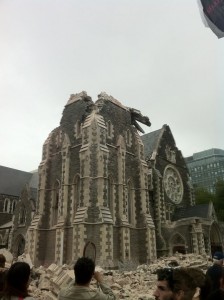
    Christchurch's Cathedral after the earthquake22 February 2011 “may well be New Zealand’s darkest day”; these were the words of Prime Minister John Key in the aftermath of the earthquake which devastated the South Island’s largest city Christchurch. The death toll is expected to be over 200, many more have been injured, have lost property and now live in fear of the next big one. Inevitably a question is posed to those, like me, who have faith in God. Where was God that day? Of course the person who asks this is not literally asking where God physically was, he is asking, why did God not prevent this from happening? Why does God allow people to suffer? God clearly, as an all powerful being, can prevent suffering so why doesn’t he?

    The question is ambiguous. Taken one way it is simply a question which assumes that God exists and asks for God’s reasons for allowing a particular event. Taken the other way it is a rhetorical question which hides an unspoken argument that the existence of disasters, like the Christchurch earthquake, is evidence that God, most likely, does not exist. In “God, Evil and Suffering” Daniel Howard-Snyder notes,

    [T]he theoretical “problem” of evil is often expressed in the form of a pointed question. God is able to prevent evil and suffering and He would know about them before they happened, right? Moreover, since He is unsurpassably good, surely He would not permit them just for the fun of it. So why doesn’t He prevent them?

    The sceptic notes two things; first that God knows about and is able to prevent suffering. Second that God, being perfectly good, would prevent this suffering unless he had a good reason for allowing it, which Howard-Snyder defines as “a reason that was compatible with his never doing wrong and his being perfect in love”. This is the implicit background to the question.

    The rhetorical force of this argument is powerful and its emotional appeal has a strong pull, particularly on the back of an horrific disaster. Nevertheless, many philosophers have found that when examined rationally it has an important flaw. The argument establishes that if God exists then He must have a good reason for allowing suffering. The sceptic is asking for an account of these reasons. The assumption is that if a believer cannot give a precise account of God’s reasons then there probably are none. It is this assumption upon which the argument hangs or falls.

    The problem is that this assumption is questionable. Philosopher Alvin Plantinga illustrates,

    I look inside my tent: I don’t see a St. Bernard; it is then probable that there is no St. Bernard in my tent. That is because if there were one there, I would very likely have seen it; it’s not easy for a St. Bernard to avoid detection in a small tent. Again, I look inside my tent: I don’t see any noseeums (very small midges with a bite out of all proportion to their size); this time it is not particularly probable that there are no noseeums in my tent—at least it isn’t any more probable than before I looked. The reason, of course, is that even if there were noseeums there, I wouldn’t see ’em; they’re too small to see. And now the question is whether God’s reasons, if any, for permitting such evils as [the Christchurch earthquake] are more like St. Bernards or more like noseeums.

    In his book The Reason for God: Belief in an Age of Skepticism, Timothy Keller notes “we see lurking within supposedly hard-nosed skepticism an enormous faith in one’s own cognitive faculties. If our mind (more…)

  • Video of John Lennox “Why? Considering the Goodness and Sovereignty of God in the Midst of Suffering”

    On 27 February 2011, John Lennox spoke at Howick Baptist Church as part of his tour of New Zealand on the topic “Why? Considering the Goodness and Sovereignty of God in the Midst of Suffering”. Here is the video of that talk. In it Lennox discusses some of the challenges to Christianity that events like the Christchurch earthquake create and suggests some possible Christian responses.

    MP3 version here.

    Hat Tip: Howick Baptist Church