Tag: Alvin Plantinga

  • Is Theism Incompatible with the Pauline Principle? Comments on James Sterba’s Argument from Evil

    My paper, “Is Theism Incompatible with the Pauline Principle?” has been published in a special issue of Religions, devoted to the topic Do We Now Have A Logical Argument From Evil? The abstract is as follows:


    This paper criticises James Sterba’s use of the Pauline principle to formulate a logical version of the problem of evil. Sterba’s argument contains a crucial premise: If human agents are always prohibited from doing some action, God is also prohibited from doing that action. This implies that the Pauline principle applies to both Divine and human agents. I argue that any Theist who affirms a divine command theory of ethics can consistently and coherently deny this premise and its implication. If a divine command theory is coherent, a theist can affirm that the Pauline principle governs human agents’ actions but not God’s actions. I will also criticise Sterba’s criticisms of a divine command theory and argue that they fail.


    Enjoy.

  • Can a Divine Command Theory Vindicate the Objectivity of Morality: Huemer on Observer Independence, part two

    In my last post, I discussed Michael Huemer’s argument that a divine command theory cannot vindicate the objectivity of moral requirements. As I interpret him, the  argument is:

    [1] Our commitment to morality presupposes that moral requirements are objective.

    [2] Moral requirements are objective just in case there obtain facts about what is right and wrong that do not constitutionally depend upon the attitude of observers towards the objects of evaluation.

    [3] If divine command metaethics is true, facts about right and wrong constitutively depend upon the attitudes of an observer towards the objects of evaluation.

    I think [3] and [1] are questionable.

    Let us begin with [3]. For [3] to be accurate, a divine command theory must entail that facts about right and wrong constitutively depend upon the attitudes of an observer. It is not enough that these facts depend upon God’s attitudes in some way or other. These attitudes must constitute moral facts in part or whole.

    Why think that [3] is true? Presumably, the inference goes like this:  If a divine command theory is true, then facts about right and wrong are identical with facts about what actions have been commanded by God. However, facts about what actions have been commanded and prohibited by God are constituted by facts about God’s attitudes. So, a divine command theory entails that facts about observers attitudes constitute deontic facts.

    However, it is not evident that facts about what actions have been commanded and prohibited by God are constituted by facts about God’s attitudes. In the literature, it is common to distinguish divine command theories from divine will or attitude theories.[1] Divine will theories contend that God’s attitudes towards certain actions constitute deontological facts. By contrast, a divine command theory contends deontological facts are identical with facts about what actions have been commanded by God.  Attitudes and commands are not the same things. Robert Adam’s stresses that “moral obligation is understood in terms of what God requires of us”. But, “requiring is something we do in relationship to each other it essentially involves communicative acts”. It is not logically equivalent to having a positive or negative attitude towards that action.

    The difference between commanding and merely willing is significant. Divine command theorists like Adam’s defend a divine command theory because they believe “the will of a legislature imposes no obligations without being commanded”. To illustrate this, Adam’s provides some examples, where what a person desires or wills and what the command comes apart.

     “Religiously, obedience to God is in large part a matter of respect for God; and interhuman examples suggest that respect would follow commands in preference to unexpressed desires. The wait staff in a restaurant show me benevolence, perhaps, but scant respect, if they bring me what they think I want instead of what I actually ordered.” [2]

    So, when a divine command theorist claims deontological facts are identical with facts about what actions God commanded, it doesnt follow that God’s attitudes constitute these facts. To get that conclusion, we need to assume that commands are constituted by attitudes. Seeing someone can command X without a pro attitude towards it, and someone can have a pro attitude towards x without commanding this is not obvious.

    This brings us to [1], Suppose divine command theories do entail moral facts constitutively depend upon an observer’s (i.e. God’s) attitudes. This is only problematic if our commitment to morality presupposes that moral facts are objective in this sense of the word.  If we define an objective fact as a fact that does not constitutively, as opposed to causally, depend on an observer’s attitudes. It does not seem to me that [1] is true.

    Objectivist metaethical theories’ plausibility consists of their accounting for and vindicating certain presuppositions of our moral thought and practice.  Our moral thought and practice assume that beings like you and I can make mistaken judgements. We have limited information, are prone to biases, and make errors of fact and reason. We reason about morality to discern which evaluations our human compatriots are correct and which are not. We use reasons to support and verify some judgments and criticize others showing they are mistaken.  We defend some of the evaluations of our society against criticisms.[3] We reject others as oppressive, immoral and in need of reform. We think our society made moral progress by rejecting slavery and racial segregation. We believe the Nazi’s evaluation of racism was mistaken, and Martin Luther King Juniors was closer to the truth.  We think some moral reformers who criticized widely endorse policies were correct. They have given us a better understanding of what is right and wrong. We believe certain actions, like the rape and murder of a small child, are wrong even if I or my society endorsed them.

    In Ethical Intuitionism, Huemer himself emphasises several of these assumptions. He notes (i) the judgements of Neo Nazi’s and Nazi society were mistaken.  (ii) That we engage in real disagreement with our compatriots, but individually and collectively contradicting what they say and offering reasons for and against their judgements. (iii) That individuals and societies are not infallible moral judges and (iv) that human judgements can be based on arbitrary reasons.[4]

    These assumptions presuppose moral facts obtain independently of the evaluation of human appraisers: appraisers like you and I who are subject to these cognitive deficiencies. Who are fallible, make mistakes, can be prejudiced and arbitrary, and ignorant of relevant facts.  They do not presuppose that this independence is only constitutive. They do not assume this independence applies to all possible appraisers. Even an infallible omniscient, impartial appraiser upon whose will everything else depends for its existence.

    Two examples will illustrate this.  Take a crude relativist theory: where actions are morally required if and only if, and because, my social group approves of them. This theory is a paradigmatic example of a subjectivist theory. All most everyone rejects it because it contradicts the objectivist presuppositions of moral thought.  Yet, according to Huemer’s view, whether this theory vindicates the objectivity of morality depends solely on whether societies approval causes or constitutes moral facts.

    Suppose there are two versions of this theory. (a) One claims the property of being morally required is identical to the property of being socially approved.  (b), Another claims my society can directly and immediately bring it about that I am required to do something by approving of it. Neither of these theories will vindicate the objectivists presuppositions of our moral thought. Both will entail that correct evaluation are co-extensive with the attitudes of my society. So, both will have implications that contradict the relevant presuppositions mentioned above. Nevertheless, in Huemer’s view, (b) entails that moral facts are objective and (a) does not.  Consequently,  a theory can vindicate the objectivity of morality, in Huemer’s sense of the word, yet fail to vindicate any objectivist presuppositions of our moral thought and practice.

    A second example, consider a form of naturalistic moral realism whereby moral facts are facts about the causal properties of certain actions. Rightness just is the property an action has when it tends to increase or enhance our happiness. Wrongness just is the property an action has when it tends to diminish our happiness. This is a paradigmatic objectivist theory. It makes wrongness depend on facts about causal physical properties of actions. It vindicates the objectivist presuppositions of our moral thought and practice. The judgements human appraisers make about causal properties can fail to correspond to causal reality.   Yet on Huemer’s view, whether this theory vindicates the objectivity of morality depends solely on what its advocates believe about the ontology of laws of nature.

    Suppose John and Mary jointly develop and defend a theory of this sort. Although they agree on the ontology of moral facts, John and Mary have different views on the ontology of laws of nature. Mary is an atheist who accepts David Armstrong’s thesis that laws of nature are a form of natural necessity[5]. By contrast, John is a Theist who accepts the view of early modern scientists that laws of nature are just the laws by which God governs the natural world. He accepts Alvin Plantinga’s[6] and John Foster’s[7] defence of the thesis that Laws of nature are divine decrees. 

    John and Mary advocate the same meta-ethical theory. But, Huemer’s definition entails that Mary’s theory vindicates the objectivity of morality and John’s theory does not. Their thesis is that certain causal properties of actions constitute the wrongness of actions. John believes that causal laws are constituted by God’s willing certain regularities occur. So, John is committed to claiming that wrongness constitutively depends on God’s will.  Mary has no such commitments.

    However, this difference between Mary and John makes no difference whatsoever for how well their joint theory vindicates the objectivist assumptions of our moral discourse. Consequently, a theory can fail to vindicate the objectivity of morality in Huemer’s sense and yet vindicate all the objectivist features of our moral discourse.

    If I am correct about this, the kind of objectivity presupposed by our moral commitments has nothing to do with whether moral facts are “constitutional” independent of any observer or appraiser.


    [1] Examples of divine will theories include those of; Matthew Carey Jordan (2012),“Divine Attitudes, Divine Commands, and the Modal Status of Moral Truths,” Religious Studies 48: 45–60; Mark Murphy (1998), “Divine Command, Divine Will, and Moral Obligation,” Faith and Philosophy 15: 3–27; Christian Miller (2009), “Divine Desire Theory and Obligation,” in Yujin Nagasawa and Erik Wielenberg (eds.), New Waves in Philosophy of Religion (Basingstoke: Palgrave Macmillan); and Linda Trinkaus Zagzebski (2004), Divine Motivation Theory (Cambridge: Cambridge University Press).

    [2] Robert Adams, Finite and Infinite Goods: A Framework for Ethics, (Oxford: Oxford University Press, 1999) 260

    [3] Think of the perennial moral debate between conservatives and progressives, which is over what social norms to preserve and defend and what to reform.

    [4] Michael Huemer, Ethical Intuitionism, (Houndmills, Basingstoke, Hampshire, England: Palgrave Macmillan, 2006) 49-53.

    [5] David Armstrong, What is a Law of Nature? (Cambridge: Cambridge University Press, 1987)

    [6] Alvin Plantinga, “Law, Cause, and Occasionalism” Reason and Faith: Themes from Richard Swinburne, (Eds.) Michael Bergmann and Jeffrey E. Brower (Oxford: Oxford University Press, 2016) 126-143.

    [7] John Foster, The Divine Lawmaker: Lectures on Induction, Laws of Nature, and the Existence of God, (Oxford: Oxford University Press, 2004) 

  • Contemporary Philosophy of Religion and NCEA Religious Studies: Part three

    This is a talk I gave to the New Zealand Association of Philosophy Teachers annual conference at St Cutherberts College in September this year. Several people have asked me to make this talk available.

    I have broken my talk up into four parts. Part One introduces what philosophy of religion. In part two I will outline two movements within analytic philosophy during the early to mid-century which I think resulted in religious beliefs not being taken very seriously within philosophy and philosophy of religion taking a fairly minor role. Part three will look at some responses to these movements offered in the late 20th century and how they changed the philosophical landscape. Part four will look at the question of “how to do philosophy of religion” comparing the methods used by two different atheist’s J L Mackie and Graham Oppy, and how this relates the National Certificate of Educational Achievement Standards. This post will contain part three.

    The late 20th century

    The late twentieth century however late 20th century saw fairly substantial intellectual shifts in analytic philosophy of religion. Here I will focus on two important developments:

    The Demise of Verificationism

    The first was the demise of verificationism. Around the 1960’s various problems began to emerge with the verificationist principle. Take the claim “a statement is only meaningful if it can in principle be either empiricallyphilosophy-of-religion verified or falsified or is analytic” This claim doesn’t seem to be one capable of empirical verification, so is it meaningful? The standard response was that it’s analytic, but the problem here is it seems to become close to a stipulative definition, of course, a person can choose to define the word “meaning” in a particular way. But it’s a lot harder to see verificationism as an account of the way people actually do use various terms or discussions. Some reason is needed as to why a believer should take this account of his own theological discourse seriously.

    Second, various counterexamples and problems began to emerge with verificationism. One area it obviously had application to was ethics. Claims like it’s wrong to rape or kill arent in principle verifiable. So the implication was that ethical statements like this are meaningless. This seems prima facie implausible and attempts by people like Ayer and Hare to develop accounts of moral discourse where moral language didn’t assert anything had trouble explaining how moral argument and disagreement could exist.

    But even in the sciences certain claims which verificationists wanted to consider meaningful became difficult not to rule out. If you defined the definition narrowly then, scientific claims were not meaningful. However, if you broaden what counts as verificationism, it ceases to rule out metaphysical claims or religious ones.

    Take the claim: “there are electrons”. This claim, by itself, is neither verifiable or falsifiable. It’s only when it’s held in conjunction with other claims about what electrons are like, how they operate, and how they are expected to influence the world and our equipment and senses, that we can test them empirically.  But then scientific claims aren’t falsifiable in isolation; rather they are testable only when embedded in broader scientific theories. The same however is true of religious claims, the claim God exists is by itself unfalsifiable. But when part of a broader theory they often are. Consider, claims about God creating the world in six 24 days or a global flood, or that God created a world which contains no suffering and evil are all testable claims.

    The point is the verificationism soon became seen to be problematic at worst, or highly controversial at best. It couldn’t be taken for granted as a kind of intellectual Desiderata for religious claims.

     2. The rejection of Evidentialism.

    Following on from the demise of verificationism, a second important development was some serious works challenging evidentialism as the correct methodology for approaching religious claims. This most notable being those of Alvin Plantinga, though other philosophers such as William Alston, and Nicholas Wolterstorff also contributed.

    Plantinga’s earlier work can be seen as raising a question; why accept evidentialism with regards to belief in God?

     It is important to note that not everything one believes needs to be proven to be rational for at least two reasons. First, the claim that everything must be proven to be rationally believed leads to a regress problem. Roy Clouser notes;

    If everything needs to be proven, then the premises of every proof would need to be proven. But if you need a proof for every proof, you need a proof for your proof, and proof for your proof of a proof and so on-forever. Thus it makes no sense to demand that everything be proven because an infinite regress of proofs is impossible.[1]

    Second, there are many things that we believe quite rationally which cannot be proved. Such things as there is a chair in front of me or that other people have thoughts and feelings. The history of philosophy has shown that when we try to prove the existence of other people or the existence of an external world, it’s notoriously difficult to do so.  Nevertheless, my belief in the existence of other people and the existence of various objects are obviously rational.

    So if not everything needs to be proven, why does Theism need to be proven to be rational?

    This question was put to a conference Alvin Plantinga; the answer he received from a leading sceptic Kai Neilsen is interesting;

    All of us can agree, at least for a large range of cases, whether somebody is in pain, whether he’s thinking, feeling anxious or the like. We do in general agree about these things. Only a madman would claim that no one is ever in pain or that no one ever knows that another person is in pain. The same is true for thinking, feeling anxious or sad and the like… Now the situation is very different in religion[2].

    The basic idea, then, is that religious belief are private beliefs that not all people (at least all sane people educated people) believe; whereas the belief that other people have thoughts and feelings are public beliefs that all people accept and no sane person would doubt. Once we see this, then, I think we can make sense of some of the assumptions at play in evidentialism. Evidentialism affirmed that:

    [1] A belief is  philosophically acceptable if it is either:
    (a) acknowledged to be true by all sane people; or,
    (b) can be proven from premises that are acknowledged to be true by all sane people;

    [2] Religious beliefs are not acknowledged by all sane people nor can they be proven to be true from beliefs acknowledged by all sane people.

    Problems with Evidentialism

    In Plantinga’s earlier work one can find two basic objections against evidentialism.

    The first is to note that if it is true, then almost every philosophical position of any significance is irrational.  As Marilyn Adams points out”[D]efense of any well-formulated philosophical position will eventually involve premises that are fundamentally controversial and so unable to command the assent of all reasonable people.[3]Philip Quinn makes a similar point, “it would seem that the appeal to any comprehensive ethical theory, including all known secular ethical theories, should be disallowed on the grounds that every such theory can be reasonably rejected by some.”[4]. The point is no philosophical position starts from assumptions which are uncontroversial accepted by all controverted by no one. So there is something arbitrary about demanding religious beliefs do.

    The second, more pertinent, response to this objection is to note that [1] is self-refuting. Take the claim explicitly articulated in [1] that if something is not acknowledged to be true by all sane people, then it needs to be proven to be true. Now the truth of this claim itself is not acknowledged by all sane, educated people. Many theologians, philosophers and lay people don’t accept [1] so by [1] we are irrational in believing it unless someone offers a proof for its truth. However, to the best of my knowledge no one has done this; therefore, if [1] is true then the rational response is to reject [1].

    (Note also that any proof the proponent of this argument attempts to offer can only appeal to premises that are accepted by all sane people. If the proponent does not, we will be required to disbelieve the premises and hence the proof.)

    This, then, is the problem with this kind of evidentialist dismissal of theism; the sceptic rejects God’s existence out of allegiance to certain assumptions about what constitutes a rational belief. The problem is that these assumptions are in the same boat as theism is alleged to be; a person who rejects theism because he or she believes these assumptions is acting inconsistently.

    What Plantinga went on to suggest that there was no reason why people with religious beliefs couldn’t start with the assumptions and presuppositions of their own traditions when doing serious philosophical work. They weren’t under some burden of proof to prove them to all dissenters first. Any more than anyone else who advocated a controversial secular position was. They could start philosophical theorising from those presuppositions, work out implications and answers to philosophical problems that assumed those assumptions, construct models and theories which incorporated them. Of course, they would have to defend those views against objections and critics. And they would have to criticise rival alternative theories and models. But that’s not the same as proving their position from premises every party to the conversation accepts.[5]

    [1] Roy Clouser Knowing With the Heart 69.

    [2] Kai Nielsen “The Skeptics Reply” in Faith and the Philosophers, ed. John Hick (London: Macmillan, 1964) 274.

    [3] Marilyn McCord Adams Horrendous Evils and the Goodness of God (Ithaca, NY: Cornell University Press, 1999) 180.

    [4] Phillip Quinn, “Political Liberalism and their Exclusion of the Religious,” in Religion and Contemporary Liberalism, ed. Paul Weithman (Notre Dame, IN: University of Notre Dame Press, 1997), 144.

    [5] See for example Alvin Plantinga “Advice to Christian Philosophers” Faith and Philosophy: Journal of the Society of Christian Philosophers vol. 1:3, 253-271 available online http://www.faithandphilosophy.com/article_advice.php


  • Alvin Plantinga Calling for an Argument

    NoahWe moved house recently but before we got the telephone services disconnected at our old house we rescued this answer-phone message left by our then 9 year old son Noah for Matt – note the attempted American accent:

    Alvin Calling

    (Noah had no idea how we worked out it wasn’t really Alvin Plantinga.)

  • In Defense of Reasonable Disagreement

    At the close of his 1967 book “God and Other Minds”, Alvin Plantinga argues that if theistic belief is to be dismissed as “irrational”, or in some sense “epistemically sub-par” on the basis that it lacks a rationally compelling argument, then likewise we should also reject belief in other minds, since the best argument for the belief in such minds (the analogical argument) is not rationally compelling[i]. What this implies is that if belief in other minds is justified even in spite of the fact that it lacks a rationally compelling argument, then equally so, belief in God may be justified in spite of such an argument[ii]. To hold then, that belief in God is unjustified in the absence of a compelling theistic proof, would be to hold a double standard[iii].

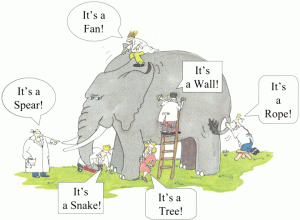
    What elephant?For obvious reasons, few people would dare to dispute the contention that belief in other minds is rational. However, Plantinga’s critics have two options: (1) they might contend that belief in other minds is rational, but only in virtue of a rationally compelling argument. Hence their burden would be to produce a rationally compulsive version of the analogical argument. (2) They could admit that there is no rationally compulsive version of the analogical argument, but argue that there is a relevant difference between theistic belief and belief in other minds, such that the two beliefs are not epistemically equivalent or, as it were, “equiprobable”.

    In this paper, I am not concerned to argue against (1), but suffice to say I think it thoroughly wrong-headed. I am concerned however, to argue against one particular version of (2). Some of Plantinga’s critics have charged that belief in God and belief in other human minds are epistemically unalike in the sense that reasonable people do not disagree about whether or not other minds exist, whereas reasonable clearly disagree about whether or not God exists.

    While he doesn’t explicitly respond to Plantinga or any of the so called “Reformed Epistemologists”, Richard Feldman argues something akin to in his article entitled “Reasonable Religious Disagreements”. Hence it makes sense to analyze his argument in the context of an objection against Reformed Epistemology.

    I do not find his argument convincing. In-fact, as I will go on to argue, un-sharable private evidence in the form of religious experience proves an intractable problem for Feldman’s argument with respect to religious disagreements. That is not to say that there is no epistemic parity between theistic belief and belief in other minds, rather it is simply to say that at least one attempt to establish any such parity is not successful.

    Feldman’s thesis is that reasonable disagreement between epistemic peers who have fully disclosed their evidence is not possible[iv]. That is to say, reasonable disagreement cannot subsist between two parties that are equivalently intelligent, have approximately equal powers of reasoning, are equal with respect to background information and have shared all relevant evidence[v]. When he says that reasonable disagreement cannot subsist between such people, Feldman does not mean to say that both parties should agree. Rather, what he means to say is that both parties should suspend judgement[vi]. In other words, those who are party to the discussion cannot simply “agree to disagree” (at least they can’t do so rationally) . Rather, they must opt for a position that can only be described as “agnostic”. The final preliminary point to clarify is the issue of “reasonability”. By this Feldman means to say is that a belief is “reasonable” just if it has sufficient evidential support. This point is important, because as Feldman points out, if by “reasonability” one simply means that there is no “obvious blunder”, then it’s possible to be “reasonable” and yet base ones beliefs on confusion and misunderstanding etc[vii]. Feldman introduces his thesis by way of the following questions: (more…)

  • Fallacy Friday: Denying the Antecedent

    This week I will look at the fallacy of denying the antecedent. Before I can elaborate exactly what is involved in this fallacy, it is important to introduce and analyse some valid arguments that are superficially similar.

    Modus Ponens
    One of the very first valid inferences one learns in logic is modus ponens. To use the well worn example that was repeated ad nauseam when I was learning logic (and one I probably bored my students with too) a paradigmatic example of modus ponens is,

    1. If it is raining then the  grass will be wet.

    2. It is raining;

    Therefore:

    3. The grass will be wet.

    Put more abstractly, a modus ponens has the form:

    1’ If P then Q.

    2’ P;

    Therefore:

    3’ Q.

    UnicornModus ponens proceeds with the first premise contending that a conditional statement is true. A conditional statement is a statement about a hypothetical situation; in this case the claim is “if it is raining then the grass will be wet”. Notice that for this conditional to be true, it does not have to actually be raining. On a sunny day it is still true that if it starts raining the grass will be wet. A conditional statement tells us what will be the case if some other thing or event is the case – not what actually is the case.

    Conditional statements of the form “if P then Q” have what logicians call an “antecedent” and a “consequent”. P is the antecedent; in the above example the antecedent is the claim, “it is raining”. In a conditional statement one talks about what occurs if the antecedent is true. Q is the consequent; in the example above the consequent is the proposition “the grass will be wet”. The consequent is what is said to be true if the antecedent is correct.

    Modus ponens proceeds by first affirming that a conditional statement is true and then affirming the antecedent is true. If both a conditional statement is true and its antecedent is true then it is impossible for the consequent to not also be true. This is obvious upon immediate reflection. If the conditional ‘if P then Q’ is true, and P is true, then Q must also be true. Note, that in a valid modus ponens inference, one affirms the antecedent. (more…)

  • Contra Mundum: Why Does God Allow Suffering?

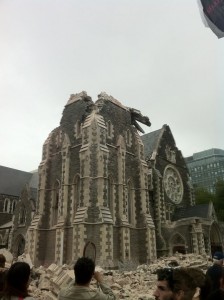
    Christchurch's Cathedral after the earthquake22 February 2011 “may well be New Zealand’s darkest day”; these were the words of Prime Minister John Key in the aftermath of the earthquake which devastated the South Island’s largest city Christchurch. The death toll is expected to be over 200, many more have been injured, have lost property and now live in fear of the next big one. Inevitably a question is posed to those, like me, who have faith in God. Where was God that day? Of course the person who asks this is not literally asking where God physically was, he is asking, why did God not prevent this from happening? Why does God allow people to suffer? God clearly, as an all powerful being, can prevent suffering so why doesn’t he?

    The question is ambiguous. Taken one way it is simply a question which assumes that God exists and asks for God’s reasons for allowing a particular event. Taken the other way it is a rhetorical question which hides an unspoken argument that the existence of disasters, like the Christchurch earthquake, is evidence that God, most likely, does not exist. In “God, Evil and Suffering” Daniel Howard-Snyder notes,

    [T]he theoretical “problem” of evil is often expressed in the form of a pointed question. God is able to prevent evil and suffering and He would know about them before they happened, right? Moreover, since He is unsurpassably good, surely He would not permit them just for the fun of it. So why doesn’t He prevent them?

    The sceptic notes two things; first that God knows about and is able to prevent suffering. Second that God, being perfectly good, would prevent this suffering unless he had a good reason for allowing it, which Howard-Snyder defines as “a reason that was compatible with his never doing wrong and his being perfect in love”. This is the implicit background to the question.

    The rhetorical force of this argument is powerful and its emotional appeal has a strong pull, particularly on the back of an horrific disaster. Nevertheless, many philosophers have found that when examined rationally it has an important flaw. The argument establishes that if God exists then He must have a good reason for allowing suffering. The sceptic is asking for an account of these reasons. The assumption is that if a believer cannot give a precise account of God’s reasons then there probably are none. It is this assumption upon which the argument hangs or falls.

    The problem is that this assumption is questionable. Philosopher Alvin Plantinga illustrates,

    I look inside my tent: I don’t see a St. Bernard; it is then probable that there is no St. Bernard in my tent. That is because if there were one there, I would very likely have seen it; it’s not easy for a St. Bernard to avoid detection in a small tent. Again, I look inside my tent: I don’t see any noseeums (very small midges with a bite out of all proportion to their size); this time it is not particularly probable that there are no noseeums in my tent—at least it isn’t any more probable than before I looked. The reason, of course, is that even if there were noseeums there, I wouldn’t see ’em; they’re too small to see. And now the question is whether God’s reasons, if any, for permitting such evils as [the Christchurch earthquake] are more like St. Bernards or more like noseeums.

    In his book The Reason for God: Belief in an Age of Skepticism, Timothy Keller notes “we see lurking within supposedly hard-nosed skepticism an enormous faith in one’s own cognitive faculties. If our mind (more…)