Tag: Alvin Plantinga

  • God and the Genocide of the Canaanites Part III: Two Implications of the Hagiographic Hyperbolic Account

    This three-part blog series is a modified version of what I presented to the Evangelical Philosophical Society meeting in November 2010.

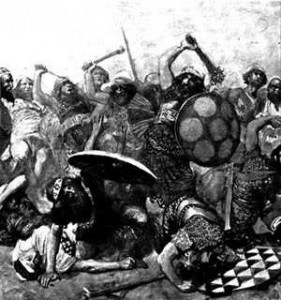
    Joshua Slaughters the Canaanites

    In a recent Conference at Notre Dame Alvin Plantinga suggested that the commands to wipe out the Canaanites, recorded in the book of Deuteronomy, might be hyperbolic; they should be understood more like how we understand a person who states, in the context of a boxing match, “knock his block off, hand him his head”, or in a football game where a person states that the team should “kill the opposition” or boasts that “we totally slaughtered them.”[1] Understood this way, the commands in Deuteronomy meant “something like attack them, defeat them, drive them out; not literally kill every man, woman, child donkey and the like”.[2]

    In two previous posts I have explored and defended Nicholas Wolterstorff’s argument for this conclusion. In God and the Genocide of the Canaanites Part I: Wolterstorff’s Argument for the Hagiographic Hyperbolic Interpretation, I elaborated on, appropriated and expanded Nicholas Wolterstorff’s case for understanding Joshua as a hagiographic, stylised and highly hyperbolic account of Israel’s early skirmishes. In Part II: Ancient Near Eastern Conquest Accounts, I argued that studies into Ancient Near Eastern historiography give considerable support to his conclusion. Joshua appears to follow the same rhetoric, literary conventions and motifs of other ancient Near East conquest accounts and one feature of such accounts is to narrate victories hyperbolically in terms of killing all people, leaving no survivors and so forth. This suggests the description of Joshua putting every inhabitant to the sword, totally destroying all and leaving no survivors, is not to be taken literally. In this last post in this series I want to look at some implications of accepting this.

    I think two implications can be drawn from this conclusion. First,

    On the assumption that Deuteronomy and Joshua are parts of the same sequence of books, this interpretation of Joshua forces a back-interpretation of Deuteronomy. If “struck down all the inhabitants with the edge of the sword” is a literary convention when used to describe Joshua’s exploits, then it is likewise a literary convention when similar words are used by Moses in his instructions to Israel in general and to Joshua in particular.[3]

    I think Wolterstorff is correct here, this interpretation of Joshua does force a back-interpretation of Deuteronomy. Deuteronomy 7:2 states “when Yahweh your God has given them up before you and you have struck them, you shall utterly destroy them”. Similarly, Deuteronomy 20:16-17 states “anything that breathes you shall not keep alive, but you shall utterly destroy them”. In Joshua 10 one sees the formulaic language of “and Yahweh gave [the city]” and they “struck it by the mouth of the sword, and its king he hath destroyed” until there were “no survivors”. The chapter is summarised with the phrase “So Joshua struck all the land, … He destroyed all that breathed”. The similar phraseology is evident.[4]

    Moreover, the book of Joshua clearly, explicitly and repeatedly identifies what Joshua did in these chapters with the command that Moses had given regarding the Canaanites in Deuteronomy.[5] If the language of “striking all the people by the sword”, “leaving no survivors”, “totally destroying”, “striking all the inhabitants with the edge of the sword”, and so on, is hyperbolic (as the evidence suggests it is) then the command cannot have been intended to be taken literally.

    This understanding of the commands in Deuteronomy also solves some other interpretative problems. Here I will mention briefly three.

    First, what God commanded regarding the Canaanites differs in various canonical books (more…)

  • God and the Genocide of the Canaanites Part II: Ancient Near Eastern Conquest Accounts

    This three-part blog series is a modified version of what I presented to the Evangelical Philosophical Society meeting in November 2010.

    Joshua stops the sun

    In my previous post, God and the Genocide of the Canaanites Part I: Wolterstorff’s Argument for the Hagiographic Hyperbolic Interpretation, I expounded and adapted Nicholas Wolterstorff’s argument for a hagiographic hyperbolic reading of the book of Joshua. Wolterstorff’s argument has, I think, considerable force. Judges and Joshua cannot both be taken literally as their accounts are at odds; given the internal evidence Wolterstorff cites it is reasonable to contend that Joshua is the one that is non-literal. Wolterstorff, however, limits his case to what I call internal evidence, evidence from within the text itself. I think there is some interesting external evidence, evidence of how particular terms and language were used in other Ancient Near Eastern histories of conquests and battles, which could be added to Wolterstorff’s argument to make it significantly more plausible. Here I will cite three lines of such evidence.

    The first is that comparisons between the book of Joshua and other Ancient Near Eastern conquest accounts from the same period demonstrate some important stylistic parallels. Various studies have documented these similarities. Commenting on the structure of the campaigns mentioned in Joshua 9-12, Kitchen notes;

    This kind of report profile is familiar to readers of ancient Near Eastern military reports, not least in the second millennium. Most striking is the example of the campaign annals of Tuthmosis III of Egypt in his years 22-42 (ca. 1458-1438). … [T]he pharaoh there gives a very full account of his initial victory at Megiddo, by contrast with the far more summary and stylized reports of the ensuing sixteen subsequent campaigns. Just like Joshua against up to seven kings in south Canaan and four-plus up north.[1] [Emphasis added]

    Kitchen adds,

    The Ten Year Annals of the Hittite king Mursil II (later fourteenth century) are also instructive. Exactly like the “prefaces” in the two Joshua war reports (10:1-4; 11:1-5), detailing hostility by a number of foreign rulers against Joshua and Israel as the reason for the wars, so in his annals Mursil II gives us a long “preface” on the hostility of neighbouring rulers and people groups that lead to his campaigns.[2] [Emphasis added]

    Kitchen adds other examples. He observes that the same formulaic style found in Joshua is also used in the Amarna letters EA 185 and EA 186.[3]Similarly, before his major campaigns (more…)

  • God and the Genocide of the Canaanites Part I: Wolterstorff’s Argument for the Hagiographic Hyperbolic Interpretation

    Around this time last year I wrote two posts Joshua and the Genocide of the Canaanites I and Joshua and the Genocide of the Canaanites II. These posts attracted a fair amount of attention and debate. I got offers to publish my ideas in several upcoming books and present them before both the Evangelical Philosophical Society (EPS) and the Society for Biblical Literature in November 2010. Since the original posts I have corresponded with various people and I have modified and refined some of the ideas. This three-part blog series is a modified version of what I presented to the EPS last month. These posts supersede and update what I wrote in a year ago.

    Joshua at AiOne of the most perplexing issues facing Christian believers is a series of jarring texts in the Old Testament. After liberating Israel from slavery in Egypt, the Israelites arrived on the edge of the Promised Land. The book of Deuteronomy records that God then commanded Israel to “destroy totally” the people occupying these regions (the Canaanites); the Israelites were to “leave alive nothing that breathes”. The book of Joshua records the carrying out of this command. In the sixth chapter it states “they devoted the city to the LORD and destroyed with the sword every living thing in it—men and women, young and old, cattle, sheep and donkeys”. In the tenth and eleventh chapters it states that Joshua “left no survivors. He totally destroyed all who breathed, just as the LORD, the God of Israel, had commanded.” The text mentions city after city where Joshua, at God’s command, puts every inhabitant “to the sword”  “totally destroyed the inhabitants” and “left no survivors.”

    If one takes these passages literally they record the divinely-authorised commission of genocide. But genocide surely is morally wrong. In the light of this, critics of Christian theism often ask a rhetorical question; how could a good and loving God command the extermination of the Canaanites?

    One response which goes back to the patristic era is to suggest that the strict, literal reading on which this rhetorical question is based is mistaken. Recently, several, protestant scholars have suggested a hyperbolic reading of the relevant passages.[1] Perhaps the most detailed is that proposed by Nicholas Wolterstorff. Wolterstorff suggests,

    “[T]hat the Book of Joshua has to be read as a theologically-oriented narration, stylized and hyperbolic at important points, of Israel’s early skirmishes in the Promised Land, with the story of these battles being framed by descriptions of two great ritualized events.  The story as a whole celebrates Joshua as the great leader of his people, faithful to Yahweh, worthy successor of Moses.  If we strip the word “hagiography” of its negative connotations, we can call it a hagiographic account of Joshua’s exploits.”[2]

    In this series I will defend Wolterstorff’s position. In this post I will sketch, adapt and defend Wolterstorff’s argument. In Part II, I will argue that external evidence from comparative studies in Ancient Near Eastern conquest accounts gives considerable support to Wolterstorff’s position. Finally in Part III I will look at two implications of this position.

    Wolterstorff’s Argument
    Wolterstorff’s contention is that “a careful reading of the text in its literary context makes it implausible to interpret it as claiming that Yahweh ordered extermination”. It is important to note what he means by context. Here, it is clear that Wolterstorff is advocating a canonical approach. He notes that,

    “Joshua as we have it today was intended as a component in the larger sequence consisting of Deuteronomy, Joshua, Judges, I and II Samuel, and I and II Kings…  I propose that we interpret the Book of Joshua as a component within this larger sequence – in particular, that we interpret it as preceded by Deuteronomy and succeeded by Judges.”[3]

    Joshua comes after Deuteronomy and before Judges. Wolterstorff points out that these books should be read as a single narrative. When one does this, however, several issues are apparent. (more…)

  • In Atlanta

    I have a few snaps of Matt in Atlanta, this first one had our kids excited when they saw it [which should tell you everything you need to know about just how much Matt is a fan of Dr Alvin Plantinga – LOL!]

    Alvin Plantinga, Matt and Rodney Lake
    Alvin Plantinga, Matt and Rodney Lake

    Fellow kiwi Rodney Lake of Thinking Matters Tauranga, also in Atlanta attending the conferences, took the above photo and wrote on Facebook of it:

    Tonight I met and chatted with simply the greatest collection of Christian thinkers the world has to offer – hands down – without a doubt – the best! You couldn’t put together a better bunch in the same room than this. There were others, but the ones I got to talk to included: Alvin Plantinga, William Lane Craig, Mike Licona, JP Moreland, Paul Copan, Craig Hazen, Frank Beckwith, Mary-Jo Sharp and of course Matthew Flannagan. Also earlier in the day shook hands with Gary Habermas and Greg Koukl. A day to remember…

    Rodney has been doing a tour around the US over the last few weeks of the various Apologetics ministries and has been meeting up with various biblical scholars and Christian philosophers. You can read about what he has been up to and who he’s been trying to talk into coming out to New Zealand on his blog.

    Jim West snapped this one, Matt the kid in the candy shop – surrounded by the worlds best in his field and their books!

    Jim West snaps Matt at the EPS

    Jim has been quite the tourist, he’s been snapping everyone and everything by the looks of his homepage.

    I just talked to Matt on Skype – we are so grateful to the kind and generous people who donated us Skype equipment – he said it is quite surreal to be wandering around, sitting in seminars and recognising all these philosophers and theologians whose works he has read and admired all around him. He said the conversations following each session are very stimulating; everyone understands the topics, it is a lot like being at a Philosophy department seminar, only everyone is coming from a Christian perspective – which is something Matt is just not used to but is really appreciating. He said that MandM is clearly more widely read than either of us realised as plenty of people recognised him and complete strangers asked after me, commented on our blog and so on. The internet clearly makes the world a small place! Anyway he is having a blast and is doing great.

  • Matthew Flannagan’s Opening Statement: Bradley v Flannagan Debate

    On Monday 2 August at the University of Auckland Emeritus Professor of Philosophy Dr Raymond Bradley and Dr Matthew Flannagan (of this blog) debated the topic “Is God the Source of Morality? Is it rational to ground right and wrong in commands issued by God?” For the benefit of those who could not be there, who are awaiting the editing and uploading of the video of the debate, we will be running a blog series where we bring you some of the debate in written form.

    DR CHRIS TUCKER’S INTRODUCTION

    Published here with permission

    Dr. Matthew Flannagan is quickly becoming a respected scholar on issues related to the philosophy of religion, ethics, and theology.  His articles and book chapters cover such weighty topics as, whether the Bible condones genocide, the ethics of holy war, abortion and tonight’s topic, the relationship of God and morality.  The importance of Dr. Flannagan’s work has led to many speaking engagements all over New Zealand and also in the United States.  Two of these speaking engagements were public debates, including one against Dr Bill Cooke, an erstwhile President of the New Zealand Association of Rational Humanists.  Dr Flannagan received his PhD in Theology from the University of Otago.  From the University of Waikato, he received his Master’s in Philosophy with First Class Honours.  You can follow Dr Flannagan’s work at mandm.org.nz, the blog that he co-authors with his wife, Madeleine Flannagan.  When he is not working, he enjoys spending time outdoors with his wife and four children. Please join me in welcoming Dr. Matthew Flannagan

    DR MATTHEW FLANNAGAN’S OPENING STATEMENT

    Is it defensible to ground right and wrong in the commands of God? In this debate I will defend an affirmative answer to this question. I will defend the position that moral rightness and wrongness consist in agreement and disagreement, respectively, with Gods commands1– this is what Philosophers call a divine command theory. In defending this thesis I will do two things. First I will argue the standard arguments against a divine command theory fail. Second I will argue that Ray’s attempts to refute this theory fail. God is the source of morality.

    1. Standard Arguments Against a Divine Command Theory

    Divine command theories are frequently said to suffer a debilitating problem, they make morality arbitrary – anything at all could be deemed ‘right’ as long as God commanded it, even torturing other people for fun. This objection assumes that it is possible that God could command atrocious things like torturing people for fun. This assumption, however, seems very dubious. We need to remember that we are not talking about right or wrong as being based on the commands of just anyone, we are talking about God defined by Ray as “omnipotent, omniscient, and morally perfect.”

    So, as the terms are defined, the claim that it is possible for God to command people to torture others for fun is true only if it is possible for a morally perfect person to command such an atrocious thing. But this is unlikely. The very reason critics cite examples such as torturing people for fun is because these actions are paradigms of conduct that no morally good person could ever entertain or endorse.

    A predictable rejoinder to this response is that if some action is wrong because God prohibits it then God cannot be said to be good in any meaningful sense. The claim ‘God is good’ turns into no more than the claim that God obeys his own commands, if this is so, can God be said to have any duties at all?

    The suggestion that if God has no duties then he cannot be said to be good in any meaningful sense, has a grain of truth to it. If we are going to understand God’s goodness in terms of God having duties that he consistently fulfils then a divine command theory cannot account for God’s goodness. However, why must the phrase ‘God is good’ be understood in terms of God having duties? I do not see why it should?

    Many theologians and philosophers have suggested an alternative, God’s goodness should be understood in terms of God having certain character traits. To claim God is good is to claim that he is truthful, benevolent, loving, gracious, merciful, that he is opposed to certain actions such as murder, rape, torturing people for fun and so on. Now, even if God does not have duties, it does not follow that he cannot have character traits such as these. It is true that God is not under any obligation to love others or to tell the truth or what have you, but that does not mean he cannot love others or tell the truth. God does not have to have a duty to do something in order to do it.

    So the standard criticisms of a divine command theory fail.

    2. Raymond Bradley’s Moral Argument

    Ray attempts a different tack. Ray argues the divine command theorist is committed to five inconsistent propositions:

    1. What God proposes for our belief–including beliefs about what we ought to do–is what we ought to believe or do.

    2. In his holy scripture God proposes for our belief that he has caused, committed, condoned, or laid down commands for us to obey, every one of the four types of crimes of types A, B, C, and D.

    3. It is morally wrong to cause, commit, condone, or command any of the crimes of types A, B, C, D.

    4. God is omnipotent, omniscient, and morally perfect.

    5. A morally perfect being would not do anything that is morally wrong.

    In response to this I will make three lines of criticism.

    I

    The first line of criticism is that even if Ray’s argument is sound it does not show that a divine command theory is false. Ray has argued that the Bible presents an indefensible picture of God. However, the question of biblical infallibility is not the topic of our debate tonight. While many divine command theorists believe in biblical infallibility, some do not. A divine command theorist could, for example, claim that the wrongness of an action is determined by God but we know what is right and wrong from our conscience and not from a written revelation. The Philosopher Philip Quinn suggested a theory like this.2 Alternatively he or she could accept some other revelation such as the Talmud or the Koran. So strictly speaking, Ray’s argument does not address the moot of the debate tonight. One could accept everything Ray says about the Bible and still defensibly embrace a divine command theory, the claim that God is the source of morality is untouched.

    II

    This brings me to my second line of criticism. Ray’s third proposition [3] is formulated as:

    3. It is morally wrong to cause, commit, condone, or command any of the crimes of types A, B, C, D.

    This claim is ambiguous; there are two ways it could be interpreted. The first is:

    [3a] It is morally wrong for human beings to cause, commit, condone or command any of the crimes of types A, B, C, D.

    or Ray could mean:

    [3b] It is morally wrong for any person (including God) to cause, commit, condone or command any of the crimes of types A, B, C, D.

    To be valid Ray’s argument needs to be interpreted in terms of [3b]. Ray argues that God, engages in wrongdoing when he causes, commits, commands and condones A B C and D. There are two problems with this interpretation.

    First, Ray’s argument does not justify this conclusion. Ray states “to deny (3) would be to … ally oneself with moral monsters like Ghenghis Khan, Hitler, Stalin, and Pol Pot.” This is false: Genghis Khan, Hitler and Stalin are human beings to condemn them we only need to accept [3a] not [3b].

    Second, Ray’s argument is circular, [3b] assumes that God has duties; however, on my view the wrongness of an action consists in its being forbidden by God. Given that God does not issue commands to himself it follows that he has no duties. To propose [3b] Ray has to assume that my view is unjustified, which is what he is supposed to be proving. He is reasoning in a circle.

    III

    My third line of criticism concerns Ray’s second proposition,

    2. In his holy scripture God proposes for our belief that he has caused, committed, condoned, or laid down commands for us to obey, every one of the four types of crimes of types A, B, C, and D.

    Actually none of the passages Ray cites contain commands to us. He cites some of God’s actions and he cites some commands God gave to Israel and to Joshua but one cannot directly infer from these that these are commands issued to us.

    We have to keep in mind that the Bible is a collection of Ancient Near Eastern (ANE) texts. It was written centuries ago in three different languages, none of which were English. The cultural methods of written communication back then differ significantly from what we are used to when we pick up the latest ‘new atheist’ book at Whitcoulls. Further, the Bible is made up of various books written in various literary genres. To interpret it correctly one needs to take what it says in context – as a whole – and in accord with the literary conventions governing ancient texts translated from foreign languages. Ray fails to do this,

    Instead he uses a selective, out of context, and excessively literalistic interpretation of these passages.

    let me cite some examples.

    1. The Slaughter of the Canaanites

    The first is the slaughter the Canaanites. Ray claims God “orders the slaughter, without compassion, of hundreds of thousands of women, children, and suckling babes.” Ray here alludes to the book of Joshua’s record of the conquest of the Canaanites. Critics, like Ray, are quick to point out that this text states Joshua “totally destroyed all who breathed”, left “no survivors” in “the entire land”, went through the land “exterminating them without mercy” at God’s command.

    What they do not note is that the text proceeds after this to state that the Canaanites were, in fact, not literally wiped out. Over and over the text affirms that the land was still occupied by the Canaanites, who remained heavily armed and deeply entrenched in the very same regions and the very same cities that Joshua was said to have “destroyed all who breathed” and left “no survivors” in. In light of this, it is unlikely that the author intended the language in question to be taken literally.3

    This conclusion is confirmed by research into Ancient Near-Eastern history writing. In a comprehensive comparative study of Ancient Near-Eastern historiography. Old Testament scholar, K Lawson Younger concludes that the Old Testament uses the same literary conventions as other Ancient Near-Eastern conquest accounts. He also establishes that within this genre the rhetoric of total conquest, complete annihilation, destruction of the enemy, killing everyone, leaving no survivors, and so on are frequently used as hyperbole4: the language functions like a person watching David Tua in a boxing match, yells, “Knock his block off! Hand him his head! Take him out!” or hopes that the All Blacks will “annihilate the Springboks” or “totally slaughter the Wallabies.”5 Now, sports fans do not actually want David Tua to decapitate his opponent or the All Blacks to become mass murderers. Understood in a non-literal sense, the phrases probably meant something like, attack them, defeat them, drive them out; not literally kill every man, woman, child, donkey, etc.

    2. Capital Punishment.

    My second example is Ray’s reference to at least 34 offences for which God prescribes the death penalty. (Actually there are only 15 such offences). Ray contends that these passages constitute literal commands to the courts to execute people. This is dubious. The Torah is is written according to the literary and rhetorical conventions of Ancient Near-Eastern legal writing. J J Finkelstein notes that capital sanctions in such texts,

    [W]ere not meant to be complied with literally even when they were first drawn up, [But rather they] serve an admonitory function. If one would be bold enough to restate Hammurabi’s 230 as a direct admonition it might run to this effect: “woe to the contractor who undertakes construction and in his greed cuts corners”.6

    One of the leading experts on Ancient Near-Eastern legal texts Raymond Westbrook states they “reflect the scribal compilers’ concern for perfect symmetry and delicious irony rather than the pragmatic experience of the law courts.”7 The method used was “to set out principles by the use of often extreme examples.”8 In Ancient Near-Eastern legal practice a person who committed a serious crime would be legally considered to have forfeited their life or limb – this, however, did not mean that they were executed or mutilated. Instead they could ransom their life or limb by making a monetary payment decided by the courts “the death sentence is mostly hyperbole,” a literary device designed to under underscore the seriousness of the crime.9

    A careful reading of the Torah confirms this. The clearest example occurs in Numbers 35. After laying out clearly and repeatedly that a person who kills in pre-meditation “shall surely be put to death” the text goes on to state “Do not accept a ransom for the life of a murderer, who deserves to die. He must surely be put to death… .” Unless there was an assumed practice of “ransoming” the lives of those under a capital sentence, this comment seems superfluous. Old Testament scholar Joe Sprinkle notes, “The availability of ransom seems to have been so prevalent that when biblical law wants to exclude it, as in the case of intentional murder, it must specifically prohibit it.”10

    3. Hell

    My third example is Ray’s discussion of hell. Ray cites the book of Revelation’s reference to “the lake of fire” where “they will be tormented with burning sulphur in the presence of the holy angels and of the Lamb, and the smoke of their torment ascendeth for ever and ever”. He maintains this text teaches God will torture people forever merely for not having the right religious beliefs.

    This is dubious, Revelation is apocalyptic literature. Apocalyptic literature is highly metaphorical and uses stock symbols drawn from the Old Testament. If one looks at how the symbols Ray refers to are actually used in the Old Testament, they do not support Ray’s conclusion. The imagery of sulphur being poured upon people and smoke rising is regularly used in the Old Testament to symbolise the destruction of various nations.(Deut 29:23; Job 18:15-17; Ps 11:6; Isa 30:33, Isa 34-8-11). Similarly the “lake of fire” is drawn from Daniel, where it symbolises the destruction of various world empires. In Rev 18, a few chapters later, the destruction of a city, named Babylon (probably a reference to Rome or Jerusalem) is symbolised by the city being tormented by fire and onlookers watch the rising smoke. The message is that Babylon has been judged and destroyed, not that it continues to be tortured forever.

    The same is true of Ray’s references to the Gospels; the phrase the “weeping and gnashing of teeth” occurs many times in both the Old Testament and the New Testament, and in almost every instance signifies hatred or rage and envy at God or the righteous – not the agony of pain and torture.(Job 16:9; Ps 35:16, Psalm 112:10, 36:16, 37:12; Lam. 2:16, Acts 7:54) In one instance, in fact, it states “they will gnash their teeth and waste away.” Similarly, the phrase “unquenchable fire” is used nine times in the Old Testament. There it refers not to a fire that tortures but one that consumes what it devours because it is never put out. (see Isa 1:31, 34:10, 11; Jer 4:4, 7:20, 17:27, 21:12; Ezek 20:47, 48; Amos 5:6).

    Ray cites from the King James version of 2 Thessalonians 1:7-8, “the Lord Jesus Christ shall be revealed from heaven with his mighty angels, in flaming fire taking vengeance on them that know not God.” He, however, snips the end off the quote, the full text states,

    God is just: He will pay back trouble to those who trouble you and give relief to you who are troubled, and to us as well. This will happen when the Lord Jesus is revealed from heaven in blazing fire with his powerful angels. He will punish those who do not know God and do not obey the gospel of our Lord Jesus. They will be punished with everlasting destruction and shut out from the presence of the Lord and from the glory of his might.

    In context the reference to fire clearly means destruction and not torture.

    Ray’s claim that the Bible teaches that people will be condemned ‘merely for having the wrong religion’ is equally dubious. An in context examination of the passages he cites show that the basis of judgement is a person’s actions not merely their beliefs.

    Conclusion

    First, even if Ray’s case is sound, at best it only amounts to an attack of the doctrine of biblical infallibility, the denial of which is perfectly compatible with a divine command theory of ethics.

    Second, his argument for proposition (3) commits the fallacy of equivocation and assumes the very thing the argument is trying to prove.

    Finally, Ray’s argument for (2) consists of citing a series of passages, often selectively, out of context and without regard for literary genre or literary conventions that are found within the texts itself.This might might be a sure-fire way to make the best-seller list at Whitcoulls but it is obviously not the way any serious biblical scholar should read a text.

    Divine command theorists are not committed to all of the five inconsistent propositions he refers to and so are not required, on pain of contradiction, to deny that God is the source of morality.

    1. Robert M Adams “Moral Arguments for Theism” in Robert Adams The Virtue of Faith (New York: Oxford University Press, 1987) 145.
    2. Philip Quinn “Divine Command Theory” in Blackwell Guide to Ethical Theory ed Hugh La Follette (Malden MA: Blackwell Publishing House, 2000) 67.
    3. See Nicholas Wolterstorff’s “Reading Joshua” in Divine Evil ? The Moral Character of the God of Abraham eds Micheal Rea, Michael Murray and Michael Bergmann (New York: Oxford University Press, 2010) forthcoming.
    4. K Lawson Younger Jr Ancient Conquest Accounts: A Study in Ancient Near Eastern and Biblical History Writing (Sheffield: Sheffield Academic Press, 1990).
    5. This example is adapted from Alvin Plantinga “Reply to Fales” and Nicholas Wolterstorff “Reading Joshua” in Divine Evil ? The Moral Character of the God of Abraham eds Micheal Rea, Michael Murray and Michael Bergmann (New York: Oxford University Press, 2010) forthcoming.
    6. J. J. Finkelstein The Ox that Gored (Philadelphia: American Philosophical Society, 1981) 35.
    7. Raymond Westbrook, “The Character of Ancient Near Eastern Law,” in A History of Ancient Near Eastern Law, Vol. 1, ed. Raymond Westbrook (Boston: Brill Academic Publishers, 2003) 74.
    8. Ibid.
    9. Walter Kaiser, “Gods Promise Plan and his Gracious Law,” Journal of the Evangelical Theological Society 35:3 (1992) 293. Joe M Sprinkle “The Interpretation of Exodus 21:22-25 (Lex Talonis) and Abortion,” Westminster Theological Journal 55 (1993) 238.
    10. Joe M Sprinkle “The Interpretation of Exodus 21:22-25 (Lex Talonis) and Abortion,” Westminster Theological Journal 55 (1993) 238.

    Please note that this series is not a transcript of the debate. Each post in this series is effectively a very close approximation of what was said on the night and has been put together from the papers and notes each speaker prepared and spoke from plus any additions each recalled making.

    RELATED POSTS:
    Video: Bradley v Flannagan “Is God the Source of Morality?
    The Podcast: Bradley v Flannagan
    Joint Communique: Bradley v Flannagan Debate
    Raymond Bradley’s Opening Statement: Bradley v Flannagan Debate
    Bradley’s Reply to Matt: Bradley v Flannagan Debate
    Flannagan’s Reply to Ray: Bradley v Flannagan Debate
    Glenn Peoples’ Review: Bradley v Flannagan Debate

    William Lane Craig, Raymond Bradley and the Problem of Hell Part One
    William Lane Craig, Raymond Bradley and the Problem of Hell. Part Two.
    Sunday Study: Joshua and the Genocide of the Canaanites Part I
    Sunday Study: Joshua and the Genocide of the Canaanites Part II
    Capital Punishment in the Old Testament: 1
    Capital Punishment in the Old Testament: 2
  • Contra Mundum: Did God Command Genocide in the Old Testament?

    Perhaps the most perplexing issue facing Christan believers is a series of jarring texts in the Old Testament. After liberating Israel from slavery in Egypt, the Israelites arrived on the edge of the promised land. The book of Deuteronomy records that God then commanded Israel to “destroy totally” the people occupying these regions (the Canaanites); the Israelites were to “leave alive nothing that breathes.” The book of Joshua records the carrying out of this command. In the sixth chapter it states “they devoted the city to the LORD and destroyed with the sword every living thing in it—men and women, young and old, cattle, sheep and donkeys.” In the tenth and eleventh chapters the text states that Joshua “left no survivors. He totally destroyed all who breathed, just as the LORD, the God of Israel, had commanded.” The text mentions city after city where Joshua, at God’s command, puts every inhabitant “to the sword” and “left no survivors.” If these passages are taken in a strict, literal fashion then it is correct to conclude that they do record the divinely authorised commission of genocide. In light of this critics of Christianity often ask how a good and loving God could command the extermination of the Canaanites?

    In response, I want to suggest that this strict, literal reading is mistaken. Reading these texts in isolation from the narrative in which they occur risks a distortion of the authors intended meaning. Consider the book of Joshua, critics are quick to point out that in chapters ten and eleven the text states that Joshua “totally destroyed all who breathed”, left “no survivors” in “the entire land”, went through the land “exterminating them without mercy”.

    The problem is that chapters fifteen to seventeen record that the Canaanites were, in fact, not literally wiped out. Over and over the text affirms that the land was still occupied by the Canaanites, who remain heavily armed and deeply entrenched in the cities. Astute readers will note that these are the same regions and the same cities that Joshua was said to have “destroyed all who breathed”, left “no survivors” in just a few chapters earlier.

    This continues through into the next book in the Old Testament. The first two chapters of the book of Judges record that the Canaanites lived in the very same regions and cities that Joshua was said to have put every inhabitant “to the sword” in and “left no survivors” in. Moreover, again we see that they occupied these cities and regions in such numbers and strength that they had to again be driven out by force, which chapter one of Judges declared was very difficult.

    Read in context then, it is difficult to see how the language of total genocide in chapters ten and eleven of the book of Joshua could have been intended to be taken literally by the authors.

    This phenomena is not limited to the books of Joshua and Judges. The book of Deuteronomy in chapters seven and twenty contain commands to the Israelites to “destroy them [the Canaanites] totally” and “not leave alive anything that breathes.” The books of Deuteronomy and Exodus, in numerous places, state that the Canaanites are to be slowly driven out and expelled from the land, which is not the same thing as killing them. In fact, legislation is cited in the texts which clearly assumes that the Canaanites will survive Joshua’s the invasion. Immediately after stating that the Israelites should “destroy them totally” the text reads, “make no treaty with them, and show them no mercy. Do not intermarry with them. Do not give your daughters to their sons or take their daughters for your sons.” If they were all supposed to be dead then why bother issuing instructions regarding treaties and intermarriage?

    When read in context, it is unlikely that the author of these texts intended the language “destroy totally”, “do not leave alive anything that breathes”, destroy “men and women, young and old”, and so on, to be taken literally. How then should these passages be understood? At a recent conference at the University of Notre Dame, Philosopher Alvin Plantinga suggested a possible solution is to take this language hyperbolically. He suggested phrases such as, “destroy with the sword … men and women … cattle, sheep and donkeys” are phrases to be understood more like we understand a person who, in the context of watching David Tua in a boxing match, yells, “Knock his block off! Hand him his head! Take him out!” or hopes that the All Blacks will “annihilate the Springboks” or “totally slaughter the Wallabies.” Now, the sports fan does not actually want David Tua to decapitate his opponent or for the All Blacks to become mass murderers. Plantinga suggests that the same could be true here; understood in a non-literal sense the phrases probably mean “something like, attack them, defeat them, drive them out; not literally kill every man, woman, child donkey and the like.” If this is correct then the differences between the different texts is easily explained and more significantly, the texts do not teach that God commanded genocide or that Joshua carried it out.

    Interestingly, research into Ancient Near-Eastern history writings bear Plantinga’s idea out. In a comprehensive comparative study of Ancient Near-Eastern conquest accounts, Old Testament scholar, K. Lawson Younger documents stylistic and literary similarities between Joshua and reports of wars written by the some of these surrounding cultures. He concludes that the Old Testament uses the same literary conventions. He notes, “the composition and rhetoric of the Joshua narratives in chapters 9-12 are compared to the the conventions of writing about conquests in Egyptian, Hittite, Akkadian, Moabite, and Aramaic texts, they are revealed to be very similar.” He substantiates with numerous examples in his book.

    In addition, when one examines the literary conventions of such accounts it is evident that the rhetoric of total conquest, complete annihilation and destruction of the enemy, killing everyone, leaving no survivors, etc, is a common hyperbolic way of describing a victory in the manner Plantinga suggests. Renowned Egyptologist Kenneth Kitchen notes,

    [T]he type of rhetoric in question was a regular feature of military reports in the second and first millennia, as others have made very clear. … In the later fifteenth century Tuthmosis III could boast “the numerous army of Mitanni, was overthrown within the hour, annihilated totally, like those (now) non-existent” –- whereas, in fact, the forces of Mitanni lived to fight many another day, in the fifteenth and fourteenth centuries. Some centuries later, about 840/830, Mesha king of Moab could boast that “Israel has utterly perished for always” – a rather premature judgment at that date, by over a century! And so on, ad libitum. It is in this frame of reference that the Joshua rhetoric must also be understood.

    Some examples will illustrate this. The Merneptah Stele states “Yanoam was made nonexistent; Israel is laid waste, its seed is not.” here the Egyptian Pharoh Merneptah describes a skirmish with Israel in which his armies prevailed, hyperbolically, in terms of the total annihilation of Israel. The Assyrian king Sennacherib uses similar hyperbole, “The soldiers of Hirimme, dangerous enemies, I cut down with the sword; and not one escaped.” Mursili II records making “Mt. Asharpaya empty (of humanity)” and the “mountains of Tarikarimu empty (of humanity).” Similarly, The Bulletin of Ramses II, an historical narrative of Egyptian military campaigns into Syria, narrates Egypt’s considerably less than decisive victory at the battle of Kadesh with the rhetoric, “His majesty slew the entire force of the wretched foe from Hatti, together with his great chiefs and all his brothers, as well as all the chiefs of all the countries that had come with him” [Emphasis added]. The examples could be multiplied but the point is that such language was hyperbolic and not intended to be taken literally.

    Consequently, if one does not read the texts in isolation and is sensitive to the genre of Ancient Near-Eastern writings then a literal reading is far from obvious. As Egyptologist James K. Hoffmeier notes, such a reading commits “the fallacy of misplaced literalism … the misconstruction of a statement-in-evidence so that it carries a literal meaning when a symbolic or hyperbolic or figurative meaning was intended.” This underscores an obvious but often neglected point, the bible is not written in accord with the conventions of 21st century English. It was written in ancient foreign languages and in the conventions that governed historical, legal, epic, etc writings of that time. To understand what it teaches accurately one needs to ask what it teaches given these factors. When one does this, it seems probable that the Old Testament does not teach that God commanded or that Israel carried out the genocide or extermination of the Canaanites.

    I write a monthly column for Investigate Magazine entitled Contra Mundum. This blog post was published in the Aug 10 issue and is reproduced here with permission. Contra Mundum is Latin for ‘against the world;’ the phrase is usually attributed to Athanasius who was exiled for defending Christian orthodoxy.

    Letters to the editor should be sent to:
    editorial@investigatemagazine.DELETE.com

    RELATED POSTS:
    Contra Mundum: Fairies, Leprechauns, Golden Tea Cups & Spaghetti Monsters
    Contra Mundum: Secularism and Public Life
    Contra Mundum: Richard Dawkins and Open Mindedness
    Contra Mundum: Slavery and the Old Testament

    Contra Mundum: Secular Smoke Screens and Plato’s Euthyphro

    Contra Mundum: What’s Wrong with Imposing your Beliefs onto Others?
    Contra Mundum: God, Proof and Faith
    Contra Mundum: “Bigoted Fundamentalist” as Orwellian Double-Speak
    Contra Mundum: The Flat-Earth Myth
    Contra Mundum: Confessions of an Anti-Choice Fanatic
    Contra Mundum: The Judgmental Jesus

  • Epistemology 101: Clash of Authorities Part III

    This three-part blog series is essentially the talk I gave at the recent Clearing the Air Forum, which was entitled “Discovering Truth in the Synthesis of Science and Faith.” The audience was comprised of scientists, church leaders, journalists and other interested parties so this is a fairly lay introduction to epistemology.

    In my first post, Epistemology 101: Science, Faith and Authority Part I, I set out some basics about epistemology. In Part II I looked at testimony and authority. Now I will turn to my final point, what about the clash of traditions or authorities, what should we believe then?

    Here is a fairly obvious example, suppose I am not a biologist but I hear it on authority that the scientific consensus is that evolutionary theory is the correct account of human origins. In the absence of any defeaters for this, such as the absence of compelling reasons for thinking that the biological sciences are unreliable in this area or some compelling disproof of evolution, I should accept this claim. One the other hand, I read the Bible and it looks like it states that the world was created by God in six 24-hour days and that humans and animals were created on separate days. I examine the subsequent genealogies and I discover that when added up these entail that the world is only a few thousand years old. If I accept the Bible as authoritative and as the word of God, then I have a reason for thinking that evolution is false. What should I do?

    I am using this case as a vivid example because it is such an obvious one in an evangelical setting, particularly one like this full of scientists who will have experienced the tension first hand. I want to look at two approaches that I think are mistaken. The first is exemplified by a well meaning school board member I encountered a few years ago. I was applying for a job as a curriculum developer at a Christian school. I was asked if I would teach that Genesis was true. I responded by saying that at the senior level, students should learn about the debate over how Genesis should be interpreted. They should be encouraged to ask whether it literally teaches that the world was created in six 24-hour days or whether, as some scholars believe, the days are a kind of literary device drawing out the relationship between human and divine work. The board member responded in horror,  he said “are you saying God might be wrong?” I did not get the job.

    There was some wisdom in the board member’s response. If God teaches something then it is true and what God says trumps all human opinion, including scientific opinion. The problem is that I was not questioning what God said, I was questioning an interpretation of Genesis which was the basis of the board member’s conclusions about what God said. God does not make mistakes but human interpreters do.

    Throughout history brilliant Christian theologians have disagreed as to how to interpret scripture and also which theological perspectives are correct. The fact that they disagree means that they cannot all be correct. Our theologising then is fallible and it is not given that we are always correct. It is mistaken then to assume that when the scientific consensus clashes with our theology it is always wrong and our theology is always correct.

    In a room full of scientists this is probably uncontroversial but I want to also reject an equally erroneous view. This is the view that whenever scientific consensus clashes with a theological position, the theological position is always incorrect. Often this view is based on mistaken views on history. In the 19th century an interpretation of Church history known as the conflict thesis emerged. This position taught that religion and science had been locked in conflict throughout their history and that science had flourished only by fighting off the shackles of the church, which had consistently suppressed its ideas. The picture was of a Church constantly losing ground to science. This view of the history of science has been rejected by most historians today but its legacy lingers on.

    In fact the history of science and religion is quite different. There were few conflicts of the sort this thesis puts forward and when they did occur issues were not as simple as science being right and theology wrong. In fact, in some cases the opposite was been true. The fact is that scientific consensus can be and has been, in the past, mistaken. Only a few decades ago the steady state theory of cosmology was widely accepted and it was believed the universe had no beginning, a thesis in direct contradiction to the Christian doctrine of creation ex nihilo. Today, theology now appears to have been correct. In the 12th century a similar clash occurred between aristotlean science and that of the Church. The church was proven correct. There are other examples, such as denials that people groups such as the Hittites ever existed and claims people could not write at the time of Moses.

    Further, scientific consensuses changes over time. Alvin Plantinga notes,

    According to Bryan Appleyard, “At Harvard University in the 1880’s John Trowbridge, head of the physics department, was telling his students that it was not worthwhile to major in physics, since all the very important discoveries in the subject had now been made. All that remained was a routine tidying up of loose ends, hardly a heroic task worthy of a Harvard graduate.”4 Twenty years later the same opinion seemed dominant: for example, in 1902 Albert Michelson, of Michelson-Morley fame declared that “the most important fundamental laws and facts of physical science have all been discovered and these are now so firmly established that the possibility of their ever being supplanted on consequences of new discoveries is remote.”5 And of course we all know of the scientific theories that once enjoyed consensus but are now discarded: caloric theories of heat, effluvial theories of electricity and magnetism, theories involving the existence of phlogiston, vital forces in physiology, theories of spontaneous generation of life, the luminiferous ether, and so on.[1]

    Scientific consensuses then can and have been mistaken. In addition to this there is an important insight in the comment of the school board member who cost me employment. Given the fallibility of humans, even as a group, if God says something and the scientific community says something else then we have good reasons for thinking the scientific community is wrong and hence we do have a viable defeater for the testimony we have heard. God, understood as a all knowing, all powerful, perfectly good being, certainly is not mistaken and it is not as if he needs some scientists to enlighten him or correct his teaching.

    I think the correct response is to allow science and theology to mutually correct each other. Take the case of evolution and the Bible. One needs to ask just how likely is it, given the evidence, that evolution occurred? One also needs to ask just how likely is it that the interpretation of Genesis underlying creationism is correct? If it is more likely that a literal interpretation of Genesis is true than it is that evolution is true then we should reject evolution despite the consensus in favour of it. On the other hand, if there are reasons for thinking our interpretation of Genesis is mistaken and that the evidence for evolution is overwhelming then we should conclude that God is not teaching us that the world is only a few thousand years old.

    My own view is that there are good reasons for rejecting a literal interpretation drawn from what we have learned about ancient near-eastern texts from the same period. Evidence suggests that ancient genealogies did not function the way the literalist picture suggests and that much of early Genesis is a polemic against ancient near-eastern mythology rather than sober history. But my views are beside the point main point.

    My point is that I think as Christians we need to say that both science and theology are valid ways of knowing and that human theorising in both fields are fallible.

    There is a view in our culture which denies this, this is a view called scientism which claims, following Bertrand Russell, that whatever is knowable is knowable by the methods of science and what science does not tell us is not knowable. This is, however, a philosophical and theological view that rejects the existence of revelation. If we accept that God has spoken to humanity then we should not assume that God has not said something that is the basis for a legitimate critique of scientific claims or culture and if he has then we should not cower from offering such a critique despite the fact that the scientific community thinks otherwise. At the same time we should not embrace the kind of naiive theologising that reads the bible in English, ignores the fact that God’s word was mediated through human texts in different languages which essentially boils down to “God said it, that settles it” type thinking. Both approaches should be repudiated.

    Let me make a final comment in this area. If we are to gain an accurate picture of the world then we need to take into account all information we know that is relevant to the question. If we bracket some information which is relevant then the picture we will only be probable on “part of the evidence” and may not be probable when everything else is factored in. If one accepts that science is the only way of knowing this does not matter much. Nor does it matter much if we think that all that is at issue is what we find in the scriptures. But if we accept, as I think we should, that both are valid sources of information then theologians and scientists needs to take others insights into account. There might be areas of reality in which both make claims. If scientists proceed ignoring information from theology that is relevant to what they study and theologians ignore what scientists are saying when it is relevant to the issue both will end up with a distorted view.

    I think this picture applies to the issue of climate change. We have scientific claims about anthropogenic global warming being affirmed and contradicted in the media, in the pulpit, on talk-back radio, in the blogosphere and so on. Those of us who are not climatologists rely on testimony and we need to start being critical about whether much of what we hear is subject to defeaters. Similarly, the issue has moved beyond science into areas of ethics, public policy, laws and even pictures of eschatology. In these areas scientists are not experts and questions of theology and ethics, among other things, come into play and we need to have a method for negotiating this.

    [1] Alvin Plantinga “Creation and Evolution: A Modest Proposal” in Robert Pennock Ed Intelligent Design Creationism and Its Critics: Philosophical, Theological and Scientific Perspectives (Cambridge, The MIT Press – Bradford Books, 2001) 785.

    RELATED POSTS:
    Epistemology 101: Science, Faith and Authority Part I
    Epistemology 101: Science, Faith and Authority Part II