Tag: Alvin Plantinga

  • There’s Probably No God? Fisking Atheist Billboards

    On the way back from Bloggers drinks we drove past one of the controversial atheist advertising billboards, put up by NZ Atheist Campaign, The Humanist Society and NZARH, which have appeared around Auckland. This appears to have come on the back of the Richard Dawkins inspired bus advertising that made headlines earlier this year. It is worth fisking them a bit.

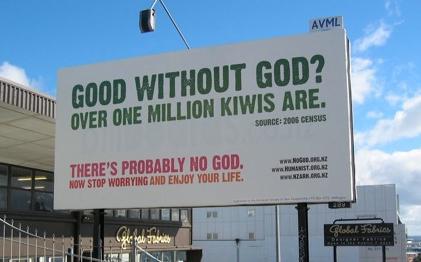
    Here is a pic of the first one.

    Good Without God? Over One Million Kiwis Are.

    Here we are told one million kiwis are good without God because the census says so. This, however, is fallacious. What the census shows is not that one million kiwis are good without God, it shows that one million kiwis are good (although this is granting a lot for the sake of argument) without believing in the existence God. But to say one can be good without believing in God is not the same as saying one can be good without God. Many people throughout history have been able to live and breath without believing in the existence of hydrogen and oxygen atoms, it does not follow that they could live without water.

    Moreover, it is hard to tell what the point of this sociological fact is anyway. Why does the fact that people do not need to believe in something to do good deeds mean that the belief is false? For centuries people have done good deeds and lived good lives without believing in evolutionary theory or quantum mechanics, should we conclude that these theories are therefore ‘probably false’? Surely these atheists are not suggesting that our beliefs should be based on what is useful or helpful as opposed to what is true or false?

    Perhaps the atheists here mean to convey something else. Some Christian thinkers such as William Lane Craig, Robert Adams, Stephen Layman, Alvin Plantinga, John Hare, Philip Quinn have argued that moral properties such as right and wrong depend on God for their existence. Atheist writers such as Paul Kurtz and Christopher Hitchens retort that this claim is falsified by the existence of morally upright atheists. I suspect something like this is behind the slogan on the billboard, it repeats Hitchens and Kurtz’s retorts as though they said something insightful or clever.

    The problem is, as any one familiar with this discussion should know, this retort misses the point (as I pointed out in On a Common Equivocation). Craig, Adams, et al are not claiming that one needs to believe in God to be good (a point made several times in the literature and particularly made so many times to Kurtz that it beggars belief that he keeps repeating it) rather their claim is that moral properties, such as right and wrong, depend on God for their existence.

    This is a fairly basic and elementary distinction in the literature. How exactly expressing a common philosophical confusion counts as reason for thinking “there probably is no God” is hard to see.

    Let’s look at the next one.

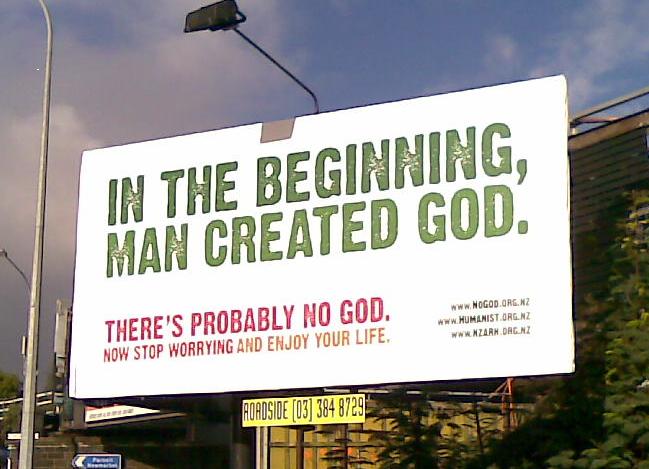
    In the Beginning, Man Created God.

    What is asserted here? That man created God. This, however, is clearly absurd. God is typically defined as an all-powerful, all-knowing, immaterial, necessarily-existent being who created the world. Now if one is going to claim that humans actually created an all-powerful, all-knowing, immaterial, necessarily-existent who created the world, then they are contradicting themselves.

    Humans are part of the world and therefore cannot have created the being that created the world – otherwise humans would have to exist prior to their own existence.

    Similarly, one cannot create a necessary being, this would entail it is possible for a necessary being to not exist, in which case it would not be a necessary being. Taken in a straight-forward, literal manner (the way freethinkers are so fond of taking every passage in the Bible) this billboard simply asserts contradictions.

    Of course, the authors of this billboard probably do not mean to say humans actually created God, they do not think he exists after all. Their claim is that humans created the idea or concept of God and developed it. This is undoubtedly true. Of course, humans also invented the idea or concept of atoms as well, ancient Greek philosophers came up the basics of this concept millennium ago. This trivial fact tells us nothing about whether or not the idea or concept humans developed actually corresponds to anything in reality. To assume that it tells us something about whether the idea or concept is true or false is a fairly obvious case of the genetic fallacy.

    So the second billboard either asserts a contradiction or it is a clear case of a logical fallacy.

    The last one is my favourite.

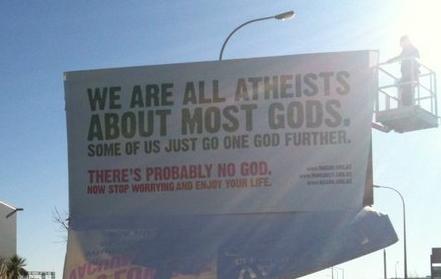
    We are all atheists about most gods. Some of us just go one god further.

    I am inclined to think the argument on this sign is invalid. To see why let’s take out the term “God” in the sign and replace it with some other term such as “non-Christian perspective.” When we do this we get: “We all reject most non-Christian perspectives, some of us just reject one more.” This argument has true premises, do we now have, a knock-down argument for Christianity?

    Similarly, an analogous argument form with true premises gives us an argument for nihilism, the total denial of the existence of morality. “We are all nihilists about some conceptions of morality, some of us are just nihilistic about one more.”

    The same argument for also furnishes a refutation of secularism, “we all reject some secular perspectives on reality, some of us just reject one more.” I could go on.

    Taking a stand on any issue of philosophical substance, whether by affirming, denying or simply being sceptical of it, is to put oneself in opposition to any number of other people and groups who take a contrary stance. That is life. Such pluralism hardly provides a reason for thinking “there probably is no God” any more than it gives us a reason to doubt any other perspective on the world.

    So what do the atheist billboards do? Well the first one tells us that some atheist groups conflate basic philosophical distinctions and don’t really understand the debate they are contributing to. The second shows us that these groups think contradictions and obvious fallacies are some how savvy and smart. The last shows us that they think that invalid argument forms, forms from which you could infer the denial of anything and everything by substituting one true premise with another, are avant-garde.

    All in all, pretty accurate advertising for these groups.

    Hat tip: MCAS

  • EPS Apologetics Conference: God and the Genocide of the Canaanites

    Matt has been invited to speak at the annual Evangelical Philosophical Society (EPS) Apologetics Conference in Atlanta, Georgia, USA which runs 18-20 November 2010. He will be speaking alongside some big names in contemporary Christian philosophy including Alvin Plantinga and William Lane Craig.

    Evangelical Philosophical Society Apologetics Conference

    Experience seasoned teaching by Alvin Plantinga, William Lane Craig, Gary Habermas, Greg Koukl, Randy Newman, Frank Beckwith, Craig Evans, Craig Blomberg, Mike Licona and over twenty other influencers in Christian apologetics as they equip you about the issues facing contemporary Christian witness.

    The full line up of speakers is here.

    You can register here.

    Matt’s talk is entitled “God and the Genocide of the Canaanites,”

    How could a just and loving God command Joshua to genocide the Canaanites as is apparently taught in the Old Testament? Is God really a moral monster as Christianity’s critics use these passages to claim? Matthew will re-examine these passages in light of the context they were written in showing that the skeptics’ case against God relies on a questionable reading of the Old Testament.

    This talk will be based on Matt’s blog series, Joshua and the Genocide of the Canaanites Part I and Part II, his Contra Mundum column, “Did God Command Genocide in the Old Testament?” (forthcoming August 2010) and his chapter, co-authored with Paul Copan, “Ethics of ‘Holy War’ for Christian Morality and Theology” in Old Testament ‘Holy War’ and Christian Morality: Perspectives and Prospects (forthcoming 2011).

    If you would like to donate to help Matt get to America to speak at the EPS Apologetics Conference please visit our support page.

  • Contra Mundum: Fairies, Leprechauns, Golden Tea Cups & Spaghetti Monsters

    That belief in God is on par with belief in fairy tales is a fairly common charge levelled at Christianity. Highly regarded atheist Philosopher Michael Tooley argues,

    If there is no evidence in support of the existence of God, then it is reasonable to believe that God does not exist. The essential line of thought which I would hope to develop later on is that if you consider other things like fairies, leprechauns, golden teacups orbiting around Venus, and so on, I would suggest that we have no evidence against the existence of those sorts of things, but if I asked you whether you were agnostic I think the answer would be “no.” You would believe there are no fairies, no leprechauns, no golden teacups orbiting around Venus. That illustrates the general principle in regard to God’s existence that the burden of proof must fall upon the person who is arguing in support of God’s existence. If there’s no positive support for it, then the other side wins by default.

    Something like Tooley’s argument regularly features in popular discussions of religion where fairies, leprechauns and golden tea-cups are substituted for flying spaghetti monsters. The basic idea remains the same, to believe in God without providing compelling arguments or evidence for his existence is on par with believing in fairy tales and this is something no sensible, educated, intelligent person can take seriously.

    To address this argument it is first necessary to unpack it. Three separate claims are being made; first, it is assumed that the rational stance to take towards the existence of fairies, leprechauns, orbiting golden tea-cups and spaghetti monsters is not a stance of agnosticism but one of certain denial. Second, it is contended that the reason why this stance is correct is not because we have reasons for believing such things do not exist, but rather that we lack any positive evidence for the existence of these things. Third, the objector assumes that a person who advocates or defends belief in God, in the absence of compelling evidence for God’s existence, has no principled way of distinguishing the case for God from the case for the existence of fairies, leprechauns, et al. Now I grant the first of these claims, it is obviously silly and irrational to believe in things like fairies, leprechauns, orbiting golden tea-cups and spaghetti monsters. The real issue is whether the second and third claims are correct; I will argue that they are not.

    Turning to the second claim that the reason it is irrational to believe in fairies, leprechauns, et al is solely because we lack evidence for their existence and not because we have reasons for thinking that they do not exist. I am inclined to think this claim is false. Consider another claim for which we also lack evidence for thinking is true, that intelligent extra-terrestrial life (ET’s) exists somewhere in the universe. We lack compelling reasons for thinking this claim is true yet it seems mistaken to infer from this that such beings absolutely do not exist, at best all that we can say is that we do not know. Moreover, even in face of agnosticism, many scientists take the existence of ET’s quite seriously; for example, the SETI research site in California spends millions of dollars sending messages into outer space and searching the universe for signs of intelligent life. I note that they do not do the same in pursuit of the search for signs of fairies, leprechauns, orbiting tea-cups or spaghetti monsters and I cannot find any evidence of an agency anywhere in the world that does.

    This example suggests that the reason it is rational to deny the existence of the stuff of fairy tales cannot be simply the lack of positive evidence for these things, if it was we would take the same stance towards ET’s yet we do not. This is because there are important differences between ET’s and fairies, leprechauns, et al over and above the mere lack of evidence we have for their existence. ET’s are the sort of things that could exist even if we lack evidence that they do. ET’s fit with the picture of the world we hold, we know that intelligent life can evolve on planets. This is not the case with fairies, leprechauns, orbiting tea-cups, spaghetti monsters and so on.

    Leprechaun’s first appeared in fairy tales and folklore; in such tales they store their wealth in pots of gold at the end of rainbows. We know that the genre of fairy tales is fantasy. We know rainbows do not have ends in the way this picture envisages. Similarly tea-cups we know are artefacts made by human beings, seeing humans have not been to Venus it is unlikely that such things orbit Venus – even if they are made of gold. It is not just that we lack evidence for the existence of such things but that we have evidence against their existence. What we do know about the world provides us with reasons for doubting they can exist. With ET’s, on the other hand, we have no such reasons for doubting they can exist. Hence, in the latter case agnosticism is justified whereas denial is required in the former case.

    The insinuation that belief in God is on par with belief in fairies, leprechauns, et al is equally questionable. In the case of these things we have no evidence for their existence. With God, however, the situation is different. It is not that no evidence exists; on the contrary, sophisticated and rigorous arguments for God’s existence have been offered and are still being offered in the literature today, it is that experts in the field are divided on the cogency of these arguments. The best that sceptics can suggest is that the evidence is inconclusive. However, even if we grant this, those who defend belief in God can and have offered principled distinctions between God and things like flying spaghetti monsters.

    Two examples will suffice. The first stems from a tradition going back to William James and Blaise Pascal is that when one cannot avoid making a choice, one can act in hope or faith that a belief is true, even if there is no evidence for it, if the expected benefits of the thing hoped for outweigh the benefits of the alternatives. James Jordan provides an example,

    A castaway builds a bonfire hoping to catch the attention of any ship or plane that might be passing nearby. Even with no evidence that a plane or ship is nearby, he still gathers driftwood and lights a fire, enhancing the possibility of rescue. The castaway’s reasoning is pragmatic. The benefit associated with fire building exceeds that of not building, and, clearly, no one questions the wisdom of the action.

    Pascal argued that if one acts on the assumption that God exists and that assumption turns out to be incorrect then one has lost little but if one acts on the assumption that God does not exist and that assumption turns out to be incorrect the one has lost everything. Modified versions of this line of argument are still defended by philosophers today.

    A second reason is that even if one has insufficient evidence for the truth of some proposition, one can be rational in believing it if it is grounded directly in one’s experience. There are plenty of things we believe which are not based on evidence, our belief in the existence in the past or our belief that it is wrong to rape women, our belief that other people exist or that basic axioms of logic are true are not based on arguments or proofs. These things are true because we experience or see them to be true, for example, I remember the existence of a past event, I intuitively conclude that rape is wrong, I observe that other people exist, I see that basic axioms of logic are self-evident. Philosophers such as Alvin Plantinga argue that belief in God is like these beliefs; it is something a person directly sees as true via direct experience or intuition of some sort as opposed to the conclusion of an evidentiary proof.

    I am not in a short article like this going to be able to develop and defend these lines of argument further. I mention them only to show that according to two standard ways of defending belief in God in the face of inconclusive evidence a principled distinction between belief in God and the stuff of fairy tales can be made. People tend to not directly experience or perceive the existence of these things nor does one risk losing everything by acting on the assumption they do not exist. Moreover, if belief in fairies, leprechauns, orbiting tea-cups and spaghetti monsters did possess these features then it is no longer obvious that belief in such beings is irrational. Suppose that instead of there being no evidence for the existence of leprechauns there was in fact some evidence but it was not compelling, perhaps experts were in disagreement. Suppose also that if I failed to act on the assumption that leprechauns existed and it turned out that they did then I would lose everything but if it turned out that they did not I would gain little. In addition, suppose that I directly perceived a leprechaun in front of me or I remembered clearly seeing one a few days ago and I had no reason for thinking my perception or memory was unreliable. If these conditions were satisfied then it would cease to be obvious that belief in leprechauns was obviously irrational. The claim that believing in God is on par with believing in “fairies, leprechauns, golden teacups orbiting around Venus” and flying spaghetti monsters is then unjustified.

    I write a monthly column for Investigate Magazine entitled Contra Mundum. This blog post was published in the July 10 issue and is reproduced here with permission. Contra Mundum is Latin for ‘against the world;’ the phrase is usually attributed to Athanasius who was exiled for defending Christian orthodoxy.

    Letters to the editor should be sent to:
    editorial@investigatemagazine.DELETE.com

    RELATED POSTS:
    Contra Mundum: Secularism and Public Life
    Contra Mundum: Richard Dawkins and Open Mindedness
    Contra Mundum: Slavery and the Old Testament

    Contra Mundum: Secular Smoke Screens and Plato’s Euthyphro

    Contra Mundum: What’s Wrong with Imposing your Beliefs onto Others?
    Contra Mundum: God, Proof and Faith
    Contra Mundum: “Bigoted Fundamentalist” as Orwellian Double-Speak
    Contra Mundum: The Flat-Earth Myth
    Contra Mundum: Confessions of an Anti-Choice Fanatic
    Contra Mundum: The Judgmental Jesus

  • Contra Mundum: Richard Dawkins and Open Mindedness

    The bold statement “Richard Dawkins opens minds” leaped out at me from the newsletter sitting on the University of Auckland’s Law Library counter. The article went on to sing the praises of Richard Dawkins and mentioned his book The God Delusion. On reading the piece one could be forgiven for concluding that Dawkins’ works are a paragon of the open minded assessment of ideas.

    Now Dawkins is a Zoologist and I, not being a Zoologist, would not presume to assess his work on Zoology. What is interesting, however, is that much of Dawkins’ most famous work is not on Zoology; it is on Theology and specifically Philosophy of Religion. That field of Philosophy which critically analyses religious questions, such as, the veracity of arguments for and against God’s existence. Having some background in these fields I find it a little surprising that an Auckland University publication would contend that his work is open minded because it is evidently not.

    In The God Delusion Dawkins’ main argument against the existence of God alludes to Fred Hoyle’s famous claim that the probability of something as complex as life evolving by blind chance was less likely than a fully-functional Boeing 747 being created by a hurricane blowing parts around in a junk yard. Dawkins writes, “However statistically improbable the entity you seek to explain by invoking a designer, the designer himself has got to be at least as improbable. God is the Ultimate Boeing 747.” Dawkins has made the same line of argument elsewhere “God, or any intelligent, decision-making calculating agent, is complex, which is another way of saying improbable.” In The Blind Watchmaker he argues,

    Once we are allowed simply to postulate organized complexity, if only the organized complexity of the DNA/protein replicating machine, it is relatively easy to invoke it as a generator of yet more organized complexity”. But of course any God capable of intelligently designing something as complex as the DNA/protein machine must have been at least as complex and organized as that machine itself.

    This argument contains three premises. First, that theism (belief in God) is justified by “postulating” God to explain the existence of organised complexity. Second that the God appealed to by theists is complex. Third, that the existence of complex beings are highly improbable. These lead to the conclusion that “God is the Ultimate Boeing 747” and hence “almost certainly does not exist”. The problem with this argument is that all three premises rest on caricatures and misunderstandings of contemporary theology and ignorance of contemporary philosophy of religion. I will explain.

    Dawkins contends that God is postulated to explain organised complexity. There are two problems with this contention. First, Dawkins assumes that God is rationally believed only if his existence is inferred by some kind of argument for the best explanation of a given phenomenon. However, not all beliefs are justified on the basis of some kind of argument of this sort. Our belief in the existence of the past, our belief that it is wrong to rape, our belief that other people exist or that basic axioms of logic are true are not based on inferences to the best explanation. It is not that they are rationally believed because they explain some phenomena better than all alternatives, it is rather that these beliefs are part of the background data that we use to assess proposed explanations against. These things are true because we immediately experience them as true. I have the experience of remembering the existence of a past event. I intuitively perceive that rape is wrong. I experience the basic axioms of logic as self-evident and so on. Such beliefs are called properly-basic beliefs.

    Since the late 1970’s an extremely important movement within Philosophy of Religion, known as the reformed epistemology movement, has offered detailed and rigorous defences of the contention that, for theists, belief in God can be properly-basic. This position has been defended by leading philosophers of religion such Alvin Plantinga, William Alston, Nicholas Wolterstorff, Peter Van Inwagen and others. Now, of course, it is possible that this movement is mistaken but Dawkins surely owes us an argument to this end as opposed to his simply assuming it and ignoring the counter evidence.

    Second, among those theists who do defend God’s existence on the basis of some argument for the best explanation, very few do so on the basis that God explains “organized complexity”. Richard Swinburne, the leading proponent of such arguments, argues that God explains the existence of laws of nature, religious experience, the origin of the universe and the continued existence of the universe. Swinburne does not postulate God to explain “organised complexity”. Similarly, William Lane Craig, a leading defender of theism, suggests that God explains the origin of the universe, the existence of morality and the fine tuning of the laws of nature. Again, Craig makes no appeal to “organized complexity”. In 2009 The Blackwell Companion to Natural Theology was published which contains the most up to date versions of the 11 most definitive arguments used to defend the existence of God in the literature today. Not one of them involves an appeal to “organised complexity”. While the cogency of arguments for the existence of God that do not involve “organized complexity” remains open to substantive debate, it is undisputed that these arguments exist. Dawkins’ picture of God as a postulate to explain organised complexity is a crude caricature of theistic scholarship.

    To be fair Dawkins attempts to address some of these other arguments elsewhere in the book. However, here again much of his writing consists of caricature. He attacks five arguments proposed 800 years ago by Thomas Aquinas as being representative of the current case for theism and completely ignores the vastly more sophisticated and vigorous versions being defended in the literature today. Ironically, Dawkins quite severely misunderstands Aquinas’ arguments and attributes to him a position no Aquinas scholar would accept as accurate. However, even if his account were accurate, critiquing theism by attacking the arguments of one 12th century theologian is a bit like me attacking evolution on the basis of the evidence for it gathered in the 12th century and ignoring any of the scientific developments of the last 800 years. Such ineptitude would not be tolerated in the scientific world and should not be seen as de rigueur just because the topic is religion.

    Dawkins’ second contention fares little better. Dawkins states that “A God capable of continuously monitoring and controlling the individual status of every particle in the universe cannot be simple” this seems to be because,

    The corners of God’s giant consciousness are simultaneously preoccupied with the doings and emotions and prayers of every single human being—and whatever intelligent aliens there might be on other planets in this and 100 billion other galaxies.

    There are several problems here. First, as Craig has noted, this confuses whether what God thinks about is complex with whether God himself is complex. Second, as Plantinga has noted, in The Blind Watchmaker Dawkins states that something is complex if it has parts that are “arranged in a way that is unlikely to have arisen by chance alone.” However, the concept of God employed by most theists is of an immaterial being that does not have material parts so by Dawkins’ own definition God is not complex (unless one assumes that God is a material being but theists almost unanimously maintain that God is an immaterial being).

    This misrepresentation is made all the more pertinent by the fact that for centuries theists have been offering rigorous and sophisticated arguments that God is not in fact complex but is simple. While these arguments may not be successful, Dawkins still needs to actually provide reasons for rejecting them. To simply assert that God is to be conceived in a way that no one conceives Him and to ignore the numerous arguments to the contrary seem more like a child who asserts his position and then puts his hands over his ears and repeats “I am not listening” than it does a serious critical evaluation of another’s position.

    Dawkins’ final contention, that the existence of complex beings is improbable, is similarly confused. Suppose one grants that God is “the Ultimate Boeing 747” and that God’s existence is as statically improbable as the complexity it is invoked to explain. Little in fact follows from this. This is because what is improbable in the Boeing 747 analogy is that the plane came into existence by chance. If God is “the Ultimate Boeing 747” then the conclusion to be drawn is only that it is improbable that God came into existence by chance. This, however, provides us with no reason for thinking that God does not exist. No theist holds that God came into existence by chance, theists hold that God is eternal. Here, again, Dawkins attacks a concept of God nobody holds to and hence is caught jousting with a straw-man.

    On examining Dawkins’ central argument what one discovers is not an open-minded, informed, careful examination of the contemporary debate over the existence of God. Nor does one find a carefully researched assessment of theism. Instead one finds Dawkins simply ignoring what theists mean by God. He ignores how they conceptualise God and ignores the arguments and discussions they have actually made. The theism Dawkins dismisses apparently assumes that God is a material being with parts, that He came into existence by chance and is postulated merely to explain organized complexity. The actual arguments proposed in defence of theism that have been put forward in the literature are not addressed at all.

    Some Auckland University academics might consider such tactics to count as open-minded but I do not. In my view an open-minded honest assessment of religion requires accurately representing what theologians say and teach. It means endeavouring to read and understand their position and offer informed and critical responses to these positions. Ignorance and caricature is not open-minded scholarship.

    I write a monthly column for Investigate Magazine entitled Contra Mundum. This blog post was published in the May 10 issue and is reproduced here with permission. Contra Mundum is Latin for ‘against the world;’ the phrase is usually attributed to Athanasius who was exiled for defending Christian orthodoxy.

    Letters to the editor should be sent to: editorial@investigatemagazine.DELETE.com

    RELATED POSTS:
    Contra Mundum: Slavery and the Old Testament

    Contra Mundum: Secular Smoke Screens and Plato’s Euthyphro

    Contra Mundum: What’s Wrong with Imposing your Beliefs onto Others?
    Contra Mundum: God, Proof and Faith
    Contra Mundum: “Bigoted Fundamentalist” as Orwellian Double-Speak
    Contra Mundum: The Flat-Earth Myth
    Contra Mundum: Confessions of an Anti-Choice Fanatic
    Contra Mundum: The Judgmental Jesus

  • Showing Christianity is True at Apologetics 315

    Brian Auten of Apologetics 315 has run an essay series through the month of April on the topic “Why is Christianity True?” Brian has accepted 23 submissions from various apologetics bloggers from around the world and has each day posted 1 essay in the series along with a podcast of each. At the end of the series a PDF ebook version of all the essays will be made available.

    Matt’s essay “Showing Christianity is True” was selected to be the concluding essay and it too has been made into a podcast. To hear the podcast and join in the global discussion pop on over to Apologetics 315 (or you can read it below).

    Showing Christianity is True

    “Can you show that Christianity is true?” To help us focus our thinking as to how one should answer this question I will pose some other questions as follows. Can you show that other people exist or that there exists a world that endures independent of our senses, which continues to exist when we no longer perceive it? Can my belief that it is wrong to inflict pain on another person for no reason at all be shown as true? What about my belief that Russell’s sceptical hypothesis that the whole Universe came into existence six seconds ago, including all apparent memories and signs of age – is this false or true?

    I hope that the point of these examples is clear. Unless we want to fall into a global scepticism that defies all common sense we have to acknowledge that there are some beliefs which we hold rationally and know are true that, nevertheless, cannot be shown or proven to be true from premises that all intelligent people are required to accept. In fact, somewhat ironically, the claim that one is only rational in believing something unless it can be shown to be true from premises all sane people are required to accept, is self-refuting; after all, many sane people reject it and it has yet to be shown to be true from premises that all sane people accept.

    However, one is rational in accepting some beliefs independent of any argument showing the truth of those beliefs; philosophers term such beliefs ‘properly basic beliefs.’ These beliefs typically function as foundational beliefs, a person reasons from them as premises to the truth of other propositions one holds. Similarly, they function as the background data against which one assesses hypotheses proposed for one’s acceptance. They arise because ongoing appeals to premises to prove premises to prove premises have to end somewhere. Properly basic beliefs constitute those beliefs where it is rational for the appeal for proof to end.

    It needs to be noted that properly basic beliefs are not groundless. While one does not believe a basic belief based on an inference, basic beliefs are often based on some form of experience. Alvin Plantinga discerns two types of experience, “sensory evidence”, such things as appearing to see, hear or feel a given object and “doxastic evidence”, which he refers to as “the belief feels right, acceptable, natural.”1  Doxastic beliefs appear to be self-evident. An example of such a belief is the corresponding conditional of modus ponens. When one entertains the conditional of modus ponens it just seems to be correct. Modus ponens seems self-evident in a way that an overtly-fallacious inference does not. It is this kind of experience that grounds basic beliefs.

    Many philosophers and theologians such as Calvin, Pascal, Alston and Plantinga hold that certain theological beliefs are properly basic. Belief in the existence of God is, from the believer’s perspective, properly basic and grounded directly in some form of religious experience; hence it is justified and rational to believe these doctrines independently of any argument in favour of them. Although I cannot elaborate it in a small article, I am in fundamental agreement with this position. The request then that Christians show or demonstrate that Christianity is true often relies on an assumption that I think is mistaken; this assumption is that rational Christian belief requires that arguments or proofs be provided for Christianity and failure to provide them renders the believer irrational.

    There is another more moderate question which lurks in the neighbourhood. If one grants that the believer is rational in accepting Christian belief in a properly basic way then what reasons can the believer give to those who do not hold to the same properly basic beliefs for accepting Christian belief? Perhaps some people, on the basis of some kind of religious experience, have immediate properly basic beliefs but many people do not have this kind of experience – what reason can be given to them for accepting the Christian faith? This problem is exasperated by the fact that it is extremely difficult to demonstrate the truth of foundational beliefs precisely because they are foundational beliefs. To prove something one needs to appeal to premises and the whole question in this instance is over what ultimate premises to accept. How then would one show to these people that Christianity is true?

    I think several strategies are available but due to space I can only briefly sketch them here.

    First, in many instances, one can show Christianity is true by rebutting objections to Christian beliefs. Properly basic beliefs are beliefs that one is rational in believing independently of any argument for them in the absence of any good reasons for them. It does not follow, however, that these beliefs cannot be defeated by reasons offered against them.  If I see John screwing his face up and grasping his leg, I might form the belief that John is in pain. However, if later John tells me that he was not in pain but rather rehearsing his death scene in a play he is acting in I might change my belief to believing that he was not in pain. The initial belief that he was in pain was properly-basic; however, because of what I later discovered, its rational status was defeated.

    I think many people stand in an analogous position to various Christian beliefs; they reject them not because they do not see them to be true but because they accept various objections to these beliefs. Consider Richard Dawkins’ “All appearances to the contrary, the only watchmaker in nature is the blind forces of physics, albeit deployed in a very special way… it is the blind watchmaker.” What is interesting here is the phrase, “all appearances to the contrary,” Dawkins admits that, prima facie, the world appears and looks like it was designed and in the absence of any reasons for denying design then the natural observation is to say that it is. Dawkins suggests, however, that appearances are deceiving because science has allegedly provided defeaters for this belief. Showing Dawkins’ arguments are unsound in such a context enables people to accept appearances.

    The second line of argument is to show that various alternatives to Christianity are false. Often people fail to see the truth of Christianity because they accept mistaken views of the world and mistaken epistemic standards such as those associated with naturalism. They may experience God’s presence in nature but believe this is an illusion because they are convinced that nothing beyond nature exists. They might think that only things which can be empirically demonstrated can be rationally believed and these experiences are an illusion fostered by evolution to ensure social co-operation. Showing that these pictures of reality are false helps them to re-consider the veridical nature of these experiences. Refuting alternatives to Christianity provides another impetus for seeing the truth of Christianity.

    People have to live by some vision of the world. In terms of practice, one cannot remain agnostic on many existential questions. If all the viable alternatives to Christianity can be shown to be implausible then Christianity has to be taken seriously by people who cannot, in practice, live a life which suspends judgment on ultimate questions.

    Third, even if a person does not accept a given proposition they can still reason about such beliefs. One can reason “conditionally”,2  if one accepts certain premises or propositions as properly basic beliefs. Then certain other positions, hypotheses and theories are likely, and people from all sides of the dispute can assess and debate whether the reasoning is cogent. Plantinga notes,

    The conclusions of theistic science may not be accepted by non-theists, but the method – trying to see how best to explain the relevant phenomena from a theistic perspective – is indeed open to all.3

    One can show that when one does reason from a theistic perspective then certain existential and theoretical questions can be given coherent answers. One can explain such things as the origin of the universe, the existence of contingent beings, the existence and nature of moral obligation, the existence of laws of nature, existential questions about guilt and forgiveness and so on. Plantinga notes that the existence of God imports a “great deal of unity into the philosophic endeavor, and the idea of God helps with an astonishingly wide variety of cases: epistemological, ontological, ethical, having to do with meaning, and the like of that.”4 Showing that if one accepts theism, then plausible, defensible, comprehensive and unified answers are available to what would otherwise be intractable questions, provides one way of showing others why they should accept belief in God as a properly basic belief.

    The fourth and final way is to put a person in a position where that person is likely to have the requisite experience that grounds properly basic theological beliefs. Suppose I see a tree in the park and my wife asks me to show her that this tree exists. The obvious way to do so is not to construct a proof of the existence of a tree but to take her to a park and show her it. Similarly, many people fail to grasp self-evident axioms of logic because they fail to understand them, but when these are explained to them they become self-evident. The same is true with Christian belief. One way to show agnostics the truth of Christianity is to put them into circumstances where, if they are attentive, they are likely to start seeing the truth.

    One can explain the scriptures to them, encourage them to seek God in prayer – this is analogous to the way a person lost in the bush might call out to a rescuer even if he or she were unsure anyone was searching for him or her. One can encourage them to engage in the study of the scriptures whilst taking seriously the possibility that they are the word of God. The person could get involved in a community of believers where God dwells and works, where the person could be encouraged to live in accord with the moral law and honestly confess their failings and seek forgiveness for their moral errors. Pascal made this point in his famous wager; while an agnostic cannot simply choose to believe something he does not believe, he or she can choose to look, to seek and to understand. When the agnostic sincerely does so, it is likely that he or she will come to experience God. Just as a person who attempts to understand logic will see why its axioms are self-evident or a person who actually looks in the park will see that there is a tree there.

    In conclusion the basic doctrines of Christianity, if true, constitute properly basic foundational beliefs. One does not believe them on the basis of argument or proof as they are grounded directly in experience. Typically it is very difficult to prove with argument that a foundational belief is true; however their truth can be shown in other indirect ways. One can argue that the arguments against such beliefs are false, one can argue that the alternatives to accepting them are false or problematic, and one can show that if one accepts Christianity then these beliefs make coherent sense out of the world, they provide comprehensive answers to many theoretical and existential questions. Finally, in the context of all of the above, one can assist the sceptic to adopt the stance of a sincere seeker; to get him to put him or herself into the kind of position where he or she can come to have the requisite encounter with God so as to see that Christianity is true. This is ultimately how one shows that Christianity is true.

    1 Alvin Plantinga Warranted Christian Belief (New York: Oxford University Press, 2000) 110-111.
    2 See Alvin Plantinga “Creation and Evolution: A Modest Proposal” in Darwinism Design and Public Education ed John Angus Campbell & Stephen C Meyer (East Lansing: Michigan State University Press, 2004) 521-232; “Reason and Scripture Scholarship” in Behind the Text: History and Biblical Interpretation ed C Bartholomew, C Stephen. Evans, Mary Healy & Murray Rae (Grand Rapids, MI: Zondervan, 2003) 98-100.
    3 Alvin Plantinga “On Rejecting The Theory of Common Ancestry: A Reply to Hasker” Perspectives on Science and Christian Faith 44 (December 1992): 258-263.
    4 Alvin Plantinga “Two Dozen or so Theistic Arguments” accessed 7 March 2010.

  • William Lane Craig and his Debate with Michael Tooley

    “Is God Real?” was the subject of the recent debate between William Lane Craig and Michael Tooley at the University of North Caroline on 24 March 2010. Whilst it is not available for free anywhere online, you can purchase it here, find reviews here, a pre-debate radio interview between the two here and of course the transcript of the first debate between these two back in 1994 is here.

    Hat Tip: I am Jonny King

    Dr Craig has written his own thoughts as to how the debate went in his Reasonable Faith newsletter:

    By contrast my debate the following evening at UNCC generated a lot of light but very little heat! My opponent for this debate on “Is God Real?” was Michael Tooley, a well-respected philosopher from the University of Colorado (Boulder). He has recently published a very complex argument against God based on examples of certain evils in the world. In preparation for the debate I worked through his argument carefully and prepared a four-point response. To read my critique of his argument click here. (I’m indebted to Timothy McGrew and Matt Flanagan for very helpful interaction!) Tooley also came well-prepared to the debate. Indeed, this was his undoing, for he had all four of his speeches (including “rebuttals”!) canned in advance. As a result, he was utterly inflexible and so didn’t respond to virtually anything I said in my rebuttals. It was as if I didn’t even need to be there! So the debate turned out to be pretty one-sided, with me replying to each of his relevant points and him just ignoring me and plugging ahead with his prepared speeches. While Dr. Tooley would, of course, disagree, I think Christian theism came away looking eminently reasonable and credible. [Emphasis added]

    Matt had emailed Dr Craig a modified version of his Tooley, Plantinga and the Deontological Argument from Evil Part I and Part II blog series prior to the debate. Matt’s piece criticises the main line of argument Michael Tooley used in his recent debate with Alvin Plantinga and he is currently seeking its publication.

  • Sunday Study: Two Forms of Inerrancy

    The discussion arising in response to my recent post Inerrancy and Biblical Authority, both on this blog and on some of the blogs that linked to it, got me thinking a bit more about this topic. I was reminded of an interesting comment made by Alan Rhoda regarding the doctrinal statement of the Evangelical Philosophical Society “EPS,”

    The Bible alone, and the Bible in its entirety, is the Word of God written and therefore inerrant in the originals. God is a Trinity: Father, Son, and Holy Spirit, each an uncreated person, one in essence, equal in power and glory.

    In a discussion with Bill Vallicella of Maverick Philosopher on the meaning, Alan Rhoda distinguishes two accounts of inerrancy,

    It seems to me that the EPS statement is sufficiently vague to permit a few different readings.

    The strongest is what’s known, I think, as verbal plenary inspiration (VPI). This is the view that each and every word used in the Biblical originals is exactly the word that God wanted used. Hence, since God is infallible, the Bible is inerrant. (VPI is the position of the Chicago Statement.)

    A weaker, and I think more defensible view, may be called didactic plenary inspiration (DPI). This is the view that whatever the Biblical originals were intended to teach is inerrant. It is not necessary that the particular words of the Bible be chosen by God so long as the particular message that God wants to convey gets across. (VPI entails DPI, but not vice-versa.) If one accepts this view, then the question to be asked with respect to a Biblical text is “what was it intended to teach?” Is Genesis 1, for example, intended to teach that the world was created in six 24-hour days? Or is it, perhaps, a kind of literary framework intended to teach the absolute superiority of Yahweh over all other gods? Or perhaps its purpose isn’t primarily didactic at all, but something primarily evocative like poetry?

    My point is that since the EPS inerrancy statement does not specify the primary locus of inerrancy (whether the words, the teachings, or something else) it permits a flexible range of approaches to Biblical interpretation.

    Rhoda suggests two different ways of understanding the doctrine of biblical inerrancy; one that follows from affirming verbal inspiration and another that follows from didactic inspiration.

    To see how DPI works consider a legal analogy, suppose that I want to write up a last will and testament. I approach a lawyer and tell set out precisely what I want put in my will. The lawyer then drafts a document that contains the provisions I stipulated but expresses them in standard legal terms and in accord with standard legal conventions and phrases e.g. “I, Matthew Flannagan, being of sound mind, hereby decree that…”

    The document expresses, in first person, my will regarding my assets and property so I can be said to be its author, a court will call it my will as will my surviving family. However, I did not write it. The form, exact wording, turns of phrase, sequencing, choice of font and paper, etc are the lawyers’. Given that the will was drafted in New Zealand, in 2010 it will be in New Zealand English and drafted in accord with the styles and conventions of the statutes and precedents applicable to New Zealand wills and testaments. Nevertheless, as the content of the document express my wishes, despite my lack of authorship, it is a faithful expression of my will. Something like this picture of inspiration is suggested in Exodus 4:10-16.

    Now it is important to note that a DPI model of inerrancy does not mean that people reject the entire biblical text as mythical and figurative stories, which illustrate theological and moral truths and assert nothing about space-time history. If the message is articulated through the literary and rhetorical conventions of human beings then a plausible interpretation, as opposed to a strained one, will take these conventions into account. When this is done, it is implausible to conclude everything in scripture is myth.

    Take, for example, the genre of ancient biography, as mentioned in my previous post. This genre does not intend to affirm as true every detail it records but rather seeks to give an accurate picture of the person the biography is about. This still requires that much of what it records is true; no one would interpret biographies about Alexander the Great to read that they did not teach that he was king of Macedon, son of Philip, who conquered Persia, fought in the battle of Gaugamela, etc. Similarly, if Jesus did none of the things recorded in the gospels and said nothing at all remotely resembling what they attribute to him then these accounts do not give an accurate picture of him.  However, the genre of ancient biography does not require that Jesus’ teaching on divorce be presented verbatim, in precisely the same order or using exactly the same words in the various synoptic gospels. Neither does it require that every temporal or geographical detail mentioned within them is taught as correct.

    Many historical books intend to teach historical claims. The Old Testament teaches, among other things, that Israel went into exile as a result of disobedience; it also teaches God lead the Israelites out of slavery in Egypt. These texts are, as far as I can tell, historiographies. Admittedly they are ancient near eastern “ANE” historiographies and the fact that the genre of ANE historiography uses hyperbole, lack of precision, a degree of historical reconstruction, etc needs to be taken into account. Nevertheless, as are historiographies they intend to teach us the significance of events that occurred in the past.

    Now a person would not take an Egyptian history as entirely figurative. One should take it to teach that a particular event happened. It is true that one should recognise the hyperbole present, the theological/political message the text affirms but this would not be taken to be all that the author teaches. Ramses’ campaigns into Syria are intended to tell us that the campaigns actually happened, that the battles actually occurred even if they use hyperbole, rhetoric and historical reconstruction to articulate a political/theological message over and above the mere reporting of history. Hence, DPI does not necessitate a licence to de-historicise the text or embrace biblical minimalism.

    Of course, there are other books and literary forms in scripture, such as the parables or the apocalyptic, which are not intended to be read as history. Then there are the early chapters of Genesis or the books of Job and Jonah, where it is not clear that the text intends to teach that the events actually occurred in history and where it seems more likely that these were stories were meant to convey theological and ethical truths. What is needed when reading these texts is attention to the genre. Conclusions about what a text teaches must be based on defensible claims about the literary style and the context of the text in question.

    DPI, therefore, is not the same as the view that scripture is infallible in faith and morals but not in history. It may simply be that at certain junctures scripture intends to teach us something about the past. On the other hand, DPI does allow for certain types of errors that a more verbal account may not allow for. Here are two examples. The first is one I alluded to in my previous post, cases where the form or way the message is articulated presupposes error. Consider Jesus’ comments in Matt 15:18-19, “But the things that come out of the mouth come from the heart, and these things make a man unclean. For out of the heart comes evil thoughts, murder, adultery, sexual immorality, theft, false testimony, slander.” Some scholars take, as metaphoric, references to the heart as the seat of the will, emotions, intellect. However, others suggest that ancient cultures literally believed the heart was the seat of psychological states like this and conclude that these texts reflect and presuppose a false and erroneous view of anatomy. I am inclined to think that even if these scholars are correct, little of interest follows.

    An analogue here would be a person who reads a 12th century account of a battle that is recorded to have occurred at “sun rise”. We know that 12th century people literally believed that the sun rose, in accord with the accepted pre-Copernican cosmology of the day. Hence, it is plausible to think that the human authors of these texts took the phrase “sun rise” to literally mean that the sun rose. Despite this, I think it would be a mistake to suggest that the phrase “the battle took place at sunrise” is false because of Copernicus’ discoveries. While the text presupposes an erroneous view of cosmology, it clearly does not intend to teach us pre-Copernican cosmology; all it teaches is that a battle occurred at dawn and it uses pre-Copernican cosmology to express this point. What the text teaches is true if the battle occurred and it occurred at dawn. It would be false if the battle occurred at another time of the day or never occurred at all.

    I am inclined think that the references to heart, kidneys, etc in the scriptures function in an analogous way to the word “sunrise” in medieval texts. I would say the same thing about references to the “four corners of the earth” or “the waters above and below” even if the original human writers understood these to be literally true. The cosmology in question is presupposed by the text abut is not what the text is trying to teach us. The author uses these phrases them to teach something else and it is what the author taught not the author’s mode of presentation that matters.

    A second example of an error that would be allowed under DPI would be where scripture affirms or states something which is unrelated to what is being taught. An example would be Paul’s instruction to Timothy in 2 Tim 4:15, “When you come, bring the cloak that I left with Carpus at Troas, and my scrolls, especially the parchments.” Suppose, for the sake of argument, Paul did not leave his cloak at Troas, perhaps he thought he had but in reality he had left it somewhere else. I am inclined to think this kind of error would make absolutely no difference to whether what Paul teaches in 2 Timothy is true or not. As the point of this letter is not to give an apostolic teaching on whether there is a cloak in Troas.

    Paul’s teaching is authoritative because he is an apostle, what he teaches as an apostle is true. It does not follow from this, that every personal conversation, remark, Paul ever made in his life or every memory he had was without error. It’s rather that what he taught in the function of an apostle has divine authority. It seems to me that while the letter to Timothy expounds apostolic teaching and instruction and the whole book letter is therefore authoritative, the specific passage in v 4:13 records a personal aside Paul gives to Timothy regarding some property he left at Troas. To interpret Tim 4:13 as a divine command to collect Paul’s cloak, or a prophetic or apostolic utterance that a cloak existed in Troas seems to me to be excessively pedantic and implausible, hence I myself see nothing about the divine authority of scripture threatened by a discovery that there was no cloak in Troas. All it would show us was that Paul’s memory was not perfect, which we already knew.

    So DPI is compatible with certain sorts of errors in the text provided they are not what the text teaches. Of course none of this means that scripture contains these errors. There may well have been a cloak at Troas. References to “the waters above,” “heart,” etc may be phenomenological language, the point is that even if these references do presuppose or  contain errors of a certain sort this does not really make any difference to the claim that whatever scripture intends to teach is true. Other examples could be given but I think you get the point.

    I suspect something like what Alan Rhoda calls didactic plenary inspiration is the view I was elaborating in my previous post. It also appears to be the view defended (at least in some places) by William Lane Craig and something like it is the view expounded by Alvin Plantinga. I also suspect that Glenn Peoples holds this view; although Glenn considers himself to not be an inerrantist he would probably, on Rhoda’s classification, be a particular kind of inerrantist, one that rejected VPI and instead asserted DPI.

    On the other hand, the sceptics I referred to in my previous post (people like Tooley, Fales, Brink, Loftus, etc) in their critiques, work with a fairly strong VPI view of inerrancy. John Loftus’ speaks of Jesus’ reference to “the heart” and how this reflects a primitive view of anatomy, Fales states that certain books may contain the genre of myth and Tooley suggests that Genesis contains a story in which God wipes out the human race. This suggests that they think that every word, illustration or literary convention used to teach us about God must itself be without error. If I am correct, then what sceptics attack is one particular version of inerrancy. They may or may not be successful in this attack but attacking one version of a doctrine does not show that all versions are false, and in this case many leading defenders of Christianity do not hold the version under attack any way.

    RELATED POSTS:
    Sunday Study: Inerrancy and Biblical Authority

    RELEVANT CONVERSATIONS:
    Basic Inerrancy
    @ First Things (also at Parableman)
    Inerrancy again – a blog about a blog about a blog about a blog
    @ Beretta
    The Pitfalls of Literalism
    & Plantinga on Inerrancy @ The Church of Jesus Christ