Tag: John Hare

  • Is Ethical Naturalism More Plausible than Supernaturalism? A Reply to Walter Sinnott-Armstrong: Part II

    This is the second part of the paper I presented to the Naturalisms in Ethics Conference at Auckland University last year.

    In my previous post, I noted that Robert Adams has argued that if God exists, then divine commands “best fill the role assigned to wrongness by the concept”.[1] He argues that if moral obligations are divine commands this explains the fact, that (i) “wrongness is an objective property of actions,”[2], (ii) it accounts “for the wrongness of a major portion of the types of action that we have believed to be wrong,”[3]   (iii) it “plays a causal role … in their coming to be regarded as wrong”,[4]  (iv) it explains how moral obligations constitute a “supremely weighty reason” for acting or refraining from an action,   and (v) he contends that DCT explains the intuition that moral duties comprise “a law or standard that has a sanctity greater than that of any merely human will or institution”.[5]

    Moreover, in my last post, I also argued that, for Armstrong to conclude his arguments call into question any theistic account of ethics, he must argue that his harm account of moral obligation provides a better explanation of all these features. Failing that, if his account doesn’t preserve these features of moral obligation, then he must provide us with a reason to suppose that they are not part of the concept of moral obligation. Or he must provide reasons for revising our concepts.

    In his monograph “Morality without God” he attempted to do this. It’s my contention that he has failed in this task.

    1. Social Requirements

    Let’s begin with (v), In “Morality without God”, Armstrong purports to address this line of argument, he claims that “the best line of argument-because it is the only argument is that moral laws require a lawgiver”[6]. He attributes to popular writer Dinesh D’Souza. He then proceeds to make short work of D’Souza’s argument.

    However, this is neither the best, nor the only argument offered in favour of a DCT. In subsequent articles and a monograph, Adam’s has developed (v) in some detail.[7] Adam’s proposes a “social requirement theory” of obligation whereby “being obligated to do something consists in being required (in a certain way under certain situations) by another person or groups of persons not to do it”[8]. Obligations are a kind of social relationship where one person makes a demand on another, failure to comply results ruptures in the relationship expressed in terms of blame, censure, punishment and alienation, which can be expiated by forgiveness. Adam’s offers a sustained argument that the role of guilt, censure, punishment, social inculcation, moral motivation, moral knowledge and forgiveness plays in our concept of obligation, make a social requirement theory plausible.[9] Nowhere in Armstrong “Morality without God” does Armstrong even (more…)

  • Does Moral Commitment Presuppose Belief in Providence?

    John HareLast week I had the privilege of hearing Professor John Hare, of Yale Divinity school, speak on God and morality at the Naturalisms in Ethics and APRA conferences. One idea Hare proposes, which fascinates me, is that commitment to morality presupposes belief in what he calls “strong providence” the position that “the world is so ordered that a person’s own virtue is consistent with her own happiness, whether other people are virtuous or not.”[1]

    Here is one line of argument he gives for this conclusion:

    “Consider the fact that we try to teach our children to be moral. We also want them to be happy. If we thought that being virtuous would make them miserable, we would be more ambivalent about teaching them virtue than we actually are. But many people persevere in the attempt to bring up their children to be morally good people even though they do not think their children will be living in a society in which most of their fellows are morally good people. … What lies behind such perseverance is surely a belief that the world is so ordered that when their children grow up, they can be both morally good and happy, and that this is secured not by general human virtue but by something else. The nature of this something else is often, I think, left indeterminate.”[2]

    This example is interesting because it focuses not on one’s own happiness but on the happiness of others. Appeals to self-interest and one’s own happiness are often dismissed as corruptions to moral motivation. In Hare’s example, one is concerned about the happiness of others, in particular one’s children, so the concerns he highlights are altruistic as opposed to egoistic.

    I am inclined to think there is something to Hare’s argument.  I do think that if we thought being virtuous would make our children miserable then a lot of parents might be less disposed towards bringing up their children to be pursue good. Most I talk to agree;  it is hard to comprehend how a loving and caring parent could teach children to be virtuous if doing so would result in their unhappiness. However, our practice of trying to teach our children to be moral suggests we do not believe being virtuous and being happy are incompatible.

    This has me wondering, does commitment to morality as an institution, where we attempt to follow its precepts and encourage them in others, commit us to assumptions about some kind of moral providential order to the world? What would happen to morality if we rejected this? Would there be something sadistic about inculcating moral virtue in our children or encouraging it in others?


    [1] John Hare Moral Faith and Providence, a paper presented at the 1996 Annual Wheaton Philosophy Conference, accessed 27 December 2010.
    [2] Ibid.

    Don’t miss hearing John Hare speak in Auckland next week, he is not in New Zealand for long. All the following events will be held at the University of Auckland and are open to the public, click on the links to get the details:


  • Ethics: What Does God have to do with it? @ Auckland University

    World class Ethicists John Hare (Yale Divinity) and Mark Murphy (Georgetown Philosophy) are in town for the Naturalisms in Ethics Conference and the Meeting of the Australasian Philosophy of Religion Association at the University of Auckland where they will be speaking along with New Zealand’s top Ethicists.

    We leaped on the opportunity to organise the following event, brought to you by the University of Auckland Department of Philosophy and Thinking Matters Auckland:

    Ethics: What does God have to do with it?

    Ethics: What Does God have to do with it? 
    A Conversation with Three Christian Philosophers

    7pm Tuesday 26 July
    Room OGGB4/260-073 (Owen Glenn Building)
    University of Auckland

    The question of the relationship between religion and morality has long been the subject of discussion and debate in western culture. Some philosophers and theologians contend the two cannot be separated; theological beliefs about God and the afterlife are needed to explain the existence and nature of moral obligations, and to ground motivation to live a moral life.

    Others contend the opposite. They claim that morality is entirely independent of religion and that religion encourages immorality. Questions have also been raised as to whether religion adds anything to morality in terms of its ideas about atonement, forgiveness and moral faith which are lacking in secular views.

    This panel brings together several of the world’s leading Christian thinkers on this question to discuss issues such as:

    – Why do we have to do what is right?
    – Can someone be a ‘good’ person without belief in God?
    – What role do grace and forgiveness play in morality?

    Bring your own questions and ask them at the Q & A session.

    This will be a free, lay friendly event open to the public – a university degree is not necessary in order for you to attend!

    Panel:
    Prof John Hare – Yale Divinity School
    Prof Mark Murphy – Department of Philosophy, Georgetown University
    Dr Glen Pettigrove  – Department of Philosophy, University of Auckland

    (Click on each of their names – they are each seriously cool!)

    Moderator:
    Dr Matthew Flannagan

    RSVP on Facebook or just turn up – bring your friends. This is soooo not to be missed!

  • Abraham, Isaac, Virginity, Rape and Child Killing (Another Old Testament Ethics Post)

    Randal Rauser has published a blog post touching on Old Testament ethics called “An update in the wake of Atlanta (plus a bit on rape and child killing)“. His post gives an update on his thoughts following his interaction with Paul Copan, Richard Hess and myself in the Evangelical Philosophical Society’s break-out panel discussion “Is Yahweh a Moral Monster” at the Society for Biblical Literature (“SBL”) in Atlanta in November. While there was considerable overlap between his position and mine, there was one particular issue on which he and I disagreed quite sharply on the night that he alludes to in his post. Let me contextualise this disagreement and then put my response to his comments.

    Back in 2009 I wrote “Abraham and Isaac – Did God Command the Killing of an Innocent?” This post addressed a dilemma several philosophers have raised for those Christians who take the patriarchal narratives in Genesis in literal manner. It seems plausible that Christians who do this are committed to an inconsistent triad,

    1. If God commands an action x then x is morally required;
    2. It is wrong to kill innocent human beings;
    3. God commanded Abraham to kill an innocent human being.

    These three propositions are inconsistent; 1 and 3 entail the denial of 2.

    To respond to this triad, I appropriated a thought experiment provided by John Hare; I wrote:

    One example Hare notes, is particularly interesting, “Perhaps (to get more bizarre) God could have willed that we kill each other at the age of 18, at which point God would bring us immediately back to life.” Hare asks us to imagine a world, in which, when people of a certain age are killed they immediately come back to life. He opines, quite plausibly, that if this were to be the case then killing people at this age would not be wrong or at least, not seriously wrong. One of the reasons that killing people is wrong in the world we live in is because people stay dead. If they were only unconscious for a split second and came back to life in full health then arguably killing a person would not be the serious wrong we believe it is.

    I suggested that, a careful examination of the text reveals that Abraham’s actions occurred in a context where he knew his son would not stay dead but would come down the mountain with him and live on to adulthood to father children of his own. I argued this fact resolves the dilemma,

    Once this is realised, I think it is evident that [1], [2] and [3] are consistent. If one assumes, for the sake of argument, that the Patriarchal Narratives are literally true then it follows that [3] is true only if a certain context is assumed. God commanded Abraham to kill his son in the highly unusual context where Abraham knew that his son would not stay dead but would come down the mountain afterwards and live on to adulthood to father children of his own. Proposition [2] is defensible only in a context where people do not know these sorts of things; the rule to not kill the innocent applies to a world where people do not come back to life after they have been killed. Hence, the story of Abraham and Isaac, if taken literally, does not entail that God commanded something immoral or contradictory.

    What I later discovered is that Paul Copan sometimes reads this blog and he, on reading my post, summarised my argument and appropriated it (with acknowledgements)  in chapter 5 of his latest book Is God a Moral Monster: Making Sense of the Old Testament God.

    The EPS Session at the SBL: Richard Hess, Randal Rauser, Paul Copan,  Matthew Flannagan, Michael ReaEnter Randal Rauser. In the paper he presented for the SBL panel, Rauser made a remark on the Abraham and Isaac issue. Copan responded by summarising his argument, which was an appropriation of my argument. Rauser responded with an analogy, which he has since (more…)

  • An Atheist and a Christian walk into a Bar… Original Sin & the Existential Paradox

    My previous post, William Lane Craig, Original Sin and Original Guilt, touched on the doctrine of original sin. According to the standard western articulation of this doctrine it has three components. First that human beings have a propensity towards doing wrong. Second, this propensity is inherited from our ancestors, it is not that we come into the world perfect and then later abandon perfection. In Edward Oakes’ words in “Original Sin: A Disputation”, “sin after Adam always takes the form of acquiescence and not of origination. We are born, that is, into a world where rebellion against God has already taken place, and the drift of it sweeps us along.” Finally, despite this we are responsible for this propensity in some way.

    As both theologians and philosophers have noted for centuries this doctrine appears paradoxical. How can we be responsible for something we inherit? I agree that there is something of a paradox in the notion of original sin and it is hard to find a coherent way of making sense of it. In this post I will take a different tack; I want to suggest that denying theological doctrines of original sin will not resolve this paradox. The reason: the paradox is in fact a paradox which is part of human existence and human moral experience. Hence, even without a doctrine of original sin, the paradox is still apparent to anyone who reflects on their experience.

    Original Sin

    This was made clear to me in a conversation I had in a bar with an atheist friend. My interlocutor, who had had a staunch Calvinist upbringing, was railing against the Calvinist doctrine of original sin and the apparent contradictions in it. His observations were fairly astute. He noted that on the one hand Calvinist parents instilled personal responsibility in their children and brought them up to accept responsibility and accountability for their actions. This he commended as morally good. At the same time he noted that these same parents believe in original sin. They believed human nature, as it exists today, is corrupt. Humans come into the world with a propensity to evil; their view is that from birth onwards it is inevitable that we will sin, that our hearts are inclined towards evil and so on. He proceeded to argue that if the latter view was correct then the former must be false. The doctrine of original sin undercuts the idea of personal responsibility.

    I listened carefully to my friend’s argument, when he had finished I asked him a question:

    Did he consider himself a moral agent who was responsible for his actions?

    Unsurprisingly, given his recent praise for personal responsibility, he immediately answered yes.

    Then came my second question:

    Have you ever lied? (more…)

  • Contra Mundum: Abraham and Isaac and the Killing of Innocents

    Since 9/11 a choir of commentators have claimed that the willingness to murder innocent people in the name of God stems from the progenator of the Abrahamic faiths. Abraham, the father of Christianity, Judaism and Islam is commended for attempting to kill his own son.

    The account of this episode is arguable the most infamous passage in the Hebrew Scriptures:

    Then God said, [to Abraham] “Take your son, your only son, Isaac, whom you love, and go to the region of Moriah. Sacrifice him there as a burnt offering on one of the mountains I will tell you about.” (Genesis 22:2)

    Now, as anyone who has read the story knows, God intervened and prevented Abraham from killing Isaac. In the Mosaic laws that follow this story, the Prophets, Psalms and the historical books, human sacrifice is unequivocally condemned. Notwithstanding these prohibitions, it appears inescapable that Abraham was acting on God’s commands. For this reason, it is not surprising that this story looms large in the criticisms of theological morality. The passage appears to show that God commanded someone to do something clearly and obviously immoral.

    Appearances can be deceiving. There are two issues here: the first is whether the text teaches that God commanded the killing of an innocent child, the second is whether commanding the killing of an innocent child is always immoral. For this objection to have force both these contentions must hold, I will examine each one in turn.

    Turning to the first, did God command the killing of an innocent child? I think the answer is yes, but in a specific context. Let me elaborate. In Gen 12:1-2, Abraham is told, by God, that he will be the father of an entire nation, one that will have its own country. An obvious implication of this is that Abraham believed he would have descendants, he would have a son who would live long enough to have children of his own. The text implicitly teaches here that Abraham knew, on the basis of a reliable source, that his son would live to adulthood.

    This point is reiterated in several other encounters between God and Abraham. In Gen 15 “the word of the LORD” came to Abraham “in a vision.” Abraham’s response was, “You have given me no children; so a servant in my household will be my heir.” God’s answer was emphatic, “This man will not be your heir, but a son coming from your own body will be your heir.” Abraham was told and hence knew, that his heir would be a son from his own body, a biological descendant.

    The text continues, “He took him outside and said, ‘Look up at the heavens and count the stars—if indeed you can count them.’ Then he said to him, ‘So shall your offspring be.’” Again, the narrative implies that Abraham knew that he would both, have a biological son and that this son would live at least long enough to have children. Moreover, the passage continues with God promising, as part of a covenant, that these things will be so. Abraham clearly had assurance that God would see that his son lived into adulthood.

    After this incident, Abraham made the mistake of sleeping with Hagar, which resulted in her giving birth to Ishmael. This lead to various domestic problems including rivalry between Hagar, Ishmael and Abraham’s wife Sarah. Abraham then had another encounter with God (Gen 17:2-14) and here again God promised that Abraham’s descendants would be numerous, again implying, very clearly, that Abraham’s son would live to adulthood. This promise was signified by a covenant marked by circumcision and it was reiterated by God changing his name from Abram (exalted father) as he was called at that point in the text to Abraham (father of many). God again promised and assured Abraham that his son would grow to adulthood.

    More specifics can be found, Gen 17:15-19 makes it crystal-clear that the promise of future descendants came through the line of  Isaac who would be born of Sarah. This seemed impossible to Abraham due to the fact that his wife was barren. God, however, was emphatic and changed his wife’s name from Sarai (my princess) to Sarah (mother of nations). So Abraham was again reassured that Isaac would be born and would live at least long enough to have children of his own. This promise is to be confirmed by a seemingly impossible event, a barren woman bearing a child.

    In chapter 18 the promise is again reiterated. Abraham is visited by three men who appear to represent God himself. The text records in verse 10, “Then the LORD said, ‘I will surely return to you about this time next year, and Sarah your wife will have a son.” Sarah will have Abraham’s child, this is the child that will live on to adulthood to have children of his own.

    If the point has not yet been be-laboured enough, when Isaac is born (Gen 21) God again makes it clear to Abraham on the day Isaac is weaned. Abraham is told in verse 12 “it is through Isaac that your offspring will be reckoned.” Again Abraham is reassured that Isaac will live to adulthood and have children of his own.

    This narrative of several chapters is the backdrop to the events described in Gen 22. To the astute reader reading the whole story as one block of text (note that chapter and verse divisions were not present in the original text, these were added centuries later) by the time a we to get to Gen 22 both Abraham and the reader should know that Isaac is not going to die, both the reader and Abraham know that Isaac will live beyond this day to rear children of his own. The text reminds us in verse 5, just before Abraham goes up the mountain to sacrifice Isaac Abraham states to his servants, “Stay here with the donkey while I and the boy go over there. We will worship and then we will come back to you.” Abraham expected Isaac to return alive.

    Further, the New Testament teaches that this is the correct way to understand this passage,

    By faith Abraham, when God tested him, offered Isaac as a sacrifice. He who had received the promises was about to sacrifice his one and only son, even though God had said to him, “It is through Isaac that your offspring will be reckoned.” Abraham reasoned that God could raise the dead, and figuratively speaking, he did receive Isaac back from death. (Hebrews 11:17-19)

    This is significant because Christians, at least, do not accept any and all interpretations of the Old Testament. Christians accept as authoritative the Old Testament as interpreted by the New Testament. If one attacks a different interpretation of the passage, one is attacking an interpretation Christians (should) reject and hence, one is not attacking anything Christians (should) believe or are committed to believing.

    The text teaches that God commanded Abraham to kill his son in a context where Abraham knew that his son would not die but would live on after the incident. God commanding killing, in this context, needs to be shown as immoral for the objection to gain traction.

    The brings us to the second question, is commanding the killing of an innocent always immoral? Here I think the answer is yes, provided a certain context is assumed.

    The applicability of many moral prohibitions depend in part on certain facts about the world. Hitting someone in the head is wrong because doing so causes pain and risks harming another. However, if the physical structure of the world was different, if hitting someone in the head did not harm people but instead advanced their health and improved their quality of life then it may be permissible to hit someone in the head. Of course, this does not show us that hitting people in the actual world is permissible because in the real world hitting people does cause harm but it does show that prohibitions rely on certain background assumptions about the effects of hitting. If these assumptions are not true then the prohibition will not hold.

    Yale philosopher John Hare develops this point in an interesting way. Hare asks us to imagine a world in which when people of a certain age are killed they immediately come back to life suffering no injury. He opines, quite plausibly, that if this were to be the case then killing people at this age would not be wrong or at least, not seriously wrong. One of the reasons that killing people is wrong in the world we live in is because people stay dead. If they were only unconscious for a split second and came back to life in full health then arguably killing a person would not be the serious wrong we believe it is. The answer to the question, is it wrong to kill an innocent then is yes, provided a certain context is assumed.

    The context where it is plausible to state that killing innocent people is seriously wrong is the very context in which the narrative shows that Abraham knew did not apply to Isaac. God commanded Abraham to kill his son in the highly unusual context where Abraham knew that he would not be deprived of an earthy life but would come down the mountain afterwards and live on to adulthood to father children of his own.

    At this stage I am sure some readers will scoff, they will contend that they do not believe these stories could be literally true, they do not think God appeared to Abraham and told him any of this or that he could not know these things for certain. This complaint is beside the point. Whether one believes the story or not, this is what the story says. If one seeks to argue that the text teaches something immoral or portrays God in a certain way then one needs to accurately portray what the text actually says. Misrepresenting what it says and using that distortion as the basis of an argument to a conclusion is not a valid criticism of the text or the faiths that hold to those texts.

    I write a monthly column for Investigate Magazine entitled Contra Mundum. This blog post was published in the Oct 10 issue and is reproduced here with permission. Contra Mundum is Latin for ‘against the world;’ the phrase is usually attributed to Athanasius who was exiled for defending Christian orthodoxy.

    Letters to the editor should be sent to:
    editorial@investigatemagazine.DELETE.com

    RELATED POSTS:
    Contra Mundum: Selling Atheism
    Contra Mundum: Did God Command Genocide in the Old Testament?
    Contra Mundum: Fairies, Leprechauns, Golden Tea Cups & Spaghetti Monsters
    Contra Mundum: Secularism and Public Life
    Contra Mundum: Richard Dawkins and Open Mindedness
    Contra Mundum: Slavery and the Old Testament

    Contra Mundum: Secular Smoke Screens and Plato’s Euthyphro

    Contra Mundum: What’s Wrong with Imposing your Beliefs onto Others?
    Contra Mundum: God, Proof and Faith
    Contra Mundum: “Bigoted Fundamentalist” as Orwellian Double-Speak
    Contra Mundum: The Flat-Earth Myth
    Contra Mundum: Confessions of an Anti-Choice Fanatic
    Contra Mundum: The Judgmental Jesus

  • There’s Probably No God? Fisking Atheist Billboards

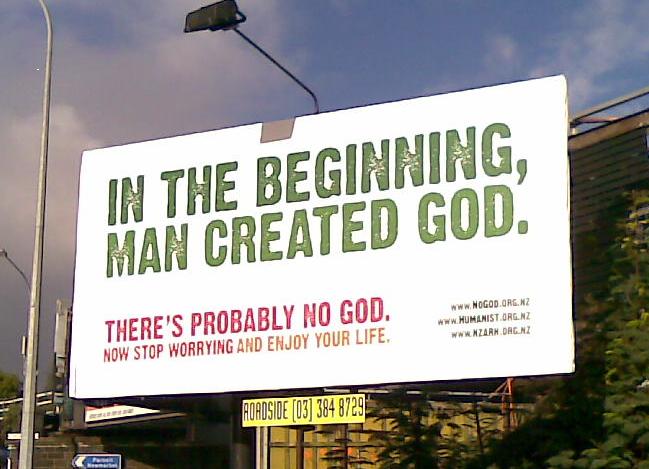
    On the way back from Bloggers drinks we drove past one of the controversial atheist advertising billboards, put up by NZ Atheist Campaign, The Humanist Society and NZARH, which have appeared around Auckland. This appears to have come on the back of the Richard Dawkins inspired bus advertising that made headlines earlier this year. It is worth fisking them a bit.

    Here is a pic of the first one.

    Good Without God? Over One Million Kiwis Are.

    Here we are told one million kiwis are good without God because the census says so. This, however, is fallacious. What the census shows is not that one million kiwis are good without God, it shows that one million kiwis are good (although this is granting a lot for the sake of argument) without believing in the existence God. But to say one can be good without believing in God is not the same as saying one can be good without God. Many people throughout history have been able to live and breath without believing in the existence of hydrogen and oxygen atoms, it does not follow that they could live without water.

    Moreover, it is hard to tell what the point of this sociological fact is anyway. Why does the fact that people do not need to believe in something to do good deeds mean that the belief is false? For centuries people have done good deeds and lived good lives without believing in evolutionary theory or quantum mechanics, should we conclude that these theories are therefore ‘probably false’? Surely these atheists are not suggesting that our beliefs should be based on what is useful or helpful as opposed to what is true or false?

    Perhaps the atheists here mean to convey something else. Some Christian thinkers such as William Lane Craig, Robert Adams, Stephen Layman, Alvin Plantinga, John Hare, Philip Quinn have argued that moral properties such as right and wrong depend on God for their existence. Atheist writers such as Paul Kurtz and Christopher Hitchens retort that this claim is falsified by the existence of morally upright atheists. I suspect something like this is behind the slogan on the billboard, it repeats Hitchens and Kurtz’s retorts as though they said something insightful or clever.

    The problem is, as any one familiar with this discussion should know, this retort misses the point (as I pointed out in On a Common Equivocation). Craig, Adams, et al are not claiming that one needs to believe in God to be good (a point made several times in the literature and particularly made so many times to Kurtz that it beggars belief that he keeps repeating it) rather their claim is that moral properties, such as right and wrong, depend on God for their existence.

    This is a fairly basic and elementary distinction in the literature. How exactly expressing a common philosophical confusion counts as reason for thinking “there probably is no God” is hard to see.

    Let’s look at the next one.

    In the Beginning, Man Created God.

    What is asserted here? That man created God. This, however, is clearly absurd. God is typically defined as an all-powerful, all-knowing, immaterial, necessarily-existent being who created the world. Now if one is going to claim that humans actually created an all-powerful, all-knowing, immaterial, necessarily-existent who created the world, then they are contradicting themselves.

    Humans are part of the world and therefore cannot have created the being that created the world – otherwise humans would have to exist prior to their own existence.

    Similarly, one cannot create a necessary being, this would entail it is possible for a necessary being to not exist, in which case it would not be a necessary being. Taken in a straight-forward, literal manner (the way freethinkers are so fond of taking every passage in the Bible) this billboard simply asserts contradictions.

    Of course, the authors of this billboard probably do not mean to say humans actually created God, they do not think he exists after all. Their claim is that humans created the idea or concept of God and developed it. This is undoubtedly true. Of course, humans also invented the idea or concept of atoms as well, ancient Greek philosophers came up the basics of this concept millennium ago. This trivial fact tells us nothing about whether or not the idea or concept humans developed actually corresponds to anything in reality. To assume that it tells us something about whether the idea or concept is true or false is a fairly obvious case of the genetic fallacy.

    So the second billboard either asserts a contradiction or it is a clear case of a logical fallacy.

    The last one is my favourite.

    We are all atheists about most gods. Some of us just go one god further.

    I am inclined to think the argument on this sign is invalid. To see why let’s take out the term “God” in the sign and replace it with some other term such as “non-Christian perspective.” When we do this we get: “We all reject most non-Christian perspectives, some of us just reject one more.” This argument has true premises, do we now have, a knock-down argument for Christianity?

    Similarly, an analogous argument form with true premises gives us an argument for nihilism, the total denial of the existence of morality. “We are all nihilists about some conceptions of morality, some of us are just nihilistic about one more.”

    The same argument for also furnishes a refutation of secularism, “we all reject some secular perspectives on reality, some of us just reject one more.” I could go on.

    Taking a stand on any issue of philosophical substance, whether by affirming, denying or simply being sceptical of it, is to put oneself in opposition to any number of other people and groups who take a contrary stance. That is life. Such pluralism hardly provides a reason for thinking “there probably is no God” any more than it gives us a reason to doubt any other perspective on the world.

    So what do the atheist billboards do? Well the first one tells us that some atheist groups conflate basic philosophical distinctions and don’t really understand the debate they are contributing to. The second shows us that these groups think contradictions and obvious fallacies are some how savvy and smart. The last shows us that they think that invalid argument forms, forms from which you could infer the denial of anything and everything by substituting one true premise with another, are avant-garde.

    All in all, pretty accurate advertising for these groups.

    Hat tip: MCAS