Tag: Stephen Layman

  • Thinking Matters Talk: Does Morality Need God? Part Two:

    This year the New Zealand apologetics organization Thinking Matters ran a “Confident Christianity Conference” in Auckland. I was asked to speak at this conference on the topic. Does Morality Need God? Below is a slightly streamlined version of the talk I gave.

    I outlined four assumptions about the kind of requirements morality imposes upon us. These were

    1. Inescapability: moral requirements apply to us irrespective of whether following them contributes to any ends or aims we currently desire.
    2. Impartiality: moral requirements are justified from an impartial perspective.
    3. Authority: agents always have conclusive reasons to do what is morally required and never have sufficiently good reasons for doing what is morally wrong.
    4. Accountability: if something is morally required, we are guilty and liable to blame if we fail to do it and lack an adequate excuse.  

    We can now turn to my first contention: secular accounts of morality cannot coherently account for these assumptions. I will make two points in support of this.

    The first is that unless prudential and impartial requirements never conflict, we won’t be able to account for these assumptions coherently.[1] Why think this? Suppose it is not always in one’s long-term self-interest to comply with impartial demands. Sometimes a particular type of practical dilemma will occur. Impartial demands will conflict with prudential requirements. When they do, we face the question: What reason is there to act impartially rather than in one’s self-interest? What reason do we have for always giving precedence to impartial demands in such cases? [2]

    One cannot answer this question by pointing out that we have impartial reasons to follow such rules based on the fact that other people will benefit or be harmed by our actions. The question, after all, is why I should give impartial reasons precedence in such cases. Nor can it be answered by appealing to my interests or because the case is one where morality and such things conflict. Many philosophers have argued that no answer is forthcoming. Three examples will illustrate the problem:

    Example #1. Ms. Poore has lived many years in grinding poverty. She is not starving but has only the bare necessities. She has tried very hard to get ahead by hard work, but nothing has come of her efforts. An opportunity to steal a large sum of money arises. If Ms. Poore steals the money and invests it wisely, she can obtain many desirable things her poverty has denied her: a well-balanced diet, decent housing, adequate heat in the winter, health insurance, new career opportunities through education, and so on. Moreover, if she steals the money, her chances of being caught are very low, and she knows this. She is also aware that the person who owns the money is well off and will not be greatly harmed by the theft. Let us add that Ms. Poore rationally believes that if she fails to steal the money, she will likely live in poverty for the remainder of her life. In short, Ms. Poore faces the choice of stealing the money or living in grinding poverty the rest of her life.[3]

    Example 2: A young woman has her heart set on getting into medical school. If she gets in, through hard work and dedication she will graduate and become a good physician. However, even after much study she has been unable to score high enough on the MCATs to be admitted to any medical school. She finds herself with an opportunity to cheat that will ensure her an MCAT score that is high enough to gain admittance to some medical school and so to eventually fulfill her lifelong dream. Her patients will not be harmed by being treated by an incompetent physician because she will not be an incompetent physician once she receives the necessary training. At most the only person who will be harmed is the person denied admittance to medical school because this young woman will take one of the available places and so leave one less slot to be filled. Assume that this person will only be slightly harmed and that somehow the young woman knows all this. It would be wrong for this young woman to cheat to get into medical school, but why isn’t it true that if she does not care about cheating, then what she has most reason to do is to cheat if she knows she can get away with it?[4]

    Example: 3 Suppose your son has robbed a rich man of his jewels, the police are after him, and he asks you to help him escape to Brazil. You know you can arrange things so that neither of you will get caught. You also know that if he is caught he will be sent to prison and his life will be ruined, but if he escapes, he will have a good life in Brazil. It would be wrong of you to help him escape, but why isn’t it true that what you have most reason to do is to help your son escape justice?[5]

    Cases like this suggest that, if impartial and prudential requirements conflict, agents don’t always have reasons to give precedence to the former. However, this means the total reasons in favor of doing what is impartially demanded will not always be stronger than the reasons against acting. Consequently, agents will not have conclusive reasons to do what they are morally required to do.

    We can summarize the conclusion here as an inference from three intuitively plausible premises:

    [1] Moral requirements are inescapable demands justified from an impartial perspective

    [2] agents always have conclusive reasons to do what is morally required

    [3] If there are cases where impartial and prudential requirements clash, then either (a) agents have reasons to always give precedence to impartial demands in such cases or (b) agents do not always have conclusive reasons to follow impartial demands.

    [4] agents do not always have reasons to give precedence to impartial demands in such cases.

    If these premises are all correct, we must either embrace the assumption that impartial and prudential demands never conflict or embrace a contradiction. We cannot claim both those moral requirements are inescapable and impartial and claim that agents have conclusive reasons to follow them. 

    Second, secular accounts of the kind of accountability we have to morality would, if true, undermine this assumption. They entail that impartial and prudential requirements do sometimes conflict. I noted earlier that if something is morally required, we are accountable for doing it. Historically, many understood this in terms of accountability to God. However, God cannot play that role in a secular theory. What does? Atheist philosopher Walter Sinnott Armstrong answers: “human beings” do. “We each have the authority to hold people responsible for violating moral duties. If my neighbor steals jewelry from his grandmother, then surely, I have the authority to criticize him and his action…You do, too.” [6] “Morality is enforced verbally by public condemnation or socially by ostracizing violators.” [7]. In addition, “we all have the authority to vote for representatives who enforce moral norms through formal institutions, such as by legal punishments…. We collectively have the authority to impose such sanctions.” [8]

    These kinds of sanctions might account for our being accountable to moral requirements. However, they are insufficient to ensure that it is always in everyone’s self-interest to comply with impartial requirements. The” norms enforced through legal punishments,” “public condemnation,” or “social ostracization” are often not justified from an impartial point of view. Laws often endorse or permit unjust practices that fail to take the interests of a segment of society into account. The accepted mores of the groups people belong to, such as nations, and gangs, often are designed to advance the interests of the group over and above those of others. The mores we legally and socially enforce are often unjustified by facts and sound reasoning. The laws of a society can and often do persecute people who act impartially. There are familiar cases where a person becomes a member of a social group where acting immoral enhances their social status, whereas doing what is right results in social ostracization.

    Even if these norms were co-extensive, agents would not be held to account in cases where a person can violate these norms secretly without being detected. There also will be cases where whatever sanctions are incurred will be more than offset by the benefits gained by non-compliance. There will be many cases where a person knows that it is extremely unlikely they will be caught, and the risk of punishment or sanction is more than outweighed by the benefits one receives from disobeying.[9]

    In summary, unless we assume that prudential and impartial commands never conflict, we cannot account for our fundamental intuitions about morality. Second, secular accounts of the kind of accountability we have to morality undermine this assumption. This means that secular accounts of morality cannot coherently account for our fundamental assumptions about morality.


    [1] The argument from this section is influenced by the argument proposed by Henry Sidgwick (1900) The Methods of Ethics Book IV, chapter VI available at https://www.gutenberg.org/files/46743/46743-h/46743-h.htm#Page_496 and also John Gay (1731) The Dissertation Concerning the Fundamental Principle of Virtue or Morality available at https://oll.libertyfund.org/title/wollaston-british-moralists-vol-2#lf1368-02_head_022  I adapt their ideas in my own way. David Brink develops a similar line of argument; see David Brink, “A Puzzle about the Rational Authority of Morality” and also “Kantian Rationalism: Inescapability, Authority, and Supremacy” in In Garrett Cullity & Berys Nigel Gaut (eds.), Ethics and Practical Reason. (Oxford University Press, 1997). 255–291 

    [2] See, for example, David Brink, “Self-Love and Altruism” Social Philosophy & Policy 14 (1997) 123.

    [3] This example comes from C. Stephen Layman’s “God and the Moral Order” Faith and Philosophy, 23 (2006): 307

    [4]  This example comes from Bruce Russell’s “Two Forms of Ethical Skepticism,” in Louis Pojman, Ethical Theory: Classical and Contemporary Readings (New York: Wadsworth, 1998), p. 595.

    [5] Ibid 595,

    [6] Walter Sinnott Armstrong, Morality Without God (Oxford: Oxford University Press, 2009). 98.

    [7] Ibid, 98.

    [8] Ibid,

    [9] These last two paragraphs summarize the argument of Henry Sidgwick in “The Method of Ethics” see Book II, chapter V.  available at https://www.gutenberg.org/files/46743/46743-h/46743-h.htm#Page_162 accessed 25/8/22
  • Does the Incommensurability of Prudential and Impartial rationality avoid the dualism of Practical Reason?

    I have been discussing the dualism of practical reason. As I understand it, this is an inference from three premises:

    [1] We always have most reason to do what is morally required

    [2] An act is morally required if and only if it is impartially demanded: demanded by rules justified from a perspective of impartial benevolence.

     [3] If there are cases where, what is impartially demanded of a person, is an action contrary to their long-term self-interest, then the strongest reasons do not always favour what is impartially demanded.

    The conclusion: unless we assume that requirements of self-interest never substantially conflict with impartial demands, we can only coherently affirm [1] and [2]. Seeing [1] is a plausible thesis about the authority of requirements, and [2] is a plausible thesis about their content.  Our fundamental moral intuitions about morality cannot be reconciled.

    One response to this argument is to deny [3]. This involves contending that impartial requirements are overriding: If impartial and prudential requirements clash, the former always take precedence. In my last post, I mentioned an argument made by Stephen Layman against this contention.   Layman asks us to consider the case of Ms Poore;

    Ms. Poore has lived many years in grinding poverty. She is not starving, but has only the bare necessities. She has tried very hard to get ahead by hard work, but nothing has come of her efforts. An opportunity to steal a large sum of money arises. If Ms. Poore steals the money and invests it wisely, she can obtain many desirable things her poverty has denied her: cure for a painful (but nonfatal) medical condition, a well-balanced diet, decent housing, adequate heat in the winter, health insurance, new career opportunities through education, etc. Moreover, if she steals the money, her chances of being caught are very low, and she knows this. She is also aware that the person who owns the money is very wealthy and will not be greatly harmed by the theft. Let us add that Ms. Poore rationally believes that if she fails to steal the money, she will likely live in poverty for the remainder of her life. In short, Ms. Poore faces the choice of stealing the money or living in grinding poverty the rest of her life. In such a case, I think it would be morally wrong for Ms. Poore to steal the money; and yet, assuming there is no God and no life after death, failing to steal the money will likely deny her a large measure of personal fulfillment, i.e., a large measure of what is in her long-term best interests[1].

    Layman takes this case to illustrate that impartial requirements are not overriding.  If there are cases where impartial demands require us to make a great sacrifice that confers relatively modest benefits on others, the strongest reasons do not support complying with impartial demands.[2] 

    Peter Bryne has criticised Layman’s example. He writes:

    Layman’s way of approaching his moral argument suggests the following picture: rational agents are aware of a variety of reasons for action. They see prudential reasons vying with moral reasons. They measure whether moral reasons for doing something outweigh prudential reasons for not doing it, and they follow that set of reasons which is stronger overall. Now it is time to ask the question “From what standpoint does Layman’s rational agent weigh or measure reasons for action?[3] 

    Bryne thinks this is question raises an important challenge:

    The unclarity in the language of weighing reasons for action, and of judging which reasons are stronger than others, lies in the fact that such language implies a common, neutral means of measuring the reasons. The very contrast, however, between morality and self-interest suggests that there can be no such means. The agent is faced with a choice between points of view and perspectives. From within a point of view or perspective, there can be weighing. What remains a mystery is how any agent could measure the relative strengths of the two kinds of consideration from neither the moral or prudential point of view but from a neutral standpoint.[4]

    Bryne’s criticism seems to be this. Layman example imagines an agent “weighing” impartial reasons against prudential reasons against each other and attempting to answer the question as to which reasons are stronger or take precedence. This implies there is some rational perspective, which is neutral between prudence and impartial demands, which can weigh and adjudicate them in a conflict. 

    Bryne thinks this is misleading. The clash between prudential and impartial reasons involves a clash between requirements justified by incommensurable points of “points of view” or “perspectives”. These points of view are perspectives on what interests to take into account and how much weight to give them. The impartial point of view is a perspective that takes into account everyone’s interests and forms a conclusion based on giving these interests equal weight and consideration. From this point of view, you always have decisive reasons to do what is impartially required. By contrast, the prudential point of view is a view that only gives takes into account the interest of the individual agent and gives equal weight to the future and past interests of this individual agent. From this perspective, you should always act in your long-term self-interest. 

    Because these are differing perspectives on what interests to take into account and how much weight to give conflicting interests, there can be no question-begging way of weighing the conclusions of each procedure against each other. You can weigh reasons for and against actions in accord with one or more of these perspectives. You can have allegiance to one or both perspectives, and weigh from that perspective. One can also give up allegiance to one perspective in favour of another. But, when they clash, you cannot accept both perspectives simultaneously and weigh them against each other. 

    I am inclined to think Byrne’s response here misses the point. Consider how Ms Poore’s case appears on Bryne’s analysis. Ms. Poore “faces the choice of stealing the money or living in grinding poverty the rest of her life”. However, you analyse this; she still has to choose what to do in this situation; she must act one way or the other. In Bryne’s terms, we can ask Which perspective should she use in making the decision and weighing the relevant factors. Which point of view should she give allegiance to? Which should she give up allegiance to? Bryne’s analysis seems to imply there is no reason one can give for or against either answer. There is no “rational” or “neutral point of view” by which she can make this choice. The implication is that Ms Poore does not have stronger or weightier reasons to do what is impartially required. This isn’t because prudential reasons sometimes outweigh or trump impartial reasons, but because one cannot coherently claim one is weightier than the other without begging the very question at issue. 

    Concerns about the dualism of practical reason are concerns about a specific sort of practical dilemma. Suppose it is not always in one’s long-term self-interest to act according to impartial demands. This will mean impartial demands sometimes come into conflict with prudential requirements. When they do, we face the question: What reason is there to act impartially, rather than in one’s self-interest. What reason do we have for assuming that impartial demands are always stronger or weightier than prudential requirements when the two clash? The concern is that no answer to this question is forthcoming. If impartial and prudential requirements cannot be weighed against each other, then its hard to see how the former can always be weightier or take precedence in a clash. If they are incommensurable, we cannot have reasons for preferring one to the other.

    Several commentators argue that this is precisely Sidgwick’s point when he agonised over the dualism of practical reason[5]. Note the argument Sidgwick gives for [3]

    [U]nless the egoist affirms, implicitly or explicitly, that his own greatest happiness is not merely •the rational ultimate end for himself but •a part of universal good; and he can avoid the ‘proof’ of utilitarianism by declining to affirm this. Common sense won’t let him deny that the distinction between himself and any other person is real and fundamental; so it puts him in a position to think: ‘I am concerned with the quality of my existence as an individual in a fundamentally important sense in which I am not concerned with the quality of the existence of anyone else’; and I don’t see how it can be proved that this distinction ought not to be taken as fundamental in fixing the ultimate goal of an individual’s rational action… If an egoist isn’t moved by what I have called proof, the only way of arguing him into aiming at everyone’s happiness is to show that this gives him his best chance of greatest happiness for himself. And even if he admits that the principle of rational benevolence is self-evident, he may still hold •that it is irrational for him to sacrifice his own happiness to any other end;[6] 

    Here, Sidgwick imagines an “egoist”: someone who has “given allegiance” to the prudential point of view and weighs reasons in accord with this perspective. This egoist discovers that an impartial point of view would prohibit some action. Does the egoist have any reason to heed this prohibition? Sidgwick argues that, unless it can be shown that doing so is in his interest, the answer is no. From the egoist’s “perspective” or “point of view,” the effects of the action on his long-term interests is the only factor that carries weight in the decision. Providing does not implicitly give allegiance to an impartial point of view, or he is willing to give up any allegiance he does have to it; he will have no reason to do what is impartially required. Nor does he have any question-begging reason why he should switch allegiance to this point of view. 

    On this interpretation: the dualism of practical reason is the problem that impartial and prudential requirements are requirements justified from incommensurable points of view. Because human beings recognise both prudential and impartial reasons for acting in their practical reasoning, they implicitly give allegiance to both. This is not a problem if their requirements are consistent. But if they contradict each other, we will be rationally committed both to both doing and not doing the same action. The incommensurability of these perspectives means there is no rational basis for resolving the contradiction in favour of impartiality. Sidgwick writes:

    [W]here we find a conflict between self-interest and duty, practical reason, being divided against itself, would cease to be a motive on either side. The conflict would have to be decided by which of two groups of non-rational impulses had more force. So we have this: •The harmony of duty and self-interest is a hypothesis that is required if we are to avoid a basic contradiction in one chief part of our thought.[7]

    We can put it this way: Either prudential and impartial reasons are commensurable, or they are incommensurable. If they are commensurable, then when these requirements clash, we will need some reason for thinking that impartial reasons are always weightier. The Ms Poore case suggests this is not the case. By contrast, suppose that prudential and impartial requirements are incommensurable perspectives, and we cannot weigh them against each other. If they clash, we will have to choose which perspective to follow, and we will have no reason to follow one or the other. It will simply be an arbitrary act of allegiance. Either way, we will lack decisive reasons always to do what is impartiality required.


    [1] C. Stephen Layman “God and the Moral Order” Faith and Philosophy, 23 (2006): 307

    [2] Layman, “God and the Moral Order” 308

    [3] Peter Bryne “God and the Moral Order: A Reply to Layman” Faith and Philosophy, 23:2 (2006): 201

    [4] Bryne, “God and the Moral Order: A Reply to Layman” 206-207:

    [5] See for example, Derek Parfit On What Matters (Volume 1) (Oxford: Oxford University Press : 2011) 130-134. See also Francesco Orsi, “The Dualism of the Practical Reason: Some Interpretations and Responses” Etica & Politica / Ethics & Politics, 10:2 (2008): 25-26

    [6] Henry Sidgwick, The Method of Ethics, 242 available at https://www.earlymoderntexts.com/assets/pdfs/sidgwick1874.pdf accessed 20/3/21

    [7] Henry Sidgwick, The Method of Ethics, 284 available at https://www.earlymoderntexts.com/assets/pdfs/sidgwick1874.pdf accessed 20/3/21


  • Does the Dualism of Practical Reason assume Egoism?

    Recently, I have been examining the question, “If there is no God, why be good?” As I interpret it, this expresses an argument about the “dualism of practical reason” made by Henry Sidgwick and John Gay. This argument had three steps.

    • First, unless we assume that it is always in our long-term self-interest to follow the demands of impartial altruism, we will not always have decisive reasons to do our duty.
    • Second, secular accounts of sanctions and moral and accountability would, if true, undermine this assumption. They imply that it is not always in our long-term self-interest to follow impartial demands.
    • By contrast, if true, a divine command theory would vindicate this assumption and provide a coherent account of our fundamental intuitions about the authority and content of moral requirements.

    The conclusion is that those divine command theories can coherently answer the question: “why should I always do my duty?” whereas secular ethical theories cannot.

    The first step of this argument was motivated by concerns about “the dualism of practical reasoning”. A contradiction that results from three intuitively plausible premises:

    [1] We always have decisive reasons to do what is morally required.

    [2] An action is morally required if it is required by rules justified from a perspective of impartial altruism.[1]

    [3] If there are cases where what is demanded by impartially justified rules conflicts with our long-term self-interest, we do not always have decisive reasons to do what is required by impartially justified rules.

    These three premises entail that we must either: (a) embrace the thesis that impartial demands and prudential demands never conflict or (b) embrace a contradiction. Affirming both that we do and do not always have decisive reasons to do morality requires.

    Some object that [3] assumes the truth of rational Egoism: the thesis that I have a reason to perform some action if and only if, and because performing that action maximises my self-interest. Walter Sinnott Armstrong, states.

    Harming others is sometimes in some people’s best interest, even considering probable costs. In those cases, some theists say that only a divine threat of Hell provides a reason to be moral. Since atheists and agnostics do not believe in God, they do not believe in divine retribution for sins, so they have to admit that sometimes some people could get away with immorality and then they have no self-interested reason to be moral. Does that mean that these people have no reason at all to be moral? No. That conclusion would follow only if every reason had to be self-interested, selfish, or egoistic. There is no basis for that assumption. Many reasons are not based on self-interest…[2]

    Armstrong provides cases where the fact an act would benefit other people provides us with reasons to do it. He concludes:

    “The fact that an act prevents harm to another person can be a reason for me to do that act. These reasons are not self-interested. They are facts about the interests of other people, not me. These unselfish reasons can answer the question, “Why be moral?”[3]

    I think this dismisses the problem far too quickly. In this post, I will explain why I think this.

    At the outset, one must concede that some important defenders of [3] have appealed rational Egoism. Consider, John Gay; Gay argued that:

    Thus those who either or don’t mention the will of God, making the immediate criterion of virtue to be the good of mankind; must either allow that virtue is not in all cases obligatory (contrary to the idea which all or most men have of it) or they must say that the good of mankind is a sufficient obligation. But how can the good of mankind by any obligation to me, when perhaps, However, its clear in particular cases, such as laying down my life, or the like, it is contrary to my happiness?[4]

    Gay uses the word “obligatory” to refer to what agents have decisive reasons to do. However, he bases his conclusion on an egoist understanding of practical reasons. Earlier, he wrote, “Obligation is the necessity of doing or omitting any action in order to be happy” we are obliged to do or omit an action…” when there is such a relation between an Agent and an action that the agent cannot be happy without doing or omitting that action.”[5]

    On some interpretations, Sidgwick held a similar view. According to David Brink: “Sidgwick wants to represent the dualism of practical reason as a conflict between a utilitarian account of duty and an egoistic or prudential account of rationality.”[6]

    If rational Egoism is true, we have a powerful argument favouring [3]. Suppose we grant rational Egoism and affirm the antecedent of [3] we get.

    [3a] We have a reason to perform some action if and only if, and because performing that action maximises my self-interest.

    [3b] There are cases where what is demanded by impartially justified rules conflicts with our long-term self-interest

    The conclusion that follows is

    [3c] There are cases where we have no reasons to do what is demanded by impartially justified rules.

    So, it is true that many people who have argued for [3] have appealed to Egoism. It is also true that rational Egoism would, if true, provide grounds affirming [3]. However, these facts do not show that [3] assumes rational Egoism. All they show is that some arguments for [3] depend on rational Egoism.

    There are other arguments for [3] which, do not appeal to rational Egoism, which have the same result. Consider, for example, David Brink, whom I mentioned above. Brink is a leading secular meta-ethicist representing a position known as “Cornell realism“: a research project that attempts to vindicate objective moral facts within a scientific-naturalist view of the world. In doing so, Brink appeals to the thesis that all reasons for action are agent-relative: “Reasons for action are dependent on the aims or interests of the agent who has them.”[7] According to this thesis, what an agent has reasons to do, is a function of or derived from his desires and interests. Facts about reasons are simply facts about what humans desire are interested in or aim at under certain conditions.  This thesis is popular in contemporary philosophy. Brink summarises some of the reasons for its popularity:

    Agent-relative assumptions seem to underlie many formal and informal discussions of individual rationality in philosophy, economics, and politics. Moreover, an agent-relative theory provides a reliable link between reasons for action and motivation, we expect one who recognises reasons for action to be motivated to act on them, and an agent seems more likely to be motivated by facts about his own interest or desires than by facts about the interest or desires of others. Also, when we explain an agent’s behaviour as an attempt to satisfy certain desires, given her beliefs, we are said to “rationalise” her behaviour. This suggests that genuinely rational behavior is that which would promote the agent’s desires or at least those desires that she would have if she met certain epistemic conditions.[8]

    This thesis does not entail that all reasons are self-interested. Even if benefiting another does not promote my interests, it can still fulfil my desires or aims. What the thesis rules out is the existence of “impartial reasons”. Reasons to promote the good of others that don’t derive from the interests or aims of the agent in question.[9] Moreover, if the thesis is true, there is a sound argument for something like [3].

    [3a]* An agent has a reason to perform some action if and only if, and because, that performing that achieves ّthe agents aims or promotes the agents’ interests

    [3b]* there are cases where what is demanded by impartially justified rules conflicts with the agents’ aims and is not in the agents’ interest

    Therefore

    [3c] There are cases where we have no reasons to do what is demanded by impartially justified rules. [10]

    Because this thesis entails that we have no reason to comply with morality in cases where doing so is not in our interests and contrary to our aims, other philosophers reject it. They contend there are also impartial reasons: reasons to promote the welfare of others that don’t derive from our interests and aims. However, even if one grants the existence of impartial reasons, worries about the dualism of practical reason still arise. Brink explains:

    [W]e do not need to think of rationality in exclusively prudential terms to raise this worry. The worry can arise even if there are impartial reasons-that is, nonderivative reasons to promote the welfare of others. For as long as there are prudential reasons, a conflict between impartial reason and prudential reason appears possible. Without some reason to treat impartial reasons as superior, the supremacy of other-regarding morality must remain doubtful.[11]

    Suppose impartial rules demand something contrary to our self-interests. If such cases occur, impartial reasons will point in one direction, and our interests and aims will point in another. This situation generates the sceptical question, “Why be Moral?” What reason do I have, in such cases, to follow impartial rules, not my self-interest? One cannot answer this question by pointing out we have impartial reasons to follow such rules. The question, after all, is why I should give impartial reasons precedence? Nor can it be answered by appealing to my interests or aims because the case is one where morality and such things conflict. 

    Stephen Layman provides a vivid example of the problem:

    Ms Poore has lived many years in grinding poverty. She is not starving but has only the bare necessities. She has tried very hard to get ahead by hard work, but nothing has come of her efforts. An opportunity to steal a large sum of money arises. If Ms. Poore steals the money and invests it wisely, she can obtain many desirable things her poverty has denied her: cure for a painful (but nonfatal) medical condition, a well-balanced diet, decent housing, adequate heat in the winter, health insurance, new career opportunities through education, etc. Moreover, if she steals the money, her chances of being caught are very low, and she knows this. She is also aware that the person who owns the money is very wealthy and will not  be greatly harmed by the theft …Ms. Poore faces the choice of stealing the money or living in grinding poverty the rest of her life. In such a case, I think it would be morally wrong for Ms. Poore to steal the money; and yet, assuming there is no God and no life after death, failing to steal the money will likely deny her a large measure of personal fulfilment, i.e. a large measure of what is in her long-term best interests.[12] 

    Layman accepts that Ms Poore has impartial reasons not to steal.[13] However, these reasons conflict with powerful prudential reasons to steal. Plausibly, there are stronger reasons to break in cases like this than complying with impartial rules. Compliance will be “irrational—in the sense that it involves acting on inferior or weaker reasons.”[14] 

    Let’s recap the dialectic: if rational egoism is true, we lack reason to obey impartial rules if doing so is contrary to our self-interest. If all reasons are agent-relative: we will lack reason to obey if doing so is not in our interests nor promotes our aims. By contrast, if there are impartial reasons, if compliance is not in our interest, prudential and impartial reasons will conflict. There is no reason always to treat impartial rules as having precedence in such conflicts. Even if rational egoism is false, a problematic dualism of practical reason looms.


    [1] To avoid wordiness, I will use the phrase “impartially justified rules” to refer to rules which are justified from a perspective of impartial altruism.

    [2] Walter Sinnott Armstrong, Morality Without God (Oxford: Oxford University Press, 2009). 114

    [3] Walter Sinnott Armstrong, Morality Without God 117

    [4] John Gay on Gay, “Dissertation Concerning the Fundamental Principle of Virtue or Morality”, available at https://oll.libertyfund.org/title/wollaston-british-moralists-vol-2#lf1368-02_head_022 accessed 29/7/21

    [5] John Gay, “Dissertation Concerning the Fundamental Principle of Virtue or Morality”, available at https://oll.libertyfund.org/title/wollaston-british-moralists-vol-2#lf1368-02_head_022 accessed 29/7/21

    [6] David Brink, “Sidgwick’s dualism of Practical Reason” Australasian Journal of Philosophy. 66:3, 1998. 303. Brink’s interpretation of Sidgwick is controversial.

    [7] David Brink, “A Puzzle about the Rational Authority of Ethics”, Philosophical Perspectives, Vol. 6, Ethics, (1992) 1

    [8] David Brink, “A Puzzle about the Rational Authority of Ethics”, 2

    [9] David Brink “Kantian Rationalism: Inescapability, Authority and Supremacy” in In Garrett Cullity & Berys Nigel Gaut (eds.), Ethics and Practical Reason. Oxford University Press (1997) 257

    [10] See David Brink, “A Puzzle about the Rational Authority of Morality” and also “Kantian Rationalism: Inescapability, Authority and Supremacy” in In Garrett Cullity & Berys Nigel Gaut (eds.), Ethics and Practical Reason. (Oxford University Press, 1997). 255–291 for the articulation of an agent-relative version of what is essentially the same problem.

    [11] David Brink, “Self-Love and Altruism” Social Philosophy & Policy 14 (1997) 123

    [12] C. Stephen Layman “God and the Moral Order” Faith and Philosophy, 23 (2006): 307

    [13] Layman “God and the Moral Order” 305:

    [14] Stephen Layman Letters to Doubting Thomas: A Case for the Existence of God, (Oxford University Press, 2006) 242


  • Erik Wielenberg and the Autonomy Thesis: Part Two Standard Objections to the Autonomy Thesis, Reasons to be Moral Without God

    defaul1The autonomy thesis contends that there can be moral requirements to φ regardless of whether God commands, desires, or wills that people φ. In his monograph, Robust Ethics: The Metaphysics and Epistemology of Godless Normative Realism,[1] Erik Wielenberg offers arguably one of the most sophisticated defences of the autonomy thesis to date.

    Wielenberg argues three things. First, I the most plausible alternative to the autonomy thesis, the divine command theory, is problematic because it cannot account for the moral obligations of reasonable unbelievers. Second, II  robust realism, the thesis that moral requirements are sui generis non-natural properties which supervene upon natural properties, can be formulated in a way that avoids the standard objections to the autonomy thesis. Third, III robust realism provides a better account of intrinsic value than any meta-ethical theory that identifies moral goodness with states of God.

    In a previous post I discussed I, I argued Wielenberg’s critique of divine command meta-ethics fails. This post will begin looking at his second major claim II. As an alternative to DCM, Wielenberg proposes a position he labels Robust Realism, the thesis that moral requirements are sui generis non-natural properties which supervene upon natural properties. By itself, robust realism is compatible with both theism and atheism. Wielenberg refers to the conjunction of robust realism and atheism as Godless Robust Normative Realism (GRNR) Wielenberg contends that his formulation of GRNR avoids the standard objections to the autonomy thesis.  Here I’ll look at one such objection.

    Reasons for being Moral without God.

    One objection Wielenberg discusses is the perennial concern that, in the absence of God, people lack compelling reasons to comply with morality’s demands. Wielenberg takes the following comments by Craig as representative of this objection.

    Even if there were objective moral values and duties under naturalism, they are irrelevant because there is no moral accountability. If life ends at the grave, it makes no difference whether one lives as a Stalin or as a saint…Why should you sacrifice your self-interest and especially your life for the sake of someone else? There can be no good reason for adopting such a self-negating course of action on the naturalistic worldview… Life is too short to jeopardize it by acting out of anything but pure self-interest. [2]

     Wielenberg initially suggests that Craig is arguing that “if people had moral obligations, but God did not exist, then people would have no normative reasons to carry out their obligations”.[3] He re-joins, plausibly, that people often do have normative reasons to refrain from wrongdoing. “the fact rape harms its victims is a compelling reason for me not to rape, regardless of whether refraining from rape benefits me” (emphasis mine).[4]

    Wielenberg then suggests that Craig might be offering a different argument. He might be contending that “if God does not exist then people lack self-interested normative reasons to perform their obligations” Wielenberg suggests taken this way, there are two problems with the argument. First, even if it were true, it wouldn’t follow that people lack any normative reasons to perform their obligations.  Second, this claim isn’t true “people often do in fact do have powerful self-interested reason’s for caring about fulfilling their obligations”[5] Wielenberg cites various empirical studies which show that immorality tends to disrupt, and damage people’s social relationships and harm meaningful connections.[6]

    However, it seems implausible to me that Craig is maintaining either of these positions. Elsewhere.  Craig clarifies his position as follows:

    [I]f God does not exist, then prudential reason and moral reason can and often do come into conflict, in which case there is no reason to act morally rather than in one’s self-interest. That’s consistent with saying that in other cases it is, indeed, prudent to act morally.[7]

    Here Craig affirms that if atheism is true, people often can have both moral and prudential normative reasons to carry out their moral obligations. So he doesn’t affirm, either of the positions, Wielenberg attributes to him.  He isn’t saying that no one ever has reasons to refrain from wrongdoing, nor is he claiming that no one ever has prudential reasons to refrain from wrongdoing.  Craig’s objection is rather that, if atheism is true, moral and prudential reasons can and do come into conflict. When they do people lack any reason to comply with what morality demands. “One has moral value pulling in one direction and prudential value tugging in the opposite, and no way to decide rationally which choice to make”[8].

    Latter Wielenberg suggests a different way of formulating the argument:

    [1] If GRNR is true then morality and self-interest sometimes diverge in the long run.

    [2] But, morality and self-interest never diverge in the long run.

    [3] Therefore, GRNR is false[9]

    Wielenberg grants the truth of [1], the empirical studies he earlier cited show only that people “often” have powerful prudential reasons to do what is right, not that they always or necessarily do. Wielenberg states that “an important different between a theistic universe and a godless universe” is that “without God, there is always the possibility that we will face a deep conflict between what is in our self-interest and what morality requires of us”. On the other hand, if God exists “there is a perfect correlation between morality and self-interest”[10]

    Wielenberg’s rebuttal, therefore, focuses on denying [2], his treatment of [2] consists of a single paragraph:

    It is hard to imagine a convincing non-question begging rationale for (2) that wouldn’t at the same time tell against (1). One might appeal to the existence of God to support (2) but this obviously begs the question. Alternatively, one might find a secular ground for (2)-but to the extent that such a ground is convincing it undermines the first premise…Craig often proceeds as if (2) were a datum for which any plausible moral theory must account. But such an approach has nothing to commend it. It is no more plausible than the falsity of (2) as a datum and arguing against Craig’s view. Such arguments get us nowhere.[11]

    Wielenberg provides two reasons for rejecting [2]. These are (a) that there is no non-question-begging reason for affirming [2] which does not undermine [1], and (b) that [2] is not a datum to be explained by a moral theory.  Neither is compelling.

    Regarding first (a), the problem is that several people, including Craig, have offered reasons for affirming [2] which neither assume theism or tell against [1].

    Robert Adam’s, for example, has appealed to the intuition that moral judgments “have an action- and preference-guiding force that they could not have unless everyone had reason to follow them in his actions and preferences.”[12]  Adam’s argues that “if happiness will, in the long run, be strictly proportioned to moral goodness, that explains how virtually everyone does have an important reason to want to be good.”[13] However, if this is not the case, it’s hard to justify the conclusion that “everyone does have reason always to be moral.”[14]

    Adam’s here focuses on the idea that everyone has a reason to be moral.  That if an action φ is morally wrong for a person P to perform, then P has a reason to not φ. Stephen Layman has offered a similar line of argument, focusing instead on the idea that people always have decisive reasons to do what morality demands.  Layman refers to what he calls the “The Reasons Thesis: The strongest reasons always favor doing what is morally required.” The idea that if something is obligatory, we not only have a reason to do it but that this reason is always decisive. Other reasons we may have for not complying such as reasons of self-interest or economics do not override it. Layman provides several examples which suggest that “If there is no God and no life after death, then there are cases in which morality requires that one make a great sacrifice that confers relatively modest benefits (or prevents relatively modest harms).” Layman argues that if such cases obtain,  reasons of prudence will override moral reasons we have doing the action in question.[15]

    Neither of these arguments begs the question by assuming God exists. They appeal not to God’s existence, but theses about the authority of moral requirements, that they provide virtually everyone with decisive reasons for acting.  Nor do these arguments give us reason for questioning [1]. Both, of them, in fact, concede and incorporate [1] in their thinking. So, Wielenberg’s claim, that it’s hard to imagine a non-questioning begging rationale for [2] that doesn’t undermine [1], is false. Several such rationales have been offered in the literature which he does not even mention let alone address.

    Moreover, Craig himself provided a similar rationale.   Craig claimed that:“[I]f God does not exist, then prudential reason and moral reason can and often do come into conflict, in which case there is no reason to act morally rather than in one’s self-interest”[16]. Elsewhere, Craig has stated:

    “I agree with Layman that on atheism, what he calls the overriding thesis ( namely that moral value always trumps prudential value) is not true, for one can have extremely strong prudential reasons for not acting morally, and there seems to be no common scale in which to weigh moral against prudential considerations”[17]

    This brings us to  (b), Wielenberg’s objection that [2] is not a datum to be explained by a moral theory. While he is correct that [2] itself is not a datum of moral theory, the claim that moral demands are authoritative so that everyone always as a decisive reason to be moral is something that, at least prima facie, a meta-ethical theory should explain.[18]  Wielenberg himself seems to accept this. He states “as I suggested in Chapter 1, to have an obligation just is to have decisive reasons to perform a certain action.” Therefore, according to Wielenberg, it is a necessary truth that we always have decisive reasons to do what we are moral required to do, and it is impossible, for people to not have such reasons or them to be overridden by other reasons such as self-interest”. Adam’s, Layman and Craig, therefore, appeal to something that is, on his view, a datum a meta-ethical theory should explain.


    [1] Erik Wielenberg, Robust Ethics: The Metaphysics and Epistemology of Godless Normative Realism (Oxford: Oxford University Press, 2014)

    [2] Erik Wielenberg, Robust Ethics, 56-57, the citation is from William Lane Craig “The Indispensability of Meta-Ethical Theological Foundations for Morality” available at http://www.leaderu.com/offices/billcraig/docs/meta-eth.html

    [3] Ibid, 57

    [4] Ibid

    [5] Ibid

    [6] Wielenberg’s examples all deal with Hume’s idea of the sensible knave, the individual who has a reputation for morality but engages in undetected wrongdoing when it’s in his self-interest. They don’t, however, address Kai Neilsen’s example of a “classist amoralist” who forms deep and genuine relationships with others within his class but ruthlessly exploits members of other classes to his advantage. See Kai Nielsen Why be Moral (Buffalo, N.Y: Prometheus Books, 1989) 295-296

    [7] William Lane Craig  “Q&A 230 Is Life Absurd without God?” available at http://www.reasonablefaith.org/is-life-absurd-without-god. Accessed 6/2/2017

    [8] William Lane Craig “This Most Gruesome of Guests” Is Goodness without God Good Enough: A Debate on Faith, Secularism and Ethics eds Robert K Garcia and Nathan L King (Lanham: Rowman & Littlefield Publishers, 2008) 182-183

    [9] Wielenberg, Robust Ethics 59

    [10] Ibid, 59

    [11] Ibid, 59

    [12] Robert Adams “Moral Argument for Theistic Belief” in The Virtue of Faith and Other Essays in Philosophical Theology, (New York: Oxford University Press, 1987). 158

    [13] Ibid

    [14] Ibid.

    [15] See C Stephen Layman “God and the moral order”, Faith and Philosophy, 19: 3 (2002) 304-16.

    [16] William Lane Craig “Q&A 230 Is Life Absurd without God?” available at http://www.reasonablefaith.org/is-life-absurd-without-god. Accessed 6/2/2017

    [17] William Lane Craig “This Most Gruesome of Guests” 183

    [18] Terence Cuneo makes this point, see  Terence Cuneo “Erik J Wielenberg Robust Ethics: The Metaphysics and Epistemology of Godless Normative Realism” Notre Dame Philosophical Reviews 2015.03.24 available at http://ndpr.nd.edu/news/56511-robust-ethics-the-metaphysics-and-epistemology-of-godless-normative-realism/ accessed 7/2/17

  • Is Ethical Naturalism More Plausible than Supernaturalism? A Reply to Walter Sinnott-Armstrong: Part II

    This is the second part of the paper I presented to the Naturalisms in Ethics Conference at Auckland University last year.

    In my previous post, I noted that Robert Adams has argued that if God exists, then divine commands “best fill the role assigned to wrongness by the concept”.[1] He argues that if moral obligations are divine commands this explains the fact, that (i) “wrongness is an objective property of actions,”[2], (ii) it accounts “for the wrongness of a major portion of the types of action that we have believed to be wrong,”[3]   (iii) it “plays a causal role … in their coming to be regarded as wrong”,[4]  (iv) it explains how moral obligations constitute a “supremely weighty reason” for acting or refraining from an action,   and (v) he contends that DCT explains the intuition that moral duties comprise “a law or standard that has a sanctity greater than that of any merely human will or institution”.[5]

    Moreover, in my last post, I also argued that, for Armstrong to conclude his arguments call into question any theistic account of ethics, he must argue that his harm account of moral obligation provides a better explanation of all these features. Failing that, if his account doesn’t preserve these features of moral obligation, then he must provide us with a reason to suppose that they are not part of the concept of moral obligation. Or he must provide reasons for revising our concepts.

    In his monograph “Morality without God” he attempted to do this. It’s my contention that he has failed in this task.

    1. Social Requirements

    Let’s begin with (v), In “Morality without God”, Armstrong purports to address this line of argument, he claims that “the best line of argument-because it is the only argument is that moral laws require a lawgiver”[6]. He attributes to popular writer Dinesh D’Souza. He then proceeds to make short work of D’Souza’s argument.

    However, this is neither the best, nor the only argument offered in favour of a DCT. In subsequent articles and a monograph, Adam’s has developed (v) in some detail.[7] Adam’s proposes a “social requirement theory” of obligation whereby “being obligated to do something consists in being required (in a certain way under certain situations) by another person or groups of persons not to do it”[8]. Obligations are a kind of social relationship where one person makes a demand on another, failure to comply results ruptures in the relationship expressed in terms of blame, censure, punishment and alienation, which can be expiated by forgiveness. Adam’s offers a sustained argument that the role of guilt, censure, punishment, social inculcation, moral motivation, moral knowledge and forgiveness plays in our concept of obligation, make a social requirement theory plausible.[9] Nowhere in Armstrong “Morality without God” does Armstrong even (more…)

  • There’s Probably No God? Fisking Atheist Billboards

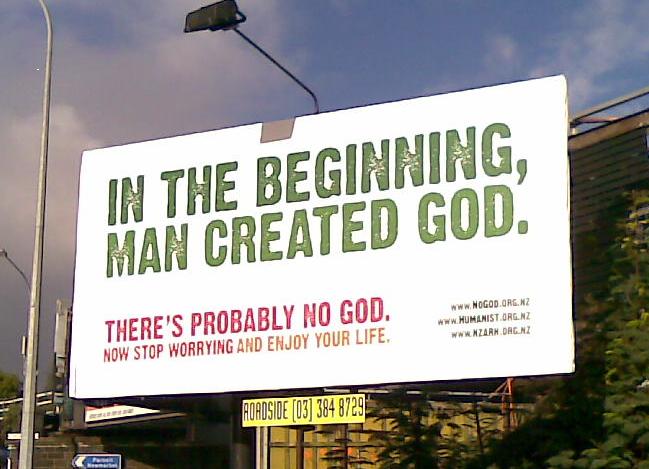
    On the way back from Bloggers drinks we drove past one of the controversial atheist advertising billboards, put up by NZ Atheist Campaign, The Humanist Society and NZARH, which have appeared around Auckland. This appears to have come on the back of the Richard Dawkins inspired bus advertising that made headlines earlier this year. It is worth fisking them a bit.

    Here is a pic of the first one.

    Good Without God? Over One Million Kiwis Are.

    Here we are told one million kiwis are good without God because the census says so. This, however, is fallacious. What the census shows is not that one million kiwis are good without God, it shows that one million kiwis are good (although this is granting a lot for the sake of argument) without believing in the existence God. But to say one can be good without believing in God is not the same as saying one can be good without God. Many people throughout history have been able to live and breath without believing in the existence of hydrogen and oxygen atoms, it does not follow that they could live without water.

    Moreover, it is hard to tell what the point of this sociological fact is anyway. Why does the fact that people do not need to believe in something to do good deeds mean that the belief is false? For centuries people have done good deeds and lived good lives without believing in evolutionary theory or quantum mechanics, should we conclude that these theories are therefore ‘probably false’? Surely these atheists are not suggesting that our beliefs should be based on what is useful or helpful as opposed to what is true or false?

    Perhaps the atheists here mean to convey something else. Some Christian thinkers such as William Lane Craig, Robert Adams, Stephen Layman, Alvin Plantinga, John Hare, Philip Quinn have argued that moral properties such as right and wrong depend on God for their existence. Atheist writers such as Paul Kurtz and Christopher Hitchens retort that this claim is falsified by the existence of morally upright atheists. I suspect something like this is behind the slogan on the billboard, it repeats Hitchens and Kurtz’s retorts as though they said something insightful or clever.

    The problem is, as any one familiar with this discussion should know, this retort misses the point (as I pointed out in On a Common Equivocation). Craig, Adams, et al are not claiming that one needs to believe in God to be good (a point made several times in the literature and particularly made so many times to Kurtz that it beggars belief that he keeps repeating it) rather their claim is that moral properties, such as right and wrong, depend on God for their existence.

    This is a fairly basic and elementary distinction in the literature. How exactly expressing a common philosophical confusion counts as reason for thinking “there probably is no God” is hard to see.

    Let’s look at the next one.

    In the Beginning, Man Created God.

    What is asserted here? That man created God. This, however, is clearly absurd. God is typically defined as an all-powerful, all-knowing, immaterial, necessarily-existent being who created the world. Now if one is going to claim that humans actually created an all-powerful, all-knowing, immaterial, necessarily-existent who created the world, then they are contradicting themselves.

    Humans are part of the world and therefore cannot have created the being that created the world – otherwise humans would have to exist prior to their own existence.

    Similarly, one cannot create a necessary being, this would entail it is possible for a necessary being to not exist, in which case it would not be a necessary being. Taken in a straight-forward, literal manner (the way freethinkers are so fond of taking every passage in the Bible) this billboard simply asserts contradictions.

    Of course, the authors of this billboard probably do not mean to say humans actually created God, they do not think he exists after all. Their claim is that humans created the idea or concept of God and developed it. This is undoubtedly true. Of course, humans also invented the idea or concept of atoms as well, ancient Greek philosophers came up the basics of this concept millennium ago. This trivial fact tells us nothing about whether or not the idea or concept humans developed actually corresponds to anything in reality. To assume that it tells us something about whether the idea or concept is true or false is a fairly obvious case of the genetic fallacy.

    So the second billboard either asserts a contradiction or it is a clear case of a logical fallacy.

    The last one is my favourite.

    We are all atheists about most gods. Some of us just go one god further.

    I am inclined to think the argument on this sign is invalid. To see why let’s take out the term “God” in the sign and replace it with some other term such as “non-Christian perspective.” When we do this we get: “We all reject most non-Christian perspectives, some of us just reject one more.” This argument has true premises, do we now have, a knock-down argument for Christianity?

    Similarly, an analogous argument form with true premises gives us an argument for nihilism, the total denial of the existence of morality. “We are all nihilists about some conceptions of morality, some of us are just nihilistic about one more.”

    The same argument for also furnishes a refutation of secularism, “we all reject some secular perspectives on reality, some of us just reject one more.” I could go on.

    Taking a stand on any issue of philosophical substance, whether by affirming, denying or simply being sceptical of it, is to put oneself in opposition to any number of other people and groups who take a contrary stance. That is life. Such pluralism hardly provides a reason for thinking “there probably is no God” any more than it gives us a reason to doubt any other perspective on the world.

    So what do the atheist billboards do? Well the first one tells us that some atheist groups conflate basic philosophical distinctions and don’t really understand the debate they are contributing to. The second shows us that these groups think contradictions and obvious fallacies are some how savvy and smart. The last shows us that they think that invalid argument forms, forms from which you could infer the denial of anything and everything by substituting one true premise with another, are avant-garde.

    All in all, pretty accurate advertising for these groups.

    Hat tip: MCAS