Tag: Christopher Hitchens

  • There’s Probably No God? Fisking Atheist Billboards

    On the way back from Bloggers drinks we drove past one of the controversial atheist advertising billboards, put up by NZ Atheist Campaign, The Humanist Society and NZARH, which have appeared around Auckland. This appears to have come on the back of the Richard Dawkins inspired bus advertising that made headlines earlier this year. It is worth fisking them a bit.

    Here is a pic of the first one.
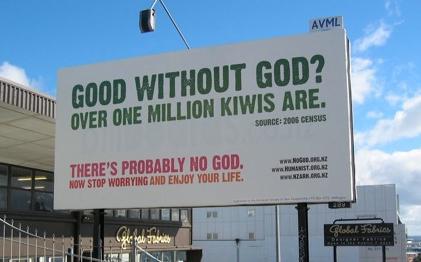
    Good Without God? Over One Million Kiwis Are.

    Here we are told one million kiwis are good without God because the census says so. This, however, is fallacious. What the census shows is not that one million kiwis are good without God, it shows that one million kiwis are good (although this is granting a lot for the sake of argument) without believing in the existence God. But to say one can be good without believing in God is not the same as saying one can be good without God. Many people throughout history have been able to live and breath without believing in the existence of hydrogen and oxygen atoms, it does not follow that they could live without water.

    Moreover, it is hard to tell what the point of this sociological fact is anyway. Why does the fact that people do not need to believe in something to do good deeds mean that the belief is false? For centuries people have done good deeds and lived good lives without believing in evolutionary theory or quantum mechanics, should we conclude that these theories are therefore ‘probably false’? Surely these atheists are not suggesting that our beliefs should be based on what is useful or helpful as opposed to what is true or false?

    Perhaps the atheists here mean to convey something else. Some Christian thinkers such as William Lane Craig, Robert Adams, Stephen Layman, Alvin Plantinga, John Hare, Philip Quinn have argued that moral properties such as right and wrong depend on God for their existence. Atheist writers such as Paul Kurtz and Christopher Hitchens retort that this claim is falsified by the existence of morally upright atheists. I suspect something like this is behind the slogan on the billboard, it repeats Hitchens and Kurtz’s retorts as though they said something insightful or clever.

    The problem is, as any one familiar with this discussion should know, this retort misses the point (as I pointed out in On a Common Equivocation). Craig, Adams, et al are not claiming that one needs to believe in God to be good (a point made several times in the literature and particularly made so many times to Kurtz that it beggars belief that he keeps repeating it) rather their claim is that moral properties, such as right and wrong, depend on God for their existence.

    This is a fairly basic and elementary distinction in the literature. How exactly expressing a common philosophical confusion counts as reason for thinking “there probably is no God” is hard to see.

    Let’s look at the next one.
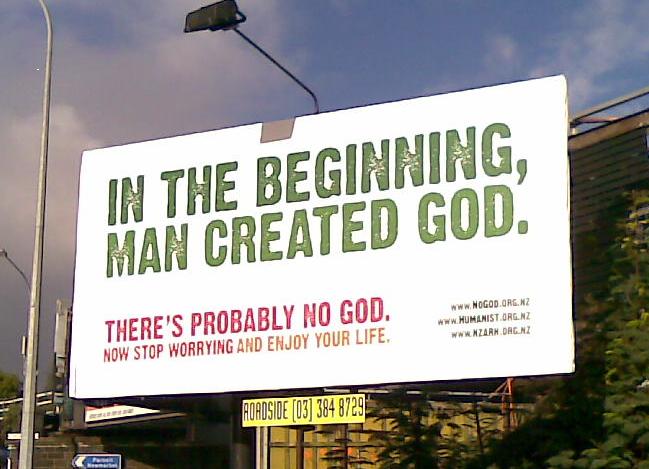
    In the Beginning, Man Created God.

    What is asserted here? That man created God. This, however, is clearly absurd. God is typically defined as an all-powerful, all-knowing, immaterial, necessarily-existent being who created the world. Now if one is going to claim that humans actually created an all-powerful, all-knowing, immaterial, necessarily-existent who created the world, then they are contradicting themselves.

    Humans are part of the world and therefore cannot have created the being that created the world – otherwise humans would have to exist prior to their own existence.

    Similarly, one cannot create a necessary being, this would entail it is possible for a necessary being to not exist, in which case it would not be a necessary being. Taken in a straight-forward, literal manner (the way freethinkers are so fond of taking every passage in the Bible) this billboard simply asserts contradictions.

    Of course, the authors of this billboard probably do not mean to say humans actually created God, they do not think he exists after all. Their claim is that humans created the idea or concept of God and developed it. This is undoubtedly true. Of course, humans also invented the idea or concept of atoms as well, ancient Greek philosophers came up the basics of this concept millennium ago. This trivial fact tells us nothing about whether or not the idea or concept humans developed actually corresponds to anything in reality. To assume that it tells us something about whether the idea or concept is true or false is a fairly obvious case of the genetic fallacy.

    So the second billboard either asserts a contradiction or it is a clear case of a logical fallacy.

    The last one is my favourite.
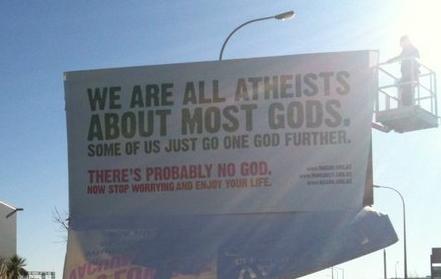
    We are all atheists about most gods. Some of us just go one god further.

    I am inclined to think the argument on this sign is invalid. To see why let’s take out the term “God” in the sign and replace it with some other term such as “non-Christian perspective.” When we do this we get: “We all reject most non-Christian perspectives, some of us just reject one more.” This argument has true premises, do we now have, a knock-down argument for Christianity?

    Similarly, an analogous argument form with true premises gives us an argument for nihilism, the total denial of the existence of morality. “We are all nihilists about some conceptions of morality, some of us are just nihilistic about one more.”

    The same argument for also furnishes a refutation of secularism, “we all reject some secular perspectives on reality, some of us just reject one more.” I could go on.

    Taking a stand on any issue of philosophical substance, whether by affirming, denying or simply being sceptical of it, is to put oneself in opposition to any number of other people and groups who take a contrary stance. That is life. Such pluralism hardly provides a reason for thinking “there probably is no God” any more than it gives us a reason to doubt any other perspective on the world.

    So what do the atheist billboards do? Well the first one tells us that some atheist groups conflate basic philosophical distinctions and don’t really understand the debate they are contributing to. The second shows us that these groups think contradictions and obvious fallacies are some how savvy and smart. The last shows us that they think that invalid argument forms, forms from which you could infer the denial of anything and everything by substituting one true premise with another, are avant-garde.

    All in all, pretty accurate advertising for these groups.

    Hat tip: MCAS

  • Maverick Philosopher on the Historical Atrocities Argument

    In making their case against theism many of the “new atheists” (indeed many of the old) commonly appeal to historical atrocities allegedly committed by believers in God. I was discussing this phenomena recently with Doug Geivett in the aftermath of the Craig v Hitchens debate. I cited the need for Christian apologists to rebut not only the contention that theism is false but also the contention that it is oppressive and dangerous. I proposed that someone of the calibre of Rodney Stark should address the sociological claims about the effect of religion on society to supplement the defences of its truth by scholars such as Bill Craig, Alvin Plantinga, etc. The full (ongoing) discussion can be found within the comments thread here.

    Yesterday I discovered this gem on the same topic on one of my favourite blogs of all time, Bill Vallicella’s Maverick Philosopher, (in fact the inspiration for MandM). I have reproduced a little below to whet your appetite and have furnished the necessary link to finish the meal. Enjoy.

    Extract Taken From:
    Is Religion the Problem? Why Isn’t Belief As Such the Problem? The Special Pleading of Some Atheists

    One of the arguments against religion in the contemporary atheist arsenal is the argument that religious beliefs fuel war and terrorism. Rather than pull quotations from such well-known authors as Richard Dawkins and Sam Harris, I will quote a couple of passages from one of the contributors to Philosophers Without Gods, Walter Sinnott-Armstrong. His piece is entitled “Overcoming Christianity.” After describing his movement from his evangelical Christian upbringing to a quietistic rejection of Christianity, Sinnott-Armstrong tells us how he became an evangelical atheist:

    My quietism ended when current events taught me the dangers of religion. I had always known how religions, including Christianity, led to wars in the Middle East, Ireland, and so on. Many wars, of course, are not based on religion. Even religious wars result from non-religious forces as well. Nonetheless, it is hard to deny that many wars have been and continue to be fueled in large part by religious beliefs. It is no coincidence that terrorists are so often motivated by religion, since it is hard to get non-religious people to volunteer as suicide bombers. (76)

    It is true that people holding religious beliefs have used, and are using, their religious beliefs to justify war, terrorism, and such other evils as forced conversions and inquisitions. No reasonable person can deny this. But what Sinnott-Armstrong (S-A) says above in the second sentence is that religions lead to wars. Does he really want to say that religions lead to wars? All religions? Buddhism? I understand that there are some Buddhist terrorists. But surely a professional philosopher such as S-A can see the difference between (i) Some Buddhists are terrorists and (ii) Buddhism causes war and terrorism. If a Buddhist is a terrorist, this is an accidental fact about him; there is nothing in the essence of Buddhism that enjoins terrorism. No Buddhist qua Buddhist is a terrorist. It escapes me how the doctrines, precepts and practices of Buddhism cause war, terrorism and kindred evils. Similarly for Christianity. Plenty of atrocities have been committed by people who identify themselves as Christians. But that is not to say that the characteristic doctrines, precepts and practices of Christianity cause war, terrorism and the like. It is rather the opposite: when the doctrines and precepts of Buddhism and Christianity are acted upon they tend to mitigate human savagery.

    And then there is the case of Gandhi whose principle of ahimsa (no-harm) derives from his Hinduism. Hinduism as understood and practiced by him surely did not lead to war and terroism. Did he perhaps not understand the principles of his religion? So it cannot be religion as such that causes war and terrorism. The central teachings of Hinduism, Buddhism, and Christianity are anti-war and anti-terrorism.

    So one of the mistakes that people like Sinnot-Armstrong make is that they confuse the doctrinal content of a religion with the behavior of some of the religion’s adherents. … read the rest here [the comments are worth looking at too]


    RELATED POSTS:
    Walter Sinnott-Armstrong, William Lane Craig and the Argument from Harm Part I

  • Craig v Hitchens: Dissecting the Debate UPDATE 2

    The debate between atheist journalist Christopher Hitchens and Christian Philosopher and Theologian Dr William Lane Craig has finished.

    There is an, albeit very brief, summary of the debate here and a more comprehensive one from a Philosopher here. One point of interest is that Hitchens appears to have given up towards the end and “yields his entire closing speech”. It will be interesting to see the video and read a more detailed transcript to see exactly what transpired.

    I find this debate particularly interesting as when, along with the New Zealand Association of Rationalist Humanists, Madeleine and I organised Dr Craig’s debate with Dr Bill Cooke in Auckland last year, the most common claim we heard from amongst our rationalist co-organisers was “the debate would go very differently if Craig was up against Hitchens” (after conceding that Dr Cooke got slaughtered).

    I strongly had my doubts, so I look forward to seeing the video and comparing it with my thoughts on the Craig v Cooke debate.

    [We are thinking of having Thinking Matters Auckland, our Apologetics group, purchase a copy and then we will screen it at one of our seminars so stay posted].

    UPDATE:
    When Debunking Christianity puts up a post entitled William Lane Craig “Won by a Landslide” Against Hitchens I think it is safe for all to say Craig bested Hitchens.

    UPDATE 2:
    Common Sense Atheism states “Craig was flawless and unstoppable. Hitchens was rambling and incoherent, with the occasional rhetorical jab. Frankly, Craig spanked Hitchens like a foolish child.”

  • Does God Exist? Christopher Hitchens v William Lane Craig

    A live blog debate will be held between atheist journalist Christopher Hitchens author of the best-selling God is Not Great and Christian Philosopher and Theologian Dr William Lane Craig author of too many things to list here.

    They will debate the topic: Does God Exist? Catch the live blog debate here on Sunday 5 April 2009 at 3.30pm NZ time [4 April 2009 at 7:30 pm (PST)];

    Hitchens v Craig
    Dr Craig debated Dr Bill Cooke at Auckland University in 2008 on the topic “Is God a Delusion?” Video footage of that debate here.

  • Contra Christopher Hitchens

    Christopher Hitchens’ critiques of religion get a thorough rebuttal here.


    My favourite paragraph is this expose,

    The effectiveness of Hitchens’ book is also undermined by the large number of errors it contains, many so glaring that they will be picked up by even a casual reader with some knowledge of history and theology. The Gnostic gospels are not of the “same period and provenance” as the canonical Gospels, but were written several decades later; the “synoptic” Gospels are not synonymous with the “canonical” Gospels; “Q” is an assumed source for the Gospels of Luke and Matthew, but not Mark and John; the process of deciding which books to include in the New Testament was not one in which “many a life was horribly lost;” “the Vulgate” was what the Reformers were trying to get away from, not what they were attempting to translate the Bible into; Luther declared “Here I stand, I can do no other” at Worms, not Wittenberg; John Adams was not a slaveholder, nor was T.

    S. Eliot a Catholic; the amount of wood from relics of the True Cross would not be sufficient if gathered together to recreate the Cross, much less create a “thousand – foot cross;” Christians have never practiced animal sacrifice, nor did the Arian heresy teach that the Father and the Son were “two incarnations of the same person;” the dogmas of the Immaculate Conception and the Assumption were promulgated in 1854 and 1950, not 1852 and 1951; the Lateran Treaty was signed seven years after Mussolini marched on Rome, not after he “had barely seized power;” Maryland never prohibited Protestants from holding office, and condoms are not a “necessary” condition for preventing the transmission of AIDS, or else celibates would all be infected. Given all these errors (and many more), there is no reason to accept anything Hitchens writes on his own authority, and he offers no authority other than his own for most of what he writes.