Tag: David Boonin

  • Erik Wielenberg and the Autonomy Thesis: Part Three Standard Objections to the Autonomy Thesis, Human Rights and Dignity without God

    In my last post I looked at Erik Wielenberg’s response to the objection that, in the absence of God, people lack compelling reasons to comply with morality’s demands.  A second objection Wielenberg briefly addresses is that without certain theological doctrines, one cannot provide a plausible basis for human rights and dignity.  Wielenberg, here again, takes Craig as paradigmatic.

    defaul1If there is no God, then what’s so special about human beings? They’re just accidental by-products of nature that have evolved relatively recently on an infinitesimal speck of dust lost somewhere in a hostile and mindless universe and that are doomed to perish individually and collectively in a relatively short time[1]

    Craig’s rhetorical question alludes to a serious point, made in more detail by Peter Singer, Louis Pojman, and Nicholas Wolterstorff, this is that it is hard to plausibly accommodate the thesis that all human beings have equal dignity and rights outside a theistic framework. Wielenberg’s response is that human rights are grounded in “non-moral intrinsic properties of human beings” He notes: “Human beings can, reason, suffer, fall in love, set goals for themselves and so on. God or no God, human beings obviously differ when it comes to intrinsic properties than dogs or mere lumps of clay[2]”

    Wielenberg here appeals to certain higher cognitive capacities human beings possess that other animals lack.

    This brief response to Craig is central to his Wielenberg’s rebuttal of evolutionary debunking arguments against moral realism latter in the book. Sharon Street and others have raised epistemological challenges to moral realism by noting that many of our basic evaluative capacities, our disposition to judge certain types of behaviour as morally wrong, has been shaped by naturalistic evolution.  Naturalistic evolution, however, isn’t guided by considerations of truth, in selecting such dispositions, but by adaptability, these basic evaluative judgements exist, because making such judgements enabled our ancestors to reproduce effectively in the environment in which they lived. Street notes “the striking coincide between independent moral truths posited by the realist and the normative views evolution has pushed us towards” and “challenges the realist to explain this coincidence.”[3]

    Wielenberg proposes that “our cognitive capacities” explain the coincidence. Moral rights D supervene upon any creature that possesses certain cognitive capacities.  Seeing these are the same cognitive capacities which produce moral beliefs. It follows that any being which believes it has moral rights will necessarily have them.[4]

    Wielenberg specifies that the supervenience relationship here involves both modal covariation, and a form of “robust causation” analogous to the way theist understand God’s relationship to the created universe, just as Theists believe that God immediately sustains the universe in existence moment by moment simply by willing its existence. So, natural those properties which constitute our higher cognitive faculties, robustly cause the existence of moral rights, without any intermediatory agency or laws of nature.

    This answer both to the grounding of human rights and evolutionary debunking arguments has a cost.  As Wolterstorff [5] and Singer [6].  have both pointed out, while it is true that normal adult humans have the cognitive capacities in question, many important categories of human beings do not. Infants and small children cannot reason, or fall in love, set goals for themselves, nor do they have the developed moral cognition Wielenberg refers to. In fact, David Boonin has noted: “by any plausible measure dogs, and cats, cows, and pigs, chickens and ducks are more intellectually developed than a new born infant.”[7].

    So, Wielenberg’s answer gives us no reason for thinking a child or infant has a rights or dignity, over and above any other animal. In fact, seeing moral rights modally covary with possession of the relevant cognitive faculties, such capacities are necessary and sufficient for the possession of moral rights.  Consequently, His position seems to entail that infant’s small children, and mentally impaired human adults have no moral rights.


    [1] Wielenberg, Robust Ethics 51, the citation is from William Lane Craig and Walter Sinnott-Armstrong God: A Debate Between a Christian and an Atheist (Oxford: Oxford University Press, 2004) 18

    [2] Ibid 51

    [3] Ibid 155

    [4] Ibid 134-175

    [5] Nicholas Wolterstorff Justice: Rights and Wrongs (Princeton NJ: Princeton University Press, 2008) 325-341.

    [6] Peter Singer, Writings on an Ethical Life (London: Harper Collins Publishers, 2001) 186-187

    [7] David Boonin, A Defense of Abortion (Cambridge: Cambridge University Press, 2003), 121, the neurological data is summarised in Michael Tooley’s Abortion and Infanticide (New York: Oxford University Press, 1983) Ch. 11.5.

  • Matt to speak at the 2013 Evangelical Theological Society in Baltimore on Feticide

    This blog’s Matthew Flannagan has had his paper “Boonin’s Defense of the Sentience Criterion: A Critique” accepted for the 65th Annual Meeting of the Evangelical Theological Society (“ETS”). The abstract for Matt’s paper is as follows:

    Abstract
    “Defenders of the permissibility of feticide commonly argue that killing an organism is not homicide unless the organism’s brain has developed enough for it to acquire sentience: the capacity for consciousness and the ability to perceive pleasure and pain. In this paper I critique one of the more sophisticated versions of this argument, proposed by David Boonin in
     A Defense of Abortion. First, I sketch some prima facie problems faced by any appeal to sentience. Second, I examine Boonin’s attempt to defend an appeal to sentience against these problems by constructing a modified future like ours (FLO) account of the wrongness of killing. I argue that Boonin’s modified FLO defence of sentience fails. Both his argument for the modified FLO account and his application of this account to feticide rest on ad hoc arbitrary manoeuvres, manoeuvres which mean that the modified FLO account is a plausible criteria for the right to life only if one already grants that feticide is not homicide.”

    Matt’s ETS paper will be based on his article “Boonin’s Defense of the Sentience Criterion: A Critique” which was published in Ethics and Medicine – An International Journal of Bioethics Vol 25:2 (Summer 2009) 95-106. (You can download this article here).

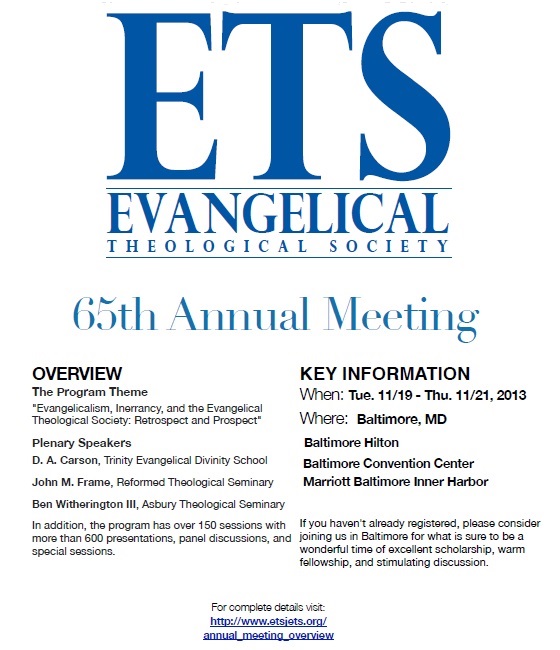
    This year’s Annual Meeting will be held in Baltimore, Maryland, USA from 19-21 November 2013.

    ETS Annual Meeting Flyer

    This year’s theme is “Evangelicalism, Inerrancy, and the Evangelical Theological Society: Retrospect and Prospect”. Plenary speakers for this year’s meeting are Dr Donald A Carson (Research Professor at Trinity Evangelical Divinity School), Dr John M Frame (Professor of Systematic Theology and Philosophy at Reformed Theological Seminary), and Ben Witherington III (Jean R Amos Professor of New Testament at Asbury Theological Seminary).

    Matt has also had a paper accepted for the Evangelical Philosophical Society’s Annual Meeting which is also in Baltimore around the same time – see Matt to speak at the 2013 Evangelical Philosophical Society in Baltimore on Divine Commands re Abraham and Isaac.

    As with previous years we will be fundraising to raise the $2,500 NZD to get him there . Donations greatly appreciated.

  • Marquis and Ideal Desires

    In response to my post Peter Singer Human Dignity and Infanticide, Ben Jury offers some astute comments:

    “I agree with you, that Peter Singer does not motivate his account of ideal desires. However, I think there is a way to motivate it as follows: Marquis objects to Singer’s account because he thinks there is an alternative account of ideal desires that is just as plausible as his. But I think Marquis’s account of ideal desires leads to a reductio. If his Marquis’s account is right, then it seems that spiders would have rights to life. This is because if spiders were fully informed and rational, they would desire to live and thus have a right to life. This is analogous to Marquis’s claim that if infants were fully informed and rational they would desire to live and thus have a right life on Singer’s account. But granting spiders the right to life seems absurd. Thus Marquis’s account of ideal desires seems mistaken. However, Singer’s account of ideal desires is not absurd because for Singer, spiders do not have desires at all and hence cannot have ideal desires. Hence, because Singer’s ideal desire account can avoid the reductio, his account is more plausible then Marquis’s. (Obviously this is excluding your Hamlet counterexample, but I am curious what you think about the above.)”

    Jury notes correctly that even if this objection is sound then it only addresses my argument that Singer’s account of ideal desires is unmotivated. It does not address the Hamlet counter-example or the other objections I raised.

    Nevertheless is worth asking whether  Jury’s objection is sound. I do not think it is. Let me offer two responses.

    First, even if Marquis’ account of ideal desires is subject to the kind of reduction that Jury mentions, it does not follow that Singer’s account is motivated. I noted in my paper: “Various different conceptions of ideal desires have been proposed which will get around the counter examples aforementioned and not all of them involve the modification of actual desires. Consequently, Singer’s position appears unmotivated.” Here I pointed out there were various different counter examples thatescape the counter examples Singer proposes his account to explain. So, even if one of them fails – the account proposed by Marquis – that does not get around the problem.

    Second, I am not convinced Marquis’ account is subject to the reduction Jury mentions. In my paper Boonin on the Sentience Criteria I suggested counter examples like the one suggested by Jury can be dealt with by distinguishing two questions.[1] The first is the question of what an ideally rational self would choose for itself (i.e. the ideally rational self), and what  an  ideally rational self would choose for  it actual self (i.e. his non-ideally rational self).

    SpiderIf one asks the former question then Jury is correct e.g. a spider that had all the rational cognitive capacities of a person, idealised, would not choose to die.

    The answer to the second question is not so clear. Here we ask what an ideally rational self would choose if it knew that it would in fact have a future identical with the future of a normal spider – a future existence with no conscious experience at all, where it would lack any ability to value its life or any thing at all. It is certainly not obvious that an ideally rational person would value a future made up of such circumstances.

    The question then arises as to (more…)

  • Peter Singer on Human Dignity and Infanticide: Part One

    This is the first section of the paper I presented to the the Evangelical Philosophical Society Annual Meeting in Milwaukee two weeks ago. Several people have asked me to post it on MandM. It will appear as a two-part post series.

    Christian theism has traditionally taught that human beings have equal dignity and worth, a moral status that separates them from non-human animals. Peter Singer has famously rejected this teaching, holding that human beings are not any more special than animals and doctrines of human dignity are indefensible.  He contends that killing a new-born infant is, in and of itself, no more problematic than killing a non-human animal such as a cow or a pig and defends the permissibly of infanticide under certain conditions.

    Peter SingerThis paper will critically assess one important part of Singer’s position: his understanding of why it is wrong to kill.  In I I will sketch Singer’s “desire account” of killing and its relationship to his own preference utilitarianism and project of animal equality. Following Don Marquis, I will argue in II, that this “desire account” is subject to important counter examples. In III I note Singer’s attempts to modify his position so as to avoid these counter examples and suggest that these modifications are problematic. In IV, I will suggest that, despite this, there is an important truth in Singer’s critique, one that Christian thinkers can appropriate in developing moral arguments for Christian theism.

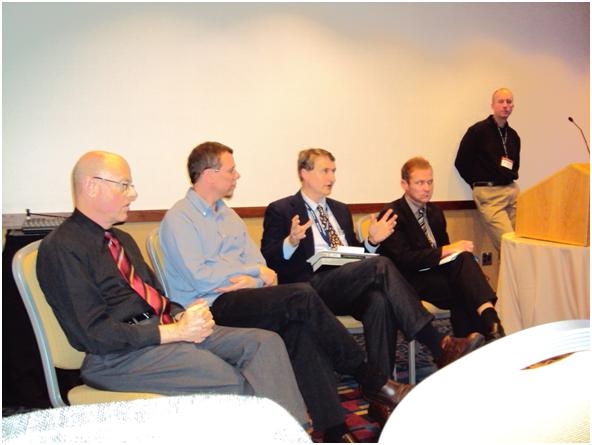
    I. Preference Utilitarianism and the desire account of the wrongness of killing
    Classical Utilitarianism conjoins three theses. First, the maximisation thesis; an action is right if and only if it maximises overall net benefit:  net benefit being the total amount of  benefit accruing to individuals as a consequence of the action, minus any harms resulting. An action maximises net benefit when the consequences of performing it constitute a higher net benefit than that associated with any alternative action.

    Second, , the thesis of equal consideration: a benefit or harm to any one individual is counted as having equal weight to a similar sized benefit or harm to any other individual.

    Third, the thesis of hedonism: on this account, benefits and harms are understood in terms of pleasure and pain. Something benefits an individual or is good if it causes him pleasure and harms him if it causes pain.

    Peter Singer is a preference utilitarian. Preference utilitarians accept both the maximisation and equal consideration theses however reject hedonism in favour of a desire fulfillment or preference satisfaction view of the good. Something is good for an individual if he desires or prefers it, and it is bad if contrary to his preferences or desires.

    Singer uses preference utilitarianism to reject the doctrine that human beings have equal dignity and worth, a moral status that separates them from non-human animals.  Sentient animals clearly have desires; they can suffer and feel pain and desire not to. The equal considerations thesis entails that in so far as these desires are similar to those of human beings the suffering of an animal must be considered equal with that of a human being.

    However, in terms of actual as opposed to potential psychological capacities, some human beings have a comparable mental life to that of animals.   A new born human infant’s psychology is primitive. David Boonin notes “by any plausible measure dogs, and cats, cows and pigs, chickens and ducks are more intellectually developed than a new born infant.” [1]  This means that the desires of a new born infant are similar to those of other animals.

    Singer illustrates this point in a discussion of animal experimentation. (more…)

  • Abortion and the Morality of Feticide: Part II

    In my last post, Abortion and the Morality of Feticide: Part I, I briefly sketched an argument against feticide,

    [1] It is wrong to kill a human being without justification;

    [2] A fetus is a human being;

    [3] In the case of feticide (at least in the majority of cases) insufficient or no justification is forthcoming.

    I argued that defenders of feticide cannot rationally reject this argument unless they reject one of the premises. I argued further that attempts to refute [3] are successful only if one assumes that a fetus is not a human being. It follows then that defenders of abortion laws cannot rationally avoid the question of whether [2] is correct, whether a fetus is a human.

    Is the Fetus a Human Being?

    Big MacThe first thing to note is that the claim that feticide is homicide has considerable prima facie plausibility. Consider this, a hunter is in the woods and notices some rustling in the bushes. Looking through his scope he sees a six-foot high, bi-pedal being with brown hair, blue eyes, wearing a red and black swanndri. He refrains from shooting. Here, the hunter makes the sensible and reasonable judgement that in firing he would risk engaging in homicide. He bases this on what the target looks like. In the absence of reasons for thinking otherwise, he has good grounds for this claim.

    This example has application to the status of the fetus; “[there is] a general consensus that the fetus is recognisably human after six weeks, and certainly after eight”[1] This fact, conjoined with the above illustration, entails that, in the absence of good reasons to the contrary, there are good grounds for thinking that feticide is homicide.

    The second thing to note is is that good reasons for thinking the fetus does not have human status are not forthcoming. Here I will focus on four common examples: viability, sentience, birth and person-hood.

    Viability
    A common argument contends that a fetus is not a human because it is not viable. Susan Sherwin argues that feticide differs from killing children because a fetus “is wholly dependent on her [the mother’s] unique contribution to its maintenance, while a newborn is physically separate, though still in need of a lot of care”.[2]

    There are several problems with this position.

    The fact that a fetus cannot survive independently of its mother does not mean it is not a human being. Fetal viability is contingent upon the medical technology of a given culture. A fetus that is not viable in (more…)

  • Abraham, Isaac, Virginity, Rape and Child Killing (Another Old Testament Ethics Post)

    Randal Rauser has published a blog post touching on Old Testament ethics called “An update in the wake of Atlanta (plus a bit on rape and child killing)“. His post gives an update on his thoughts following his interaction with Paul Copan, Richard Hess and myself in the Evangelical Philosophical Society’s break-out panel discussion “Is Yahweh a Moral Monster” at the Society for Biblical Literature (“SBL”) in Atlanta in November. While there was considerable overlap between his position and mine, there was one particular issue on which he and I disagreed quite sharply on the night that he alludes to in his post. Let me contextualise this disagreement and then put my response to his comments.

    Back in 2009 I wrote “Abraham and Isaac – Did God Command the Killing of an Innocent?” This post addressed a dilemma several philosophers have raised for those Christians who take the patriarchal narratives in Genesis in literal manner. It seems plausible that Christians who do this are committed to an inconsistent triad,

    1. If God commands an action x then x is morally required;
    2. It is wrong to kill innocent human beings;
    3. God commanded Abraham to kill an innocent human being.

    These three propositions are inconsistent; 1 and 3 entail the denial of 2.

    To respond to this triad, I appropriated a thought experiment provided by John Hare; I wrote:

    One example Hare notes, is particularly interesting, “Perhaps (to get more bizarre) God could have willed that we kill each other at the age of 18, at which point God would bring us immediately back to life.” Hare asks us to imagine a world, in which, when people of a certain age are killed they immediately come back to life. He opines, quite plausibly, that if this were to be the case then killing people at this age would not be wrong or at least, not seriously wrong. One of the reasons that killing people is wrong in the world we live in is because people stay dead. If they were only unconscious for a split second and came back to life in full health then arguably killing a person would not be the serious wrong we believe it is.

    I suggested that, a careful examination of the text reveals that Abraham’s actions occurred in a context where he knew his son would not stay dead but would come down the mountain with him and live on to adulthood to father children of his own. I argued this fact resolves the dilemma,

    Once this is realised, I think it is evident that [1], [2] and [3] are consistent. If one assumes, for the sake of argument, that the Patriarchal Narratives are literally true then it follows that [3] is true only if a certain context is assumed. God commanded Abraham to kill his son in the highly unusual context where Abraham knew that his son would not stay dead but would come down the mountain afterwards and live on to adulthood to father children of his own. Proposition [2] is defensible only in a context where people do not know these sorts of things; the rule to not kill the innocent applies to a world where people do not come back to life after they have been killed. Hence, the story of Abraham and Isaac, if taken literally, does not entail that God commanded something immoral or contradictory.

    What I later discovered is that Paul Copan sometimes reads this blog and he, on reading my post, summarised my argument and appropriated it (with acknowledgements)  in chapter 5 of his latest book Is God a Moral Monster: Making Sense of the Old Testament God.

    The EPS Session at the SBL: Richard Hess, Randal Rauser, Paul Copan,  Matthew Flannagan, Michael ReaEnter Randal Rauser. In the paper he presented for the SBL panel, Rauser made a remark on the Abraham and Isaac issue. Copan responded by summarising his argument, which was an appropriation of my argument. Rauser responded with an analogy, which he has since (more…)

  • Contra Mundum: Confessions of an Anti-Choice Fanatic

    If current media is to be believed opposition to legal abortion comes from misogynist fundamentalist fanatics who want to impose their religious mores onto others. This string of pejorative terms is amusing; however, it does not actually address the more crucial question of whether laws against feticide (the killing of a fetus) are just. I maintain they are and, unlike most media commentators and politicians who pontificate on the topic, I will argue three points for this thesis.

    The first is that the typical arguments in favour of abortion succeed only if it is assumed from the outset that feticide is not a form of homicide. A couple of examples will illustrate this. It is frequently asserted that women have a right to do whatever they like with their own bodies. This assertion is false. Women do not have a right to do whatever they like with their bodies; no one has such a right. Women cannot use their bodies to rape or commit homicide or set fires. The right to do as we please is limited by the morality of our actions, thus whether abortion falls into the category of an action we are free to choose depends on whether feticide is homicide. If it is, then this argument fails but as currently used it is just assumed that it is not.

    Some might object that such an interpretation is an uncharitable reading of this contention. What is important from this perspective is that all people have a right to control what happens inside or to their own bodies. I have a right to control what happens to mine and you have a right to control what happens to yours. Hence, provided the decision I make does not involve me using your body in a way that you do not consent to then I have a right to do it. However, implicit in this argument is the claim that a fetus, at least until born, is part of a woman’s body, that it is not a separate, bodily-living, human being on its own. However, this claim is erroneous. To suggest that a fetus is part of a woman’s body entails that the mother of a male fetus has two heads, four arms and a penis. Once again this argument is successful only if one assumes a fetus is not a human being from the outset because if the fetus is human then it too has a right to not have its body harmed.

    The infamous illegal “back-street” abortion argument fares no better. The allegation that “hundreds” (I put this in scare-quotes because actually the figures show it was significantly a lot less than this) of women died from illegal abortions can justify legalisation only if feticide is not homicide. If it is homicide then this argument reduces to the bizarre assertion that we should kill eighteen thousand children each year in order to prevent “hundreds” of women from harming themselves by breaking the law.

    Typical consequentialist arguments also fail. Abortion prevents unwanted children who are likely to be poor, abused or engage in crime. It is hailed as a solution to over-population and the existence of more handicapped people. It prevents adult and teenage women from falling into economic hardship and stress. It enables them to complete their education, pursue their careers. However, all this is equally true of infanticide. Infanticide prevents the existence of unwanted children and their associated social costs, lowers the population, prevents the handicapped existing and saves women and teenagers from the economic and emotional stresses of parenthood. Yet infanticide, as convenient as it is, is condemned because it is homicide. Again, all these arguments assume that the fetus is not human without actually arguing for it.

    This is not to say feticide can never be unjustified. Utilising the justification of self-defence, I think a case can be made for feticide where pregnancy constitutes a threat to a woman’s life or perhaps in cases of rape (space prevents me elaborating the casuistry here). Such cases are extremely rare and make up less than 0.5% of all cases (according to figures compiled by the Abortion Supervisory Committee). So, if feticide is homicide, the vast majority of abortions lack justification. To defend permissive abortion laws on these grounds is a bit like allowing people to murder on demand on the grounds that there exist rare cases of justifiable killing in self-defence.

    My second point is the claim that feticide is homicide has considerable prima facie plausibility. Consider this scenario. A hunter is in the woods and notices some rustling in the bushes. Looking through his scope he sees a six-foot high, bi-pedal being with brown hair, blue eyes, wearing a swann-dri. He refrains from shooting. Here, the hunter makes the sensible and reasonable judgment that in firing he would risk engaging in homicide. He bases this on what the target looked like. In the absence of reasons for thinking otherwise he has good grounds for this claim. However, “[there is] a general consensus that the fetus is recognisably human after six weeks, and certainly after eight” (D Boonin A Defense of Abortion (2003) 95). This fact, conjoined with the above illustration, entails that, in the absence of good reasons to the contrary, there are good grounds for thinking that feticide is homicide.

    My final point is that good reasons to the contrary are not forthcoming. Here I will focus on three common examples starting with the fetus not being viable.

    The fact that a fetus cannot survive independently of its mother does not mean it is not a human being. Fetal viability is contingent upon the medical technology of a given culture. A fetus that is not viable in Chad is viable in Los Angeles. If viability is necessary for something to be a human then a woman pregnant with a viable fetus in Los Angeles who flies from Los Angeles to Chad carries a human being when she leaves but this human being ceases to exist when she arrives in India and yet becomes human again when she returns (Peter Singer Writings on an Ethical Life (2000) 148).

    Similarly, while the fetus lacks consciousness, lack of consciousness does not make a being non-human. If it did, then a human being ceases to exist when asleep or unconscious and then pops back into existence upon awakening. Shooting someone would cease to be homicide provided we render him or her unconscious first.

    Appeals to fetal consciousness face other problems. David Boonin notes that those who attempt to ground humanity in the amount of brain development an organism has undergone face a dilemma. “Any appeal to what a brain can do at various stages of development would seem to have to appeal to what the brain can already do. Or to what the brain has the potential to do in the future.” (David Boonin A Defence of Abortion (2002) 125). Either option leads to problems for a defender of the permissibility of feticide who does not also want to endorse infanticide. This is because “by any plausible measure dogs, and cats, cows and pigs, chickens and ducks are more intellectually developed than a new born infant”.(Boonin, 121)

    Suppose, then, that one takes the first horn of the dilemma and appeals to what the brain can already do. However, unless one wishes to affirm that “dogs, and cats, cows and pigs, chickens and ducks” are human beings then “appeals to what the brain can already do” will “be unable to account for the presumed wrongness of killing toddlers or infants.”

    Suppose, then, one takes up the second horn and appeals to “what the brain has the potential to do in the future.” Boonin notes that this will entail that feticide is homicide. “If [such an account] allows appeals to what the brain has the potential to do in the future, then it will have to include fetuses as soon as their brains begin to emerge, during the first few weeks of gestation.”(Boonin, 121)

    Finally, while it’s true that fetuses are not ‘persons,’ where person is defined as “a thinking, intelligent being that has reason and reflection and can consider itself as itself, the same thinking being, in different times and places,” (J Locke Essay Concerning Human Understanding) neither are newborn infants. In fact, a newborn cow is more person-like than an infant is. The price of a cogent pro-abortion argument is the reduction of newborn infants to the ethical level of cows. It is difficult to understand, on this view, why killing a newborn infant is any more problematic than killing a calf.

    In summation, except for a few rare cases, abortion is justified only if feticide is not homicide. However, there are good prima facie grounds for thinking feticide is homicide and these prima facie grounds are not overridden by reasons to the contrary. Jointly, these contentions demonstrate that feticide constitutes unjustified homicide, and, hence, should not be a practice that is tolerated or sanctioned by the state.

    I write a monthly column for Investigate Magazine entitled Contra Mundum. This blog post was published in the January 10 issue and is reproduced here with permission. Contra Mundum is Latin for ‘against the world;’ the phrase is usually attributed to Athanasius who was exiled for defending Christian orthodoxy.

    Letters to the editor should be sent to: editorial@investigatemagazine.DELETE.com

    RELATED POSTS:
    Is Abortion Liberal? Part 1
    Is Abortion Liberal? Part 2
    Sentience Part 1
    Sentience Part 2
    Viability
    Abortion and Child Abuse: Another Response to Farrar
    Abortion and Brain Death: A Response to Farrar
    Abortion and Capital Punishment: No Contradiction
    During, Sherwin & Hutchison on Backstreet Abortion
    Imposing Your Beliefs onto Others: A Defence
    Boonin’s Defense of the Sentience Criterion: A Critique Part I
    Boonin’s Defense of the Sentience Criterion: A Critique Part II