Several years ago, I gave a talk on the morality of abortion at New Hope Community Church in East Auckland. This talk was based on my Ph.D. research at Otago University. Apparently, in the wake of recent supreme court decisions in America, some interest has been expressed in this talk. So, I attach it here.
Tag: Ethics
-
The question “Why Be Moral?” and the book of Proverbs.
I gave a brief talk at Orewa Community Church on 10 January 2020. The talk was part of a short series OCC are doing on the book of proverbs. It is available here.
-
The Challenge of Moral Relativism: Three Problems with Relativism
This is the third of a series of posts on moral relativism. These talks are based on some talks I have given on the subject in the last few months. In the first post, I looked at what the basic issues are. The second post examines some of the reasons people offer for accepting relativism. This last post looks at some problems with relativism.
Today most ethicists whether Christian or non-Christian reject relativism. Critics of relativism argue it faces several problems, which give us reason to reject it. I will focus on three.
1. The Problem of Moral Progress and Moral Reform.
Relativism is incompatible with moral progress or reform. While relativists can accept that the moral judgements of societies change they can’t consistently claim these changes amount to progress. If society at one time supports
 slavery or racial segregation, and then later disapproves of these things. Relativists cannot say that society has thrown off an incorrect view and adopted a correct, one. Instead, it must say that it has gone from one correct view to another one.
A related problem is that relativism suggests that moral reformers who spoke out against slavery and segregation were in fact in the wrong. They were opposing what society approved of and hence what was right for members of society.
This problem also applies to subjectivism. If a member of the Ku Klux Klan holds racist judgements at one time and then later rejects these judgements as bigotry, The subjectivist can’t say he has moved from a mistaken to a correct. Instead, he has changed from one correct view to another. Individuals don’t grow in moral insight or develop more discernment
2.The possibility of Error
There is another problem with relativism. It seems plausible that we can be mistaken in our moral judgements. I can make judgements about what is right and wrong which are incorrect, and whole societies can do this. Relativism, however, suggests mistakes like this are impossible. Subjectivism means that If I believe something is right, then I am right in doing it. Relativism means that if a society endorses a practice then its right for members of that society to do the practice. The consequence is that mistakes about morality are impossible. For a person or a community to make a mistake, it has to be possible for the standards an individual or society accepts to be different from the standards which are correct.
3. Relativism Implies that Obvious Moral Wrongs Are Acceptable
Perhaps the most important objection to relativism is that it implies that obvious moral wrongs are acceptable. If actions are right or wrong relative to an individual or societies standpoint, then anything at all can be justified. Genocide, rape, torture of children, racial intolerance, are all morally right for a person if he believes that they are or his society endorses them. Many find this implication hard to swallow if a serial killer thinks it’s permissible to kill women, is it really plausible to suggest this fact alone means his actions are right or did the fact German society adopted Nazism in the 1930s mean that Germans did no wrong when they implemented these policies.
Conclusion
Let me now bring the threads of this talk to a close. I have explained what relativism and objectivism are. I noted some common reasons why people accept relativism and suggested these reasons fail. The appeal to diversity fails to make some important distinctions and appeals to tolerance, openness and so on are incoherent. I have also sketched several problems with relativism it entails moral reform is impossible moral error is impossible and that obvious moral wrongs are right. For reasons like this most philosophers, today reject moral relativism. While it’s a challenge to the way, Christians think about ethics. I am not convinced it’s a challenge which is very defensible.
-
Thank God for the New Zealand Anti Terrorist Squad: Online
Matt’s article is available at this link flannagan-pc-18-1
Permission has been granted from the Editor of Philosophia Christi to upload this contribution. Learn more about the journal by going to www.epsociety.org/philchristi. -
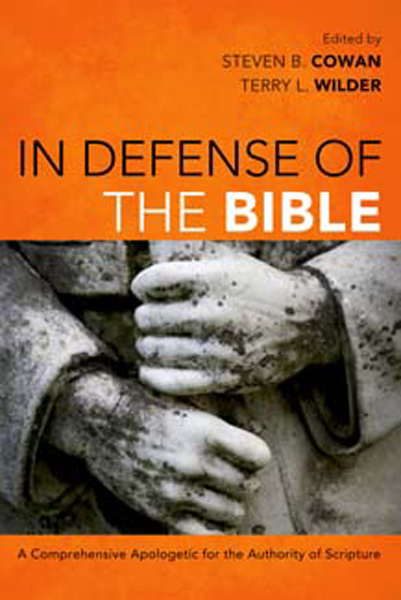
In Defense of the Bible: A Comprehensive Apologetic for the Authority of Scripture

Another of the books Matt has contributed to arrived from the publisher’s today. In Defense of the Bible: A Comprehensive Apologetic for the Authority of Scripture addresses and responds to the major contemporary challenges to the divine inspiration and authority of Scripture. It is edited by Steven B Cowan and Terry L Wilder and published by B&H Academic.
The blurb from the publishers:
In Defense of the Bible begins by looking at philosophical and methodological challenges to the Bible—questions about whether or not it is logically possible for God to communicate verbally with human beings; what it means to say the Bible is true in response to postmodern concerns about the nature of truth; defending the clarity of Scripture against historical skepticism and relativism.
Contributors also explore textual and historical challenges—charges made by Muslims, Mormons, and skeptics that the Bible has been corrupted beyond repair; questions about the authorship of certain biblical books; allegations that the Bible borrows from pagan myths; the historical reliability of the Old and New Testaments.
Final chapters take on ethical, scientific, and theological challenges— demonstrating the Bible’s moral integrity regarding the topics of slavery and sexism; harmonizing exegetical and theological conclusions with the findings of science; addressing accusations that the Christian canon is the result of political and theological manipulation; ultimately defending the Bible as not simply historically reliable and consistent, but in fact the Word of God.
Contributors include R Douglas Geivett, William A Dembski, Mary Jo Sharp, Darrell L Bock and Paul Copan, with whom Matt co-authored a chapter entitled “Does the Bible Condone Genocide?”
A couple of endorsements:
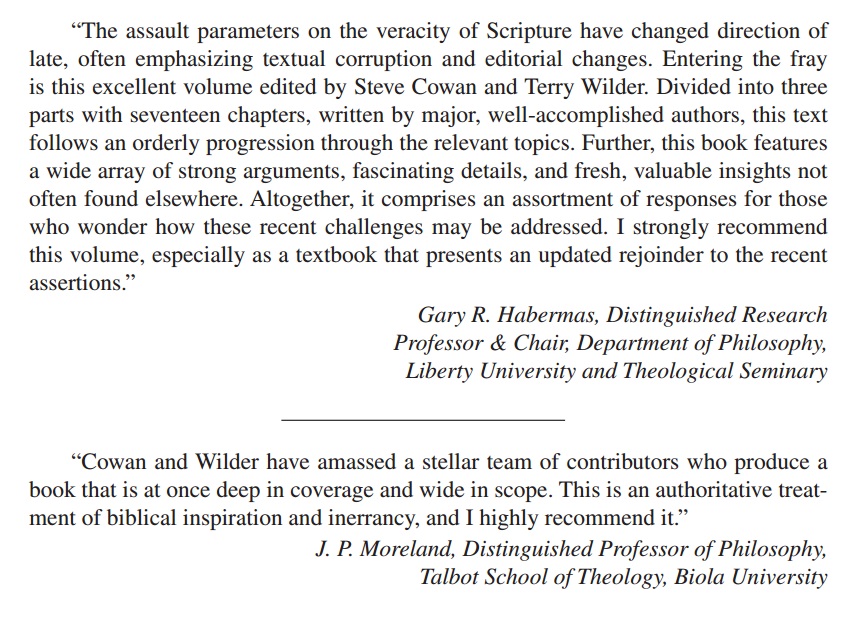
In Defense of the Bible is available in both Kindle and Paperback formats. Get your copy from Amazon or Book Depository or wherever you like.
-
Marquis and Ideal Desires
In response to my post Peter Singer Human Dignity and Infanticide, Ben Jury offers some astute comments:
“I agree with you, that Peter Singer does not motivate his account of ideal desires. However, I think there is a way to motivate it as follows: Marquis objects to Singer’s account because he thinks there is an alternative account of ideal desires that is just as plausible as his. But I think Marquis’s account of ideal desires leads to a reductio. If his Marquis’s account is right, then it seems that spiders would have rights to life. This is because if spiders were fully informed and rational, they would desire to live and thus have a right to life. This is analogous to Marquis’s claim that if infants were fully informed and rational they would desire to live and thus have a right life on Singer’s account. But granting spiders the right to life seems absurd. Thus Marquis’s account of ideal desires seems mistaken. However, Singer’s account of ideal desires is not absurd because for Singer, spiders do not have desires at all and hence cannot have ideal desires. Hence, because Singer’s ideal desire account can avoid the reductio, his account is more plausible then Marquis’s. (Obviously this is excluding your Hamlet counterexample, but I am curious what you think about the above.)”
Jury notes correctly that even if this objection is sound then it only addresses my argument that Singer’s account of ideal desires is unmotivated. It does not address the Hamlet counter-example or the other objections I raised.
Nevertheless is worth asking whether Jury’s objection is sound. I do not think it is. Let me offer two responses.
First, even if Marquis’ account of ideal desires is subject to the kind of reduction that Jury mentions, it does not follow that Singer’s account is motivated. I noted in my paper: “Various different conceptions of ideal desires have been proposed which will get around the counter examples aforementioned and not all of them involve the modification of actual desires. Consequently, Singer’s position appears unmotivated.” Here I pointed out there were various different counter examples thatescape the counter examples Singer proposes his account to explain. So, even if one of them fails – the account proposed by Marquis – that does not get around the problem.
Second, I am not convinced Marquis’ account is subject to the reduction Jury mentions. In my paper Boonin on the Sentience Criteria I suggested counter examples like the one suggested by Jury can be dealt with by distinguishing two questions.[1] The first is the question of what an ideally rational self would choose for itself (i.e. the ideally rational self), and what an ideally rational self would choose for it actual self (i.e. his non-ideally rational self).
 If one asks the former question then Jury is correct e.g. a spider that had all the rational cognitive capacities of a person, idealised, would not choose to die.
The answer to the second question is not so clear. Here we ask what an ideally rational self would choose if it knew that it would in fact have a future identical with the future of a normal spider – a future existence with no conscious experience at all, where it would lack any ability to value its life or any thing at all. It is certainly not obvious that an ideally rational person would value a future made up of such circumstances.
The question then arises as to (more…)
-
Peter Singer on Human Dignity and Infanticide: Part Two
This is the second half of the paper I presented to the the Evangelical Philosophical Society Annual Meeting in Milwaukee three weeks ago. It is part of a two-part post series; make sure you have read part one Peter Singer on Human Dignity and Infanticide.
II. Marquis’ Critique
In my previous post I sketched Singer’s desire account of killing and how it relates to Singer’s preference utilitarianism and position on vegetarianism. Don Marquis has offered two kinds of counter examples to the desire account of killing:[1] take depressed people who are either suicidal or simply don’t care about life, but whom we know will with medication or counselling overcome this. Such people have no desire to live, yet it seems they have a right to life. Killing them is not in their interests and we would wrong them, not just their relatives or society, if we killed them.Or consider people brainwashed in a religious cult to commit suicide, or people who, believing they will be rewarded in the afterlife, offer themselves as voluntary human sacrifices. These people lack a desire to live yet they still have a right to life. Morality requires we try and save them from the cult rather than that we kill them. The desire account thus appears false, and given that preference utilitarianism entails the desire account, preference utilitarianism is problematic.
These counter examples are part of a more general problem. Singer’s position infers a right to continue to exist from a desire to continue existing. However, the inference that “X has a prima facie right to Z” from “X desires Z”, is problematic. Children have rights to medical care, nutritious food, and education, but often children have little or no desire for these things. Often in cases of complicated medical procedures the child lacks a conception of the operation itself, yet it still has a right to such things. This claim is based on it being in their interests to have these things, and they will be harmed by not having them, it’s not plausible to ground these rights in the fact the parents or society want the child to have them.
III. Singer’s reply
 In A Reply to Don Marquis,[2] Singer acknowledges the cogency of Marquis’s counter examples and offers a revision to the desire account of killing. He cites the example of a tennis player who desires to drink a bottle he believes is full of water, but in reality contains poison. Singer concludes from this case “if a person’s desire to die is based on a false belief, it does not justify assisting him in satisfying the preference”[3], also ruling out the example of the fanatical religious believer. Similarly, “for a preference to be one we should act upon it should be based not only on accurate information …” but also a “calm and rational assessment of the situation”; this rules out the example of the depressed individual.[4]
Singer’s revision means the issue is not the actual desires an individual has but rather their ideal desires, i.e. desires the individual would have had if they were reasoning correctly and had correct information. Marquis’s counter-examples therefore fail.
IV. Critique of Singer’s Reply
I will offer three lines of response to Singer’s reply.Motivation and Arbitrariness
The first problem is that Singer’s position appears unmotivated. Anticipating Singer’s response, Marquis noted that while infants lack actual desires to continue to exist, it’s not clear they totally lack a rational desire to live because “if a fetus were fully informed and rational, it would desire to live” [5]. Singer’s modification then would appear to undercut his advocacy of infanticide.To avoid this, Singer adopts a particular conception of ideal desires. Ideal desires are a being’s actual desires corrected for false information and errors of reasoning. Seeing infants lack any desire to continue existing they cannot in this sense have an idealised desire to exist in the future. Consequently, Singer suggests that preference utilitarianism should be modified so as to involve the maximisation of idealised preferences so defined. The problem is that apart from the fact it enables him to both support abortion and infanticide and avoid the counter examples, Singer offers no reason why one should adopt this particular conception of ideal desires. Various different conceptions of ideal desires have been proposed which will get around the counter examples aforementioned and not all of them involve the modification of actual desires. Consequently, Singer’s position appears unmotivated.
Singer’s response to this rejoinder is to state,
“Adjusting a person’s actual desires for errors is one thing; attributing a wholly new desire to a being that is not capable of having any desires at all, or any desires of the relevant kind is something else altogether, and something for which there is no obvious motivation” [6]
This is inadequate; Singer asserts that his account is different from one other account and that this other accounts is unmotivated. But the fact other accounts are unmotivated does not entail that Singer’s own account is motivated.
The Hamlet problem
A second problem is that even if Singer’s account escapes Marquis’s counter example it seems vulnerable to a new one. Consider the following lines from Hamlet (more…)