Tag: Selection

  • God and the Genocide of the Canaanites Part I: Wolterstorff’s Argument for the Hagiographic Hyperbolic Interpretation

    Around this time last year I wrote two posts Joshua and the Genocide of the Canaanites I and Joshua and the Genocide of the Canaanites II. These posts attracted a fair amount of attention and debate. I got offers to publish my ideas in several upcoming books and present them before both the Evangelical Philosophical Society (EPS) and the Society for Biblical Literature in November 2010. Since the original posts I have corresponded with various people and I have modified and refined some of the ideas. This three-part blog series is a modified version of what I presented to the EPS last month. These posts supersede and update what I wrote in a year ago.

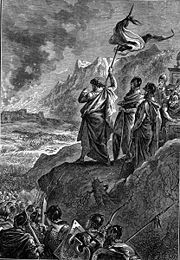
    Joshua at AiOne of the most perplexing issues facing Christian believers is a series of jarring texts in the Old Testament. After liberating Israel from slavery in Egypt, the Israelites arrived on the edge of the Promised Land. The book of Deuteronomy records that God then commanded Israel to “destroy totally” the people occupying these regions (the Canaanites); the Israelites were to “leave alive nothing that breathes”. The book of Joshua records the carrying out of this command. In the sixth chapter it states “they devoted the city to the LORD and destroyed with the sword every living thing in it—men and women, young and old, cattle, sheep and donkeys”. In the tenth and eleventh chapters it states that Joshua “left no survivors. He totally destroyed all who breathed, just as the LORD, the God of Israel, had commanded.” The text mentions city after city where Joshua, at God’s command, puts every inhabitant “to the sword”  “totally destroyed the inhabitants” and “left no survivors.”
    If one takes these passages literally they record the divinely-authorised commission of genocide. But genocide surely is morally wrong. In the light of this, critics of Christian theism often ask a rhetorical question; how could a good and loving God command the extermination of the Canaanites?

    One response which goes back to the patristic era is to suggest that the strict, literal reading on which this rhetorical question is based is mistaken. Recently, several, protestant scholars have suggested a hyperbolic reading of the relevant passages.[1] Perhaps the most detailed is that proposed by Nicholas Wolterstorff. Wolterstorff suggests,

    “[T]hat the Book of Joshua has to be read as a theologically-oriented narration, stylized and hyperbolic at important points, of Israel’s early skirmishes in the Promised Land, with the story of these battles being framed by descriptions of two great ritualized events.  The story as a whole celebrates Joshua as the great leader of his people, faithful to Yahweh, worthy successor of Moses.  If we strip the word “hagiography” of its negative connotations, we can call it a hagiographic account of Joshua’s exploits.”[2]

    In this series I will defend Wolterstorff’s position. In this post I will sketch, adapt and defend Wolterstorff’s argument. In Part II, I will argue that external evidence from comparative studies in Ancient Near Eastern conquest accounts gives considerable support to Wolterstorff’s position. Finally in Part III I will look at two implications of this position.

    Wolterstorff’s Argument
    Wolterstorff’s contention is that “a careful reading of the text in its literary context makes it implausible to interpret it as claiming that Yahweh ordered extermination”. It is important to note what he means by context. Here, it is clear that Wolterstorff is advocating a canonical approach. He notes that,

    “Joshua as we have it today was intended as a component in the larger sequence consisting of Deuteronomy, Joshua, Judges, I and II Samuel, and I and II Kings…  I propose that we interpret the Book of Joshua as a component within this larger sequence – in particular, that we interpret it as preceded by Deuteronomy and succeeded by Judges.”[3]

    Joshua comes after Deuteronomy and before Judges. Wolterstorff points out that these books should be read as a single narrative. When one does this, however, several issues are apparent. (more…)

  • God, Morality and Abhorrent Commands: Part II Robert Adams

    In this three-part series I will look at some different ways of adjudicating conflicts between apparent divine commands and moral beliefs. I started with Immanuel Kant, now I will look at Robert Adams’ position.

    In “God, Morality and Abhorrent Commands: Part I Kant” I mentioned Phillip Quinn’s observation that theists can face a particular dilemma,

    “[I]t seems possible that a theist should have both good reasons for believing that God has commanded him to perform a certain action and good reasons for believing that it would be morally wrong for him to perform that action. Thus a theist can be confronted with moral dilemmas of a peculiar sort.”

    Immanuel Kant argued that when faced with such a dilemma the theist should reject the belief that God has commanded the action and accept the moral belief. This was due to his belief that moral beliefs are more certain that theological beliefs. I contested this claim. More recently Robert Adams has defended Kant’s conclusion. Consider the structure of the kind of dilemma Quinn cites,

    [1] Whatever God commands is morally permissible;

    [2] God commands X;

    [3] It is wrong to do X.

    These three claims contradict each other; like Kant, Adams suggests that the rational person should reject [2]. However, his reasons are somewhat different. Adams persuasively reasons that [1] is true only if God is understood as perfectly good, in the sense of being loving, just and so on. If God were evil or morally indifferent then it would be possible for him to command wrongdoing and so [1] would be false.  This means that a person who accepts [1] must presuppose that God is good.

    Adams argues that God cannot be meaningfully said to be good if what he commands drastically departs  from what we consider to be right and wrong. Human beings have some grasp of what constitutes goodness and some grasp of what constitutes right and wrong and it is part of our concept of what is good that a good being does not command wrong doing. Moreover, to call a being good is to attribute to it a character trait that is incompatible with certain other actions, attitudes and so on. Raymond Bradley made the point succinctly in his debate with William Lane Craig “Can a Loving God Send People to Hell?“

    “If we were to describe someone such as Hitler as perfectly good despite all his evil doings, we’d be playing word games which are intellectually dishonest as they are morally pernicious. … it would be to deprive the word “holy” of its ordinary meaning and make it a synonym for “evil.”

    This supports Adams’ conclusion that one cannot rationally accept [1] as one implicitly assumes that God does not issue commands at variance with our conception of morality. In Finite and Infinite Goods: A Framework for Ethics he concludes,

    “Our existing moral beliefs are bound in practise, and I think, ought in principle, to be a constraint on our beliefs about what God commands. We simply will not and should not, accept a theological ethics that ascribes to God a set of commands that is too much at variance with the ethical outlook we bring to our ethical thinking.” [Emphasis original]

    As with Kant there is a lot of truth to this; however, Adams’ position has certain limits.  As critics of Adams have pointed out his conclusion is limited. In the paragraph above Adams concludes that “our existing moral beliefs” must be a constraint on our beliefs about what God commands. His justification for this is that we “should not, accept a theological ethics that ascribes to God a set of commands that is too much at variance with the ethical outlook we bring to our ethical thinking.” The phrase “too much” suggests that one can accept ascription of a set of commands that is somewhat at odds with the outlook we bring to our ethical thinking.

    Two points Adams makes elsewhere in Finite and Infinite Goods suggest that this limitation on his conclusion is necessary. First, while we do have some grasp of what is good and some grasp of what is right and wrong it is evident that our moral judgements are fallible. Adams calls this the “transcendence” of the good. He states,

    “All of God’s commands and judgments are right; God is the ethical standard. But our beliefs (even the most cherished) about them must be distinguished from God’s commands and judgments themselves. To fail to make that distinction is idolatry.”

    Adams is surely correct here. While God does not command wrongdoing. It is quite likely that a perfectly good omniscient being would command something contrary to what we think is wrong.  Our moral intuitions are fallible, hence it is possible that some of God’s commands would clash with our own moral judgements. In fact to suggest that God would never command something which we consider to be wrong expresses an incredible hubris. It is to dogmatically assume that we are such good judges of morality that God could never disagree with us. It is to put our own moral judgements beyond question. The existence of some commands that strike us as strange or immoral does not count for much.

    Second, our concept of goodness and our judgement about particular cases can be and sometimes is subject to revision. We change our opinions about the goodness and rightness of certain things without “playing word games which are intellectually dishonest” or depriving “the word ‘holy’ of its ordinary meaning and make it a synonym for ‘evil.’”  If this were not the case, one could never honestly or rationally change ones mind on an ethical issue. Nor could people coherently disagree with or persuade one another about moral issues. Adams’ notes this when he writes that he accepts “the possibility of a conversion in which one’s whole ethical outlook is revolutionized, and reorganized around a new center” but “we can hardly hold open the possibility of anything too closely approaching a revolution in which, so to speak, good and evil would trade places”.

    These points, however, quite evidently limit Adams’ conclusion. What his argument, in fact, shows is not that “our existing moral beliefs must serve as a constraint on our beliefs about what God commands” but rather that certain types of our existing beliefs do this, those so central to our concept of goodness that accepting them would be “approaching a revolution in which, so to speak, good and evil would trade places.” In “A Psychological Constraint on Obedience to God’s Commands: The Reasonableness of Obeying the Abhorrently Evil” James Rissler notes,

    “In such an instance, obedience requires that one give up everything one previously believed about morality… one has been commanded to relinquish everything one understands about the nature of goodness, one will have no concept of the good with which to identify Gods command, there will be complete breakdown of between everything one currently affirms about goodness and everything one is asked to believe about goodness.”

    Rissler gives two examples; the first is where God issues a command to reverse one’s conception of right and wrong or issues a set of commands, each one of which negates every moral imperative one currently accepts. Second, he suggests that a moral belief might be “sufficiently integral to one’s conception of morality” that abandoning it would force such a radical revision as to destroy one’s concept of goodness all together. Imagine a command to kill everyone around you purely for entertainment or a command that said harming, hurting and inflicting suffering on people for no reason at all is permissible. Consider a command to hate God and despise all other human beings. One cannot accept a system of divine commands where every duty we believe in is declared false nor can we accept a system which suggests that the vast majority of our moral beliefs are mistaken. This would come too close to the problematic revolution Adams talks of.

    To sum up, in Part I and II, I have looked at the Kantian approach to the kind of dilemma Quinn sketches. Neither Kant or Adams, I think, establish the claim that in “our existing moral beliefs must serve as a constraint on our beliefs about what God commands.” They did, however, lend support for a weaker thesis. Kant’s argument, for example, does suggest that those moral claims about which we are certain, should serve as such a constraint and I mentioned several beliefs which I consider to be fairly certain as examples.

    Adams’ argument on the other hand suggests that we cannot coherently “accept a theological ethics that ascribes to God a set of commands that is too much at variance with the ethical outlook we bring to our ethical thinking.” He argues that we cannot coherently or defensibly accept a theological ethics which, in effect, makes good and evil trade places and which so radically transforms our concept of goodness so that good becomes a synonym for what we call evil or calls our concept of goodness so radically into question that it breaks down. Certain beliefs such as it is prima facie wrong to inflict pain and suffering on others or it is prima facie wrong to treat others with contempt” or it is prima facie wrong to lie, steal and kill are so central to our account of goodness that we cannot coherently accept that a perfectly good being has issued commands that negate them.

    In my next post I will look at Philip Quinn’s alternative.

    RELATED POST:
    God, Morality and Abhorrent Commands: Part I Kant
    God, Morality and Abhorrent Commands: Part III Philip Quinn

  • Myth, Truth and Genesis 1-11

    In Naturalism Defeated, Evan Fales attacks the biblical teaching that man is made in the image of God. One reason he gives is, “How seriously, then, should one take the testimony of Genesis 1:26-27? … There is the generally mythical character of Genesis; many of the themes in the first 11 chapters are borrowed from, or influenced by, the myths of other ancient Near Eastern cultures.”[1]

    Fales’ reasoning here is not uncommon. He argues that what Genesis teaches is false because Genesis 1-11 is a myth. The latter claim he substantiates by comparing the early chapters of Genesis to various Ancient Near Eastern texts which we know to be myths. Fales contends that a comparison of the texts in question leads to the conclusion Genesis is a myth and hence what it teaches lacks authority.

    In this post I want to address one aspect of this argument. The key premise I want to contest is that if Genesis is a myth and of the same genre as Ancient Near-Eastern myths then what it teaches lacks authority. Note this is a conditional claim: I am arguing that if Genesis 1-11 is mythic in genre then this would not necessarily entail that the text lacks authority. I am not, in this post, committing myself to any claim that Genesis is mythic; I am simply asking what follows if it is.

    As a way of entering this question let me start by summarising a debate between two evangelical scholars, both of whom affirm biblical inerrancy. In Inspiration and Incarnation, Peter Enns compares the story of creation, fall, flood and Babel in Genesis 1-11 to various Ancient Near-Eastern texts such as Enuma Elish, The Gilgamesh Epic, Atrahasis Epic, the Sumerian Flood Story and the Sumerian King Lists. Enns argues that:

    (a) these writings appear to be earlier than Genesis; and,
    (b) the latter four in particular contain obvious parallels to Genesis that cannot be mere coincidence; and,
    (c) these texts are myths.

    In light of this, Enns argues that Genesis must be understood as a myth.

    When Enns says Genesis is a myth it is important to not misunderstand his meaning here. In contemporary English the word myth is often a colloquial term for a falsehood, so that calling something a myth means it is false. In Enns’ use of the term the word ‘myth’ refers to a particular kind of genre, “myth is an ancient, pre-modern, pre-scientific way of addressing ultimate meaning and origins in the form of stories: Who are we ? Where do we come from ?”[2] Hence, by saying Genesis is a myth Enns is not committing himself to the claim that the text is false.

    However, later in the same book Enns goes on to state that “the biblical account, along with its ancient Near Eastern counterparts assumes the factual nature of what it reports. They did not think, “We know this is all ‘myth’ but we will have to wait until science is invented to give us better answers.”[3] He suggests that while the text is myth, its original hearers would probably not have distinguished myth from what we would call an historical narrative.

    It is worth noting that Enns is not alone in this kind of assessment. Drawing on the same literary parallels, Gordon Wenham has argued that the author of Genesis 1-11 was retelling stories that were well known in Babylonian culture. However, the author was transforming them to make a radically different theological point. These  points, in fact, repudiate and at times ridicule, the very teachings the Babylonian myths  were trying to teach.

    Like Enns, Wenham notes several important parallels between Gen 1-11 and Ancient Near-Eastern myths and legends to substantiate this point. Wenham suggests that in retelling the Babylonian myths to make theological counter points the authors assumed or took for granted, the historicity of the folk stories in question. In The Erosion of Inerrancy in Evangelicalism, Greg Beale responds to Enns’ suggestion, “But Enns is saying more than this: the biblical writers thought they were recording history but were really recording myth … Thus one ends up with a completely inspired bible  in which the narrators recorded what they thought was history, but we know they are wrong. This is tantamount to saying the biblical writers made mistakes.”[4]

    Beale goes on to state that Enns sees Genesis as “a genre of divine accommodation,  whereby God knew better but the Israelite writers did not. They thought they were writing true history, but God knew they were not. In this respect has Enns formulated a new version of sensus plenor?”[5]

    I think Beale is correct; Enns’ position does commit him to the claim that the biblical authors made mistakes. However, I think the conclusion he tries to draw, that this claim compromises the authority of scripture is too quick. It is worth noting that Enns claimed that the biblical writers assumed the factual nature of what they reported. He explicitly states also that the genre of myth uses stories to teach answers to certain theological and existential questions.  For example, questions regarding ultimate meaning and origins, such things as, who are we? where do we come from? and so on. Hence while Enns position accords errors to what biblical writers assumed, it does not necessarily entail that what the text teaches is erroneous. This may sound like a minor technical point but I am inclined to think it is important.

    An example might help to illustrate this point. Let’s take as an example the well known story of  the boy who cried wolf. This story, on the face of it, is simply a description of a shepherd boy who was killed after giving false alarms about wolves. Taken in a straight-forward, literal fashion it appears to relay an historical event. Now most people recognise that this story is not designed to teach us an historical event, those who retell this story do so to make a moral point about the dangers and pitfalls of repeatedly lying. The story is a powerful and graphic way of teaching this point and gives the point a vividness and power that the mere claim “don’t lie” does not have.  It is also clear, I think, that no one would consider what this story teaches to be false if it was discovered the events the story described never happened (which they probably did not). This is because once the genre of the text is realised, it is evident that the text does not teach that the events happened and if it does not teach that they happened then the fact that they did not cannot render what it teaches as false.

    Now, let me provide a hypothetical situation. Suppose I was researching the origins of the story of the boy who cried wolf and I discovered that at some point in the past a person heard this story and believed it to be literally true, the person believed that the events actually happened. Suppose this person was also struck by the fact that these events provided a powerful illustration of the dangers of lying and issuing false reports so much so that this person began using this story to teach about the dangers of lying. Suppose that this person’s pedagogy caught on and the story entered into cultural consciousness and that those people who heard and retold the story also believed it actually happened. Would this discovery lead us to conclude that what the story teaches is false? Again it seems clear to me that it would not. This is because whatever the original teller believed about the story, what the story teaches remains true. The original teller may have all sorts of beliefs about what was authored but unless the story was actually used to teach each of these beliefs the story is not discredited by any finding to the effect that these beliefs are false. The story of the boy who cries wolf teaches us about lying it does not teach (nor does it purport to teach us) an historical event. As such, it is shown to be false only if someone can show us that what it says about lying is false.

    It is important to see the limitations of this illustration. I am not arguing that Genesis 1-11 should be construed as a fable in the vein of the story of the boy who cried wolf – I think Genesis  is clearly not a fable – the point I am making is that there is a distinction between what a person assumes about a story when they tell it and what the story actually teaches. Even if a person falsely assumes the factual accuracy of the events in a story or narrative as true then that does not entail that what the text teaches is untrue. The example of the boy who cries wolf shows that with some genres the truth of what is taught stands whether or not the story used to teach this truth is historically accurate. Even if we grant that Genesis is myth or folklore, it does not follow that what it teaches is false.


    [1] Evan Fales “Darwin’s Doubt, Calvin’s Calvary” in James Beilby Naturalism Defeated? Essays on Plantinga’s Evolutionary Argument Against Naturalism (Ithaca: Cornell University Press, 2000) 55.
    [2] Peter Enns  Inspiration and Incarnation: Evangelicals and the Problem of the Old Testament (Grand Rapids MI : Baker Books, 2005) 50.
    [3] Ibid 55.
    [4] Greg Beale The Erosion of Inerrancy in Evangelicalism: Responding to New Challenges to Biblical Authority (Wheaton Ill: Crossway Books, 2008) 69.
    [5] Ibid.

  • Contra Mundum: Confessions of an Anti-Choice Fanatic

    If current media is to be believed opposition to legal abortion comes from misogynist fundamentalist fanatics who want to impose their religious mores onto others. This string of pejorative terms is amusing; however, it does not actually address the more crucial question of whether laws against feticide (the killing of a fetus) are just. I maintain they are and, unlike most media commentators and politicians who pontificate on the topic, I will argue three points for this thesis.

    The first is that the typical arguments in favour of abortion succeed only if it is assumed from the outset that feticide is not a form of homicide. A couple of examples will illustrate this. It is frequently asserted that women have a right to do whatever they like with their own bodies. This assertion is false. Women do not have a right to do whatever they like with their bodies; no one has such a right. Women cannot use their bodies to rape or commit homicide or set fires. The right to do as we please is limited by the morality of our actions, thus whether abortion falls into the category of an action we are free to choose depends on whether feticide is homicide. If it is, then this argument fails but as currently used it is just assumed that it is not.

    Some might object that such an interpretation is an uncharitable reading of this contention. What is important from this perspective is that all people have a right to control what happens inside or to their own bodies. I have a right to control what happens to mine and you have a right to control what happens to yours. Hence, provided the decision I make does not involve me using your body in a way that you do not consent to then I have a right to do it. However, implicit in this argument is the claim that a fetus, at least until born, is part of a woman’s body, that it is not a separate, bodily-living, human being on its own. However, this claim is erroneous. To suggest that a fetus is part of a woman’s body entails that the mother of a male fetus has two heads, four arms and a penis. Once again this argument is successful only if one assumes a fetus is not a human being from the outset because if the fetus is human then it too has a right to not have its body harmed.

    The infamous illegal “back-street” abortion argument fares no better. The allegation that “hundreds” (I put this in scare-quotes because actually the figures show it was significantly a lot less than this) of women died from illegal abortions can justify legalisation only if feticide is not homicide. If it is homicide then this argument reduces to the bizarre assertion that we should kill eighteen thousand children each year in order to prevent “hundreds” of women from harming themselves by breaking the law.

    Typical consequentialist arguments also fail. Abortion prevents unwanted children who are likely to be poor, abused or engage in crime. It is hailed as a solution to over-population and the existence of more handicapped people. It prevents adult and teenage women from falling into economic hardship and stress. It enables them to complete their education, pursue their careers. However, all this is equally true of infanticide. Infanticide prevents the existence of unwanted children and their associated social costs, lowers the population, prevents the handicapped existing and saves women and teenagers from the economic and emotional stresses of parenthood. Yet infanticide, as convenient as it is, is condemned because it is homicide. Again, all these arguments assume that the fetus is not human without actually arguing for it.

    This is not to say feticide can never be unjustified. Utilising the justification of self-defence, I think a case can be made for feticide where pregnancy constitutes a threat to a woman’s life or perhaps in cases of rape (space prevents me elaborating the casuistry here). Such cases are extremely rare and make up less than 0.5% of all cases (according to figures compiled by the Abortion Supervisory Committee). So, if feticide is homicide, the vast majority of abortions lack justification. To defend permissive abortion laws on these grounds is a bit like allowing people to murder on demand on the grounds that there exist rare cases of justifiable killing in self-defence.

    My second point is the claim that feticide is homicide has considerable prima facie plausibility. Consider this scenario. A hunter is in the woods and notices some rustling in the bushes. Looking through his scope he sees a six-foot high, bi-pedal being with brown hair, blue eyes, wearing a swann-dri. He refrains from shooting. Here, the hunter makes the sensible and reasonable judgment that in firing he would risk engaging in homicide. He bases this on what the target looked like. In the absence of reasons for thinking otherwise he has good grounds for this claim. However, “[there is] a general consensus that the fetus is recognisably human after six weeks, and certainly after eight” (D Boonin A Defense of Abortion (2003) 95). This fact, conjoined with the above illustration, entails that, in the absence of good reasons to the contrary, there are good grounds for thinking that feticide is homicide.

    My final point is that good reasons to the contrary are not forthcoming. Here I will focus on three common examples starting with the fetus not being viable.

    The fact that a fetus cannot survive independently of its mother does not mean it is not a human being. Fetal viability is contingent upon the medical technology of a given culture. A fetus that is not viable in Chad is viable in Los Angeles. If viability is necessary for something to be a human then a woman pregnant with a viable fetus in Los Angeles who flies from Los Angeles to Chad carries a human being when she leaves but this human being ceases to exist when she arrives in India and yet becomes human again when she returns (Peter Singer Writings on an Ethical Life (2000) 148).

    Similarly, while the fetus lacks consciousness, lack of consciousness does not make a being non-human. If it did, then a human being ceases to exist when asleep or unconscious and then pops back into existence upon awakening. Shooting someone would cease to be homicide provided we render him or her unconscious first.

    Appeals to fetal consciousness face other problems. David Boonin notes that those who attempt to ground humanity in the amount of brain development an organism has undergone face a dilemma. “Any appeal to what a brain can do at various stages of development would seem to have to appeal to what the brain can already do. Or to what the brain has the potential to do in the future.” (David Boonin A Defence of Abortion (2002) 125). Either option leads to problems for a defender of the permissibility of feticide who does not also want to endorse infanticide. This is because “by any plausible measure dogs, and cats, cows and pigs, chickens and ducks are more intellectually developed than a new born infant”.(Boonin, 121)

    Suppose, then, that one takes the first horn of the dilemma and appeals to what the brain can already do. However, unless one wishes to affirm that “dogs, and cats, cows and pigs, chickens and ducks” are human beings then “appeals to what the brain can already do” will “be unable to account for the presumed wrongness of killing toddlers or infants.”

    Suppose, then, one takes up the second horn and appeals to “what the brain has the potential to do in the future.” Boonin notes that this will entail that feticide is homicide. “If [such an account] allows appeals to what the brain has the potential to do in the future, then it will have to include fetuses as soon as their brains begin to emerge, during the first few weeks of gestation.”(Boonin, 121)

    Finally, while it’s true that fetuses are not ‘persons,’ where person is defined as “a thinking, intelligent being that has reason and reflection and can consider itself as itself, the same thinking being, in different times and places,” (J Locke Essay Concerning Human Understanding) neither are newborn infants. In fact, a newborn cow is more person-like than an infant is. The price of a cogent pro-abortion argument is the reduction of newborn infants to the ethical level of cows. It is difficult to understand, on this view, why killing a newborn infant is any more problematic than killing a calf.

    In summation, except for a few rare cases, abortion is justified only if feticide is not homicide. However, there are good prima facie grounds for thinking feticide is homicide and these prima facie grounds are not overridden by reasons to the contrary. Jointly, these contentions demonstrate that feticide constitutes unjustified homicide, and, hence, should not be a practice that is tolerated or sanctioned by the state.

    I write a monthly column for Investigate Magazine entitled Contra Mundum. This blog post was published in the January 10 issue and is reproduced here with permission. Contra Mundum is Latin for ‘against the world;’ the phrase is usually attributed to Athanasius who was exiled for defending Christian orthodoxy.

    Letters to the editor should be sent to: editorial@investigatemagazine.DELETE.com

    RELATED POSTS:
    Is Abortion Liberal? Part 1
    Is Abortion Liberal? Part 2
    Sentience Part 1
    Sentience Part 2
    Viability
    Abortion and Child Abuse: Another Response to Farrar
    Abortion and Brain Death: A Response to Farrar
    Abortion and Capital Punishment: No Contradiction
    During, Sherwin & Hutchison on Backstreet Abortion
    Imposing Your Beliefs onto Others: A Defence
    Boonin’s Defense of the Sentience Criterion: A Critique Part I
    Boonin’s Defense of the Sentience Criterion: A Critique Part II

  • Contra Mundum: The Flat-Earth Myth

    A while back I made a passing comment on my blog criticising an advertisement which claimed that, prior to Columbus, the Church taught that the world was flat. In response I received the following email from a high-school student in the US,

    I’ve been studying Christopher Columbus in my history class and my history books say that prior to Columbus everyone did think the world was flat……..I don’t know if it was a mistake in the history book or your mistake…..but anyway….I guess I have some things to learn! God bless ~ Katie

    We have all heard the story behind this. Prior to Columbus, the Church and its theological scholars taught that the world was flat. For this reason they opposed Columbus’ proposed voyage in 1492 as they believed he would sail off the edge of the earth (or that he would prove them wrong and they would lose standing in society). Despite this Columbus sailed anyway and his rejection of the Church’s position was vindicated, he scored a victory for science and reason.

    My correspondent is correct. They do teach this in high school text books. I was taught it at both primary and high-school. In fact, not too long ago Prentice Hall published claims to this effect in their middle school textbook Prentice Hall Earth Science.

    At a philosophy conference at Otago University, shortly after I graduated, I recall one speaker using the example of “medieval flat-earthers” in his paper as an example of an irrational belief. Almost everyone in attendance nodded their heads in agreement; no one contested the historical assumptions implicit in the example. More recently Victoria University ran a slick television campaign stating that in the 14th century most people believed the world was flat. The ad showed a picture of a boat sailing across the sea only to fall over the side of the earth and concluded “It makes you think.”

    You might have gathered from obvious clues like the title and from the way I have set this article up that I dispute the veracity of much of these historical claims. If I state this publicly there are very few settings where this admission does not at least earn me an incredulous stare (as if I were, in fact, asserting that the earth was flat). Invariably some comment follows, “come on Matt, everyone knows this story is true, didn’t you learn this at school? Haven’t you read any history textbooks?”

    It is true that I did learn this story at school and that I have read it in more than one history textbook but because I took the time to research the history of theology when I was at university I know that this story is fiction. It is a slanderous fabrication invented by opponents of Christianity in the 19th century and has been thoroughly debunked by contemporary historians of science.

    The definitive study is undoubtedly that of Jeffrey Burton Russell in Inventing the Flat Earth: Columbus and Modern Historians. Russell summarised his findings, in a paper presented to the 1997 American Scientific Affiliation Conference, as follows,

    [W]ith extraordinary few exceptions no educated person in the history of Western Civilization from the third century B.C. onward believed that the earth was flat. A round earth appears at least as early as the sixth century BC with Pythagoras, who was followed by Aristotle, Euclid, and Aristarchus, among others in observing that the earth was a sphere. Although there were a few dissenters—Leukippos and Demokritos for example–by the time of Eratosthenes (3 c. BC), followed by Crates(2 c. BC), Strabo (3 c. BC), and Ptolemy (first c. AD), the sphericity of the earth was accepted by all educated Greeks and Romans.

    Nor did this situation change with the advent of Christianity. A few—at least two and at most five—early Christian fathers denied the spherically of earth by mistakenly taking passages such as Ps. 104:2-3 as geographical rather than metaphorical statements. On the other side tens of thousands of Christian theologians, poets, artists, and scientists took the spherical view throughout the early, medieval, and modern church. The point is that no educated person believed otherwise.

    Russell traced the story about Columbus and medieval flat-earthers back to the 19th century; it originated in a fictional novel by Washington Irving The Life and Voyages of Christopher Columbus I (1829). Later it was picked up by two influential books, John Draper’s History of the Conflict between Religion and Science (1874) and Andrew Dickson White’s book A History of The Warfare Between Science and Theology in Christendom. These books famously used the Columbus story plus many others to defend the thesis that the Church, for centuries, suppressed science and worked to prevent its flourishing; this is known as the conflict thesis.

    These books and the conflict thesis they spawned, are highly influential in popular science and media coverage of theological and scientific issues today despite most historians rejecting them as propaganda. In The Encyclopedia of the History of Science and Religion, Collin Russell notes,

    Draper takes such liberty with history, perpetuating legends as fact that he is rightly avoided today in serious historical study. The same is nearly as true of White, though his prominent apparatus of prolific footnotes may create a misleading impression of meticulous scholarship.

    Steven Shapin wrote in the same vein in The Scientific Revolution,

    In the late Victorian period it was common to write about the “warfare between science and religion” and to presume that the two bodies of culture must always have been in conflict. However, it is a very long time since these attitudes have been held by historians of science.

    Numerous other specialists in the field of the history of science and religion concur that the existence of medieval flat-earthers is a myth. Numbers and Lindberg noted in a journal article, “there was scarcely a Christian scholar of the Middle Ages who did not acknowledge [Earth’s] sphericity and even know its approximate circumference.” In his study of medieval cosmology, God and Reason in the Middle Ages, distinguished historian Edward Grant noted that,

    All medieval students who attended a university knew this. In fact any educated person in the Middle Ages knew the earth was spherical, or of a round shape. Medieval commentators on Aristotle’s “On the Heavens” or in the commentaries on a popular thirteenth century work titled “Treatise on the Sphere” by John of Sacrobosco, usually included a question in which they enquired “whether the whole earth is spherical”. Scholastics answered this question unanimously: The earth is spherical or round. No university trained author ever thought it was flat.

    Draper’s and White’s books remain widely cited despite being debunked as historically inaccurate. In fact, the kinds of textbooks Katie mentioned have been subject to scathing criticism precisely for making the aforementioned claims. Lawrence S. Lerner, a professor in the Department of Physics and Astronomy at California State University who is a member of the panel that wrote the 1990 framework for science education in California’s public schools criticised Pretence Halls history text denouncing it as “ignorant fakery.” In an article entitled “Fake ‘History’ That Is Flatly Wrong,” Lerner described the flat-earth claims as a “popular piece of pseudo historical folklore” he added that it “remains popular today among people who have had little education. These evidently include the people who produce ‘science’ books for Prentice Hall.”

    The historical facts are difficult to dispute. During the, so called, “dark ages” Boethius (480-525) cited a well known and accepted ancient Greek cosmological model that affirmed the sphericity of the earth in the Consolidation of Philosophy. Isidore of Serville (560-636) affirmed a round earth in the Etymologies. Bede (672-735) in The Reckoning of Time taught the earth was round; as did Rabanus Marcus in the ninth century.

    The late middle-ages are no different. Hemannus Contractus (1013-155) measured the circumference of the world. Hildegard of Bingen (1098-1179) taught the world was round as did John of Sacrbosco (1200-1256) and Peire d’Ailly (1350-1420). Dante’s Divine Comedy portrays the earth as a sphere. In the Summa Theologicae Thomas Aquinas wrote,

    The physicist proves the earth to be round by one means, the astronomer by another: for the latter proves this by means of mathematics, e.g. by the shapes of eclipses, or something of the sort; while the former proves it by means of physics, e.g. by the movement of heavy bodies towards the center, and so forth.

    Even medieval textbooks taught the world was round. Both the Elucidarium of Honorius Augustodunensis, a twelfth century manual for educating clergy, and On the Sphere of the World, the standard cosmological textbook of medieval universities in the 13th century, taught that the world was round.

    As I have delved into religious history further I have found that this had not been the first or only instance where I was fed false propaganda about Christianity. I could document several other false versions of history; the flat-earth story will suffice for now. As New Zealand blogger Contra Celsum wrote, “the flat earthers are those who think they existed.”

    I write a monthly column for Investigate Magazine entitled Contra Mundum. This blog post was published in the December 09 issue and is reproduced here with permission. Contra Mundum is Latin for ‘against the world;’ the phrase is usually attributed to Athanasius who was exiled for defending Christian orthodoxy.

    Letters to the editor should be sent to: editorial@investigatemagazine.DELETE.com

    RELATED POSTS:
    The “Dark Ages” and Other Propaganda
    More on the “Dark Ages” and Other Propaganda
    Things They Don’t Teach you in Public Schools…
    The Flat Earth Myth
    Guest Post: Dan Brown’s History of Science

  • Recyling: Rawls on Religion and Public Life

    A common theme appeared in the comments section of my Investigate Magazine article, Contra Mundum: What’s Wrong with Imposing your Beliefs onto Others? Commenters suggested I had not addressed the standard liberal conception of the role of religion and public life, the view that no law should be based on premises that not all reasonable people accept. Mention was made of Rawls’ particular version of this argument so I thought it would be timely to recycle a series I wrote on this topic that many current regular readers might not have seen.

    Thanks to the wonders of WordPress’ more tag it is complete in this post.

    Rawls on Religion and Public Life

    One common line of argument for excluding theological premises from public debate is that not everyone accepts the truth of such premises. Any policy decisions based on such a purported divine law would be binding upon these people in spite of the fact they do not accept such theological doctrines.

    One obvious problem with this line of argument is that exactly the same thing can be said about many secular, non-theological, beliefs. Phillip Quinn articulates this point,

    … if the fact that religious reasons can not be shared by all in a religiously pluralistic society suffices to warrant any exclusion of religious reasons for advocating or supporting restrictive laws or policies, then much else ought in fairness also be excluded on the same grounds.[1]

    Quinn notes correctly that secular moral theories such as Utilitarianism or Kantianism, Intuitionism, Socialism, Libertarianism, can all be reasonably rejected in a philosophically-pluralistic society.

    Indeed, it would seem that the appeal to any comprehensive ethical theory, including all known secular ethical theories, should be disallowed on the grounds that every such theory can be reasonably rejected by some citizens in a pluralistic democracy. And if justification of restrictive laws or policies can be conducted only in terms of moral considerations no citizen of a pluralistic democracy can reasonably reject, then in a pluralistic democracy such as ours very few restrictive laws or policies would be morally justified, a conclusion that would, I suspect, be welcome only to anarchists.[2]

    One influential attempt to avoid these problems is proposed by John Rawls in Political Liberalism.[3] Rawls defends the thesis that it is wrong to appeal to religious or theological beliefs in debates pertaining to “constitutional essentials and questions of basic justice”.[4] Rawls does this on the same grounds that Quinn refers to above; such beliefs can be “reasonably rejected by some citizens in a pluralistic democracy”.[5] Rawls states,

    Our exercise of political power is proper and hence justifiable only when it is exercised in accordance with a constitution the essentials of which all citizens may reasonably be expected to endorse in light of principles and ideals acceptable to them as reasonable and rational.[6]

    (more…)

  • Sunday Study: Abraham and Isaac – Did God Command the Killing of an Innocent?

    Perhaps the most infamous passage in the Hebrew scriptures occurs in Genesis 22:2,

    Then God said, “Take your son, your only son, Isaac, whom you love, and go to the region of Moriah. Sacrifice him there as a burnt offering on one of the mountains I will tell you about.”

    Of course, as anyone who has read the story knows, God intervened before Abraham carried out the command and prevented him from killing Isaac. It is also true that in the Mosaic laws that follow this passage, the Prophets, the Psalms and the historical books, human sacrifice is condemned. Nevertheless, God still, in this instance, commanded Abraham to kill Isaac. For this reason this story looms large in the criticisms of theological morality. The problem can be expounded succinctly; it seems plausible that Christians are committed to an inconsistent triad;

    [1] If God commands an action A then A is morally required;
    [2] It is wrong to kill innocent human beings;
    [3] God commanded Abraham to attempt to kill an innocent human being.

    It is worth noting here that the problem in [3] arises only if one takes the patriarchal narrative in Genesis as literally true, if one assumes that these narratives accurately and reliably convey the actual historical events. Some commentators evade the dilemma by denying this; according to one line of interpretation, the story of Gen 22 is a sort of parable instructing Israel, in an age where infant sacrifice was common, that God did not require such sacrifices and instead required that such piety be expressed through the sacrifice of goats.

    If this interpretation is correct the problem evaporates. However, I will not pursue this line here because, while I think there are some interesting questions around whether the proto-history of Gen 1-11 should be understood as literal history, I am not convinced that this applies to the patriarchal narratives. Kenneth Kitchen makes a reasonable case that these narratives are historically reliable. Moreover, even if he is mistaken, it seems clear that anyone who raises this objection must assume this (at least for the sake of argument). If not then there would be no basis for asserting [3] and the dilemma would again evaporate. So, in this post I will assume it as a given that the patriarchal narratives are literally true, that what they describe actually occurred.

    As I understand the objection, the objector is offering a reductio ad absurdum. He or she starts by assuming, that the patriarchal narratives are literally true and then derives a contradiction from this assumption. The question then is whether, granting this assumption, such a contradiction actually does arise.

    Proceeding on this basis, the obvious problem is that [1], [2] and [3] cannot all be true. Kant and Robert Adams have contended Christians should abandon [3] in favour of [2]. While others such as Quinn and Evans have offered defences of the claim that it in certain situations a person (or at least a person in Abraham’s epistemic situation) could rationally deny [2]. While the philosophical questions here are interesting, in this post I will endeavour to solve the dilemma exegetically. I will argue that while [1] is true, a careful examination of the text shows that the events occur in a certain context. I will then argue that when the context is taken into account, [2] is not correct. In essence, while it is true under normal circumstances that killing the innocent is wrong, in certain unusual circumstances it is not wrong. A contextual interpretation of The Torah suggests it affirms that in the case of Abraham unusual circumstances were in play.

    The Command in its Context
    In Gen 12:1-2 God reveals;

    The LORD had said to Abram, “Leave your country, your people and your father’s household and go to the land I will show you. “I will make you into a great nation and I will bless you; I will make your name great, and you will be a blessing.

    Here Abram is told by a God that he will be the father of an entire nation, one that will have its own country. An obvious implication of this is that Abram will have descendants; he will have a son who will live at least as long enough to have children of his own. The text then implicitly teaches that Abram knew on the basis of a reliable source that his son would live to adulthood.

    This point is reiterated in several other encounters between God and Abram. In Gen 15 “the word of the LORD” comes to Abram “in a vision.” Abram’s response is, “You have given me no children; so a servant in my household will be my heir.” God’s answer was emphatic, “This man will not be your heir, but a son coming from your own body will be your heir.” Abram is told, and hence knows, that his heir will be a son from his own body, a biological descendant.” The text continues; “He took him outside and said, ‘Look up at the heavens and count the stars—if indeed you can count them.’ Then he said to him, ‘So shall your offspring be.’”

    In the New Testament Paul utilises this incident as a paradigm example of salvation by faith. Paul notes that Abram, at this stage a Gentile, is considered righteous because of his response in faith to God’s revelation. What’s important in this context is that again Abram knows that he will, both, have a biological son and that this son will live at least long enough to have children. Obviously, if his son dies early in life, before he is able to have children, then Abram will not have biological descendants yet it is clear that Abram knew that he would. Moreover, the passage continues with God promising, as part of a covenant, that these things will be so; again Abram knows that his son will live into adulthood.

    After this incident, Abram makes the mistake of sleeping with Hagar, which results in her giving birth to Ishmael. This leads to various domestic problems including rivalry between Hagar, Ishmael and Abram’s wife Sarah. However, Abram has another encounter with God; in Gen 17:2-14 we read,

    I will confirm my covenant between me and you and will greatly increase your numbers.”

    Abram fell facedown, and God said to him, “As for me, this is my covenant with you: You will be the father of many nations. No longer will you be called Abram; your name will be Abraham, for I have made you a father of many nations. I will make you very fruitful; I will make nations of you, and kings will come from you. I will establish my covenant as an everlasting covenant between me and you and your descendants after you for the generations to come, to be your God and the God of your descendants after you. The whole land of Canaan, where you are now an alien, I will give as an everlasting possession to you and your descendants after you; and I will be their God.”

    Then God said to Abraham, “As for you, you must keep my covenant, you and your descendants after you for the generations to come. This is my covenant with you and your descendants after you, the covenant you are to keep: Every male among you shall be circumcised. You are to undergo circumcision, and it will be the sign of the covenant between me and you. For the generations to come every male among you who is eight days old must be circumcised, including those born in your household or bought with money from a foreigner—those who are not your offspring. Whether born in your household or bought with your money, they must be circumcised. My covenant in your flesh is to be an everlasting covenant. Any uncircumcised male, who has not been circumcised in the flesh, will be cut off from his people; he has broken my covenant.”

    God promises that Abram’s descendants will be numerous, again implying, very clearly, that Abram’s son will live to adulthood. This promise was signified by a covenant marked by circumcision; it was reiterated by God changing his name from Abram (exalted father) to Abraham (father of many).

    The text goes on however to provide us more specifics in verses 15-19,

    God also said to Abraham, “As for Sarai your wife, you are no longer to call her Sarai; her name will be Sarah. I will bless her and will surely give you a son by her. I will bless her so that she will be the mother of nations; kings of peoples will come from her.”

    Abraham fell facedown; he laughed and said to himself, “Will a son be born to a man a hundred years old? Will Sarah bear a child at the age of ninety?” And Abraham said to God, “If only Ishmael might live under your blessing!”

    Then God said, “Yes, but your wife Sarah will bear you a son, and you will call him Isaac. I will establish my covenant with him as an everlasting covenant for his descendants after him.”

    Here it is made crystal clear; the promise will come through the line of a child called Isaac who will be born through his wife. This seems impossible to Abram due to the fact that his wife is barren. God, however, is emphatic, changing his wife’s name from Sarai (my princess) to Sarah (mother of nations). Abram is again reassured that Isaac will be born and will live at least long enough to have children of his own and will enter into a covenant with God himself. This promise is promised to be confirmed by a seemingly impossible event, a barren woman will bear a child.

    In chapter 18 the promise is again reiterated. Abraham is visited by three men who appear to represent God himself. The text records in verse 10, “Then the LORD said, ‘I will surely return to you about this time next year, and Sarah your wife will have a son.’” Again the point is made in a crystal clear fashion; Sarah will have a child. Again the strong impression from the surrounding text is that this child will live on to adulthood to have children of his own. Abraham is again reassured that Isaac will survive to adulthood.

    If the point has not yet been belaboured enough by the narrative, in Gen 21, when Isaac is born, God again makes it clear to Abraham on the day Isaac is weaned. Abraham is told in verse 12, “Listen to whatever Sarah tells you, because it is through Isaac that your offspring will be reckoned.” Again Abraham is reassured that Isaac will live for at least long enough to have children of his own.

    This then, is the backdrop to the events described in Gen 22. It is worth remembering that this is all one narrative, the division into chapters and verses that occurs in our modern English version were added centuries later. In the original narrative and in the canonically authoritative forms, the division does not occur. Hence by the time we get to Gen 22 both Abraham and the astute reader know that Isaac is not going to die; both the reader and Abraham know that Isaac will live beyond this day to rear children of his own. This is actually pointed out in the text; just before Abraham goes up the mountain to sacrifice Isaac, Abraham states to his servants in verse 5, “Stay here with the donkey while I and the boy go over there. We will worship and then we will come back to you.” Abraham expected Isaac to return alive.

    Just to clinch this point, let me note a final line of evidence; the New Testament teaches that this is the correct way to understand the passage. In Hebrews 11:17-19 it states,

    By faith Abraham, when God tested him, offered Isaac as a sacrifice. He who had received the promises was about to sacrifice his one and only son, even though God had said to him, “It is through Isaac that your offspring will be reckoned.” Abraham reasoned that God could raise the dead, and figuratively speaking, he did receive Isaac back from death.

    Earlier in the same chapter, verses 11-12, the reader is reminded of the promise that Isaac would live to have many descendants. This is significant because Christians do not accept any and all interpretations of the Old Testament, Christians accept as authoritative, the Old Testament as interpreted by the New Testament. One can think whatever they like about Christianity, but this is how Christians are supposed to accept and interpret the story. If one attacks a different interpretation of the passage, one is attacking an interpretation Christians (should) reject, and hence, are not attacking anything Christians (should) believe or are committed to believing. In light of this, I think we can establish the following point, that premise [3] is true provided that a certain context or qualification is understood to apply; namely, God commanded Abraham to attempt to kill his son in a context where Abraham knew that his son would not die but live on after the incident.

    At this stage, no doubt, some will scoff; they will contend that they do not believe these stories could be literally true. They do not think God appeared to Abraham and told him any of this or that he did know these things. However, this complaint is beside the point, whether a person believes the story or not, this is what the story says. If a person is to argue that the text, taken literally, is immoral or portrays God a certain way then he or she needs to accurately portray what the text says. Not believing what a text says is one thing, however, misrepresenting what it says and using that distortion as the basis of an argument to a conclusion is another.

    In the context of this discussion we are asking, if one takes the text to be literally true then what does it teach? Does it teach that God commanded Abraham to kill his son? The answer here, is that God commanded Abraham to kill his son, in a context where Abraham knew his son would not die but live on after the incident. Commanding killing, in this context needs to be shown as immoral for the objection to gain traction.

    Is This Immoral?
    I have argued that [3] is true only if a certain context is assumed. I will now ask if [2] is correct, the claim that “It is wrong to kill innocent human beings.” Here again, I think the answer is yes provided a certain context is assumed. Many people will find this answer a little shocking; I think some reflection, however, will show that it is not.

    Many of the ethical prohibitions that hold in the actual world do so because of certain facts about the world. Hitting someone in the head, for example, is wrong because, in the world we actually live in, doing so causes pain and harms people. However, if the physical structure of the world was different, if hitting someone in the head actually advanced their health and improved their quality of life, then it would be permissible and possibly even commendable, to hit someone in the head. Of course, none of this shows us that in the actual world hitting people in this way is not wrong, this is because in the actual world hitting people in the head usually cause harm. However, it does show that the prohibition relies on certain background assumptions about the effects of hitting. If these assumptions were not true then the prohibition would not hold.

    In a critique of deductivist natural law theory, John Hare develops this point showing that slight alterations in the way God set the world up could lead to quite different moral rules applying than in fact do. One example Hare notes, is particularly interesting, “Perhaps (to get more bizarre) God could have willed that we kill each other at the age of 18, at which point God would bring us immediately back to life.” Hare asks us to imagine a world, in which, when people of a certain age are killed they immediately come back to life. He opines, quite plausibly, that if this were to be the case then killing people at this age would not be wrong or at least, not seriously wrong. One of the reasons that killing people is wrong in the world we live in is because people stay dead. If they were only unconscious for a split second and came back to life in full health then arguably killing a person would not be the serious wrong we believe it is.

    Once this is realised, I think it is evident that [1], [2] and [3] are consistent. If one assumes, for the sake of argument, that the Patriarchal Narratives are literally true then it follows that [3] is true only if a certain context is assumed. God commanded Abraham to kill his son in the highly unusual context where Abraham knew that his son would not stay dead but would come down the mountain afterwards and live on to adulthood to father children of his own. Proposition [2] is defensible only in a context where people do not know these sorts of things; the rule to not kill the innocent applies to a world where people do not come back to life after they have been killed. Hence, the story of Abraham and Isaac, if taken literally, does not entail that God commanded something immoral or contradictory.

    1. See for example, Louise Anthony “Atheism as Perfect Piety” in Is Goodness without God Good Enough: A Debate on Faith, Secularism and Ethics Eds Robert K Garcia and Nathan L King (Lanham: Rowan & Littlefield Publishers, 2008), 77-79.
    2. Kenneth Kitchen On the Reliability of the Old Testament (Grand Rapids MI: Eerdmans Publishing Company, 2003) 313-372.
    3. Immanuel Kant The Conflict of the Faculties (Ak. VI1, 63) 115; similar statements can be found in Kant’s
    Religion within the Boundaries of Mere Reason (Ak, VI,87, 186f).
    4. Robert Adams Finite and Infinite Goods (New York: Oxford University Press, 1999) Chapter 12.
    5. Philip Quinn Divine Commands and Moral Requirements (Oxford: Oxford University Press, 1978); also “Obligation, Divine Commands and Abraham’s Dilemma” Philosophy and Phenomenological Research 64(2) 459-466.
    6. C Stephen Evans Kierkegaard’s Ethic of Love: Divine Commands and Moral Obligations (New York: Oxford University Press, 2004).
    7. Ibid.
    8. John E Hare God’s Call: Moral Realism, God’s Commands and Human Autonomy (Grand Rapids MI: Eerdmans Publishing Co, 2001) 68-69.