Tag: Doctrine of Religious Restraint

  • Freedom of Religion in a Secular Society @ Auckland University this Monday

    Church and StateAs part of AUSA’s Human Rights week at the University of Auckland, and in association with Thinking Matters, Matt and I will be giving a free public lecture with Q&A on the topic “Freedom of Religion in a Secular Society” on Monday 12 September from 7-8.30pm in Clock Tower Lecture Room 032.

    The Facebook page for this event states:

    The New Zealand Bill of Rights Act states:

    13 – Everyone has the right to freedom of thought, conscience, religion, and belief, including the right to adopt and to hold opinions without interference.

    14 – Everyone has the right to freedom of expression, including the freedom to seek, receive, and impart information and opinions of any kind in any form.

    15 – Every person has the right to manifest that person’s religion or belief in worship, observance, practice, or teaching, either individually or in community with others, and either in public or in private.

    • How should we read these sections alongside idea that New Zealand is a secular society?
    • How should we read them alongside the viewpoint advanced most notably by philosophers such as John Rawls that religion should be privatised?
    • Does Separation of Church and State require Separation of Religion from public life?
    • Can we still have Freedom of Religion in New Zealand and hold to these views?
    • What approach is just and fair in a pluralistic society like ours?

    Analytic Theologian and Ethicist, Dr Matthew Flannagan and Legal Scholar, Madeleine Flannagan (a post-graduate student in Law at Auckland) will give a joint lecture followed by a Q&A session on the topic Freedom of Religion in a Secular Society from 7.00-8.30pm on Monday 12 September 2011 in Clock Tower 032.

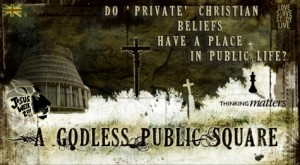
  • A Godless Public Square: Do ‘Private’ Christian Beliefs Have a Place in Public Life? on Video

    Thinking Matters and Evangelical Union hosted an event at the University of Auckland for Jesus Week entitled A Godless Public Square: Do ‘Private’ Christian Beliefs Have a Place in Public Life? This event was essentially a conversation between Theology, Philosophy and Law on the topic of Religion in Public Life. It featured Matthew Flannagan – Analytic Theologian, Glenn Peoples – Philosopher and Madeleine Flannagan – Legal Scholar and was moderated Patt Brittenden. If you missed it you can now watch it on video.

    httpv://www.youtube.com/watch?v=sfnCKFs9DWk&list=PLEB96E8226DC6BA8C&feature=plpp

    Each speaker has published the speeches they wrote for this event:

    Hat tip (and credit for filming and editing this video): Stuart at Thinking Matters.

  • A Godless Public Square: Do ‘Private’ Christian Beliefs Have a Place in Public Life? Part III Madeleine Flannagan – Law

    A Godless Public Square: Do ‘Private’ Christian Beliefs Have a Place in Public Life? A few weeks ago, as part of Jesus Week at the University of Auckland, Thinking Matters and Evangelical Union hosted an event entitled A Godless Public Square: Do ‘Private’ Christian Beliefs Have a Place in Public Life? This event was a conversation between Theology, Philosophy and Law and featured Matthew Flannagan – Analytic Theologian, Glenn Peoples – Philosopher and Madeleine Flannagan – Legal Scholar. The video is still being edited and will be available soon but for now, this 3-part series comprises the written speeches of each speaker.

    Madeleine Flannagan – Law

    Glenn and Matt dealt with moral restraint; the idea prevalent in our society that those of us with religious convictions ought to keep them to ourselves when we participate in public life.

    Often people contend or try to imply that this obligation is required by law. We’ve all heard politicians, people in the media, leaders in our communities, lecturers at university assert that we are a secular nation and that our commitment to freedom of religion requires a secular public square.[1]

    And they are not wrong to a degree. It is evident that something like this ‘obligation’ advanced by the likes of Rawls, Audi, Gaus, et al is present in western jurisprudence – most obviously in that coming out of the United States; you do not need to have studied law to be aware of this, you will have picked up on it if you have watched any American TV.

    Separation of Church and State or Separationism?

    Most people are aware that the US Supreme Court has interpreted America’s Religious Freedom and Free Exercise laws to mean that religious instruction, prayer, references to God, displays of the 10 commandments, nativity scenes — even where participation is totally voluntary — are banned from public institutions.

    This “separationist” reading of the 1st amendment is drawn from US Founding Father Thomas Jefferson’s “Wall of separation Letter” to the Danbury Baptists Association in 1802. But it is unlikely that this reading is what Jefferson meant. At the time he was writing in early nineteenth century America, the common perception of the relationship between church and state reflected a long-standing European tradition.

    Legal scholar Steven Smith wrote in “Separation and the Secular: Reconstructing the Disestablishment Decision” that,

    … At least since the middle ages, scholars and polemicists of all stripes had argued-on both religious and political grounds-that the church should exercise control over the state or-again on both religious and political grounds-that the state should control the church. The common view for centuries had been that an established church was essential to political and social stability.[2]

    He added,

    … In medieval Europe, for example, kings had claimed, and had exercised, the power to appoint bishops and popes. After the Reformation, the British monarch became the official head of the Church of England, and British government assumed control over both the selection of ecclesiastical officials and the formulation of religious doctrine.[3]

    In fact, the Book of Common Prayer, including the 39 Articles, was commissioned and approved by the Crown.

    Smith goes on,

    … medieval popes regularly crowned earthly emperors and kings, and they claimed (and frequently purported to exercise) the authority not merely to excommunicate but actually to depose those kings. Popes sometimes asserted jurisdiction to adjudicate what were essentially political or property disputes. In England, the Church enjoyed-and still enjoys-official representation in Parliament. Immigrants later imported established churches in some form into most of the American colonies.[4]

    The church-state relationship that was familiar to an eighteenth century American was that “governments controlled or directly intervened in the internal affairs of churches, and churches claimed and were formally endowed with governmental powers.”

    At the time Jefferson was writing, many US States had established churches; so when the United States Congress promised to “… make no law respecting an establishment of religion, or prohibiting the free exercise thereof…”[5] they more likely had in mind that Separation of Church and State is simply the idea that the church should not be formally endowed with governmental powers and the state should not try to intervene in or control the church.

    Separation of church and state is not separation of religious beliefs from public life (perhaps this confusion arises because both concepts have the word “separation” in them). The idea that Congress meant something more than mere Separation of Church and State when it passed the first amendment – that Congress meant Separationism — was birthed in the mid to late 20th century – some 200 years later – by the US Supreme Court when it began to hear cases about prayer in schools and the funding of Catholic schools.

    Separationism and Separation of Church and State, as we have seen, are different ideas and one doe not entail the other.

    Comparitive Jurisdictions

    This is not just about the US. Separationist understandings of freedom of religion can be seen in Western jurisprudence elsewhere. There are European cases that exhibit it – even in places like the UK that do have an established church. Many of you will have heard the cases in the media of workers being sent home from their jobs after refusing to follow an instructions from their employers to remove religious jewellery[6] – normal jewellery was fine, just not anything that symbolised God.

    The “Liberty Intervening” case is another UK example; a state-Celebrant refused to perform civil partnerships between members of the same sex. Because of her views on marriage, she was found to have discriminated against those couples. She could not appeal to freedom of religion as the court held that her employer’s requirement she perform same sex civil partnerships did not interfere with her ability to worship.[7]

    Then there is this case, the summary from the head note explains (more…)

  • A Godless Public Square: Do ‘Private’ Christian Beliefs Have a Place in Public Life? Part II Glenn Peoples – Philosophy

    A Godless Public Square: Do ‘Private’ Christian Beliefs Have a Place in Public Life? A few weeks ago, as part of Jesus Week at the University of Auckland, Thinking Matters and Evangelical Union hosted an event entitled A Godless Public Square: Do ‘Private’ Christian Beliefs Have a Place in Public Life? This event was a conversation between Theology, Philosophy and Law and featured Matthew Flannagan – Analytic Theologian, Glenn Peoples – Philosopher and Madeleine Flannagan – Legal Scholar. The video is still being edited and will be available soon but for now, this 3-part series comprises the written speeches of each speaker.

    Glenn Peoples – Philosophy

    Often the subject of religion and politics is alluded to by way of references to terrorism, vigilantism, totalitarianism and persecution, as though these are the only alternative to a public square stripped of religious conviction altogether. This is about as helpful and honest as the automatic association of secularism with the purges of Stalin. The truth is that the flourishing debate in the Western world over the legitimate role of religious convictions in our public decision making is set within the broad liberal democratic tradition. Within that tradition, taking for granted things like freedom of religion, freedom of speech, clear institutional separation of church and state, freedom of association and so on, we’ve seen that it is clearly possible to hold a variety of views on the proper place of religious belief in politics, policy, public lobbying, your own voting and so on. Of course, there are plenty of religious people in the world and in history who do not cherish liberty and mutual respect (as there are and have been non-religious people who do not cherish these things), but you and I do.

    Our popular level discussion here in New Zealand over the proper role of religion in a free society – in the media, in letters to the editor, on talkback radio, in religious speeches, could have been greatly benefited by an exposure to the way that this issue has been dealt with in philosophy, specifically in political philosophy, in ethics and philosophy of religion, which are the areas that really interest me. In particular the following issues need to be seen as central: What is the specific concern that justifies people in identifying religious convictions as an area of worry over and above other convictions? Are these concerns applied consistently and fairly when not thinking in terms of religious convictions? Are they the right concerns to have about public life generally? Secondly, should these concerns really cause us to reconsider the role of religious convictions at all? If so, then how?

    Why is religion singled out?

    Conflict and Polarisation
    Why is there an issue centred specifically around religion in the public square? We don’t hear much, if anything, about the worry of acting on our political beliefs or (usually) our ethical convictions or our scientific findings – at least not because they are political beliefs, ethical convictions scientific findings, yet there is a concern about religious beliefs in the public square, and that concern exists because the beliefs in question are religious. What makes religion special?

    Perhaps the more popular reason that people might have for wanting to see religion take a back seat when it comes to public reason is that, in their view, religious beliefs unleashed in public are dangerous in certain ways. American philosopher Robert Audi is not alone in voicing the concern that “religious disagreements are likely to polarize government” leading to irresolvable disputes and political stand-offs.[1] In order to avoid strong polarisation and the associated mischiefs that come with it (lack of co-operation, social unease and mutual suspicion, perhaps even rioting and acts of violence or terrorism as in Northern Ireland), let us keep our religious beliefs well away from our political reason.

    Matt has already said a thing or two about this, so I’ll just be brief. Is this fair? For starters, is it really true that as soon as we allow people to lobby, vote or even legislate in certain ways because of their religious convictions, we will witness intractable political stand-offs and social disorder? Not at all. We can easily imagine scenarios in which one person or group lobbies for a given policy because their religious convictions motivate them to do so, and another person or group lobbies for exactly the same policy with quite different motives. I think, for example, of the government’s role in marriage. I know of religious people who maintain that the state has no role in formalising marriage since this is, in brief, “God’s business” that the government should frankly stay out of as a matter of the purity of marriage as a holy institution. I also know of libertarians committed to the doctrine of self-ownership and the priority of personal liberty who also think, without any reference to God, that marriage properly belongs entirely to the private realm. So it can’t be the case that endorsing policies because of one’s religious convictions will inevitably or always lead to social or political polarisation and conflict.

    That said, it’s true that different religious convictions (more…)

  • A Godless Public Square: Do ‘Private’ Christian Beliefs Have a Place in Public Life? Part I Matthew Flannagan – Theology

    A Godless Public Square: Do ‘Private’ Christian Beliefs Have a Place in Public Life? A few weeks ago, as part of Jesus Week at the University of Auckland, Thinking Matters and Evangelical Union hosted an event entitled A Godless Public Square: Do ‘Private’ Christian Beliefs Have a Place in Public Life? This event was a conversation between Theology, Philosophy and Law and featured Matthew Flannagan – Analytic Theologian, Glenn Peoples – Philosopher and Madeleine Flannagan – Legal Scholar. The video is still being edited and will be available soon but for now, this 3-part series comprises the written speeches of each speaker.

    Matthew Flannagan – Analytic Theology

    Recently, many Christian ethicists have defended the central place of God’s commands in Theological ethics. In this talk I want to discuss one important objection to appeals to God’s commands; this is the claim that, while it is perfectly appropriate for believers to appeal to purported divine commands when regulating their private conduct or the conduct of voluntary religious communities who believe in such commands, it is morally wrong to appeal to theological beliefs of this sort in any discussion of social ethics. When doing Ethics as a public enterprise i.e. engaging in debates over social policy or offering criticism of cultural and social practices, Christian Ethicists are morally bound to only appeal to secular considerations. I will argue that this position, though widely accepted inside and outside of the church, is mistaken.

    The Objection
    So what is the problem with appealing to divine commands in social ethics? Christian theological convictions ought to impact the whole of life both in the private and public spheres; this is what is meant by the idea of an “undivided life”, where Jesus is Lord of all aspects of our lives.

    Yet this consequence of Christian faith conflicts with a pervasive contemporary attitude: the view that that religion is fundamentally a private matter. It is accepted that a Christian is free to utilise theological convictions when they make decisions about their own life but in a pluralistic society it is increasingly deemed inappropriate to bring such convictions into public discussions about morality, law, politics, economics, education, scholarship and so on. The desire to influence society with Christian ideals or to convert others to the faith is viewed by many as an intolerant desire to impose one’s private views onto others.

    It is widely accepted that theological convictions can govern churches and the private lives of believers yet we are told that the public square – government, public policy, the courts, the academy, education, business, arts, media, etc – should be secular only.The problem is nicely summarised by Stephen Carter Christian theological convictions ought to impact the whole of life both in the private and public spheres; this is what is meant by the idea of an “undivided life”, where Jesus is Lord of all aspects of our lives.

    Yet this consequence of Christian faith conflicts with a pervasive contemporary attitude: the view that that religion is fundamentally a private matter. It is accepted that a Christian is free to utilise theological convictions when they make decisions about their own life but in a pluralistic society it is increasingly deemed inappropriate to bring such convictions into public discussions about morality, law, politics, economics, education, scholarship and so on. The desire to influence society with Christian ideals or to convert others to the faith is viewed by many as an intolerant desire to impose one’s private views onto others.

    It is widely accepted that theological convictions can govern churches and the private lives of believers yet we are told that the public square – government, public policy, the courts, the academy, education, business, arts, media, etc – should be secular only.

    This event looks at this issue. The conversation will span Theology, Philosophy and Law led by a panel made up of Christian representatives from each discipline along with you the audience:

    “One good way to end a conversation – or start an argument – is to tell a group of well educated professionals that you hold a political position (preferably a controversial one such as being against abortion or pornography) because it is required by your understanding of God’s will. In the unlikely event that anyone hangs around to talk with you about it, chances are that you will be challenged on the ground that you are intent on imposing your religious beliefs on other people. And in contemporary political and legal culture, nothing is worse.”[1]

    Carter cites the objection that appealing to God’s commands in public moral debate involves imposing one’s religious beliefs onto other people, and points out that such impositions are morally wrong. Note that the objection is not that such divine commands do not exist or that it is irrational to believe that they do. The objection is a specifically moral one. It is morally wrong to appeal to such beliefs; doing so violates a moral obligation people have to not impose their religious beliefs onto others. Something like this moral objection is widely held, both inside and outside the church. In response to this I will make four points. (more…)

  • The New Zealand Association of Rationalist Humanists and the Privileging of Secularism

    The New Zealand Association of Rationalist Humanists (“NZARH”) has a statement of aspirational ideals for the New Zealand state on their website. Entitled “The Tolerant Secular State” it is anything but.

    The first two sentences of the document exhibit a confusion which is inherent throughout (and commonly found in discussions of church and state):

    Lord Voldemort

    “The NZARH strongly believes that government should be secular; that is dealing with the issues of this world rather than following a religious agenda. Our law should not give one set of beliefs privilege over another and the state should treat religious organisations the same as any other organisation.”

    An equivocation on the meaning of the word “secular” in the very first sentence is immediately apparent.

    Stephen Smith notes that the word secular has two distinct meanings. Etymologically, “secular” refers to things pertaining to this world and life as opposed to the next. In this sense of the word “secular” is not opposed to religion; many religious beliefs and values pertain to life in this world, beliefs about: marriage, sex, human life, killing,  justice for the poor, what one’s duties are in this life, what God’s purposes are in this life and so on are all secular beliefs in this sense. The second and more common meaning of “secular” is to say it excludes, is in opposition to beliefs and values that are religious in nature; this is usually the first definition one will find in a dictionary.

    The NZARH use both meanings in the first sentence of their “Tolerant Secular State” document (more…)

  • The Separation of Church and Self: Rethinking Separationism

    Is it just for a pluralistic society to ground its public policy on religious premises? What role should religion play in such a society? Debate over questions like these has figured in theology, philosophy, political science, jurisprudence and popular culture for centuries. In contemporary Western pluralistic society the debate continues. Even for those unfamiliar with its nuances at the higher levels the effect of the standard view, as described by Stephen Carter, is immediately familiar:

    “One good way to end a conversation – or start an argument – is to tell a group of well educated professionals that you hold a political position (preferably a controversial one such as being against abortion or pornography) because it is required by your understanding of God’s will. In the unlikely event that anyone hangs around to talk with you about it, chances are that you will be challenged on the ground that you are intent on imposing your religious beliefs on other people. And in contemporary political and legal culture, nothing is worse.”[1]

    James Madison

    Carter is referring to the separationist understanding of religion and public life, the idea that in a contemporary pluralistic society significant restraint must be put on the political role of religious reasons. This restraint is negative; when a functionary deliberates over a proposed policy it is not justified for that functionary to decide to support or oppose that policy on grounds derived from religion. A corollary of this is that citizens should not try to influence public policy by appealing to religious reasons. Separationists argue that the public policy of a pluralistic society must be able to be justified by a plausible secular justification in order for it to be just to all. Religious beliefs, while utilised and followed in private, should be kept separate from public policy debates, the administration of public institutions and the deliberation of public functionaries. (more…)