Tag: Tim McGrew

  • True Reason: Confronting the Irrationality of the New Atheism – in Paperback

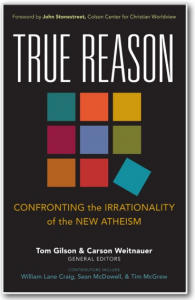
    True Reason: Confronting the Irrationality of the New AtheismThe paperback version of the Kindle book, True Reason: Christian Responses to the Challenges of Atheism,  which Matt wrote a chapter for, recently arrived from the publishers. This release has been re-released as True Reason: Confronting the Irrationality of the New Atheism (the link takes you to the book’s official website).

    True Reason is still edited by Tom Gilson and Carson Weitnauer and is still published by Kregal Publications; however, this edition has been updated and expanded and it has two additional chapters. The table of contents is as follows:

    1. The Party of Reason?
      Tom Gilson
    2. The Irony of Atheism
      Carson Weitnauer
    3. Dawkins’s Delusion
      William Lane Craig
    4. Richard Dawkins’s Illusions
      Chuck Edwards
    5. Unreason at the Head of Project Reason
      Tom Gilson
    6. John Loftus and the “Outsider-Insider Test for Faith”
      David Marshall
    7. Atheism and the Argument from Reason*
      Lenny Esposito
    8. The Explanatory Emptiness of Naturalism
      David Wood
    9. Reason in a Christian Context
      Peter Grice
    10. The Marriage of Faith and Reason
      David Marshall
    11. Faith and Reason in Historical Perspective*
      David Marshall and Timothy McGrew
    12. A Sun to See By—Christianity, Meaning, and Morality
      Samuel J. Youngs
    13. Are Science and Christianity at Odds?
      Sean McDowell
    14. God and Science Do Mix
      Tom Gilson
    15. The Problem of Evil and Reasonable Christian Responses
      John DePoe
    16. Historical Evidences for the Gospels
      Randy Hardman
    17. Did God Command the Genocide of the Canaanites?
      Matthew Flannagan
    18. Christianity and Slavery
      Glenn Sunshine
    19. Epilogue
      Carson Weitnauer

    *Chapters Seven and Eleven are new additions in the second edition, not included in the Kindle version of True Reason.

    Read the author’s bios here.

    The blurb from Amazon is as follows:

    Today’s New Atheists proclaim themselves our culture’s party of reason. It is a claim they cannot sustain. Reason is the New Atheists’ weakness, not their strength and in fact, the Christian faith is a far better place to look for True Reason.

    In sixteen carefully constructed essays by more than a dozen Christian thinkers including William Lane Craig, Sean McDowell, and Timothy McGrew,True Reason unmasks the frequent irrationality displayed by leading atheists like Richard Dawkins, Sam Harris, and Christopher Hitchens. The authors go on to show the great extent to which the Christian faith has historically supported sound reasoning, and that Christian thinkers, past and present, have demonstrated real excellence in reasoned, rational thinking.

    Making their case accessible to the first-time inquirer as well as the serious student, this top-flight team of writers presents a sound defense and a strong introduction to the true reason uniquely found in Christianity.

    You can buy the paperback version of True Reason: Confronting the Irrationality of the New Atheism on Amazon here.

  • Jesus, Hot Cross Buns, Easter Eggs, Ishtar and Constantine: Is Easter Pagan? Tim McGrew says No!

    Easter can be annoying.  My kids all want chocolate, this year the hot cross buns sold out and Matt brought crumpets home from the supermarket instead. People who don’t normally have any time for Christianity suddenly feel they must go to church, whilst some of my Christian friends refuse to let their children eat chocolate because Easter is a pagan festival. Navigating it does my head in sometimes.

    Easter

    In the past week we’ve had people phone, email, text and raise in conversation that Easter was invented by Constantine, that the bunnies and the buns are pagan and thus consuming them is an offence against God. We’ve heard that the dates are wrong and that Easter dates do not coincide with Passover, that it is a Roman festival, while others say that Easter is tied up with Ishtar. This wasn’t limited to people coming to us; Matt was on the Pat Brittenden Mornings Panel earlier in the week and because of that we heard that talkback radio was full of this too. So, it was very cool that Matt and I were able to have a word with the producers at Radio Rhema after the Panel, and put them in touch with Dr Tim McGrew whose interview as to Whether Easter is Pagan aired on Tuesday – click the link to listen.

    Tim is a good friend, a world renowned scholar whose expertise on miracles and particularly the historical accuracy of the resurrection qualifies him as an authority on some of these Easter-is-pagan claims. While he does not touch on all of the above in the interview he debunks a lot of it.

    Normally Matt and I try to do a Passover-ish meal – we do lamb, rosemary and red wine – and the kids all get to choose a king size block of chocolate each (they reason they get more chocolate for the money than buying Easter Eggs) and I try to ensure indulgement in a decent hot cross bun. Throughout the weekend we focus on Christ, his death and resurrection. We read relevant passages, we have conversations about the Passover and the fact that Christ is the fulfillment of it, in years gone by when the kids were younger we’ve made Easter story cookies. Basically we enjoy the food, the public holiday and we weave learning opportunities and ways to focus on Christ in as we go so that the thrust of Easter is on him.

    We are not worried about taking this approach because Christ conquered all and our focus and heart and intent is on him. Don’t get me wrong, it is important to pause and check that one is not engaging in Paganism but just because something at some point had something to do with Paganism does not mean it is Paganism presently. Tree worship is common among Pagans so must we eschew wood? What about Pythagorus’ theorem? If Easter was just Ishtar worship then we would not be celebrating it; how many of us wanting the spiritual side of Easter are heading to the local Ishtar temple this weekend? As for Constantine inventing Easter, direct evidence for Easter being celebrated by Christians can be identified in the 2nd century, some couple of hundred years prior to Constantine – Wikipedia can tell you that much.

  • Thinking Matters Youth Conference

    This Saturday is the first, of hopefully many, Thinking Matters Youth Conference, the schedule is  below.  I am leading a breakout session on Moral Relativism

    WHEN: Saturday, February 18
    WHERE: Greenlane Christian Centre, 17 Marewa Rd, Greenlane, Auckland
    COST: $10


    Schedule:
    10am Registration
    10.30am Jeff Tallon – Is Science a Threat to Faith?
    11.30am Sean McDowell – Is Faith Blind? (via Skype)
    12.15pm Lunch
    1pm Breakout Sessions 1

    • Stream 1: Is morality relative and does it matter? – Matt Flannagan
    • Stream 2: How can one religion be “right” and the others “wrong”? – Trevor Mander
    • Stream 3: Why doesn’t God do something about the evil in the world? – Ben Carswell
    • Stream 4: Does God get mad when we doubt? – Jason Kumar and Dominic Bnonn Tennant
    1.45pm Breakout Sessions 2 (repeated)
    2.30pm Tim McGrew – Is the Bible Reliable? (via Skype)
    3.30pm Q&A Panel – Jeff Tallon, Ben Carswell, Matt Flannagan, and Trevor Mander
    4.15pm Conference closes
  • Guest Post: Tim McGrew defends “The Argument from Miracles: A Cumulative Case for the Resurrection of Jesus of Nazareth”

    Tim McGrewA little while back we published a post linking to some talks by Tim McGrew on Undesigned Coincidences in the Gospels. For some bizarre reason this post of ours prompted fellow kiwi blogger Deane Galbraith to write a post on the Bulletin for the Study of Religion, linking to our post, on the separate topic of Tim and his wife Lydia McGrew’s article “The Argument from Miracles: A Cumulative Case for the Resurrection of Jesus of Nazareth” which was published in the The Blackwell Companion to Natural Theology.

    Here is a snippet of Galbraith’s post from the beginning:

    There are quite a few academic and quasi-academic studies in which statistical analysis seems to be employed as a substitute for thinking. It is, perhaps, fairly understandable why some people are tempted by the allure of numbers. Those mysteriously complex formulae, mindnumblingly boring statistics and obscure mathematical notations lend a magical aura of scientific objectivity and plausibility to even the most patently absurd claims.

    What gets me talking about this at this moment is my dumbfounded reading last night of an article published by Timothy McGrew and Lydia McGrew, entitled“The Argument from Miracles: A Cumulative Case for the Resurrection of Jesus of Nazareth” (2009). In this article, the McGrews utilize Bayesian probability in order to argue to the “scientific” conclusion that the probability of the resurrection of Jesus is a “staggering” 100,000,000,000,000,000,000,000,000,000,
    000,000,000,000,000 to 1.

    Are you staggered? overwhelmed? swooning? Were you previously skeptical about the Christian claim that Jesus was resurrected, but now you’re feeling pretty silly? Perhaps not.

    The post goes on in the same vein to accuse the McGrews of trying to trick people into belief in the resurrection. It is littered with terms like “flimsy basis”, “populist apologetics”, “fanciful” and “deeply and unavoidably farcical” and is illustrated complete with a giant white-robed Caucasian Jesus wistfully looking heavenward as he steps out of the tomb. It finishes with Galbraith laying out his understanding of their mathematical reasoning, the tone at this point is dripping with lashings of smug, self-congratulation at how easily he, PhD student from Otago whose research area is giants in the Old Testament narrative, had dispatched two of the top philosophers of religion working in this field, both specialists in probability theory.

    Not being qualified remotely in Bayesian probability theory myself, and therefore not wanting to presume anything beyond assessing the tone as exceedingly arrogant, I passed on Galbraith’s criticisms to the McGrews on Facebook. Well it turns out that Galbraith isn’t the only non-qualified liberal/atheist to take a punt at their reasoning on this piece. Tim McGrew explains that straw men have been popping up all over.

    Straw Men Burning: Misinterpretations of our Article on the Resurrection

    One of the hazards of writing technical philosophy is the risk that someone who lacks the appropriate expertise will attempt to critique it. In the case of the article on the resurrection that Lydia and I wrote for The Blackwell Companion to Natural Theology, this has already happened. It is hard enough to correct misimpressions of this sort on a relatively neutral topic; when the subject rouses passions of the sort that, as Hume reminds us, religious disputes are apt to generate, then the difficulties are redoubled.

    But one thing that we did not anticipate is that (more…)