Tag: Rights and Freedoms

  • Nonsense on Stilts: Non-Discrimination Rights

    When the Human Rights Act was passed in 1993 I supported the writing of non-discrimination rights into law. At that time I, like many New Zealanders, believed that people had a right to not be discriminated against that the government should protect. Since then, reflecting on the issue has lead me to change my mind. I am now inclined to think that non-discrimination rights do not exist, they are “nonsense on stilts”. Laws which purport to recognise and protect them are recognising and protecting something that does not exist.

    My position now is that discrimination is not wrong, it is morally neutral. It is justified and reasonable to discriminate on certain grounds in certain contexts, and it is unjustified to do so in other contexts. When it is unjustified, what makes it so are factors that have nothing to do with discrimination; these factors would be problematic if applied equally.

    Jake the muss: not a skinny asian womanBefore elaborating my reasons for being sceptical about such rights, let us be clear as to what denying non-discrimination rights does not mean. It does not mean I believe that it is permissible for people to refuse to serve ethnic minorities because one holds to false sterotypes and has unwarranted hatred towards those minorities. Nor does it mean I support depriving women or African Americans of the vote. Likewise I do not support racist lynchings or gay bashings.

    A sceptic about anti-discrimination rights can oppose all these things and still not be committed to supporting the existence of anti-discrimination rights. All that is entailed by my scepticism is that these thing are not wrong because they violate a right to not discriminate, and its clear to me that this is true; they are wrong for other reasons.

    Discriminating against minorities in the manner suggested above is wrong because we have duties to not stereotype and treat people with contempt. If we treated everyone equally in this way it would still be wrong. Similarly, racist lynchings are wrong because they involve kidnapping, assault and homicide. If people were equal-opportunity lynchers who indiscriminately lynched people of all races, sexes, lifestyles and degrees of ability, it would still be wrong for them to do so. Depriving people of the vote is wrong because people have a right to vote, the right is not attached to sex or race, and so on. The point is that the wrongness of these sorts of practices can be adequately explained, and I think is more plausibly explained, without recourse to an alleged right to not be discriminated against. An appeal to “discrimination” misdiagnoses the moral problems with the action complained of.

    Why Discrimination is Not Wrong
    It is not wrong to discriminate. To discriminate against one person in favour of another is to treat the former less favourably than the latter. The problem is that, so defined, discrimination is clearly not wrong. In fact, discrimination is essential to any moral thinking at all.

    To make a moral judgement condemning a particular action involves adopting a less favourable stance towards those who perform that action. We condemn particular actions, and if a person doing those actions lacks an adequate excuse we blame and censure that person for what he or she did. We expect the person to feel guilty and to make appropriate apology and reparations. On the other hand to judge an action is right (more…)

  • Watch Matt on the GCSB Bill on Shine TV

    On 30 July 2013 Matt was interviewed on Shine TV about the Government Communications Security Bureau and Related Legislation Amendment (“GCSB”) Bill. The discussion on the issues of civil liberties, spying in times of threats against citizens is very good. The video is here:

  • Why Defamatory Speech is not Free Speech

    The following is a representation of the standard argument as to why a remedy requiring the removal of defamatory speech from a publication is not a violation of the right to free speech:

    1. The right to Freedom of Expression is protected by s14 of the Bill of Rights Act 1990 (“BORA”).
    2. The operational provisions of the BORA provide in section 5 that a reasonable limit to Freedom of Expression can be justified in a free and democratic society where that limit is prescribed by law.
    3. Section 5 is subject to section 4, which states in mandatory terms that no court can decline to apply any provision of an enactment on the sole grounds that the provision is inconsistent with the BORA.
    4. Notwithstanding this, section 6 requires the court rule in a manner as consistent as possible with Bill of Rights.
    5. If a Respondent’s actions constitute a breach of s4 of the Defamation Act 1992 therefore the remedy sought, removal of the defamatory material from the publication, does not violate the Respondent’s right to Freedom of Expression.

    Freedom of SpeechWhile this is the standard argument it has always felt wrong to me. There is something unsatisfactory about appealing to a mechanism in the law that, as argued, feels like it is shearing off a part of an important right and freedom, even if the law says that it is ok.

    I find this argument unsettling and lacking something; at the same time defamatory speech is insidious, causes harm, hurts; intuitively it just feels wrong to say that one is morally justified in spreading harmful falsehoods about a person and is not required to account for the wrongs done, because of their right to free speech.

    After discussions with Matt about this I have decided that I prefer the following argument:

    1. Freedom of Expression exists to allow people to freely express their opinions and impart information without fear of legal penalty.
    2. Defamation is expression imparted to another that lowers the standing of a person in the eyes of their peers and is not true and is not honest opinion which is genuinely held.(I am ignoring the third defence, privilege).
    3. A person who expresses defamation is not engaging in Freedom of Expression as where there is no truth or honest opinion then a person is neither attempting to inform another or attempting to express their opinion.
    4. The basis for this is that to attempt to inform someone is to attempt to increase that person’s repertoire of true beliefs’ and to impart an opinion is to express what one honestly believes to be the case.
    5. Therefore, the freedom that the right to Freedom of Expression protects is all speech that is true or honestly held to be true by the speaker.

    That is much better.

    Defamatory speech is not free speech therefore legal sanctions against it are entirely appropriate in both legal and moral senses.

    Context:
    Two blogs have recently been found to have published defamation of me, the nature of which was described as “extremely serious” by a Court of Law. The above demonstrates why I feel I was perfectly justified in seeking the removal of the defamatory material, one by Court Order, one by private request. John Stuart Mill, the UN Charter, Milton, Common Law, to point to a few, have agreed for centuries that defining Freedom of Speech to be all speech that is not Defamation is just in all mediums. Defamatory speech being restricted or punished by law, offline or online, poses no threat to anyone.

  • Why Defamatory Speech is not Free Speech

    The following argument as to why a remedy requiring the removal of defamatory speech from a publication was not a violation of the right to free speech is representative of one I have previously put before the court:

    1. The right to Freedom of Expression is protected by s14 of the Bill of Rights Act 1990 (“BORA”).
    2. The operational provisions of the BORA provide in section 5 that a reasonable limit to Freedom of Expression can be justified in a free and democratic society where that limit is prescribed by law.
    3. Section 5 is subject to section 4, which states in mandatory terms that no court can decline to apply any provision of an enactment on the sole grounds that the provision is inconsistent with the BORA.
    4. Notwithstanding this, section 6 requires the court rule in a manner as consistent as possible with Bill of Rights.
    5. It is submitted that the Respondent’s actions constitute a breach of s4 of the Defamation Act 1992 therefore the remedy sought, removal of the defamatory material from the publication, does not violate the Respondent’s right to Freedom of Expression.

    Freedom of SpeechWhile this is the standard argument it feels wrong to me. There is something unsatisfactory about appealing to a mechanism in the law that, as argued, feels like it is shearing off a part of an important right and freedom, even if the law says that it is ok.

    I find this argument unsettling and lacking something; at the same time defamatory speech is insidious, causes harm, hurts; intuitively it just feels wrong to say that one is morally justified in spreading harmful falsehoods about a person and is not required to account for the wrongs done, because of their right to free speech.

    After discussions with Matt about this I have decided that I prefer the following argument:

    1. Freedom of Expression is defined in the BORA as “the freedom to … impart information and opinions …”.
    2. Defamation is expression imparted to another that lowers the standing of a person in the eyes of their peers and is not true and is not honest opinion which is genuinely held.(I am ignoring the third defence, privilege).
    3. A person who expresses defamation is not engaging in Freedom of Expression as where there is no truth or honest opinion then a person is neither attempting to inform another or attempting to express their opinion.
    4. The basis for this is that to attempt to inform someone is to attempt to increase that person’s repertoire of true beliefs’ and to impart an opinion is to express what one honestly believes to be the case.
    5. Therefore the speech the BORA protects is all speech that is true or honestly held to be true by the speaker.

    That is much better.

    Defamatory speech is not free speech therefore legal sanctions against it proportionate to the harm caused are entirely appropriate in both legal and moral senses.

    RELATED POSTS:
    Pluralism and Being Right
    Of course I think I’m right!


  • Freedom of Religion in a Secular Society @ Auckland University this Monday

    Church and StateAs part of AUSA’s Human Rights week at the University of Auckland, and in association with Thinking Matters, Matt and I will be giving a free public lecture with Q&A on the topic “Freedom of Religion in a Secular Society” on Monday 12 September from 7-8.30pm in Clock Tower Lecture Room 032.

    The Facebook page for this event states:

    The New Zealand Bill of Rights Act states:

    13 – Everyone has the right to freedom of thought, conscience, religion, and belief, including the right to adopt and to hold opinions without interference.

    14 – Everyone has the right to freedom of expression, including the freedom to seek, receive, and impart information and opinions of any kind in any form.

    15 – Every person has the right to manifest that person’s religion or belief in worship, observance, practice, or teaching, either individually or in community with others, and either in public or in private.

    • How should we read these sections alongside idea that New Zealand is a secular society?
    • How should we read them alongside the viewpoint advanced most notably by philosophers such as John Rawls that religion should be privatised?
    • Does Separation of Church and State require Separation of Religion from public life?
    • Can we still have Freedom of Religion in New Zealand and hold to these views?
    • What approach is just and fair in a pluralistic society like ours?

    Analytic Theologian and Ethicist, Dr Matthew Flannagan and Legal Scholar, Madeleine Flannagan (a post-graduate student in Law at Auckland) will give a joint lecture followed by a Q&A session on the topic Freedom of Religion in a Secular Society from 7.00-8.30pm on Monday 12 September 2011 in Clock Tower 032.

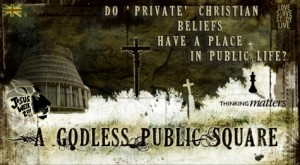
  • A Godless Public Square: Do ‘Private’ Christian Beliefs Have a Place in Public Life? Part III Madeleine Flannagan – Law

    A Godless Public Square: Do ‘Private’ Christian Beliefs Have a Place in Public Life? A few weeks ago, as part of Jesus Week at the University of Auckland, Thinking Matters and Evangelical Union hosted an event entitled A Godless Public Square: Do ‘Private’ Christian Beliefs Have a Place in Public Life? This event was a conversation between Theology, Philosophy and Law and featured Matthew Flannagan – Analytic Theologian, Glenn Peoples – Philosopher and Madeleine Flannagan – Legal Scholar. The video is still being edited and will be available soon but for now, this 3-part series comprises the written speeches of each speaker.

    Madeleine Flannagan – Law

    Glenn and Matt dealt with moral restraint; the idea prevalent in our society that those of us with religious convictions ought to keep them to ourselves when we participate in public life.

    Often people contend or try to imply that this obligation is required by law. We’ve all heard politicians, people in the media, leaders in our communities, lecturers at university assert that we are a secular nation and that our commitment to freedom of religion requires a secular public square.[1]

    And they are not wrong to a degree. It is evident that something like this ‘obligation’ advanced by the likes of Rawls, Audi, Gaus, et al is present in western jurisprudence – most obviously in that coming out of the United States; you do not need to have studied law to be aware of this, you will have picked up on it if you have watched any American TV.

    Separation of Church and State or Separationism?

    Most people are aware that the US Supreme Court has interpreted America’s Religious Freedom and Free Exercise laws to mean that religious instruction, prayer, references to God, displays of the 10 commandments, nativity scenes — even where participation is totally voluntary — are banned from public institutions.

    This “separationist” reading of the 1st amendment is drawn from US Founding Father Thomas Jefferson’s “Wall of separation Letter” to the Danbury Baptists Association in 1802. But it is unlikely that this reading is what Jefferson meant. At the time he was writing in early nineteenth century America, the common perception of the relationship between church and state reflected a long-standing European tradition.

    Legal scholar Steven Smith wrote in “Separation and the Secular: Reconstructing the Disestablishment Decision” that,

    … At least since the middle ages, scholars and polemicists of all stripes had argued-on both religious and political grounds-that the church should exercise control over the state or-again on both religious and political grounds-that the state should control the church. The common view for centuries had been that an established church was essential to political and social stability.[2]

    He added,

    … In medieval Europe, for example, kings had claimed, and had exercised, the power to appoint bishops and popes. After the Reformation, the British monarch became the official head of the Church of England, and British government assumed control over both the selection of ecclesiastical officials and the formulation of religious doctrine.[3]

    In fact, the Book of Common Prayer, including the 39 Articles, was commissioned and approved by the Crown.

    Smith goes on,

    … medieval popes regularly crowned earthly emperors and kings, and they claimed (and frequently purported to exercise) the authority not merely to excommunicate but actually to depose those kings. Popes sometimes asserted jurisdiction to adjudicate what were essentially political or property disputes. In England, the Church enjoyed-and still enjoys-official representation in Parliament. Immigrants later imported established churches in some form into most of the American colonies.[4]

    The church-state relationship that was familiar to an eighteenth century American was that “governments controlled or directly intervened in the internal affairs of churches, and churches claimed and were formally endowed with governmental powers.”

    At the time Jefferson was writing, many US States had established churches; so when the United States Congress promised to “… make no law respecting an establishment of religion, or prohibiting the free exercise thereof…”[5] they more likely had in mind that Separation of Church and State is simply the idea that the church should not be formally endowed with governmental powers and the state should not try to intervene in or control the church.

    Separation of church and state is not separation of religious beliefs from public life (perhaps this confusion arises because both concepts have the word “separation” in them). The idea that Congress meant something more than mere Separation of Church and State when it passed the first amendment – that Congress meant Separationism — was birthed in the mid to late 20th century – some 200 years later – by the US Supreme Court when it began to hear cases about prayer in schools and the funding of Catholic schools.

    Separationism and Separation of Church and State, as we have seen, are different ideas and one doe not entail the other.

    Comparitive Jurisdictions

    This is not just about the US. Separationist understandings of freedom of religion can be seen in Western jurisprudence elsewhere. There are European cases that exhibit it – even in places like the UK that do have an established church. Many of you will have heard the cases in the media of workers being sent home from their jobs after refusing to follow an instructions from their employers to remove religious jewellery[6] – normal jewellery was fine, just not anything that symbolised God.

    The “Liberty Intervening” case is another UK example; a state-Celebrant refused to perform civil partnerships between members of the same sex. Because of her views on marriage, she was found to have discriminated against those couples. She could not appeal to freedom of religion as the court held that her employer’s requirement she perform same sex civil partnerships did not interfere with her ability to worship.[7]

    Then there is this case, the summary from the head note explains (more…)