Blog

  • Christian Blog Rankings Report for March 09 – Tumeke

    Here are the top 10 NZ Christian blogs based on Tumeke’s NZ blog stats for March; these stats are used in the calculations for the MandM top 10 NZ Christian Blog rankings for March 09:
    1. MandM 35 [Incorrect uniques used due to stats going down; correct rank was 31 (score 237)]

    Top 10 Tumeke. name of blog Tumeke rank

    Of Note:

    • A change in the number 1 spot – well done Scrubbone!
    • All top 10 are well within the top 100; in fact Contra Celsum, Star Studded Super Step, Blessed Economist and True Paradigm all made the top 100 despite being just outside the top 10.

    Note: This list only includes Christian blogs that openly identify as Christian blogs on Tumeke’s ranking descriptions. If you think your blog should be on the MandM top 10 NZ Christian Blogs rankings contact Tim Selwyn of Tumeke and ask him to change your blog description to include something identifiably Christian on his rankings.

    Now that Tumeke’s March stats are out we will compare them with HalfDone’s and publish the overall MandM top 10 NZ Christian Blog rankings for March 09 shortly.

  • Divine Commands and Intuitions: A Response to Ken Perrott

    Ken Perrott from Open Parachute has asked me some questions about my views on morality and divine commands. Views I have repeatedly expressed on this blog. Given that others have from time to time asked me similar questions, and given the length of my response, I have decided to turn my answers into a post. [Ken’s questions are copied and pasted from the comments section of With God Anything can be Permitted: Another Bad Argument against Theistic Morality, numbered and italicised below]

    1. I think a key issue, one which should really be spelt out in detail, is the concept of “grounding moral duties in divine commands”. What does this mean?

    Basically, I think the relationship between the moral properties of being wrong and the property of being contrary to God commands is analogous to the relationship between water and H2O. Just as we explain the existence and nature of water by identifying it with H2O. I would explain the existence and nature of wrongness by identifying it with the property of being contrary to Gods commands.

    2. So what do you mean by “divine commands”? How do you get them? Do you hear voices?

    No I don’t hear voices. God is an immaterial being and hence has no vocal chords. I think it is possible for God to create an audible voice issuing a command but I think that this would be fairly atypical. In any event, I do not think that an auditory voice is necessary for issuing a command. I can communicate a command orally but I can also do it via e-mail, text, sign language, waving a flag, etc.

    In the normal and typical cases, I think divine commands are usually discerned via a person’s conscience. One intuitively sees that certain actions are right and others wrong and hence intuitively perceives certain imperatives such as “do not torture children for fun,” etc. Moreover, I think anyone whose faculties are functioning properly perceives God’s commands this way whether they believe in his existence or not.

    The H2O analogy may illuminate this. We know that the property of being water is the property of being H2O. However, people can know something is water immediately via perception even if they do not have any beliefs about molecules, atoms or contemporary science. Pre-European Maori, for example, knew about the existence of water and competently used water for centuries before they knew about the existence of hydrogen and oxygen.

    I think something analogous holds with divine commands. The property of being wrong is the property of being contrary to divine commands; however, people can immediately perceive via intuition what is wrong even if they do not believe in divine commands.

    Hence, on my view, atheists can know what is right and wrong. The real question is whether atheism can adequately explain the existence of right and wrong or whether, given atheism, it is likely that moral properties such as right and wrong exist. These are separate questions.

    A person can believe in the existence of something and yet be committed to beliefs, which if true, entail that what they believe is a fantasy. I suspect this is precisely the way Atheists view Christians.

    3. And if such a command tells you commit an act which conflicts with your moral intuitions and logic – which one do you follow?

    If I understand Ken correctly here, he is asking me what I would do if I believed that God had commanded an action that I intuitively considered to be wrong. This is actually a big topic, worthy of a post in and of itself, I do plan to post something more substantial on this in the future, here I can only summarise my current position.

    As I noted above, I agree with Ken that people can intuitively recognise certain principles of right and wrong. I would, however, point out that these intuitions are fallible. So, in contrast to what Ken appears to think, I would not assume that every time there was a clash between what I believed God’s commands are and my intuitions that the latter are correct. At the same time I also think our interpretations about what God commands are also fallible and so I would not assume that my interpretations of what God commanded were always correct either. In fact, given that I have already argued that one knows God’s commands intuitively through one’s conscience, intuitively perceiving an action is wrong is some evidence that God forbids it and that claims to the contrary are mistaken.

    My answer then to Ken’s question, what do you do if one’s interpretation of God’s commands conflicts with one’s moral intuitions? is that it depends on one’s epistemic situation. If the belief that God has commanded a particular action is something that, after critical reflection, seemed to me well established by the evidence and by contrast, the contrary intuition that the action was wrong was fairly weak, peripheral and less plausible then I would go against the intuition. If, on the other hand, the intuition was very clear and seemed extremely plausible while the rival interpretation of God’s commands was, by comparison, fairly weak and tentative then I would follow the intuition.

    To turn to one example Ken mentions, the terrorist attacks in New York on September 11, 2000, I think the intuition that it is wrong to kill innocent human beings is a very strong one. Whereas I do not believe that the case from, say, scripture or theological tradition for killing innocent people in this way is very strong at all (in fact both scripture and tradition are fairly unanimously opposed to terrorism of this sort).

    On other issues my thinking is different. For example some people appear to find it self-evident that there is nothing wrong with homosexual conduct. I myself do not have this intuition, nor do most people I know, in fact, many defenders of homosexual conduct I have spoken to admit that they personally find the idea of two men having sex disgusting but defend the “liberal” view in spite of this. Moreover, for I do not think it is implausible to conclude that much of the contemporary acceptance of homosexual conduct is due to cultural conditioning rather than a sudden direct insight gained in the mid 20th century. The arguments typically given for the permissibility of homosexual sex are fairly weak and frequently consist of no more than castigating others as bigots. On the other hand, I think the theological case against homosexual conduct from scripture and tradition is fairly strong.

    I have posted a bit more about my thoughts on this in my post Brink on Dialetical Equilibrium.

    4. After all, I keep hearing of people who have committed murder as a result of “divine commands” and society usually locks them up.

    I am not sure what Ken intends to prove with this point. Ken is correct that some people who suffer from a mental disorder believe that God has commanded them to kill. I don’t think this proves much. I know of people who suffer from dementia who have had hallucinations that there is a river running through their lounge. Does it follow then that referring to the existence of rivers is somehow dubious? In fact, mental patients can also have faulty “moral intuitions” and moral logic quite independently of any theological beliefs they have.

    Despite this, Ken maintains, correctly, that people whose cognitive faculties are functioning properly can intuitively discern the presence of right and wrong. I agree with him, the difference is that I believe that what they discern is in fact the property of being in accord with or contrary to divine commands. Ken clearly does not. The question that some theistic critics of secular morality poses is not whether atheists can discern right and wrong, they can; the question is whether, if atheism is true, right and wrong actually exist.

    RELATED POSTS:
    With God Anything can be Permitted: Another Bad Argument against Theistic Morality
    See labels:
    Divine Command Theory
    Euthyphro

  • Bullying (Again) and Coming Posts

    Matt and I have not written much of late for MandM due to the bullying problem having arisen again. Christian was assaulted/bullied on four separate occasions at school last week. Twice during class and in both instances the teachers failed to address the matter adequately. In addition, despite the most serious incident happening at lunchtime, he was knocked to the ground and kicked by a pack of boys, the first we heard of it was after school when he came home as he was sent back to class despite repeatedly asking for us to be phoned; when he went back to class another boy punched him three times.

    We have not sent him to school since all this happened, we have been seeking legal advice and are trying to decide what to do going forward as he has Aspergers so does not want any change on top of everything else, the mere thought of another school or being home-schooled with his siblings makes him panic but neither he or us has any doubt that he will get hit again if he returns to school and none of us have any faith in the school to be able to keep him safe or have their teachers act properly against the perpetrators if it happens in class – our complaint that we are drafting to the board of trustees names 4 of his 6 teachers. Writing it takes precedence over drafting new blog posts, at least the sort of posts that require our heads to be focused and require several hours of research and writing.

    So as you can imagine our heads are not really on MandM – please chat amongst yourselves, if anyone has guest posts they want to submit that would be cool.

    Coming up though, we do have some posts in the pipeline:

    Matt has a two part response to John W. Loftus’ The Christian Illusion of Moral Superiority – it is about 1/3 edited and needs a couple of quotes checked so it is not far away; he has a response to Ken on Divine Commands and Intuitions that I think he said if I could edit today is ready to go – I will have to have a look; he has something on Tooley’s deontological argument from evil and Plantinga’s response that apparently just needs editing and a footnote to be chased up and he is writing a guest post for Debunking Christianity that we will cross post here and he still owes me the piece on Sodom and Gomorrah he promised me and Anna last weekend. There are a handful of other things on his I-must-get-to-that list too – Kaiwai posted something on our Is Abortion Liberal series on his blog that he should respond to and he has some other stuff in his head as well.

    I have been working on some of the reader requests and I have a half-written post of the foreshore and seabed legislation with a jurisprudential spin – my lecturer told me yesterday that someone is submitting a shadow report to the UN on Thursday regarding a human rights complaint on this issue and it is available online currently so I need to read that first. I have in my head the why we have the Colosseum on our banner post and have gotten as far as some research on it, I also have a domestic violence post rattling around my head as well that I should be able to bring together easily enough by hacking up an old law paper and adding some thoughts from my recent reading on the matter. There will be something turning up in the next month or so on human rights, what are they are they not and a specific examination of both ‘property rights’ and ‘health rights’ (because I have to produce a 4,000 word essay on the subject to pass one of my papers so I may as well turn it into a blog post). Oh and of course Tumeke’s March rankings finally came out on Sunday so I need to do the report and run the top 10 NZ Christian blogs for March – no sign of HalfDone’s April rankings so I have a breather there for that report.

    So please bear with us and we will work on getting something online soon.

  • Lunchtime Forum: Bringing Faith and Logic out of the Closet

    You’re invited to a lunchtime forum to get a taste of what happens at Thinking Matters’ Tuesday seminars:

    What: Dr Glenn Peoples and Dr Matthew Flannagan speaking on Bringing Faith and Logic out of the Closet
    When: Thursday 7 May 12:30-1.30 pm
    Where: Lecture Room 2, Laidlaw College, 80 Central Park Drive, Henderson, West Auckland
    Format: Brief talk followed by questions, answers and discussion
    Cost: Free but donations are appreciated

    Dr Flannagan will speak on faith and logic, their compatibility and relationship to each other and why Christians should not fear them as secular, humanistic tools. Dr Peoples will speak on how to use these tools to defend Christianity’s place in public life and provide a sample of his coming Tuesday talk.

    Drs Peoples and Flannagan both have years of experience defending the faith and dialoguing with sceptics, so bring a friend and bring your questions!

    Thinking Matters

  • Sunday Study: Gender in Genesis a take on Adam’s Rib

    In the comments on The Problem of Evil: Why does God Allow Suffering? Marc suggested that the scriptures denigrate women. In the comments on The Inconsistent, Condescending, Paternalism of Left-Wing Feminism, Anna has also raised some thoughtful questions about the scriptures and how they portray women, many of which are worth addressing. The issue, however, is a large one; numerous different texts could be discussed and there is too much to deal with in a single blog post. Here I thought I would elaborate on some reflections I made a few years ago in response to a comment by Hugh Young, a thoughtful, Wellington based, historian. (A reflection, I later used as the basis for a homily I preached at Lost Soul’s wedding last year.)

    The discussion began when Young stated that the creation story in Genesis 2 “denigrates women.” When questioned, he clarified his position somewhat; he stated that the text in Genesis “defines the woman in terms of the man, rather than as a human being in her own right. It says women were MADE to be “helps meet” for men (and nothing else).” And went on to state

    I guess the inferior position of women came first, and the story was concocted to justify it. They’d hardly write a creation myth in which man was created out of woman’s rib and then say “Hey, we ought to be treating women better! “When I said “the INTENTION is to denigrate women” I meant the intention is to keep them in their place.

    Young is of course not unique in reading Genesis in this way. I have heard feminist critics of Christianity express essentially the same interpretation of the passage on several occasions so I hope my response is helpful to the current discussions on the matter.
    First, the Hebrew word is not necessarily a reference to a rib; the meaning is broader and is probably more accurately translated as something like ‘side’. Also, the text needs to be read in the context in which it appears. The immediate context is Gen 2:19-24,

    Then the LORD God said, “It is not good for the man to be alone; I will make him a helper suitable for him.”19 And out of the ground the LORD God formed every beast of the field and every bird of the sky, and brought them to the man to see what he would call them; and whatever the man called a living creature, that was its name.20 And the man gave names to all the cattle, and to the birds of the sky, and to every beast of the field, but for Adam there was not found a helper suitable for him.21 So the LORD God caused a deep sleep to fall upon the man, and he slept; then He took one of his ribs, and closed up the flesh at that place.22 And the LORD God fashioned into a woman the rib which He had taken from the man, and brought her to the man.23 And the man said, “This is now bone of my bones, And flesh of my flesh; She shall be called Woman, Because she was taken out of Man.”24 For this cause a man shall leave his father and his mother, and shall cleave to his wife; and they shall become one flesh.

    Note three things here. The emphasis is on the fact that it is not good for man to be alone and he needs a helper suitable to him. This phrase in Hebrew is ezer neged this is the idea of someone who helps or aids and who is similar; a counterpart to or an equal to oneself. David Freedman argues it has the sense of a help equal to him,[1] a view defended by Walter Kaiser.[2] The phrase appears to teach that the helper is like the male, on par with, a counter-part to him, an equal.

    Second, this fact is emphasised further by the context. Note that none of the animals is a help equal to man; while no Hebrew in an agrarian society would deny that animals can be aids or helps to mankind they are not helpers that are equal to or of the same nature as humans and that is the whole point.

    Finally, note Adam’s response, when he learns that Eve has been created from his side, This is now bone of my bones, And flesh of my flesh; She shall be called Woman, Because she was taken out of Man.

    Two things are noteworthy here. First the reference to bone of my bones, etc is a Hebrew idiom for kinship. Second, the last sentence emphasises a Semitic literary technique known as paronomasia or word-play. This technique is common in this section of Genesis; for example, Noah sounds similar to the Hebrew word for comfort and Noah designates the man in the narrative who brings comfort (Gen 5:29). Abraham means ‘father of many’ and the whole story of Abraham is a story about how he is promised that he will have many children. Jacob means ‘pulls his leg’ and the story is of a trickster. In each case the name is deliberately used to emphasis a characteristic or feature of the person named. In Gen 4 it is noted that Adam and Eve acquired a child by the LORD, the child is named Cain which sounds like the Hebrew word acquired.

    Similarly, use of word-plays occurs here in Genesis. Adam is similar to the Hebrew word for dust ‘Adamah.’ The emphasis of Genesis 2-3 is that man has kinship with the dust; he is made from it 2.7; will return to it 3.19; will toil it 3:17; his sin curses it once again. The clearest use is in 3:19 where it says “dust you are,” the name Adam is used to point to a feature or character of man.

    Similar things can be said about Eve. The word eve sounds like the Hebrew word for mother; the text notes that she was called Eve because she was the mother of the living. Again, the name is deliberately chosen to reinforce a point or teaching.

    In this passage the play is on the Hebrew word for women ishshah and man iysh. The idea is that she is called ishshah because she comes from man iysh, the point is that the two are fundamentally of the same nature. Understood in its genre, then, the passage asserts that women and men are very close kinsman, they are fundamentally of the same nature, they are one.

    The passage then states that it was not good for man to be without a helper equal to or like him. The animals, though helpful, are not like him, they are different and hence, won’t do. That is the point of the passage. Far from teaching the inferiority of men to women or teaching women are subhuman, the passage teaches the precise opposite.

    [1] R. David Freedman “Woman, A Power Equal to Man” Biblical Archaeology Review January-February 1983 56-58.
    [2] Walter Kaiser Towards an Old Testament Ethics.

  • April with MandM

    April April was another busy month for us. We had just over 4,500 unique visitors, another record high for us, and we had our highest ever stat day (since keeping stats) that saw us have 600 page views in one 24 hour period. Further, HalfDone’s half-April stats reported we were in the position of 6th most read New Zealand blog; we are looking forward to the official result for April coming out in the next day or so.

    Our Alexa stat continued to grow. At the time of writing this our Alexa score is 295,028, up considerably when you consider this time last month it was 365,051 a climb 170,000 spots in the past month and 6.8 million in the last year. (The Alexa number tells you how far away a website is from the position of number 1 most read website in the world – this is not limited to blogs)

    We have maintained our US traffic ranking, which varies from 10-15%. The US IP addresses suggest that most of this comes from US Universities with strong Philosophy departments, so we are absolutely delighted about that! We have also made the blogrolls of a few major US philosophy websites in the past month and would have no objection to being added to more 😉

    We have also been personally approached by three separate media websites comprising, international and local, who have asked for our feedback, participation and endorsement and our number of followers on Twitter has almost doubled.

    One of Matt’s recent publications, “Abortion and Capital Punishment,” came online; Thinking Matters Auckland, which we run, has announced its winter lineup and things are going well for all of us undertaking tertiary study. Still on the wish-list, however, is the elusive permanent, full-time lectureship for Matt; we will relocate anywhere in the world so if you have an ethics, philosophy of religion or theology vacancy please contact Matt to see his CV.

    In case you missed them, here are seven quick takes as to what was most read on MandM during April:

    Good Friday: Why Celebrate Easter?
    Matt wrote some reflections on the importance of ritual from a Protestant perspective. He shared some of his faith means to him personally alongside his cerebral insights.

    The Problem of Evil: Why does God Allow Suffering?
    Madeleine gave an overview of the problem of evil and the resources that Christian Philosophy offers to overcome it.

    How to become a Famous Blogger
    Madeleine sarcastically poked at those who insist that paying attention to blog rankings is evidence of bad motives.

    Guest Post: The Virtue of Christian Dogma
    Dominic Bnonn Tennant defended being dogmatic and rebutted the cliched and superficial epistemology that is often used to repudiate dogmatism.

    With God Anything can be Permitted: Another Bad Argument against Theistic Morality
    Matt responded to Ken Perrott of Open Parachute’s contention that because people appeal to divine commands on different sides of the same debate that it follows that theistic morality is relativistic.

    Walter Sinnott-Armstrong, William Lane Craig and the Argument from Harm
    In a two-part series Matt responded to Armstrong’s arguments for the conclusion that God is not an adequate foundation for morality because causing harm is a more plausible foundation.

    The Foundations of the Alexandrian Argument against Feticide
    In a six-part series Matt set out his Alexandrian Argument and then offered a critique of Beverly Wildung-Harrison’s claim that this argument is based on a mistranslation of the Septuagint.

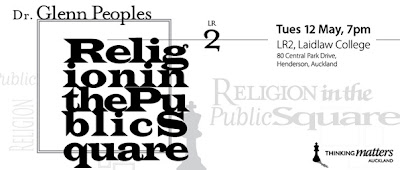
  • Dr Glenn Peoples on Religion in the Public Square

    You are invited to the next Thinking Matters Auckland event in the God, Morality and Society winter series:

    What: Dr Glenn Peoples speaking on Religion in the Public Square
    When: Tuesday 12 May – 7:00pm
    Where: Lecture Room 2, Laidlaw College, 80 Central Park Drive, Henderson, West Auckland
    Format: Talk followed by questions, answers and discussion
    Cost: Free but donations are appreciated

    According to a number of influential thinkers, it is wrong for citizens to support policies because of their religious convictions because this would make those policies unjustified in a liberal democracy. Is this true?

    Dr Peoples argues that the rules used to exclude such policies are simply not workable or reasonable. He explains that more sensible and fair models of public justification do in fact permit us to promote policies that we hold on the basis of our religious convictions. However, when the architects of these improved models realise that they have now opened the door to religious participation in public life, they change the rules, shifting the goalpost and inventing special exceptions in order to maintain that those with religious convictions should keep them out of the public square.

    Dr Peoples graduated with his PhD in philosophy from the University of Otago in 2008 after completing undergrad and graduate degrees in theology. He runs New Zealand’s top Christian podcast, Say Hello to my Little Friend and is a very clear and articulate speaker.

    Religion in the Public Square