Author: John Tertullian

  • More Swamps than Christchurch: The Liquefaction of the Left

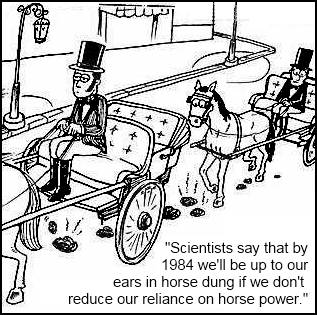
    "Scientists say that by 1984 we'll be up to our ears in horse dung if we don't reduce our reliance on horsepower.""One of the most destructive carnards concreted into the mind of greenism and environmentalism is the proposition that natural resources are fixed, finite, and limited. Once gone, they are gone forever. Therefore, conservation of said resources is a moral imperative.

    Statists warm to this proposition reflexively, that is, without thinking. To conserve on a grand scale requires big government: to regulate, limit, control, restrict, order, prescribe, proscribe, and ban. Without such a big intrusion into the lives and endeavours of citizens, disaster will fall upon the entire race. Therefore, statists join the moral crusade. Advocating for big-brother government suddenly makes one morally good. Saving the planet and saving humanity has a nice moral ring to it, making big government itself a moral imperative.

    Socialists likewise find the proposition of limited resources needing to be conserved a convenient doctrine. It justifies pre-emptive property rights of the state over private citizens. It also gives moral cover to advocating for more government taxation and expropriation to fund things like “green industries” and “green energy”. You just have to take a glance at President Obama’s “new” energy strategy. Instead of “drill, baby drill” it is “spin, baby, spin”, referring of course to the windmills he is spending billions of dollars worth of citizen’s property to manufacture and deploy.

    So, we have the ideological Grand Coalition of our times: greenists, environmentalists, statists, and socialists. Ladies and gentlemen put your hands together for “the Left”.

    There is one small problem. This monumental intellectual and political construction is built upon a simple fallacy, known as the fallacy of composition. It beggars belief that in a world self-proclaimed to be so smart and so rational that the very same wise-in-their-own-estimation are actually operating with a grand intellectual and political edifice built on more swamps than Christchurch, or more volcanoes than Auckland.

    The fallacy of composition assumes or asserts that the attributes of the parts must sum to the attribute of the whole. In this case, since each specific natural resource is clearly finite, natural resources as a whole must, therefore, be finite. Once you explode this childish error (more…)

  • Internationalism is Dead: Boneparte’s Descendants

    OK, so we thought that you would want to hear it here first. Internationalism–the idea that nation states are subject to a higher “sovereignty”– is dead. The corpse is rotting. The Libyan “adventure”, called for by the UN, is growing madder than a March Hare. All the problems and faults of internationalism are now clearly displayed. We hear Joan Baez in the background, intoning “when will they ever learn?” Not in a hurry would be our bet.

    Muammar Muhammad al-Gaddafi

    Though internationalism may be dead, the foolishness that is bound up in the heart of unconverted man is likely to keep flogging that particular equine corpse for decades to come.

    Consider the mess that the internationalists are now in. The UN has passed a resolution directing that a no-fly zone be established in Libya. The internationalist community has spoken. Man, the universal overlord of the globe, has determined that what was happening in Libya ought not to be; some kind of nebulous higher ethic was appealed to which mean that “humanity” or “the international community” had to step up and into Libya to sort things out.

    The echoes in the UN Security Council chamber had not died away before they were drowned by arguments between those who voted over what the meaning and application of the resolution. This from Al Jazeera:

    International criticism of the coalition enforcing the no-fly zone has continued to grow, with India joining China in publicly calling for an end to the airstrikes. Jiang Yu, a spokeswoman for China’s foreign ministry, said on Tuesday that the government opposed “the wanton use of armed force leading to more civilian casualties and more humanitarian disasters”. China had already called for a ceasefire.

    S M Krishna, the Indian foreign minister, called for a “cessation of armed conflict”. His office had previously issued a statement on Monday expressing “regret” for the military intervention. Pranab Mukherjee, the country’s foreign minister, said in a speech to parliament that “no external powers” should interfere in Libya. “Nobody, not a couple of countries, can take that decision to change a particular regime,” he said

    The Sydney Morning Herald reports that the Brits cannot even agree amongst themselves as to what the resolution means: can they take Gaddafi out or not? Some say yes; others nay-say. Neither can the French agree amongst themselves. Does the resolution mean that Gaddafi can legitimately stay in power. Yes. No. Maybe. All of the above. Meanwhile, Turkey a member of NATO has announced that it will not allow its airspace to be used in enforcing the no-fly zone, if it goes beyond the UN resolution–whatever it might mean, and no-one knows.

    The announcement came after Turkey, a member of the NATO, warned on Tuesday that it could not agree to the military alliance taking over the enforcement of the no-fly zone if their mission went “outside the framework” of the UN decision.

    Meanwhile in the US, President Obama, a committed internationalist, appeared deeply reluctant to (more…)

  • The End of State Education: Resistance is Futile

    The litany of the forces arrayed against quality state education systems is long. We believe these forces make state education’s decline inevitable. Without a thoroughgoing reformation of the fundaments of Western society itself, resistance is futile. The Borg is here.

    We know that in New Zealand roughly one third of all graduates from state schools are functionally illiterate and innumerate. They cannot read supermarket shelf labels. Nor can they compare prices. We also know that on any given school day one tenth of pupils will be absent, without a conscientious reason. Truancy is systemic.

    State Education

    Recently we sought to interview potential candidates for a teaching position in our Christian school. These candidates were committed Christians; they were currently studying at a teacher training institution; they were zealous for their prospective careers–but they were unable to write a paragraph that was grammatically or syntactically correct. Apparently they had never learned through thirteen years of state schooling what a full-stop was, or how one was to begin a sentence. Yet, they had all graduated with “flying colours” from NCEA levels 11 through 13 in English! Sadly they were unemployable in our school.

    These folk were part of another cohort of graduates from our state schools that are neither functionally illiterate nor innumerate–but they are   incompetent in even the rudiments of language and maths. This, of course, means that their ability to think, reason, encapsulate, describe, argue, and comprehend is severely curtailed. We guess that this cohort would represent another third of graduates from state schools.

    Those who think that starting a new state funded programme (for example, Early Childhood Education), or shrinking classroom sizes, or raising teacher salaries, or introducing national testing will turn the tide are naive. They have not reckoned with the barrage of the secular forces arrayed against state schools.

    Let’s name two of these secular forces. The first is statism–which arguably is the established religion of our day. By this we mean that for many the state or the government is the ultimate reality and force. Name any social, political, material, economic or cultural problem and within a nano-second the conversation will have become political–by which we mean that “the government needs to do something, or this, or that” will have been introduced into the conversation. Functionally our society looks to government as its god.

    The spin-off effect upon state education is direct. The state’s “long term” solution to any problem is to attempt to use its schools to change human nature and action to solve society’s perceived problems. Government as redeemer translates into schools as agents of socialisation and state propaganda, not education. This is a weight which schools simply cannot bear. They both stop educating and fail miserably in socialisation.

    The second secular force also has religious roots (more…)

  • Hearing the Voice of God: Tragedy and its Aftershocks

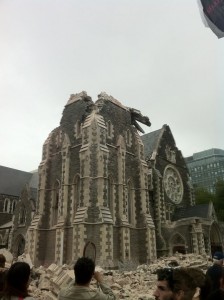
    Christchurch's Cathedral after the earthquakeThe “big one” has hit Christchurch. Few in the entire country will be untouched or unaffected, since we in New Zealand are a little village. To a man each will have relatives, friends, colleagues and mates in Christchurch. In that sense it is a national disaster.

    The meaning and significance of such disasters are always multi-dimensional and multi-faceted. The effects similarly. Some people will find new meaning, purpose and direction in life though this adversity. Others will discover afresh that the “good things” of life are mere trinkets and will become profoundly thankful again for the basics of food and clothing and shelter. With these they will be content. Others will appreciate family, loved ones, neighbours and friends in deeper ways.

    Still others will find courage that they never knew they had. Some will mourn deeply the passing of loved ones. Some will mend their lives and begin again. Others never will. Many will live in fear of further calamity until the day they die. One of the things that earthquakes do–more than any other calamity, it would seem–is shake the fundaments of life to the very core. Nothing is sure. Nothing is certain. Everything is tenuous. There is no security. If the very earth cannot bear us up and support us, nothing can.

    At such times, our thoughts always turn particularly to the saints. “When one suffers, all suffer,” is the motto of the Church. It is the spiritual foundation of the secularised “all for one, and one for all”. The saints will congregate. They will once again review their lives in the light of eternity. They will remind one another that time is short and man’s days upon the earth are like grass. They will extend hospitality to the needy. They will mourn with those who mourn. They will rejoice with those who have been delivered. Their shepherds will minister the Word of God to them. They will realise afresh that though heaven and earth pass away, the Word of the Lord will abide forever. This tragedy will re-orientate and re-focus their lives in ways that few other things ever would.

    It is probable that many will become Christians; they will come to belief and a saving faith in Christ. They thought they were atheists or they lived in casual, who-cares agnosticism. But spontaneously, from the depths of their heart, they called out to God, as the very earth shook and the buildings fell. Faced with eternity, they became believers in an instant, crying out, “Remember me, Lord.” Whilst many will have cried out to God and have already since forgotten, pushing out the warnings from their mind, others will have been converted, born again by the Spirit. He moves as the wind. Who can tell whence He came, and where He goes.

    Just like the great storm and the roaring flood, earthquakes are the voice of God. He speaks in them and through them, to all who have ears to hear.

    Cross posted at Contra Celsum

  • The Pretensions of Democracy and the Egypt Riots

    The secular west has a secular gospel. It is the good news of democracy. When problems assail a nation, all would be assuaged if not solved if it had more democracy. And so it has come to pass with respect to Egypt.

    The West is not unique in that it has its own version of gospel. All human cultures, religions, and peoples have a gospel of some kind. The word “gospel” of course means good news. The gospel of any society is the proclamation of what that society believes will make things right. Whatever a culture looks to as the “super problem solver” is its saviour. Proclaiming and touting that “saviour” is its gospel. That gospel reaches the status of being established in a society when its promises and claims are seen as self-evident and beyond question. Whenever a culture fails to achieve a consensus view of what its saviour is, it has no gospel: fracturing is inevitable.

    In the West, under the aegis of its established religion of secular humanism, democracy is it. It is easy to understand why democracy has become the West’s established gospel of choice. The West is primarily about the glorification and celebration of man. Democracy is that form of government which does respectful obeisance to man–it is the system of government which seems to accord most closely with the idea that man is his own self-saviour. If man is his own self-saviour, then democracy is the form of government which brings man into a position of institutional supremacy in society. The will of the people is the voice of our god.

    So, if any society has problems (and all do), a system of government which institionalises and reifies the will and wisdom of man must be better, if not best. Democracy facilitates man taking control of his own destiny and this will result in the solving and resolution of all problems.

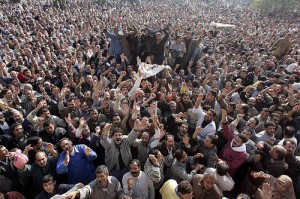
    Egypt RiotsAs the West opines and pontificates over Egypt it cannot help but project its gospel upon that country. The future for Egypt would be much more assured and all problems would be mitigated if the government were to become less authoritarian. If free and fair elections were held and the people had a voice all would be well, or at least better. How beautiful upon the mountains are the feet of those who come proclaiming the gospel of democracy. What a tingle goes up the spine when our high priests in the West proclaim our secular liturgical chants.

    Problem number one. (more…)

  • Maori Animism: New Zealand’s Established Religion

    New Zealand, along with all nations, is acutely religious. But, more than most Western countries, the dominant religion is now the Established Religion. We are using “established” in the historical sense of a religion prescribed and protected, so that all citizens must respect and honour that particular religion’s beliefs and practices. Established religion is the religion buttressed and proscribed by the law of the land and funded by tax money.

    The established religion in New Zealand is Maori animism. In historical terms it is a pagan and primitive religion, riddled with superstition and idolatry. It is an offence and provocation to the Living God. But none who want official and public respect in New Zealand dare criticise the Establishment. Those, however, who fear God more than man are prepared to call it for what it is: stale hokey pokey–a thoroughly sour, ignorant and stupefying batch of mouldy ice-cream. Every Christian who understands what the Bible says about idolatry and false gods has no hesitation in flatly rejecting Maori animism. In so doing, we have become the new dissenters.

    Wavering Christians may well be offended at such a stand because they fear it will cause offence to Maori. Not causing offence has regrettably become for some of our brethren, not the eleventh commandment, but the only commandment. To these brethren we say, “harden up”. Fear God, not man. These weaker brethren have not yet realised that when it comes to a choice between offending the Living God, on the one hand, or man on the other, Christians must offend man a thousand times over. We must never, ever wilfully offend our God.

    We will drive out any idol, never tolerating any in His presence. We will be as jealous of God’s honour as God is Himself. We will never bow down or honour any image of God, which makes all graphical representations of God idolatrous. We will never tolerate His Name being used in an empty or vain fashion. We will honour His holy day. This is what former generations called the First Table of the Law.

    The ignorance and stupidity of Maori animism has been on display in recent days. A church youth group had a fantastic day out, climbing Mount Taranaki, packing up a couch and BBQ by hand. Quite a feat. At the top they reclined for a celebratory meal. After enjoying the Lord’s creation and celebrating his goodness, they decamped taking their gear and detritus with them.

    Mt TaranakiOn returning to the land of the living dead they were assailed by a government official: an outraged Taranaki Department of Conservation boss, Phil Mohi. Now, Phil it turns out is a Maori who has returned to the religion of his ancestors and is a card carrying animist. He has taken it upon himself to speak out in the name of his god. His god is the mountain (Mt Taranaki). The top of the mountain is tapu–sacred ground, in the eyes of Phil and his colleagues. To eat up there is to eat on his god’s head. (We are not making this up. One shudders to think the depths of outrage that would be disembogued were anyone forced to relieve themselves up the mountain.) According to a media report entitled “Mt Taranaki summit cook-up ‘tapu offence’“:

    He said the summit barbecue was disappointing because the young people there probably didn’t realise or hadn’t learnt that the mountain and especially the summit is a very sacred place for iwi of Taranaki. “We discourage camping at the summit and try to make people aware that the very highest part is the most sacred of all – and ask climbers to avoid standing there. “There’s a difference too between eating prepared food for sustenance and actually cooking on the summit,” he said.

    Ah, the casuistry of the animist. How quaint. Now the young Christians were taken aback by this outburst. They apologised. They did not want to cause offence, they said.

    What they should have said is something like this (more…)

  • Progressive Enslavement: The Seductions of Scientism

    One of the silly characteristics of our age is the credulous and naive veneration of science. It has led to the emergence of what we call scientism–faith in science as the ultimate source of truth and wisdom. This faith is pervasive.  How many social issues or ethical questions are falsely claimed to be resolved by the magisterium of “scientists say . . . “, or “science tells us . . . “? Consider the insinuation of “science” into the humanities: social “science”; political “science”; anthropological “science”; and “scientific” pedagogy, to name but a few.  Recall how global warming propagandists have tried to pull a swift one by asserting, “the science is settled” by which is meant that infallible truth has been discovered, and that all must now stop debating, stop questioning. Reflect on how politicians crave “scientific” warrant for crazy schemes. Consider how the adjective “unscientific” is used to bludgeon the views of opponents. It is the ultimate evisceration of an opponent’s argument.

    "Mee-mee-mee meep"How did it come to this?  Whilst not alone, probably the most influential protagonist in the English speaking realm for “science”  and the “scientification” of all of life has been John Dewey.  He moved things along a bit from the first phase of the Enlightenment which had held to the idea that Nature was governed by a collage of immutable laws.  Darwin had taught Dewey and his contemporaries otherwise.  Darwin and his popularizers had “convinced” the West that Nature was not fixed, but was changing; mankind, therefore, could not be said to have an immutable nature.  Mankind was now seen as also changing and developing.

    But, reasoned Dewey, this opened up the opportunity for mankind to seize the day.  Mankind had become so advanced and developed that he could now take charge of and manage his own evolutionary development.  “Following Bacon’s prescription, the power to manipulate nature with a view to human purposes had been exercised to remarkable effect.  But the [old] belief  in a fixed human nature meant that the power unleashed by science had not yet been applied in a thorough fashion to our essentially plastic human nature and political society.” (J. Judd Owen, Religion and the Demise of Liberal Rationalism: The Foundational Crisis of the Separation of Church and State (Chicago: University of Chicago Press, 2001), p.19)  If the scientific method were applied to humanity, we would be able to take effective charge of our evolutionary development.  Humanity would therefore progress more effectively and more quickly.

    Here is Dewey, writing in 1931:

    The entrenched and stubborn institutions of the past stand in the way of our thinking scientifically about human relations and social issues.  Our mental habits in these respects are dominated by institutions of family, state, church, and business that were formed long before men had an effective technique of inquiry and validation.  It is this condition from which we suffer today.  Disaster follows in its wake. (Cited by Owen, ibid, p.21)

    Note the radical nature of the claims here. We must, says Dewey learn to think scientifically about human relations and social issues.  Science alone has an effective technique of “inquiry and validation”; the verities of the past (family, church, state) are relics.  If we continue to resist the “sciencing” of society, we will face disaster.  He means by this that we will not be able to take control of our development–which opens up the possibility, if not probability, that mankind will self-extinguish, proving unfit to survive.  Because Nature is evolving, old verities are worthless.

    Dewey  went on to assert that the Great Scientific Revolution was still awaiting.  We ain’t seen nothing, yet.

    In spite, then, of all the record of the past, the great scientific revolution is still to come.  It will ensue when men collectively organize their knowledge for application to achieve and make secure social values; when they systematically use scientific procedures for the control of human relationships and the direction of the social effects of our vast technological machinery.  (Ibid, p.22)

    The hard, natural sciences had allowed man to understand and then to control and exploit nature to his own advantage.  Dewey says the same rigorous methodology, when applied to humanity and society will allow us to “secure” social values (picking out the best from the emergent changing value grid); then controlling human relationships and setting the direction of society.  “Science” will enable humanity to take control of its own destiny; control its own evolutionary development.

    Two postulates immediately follow: “science” must be elevated into a quasi-infallible status, which explains why scientism is an intrinsic part of the new idolatry.  The ultimate answer to all public and human problems becomes, What does “science” tell us? or, What is the scientific approach?  Secondly, science must control humanity–which is to say that a power nexus of science-government must be formed to order everything, which helps explain the relentless expansion of state powers in the twentieth century to “make things right”.

    The natural law theorists of the early Enlightenment elevated natural law to the place of God.  This meant that mankind was subject to the natural order and could only succeed as he worked in accordance with natural law or “the way the world worked”.  As Rushdoony has astutely pointed out, (more…)