Author: Machine Philosophy

  • I’m so Objective about how You’re so Subjective

    One general objection to theistic arguments for God is that no such argument could be based on the subjective experience of one’s own cognitive processes, and that therefore it suggests delusions of grandeur to think that one can get from such a basis to God necessarily existing.

    I have an experiential awareness of a sign but I can't empirically prove it existsBut to deny that a sound argument could be based on one’s subjective experience of one’s own cognitive processes is self-exempting if it is -itself- claimed to arbitrate the status of that experience in relation to such an argument. This is the same old self-referential inconsistency that itself claims to be above that which it is itself an instance of by sheer force of the domain of its subject term.

    The delusion of grandeur is in thinking that one has the logical standing to predicate the -denial- of such an inferential move with any authority beyond one’s -own- cognitive subjectivity by exempting oneself from that alleged limitation in order to make that trans-subjective claim and thus pass judgment on the entire scope and limits of that very subjectivity itself for all thinking subjects.

    Moreover, how could one’s own subjectivity be capable of such a universal claim about what one can or cannot know or infer, if subjectivity itself is as self-limited as that claim itself asserts? Especially when no argument or criteria is ever even mentioned.

    In fact, how does this differ from a religious-like admonition: “Believe in my arbitrarily subjective self-stultifying claims about the possibility of knowledge and thou shalt be saved”?

    In other words, how does an unargued self-contradictory prohibition on everyone’s thinking differ from the religious proof-texting of an arbitrarily-protected claim that restricts all other claims except itself?

    Such self-exemption is never mentioned for a reason, although not a logical one.

  • Transcript: Sam Harris v William Lane Craig Debate “Is the Foundation of Morality Natural or Supernatural?” UPDATED

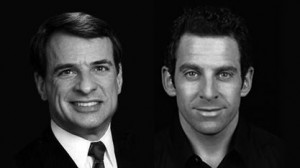
    William Lane Craig v Sam HarrisSam Harris and William Lane Craig debated the moot “Is the Foundation of Morality Natural or Supernatural?” at the University of Notre Dame on 7 April 2011. We’ve already linked to the debate MP3 and a playlist of the video and we have published a two part review but now, as an MandM exclusive, we bring you the transcript.

    This transcript is the result of some 32 playbacks of the debate and is accurate down to the “uhs” and “oks”.

    UPDATE:
    Since publishing this transcript, William Lane Craig has emailed us and asked us to adjust the paragraph breaks and punctuation in his sections of the transcript in accord with where he placed them — something he conceded was very hard to get right when one is transcribing from audio. He also provided us with the footnotes for his sources which we have also included below.

    If Sam Harris wishes us to adjust his sections of this transcript in the same manner we are very happy to do so.

    – Madeleine

    Transcript of the Harris v Craig debate

    MODERATOR:

    Welcome to the second installment of “The God Debate”. My name is Michael Rea. I’m a professor of philosophy here at the University of Notre Dame, and the director of the Center for Philosophy of Religion, one of the sponsors of tonight’s event. The Center for Philosophy of Religion was founded in the late 1970s with the aim of promoting cutting-edge research on topics in the philosophy of religion, and in distinctively Christian philosophy. One of our goals in sponsoring the “God Debate” series is to try to bring some of the very issues discussed among our research fellows to a wider, non-academic audience, and in a format that will hopefully be fun and engaging.

    Our show tonight, as you already know, is a debate between William Lane Craig and Sam Harris, coming together for the very first time to discuss the question, “Are the foundations of moral values natural or supernatural?”

    William Lane Craig is Research Professor of Philosophy at Talbot School of Theology in La Mirada, California. He is best-known among philosophers for his extensive and influential work in the philosophy of time and the philosophy of religion. He is known to the wider public as someone who is able to articulate and defend the doctrines of the Christian faith in a way that is highly accessible but also philosophically and theologically rigorous. He became a Christian at the age of 16, pursued undergraduate studies at Wheaton College, and holds two earned doctorates: one in philosophy from the University of Birmingham, and one in theology from the University of Munich. He has authored or edited over 30 books, as well as over a hundred articles in professional journals of philosophy and theology.

    Known as one of the “Four Horsemen” of the New Atheist movement, Sam Harris is the author of the New York Times best sellers: The Moral Landscape, The End of Faith, and Letter to a Christian Nation. The End of Faith won the 2005 Pen Award for non-fiction. Mr. Harris’s writing has been published in over 15 languages. He and his work have been discussed in Newsweek, Time, The New York Times, Scientific American, Nature, Rolling Stone, and many other journals. His writing has appeared in Newsweek, The New York Times, The Los Angeles Times, The Economist, The Times London, The Boston Globe, The Atlantic, the Annals of Neurology, and elsewhere. Mr. Harris is a co-founder and CEO of Project Reason, a non-profit foundation devoted to spreading scientific knowledge and secular values in society. He received a degree in philosophy from Stanford University, and a PhD in neuroscience from UCLA.

    The structure of tonight’s debate will be as follows: Each debater will take 20 minutes for his opening speech, followed by rebuttals of 12 minutes and 8 minutes respectively, and then closing speeches of 5 minutes each. At the conclusion of the debate, we will have about 30 minutes for questions from the audience. If you would like to ask a question, line up behind one of the two microphones in front, or in the balcony. We’re letting Notre Dame students ask the first four questions tonight, so if you are not a Notre Dame student, and somehow find yourself at the front of the Q&A line, please allow a student to go ahead of you.

    Time will be kept strictly. There is a timekeeper in the front who can be seen by both speakers, and once each speaker’s time has elapsed, he will be given at most 15 seconds to finish his final sentence before being rudely interrupted by me, the time enforcer. Because we are keeping the time strict, we ask you to hold all applause and other indications of agreement or disagreement, cheering, crowd-surfing, and the like, until the very end of the debate. Please remember that flash photography, video taping, and active cell phones are all prohibited.

    Finally, remember that Notre Dame is the world’s number one institution in the philosophy of religion, and also has one of the world’s best theology departments. Any questions you don’t get to ask during the 25 or 30 minute Q&A, you can ask of your local faculty in the days and weeks to come. And now, on with the show.

    CRAIG:

    Well, good evening. It’s wonderful to be here at the University of Notre Dame, and I want to begin by

    MODERATOR:

    Bill

    CRAIG:

    thank—

    MODERATOR:

    Sorry.

    CRAIG:

    Sorry.

    MODERATOR:

    I need to—We’re gonna begin each speech with me checking with the timekeeper to make sure that he’s ready, and then the timekeeper is gonna hit “Go”, and then you get to go—

    CRAIG:

    Alright.

    MODERATOR:

    So, so you go—

    CRAIG:

    Sorry—

    MODERATOR:

    —when I say “Begin”.

    CRAIG:

    Sorry for jumping the gun.

    MODERATOR:

    Professor Craig gets, uh, gets the first word in the debate, uh, Dr. Harris gets the last word. Timekeeper, are you ready? This is 20 minutes. Begin.

    CRAIG:

    I want to begin by (more…)
  • Induction: Assuming the Uniformity of Nature

    Most people engage in what philosophers call “inductive” reasoning. People make accurate predictions about the future on the basis of conjunctions they have observed in the past. For example, I assume the sun will rise tomorrow because in the past I have observed it rise. Scientists, in particular, rely on extrapolations of this sort in the construction of their theories and in the detection of the laws of nature.

    Implicit in such reasoning is the assumption that nature is uniform or regular, one can legitimately contend that events in the past will resemble events that will occur in the future. One interesting problem consists of how one knows that the future will resemble the past in this way. What is the basis for this view? In this post Machine Philosophy discusses some of these issues.

    Conjunction and Inductive Argument

    Uniformity of Nature?Even those who accept the regularity view are compelled, sometimes in the statement of that view itself, to assume that that regularity view itself is false.

    Events have causes in the sense of regular and special antecedents.

    Do you intend to apply that to the future as well?

    Yes.

    But you have not experienced the future.

    No.

    Then you must be using an argument. You’re saying that b will continued to follow a in the future because b has followed a in the past.

    But unless a is connected with b by something more than mere proximity of place or time, there’s no ground for that argument.

    Without some other connection, there is no reason for saying that past uniform sequence must be followed by future uniform sequence.

    When we’ve argued from past uniformities to their continuation in the future, our expectations have been verified.

    But the uniform sequence of verification of your expectation is just another sequence. It has no special privileges when we’re asking why one should argue from any past sequence to future ones.

    It’s a matter of probability. Two or more events frequently occuring together is more likely to be maintained than broken.

    You’re either repeating the old assumption whose basis is in question, that the past is a guide to the future, or else it’s is false.

    If a and b are unconnected, there’s no more reason to expect them to continue together than there is to expect an unloaded penny to continue turning up heads because it has just done so ten times in a row.

    We ‘postulate’ the  (more…)

  • Nietzsche on Over-Compensating

    Friedrich Nietzsche

    They are rid of the Christian God and now believe all the more firmly that they must cling to Christian morality. They must rehabilitate themselves after ever little emancipation from religion by showing in a veritably awe-inspiring way what moral fanatics they are. That is their penance.

    Friedrich Nietzsche

  • Once Upon an A Priori…

    To formulate a statement that reduces a universal domain that includes myself and my thoughts or statements, to one or more factors that affect truth-value domain-wide, I must nevertheless transcend that universal domain so that I can make that factor-exempt statement itself, as well as any factor-exempt arguments that I might want to offer for that statement.

    Undercutting your own position is never wise.Otherwise, precisely because everything including the reduction itself is by that reduction’s own assertion subject to the effects of those truth-limiting or truth-changing factors, that reduction cannot be true merely in and of itself as a statement within the predicated domain that nevertheless makes a general statement about it.

  • God and Other Unquestioned Authorities

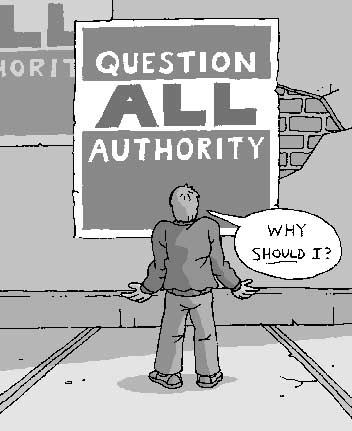
    Question AuthorityThe ultimacy and decisiveness of reason is itself just as vulnerable as the existence of God. That one ought to “justify” one’s thought is to me just another religious-like commandment. If someone does not buy into the god-level authority of reason, especially pertaining to universal and ultimate domains of predication themselves, there is no possible logically prior inferential warrant.

    Only assuming logic and reason makes logical priority possible and necessary, so there is nothing possibly logically prior, in the sense of more inferentially basic, if logic itself is questioned. One can end up *appealing* to some kind of intellectual pragmatics, but that cannot be a *logical* appeal without simply begging the same question all over again: namely, whether logic or general reason have any god-like authority over one’s thinking.

    And this is just as questionable in any other proposed authority. Hardly limited to the God belief. Sorry to dash a certain hope.

    But these points and any other possible points that I might be making in this writing are themselves subject to the same problems, since they too depend on a wholesale acceptance of some core of a logical/rational ideal, nonlocal obligation relations between rational standards and each mind, the preferential value of inquiry, the decisive criterial status of reason, and so on.

    But at that level what can be argued against them?

    And what need is there to justify them?