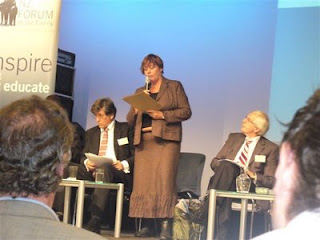
My small idea of getting Dr William Lane Craig to have a debate at Auckland University ended up being an event that far exceeded my expectations. Despite the New Zealand Association of Rationalists and Humanists (NZARH) booking a larger lecture theatre at the last minute we still had to open up three additional lecture theatres with live video feeds and we still had people sitting on the floor! Question time had to be extended because of the interest. The range of people in attendance was excellent; hardened skeptics, evangelical Christians and everyone in between, young and old, high school students through to tertiary faculty.
My experience within the tertiary sector and NZ Christiandom has lead me to believe that despite the secular and popular veneer one sees in New Zealand culture and often in the church, there is a real interest in questions about God, religion and morality. The reaction last night to a civil, rational, intellectual exchange over these issues confirms my suspicion that not only are people hungry for articulate and well thought out answers to these questions but that they can handle these answers coming in a sophisticated and academic manner; the trend of dumbing down these issues in order to be seeker friendly or to have lay appeal is misguided.
Anyway to the debate; the moot was “Is God a Delusion?” Bill Craig opened by defining a delusion, in accord with the dictionary, as a false belief. He then contended (A) there are no good reasons for thinking atheism is true; and, (B) there are good arguments or reasons for believing in God.
In support of (B), he summarised five arguments which he has defended in more detail in the Philosophical literature, very briefly they were: (i) the Kalam Cosmological argument (God is the best explanation for the origin of the Universe); (ii) The New Teleological argument (God is the best explanation for the fine-tuning of the Universe); (iii) The Meta-Ethical Moral argument for theism (God is the best explanation for the existence of objective moral norms); (iv) God is entailed by the best explanation of certain facts about the historical Jesus and his resurrection; and, finally, (v) a brief summary of Plantinga’s thesis that immediate experiences about God provide prima facie grounds for affirming that God exists.
Cooke’s opening was disappointing. I am not saying this because I am a theist and he is not, I have read many skeptical Philosophers who provide brilliant and powerful arguments for atheism (Paul Draper and Michael Tooley are obvious examples) and although I disagree with them I think they provide challenging cases that I can respect. However, Cooke did not follow their lead. Instead Cooke opened by defining atheism as the claim that “we do not know what the word God means.” Cooke then went on to state he does not think Thiesm is false but is rather a distraction. His argument then appeared to consist of claims that the concept of God has evolved throughout history, that this belief has been used by some to commit atrocities and to not follow important social and political reforms. He stated that there are numerous other accounts of God and there are non-cognitive forms of Liberal Christianity which are more helpful to the humanistic aims he shares.
Cooke also stated his distaste for a debate format where there were rebuttals. He alluded briefly to the problem of evil; however, he did not offer or defend any of the rigorous probabilistic arguments from evil proposed in the literature by people such as Tooley, Draper and Rowe. A crucial premise of many probabilistic arguments from evil is that God has no adequate reasons for allowing the evils which exist in the world. Craig (along with many Philosophers of Religion such as Wykstra, Plantinga, Van Inwagen, Tooley, Alston) has argued this premise is unwarranted as no reasons have been given for thinking the premise is true. The arguments on this topic are fairly detailed but not complex. Cooke did not offer a rebuttal but simply declared Craig’s position as distasteful.
In rebuttal, Craig noted that Cooke’s definition of atheism was incorrect. He quoted from a standard philosophical encyclopedia a definition of atheism as the belief that God does not exist which is quite different to Cooke’s definition which is actually something more like verificationism. Craig also offered a definition of what he means by God so Cooke could be clear on the meaning of God for the purpose of the debate. Craig then pointed out that Cooke had not offered any arguments for atheism in his speech. He had dismissed a response to the problem of evil but had not argued for it.
Much of the rest of Cooke’s speech was irrelevant as the question was not whether God had good political consequences but whether theism was true. Even if a belief is the result of social evolution over time, it does not entail that it is false (people’s understanding of democracy has evolved over time, it does not follow that democracy is mistaken because it has evolved and developed over time). Craig also noted that the truth or falsity of a belief is a separate issue from the conduct of those who hold to the belief. Similarly, the fact that a belief distracts some people from certain causes does not necessitate that it is false.
Craig also pointed out contradictions in Cooke’s speech. Cooke had stated that he did not contend that theism is false but later on he had stated that God was a human invention. Craig also noted that merely pointing out that other theologians disagree with Craig’s cognitive theism and offer alternative accounts of God does not show Craig’s position is false. The existence of differing opinion on a matter does not render the matter false, the reasons offered are what must come under scrutiny.
Cooke’s rebuttal of Craig was weak. Cooke responded briefly to the meta-ethical moral argument noting that theists and atheists are both aware of certain moral truths and should work together on certain worthy projects. This response, as Craig pointed out, confuses the question of whether an atheist can know moral truths with the question of whether atheism can provide an adequate meta-physical foundation for these truths. Cooke’s position that human beings have no real significance, that morality was simply an evolved convention of some sort, was, in essence, a concession of the meta-ethical argument.
Cooke addressed the Kalam Cosmological argument and New Teleological argument by stating that he was not a cosmologist and neither was Craig. He also suggested Craig’s knowledge of the historical facts surrounding Christ were mistaken, that scholars disputed the alleged facts Craig appealed to. He suggested that Craig was not familiar enough with Gerd Ludemann whose later works Cooke himself had read.
Unfortunately for Cooke, Craig was able to counter these claims. First, as noted Craig has studied contemporary cosmology; he did his doctoral work on the theological implications of big bang cosmology and has authored a book on it as well as several published articles. In addition, he has debated Gerd Ludemann and co-written a book with him and so could point out that Ludemann in fact did accept the facts he appealed to. Moreover, Craig could produce published review articles that surveyed the voluminous literature on the subject and the results showed that the consensus was as Craig had suggested. Craig also produced a fairly amusing illustration from Kai Neilson (perhaps more ironic given that Cooke frequently cites Kai Neilson in his debates) which illustrated the counter-intuitive nature of asserting that something could come out of nothing by nothing.
Cooke did make another claim that Craig did not counter, which was that scientific discoveries are subject to change and so it is questionable to base theological claims on such an unstable foundation. This may be a valid point, the problem is it would appear to uncut a key motif of Cooke’s rationalism. After all, don’t rationalists promote science as a source of knowledge and often attack Christian belief because it allegedly conflicts with science?
So in my opinion Craig was the clear winner. He offered five arguments, Cooke offered weak responses to which Craig adequately responded. Cooke at times refused to argue at all and kept trying to address side issues and did not really offer a case for atheism.
Of course it needs to be noted in fairness, that in many respects this was a mismatch. Craig is one of the best Philosophers of Religion in the world. He has published hundreds of articles defending arguments for God’s existence in the philosophical literature and is an extremely experienced debater. Cooke is a historian of the history of free thought with little or no publications in this area. Some of Craig’s previous debate with philosophical heavyweights like Michael Tooley and Quentin Smith were less one-sided.
I thought some of the real interesting issues and arguments came out in the Q&A. Robert Nola from the Philosophy department made an important point about the New Teleological argument noting that the fact that something is highly improbable does not mean it is irrational to hold to. Craig’s response was probably not as clear as it could be, he noted that the fine-tuning argument is not based merely on the claim that fine-tuning is improbable but rather that fine-tuning constitutes an improbable sequence of patterns. (Craig has made this point more thoroughly in the literature.)
Ray Bradley, a retired Philosophy Professor, raised a version of the deontological problem of evil noting that God seems to violate certain moral duties such as do not kill. Craig’s response was that if one holds to a divine command (DCT) theory of ethics then right and wrong are constituted by God’s commands. From this, it follows that because God does not issue commands to himself, he does not have duties. If God has no duties then God cannot violate any.
However, this is not the full story; one powerful objection to a DCT is to note that God could command abhorrent things like torture and hence a DCT would entail the counter-intuitive conclusion that torture is morally required. Divine Command theorists (like Craig and myself) typically avoid this objection by noting that God is perfectly virtuous and hence there are certain things he would not command. Bradley’s question could be rephrased in terms of whether a virtuous person would command or do these things and Craig’s initial response would not settle this but there are plenty of lines of thought in the literature which could.
In another exchange Bradley raised the issue of Hell noting that the book of revelation portrays this as a place of eternal torment in fire. Craig pointed out that such passages are in fact highly metaphorical and do not in fact say what Bradley thinks they do. Cooke responded by stating that Craig was being inconsistent he sometimes takes the bible literally and sometimes figuratively and Craig (who has a DTheol in New Testament studies) does not understand that the genre of the new testament is myth.
In fact Cooke is wrong and Craig is right. Revelation has a particular genre, it is Jewish Apocalyptic and this genre is known to use special types of recognisable symbolism. Burridge has shown the gospels are written in the genre of greek biography and not myth. Moreover, the implicit assumption on Cooke’s part that when reading a piece of writing with multiple genres (such as the bible) one should either reads everything literally or everything figuratively is absurd. Even in every-day conversation one uses a mixture of both literal and metaphorical phrases and things like context and genre determine which reading one engages in. As Madeleine pointed out to me, one of her favourite books is a sci-fi fantasy novel that contains an index of characters and terms at the back. Despite the fact the index and the story are contained in one book, she would be in error to read the index figuratively or the story literally; it is not uncommon for one book to have more than one genre. Unfortunately in the short exchange, before an audience untrained in biblical hermeneutics, these points may not have been grasped. As a result I think Cooke came across the better in this exchange despite the fact he was wrong.
Critical questions were raised about Craig’s theodicy as well. Craig’s position is that God allows certain evils because they are the best way to bring about greater good that otherwise would not be achieved. Some members of the audience found this counter-intuitive. Craig responded that the goods he envisaged infinitesimally outweigh the evil permitted. Craig’s position is utilitarian; one can allow (or cause) evil in order to bring about greater good. Of course utilitarianism is a sophisticated ethical theory and there have been numerous sophisticated defenses of a utilitarian framework in the literature but of course Craig was not able to go into it in sufficient depth last night.
Overall the night was excellent, a huge turnout and a stimulating discussion of some really deep and important issues. As we left we heard people all around us discussing the ideas offered by both sides and lots of positive feedback about how much they had enjoyed the evening. NZARH arranged to have the event filmed and a copy should be online over the weekend.