Category: Videos

  • Fallacy Friday Podcast on Apologetics 315: Assessing Arguments

    Fallacy Friday PodcastsApologetics 315 are producing an audio version of Matt’s Fallacy Friday series.

    The Fallacy Friday Podcasts are released every Friday on Apologetics 315. You can subscribe using:

    • RSS Feed
    • Via iTunes
    • one-click to your feed-reader

    The Mp3 of Assessing Arguments is here.

    To navigate the series in print, use the Fallacy Friday tag, to navigate MP3 series use the Fallacy Friday Podcast tag.

  • Fallacy Friday Podcast on Apologetics 315: Introduction & What is an Argument?

    Fallacy Friday PodcastsApologetics 315 are producing an audio version of Matt’s Fallacy Friday series.

    The Fallacy Friday Podcasts will be released every Friday on Apologetics 315. You can subscribe using:

    • RSS Feed
    • Via iTunes
    • one-click to your feed-reader

    The Mp3 of the introduction to the series is here; the first episode: What is an Argument? is here.

    To navigate the series in print, use the Fallacy Friday tag, to navigate MP3 series use the Fallacy Friday Podcast tag.

  • Fallacy Friday: Tu Quoque (But you did it too!)

    Last week I looked at the Straw Man Fallacy, today I want to explore the tu quoque fallacy. In latin tu quoque (too kwo-kwee) means “you too”;  in fact, the phrase “you did it too” is a good, succinct account of this fallacy. A tu quoque occurs when one rebuts a particular criticism of one’s own position by showing one’s opponent’s position is subject to the same criticism; this is done instead of showing that one’s own position is not susceptible to the criticism.

    A good example is the following segment of a CNN Interview with Osama Bin Laden,

    Q: Now, the United States government says that you are still funding military training camps here in Afghanistan for militant, Islamic fighters and that you’re a sponsor of international terrorism. … Are these accusations true? …

    Osama Bin LadenOsama Bin Laden: … At the time that they condemn any Muslim who calls for his right, they receive the highest top official of the Irish Republican Army at the White House as a political leader, while woe, all woe is the Muslims if they cry out for their rights. Wherever we look, we find the US as the leader of terrorism and crime in the world. The US does not consider it a terrorist act to throw atomic bombs at nations thousands of miles away, when it would not be possible for those bombs to hit military troops only. These bombs were rather thrown at entire nations, including women, children and elderly people and up to this day the traces of those bombs remain in Japan. The US does not consider it terrorism when hundreds of thousands of our sons and brothers in Iraq died for lack of food or medicine. So, there is no base for what the US says and this saying does not affect us.[1]

    Here Bin Laden was asked to respond to the claim that he has been sponsoring terrorism and training Islamic militants. Bin Laden argued that there is no basis for this claim because the United States supports terrorism and has itself engaged in activities which can justifiably be labelled ‘terrorist’. Bin Laden’s comments about the United States may or may not be true but either way it would not answer the questions as to whether Bin Laden has been sponsoring terrorism. It is possible, after all, that both Bin Laden and the United States sponsor and engage in terrorism.

    The Difference Between a Tu Quoque and Internal Criticism
    It is important to distinguish this argument from another similar argument, which I will call internal criticism. Internal criticism occurs when one argues against an opponent’s position by noting that one proposition the opponent holds conflicts with another proposition he holds.

    An example is Alvin Plantinga’s famous argument in God and other Minds. In this book Plantinga looks at the question of whether belief in the existence of God is irrational because it cannot be proven to be true with a non-circular argument (more…)

  • Video of Matthew Flannagan Speaking on Divine Command Theory

    On 4 February 2011 the Auckland Reason and Science Society (“RSS”) hosted an event they titled “Divine Command Theory with Dr. Matthew Flannagan” at the University of Auckland. For those of you who missed the event, here is the video.

    Note: This video only includes footage of the talk itself and not the Q&A that followed the talk.

  • A Refutation of Zeitgeist – The Movie

    Zeitgeist the MovementZeitgeist – The Movie is an internet phenomenon that has taken a lot of people in. I know several people who have seen it and have either been convinced by it or it has heavily rocked them. We’ve had commenters on this blog raising issues and asking questions which clearly have their roots in Zeitgeist. There is a global movement complete with a New Zealand chapter.

    For me the claims in Zeitgeist are patently absurd, funny almost and I totally got what Glenn Peoples was on about when he said on Facebook “I swear, watching Zeitgeist is draining my IQ” but it is important to not dismiss the opportunity to take such a clearly influential phenomenon apart, examine the claims it makes and clearly demonstrate the flaws in it so that those who are rocked by it have a good resource to get their feet back on solid ground with. It also won’t hurt those of us immune to Zeitgeist’s charms to take the time to see how best to respond to it for the next time we encounter someone who has been swayed by its content.

    For these reasons when Glenn asked for suggestions for his next podcast topic I suggested an analysis of Zeitgeist and for much the same reasons he leaped on it. Glenn has a PhD in Philosophy and a Masters and Bachelors in Theology. He is also a very lucid and clear thinker who makes the best podcasts which often have cool sound effects and original music. So grab a cuppa and sit back and listen to his podcast Episode 038: Zeitgeist (you’ll need a spare 55 minutes).

    One of the accompanying links Glenn has with his podcast is a must-view. It is written by a non-Christian and it thoroughly examines the astrological claims made by Zeitgeist complete with astrological charts and diagrams. The author states:

    “I prefer honesty in polemics. Some of the astronomical and astrological claims of Zeitgeist are simply wrong, and lead to a wrong impression of the origins of Jesus’ birth narrative. I hope to demonstrate scientifically why they’re wrong”.

    The link to this is here: Zeitgeist Astronomy.

  • Download Matt’s EPS Talk “God and the Genocide of the Canaanites” (& other EPS talks)

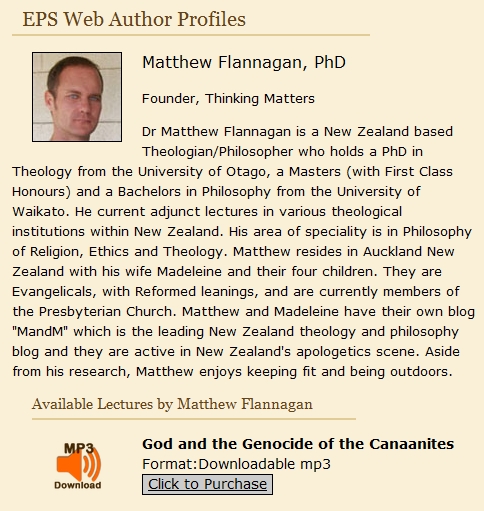
    In November Matt flew to Marietta, Atlanta, Georgia and delivered a talk entitled “God and the Genocide of the Canaanites” for the Evangelical Philosophical Society’s (“EPS”) annual meeting. Matt’ talk is now available to download over here at the EPS website for the very low price of $1.99 USD.

    Download "God and the Genocide of the Canaanites"

    The EPS have made available for download, all of the great teaching from the their popular EPS-Sponsored conferences from 2003 to (more…)

  • Podcasts on Christian Physicalism and The Probability of Christianity

    Matt and I have been listening to podcasts in the evening lately. These two, featuring two of our friends, who are both philosophers and bloggers, are really worth a listen.

    Glenn on Physicalism
    Glenn Peoples, of Say Hello to my Little Friend: The Beretta Blog and Podcast, recently spoke at the University of Oxford at the annual conference of the European Society for the Philosophy of Religion on the topic “Raising the Justificatory Hurdle: How to Make Sure Religion Stays Out of Politics No Matter What” and while he was there he appeared on the UK’s Unbelievable? radio show to debate the issue of physicalism with John Haldane.

    Listen to: Christian Physicalism: Do we have a soul? – Unbelievable? 04 Sep 2010

    Christians have traditionally held that humans comprise two things – a body and a soul. Christian Philosophers have written in defence of the soul against a reductive atheism that claims we are material beings alone.

    But a new movement in Christian philosophy claims that the atheists are correct, at least when it comes to humans.

    Dr Glenn Peoples is a Christian philosopher who subscribes to physicalism – that humans are only physical and they have no immaterial soul. He explains how he arrived at that view from Scripture and how he defends it philosophically, without giving up an evangelical Christian view.

    Prof John Haldane is a Christian philosopher at St Andrews University in Scotland. He believes that Christian faith and Philosophy bear witness to an immaterial soul – though his “Thomistic” view defends it differently to the prevailing trend.


    Lydia on The Probability of Christianity
    Dr Lydia McGrew, of What’s Wrong With the World and Extra Thoughts, has recently co-authored a Bayesian defence of the historicity of the resurrection in The Blackwell Companion to Natural Theology, and so Luke Muehlhauser, of Common Sense Atheism, interviewed her for his podcast, Conversations from the Pale Blue Dot.

    Listen to: Lydia McGrew – The Probability of Christianity – CPBD episode 071

    Lydia describes herself as ‘a homemaker and home schooling mum who does analytic philosophy in some of her spare time.’ She is very good at it, as you will quickly pick up in her discussion with Luke. They talk about, among other things:

    • The probability of the Resurrection v the probability of witchcraft at Salem and the Hindu milk miracle
    • The practice of Christian philosophy
    • The fine-tuning argument
    • God as an explanation

    Listen carefully to work out which blogger from this blog gets cited in an example 😉