Over at Moral Apologetics, David Baggett and Mark Foreman, are undertaking the task of writing chapter summaries of Paul Copan’s and my book, “Did God Really Command Genocide?” The chapter summaries are available here.

Over at Moral Apologetics, David Baggett and Mark Foreman, are undertaking the task of writing chapter summaries of Paul Copan’s and my book, “Did God Really Command Genocide?” The chapter summaries are available here.
You should not judge a book by its cover, unless you are a secularist… then it is okay.
In a post entitled “Books Like This Should be a Warning Signal to Inerrantists“, published on 26 September 2014, The Secular Outpost’s Jeffery Jay Lowder refers to Paul Copan and this blog’s Matthew Flannagan’s, then forthcoming, book Did God Really Command Genocide? Coming to Terms with the Justice of God.
 After making an acknowledged assumption as to whom authored the publisher’s description, Lowder then moves to confidently asserting that his assumption was correct, and leaps from there to critiquing the then-not-yet-published-or-available to-Lowder-to-actually-read content of the book. Yes folks, it is a live example of judging a book, quite literally, by its cover.
Lowder wrote: [note: that bold, underlined, italics are my emphasis, any other emphasis is original. My comments are in italics]
“So they admit that the relevant passages are among “the most confusing and uncomfortable passages of Scripture,” passages which make even hardened inerrantists like Copan and Flannagan “squeamish.”
This is the bit wrongly attributed to Paul and Matt that I referred to above.
“But, being the faithful believers that they are, Copan and Flannagan will argue that, yes, a “good, kind, and loving deity” would command (and, in fact, has commanded) “the wholesale slaughter of nations.””
Apparently Lowder is a clairvoyant secularist. Either that or he is really good at cover interpretation.
“How will they reconcile God’s goodness, kindness, and love with genocide? The book’s subtitle suggests that they will argue that “justice” is the answer.”
See?
“The fundamental problem with books like this is that they fly in the face of what seems obvious to everyone else who doesn’t already hold the a priori belief that everything the Bible says must be true,”
Ah, so not being a Christian is what gives secularists the ability to boldly state the “obvious” about the content of books they have only had access to the covers of. I thought that maybe I just lacked the confidence to make such bold assertions about the content of books I have not read. (…Well, that, and the fact that, unlike Lowder, I do have access to the manuscript by virtue of my sleeping with one of the authors [whom I am married to] and I know for a fact that this is *not* actually what Paul and Matt argue. Small details, I know.)
“just because the Bible says it.””
That is actually not what inerrantists of Matt and Paul’s ilk believe; this is actually a strawman (small detail, again, I know).
To paraphrase something Nick Trakakis wrote in another context, “Defenses of genocidal behavior by the OT god turn a blind eye to what seem clear and obvious to everyone else — that such behavior makes a mockery out of what any person would consider morally justifiable behavior.””
This would be a good ending if the book actually did defend “genocidal behavior by the OT god.” Again, small detail.
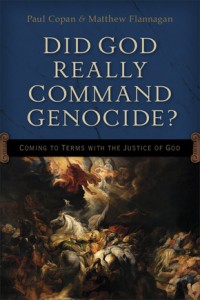 Advice to Lowder: try, I don’t know, reading it. It got released today so you finally can. Did God Really Command Genocide? is now available from the following book providers:
Well done Matt and Paul. 🙂
Out now!
Get your copy today of Did God Really Command Genocide? Coming to Terms with the Justice of God, by Paul Copan and Matthew Flannagan, published by Baker Books.
Buy from Baker Books
Buy on Amazon in paperback
Buy for your Kindle
Buy from Book Depository
(The New Zealand store launch is not until 31 January 2015 but Book Depository do free international posting.)
Coming to a bookstore near you in November 2014: Did God Really Command Genocide? Coming to Terms with the Justice of God by: Paul Copan and Matthew Flannagan
From Baker Publishing Group’s page:
“Reconciling a violent Old Testament God with a loving Jesus
Would a good, kind, and loving deity ever command the wholesale slaughter of nations? We often avoid reading difficult Old Testament passages that make us squeamish and quickly jump to the enemy-loving, forgiving Jesus of the New Testament. And yet, the question remains.
In the tradition of his popular Is God a Moral Monster?, Paul Copan teams up with Matthew Flannagan to tackle some of the most confusing and uncomfortable passages of Scripture. Together they help the Christian and nonbeliever alike understand the biblical, theological, philosophical, and ethical implications of Old Testament warfare passages.”
Some of the endorsements are below, you can read more here:
“The Old Testament describes God as a warrior who directs his people to fight the Canaanites. Divine violence in the Bible is a theme that has aroused the ire of atheists and the discomfort and confusion of many Christians. Copan and Flannagan address the arguments of the atheists who use these texts to undermine belief and confidence in God. Not only are they adept at biblical interpretation and philosophy as they effectively counter this challenge, but they also write in a deeply compelling way that will appeal to both students and laypeople.”
Tremper Longman III, Robert H. Gundry Professor of Biblical Studies, Westmont College, Santa Barbara, California
“In their wide-ranging book, Copan and Flannagan go beyond standard treatments of Old Testament warfare; they incorporate biblical, theological, philosophical, ethical, legal, and historical perspectives on a much-debated but often misunderstood topic. This volume makes important strides forward in laying out a case for the coherence of divine command theory in connection with these Yahweh-war texts.”
William Lane Craig, research professor of philosophy, Talbot School of Theology, La Mirada, California
“As a full-scale follow-up to the excellent popular treatment of the topic in Is God a Moral Monster?,this book provides the most thorough and comprehensive treatment of the problem of violence in the Old Testament that I have encountered. The authors tackle the aggressive charges of the new atheists, as well as other equally sceptical but less strident critics of ‘the God of the Old Testament.’ And they do so with a blend of careful biblical exegesis and incisive moral argumentation. The book reaches deep, but remains readable, and the summaries at the end of every chapter are a great help in following the case as it is steadily built up. All of us who, in teaching or preaching the Old Testament, are constantly bombarded with ‘But what about the Canaanites?’ will be very grateful for these rich resources for a well-informed, gracious, and biblically faithful reply.”
Christopher J. H. Wright, International Ministries Director, Langham Partnership, author of Old Testament Ethics for the People of God and The God I Don’t Understand
Pre-order your copy now on Amazon, Book Depository or Mighty Ape (or wherever you normally get your books).
When I was in Baltimore last November I caught up with fellow theologian and blogger Randal Rauser. Randal is professor of Theology at Taylor Seminary in Edmonton Canada.
Randal and I have had some spirited but cordial exchanges in the past, including a panel discussion at the Society of Biblical Literature in 2010.While we do not always agree I find him to be a very astute critic of my work.
Randal asked to interview me in Baltimore on the topic “Matthew Flannagan on God, ethics, and divine commands” so the readers of his blog could get a take on the positions I have staked out. The interview is now available at the link above.
For those who are interested, the Evangelical Theological Society has put recordings of all the papers presented in Baltimore online for a price of $4 each. My 2 presentations are available here. The talks include the Q&A so during the second presentation Professor Swinburne from Oxford University can be heard offering critical comments on my paper.
I found that the website says that most people who bought recordings of my talks also bought recordings of a paper by Gordon Otese, Associate Professor of Old Testament and Hebrew at Heritage Theological Seminary, Cambridge, Ontario, who presented a paper in the old testament narrative session at the ETS, entitled “The Use of 1 Samuel 15 as a Critique of Holy War Hyperbole“. I purchased a recording of Otese’s paper and found that it discusses, critiques and expands upon some of my work on the existence of hyperbole in 1 Samuel 15.
UPDATE: My third talk “Morality and Gods Commands: Answering Common Objections” presented at the Annual Apologetics Conference of the Evangelical Philosophical Society is now available.
 In my last post “Response to William Lane Craig’s Question 225: “The ‘Slaughter’ of the Canaanites Re-visited” Part I” I discussed William Lane Craig’s position on the Canaanite Conquest account (in light of the fact that Craig referred to my argument in his question of the week: “Question 225: The “Slaughter” of the Canaanites Re-visited”). I clarified the delineations as to where he agrees and disagrees with the position I presented at the Evangelical Philosophical Society’s session at the Society for Biblical Literature Meeting in Atlanta last year and I established that the point of divergence in our agreement rests on 1 Samuel 15.
In my Atlanta paper I argued that Nicholas Wolterstorff’s reading of the Canaanite conquest accounts in Joshua can also be applied to the account of Saul exterminating the Amalekites in 1 Sam 15.
First, the so-called ‘genocide accounts’ in 1 Sam 15 are part of a broader context that includes the rest of Samuel and also other canonical books, such as 2 Samuel and the book of Chronicles. When one reads the whole sequence, one observes that while 1 Samuel 15 describes Saul, at God’s command, exterminating the Amalekites, later passages in Samuel and Chronicles proceed on the assumption this never literally happened.
The key passage is God’s command to Samuel, “strike [nakah] Amalek [the Amalekites] and utterly destroy [haram] all that he has, and do not spare [hamal] him; but put to death both man and woman, child and infant, ox and sheep, camel and donkey.”[1] The text goes on to explicitly state that the Amalekites were all wiped out:
“So Saul defeated [nakah] the Amalekites, from Havilah as you go to Shur, which is east of Egypt. He captured Agag the king of the Amalekites alive, and utterly destroyed [haram] all the people with the edge of the sword. But Saul and the people spared [hamal] Agag and the best of the sheep, the oxen, the fatlings, the lambs, and all that was good, and were not willing to destroy them utterly; but everything despised and worthless, that they utterly destroyed.” [2]
A few verses later (15:33) the text records that Agag, the sole survivor, was executed. So, read literally, this passage states that all the Amalekites were killed and all their livestock were either destroyed or taken as plunder to be sacrificed to God at Gilgal.[3]
Now the language of “defeated” (or struck), “utterly destroyed”, the reference to “sparing” and to livestock parallels the language of the command in 15:3. Given this, it seems implausible that we should interpret the command in verse 3 as literal but the fulfilment, just 4 verses later, as hyperbolic; the text requires that the command and fulfilment be read in the same sense.
That said, when one reads this passage as part of as a single narrative a literal reading appears untenable; the proceeding text states quite emphatically that the Amalekites were not, in fact, literally wiped out. In 1 Samuel 27:8-9 David invaded a territory full of Amalekites:
“Now David and his men went up and raided the Geshurites, the Girzites and the Amalekites. (From ancient times these peoples had lived in the land extending to Shur and Egypt.) Whenever David attacked an area, he did not leave a man or woman alive, but took sheep and cattle, donkeys and camels, and clothes. Then he returned to Achish.”
Not only does this text affirm that the Amalekites still existed but the reference to Egypt and Shur states that they existed in the very same area that Saul ‘utterly destroyed every single one of them’ in in the previous passages. Moreover, David took sheep and cattle as plunder; again, livestock was another of the things Saul was said to have already eradicated.
After the text has told us that Saul “utterly destroyed all the people”, including King Agag, and despite the text telling us that when David attacked an area (the very same areas as Saul) he did “not leave a man or woman alive”, three chapters later we read that a sizeable Amalekite army attacked Ziklag![4] David apparently pursued this army and fought a long battle with them and 400 Amalekites fled on horseback!![5] Where are all these Amalekites coming from?
These are not the only examples. In 2 Samuel 1:8 an Amalekite took credit for killing Saul –but didn’t Saul “utterly destroy all the people”? In 1 Chronicles 4:43 Amalekites were still around in battle-ready numbers during the reign of Hezekiah who reigned after Saul and David.
Read literally, the narrative affirms both that the Amalekites were and were not totally wiped out. This apparent contradiction in the Samuel narrative is (more…)