Tag: Classical Liberalism

  • The Theology of the Declaration of Independence

    As I write this it is just beginning to be the 4th of July in the United States now, though its been 4th July for some time here in New Zealand.

    The 4th of July is, of course, Independence Day. Typically in New Zealand, those members of the secular blogosphere, who consider themselves to be classical liberals, have an annual rant on the 4th of July about the Declaration of Independence, praising the philosophy expounded in this document.

    Declaration of IndependenceNot PC’s Peter Cresswell, for example, states in Happy July 4th! that “with the exception of just a few words, the words could hardly be bettered today;” the declaration is, “A wonderful, wonderful anthem to freedom that rings down through the years.”  He bemoans, “if only the real meaning of those words could be heard and understood.”

    A few years ago Kiwiblog’s David Farrar made similar claims, he stated he would often “marvel at those marvelous words, written in the heat of oppression…Marvelous, absolutely marvelous.”

    I agree. I would simply point out to my secular, liberal, country-men what the words in this document actually say, and some of the philosophical ideas they expound.

    First, the declaration refers to God; it does so four times. Maverick Philosopher has an excellent analysis of the theological content;

    In the initial paragraph, we find the phrase “…Laws of Nature and of Nature’s God….” This phrase rules out pantheism: God is distinct from Nature. In the second paragraph, there is the phrase, “…endowed by their Creator with certain unalienable rights….” Putting these two references together, we may infer that the God being referred to is not merely a deistic initiator of the temporally first segment of the physical universe, but a being involved in the creation of the human race. For if God endowed human beings with rights, this endowment had to occur at the time of the creation of human beings, which of course occurred later than the beginning of the physical universe. In traditional jargon, God is a creator continuans rather than a mere creator originans. He is not a mere cosmic starter-upper, but a being who is continuously involved in maintaining the universe in existence.

    …

    The other two references are in the final paragraph. There we find the phrase, “…Supreme Judge of the World for the Rectitude of our Intentions….” near the beginning of the paragraph, and near the end, “…a firm Reliance on the Protection of divine Providence….” Now if God is the Supreme Judge, then he is more than a mere metaphysical cause responsible for the universe’s beginning to exist; he is also the supreme moral arbiter. And since he endows human beings with rights, as opposed to being merely a judge of rights antecedently possessed, then it seems we may infer that God is the source of moral distinctions (as opposed to a mere judge of them).

    The reference to divine providence is further evidence that the conception of God in the Declaration is non-deistic. For if God provides and protects, then God has an ongoing involvement with the world and its inhabitants such as would be ruled out by a deistic view. It should also be obvious that talk of providence (from the Latin, pro-videre) implies divine foreknowledge which implies intelligence and perhaps omniscience on the part of the deity. The God of the Declaration is not a blind metaphysical cause posited to explain why the universe began to exist, but a being with such attributes as moral goodness and intelligence…. So if by ‘deism’ is meant the doctrine that God is a mere metaphysical cause of the universe’s beginning to exist who is thereafter uninvolved in its continuing to exist, then the God of the Declaration is non-deistic.

    Second, the declaration claims that belief in a creator is self-evident; that is, it is a properly basic belief, which is rationally acceptable to hold in the absence of any proof.

    We hold these truths to be self-evident, that all men are created equal, that they are endowed by their Creator with certain unalienable Rights, that among these are Life, Liberty, and the pursuit of Happiness.

    Third, the declaration makes political pronouncements about public policy on the basis of these theological claims and expects these pronouncements to be taken seriously.

    Fourth, the declaration says that various rights, such as the right to life and liberty, are unalienable. That is, a person cannot alienate one’s life or freedom as they can legally alienate a piece of property. You can’t take my property if I do not consent to you having it but if I do consent, you can take it; property is alienable, life and liberty are not. The argument of the declaration reflects John Locke’s argument in the Second Treatise of Civil Government;

    To understand political power right, and derive it from its original, we must consider, what state all men are naturally in, and that is, a state of perfect freedom to order their actions, and dispose of their possessions and persons, as they think fit, within the bounds of the law of nature, without asking leave, or depending upon the will of any other man.[1]

    …

    But though this be a state of liberty, yet it is not a state of licence: though man in that state have an uncontroulable liberty to dispose of his person or possessions, yet he has not liberty to destroy himself, or so much as any creature in his possession, but where some nobler use than its bare preservation calls for it. The state of nature has a law of nature to govern it, which obliges every one: and reason, which is that law, teaches all mankind, who will but consult it, that being all equal and independent, no one ought to harm another in his life, health, liberty, or possessions: for men being all the workmanship of one omnipotent, and infinitely wise maker; all the servants of one sovereign master, sent into the world by his order, and about his business; they are his property, whose workmanship they are, made to last during his, not one another’s pleasure[2]

    …

    This freedom from absolute, arbitrary power, is so necessary to, and closely joined with a man’s preservation, that he cannot part with it, but by what forfeits his preservation and life together: for a man, not having the power of his own life, cannot, by compact, or his own consent, enslave himself to any one, nor put himself under the absolute, arbitrary power of another, to take away his life, when he pleases. No body can give more power than he has himself; and he that cannot take away his own life, cannot give another power over it.[3]

    The point here is that because your right to life and liberty are from God, no one can legitimately enslave or kill you, even if you consent to it. This was not a mere incidental addendum idea, it was central to Lockean political philosophy, which maintained (as the declaration does) that the government derives its powers from the consent of the governed. If a person can consent to be killed or enslaved then they can consent to the government enslaving them also to having the arbitrary power to kill them and hence tyranny can be legitimate. The reason tyranny is illegitimate is because, “No body can give more power than he has himself; and he that cannot take away his own life, cannot give another power over it.”

    The declaration then makes a metaphysical claim: God exists. It makes an epistemological claim about faith and reason: that belief in God is rational independent of proof. It makes an implicit claim of political philosophy: religion is not a private thing that should not influence public life but rather, theological claims should influence public life. Finally it makes a moral claim; that consenting adults do not have a right to do whatever they like with their own bodies, rather there are “Laws of Nature and of Nature’s God” that bind all human beings, that they are compelled to follow even if all parties consent otherwise. Governments are legitimate to the extent in which they respect these laws.

    I agree with PC, it is hard to improve on this philosophy; I have defended it in several places on this blog.

    Ironically, however, the militant secular liberals in NZ who parrot the declaration seem committed to attacking these ideas and rejecting them on every point. They argue that belief in God is irrational because it cannot be empirically proven, they claim that the public square should be secular, that religion should be private and not influence public policy and they argue that liberty means consenting adults can do whatever they like with their own bodies and lives. Far from being unalienable, a person’s life and freedom is his property to alienate as that person sees fit.

    It is also hard to disagree with PC’s sentiments that the declaration is “A wonderful, wonderful anthem to freedom that rings down through the years. If only the real meaning of those words could be heard and understood.” “Indeed, if only.”

    [1] John Locke Second Treatise of Civil Government Section II 4.
    [2] Ibid II6.
    [3] Ibid IV 23.

  • Is Abortion Liberal? Part 2

    In my previous post, Is Abortion Liberal? Part 1, I argued that liberals who support the non-initiation of force principle can support abortion only on two grounds;

    (a) the fetus is a person but its existence inside the mother without her consent constitutes a form aggression, and hence, the mother’s action of killing it is defensive; or,
    (b) a fetus is not a person.

    I will now address each of these in turn.

    Is the Fetus an Aggressor?
    Consider first (a), the contention that a fetus can be considered an aggressor because it is intruding upon a woman’s body without her consent; an intrusion grave enough to justify the use of lethal force. In this respect then, being subject to an unplanned pregnancy would be on par with being the recipient of a serious assault such as being raped or severely beaten.

    Frank Beckwith and Steve Thomas in Consent, Sex and the Pre-Natal Rapist, have demonstrated several problems with this claim. It leads to the conclusion that, in certain circumstances abortion is justified without the consent of the woman.

    Consider the following scenario. A young woman is involved in a car accident and is rendered unconscious by her injuries. She is brought to a hospital where, still comatose, she is examined by a doctor. While performing some tests, the doctor determines that the woman has been pregnant for several weeks. Furthermore, suppose that evidence comes to light to suggest that the woman is unaware of her pregnancy, perhaps her close friends know nothing of the pregnancy, her diary shows no knowledge of being pregnant, and so on.

    Adopting McDonagh’s understanding of pregnancy as morally equivalent to rape or assault, what is the doctor’s obligation to this unconscious patient? It would seem that, under these conditions, the doctor is morally required to perform an abortion to rid his patient of the ‘massive intrusion’ being imposed upon her by her unborn offspring. After regaining consciousness, the woman would have to be told that she’s undergone an abortion for a pregnancy of which she was not aware, for there was good evidence that no consent had been given and that she was under assault.[i]

    Beckwith’s point is that if the fetus is morally or legally on par with an aggressor who intrudes upon a woman’s body without her consent, such as a assailant or rapist then it would follow that in the case sketched above the doctor would be justified (and arguably would have an obligation) to abort despite the fact that no consent from the women had been obtained.

    Consider, that if one saw a person having sex with an unconscious woman and one knew the woman had not consented, it would be absurd to wait for the woman to wake up to see if she wanted to consent to sex. One would be obligated to intervene. “[T]he doctor in the midst of the situation, aware of the pregnancy in the absence of consent, must see it as the rape-in-progress of his unconscious patient. How could he do anything else but end the assault?”[ii]

    Now I assume that liberals would oppose the idea that any woman who both does not know she is pregnant and is unconscious should be subjected to an abortion without her consent. If this is the case then it is clear that they do not think that an unconsented to pregnancy constitutes an act of serious aggression.

    If the fetus is an unjust aggressor then liberals are committed to coercive abortions. If coercive abortions are not liberal then the fetus is not an unjust aggressor.

    Is the Fetus a Person?
    If the fetus is not an unjust aggressor then a liberal defense of abortion must be based upon (b), the idea that a fetus is not a person, a being that possesses the rights to life, liberty and property that liberals believe the state exists to protect.

    Now a fetus is clearly a human organism. After 14 days at least, it is an individual living being that is a member of the species homo sapiens. To justify abortion via (b), the liberal needs to tell us what property a human being possesses that grounds the right to not be subjected to the initiation of force, to not be killed. Further a liberal must also be able to plausibly maintain that a human organism does not acquire this property until after the fetal stage.

    Peter Cresswell takes the view,

    [T]he foetus is not yet a human being, but a part of a human being – the mother – who has rights over it. To be an actual, rather than merely potential, human being is, among other things, to be physically separate, which a foetus is not.

    This claim is erroneous. First the “parts of” relationship is transitive; if a brick is part of a wall and the wall part of a house then the brick is part of the house. If a fetus is part of a woman’s body it follows then that any organ that is part of the fetus will be part of the mother. A woman pregnant at eight weeks then possesses four arms, four legs and two brains. If the fetus is male, she will have both a vagina and a penis and be both male and female. Conclusions that are even more bizarre follow if the woman is pregnant with twins. She could have three faces, three brains, six arms, two penises and a vagina, three hearts, six kidneys and so on.[iv]

    Moreover, PC’s contention that “to be an actual human” one must be “physically separate” entails that conjoined twins are not human. Consider conjoined twins Bob and Scott. If Bob is a human being then since Scott cannot live independently of Bob, Scott must not be a human person (the converse is equally true).

    Yet it is difficult to see what property Bob has that Scott lacks which would justify considering one of them human and the other not simply because neither is dependant of the other. It appears then, that one would be forced to conclude that they both are and are not, human. Perhaps PC is simply giving a poorly worded defence of the viability criteria, which I have previously critiqued here.

    However, the usual liberal response is to ground the right to not be subjected to the initiation of force, to not be killed, in certain psychological capacities that human beings typically display; such things as sentience, rationality, self-awareness, autonomy, etc.

    Despite the pervasive appeal of this approach, it faces serious problems. Boonin notes that those who attempt to ground humanity in the amount of brain development an organism has face a dilemma. “Any appeal to what a brain can do at various stages of development would seem to have to appeal to what the brain can already do. Or to what the brain has the potential to do in the future.”[v]

    Either option leads to problems for a defender of the permissibility of abortion who does not also want to endorse infanticide. This is because “by any plausible measure dogs, and cats, cows and pigs, chickens and ducks or more intellectually developed than a new born infant.”[vi] Suppose, then, one takes the first horn and appeals to what the brain can already do. However, unless one wishes to affirm that cats, dogs and chickens are human beings, “appeals to what the brain can already do” will “be unable to account for the presumed wrongness of killing toddlers or infants.”[vii] Suppose, then, one takes up the second horn of the dilemma and appeals to “what the brain has the potential to do in the future;”[viii] Boonin notes that this will entail that feticide is homicide. “If [such an account] allows appeals to what the brain has the potential to do in the future, then it will have to include fetuses as soon as their brains begin to emerge, during the first few weeks of gestation.”[ix]

    A couple of examples will illustrate this. Suppose the liberal appeals to sentience, the capacity for consciousness and the ability to perceive pleasure and pain. This criterion will mean abortion is permissible up to 24 weeks.[x] The problem is that this criterion also catches cats, dogs, cows, and chickens as well all. All of which are as sentient if not more sentient than new born infants and post-24 week fetuses.

    If the liberal draws the line at sentience, he/she will have to hold that farming, butchers shops, McDonald’s restaurants, Kentucky fried Chicken restaurants all engage in unjustified aggression against people because they kill sentient beings without their consent. Further, to remain consistent, the liberal will have to maintain a policy of outlawing all these industries and prosecuting those who engage in them for murder and cannibalism.

    Suppose the liberal appeals to more advanced psychological states such as self-awareness, rationality or autonomy. Such accounts of the grounding of rights will exclude the animals mentioned above and will exclude human fetuses. The problem is, according to this account, newborn infants are not persons either.

    In a definitive study of infanticide, Michael Tooley compiles an impressive array of neurological and physiological data that demonstrates that infants are not persons in this sense until some time after birth.[xi] The price of this line of inference is the reduction of newborn infants to the ethical level of cows. A newborn cow, and certainly a mature cow, is more person-like than an infant is. It is difficult to understand by this view why killing and eating infants is any more problematic than consuming a Big Mac.

    Of course the liberal can avoid this by claiming that it is the potential to acquire properties such as rationality, self-awareness, autonomy, not their actuality that matters. This will enable one to claim infants are protected by the non-initiation of force principle and will exclude animals. But the problem of course is that foetuses will also be protected by the non-initiation of force principle because fetuses also have the potential to possess these properties.

    In summation, liberal proponents of the non-initiation of force principle can only support abortion if they are willing to be inconsistent and arbitrary in their application of the principle or if they are willing to endorse not just infanticide but the eating of newborn infants or state mandated vegetarianism or coercive abortions. These policies are an anathema to most liberals; as such, abortion is not liberal.

    UPDATE: In response to comments below see Sentience Part 1 and Sentience Part 2.

    [i] Francis J. Beckwith & Stephen Thomas, “Consent, Sex, and the Prenatal Rapist; A Brief Reply to McDonagh’s Suggested Revision of Roe v Wade,” Journal of Libertarian Studies 17: 3 (2003): 4.
    [ii] Ibid, 6.
    [iii] Peter Creswell, “Not PC: Cue Card Libertarianism – Abortion”.
    [iv] Here I am influenced by Peter Kreeft, The Unaborted Socrates (Downers Grove, IL: InterVarsity Press, 1983), 45-47 and Francis J Beckwith, Politically Correct Death, 124.
    [v] David Boonin, A Defense of Abortion (Cambridge: Cambridge University Press, 2003) 125.
    [vi] Ibid, 121.
    [vii] Ibid.
    [viii] Ibid.
    [ix] Ibid.
    [x] It is generally accepted that sentience occurs around 24 week’s gestation. There is some dispute over this and some scientists date sentience in the first 10 weeks of gestation.
    [xi] Michael Tooley, Abortion and Infanticide (New York: Oxford University Press, 1983) Ch. 11.5.

  • Is Abortion Liberal? Part 1

    Laws permitting abortion on demand are often deemed to be liberal. Further, political liberals are frequently ardent defenders of such laws. I think these conclusions are mistaken. In a series of two posts I will provide some reasons why.

    Most contemporary liberals advocate a form of the harm principle, famously articulated by Mill in On Liberty,

    The only part of the conduct of anyone, for which he is amenable to society, is that which concerns others. In the part which merely concerns himself, his independence is, of right, absolute. Over himself, over his own body and mind, the individual is sovereign.[i] [Emphasis added]

    Mill here draws a distinction between other-regarding actions, actions that harm other people, and self-regarding actions, those that harm oneself. He argues that society, either by law or by social pressure, cannot justly regulate any action a person performs unless it is other-regarding; that is, it harms people other than the agent him/herself. As Mill’s position is typically interpreted harm is understood to be governed by the principle volenti non fit injuria (where there is consent, there is no injury) and hence refers to things done to other people without their consent. On this interpretation, self-regarding actions are those that people consent to and that harm no non-consenting, third party. As Mill himself notes, a self-regarding action is that “which affects only himself, or affects others with their free and voluntary, and undeceived consent”.[ii]

    The most common version of the harm principle is known as the non-initiation of force principle; Rothbard sums it up well,

    The libertarian creed rests upon one central axiom: that no man or group of men may aggress against the person or property of anyone else. This may be called the “nonaggression axiom.” “Aggression” is defined as the initiation of the use or threat of physical violence against the person or property of anyone else. Aggression is therefore synonymous with invasion.[iii]

    I do not subscribe to the harm principle or the non-initiation of force interpretation of it (I give some reasons why here). However, in this series of posts I will adopt it for the sake of argument so as to examine what follows for abortion. Abortion involves killing a fetus, usually by dismembering it. Moreover, the fetus does not consent to it. Hence if a Liberal is to support abortion he/she must do so for only one of two reasons. Either,

    (a) the fetus is a person but its existence inside the mother without her consent constitutes a form aggression, and hence, the mother’s action of killing it is defensive; or,
    (b) a fetus is not a person.

    Only if one of these two options is adopted, can a liberal support the non-initiation of force principle and permissive abortion legislation and remain consistent.

    Failed Avoidance Tactics
    At this juncture it is worth noting that two very common tactics of avoiding this conclusion fail. The first is to defend abortion, as Rodney Hide tried to at the recent Family First Forum, on the basis of the perceived positive social consequences of ‘liberal’ abortion laws. In popular political discourse, and in some feminist writings, abortion is defended on consequentialist grounds; it is argued that abortion prevents unwanted children, children who are likely to be poor, abused, neglected or engage in crime. It is hailed as a solution to over-population and the existence of handicapped people. It prevents adult and teenage women from falling into economic hardship and stress and enables them to complete their education, pursue their careers and so on.

    The problem with this line of argument is that this is only cogent for liberals if they assume that abortion does not violate the non-initiation of force principle. If abortion does violate this principle then allowing abortion on these grounds would be tantamount to saying that people can engage in aggression (as Rothbard defines it) they can initiate lethal force against others provided doing so brings about positive consequences, like lower crime rates, less child abuse, lower population rates, access to education and employment, etc. This conclusion contradicts the non-initiation of force principle which states that one cannot justly pursue social utility by violating an individual’s right to life, liberty or property; the very basis of their opposition to socialism.

    The second avoidance tactic is to appeal to slogans such as “you can’t force your morality onto others, you can’t legislate morality”. The problem with these claims is that the non-initiation of force principle is itself a moral principle and liberals believe the state should enforce this principle and should defend people against others who would violate it. This forces a dilemma upon liberals who cite this slogan; either the claim “you can’t force your morality onto others” applies to the non-initiation of force principle or it does not. If it does, then abortion involves an unjust imposition of morality onto another only if you assume it is not the initiation of force. If it does not, then liberalism as a doctrine collapses as the state has no duty to protect the life, liberty and property of its citizens from aggression. In fact, it entails the conclusion that acts of aggression such as rape and murder should be decriminalised alongside abortion.

    It follows then that the liberal cannot rationally avoid the question. If one is to both support ‘liberal’ abortion laws and hold to the non-initiation of force principle, one must do so either on (a) or (b) above. I think neither is terribly defensible. I will address (a) the fetus is a person but its existence inside the mother without her consent constitutes a form aggression, and hence, the mother’s action of killing it is defensive; and, (b) a fetus is not a person, in my next post, Is Abortion Liberal? Part 2.

    [i] John Stuart Mill, On Liberty (London: Penguin Classics, 1985), 69.
    [ii] Ibid. 71.
    [iii] Murray N Rothbard, For A New Liberty: The Libertarian Manifesto (New York: Collier Books, 2002) 23.

  • Voting, the Role of the State and Similarities Between libertarianism and Christianity

    Someone emailed us a while ago asking what the difference was between Matt’s classical liberalism and my libertarianism, where did we part company and why did we define ourselves this way. We never answered because we have never really tried to pin it down before, we knew there we differed on some things and we knew that those difference put us in these particular camps but putting it into words was something we didn’t get to until now.

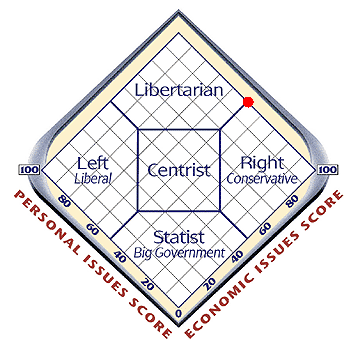
    We definitely differ; see our respective scores on The World’s Smallest Political Quiz, mouseover to see whose is who’s.

    Madeleine

    Matt

    So I am clearly in the libertarian camp (I am not in the Libertarian camp as in capital L or “Objectivist” (Randian)). Does that mean I can be both Christian and libertarian? Well not if my approach to the role of the state is to simply hold the single absolute principle “that nobody should initiate force against another.” However, yes if the outworking of what I do hold puts me closest to the libertarian perspective than any other position.

    I find the non-initiation of force principle to have no basis in divine or natural law. However, something close to is definitely there and I believe that it is the closest secular position to the correct application of Christianity to the role of state for the following reasons.

    Scripture teaches that it is wrong to kill an innocent human being. This prohibition on killing can plausibly be extended to a prohibition against violence and force in general. This is the heart of traditional Christian positions on war, abortion, euthanasia, capital punishment, etc. The idea is that the state can use retributive force against guilty people but it can never threaten the life, liberty and property of an innocent person unless they engage in unjustified aggression against another. In both situations there are important limits further still, for example, retributive force can only be used by a lawful authority after a impartial trial has found the person guilty the force must be proportionate to the offence and cruel and degrading punishments are illicit. Similarly, with defensive force. It can be used only when it is necessary to stop the aggression and again the force used must be proportionate to the perceived threat.

    A government that limited its use of force to these functions and only taxed its citizens to ensure that these functions were carried out would be severely limited and would look like no current government anywhere, yet this is the Biblical picture and you can see that it does look a lot like the libertarian non-initiation of force principle (and nothing like the strawman-caricature that Rand paints in her books).

    The key passage on the role of the state is Romans 13:1-7:

    Everyone must submit himself to the governing authorities, for there is no authority except that which God has established. The authorities that exist have been stablished by God. Consequently, he who rebels against the authority is rebelling against what God has instituted, and those who do so will bring judgment on themselves. For rulers hold no terror for those who do right, but for those who do wrong. Do you want to be free from fear of the one in authority? Then do what is right and he will commend you. For he is God’s servant to do you good. But if you do wrong, be afraid, for he does not bear the sword for nothing. He is God’s servant, an agent of wrath to bring punishment on the wrongdoer. Therefore, it is necessary to submit to the authorities, not only because of possible punishment but also because of conscience. This is also why you pay taxes, for the authorities are God’s servants, who give their full time to governing. Give everyone what you owe him: If you owe taxes, pay taxes; if revenue, then revenue; if respect, then respect; if honor, then honor.

    This passage spells out the reasons why we are required to obey the government and why we are required to pay taxes. Paul states that governments act as God’s agent, that is on his behalf, to perform a specific function, namely, to punish wrong-doing. Paul emphatically states that the state does not bear the sword, have the power to use force, for nothing but to act as an agent of retributive punishment. It is because it is an agent of God in carrying out this function that it can legitimately demand obedience and financial support. Nothing in this passage provides any basis for claiming that a government that did other things apart from these basic functions and used force to back it up would be acting as God’s agent (in fact the opposite is suggested in 1 Samuel 8:10-22 – any government that taxes its people more than 10% and undertakes functions outside its legitimate mandate is corrupt). If a government steps outside this mandate then it is acting unjustly. The passage states that the government is God’s servant, it is under God and therefore subject to the same laws as its people. In Revelation, written in the latter part as opposed to the earlier part of Nero’s reign, the same ruler is no longer described at God’s servant but as Satan incarnate because he sought to be God, he stepped outside the mandate of legitimate government.

    In summation, if you are a Christian you should either be a libertarian or a classical liberal. You might end up as a conservative if you throw some pragmatism in but if you end up as a centrist or left wing you have failed to understand Scripture, you are placing government in the role of God.

    One of the biggest problems New Zealand faces is the same the world over and was the same at the time of Samuel; the people want a government in the place of God, they want the government to provide welfare, health, education, families commissions, art, television (well maybe not that one at the time of Samuel but you get the picture). It feels and seems easier if we don’t have to take our responsibility to love our neighbour personally.

    Biblically speaking, the state’s role essentially boils down to law, order, justice and defence. Do we then get to forget about all the rest? No.

    “Teacher, which is the greatest commandment in the Law?” Jesus replied: ” ‘Love the Lord your God with all your heart and with all your soul and with all your mind.’ This is the first and greatest commandment. And the second is like it: ‘Love your neighbor as yourself.’ All the Law and the Prophets hang on these two commandments.”

    This means that looking out for others is our responsibility but, contrary to the picture Rand paints, this is strictly qualified. We do not have an obligation to give to everyone who has their hand out. If their own choices and refusal to help themselves has led them to the dire situation they find themselves in then unless they are prepared to get off their buts and help themselves and learn from their mistakes we owe them no charity. If people refuse to help themselves then we are justified in not helping them. The scriptures are full of examples, if people refuse to work then they don’t get to eat (2 Thess 3:10), you left the corners of your crops un-gathered so the poor could come and work and feed themselves – you did not hand them the fruit of your day’s labour while they sunned themselves all day, they had to work for it (Deut 24:19-22), families had to take responsibility for their own, the needy only receive private assistance if they could not work and had no family who would provide for them and were not idle people (1 Tim 5), etc.

    Given this, I have less than a month to decide who I will vote for. The choices below (in the order they appear on the Decision 08 website) are not great because none of them fit the criteria above.

    Resident’s Action Movement
    The Bill and Ben Party
    ACT
    Alliance
    Aotearoa Legalise Cannabis
    Party
    Democrats for Social Credit
    Direct Democracy Party
    Green
    Labour
    Libertarianz
    Maori Party
    National
    New World Order
    New Zealand Pacific Party
    NZ First
    Progressive
    The Family Party
    The Kiwi Party
    The Republic of New Zealand
    Party
    United Future

    Matt and I want to be really careful to not endorse a political party so we are still debating each other as to whether we will publicly state who we vote for but we agree we can take this next step, the first cull, namely getting rid of the no-way, no-how parties and assessing the pro’s and con’s of the remaining possibilities. Our intention is to more thoroughly look at and read up on these parties, their philosophy, their people and their policies. The revised list, and this goes for both of us (at this stage, last election we each voted differently), is this (again the order is the order as above):

    ACT
    Libertarianz
    Maori Party
    National
    New Zealand Pacific Party
    The Family Party
    The Kiwi Party

    Libertarianz and ACT would be the closest to my political position but the points I part ways with them are fairly major. Both parties philosophically adhere to the non-initiation of force but both throw their well reasoned, consistent thinking out the window on the topic of abortion (and a few other issues).

    Rodney Hide spoke at the recent Forum on the Family outlining clear and sensible policies all sharply reasoned, setting aside emotion, appealing to doing what is right, promoting a consistent
    theme of personal responsibility as opposed to state dependency and then when asked for his position on abortion outlined a mushy, soft and sentimental pile of rubbish. Gone was his consistent personal responsibility – non-initiation of force reasoning, suddenly his reasoning skills dropped to that of Sue Bradford’s as he spoke of it being a conscience issue (it is not – abortion is either killing, therefore the initiation of force, 100% homicide or it is not killing and is on par with tonsillectomy’s and there is zero problem with it). Rodney, citing his emotions, said he didn’t want to impose his beliefs onto women (but apparently he can when it is restricting women from, say, theft). [Here are some secular reasons on why libertarians should be pro-life]

    Rodney, ACT and the Libz on this subject are inconsistent. I am not. I have a problem with voting for a party that 1. endorses or is agnostic on homicide (and has no reasoned position that can withstand defeaters justifying their stance) and 2. that is that inconsistent.

    Further, the Libz and to a lesser degree ACT, are riddled with pathological secularists who have a closed, caricatured view of Christianity – extremely closed minded which makes supporting them difficult as many within their ranks refuse to see the similarities and work together. Also the Libz are prone to massive in-house fighting amongst the factions which seriously kneecaps them at times.

    The Maori Party make our list because they get it right on a number of issues, less often than ACT and the Libz, but best demonstrated by their policy on the seabed and foreshore where they are a seemingly lone voice speaking against the Labour government’s worst attack on the right to due process in recent times otherwise known as the Foreshore and Seabed Act 2004 (all Christians should be horrified at the passage of this law). Further we respect Tariana’s daring to cross to Helengrad and the fact that they are, by and large, a party that stands on principles not on popularism and even though many of their principles are too left/statist you have to respect that and you definitely want more politicians like that in parliament.

    National. National is not Labour. If their policies reflected their stated principles I might say more.

    The Christian Parties. First of all, so what if there are three of them? How many secular parties are there? Christians need to get over this. How many denominations of Christianity are there? Demanding that the three merge before you will support them is as ridiculous as refusing to attend church unless every denomination merges. We still somehow manage to be one body despite our differences. As with denomination and church choice, if you want to go there, look at the options and pick the one that best reflects which is right.

    • NZ Pacific. Putting aside the accusations against Taito, remember due process, Taito was part of Labour which makes him left/statist. However, like Tariana he earns brownie points for sticking it to Helengrad and he is a Christian so he makes the cut.
    • The Family Party. Putting aside the Destiny factor, they must be judged on their merits and not a knee-jerk reaction, there have been serious allegations made that they do not adhere to the theological position of separation of church and state, if this is true then they are no go, but again they are a Christian party so we will look at them.
    • The Kiwi Party. Probably the holds the number one spot of the three at this stage but this is the party that has candidates who stood with Labour and were responsible for inflicting the families commission on us and worse they seem to have not learned from their mistakes and are advocating government sponsored marriage promotion. That said their intention is good but like all the other Christian parties they are too statist and fail to understand that only when we get the state out of the lives of good law abiding citizens and when the state stops usurping the role of God can the church really flourish.

    The Christian parties are really disapointing because all of them have access to the truth and have missed it. Contra Celsum writes on the issue of whether Christians should be in politics at all. He outlines four critical reasons why he believes it inappropriate for Christians to seek political office at the present time. His four reasons are right on the button in terms of my issue with our choice of Christian parties, particularly the part on vacuous minds and points 2.d) and e)., I just am really reluctant to concede his conclusion. Am I really in that much of a minority? How did we fall this far?

    1. Whipped parties. In Jerusalem, one of the most important institutions is the believing and confessing heart. In Romans 10: 9,10 we read: “ . . . if you confess with your mouth Jesus as Lord, and believe in your heart that God raised Him from the dead, you shall be saved; for with the heart man believes, resulting in righteousness, and with the mouth he confesses, resulting in salvation.” This means that each individual must be free, as a Christian, to profess and act according to his belief. The institutions of Jerusalem are built on this principle. This is why Luther’s declaration at the Diet of Worms is in accord with the heart of the Gospel and the Kingdom of God:

    Unless I am convinced by Scripture and plain reason – I do not accept the
    authority of the popes and councils, for they have contradicted each other – my conscience is captive to the Word of God. I cannot and I will not recant anything for to go against conscience is neither right nor safe. God help me. Amen.

    But the modern political convention of whipped parties, where one is bound to vote and act, not according to conscience but to the policy of party [this applies equally to parties controlled by churches], means that Christians in the modern political arena are inevitably forced to approbate and vote for actions, laws, and policies which they
    know to be wrong and intrinsically evil.

    Of course, opponents would counter by pointing out that this does not preclude a Christian party from participating, provided that such a party stipulate that all votes would be conscience votes. This is true, as far as it goes, but we immediately see that such an approach would be virtually inconsequential within the current functioning of Parliament itself, contributing little to justice and the legislative task. It would therefore be of little use. There are far more urgent and practical things which Jerusalem should be engaged in at the moment.

    2. The Prevailing Dominant Ethic of Secular Humanism. We have seen in recent history that parties can only win reasonable support if they ground themselves in the incumbent control-beliefs of our day. Every political party can only build appeal if it agrees with the following controlling creed:

    a.) The Living God has no relevance to politics and government.

    b.) All government must be secular.

    c.) Government is the ultimate power in our society.

    d.) Government has a duty to expropriate income from some and extend welfare to others.

    e.) Government has a duty to provide for the health, education and well-being of its people.

    As long as people generally are held in the thrall of this creed, no Christian or Christian party can make any meaningful contribution. However, when sixty or seventy percent of the society are professing Christians who fear and love the Lord, it will be a very different matter. The creed of secular humanism will be seen for what it is and Christian politics and government will come into its own.

    3. The Small Numbers of Believers. Part of wisdom in God’s Kingdom is knowing when something is appropriate, and when it is not. In the end, government and law reflects the heart of the people. When such relatively small numbers are found in Jerusalem, talk of political activities is premature. The priorities before us now are the extension of the Kingdom through the preaching of the Gospel, on the one hand, and the building up a Christians in the faith, on the other. It is only as we act consistently with our God-given duties and responsibilities that we can expect the covenantal blessings of God to fall upon us. As they fall, the cultural power and influence of God’s people in the community will grow as an inevitable result. Eventually, the citadels of unbelief will be surrounded, and the halls of government captured. But we must build an army first—a host of God’s people living, working, serving in the community, doing good to all men, but especially to those of the household of faith.

    4. Vacuous Christian Minds. The majority of professing Christians have been taught all their lives in the state’s secular education system. They have been indoctrinated to think as humanists in almost every area of life. Jerusalem’s great and urgent duty is the reformation of Church, Family and School. Until we are able to educate our children in a manner consistent with our faith, we cannot expect that the Christian community will be able to distinguish between the counsels of secular humanism, on the one hand, and faithful Christian principles, on the other.

    Until our children are properly taught and educated, we will not produce faithful Christians who think and act Christianly in their professions, whether they be in science, medicine, law, the liberal arts, or whatever. It is only upon such a foundation that true, God-honouring political views can emerge.

    If Christians cannot distinguish between the justice of secular humanism and the justice of Jerusalem we are utterly ill-equipped and malformed for roles in politics. If we are not clear according to Scripture on the God-ordained roles and responsibilities of the Church, the Family, the State, the School, the Corporation, how could we distinguish between the policies of God and of Baal in the civic and public sphere? And if we cannot even get our thinking right on these matters, any actual Christian political involvement will end up as an abortion.