10 Things to Scratch From Your Worry List
For most of the year, it is the duty of the press to scour the known universe looking for ways to ruin your day. The more fear, guilt or angst a news story induces, the better. But with August upon us, perhaps you’re in the mood for a break, so I’ve rounded up a list of 10 things not to worry about on your vacation.
Now, I can’t guarantee you that any of these worries is groundless, because I can’t guarantee you that anything is absolutely safe, including the act of reading a newspaper. With enough money, an enterprising researcher could surely identify a chemical in newsprint or keyboards that is dangerously carcinogenic for any rat that reads a trillion science columns every day.
What I can guarantee is that I wouldn’t spend a nanosecond of my vacation worrying about any of these 10 things. (You can make your own nominations in the TierneyLab blog.)
1. Killer hot dogs.
What is it about frankfurters? There was the nitrite scare. Then the grilling-creates-carcinogens alarm. And then, when those menaces ebbed, the weenie warriors fell back on that old reliable villain: saturatedfat.
But now even saturated fat isn’t looking so bad, thanks to a rigorous experiment in Israel reported this month. The people on a low-carb, unrestricted-calorie diet onsumed more saturated fat than another group forced to cut back on both fat and calories, but those fatophiles lost more weight and ended up with a better cholesterol profile. And this was just the latest in a series of studies contradicting the medical establishment’s predictions about saturated fat.
If you must worry, focus on the carbs in the bun. But when it comes to the fatty frank — or the fatty anything else on vacation — I’d relax.
2. Your car’s planet-destroying air conditioner.
No matter how guilty you feel about your carbon footprint, you don’t have to swelter on the highway to the beach. After doing tests at 65 miles per hour, the mileage experts at edmunds.com report that the aerodynamic drag from opening the windows cancels out any fuel savings from turning off the air-conditioner.
3. Forbidden fruits from afar.
Do you dare to eat a kiwi[fruit]? Sure, because more “food miles” do not equal more greenhouse emissions. Food from other countries is often produced and shipped much more efficiently than domestic food, particularly if the local producers are hauling their wares around in small trucks. One study showed that apples shipped from New Zealand to Britain had a smaller carbon footprint than apples grown and sold in Britain.
4. Carcinogenic cellphones.
Some prominent brain surgeons made news on Larry King’s show this year with their fears of cellphones, thereby establishing once and for all that epidemiology is not brain surgery — it’s more complicated.
As my colleague Tara Parker-Pope has noted, there is no known biological mechanism for the phones’ non-ionizing radiation to cause cancer, and epidemiological studies have failed to find consistent links between cancer
and cellphones.
It’s always possible today’s worried doctors will be vindicated, but I’d bet they’ll be remembered more like the promoters of the old cancer-from-power-lines menace — or like James Thurber’s grandmother, who covered up her wall outlets to stop electricity from leaking.
Driving while talking on a phone is a definite risk, but you’re better off worrying about other cars rather than cancer.
5. Evil plastic bags.
Take it from the Environmental Protection Agency : paper bags are not better for the environment than plastic bags. If anything, the evidence from life-cycle analyses favors plastic bags. They require much less energy — and greenhouse emissions — to manufacture, ship and recycle. They generate less air and water pollution. And they take up much less space in landfills.
6. Toxic plastic bottles.
For years panels of experts repeatedly approved the use of bisphenol-a, or BPA, which is used in polycarbonate bottles and many other plastic products. Yes, it could be harmful if given in huge doses to rodents, but so can the natural chemicals in countless foods we eat every day. Dose makes the poison.
But this year, after a campaign by a few researchers and activists, one federal panel expressed some concern about BPA in baby bottles. Panic ensued. Even though there was zero evidence of harm to humans, Wal-Mart pulled BPA-containing products from its shelves, and politicians began talking about BPA bans. Some experts fear product recalls that could make this the most expensive health scare in history.
Nalgene has already announced that it will take BPA out of its wonderfully sturdy water bottles. Given the publicity, the company probably had no choice. But my old blue-capped Nalgene bottle, the one with BPA that survived glaciers, jungles and deserts, is still sitting right next to me, filled with drinking water. If they ever try recalling it, they’ll have to pry it from my cold dead fingers.
Leighton’s favourite was 3. as he “found it cute for obvious reasons.” Mine is number 1. the reference to not stressing about eating saturated fat resulting in more weight loss and better cholesterol levels is something I have been saying for years – its the high GI carbs you wanna watch for!
Please post any other enviro myths you have to hand in the comments section.
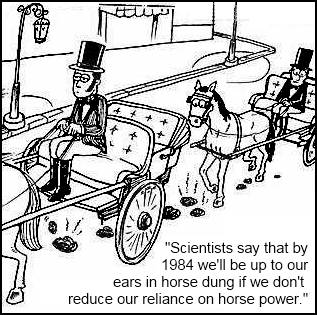 One of the most destructive carnards concreted into the mind of greenism and environmentalism is the proposition that natural resources are fixed, finite, and limited. Once gone, they are gone forever. Therefore, conservation of said resources is a moral imperative.