Tag: Evangelical Philosophical Society

  • Madeleine and Matt to speak on “Being Good: Christian Virtues for Everyday Life” at the 2012 Evangelical Philosophical Society Meeting in Milwaukee

    Evangelical Philosophical Society

    I have had to revise my earlier statements about not going to the November 2012 academic conferences in Milwaukee on the grounds that when you are personally invited to participate in a panel discussion by Doug Geivett and Mike Austin at the Evangelical Philosophical Society (“EPS”) you do not say no 🙂

    (If I said “no” I think Andrew would throw things at me and AndrĂ© Z would egg him on)

    Matt has been invited to speak on the same panel too.

    Here is what we know so far:

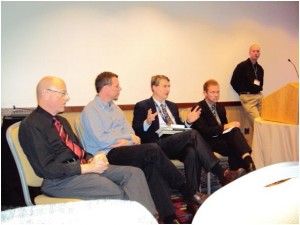
    Being Good: Christian Virtues for Everyday LifeMike and Doug co-edited a book entitled Being Good: Christian Virtues for Everyday Life.  At the EPS meeting in Milwaukee in November 2012 there will be a panel discussion in one of the sessions offering critical discussion of the book and it’s themes. Matt and I are now scheduled to be participants in that panel.

    The panel will discuss different aspects of the book, such as, an analysis of a virtue in the book that a participant disagrees with by giving an extension of the book’s discussion of character in some way.

    Matt was already going anyway as his paper on Singer and Infanticide got through the blind review process and was accepted.

    I had thought I might not go as we in the process of radically changing how I earn money. I am about to swap my regular weekly income for a contract for services that will see me retain most of the money I make my firm but pay my own expenses (and still be supervised and under the umbrella of a firm as all baby-lawyers should be under the law). So this is both exciting as I will have more control over what I earn but it is also scary as there are no guarantees that I will earn consistently; imminent changes to how legal aid is to be paid make that even scarier. The theory is that in the long run I will make more than I was on my very low baby-lawyer income but it is yet to be tested. As I am the primary earner in our house there is a lot riding on this, including the extension to our mortgage to purchase this opportunity. Going to America is not a cheap exercise from New Zealand but we have providentially managed to find a way the last two years with a lot of help from our friends so I am going to stop worrying and focus on trusting in God to whom I am  grateful for this opportunity.

  • Matt to speak on Singer and Infanticide at 2012 Evangelical Philosophical Society Meeting in Milwaukee

    Every November there is about a two week period in America where a number of professional academic conferences are held where the best of the best in the field gather. For the last two years Matt has been either accepted or invited to speak at them (I was accepted to speak at them last year too but had a visa problem at the last minute so Matt went without me). Anyway, this year they are all being held in Milwaukee and I am happy to announce that Matt received this email last week:

    Evangelical Philosophical SocietyCongratulations!  Your paper proposal for the 2012 Evangelical Philosophical Society meeting in Milwaukee (14-16 November) has been accepted for presentation.

    …

    Since there were nearly twice as many proposals as spaces, many fine papers had to be rejected.  If for any reason you will not be able to present your paper after all, please inform the EPS program committee as soon as possible so that we can allow one of the alternates to fill the vacated slot.

    Again, congratulations, and we look forward to hearing your paper in Milwaukee!

    Sincerely in Christ,

    The EPS program committee

    Yay – so proud of him! The abstract he submitted for blind review was as follows:

    Peter Singer, Human Dignity, and Infanticide

    Christian theism has traditionally taught that human beings have equal dignity and worth, a moral status that separates them from other non-human animals. Peter Singer has famously argued that this teaching is problematic; human beings are not any more special than animals and doctrines of human dignity are indefensible.  He contend that killing a new-born infant is, in and of itself, no more problematic than killing a non-human animal such as a cow or a pig, and he defends the permissibility of infanticide.

    This paper will critically assess one important part of Singer’s position: his understanding of why it is wrong to kill.  In part 1 I will sketch Singer’s “desire account” of killing and its relationship to his own preference utilitarianism and project of animal equality. Following Don Marquis, I will argue that this “desire account” is subject to important counter examples. In part 2, I will note Singer’s attempts to modify his position so as to avoid these counter examples and suggest that these modifications undercut his arguments for animal equality. In part 3, I will suggest that, despite this, there is an important truth in Singer’s critique, one that Christian thinkers can appropriate in developing moral arguments for Christian theism.

    Matt did not apply for any other of the conferences this year, although he was invited to give a paper at the Society for Biblical Literature but the session got cancelled. He and I are contemplating applying to Notre Dame’s annual conference on the week before, it’s theme this year is Justice so both of us could, and I still have enough time on my US Visa to go, but I am not sure if I have time to write a paper as my case-load is insane, so it might be just Matt. Anyway – yay Matt!

    Update
    Wow, already in receipt of donation offers to help get him there! We love you guys 🙂 We have just over $1.5k left over from blog donations and fundraising last time which constitutes the refunds from my aborted-lack-of-visa trip. I will price Auckland to Milwaukee and put up a fundraising widget in the sidebar soon – as with previous years accommodation options will be needed so Milwaukee readers if you have a couch talk to me 🙂

  • Back from San Francisco: A Belated Report

    MandM has been quite of late, this is because Madeleine and I have been very busy.  With moving house in the midst of Christmas and New Years and Madeleine working part-time in a law firm and so on, we’ve had little time to blog. We are now set up, to some extent, and so this post will be a belated comment on my recent trip to San Francisco.

    In November I flew to San Francisco where I attended I attended the  Meeting of the Evangelical Theological Society (ETS), The Annual Meeting of the Evangelical Philosophical Society (EPS), The Evangelical Philosophical Society Apologetics Conference and The Annual Meeting of the Society for Biblical Literature (SBL) and American academy of religion.(AAR). While I would love to give detailed commentary on each session, to do so would require several blog posts of inordinate length, instead I will simply summarise what went down.

    I arrived in San Francisco at around 4pm  on the 15th. I presented my first paper at 8:30am the next morning. My paper was a critique of Walter Sinnott Armstrong’s arguments against divine command theory meta-ethics. Armstrong contends that the nature of moral obligation is best explained by identifying moral obligations with the natural property of harming others without justification, and, focusing largely on Craig’s work, argues this is superior to divine command ethics. I argued: (a) his argument fails to note the conditional nature of Craig’s (his main target’s) contention that if theism is true moral obligations are best explained as divinecommands (b) Armstrong’s does not provide a better account of moral objectivity (c) Armstrong’s account is not more economical than a divine command theory. (d) Even if it were an economical account, it does not explain various features of obligation such as (i) the social nature of moral obligations (ii) the fact that moral obligations constitute a decisive reason for acting and (iii) the specific moral content of obligations; as well as a divine command theory. All in around 30 minutes!!! The paper was very well received, with several people asking me to forward them a copy. I plan to get it published later this year.

    The rest of the morning was filled with me hearing various papers on moral theory and philosophy of religion all of which were interesting and stimulating. These panellists all shared similar perspectives yet were astutely critical of each other’s arguments. Particularly interesting was the dialogue between Baggett and Craig. Some of the issues here were technical and deserve further discussion so I plan to blog on this dialogue in more detail in the future. But in sum: Craig has defended a counterfactual: if God did not exist then moral obligations would not exist. Baggett  argued for various reasons that this is too strong; if God, the creator and sustainer of the universe, did not exist, the universe would not exist. To make sense, Craig’s claim needs to envisage a compossible world, which is like the actual world in all respects except that God does not exist, if it’s like the world in all other respects however, then it has all the features of the world God has created – and hence the resources for something like moral obligations to exist. Instead, Baggett contended, one should argue that a world with God provides a better explanation of the nature and existence of moral obligations than a world without God does. This means the theist does not have to argue, with Craig, that there is no adequate secular account of the existence of moral obligations, only that a divine command theory is more plausible than such accounts. Both Craig and Baggett made telling points which I will have to elaborate on some other time. highlight of Wednesday was the afternoon session. A panel discussion of David Baggett and Jerry Wall’s new book “Good God: The Theistic Foundations of Morality”. This book is the latest defence of divine command theory ethics, recently published by Oxford University Press. Baggett and Walls sketched briefly the content of the book and Paul Copan and William Lane Craig offered critical commentary, to which Baggett and Walls responded.

    Thursday started with an excellent critique of evolutionary (more…)

  • The Nominations for Evangelical Philosophical Society Executive are in…

    Matthew FlannaganVoting for the 2011 Executive Committee of the Evangelical Philosophical Society (EPS) has begun today. I am pleased to announce that this blog’s Matthew Flannagan has been nominated as one of the seven candidates for the three vacant executive committee positions. Matt is the only New Zealander to have been nominated – so proud of him 🙂

    If you are a member of the EPS make sure you check out the full candidate list and vote!

  • Hear Matt’s EPS Apologetics Conference Paper in Advance & Eat 3 Courses for $10 – This Weekend in Auckland

    We are going to the United States in November to, between us, give 4 talks to 4 different conferences that we have been invited to speak at (details below). We need to raise the funds to get there and so far we have raised about half of what we need thanks to the generosity of readers of this blog 🙂

    Sticky Date Pudding with Maple Butterscotch Sauce - recipe at Mad | FoodMassey Presbyterian Church (“MPC”) has offered to help us put on a fundraising night where both of us will utilise our talents to bring you a three-course meal for $10 cooked by me (I cook see my cooking website Mad | Food) and a talk given by Matt “Can God Command Evil? The Problem of Apparently Immoral Commands” – this will be a slightly abridged version of the very same talk Matt will give to the EPS Apologetics conference in November so make sure you don’t miss it or you’ll have to fly to San Francisco to hear it!

    This event is happening this weekend at the MPC Night Church Service on Sunday 2 October. The starter and main will be served to your table before the service and the dessert will be served after. So please arrive at 6pm to be seated if you are coming for dinner; the service will start at 7pm.

    Menu

    (Diners choose 1 from each category)

    Entree:

    Creamy Tomato Soup – home made, mildly spiced (gluten free)

    MPC Bread – fresh-baked individual loaf with hummus

    Main:*
    White Chilli Chicken Enchilada – chicken, cannellini beans and mild mexican flavours in a delicious sauce wrapped and baked in a tortilla (Gluten free option: served without the tortilla on rice)

    Beef Lasagne – tasty beef mince, layered with pasta and topped with a cheese sauce

    Empanadas – mildly spiced, creamy vegetable and chickpea curry encased in flaky puff pastry topped with poppy seeds, served with chutney on the side (vegetarian) (Gluten free option: served without the pastry on rice)

    * All mains served with your choice of crunchy slaw or steamed winter vegetables

    Dessert:
    Berry Bombe with Boysenberry Coulis – Home made ice-cream with crushed meringue, marshmallows and berries topped with home made boysenberry sauce. (Gluten free)

    Chocolate Tiramisu – layers of coffee-rum flavour infused chocolate sponge and cream (alcohol free)

    Sticky Date Pudding with Maple Butterscotch Sauce – light, fluffy and so delicious!

    Non-alcoholic beverages will also be available.

    Donations towards our trip gratefully received 🙂 

    (If you can’t eat a whole three-course meal or you want two of something individual prices are: entree $2, main $5, dessert $3)  

    Please use the Facebook Page to RSVP and invite others.

    (more…)

  • Response to William Lane Craig’s Question 225: “The ‘Slaughter’ of the Canaanites Re-visited” Part II

    Samuel rebukes SaulIn my last post “Response to William Lane Craig’s Question 225: “The ‘Slaughter’ of the Canaanites Re-visited” Part I” I discussed William Lane Craig’s position on the Canaanite Conquest account (in light of the fact that Craig referred to my argument in his question of the week: “Question 225: The “Slaughter” of the Canaanites Re-visited”). I clarified the delineations as to where he agrees and disagrees with the position I presented at the Evangelical Philosophical Society’s session at the Society for Biblical Literature Meeting in Atlanta last year and I established that the point of divergence in our agreement rests on 1 Samuel 15.

    In my Atlanta paper I argued that Nicholas Wolterstorff’s reading of the Canaanite conquest accounts in Joshua can also be applied to the account of Saul exterminating the Amalekites in 1 Sam 15.

    First, the so-called ‘genocide accounts’ in 1 Sam 15 are part of a broader context that includes the rest of Samuel and also other canonical books, such as 2 Samuel and the book of Chronicles. When one reads the whole sequence, one observes that while 1 Samuel 15 describes Saul, at God’s command, exterminating the Amalekites, later passages in Samuel and Chronicles proceed on the assumption this never literally happened.

    The key passage is God’s command to Samuel, “strike [nakah] Amalek [the Amalekites] and utterly destroy [haram] all that he has, and do not spare [hamal] him; but put to death both man and woman, child and infant, ox and sheep, camel and donkey.”[1] The text goes on to explicitly state that the Amalekites were all wiped out:

    “So Saul defeated [nakah] the Amalekites, from Havilah as you go to Shur, which is east of Egypt. He captured Agag the king of the Amalekites alive, and utterly destroyed [haram] all the people with the edge of the sword. But Saul and the people spared [hamal] Agag and the best of the sheep, the oxen, the fatlings, the lambs, and all that was good, and were not willing to destroy them utterly; but everything despised and worthless, that they utterly destroyed.” [2]

    A few verses later (15:33) the text records that Agag, the sole survivor, was executed. So, read literally, this passage states that all the Amalekites were killed and all their livestock were either destroyed or taken as plunder to be sacrificed to God at Gilgal.[3]

    Now the language of “defeated” (or struck), “utterly destroyed”, the reference to “sparing” and to livestock parallels the language of the command in 15:3. Given this, it seems implausible that we should interpret the command in verse 3 as literal but the fulfilment, just 4 verses later, as hyperbolic; the text requires that the command and fulfilment be read in the same sense.

    That said, when one reads this passage as part of as a single narrative a literal reading appears untenable; the proceeding text states quite emphatically that the Amalekites were not, in fact, literally wiped out. In 1 Samuel 27:8-9 David invaded a territory full of Amalekites:

    “Now David and his men went up and raided the Geshurites, the Girzites and the Amalekites. (From ancient times these peoples had lived in the land extending to Shur and Egypt.) Whenever David attacked an area, he did not leave a man or woman alive, but took sheep and cattle, donkeys and camels, and clothes. Then he returned to Achish.”

    Not only does this text affirm that the Amalekites still existed but the reference to Egypt and Shur states that they existed in the very same area that Saul ‘utterly destroyed every single one of them’ in in the previous passages. Moreover, David took sheep and cattle as plunder; again, livestock was another of the things Saul was said to have already eradicated.

    After the text has told us that Saul “utterly destroyed all the people”, including King Agag, and despite the text telling us that when David attacked an area (the very same areas as Saul) he did “not leave a man or woman alive”, three chapters later we read that a sizeable Amalekite army attacked Ziklag![4] David apparently pursued this army and fought a long battle with them and 400 Amalekites fled on horseback!![5] Where are all these Amalekites coming from?

    These are not the only examples. In 2 Samuel 1:8 an Amalekite took credit for killing Saul –but didn’t Saul “utterly destroy all the people”? In 1 Chronicles 4:43 Amalekites were still around in battle-ready numbers during the reign of Hezekiah who reigned after Saul and David.

    Read literally, the narrative affirms both that the Amalekites were and were not totally wiped out. This apparent contradiction in the Samuel narrative is (more…)

  • Response to William Lane Craig’s Question 225: “The ‘Slaughter’ of the Canaanites Re-visited” Part I

    Every week William Lane Craig answers a question on his website; this week’s question of the week is entitled “The “Slaughter” of the Canaanites Re-visited”. The questioner asked what Craig thinks of the Canaanite Conquest account. I got a mention in Craig’s reply:

    The EPS Session at the SBL: Richard Hess, Randal Rauser, Paul Copan, me, Michael Rea

    “The topic of God’s command to destroy the Canaanites was the subject of a very interesting exchange at the Evangelical Philosophical Society session last November at the Society of Biblical Literature Convention in Atlanta. Matt Flannagan defended the view put forward by Paul Copan in his Is God a Moral Monster? that such commands represent hyperbole typical of Ancient Near Eastern accounts of military conquests. Obviously, if Paul is right about this, then the whole problem just evaporates. But this answer doesn’t seem to me to do justice to the biblical text, which seems to say that if the Israeli soldiers were to encounter Canaanite women and children, they should kill them (cf. Samuel’s rebuke of Saul in I Sam. 15.10-16).”

    Craig raises an important issue. In God and the Genocide of the Canaanites I, II and III I defended Nicholas Wolterstorff’s take on the Canaanite massacre in “Reading Joshua”.[1] Wolterstorff argued that the book of Joshua is a highly figurative, hagiographic and hyperbolic account of Israel’s early skirmishes and it is not intended to be taken literally in its details. My adaptation of Wolterstorff’s argument consists of three points.

    First, taken as a single narrative, and taken literally, Joshua 1-11 gives a contradictory account of events to that narrated by Judges and also to that narrated by the later chapters of Joshua itself.

    Second, those who put these books into a single narrative would have been well aware of the obvious contradictions mentioned above. These editors were not mindless or stupid, particularly if we hold that God spoke through them.

    Third, while Judges reads more like “down-to-earth”[2] history, a careful reading of Joshua shows it to be full of ritualistic, stylised accounts and formulaic language. I supported this third point with research into Ancient Near Eastern conquest accounts. Studies show such accounts are hyperbolic, hagiographic, figurative and follow a common transmission code. Comparisons between these accounts and the early chapters of Joshua suggest Joshua was written according to the same literary conventions and transmission code. I suggest these three points, taken together, provide compelling reasons for thinking that one should interpret the text as a hyperbolic, hagiographic and figurative account of what occurred; it was not meant to be taken as literally true in all its details.

    Craig’s objection to my position (and that of Paul Copan’s whose position is very close to mine) is a reference to 1 Samuel 15. Craig referred specifically to verses 10-16, where Samuel rebuked Saul “because [Saul] has turned away from [God] and has not carried out [God’s] instructions.”[3] The instructions in question were given in verse 3; God commanded Saul, “Now go and strike [nakah] Amalek [the Amelekites] and utterly destroy [haram] all that he has, and do not spare [hamal] him; but put to death both man and woman, child and infant, ox and sheep, camel and donkey.”[4] Craig suggests this “seems to say that if the Israeli soldiers were to encounter Canaanite women and children, they should kill them”. I think Craig pushes an important objection (more…)