Climategate has been all the rage on the blogosphere of late and judging by the emails we’ve received in the past few days from our international readers, New Zealand’s own climategate has gone global. The fuel providing the heat is a recent criticism of New Zealand’s National Institute of Water and Atmospheric Research (NIWA) by the New Zealand Climate Science Coalition (NZCSC).
The coalition released an 8-page report that compares the figures on NIWA’s website with the official graph NIWA has constructed that purports to show that New Zealand’s temperatures have steadily risen since 1909.
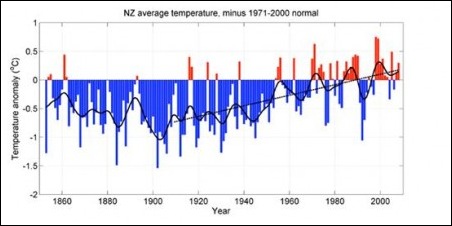
The problem is that the two sets of figures do not match. When one graphs NIWA’s own websites figures the graph shows a constant steady rate of temperature.
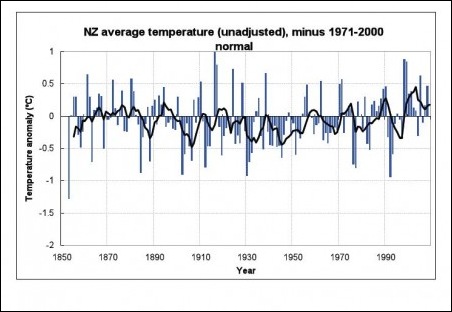
The climb in temperature in the official graph is due to the fact that NIWA adjusted the raw data, in almost all cases, upwards. It is these adjustments, and not the raw data itself, which leads to the incline on the official graph. NZCSC have cried foul, Ian Wishart, author of best seller Air Con: The Seriously Inconvenient Truth About Global Warming, got hold of it, the blogosphere followed suit.
In response NIWA have argued that they had good reasons for adjusting the raw data in this fashion. They maintain that over a hundred years the sites where measurements have been taken have changed and so they have needed to adjust their figures upwards to correct for the distortions these changes would have made.
I am aware that not being a climatologist or someone that familiar with the relevant data to any great extent makes it difficult to arrive at an informed position in this debate. However, it seems to this lay person that two things are evident.
From what I have seen from NIWA’s response, the raw data does not support their conclusions and the method of collecting the raw data was flawed and inaccurate to begin with.
The issue then is whether one is justified in adjusting the data to fit what one thinks it would have been if these inaccuracies did not exist, and, if we are, how confident we can be of the results based on counter-factual speculations of this sort. I myself have no idea of the answer but certainly I think that it is fair for people to ask questions of this sort. Especially with the backdrop of the international climategate emails and memos and when serious political policies such as the Emissions Trading Scheme (ETS), which restricts people’s life, liberty and property, are being passed on the basis of the legitimacy of climate change science.
Scientific debates aside, it seems that as a point of justice the burden of proof must fall on those who wish to impose severe restrictions on other people’s lives, liberty and property; those advocating restrictive policies, like the ETS and those under discussion at Copenhagen, must be able to show that their polices are defensible. This is simply an implication of the idea that people have a prima facie right to liberty and property. A prima facie right is one that holds as a default position in the absence of sufficient reason to the contrary. It seems to me fairly self-evident that if one is going to restrict people’s freedom or property one needs good reasons for doing so. A principle that suggests we could enslave, coerce and confiscate people’s property for no reason, trivial reasons or simply when we unsure there were any reasons would clearly be wrong – much more so when the question hangs over the reason as to whether or not the justification has been faked.
One thing that did interest me in this whole debate, however, is how some scientists have defended NIWA against its critics. What I have observed does not inspire confidence. A good example occurs over at MacDoctor. MacDoctor had raised questions about NIWA’s data, the response from Gareth Renowden, author of Hot Topic.
I think you are giving far too much weight to the CRU email hack. Here’s a few reasons why:
1: The emails were stolen. Those released amount to under 2% (pers comm) of the total stolen, and have clearly been selected to support the storylines being run by the “right wing blogs” you mention. The editorial selection has been made by a bunch of crooks.
2: Many of the mails being talked about have perfectly innocent explanations (see RealClimate). They are the private conversations of a bunch of working scientists, not the science itself. We see that they can be rude about each other and their rivals — that only proves that scientists are human. However, the climate sceptic network is making all sorts of outrageous claims about what they say. Sadly you seem to have bought those interpretations, rather than the somewhat more mundane truth.
3: Our body of scientific knowledge is found in the peer-reviewed literature, not in a careful selection of emails. Not one peer-reviewed paper is called into question by these emails.
4: Timing is everything. These emails were “released” a couple of weeks before the Copenhagen conference, and while a major emissions reduction bill is before the US legislature. They were immediately trumpeted from the rooftops by the usual suspects – those campaigning against action on climate change. Coincidence, or part of a campaign?
If I was a climatologist, I would be very angry at this point, not because I have to go back and redo any work, but because those seeking to delay or prevent action on climate change are resorting to vicious personal attacks against my colleagues. After all, if you can only make a case by stealing and lying, what sort of case have you got?
There are some things about this response that deserve comment. Consider the points raised in 1: here Gareth’s response is to attack the character of those who took the emails. He notes that they are crooks, that the data has been used to support a particular line of interpretation put forward by “right wing blogs.” Similarly, in 4: he suggests that the timing of the information was politically motivated.
These arguments commit the ad hominem fallacy; whether or not the material put forward by climate change sceptics is true or false depends on the empirical evidence for it and not on the motives of those who put it forward. One can see the point better by simply reversing it, suppose a body of scientific data is appropriated by left-wing bloggers and is released just before an important political meeting. Does it follow that the studies themselves are worthless? Gareth seems to be suggesting that because the people had particular political leanings or particular political motivations that one should reject their research without actually examining the evidence. Far from showing that the sceptics claims are unfounded, this very line of argument suggests that the scientists are letting political commitments dictate the lines of inquiry they will consider from the outset.
Gareth’s points 2: and 3: have more merit. He suggests correctly that the nasty rude character of individual scientists does not mean their research is flawed. This is correct; it makes the valid point that whether an individual scientist has a good character is in fact a different question as to whether his arguments are sound. Of course this observation actually rebuts most of what he has said in 1: and 4:.
Moreover, Gareth suggests that what matters is what the peer reviewed studies show and these are not called into question by anything in the leaked (stolen) emails and memos at the centre of climategate and goes on to suggest that there are innocent explanations of the conversations in question. These latter claims, if correct, do provide a valid response to the questions people raised.
MacDoctor responds to this as follows:
Those released amount to under 2% (pers comm) of the total stolen
No. You can access all the emails. The ones being discussed in blogs and the media amount to about 2%.
Many of the mails being talked about have perfectly innocent explanations
I’m sure you are right. However, many of the e-mails have meanings that cannot be interpreted in any way except that they reveal severe selection bias. Even Monbiot thinks that they show more politics than science.
Our body of scientific knowledge is found in the peer-reviewed literature
Apparently not, according to the emails. There appears to have been a concerted effort made to keep certain articles out of the peer reviewed literature. The smothering of dissenting views makes for a flawed, truncated science that is all but worthless.
Timing is everything
Indeed. CRU timed plenty of scary statistics to be brought forth just before the Copenhagen conference – now all suspect. The timing works both ways.
Here MacDoctor addresses both the valid and invalid arguments. In response to the issue of peer review, MacDoctor notes that the climategate emails and memos provide evidence that the process of peer review has been corrupted. He also notes that not all of the emails and memos can be plausibly explained away in the fashion Gareth suggests.
At this point I was interested in seeing if Gareth had an adequate response to these points. I was disappointed. Gareth’s response is as follows,
Selection bias! In the cherry-picking of stuff to feed into right wing attack lines, yes.
The “concerted effort” was to deal with crap – papers that should never have got through peer review. Note that the perversion of peer review was actually being conducted by sceptics – notably Chris de Freitas, who as an editor at Climate Research was responsible for passing several papers from his sceptic mates for publication without proper peer review. Six editors resigned in protest. Full story here from one of the editors who resigned.
CRU “timed” no scary statistics for release, and none of their normal products are now suspect.
I must say I’m astonished that someone who (presumably) relies on evidence-based should be so partial when it comes to work in another field. Your choice. Your loss.
What we see here is not a valid response to MacDoctor’s concerns but rather a series of tu quoques. He responds by noting that right wingers have selection bias. That may or may not be true but that was not the question. The question was whether the scientists at the heart of climategate had selection bias. You do not show that one person is not biased by pointing out that someone else is or might be. In the same way, pointing out, as Gareth does, that some sceptics of anthropogenic global warming (AGW) have tried to manipulate peer review does not actually tell us anything about whether defenders of AGW have also manipulated peer review.
If anything, Gareth’s remaining comments tend to suggest that they did try to do this but were justified because the work of sceptics is “crap.” This shows us that, at the crucial point, his defence degenerates to denigration and name-calling. The rest of the response is to insinuate that those who do not disagree with these obviously fallacious arguments do not follow “evidence based research.” Strange, I though evidence based research involves actually providing evidence for your claims, not raising red herrings and making evasions.
After reading the exchange I am left wondering; here scientists are defending their position by using clear-cut obvious examples of fallacious reasoning but surely scientists of all people know not to do this don’t they?
For those like myself who are lay people the questions remain. Governments advocate using the force of law, with policies such as the ETS, to restrict peoples freedom, confiscate their property and raise the price of food, petrol and power. We are told this is because a “consensus” of scientists thinks certain facts about climate change and AGW are the case and that these facts justify certain action. Apart from the obvious is ought fallacy employed in such reasoning (empirical research by itself cannot answer moral questions about what we ought to do) and putting aside the question of whether scientific consensus are always reliable guides to truth, it is disconcerting, in such a politically charged context as we find ourselves in amidst climategate, that when people discover that data has been adjusted on the basis not of what it actually showed but what they think it should have shown under non-existent ideal conditions and they ask questions about this that at least some defenders of science respond with evasions. People who are trained in scientific thinking must know that such responses are fallacious and inadequate. When I witness this, especially when some of it seems premised on the idea that views can be dismissed out of hand if the conclusions are “right wing,” it makes one, at the very least, a bit suspicious that we are dealing with politics and agendas as much as science.
 Macsyna is coming out of the closet via a book, Breaking Silence: The Kahui Case, written by Ian Wishart. The mob has called for the book to be banned, via boycott, successfully pressuring booksellers not to carry it. She was the mother of murdered (or manslaughtered) infant twins, Chris and Cru Kahui. The court acquitted her then current boyfriend (and father of the twins) of responsibility for their deaths. No-one else has been charged. The defence argued that Macsyna herself was their killer.