Tag: Islam

  • Is it Arrogant to Claim Jesus is the Only Way?

    Last week I spoke at Massey Presbyterian Church on the topic “Is it arrogant to claim Jesus is the only way?” The following is an abridged version of the talk I gave.

    ArrogantI was recently on a panel at Auckland University where an audience member raised the issue during the Q&A of religious pluralism. The issue is commonly raised as a rhetorical challenge, “isn’t it arrogant to believe Jesus is the only way?” In a world where there exists widespread religious pluralism, where there are people who are just as intelligent, educated, and ostensibly as sincere as we are who hold to and pratice a different religion to Christianity or no religion at all, how can a Christain maintain that she is right and everyone else is wrong. Isn’t believing that Jesus is the only way simply arrogant?

    In addressing this question I will first make three preliminary comments to identify what the issues are. Then, I will sketch three lines of response.

    First some prelimaries. As a matter of logic, if you affirm some proposition then you must reject the negation or denial of that proposition. Contradictory claims cannot both be true. It follows from this that in so far as one accepts the teachings of a religion like Christianity are true, as opposed to accepting the teachings for purely pragmatic reasons, one is rationally commited to rejecting claims that contradict this teaching. If one accepts God exists then it follows that one will believe that atheism, the denial of God’s existence, is false. If God created the world then the claim the world is not created is false. If Jesus died by crucifixition then the claim he did not exist or he died some other way is false.If there will be a final ressurection from the dead where people are judged for their actions then the claim there is no afterlife is false. So, if one accepts Christianity is true then one has to believe that other religions and perspectives that contradict Christianity are false; failure to believe this would be irrational.

    Second, accepting Christianity is true does not commit one to holding that there is no truth or value or good in other religions but it does commit one to the claim that these religions are mistaken where their teachings contradict the teachings of Christianity. This is signifcant as there are many issues on which different religions agree with Christianity, which makes them compatible with Christian teaching.

    Consider, for example Islam. Muslims believe there is only one God whom they call Allah. Allah is the Arabic word for God and was used by Christians to refer to God before the time of Mohamed. Muslims also believe that God is the creator and sustainer of the world. They believe God is all powerful, all knowing and has certain traits such as being just and merciful. Muslims believe God will judge all people and there will be a general ressurection of the dead. In all these things, Christians agree with them.

    Similarly, there are issues where Islam teaches about the way we should live that are perfectly compatible with Christian teachings, and which are arguably admirable given the standard Christian teachings on the same things. Muslims believe that one should give a third of one’s income to the poor, that one should pray five times a day.

    On the other hand, Islamic theology teaches things that are incompatible with central Christian doctrines. Muslim’s deny the Trinity, deny that Jesus was the son of God, deny that Jesus was crucified and that he rose from the dead. They affirm that Mohamaded is the final and ultimate prophet of Allah. Accepting Christianity commits one to denying these claims but not the former ones.

    What this shows is that Christians can accept that other religions and beliefs, and philosophers and theologians from within those traditions, can gain and appropriate genuine insight into the nature of God and his will for human kind. In fact, the Christian scriptures affirm this. In the first chapter of Romans the Apostle Paul states that “since the creation of the world God’s invisible qualities—his eternal power and divine nature—have been clearly seen, being understood from what has been made, so that people are without excuse.” Paul goes on to observe that this knowledge has been corrupted by Greco-Roman society but the point is that even behind such distortions is geniune insight of which the Pagans are (more…)

  • Easy Dupes: Amina Abdallah Arraf al Omari “Gay Girl in Damascus”

    Free Amina Abdallah Arraf al Omari Narratives are powerful.  They control what we identify as significant data or facts, how we empirically apprehend the data, what interpretations and shades of significance we place upon the evidence, and the conclusions drawn.  Absolute objectivity is impossible.  Only relative neutrality and disinterestedness are possible.  The cut of our jib determines the winds we catch and the sailing progress we make. True objectivity consists only in this: full disclosure of the jib’s cut whilst our sailing exploits narrative unfolds.

    Post-modernism has challenged our culture to face up to the inevitable and intrinsic cant in everyone’s understanding.  That is why it is despised by those still claiming absolute objectivity, operating just by the facts, only the facts.  Every so often we see the pervasive power of narrative on ridiculous display.  It can lead to an easy gullibility and childish credulity.

    “Gay Girl in Damascus” had been lionised by the Commentariate–which, as it happens, relentlessly denies the cut of its own sailing rig–both to itself and its audience.  Therefore it is an easy mark.  The Commentariate is deeply invested in the narrative of secular human rights.  All human beings on the planet basically think the same way about demand rights and civil rights; so much so that if external repressions were to be removed, the people would rise up to claim and enjoy their rights–and the demand rights of others.  To put it crassly, were authoritarian regimes to be removed, a hundred blooms of western-style secular democracy would inevitably and naturally spring forth.

    “Gay Girl” purported to be a lesbian blogger in Syria.  The narrative of the Commentariate has for a long time failed to “see” the evidence of Islamic repression against women.  Certainly it exists–but it is not intrinsic to Islam itself or to the native heart of Islamic people.  It is therefore not really real.  Remove the oppressive regimes and hey-presto, Islam will suddenly look and act like a secular Western culture, complete with nude beaches soaking up loooove and tolerance.  “Gay Girl” became a cause celebre because she described her experience of the natural, easy tolerance of homosexuality in Syria: the oppression against homosexuals was a foreign imposition originating from an oppressive regime.  She also was an enthusiastic supporter of the oppressed Palestinian story, and an astringent foe of Israel.  Once again, she fell neatly into the predispositions of credulity in the Commentariate.

    “Gay Girl” was Amina Abdallah Arraf al Omari, a Syrian-American woman living in Damascus.  According to Jonah Goldberg,

    People desperately wanted to believe in this “hero”: a saucy, sage, left-wing member of the LGBT community who likes to wear the hijab, can’t stand Israel or George W. Bush, and who parrots every cliché about the romantic authenticity of the Arab people and their poetic yearning for democracy, peace, and love. . . .  Amina’s assertions succeeded with little effort. For instance, (more…)

  • The Pretensions of Democracy and the Egypt Riots

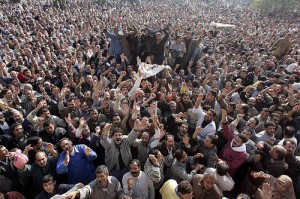
    The secular west has a secular gospel. It is the good news of democracy. When problems assail a nation, all would be assuaged if not solved if it had more democracy. And so it has come to pass with respect to Egypt.

    The West is not unique in that it has its own version of gospel. All human cultures, religions, and peoples have a gospel of some kind. The word “gospel” of course means good news. The gospel of any society is the proclamation of what that society believes will make things right. Whatever a culture looks to as the “super problem solver” is its saviour. Proclaiming and touting that “saviour” is its gospel. That gospel reaches the status of being established in a society when its promises and claims are seen as self-evident and beyond question. Whenever a culture fails to achieve a consensus view of what its saviour is, it has no gospel: fracturing is inevitable.

    In the West, under the aegis of its established religion of secular humanism, democracy is it. It is easy to understand why democracy has become the West’s established gospel of choice. The West is primarily about the glorification and celebration of man. Democracy is that form of government which does respectful obeisance to man–it is the system of government which seems to accord most closely with the idea that man is his own self-saviour. If man is his own self-saviour, then democracy is the form of government which brings man into a position of institutional supremacy in society. The will of the people is the voice of our god.

    So, if any society has problems (and all do), a system of government which institionalises and reifies the will and wisdom of man must be better, if not best. Democracy facilitates man taking control of his own destiny and this will result in the solving and resolution of all problems.

    Egypt RiotsAs the West opines and pontificates over Egypt it cannot help but project its gospel upon that country. The future for Egypt would be much more assured and all problems would be mitigated if the government were to become less authoritarian. If free and fair elections were held and the people had a voice all would be well, or at least better. How beautiful upon the mountains are the feet of those who come proclaiming the gospel of democracy. What a tingle goes up the spine when our high priests in the West proclaim our secular liturgical chants.

    Problem number one. (more…)

  • September 11

    Today I reflect, as do many, where I was and what I was doing when I first heard about the attacks on the World Trade Tower. Like my parents generation’s remembrance of where they were and what they were doing when Kennedy was assassinated and their parents remembrance of the news of V-Day this was a moment in time that is burned in the minds of those of us who were old enough to remember.

    I was asleep. Our son Noah was just 2 weeks old and the phone rang at about 4am. I recall angrily thinking ‘who in their right minds phones parents of a 2 week old in the middle of the night’ as Matt stumbled to the phone. His father was ringing from overseas and his first words were “I’m alright.” Matt says it took him a few minutes to work out that it wasn’t that he’d missed something his father had said in sleepy stupor but that when he’d woken up an hour earlier hearing Christian, then aged 6, moving around and had found him in the lounge watching ‘some war movie about New York’ that it wasn’t a war movie that he’d turned off when he sent Christian back to bed.

    When Matt came into the room and turned the lights on he didn’t give me time to throw anything at him for being woken me up for the 5th time that night because what he was saying just didn’t make any sense.  I went from sleep-deprived-anger to what is he on about? Something about the World Trade Towers? Some business thing his father was doing? Hang on, hijacked planes? What? Why do I have to get up right now? He had to pull me out of bed and take me to  the television to get it to sink in. Then I was wide awake and it was some time before I wanted to sleep again.

    When I reflect on that day eight years later one thing that never fails to stun me is the way some leftists seem to back radical Islam and excuse their actions as that of victims, minimising the role of their religious ideology. Frequently I hear Matt inform said lefties that secular media often fail to understand religion or religious history. This failure to take religion seriously as a motivating force in peoples lives, coupled with Marxist critiques of religion, mistakenly reduces religion to economics. This thoroughly discredited error leads otherwise intelligent people to explain away religious terrorism as simply the “sigh of the oppressed creature.”

    The evil we saw on this day eight years ago should have shaken everyone from this naivety. I am not buying into the Hitchens-Dawkins, ‘religion-is-evil secular-is-beneficent myth;’  secular ideologies also lead people to commit atrocities. However, 9/11 reminded us that there are people out there who want to engage in the random killing of  innocent men women and children and believe it a religious duty to do so; this is scary and those who don’t get it need to wake up.

  • Mumbai, Muslims & Libertarian Su

    Like most people, Matt and I are pretty horrified at what is going on in Mumbai. We have wanted to write something on it but just now I found this piece by Susan the Libertarian, oft heard quoted on Newstalk ZB.

    Whilst I would not describe the abuse Sus experienced as “feudal nonsense” (chivalry came out of the feudal period) the rest of the article is pretty much what I think.

    Extract from Mumbai, Muslims & Me:

    It could be the latest Frederick Forsyth.

    • Meticulous planning that took more than a year
    • Detailed reconnaissance training
    • Remote mountain camps in Kashmir
    • Marine commando techniques
    • Covert acquisition of ships
    • Hijacking fishing boats
    • Stockpiling weapons while holed up in the Taj Mahal hotel, itself.

    But it’s not the latest Forsyth, more’s the pity. It’s not fiction. It’s commentary from the London Telegraph via yesterday’s Sydney Morning Herald, reportedly from the sole captured Mumbai terrorist, Ajmal Amir Kasab, aged 21. “We wanted to kill 5000,” the newspaper quotes him as saying. Kasab and his cohorts fell a bit short of the mark, getting 172 as of yesterday; 172 innocent people including children, who this time last week were alive and well and planning for long and fruitful lives.


    An end-of-year prize-giving ceremony was held at a secondary school in Sydney last Thursday evening. While the Principal was addressing the large turnout, there was a disturbance in the audience. It quickly became obvious that there was a problem that didn’t look like resolving itself in a hurry. Within seconds the horrified audience watched two students – sisters – gasp with horror and turn white with shock as they were bundled out of the auditorium by weeping family and friends.


    News travels quickly and bad news the fastest of all. It transpired that the girls had just been informed that their father, in Mumbai on business, had been formally identified as one of the murdered.


    Q: Do you think Kasab feels any sorrow – the tiniest bit – for having been party to deliberately taking the life of an innocent businessman from the other side of the Indian Ocean? Of depriving an innocent family of their much-loved dad? Well, do you?


    Unless I have to be elsewhere, I routinely talk to my sister in Sydney every Friday night. We usually yak for ages, catching up with what each other’s been doing and swapping family news. We especially relish reliving old family stories guaranteed to bore all senseless, including the participants. We discuss politics, films, books and important stuff like facts about the Bay City Rollers whom we both loved with a passion 30+ years ago. (I’m not joking. You don’t joke about real love — and that’s what it was, so there). It’s the sort of female phone call that men (most men … like 99 out of 100) just don’t get.


    There was none of that last Friday. It was a sombre call and very brief. You just can’t scream with laughter over abject nonsense when your sister’s colleague is barricaded in the bathroom of his Oberoi hotel room in Mumbai and has been for two days. That the SAS has told him to push a mattress between the door and whatever heavy furniture he can drag over, as a makeshift shock absorber in the event of an explosion. That he’s had little or no food. That he doesn’t know what the hell’s going on for most of the time. That his cellphone’s almost out of battery and the power’s off. That while his Australian passport may (or not) offer some ‘protection,’ his religion, should it be discovered, is another story. You see, my sister’s colleague is Jewish.


    After I hung up, I thought about the first Muslims I ever came across. It was in London’s Paddington where I lived in a grungy place just around the corner from the famous old station. Like Kasab, I was 21. Funds were tight, and I used to walk miles to avoid tube fares. Walking down to Oxford Street involved navigating Edgeware Road, which I always dreaded, thanks to its inhabitants who seemed to consist solely of young Muslim males. These guys never seemed to do anything, except loll about the footpaths mouthing obscenities at passing women. I’ve never been good at taking crap from anybody, least of all sexist pigs, and I was determined to stop them.


    My efforts were in vain. The obscenities became so bad, so quickly, that I sought drastic action. I bought a Walkman, which I had vowed and declared I would never do (being anti-social, you see). I could then cheerfully walk past them all and not hear a thing. I can truthfully say that I detested those individuals, each and every one of them. I would have been delighted to change my mind had I met one – just one – who didn’t look upon me as nothing more than a piece of meat, but I never did. And what really disgusted me was that this feudal nonsense was occurring in one of the world’s leading western capitals.


    Earlier last Friday, Paul Holmes chatted with Mike Hosking and Wendyl Nissen. When he opened the segment by deriding the terror in Mumbai, Wendyl immediately jumped in to remind us all that “not all Muslims are terrorists” and “most Muslims are lovely people,” blah blah.


    I wonder if Wendyl would have been so quick to be so tempered had she personally known somebody trapped and terrified in the Trident-Oberoi right at that moment? Or if her children had received the horrific news of their father’s murder the night before?


    Memo to the Wendyls of this world: Most of us know that all Muslims aren’t terrorists, thanks. Most of us aren’t altogether stupid. But the cold, hard truth is that while not all Muslims are terrorists – all terrorists right now would appear to be Muslim.


    It’s been a long time since I walked down the Edgeware Road. I wonder if the next generation of young western women are being hassled by the next generation of young Muslim males. Something tells me it’d be a safe bet.

  • Mayra Veronica and the Troops in Iraq: Where the Islamists Have a Point

    I am a fan of Bill Vallicella’s blog. A few days ago I found a post of his which is worth reproducing [link to post now broken Jan 2011]. He led with a picture of a scantily clad and busty Mayra Veronica and wrote:

    Don’t expect any more ‘eye candy’ on this site, but now that I have your attention I want to make a serious point. The well-endowed lass a picture of whom you see to the left has a name as beautiful as her body, Mayra Veronica. She was a guest on the O’Reilly Factor last night. She supports the troops in Iraq by going there and meeting with them, hugging and kissing them (that’s what she said!), signing photographs and posters, and distributing calendars. The ‘pin-up girl’ is of course nothing new — our fathers and grandfathers gawked at Grable — but one has to ask how much we have to teach the Iraqis. Islamic culture is in many ways benighted and backward, but it is not clear that our trash culture is much of an improvement. If they think that our decadent culture is what democracy is all about, and something we are trying to impose on them, then we are in trouble.

    Militant Islam’s deadly hatred of us should not be discounted as the ravings of lunatics or psychologized away as a reflex of envy at our fabulous success. For there is a kernel of insight in it that we do well to heed. Sayyid Qutb (Milestones, 1965, emphasis added): “Humanity today is living in a large brothel! One has only to glance at its press, films, fashion shows, beauty contests, ballrooms, wine bars and broadcasting stations!Or observe its mad lust for naked flesh, provocative pictures, and sick, suggestive statements in literature, the arts, and mass media! And add to
    all this the system of usury which fuels man’s voracity for money and engenders vile methods for its accumulation and investment, in addition to fraud, trickery, and blackmail dressed up in the garb of law.”

    A wild exaggeration in 1965, the above statement is less of an exaggeration today. But setting aside the hyperbole, we are in several ways a sick and decadent society getting worse day by day. On this score, if on no other, we can learn something from our Islamist critics. The fact that a man wants to chop your head off does not mean that he has nothing to teach you. The decadence of the West is a huge and many-sided topic. I’ll mention just two trends. One is the degeneration of popular music, especially black music. There is a huge difference between Sam Cooke and the rap ‘artists’ popular today. Another is the drive to push all vestiges of religion out of public life. Since religion is the means whereby most people learn morality, the assault on religion is also an assault on morality.

    Of course, when I say that there is something to be learned from our Islamist critics, that in no way implies that their actions can be justified. They are murderous terrorists who need to be hunted down and killed, and the governments that support them need to be toppled. What I am opposing is a certain thoughtless attitude that says, “They are demons, I don’t want to understand them, and I shut my ears to everything they say.”

  • The Question of Islam

    An interesting discussion of Islam has been occurring at Kiwiblog. Up until now I have merely chipped in to correct inaccurate claims about Christian beliefs and practices. However, for what its worth I’ll add my two cents worth here.

    Here is what I think the issues are.

    We are familiar with Christian teachings on the morality of violence. The just war theory of Augustine, Aquinas, Gratian, Vitoria, Calvin, Luther and Grotius have been pretty much codified into international law and things like the Geneva accords. They are now at least held up as the correct rules ( even if they are not always followed in practice) by liberal democratic societies. We are also familiar with various other ideas which come from Christianity the idea that individuals have inalienable rights which the state cannot transgress. Those non believers should be tolerated. That Government should be limited. That Church and state are separate institutions with degrees of autonomy from each other. That the state should be concerned with the temporal welfare of its citizens and not their welfare in the life to come. While it’s fashionable for people to attribute to these things to the enlightenment, in reality, much of this in is found in Medieval Theology and even in earlier writers like the Church fathers. The basic premises of course come from the scriptures.

    Now when we confront Islam we confront (a) a religion we know less about (b) a religion which historically has threatened parts of Europe with invasion and hence has been feared and (c) whose high profile practitioners seem to have very different understandings of these things. Some of them appear to believe direct killing of non combatants is permissible and they seem to not respect the Geneva accords. They appear to have more absolute governments. Have clerics exercising vetoing legislation and they seem to threaten people with death if they don’t convert etc.

    I guess the question is this: does this historically feared tradition have the same moral teachings about these things Christianity does? And if it does not what does that mean for religious tolerance? How far can a religion disagree with our current consensus on these types of questions before tolerance is no longer acceptable? And finally, if we tolerate it and large numbers of the population embrace this religion how will that change the cultural values and assumptions which our liberal institutions are based on?

    I do not know the answers to these questions. but I think they need to be asked and debated. Not dismissed as Islamiphobia. I also think that the debate should be informed not a banding about of stereotypes and caricatures about either religion.

    This latter point requires emphasis. If we see the discussion as it occurs today one side dregs up stereotypes of Muslims and attempts to quote the Koran out of context without examining the tradition, critical commentaries that responsible study of this document requires. Another side dregs up stereotypes of Christians and argues they are the *real* problem and predictably do the same thing. They argue that the scriptures support rape, torturing heretics we are told. Any debate on the question of religious tolerance which relies on slander, ignorance and prejudice towards religious minorities scares me. The alternative to tolerance is supression; which involves violence. If it comes to that then lets make sure we have been informed enough to make the right decision.

    I would also add that these questions are not new. Medieval Theologians like Aquinas supported religious tolerance for Jews and Muslims but and not for Heretics. This is because he perceived heretics to threaten the institutions of society whereas other monotheistic minorities did not. Latter, John Locke suggested that religious dissenters (what Aquinas would have called Christian heretics) should be tolerated provided they did not challenge the moral values essential to a free and just society. Locke advocated suppressing Christian groups that taught contracts could not be kept with heretics because that would undermine the co-operation needed to maintain a free and just society. He also supported the suppression of atheists because he felt belief in a moral law giver was a necessary foundation for such a society. Some contemporary Gay rights advocates seem to believe we should not tolerate evangelical Christianity because opposing homosexual conduct inevitably incites violence. Or is opposed to certain understandings of equality which they think justice requires. Libertarians draw the line at aggression, because they believe freedom needs to be based on everyone refraining from the initiation of force.

    The irony of this, of course, is that many of defenders of one position view the others as being opposed to tolerance. As though tolerance did not come in degrees. Everyone is for tolerance of some religions and no one to my knowledge tolerates all religions. Because we have conducted the debate in this manner few people have been able to ask the real question : How far should tolerance extend?

    Aquinas’s question is still with us. When does error in Theology become serious enough for the state to step in?